
Levies & Collections
Can the IRS Levy PayPal or Venmo? What Payment-App Users Need to Know (2026)
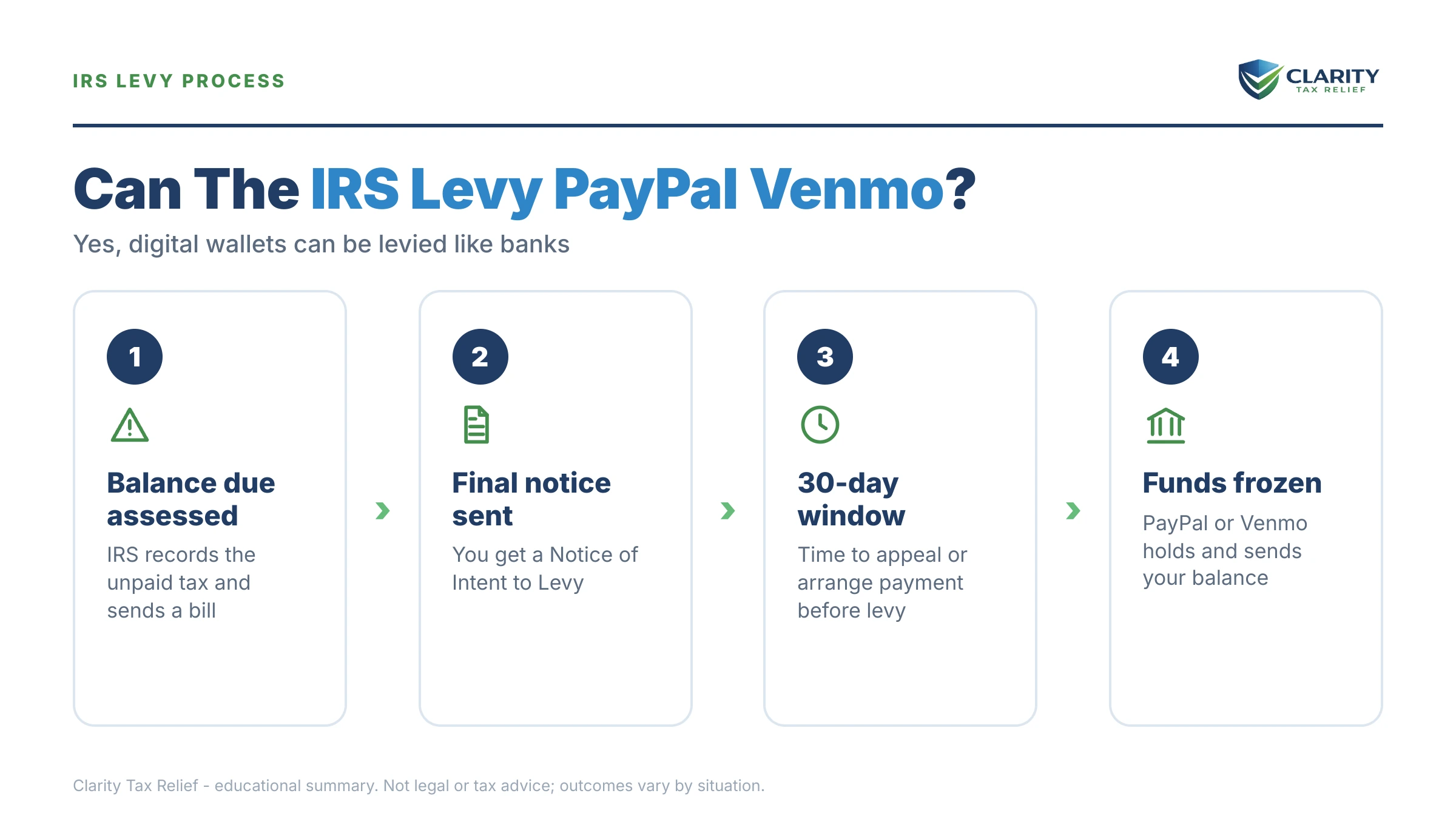
The short answer: yes — the IRS can levy PayPal and Venmo. Both hold your money in FDIC-insured partner banks, so a balance is reachable like a bank account under IRC §6331. The IRS serves a Notice of Levy on the platform and captures whatever balance is there that day — but it's a one-time snapshot, not a continuous grab.
You saw a hold on your Venmo balance, or you're bracing for one because you owe the IRS and your income runs through a payment app. Here's what you need to know first: a payment-app levy grabs only the balance sitting there when it hits — not your future deposits — and in most cases the IRS must send a final notice and wait 30 days before it can act at all.
That means you almost always have warning, and warning is leverage. The visual guide below lays out the key facts and deadlines of a payment-app levy, so you can see where you stand fast.
The other thing that matters: if your debt is large enough that a federal tax lien is on record, the lien — not the levy — is what can wreck a refinance or a home sale. We'll cover both.
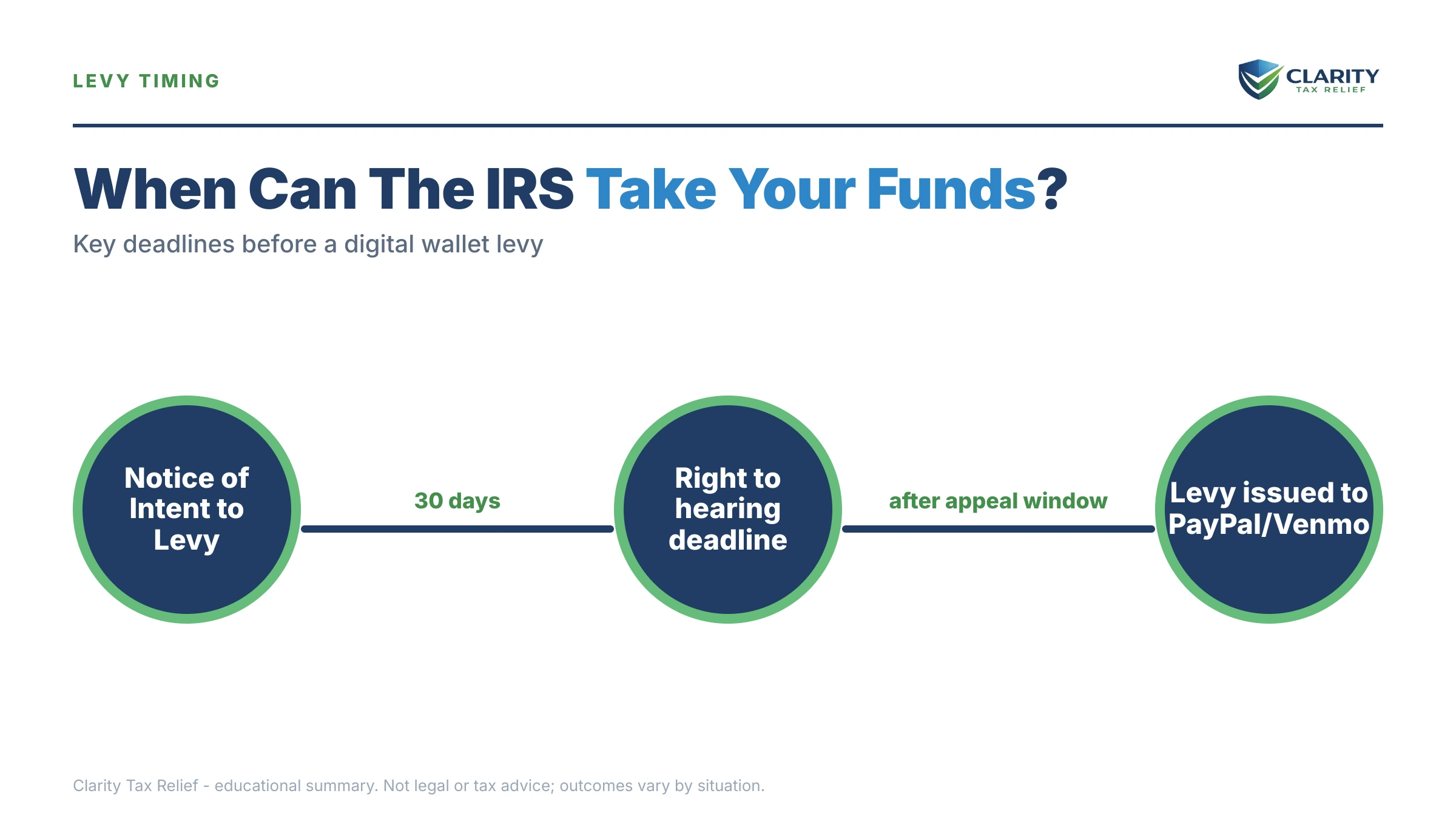
⏱ Your window: the IRS generally must wait 30 days after a Final Notice of Intent to Levy (LT11 / Letter 1058) before it can levy. And once funds are frozen in a partner-bank balance, there's typically a 21-day hold before the money actually leaves — that hold is your last chance to request a release.
Why the IRS can reach a payment app at all
A levy is the IRS's legal seizure of property to satisfy a tax debt, and money you hold in a payment app is property. When PayPal or Venmo shows a "balance," that money is parked in an FDIC-insured account at a partner bank, held for your benefit. Under IRC §6331, the IRS can serve a Notice of Levy (Form 668-A) on any third party holding your funds — a bank, a brokerage, or a payment platform. PayPal owns Venmo, so a single levy can reach both.
This is fundamentally different from a wage garnishment. A garnishment is continuous and repeats every payday. A levy on a PayPal or Venmo balance is a one-time snapshot — it captures the balance the moment the levy is served, up to what you owe, and stops there. Money that lands the next day is not swept up by that same levy.
Two accounts the IRS cannot reach through the app: funds that clearly belong to someone else (a genuine joint or business partner's share) and money already transferred out before the levy landed. But proving "that isn't mine" after the fact is hard, which is why timing matters so much.
Why you got here
A payment-app levy is late in the collection story, not the start of it. It means an unpaid balance escalated through the IRS's notice sequence without a resolution in place. The most common path: a self-employed person or side-hustler receives income through PayPal or Venmo, doesn't set aside enough for taxes, files (or doesn't), and a balance builds with penalties and interest on top.
The 1099-K reporting threshold reverted to $20,000 and 200 transactions for 2026 — the $600 rule is dead. But that changes only what the app reports to the IRS. Income under the threshold is still taxable, and any old debt from years the IRS already knows about remains fully collectible. Lower reporting does not shrink an existing balance.
What happens if you ignore it
The IRS collection sequence is automated and it escalates on a schedule whether or not a human ever looks at your file. Each stage adds interest and unlocks more enforcement power:
- CP14 — the first bill for the balance due. No enforcement yet.
- CP501 / CP503 — reminder notices. The balance keeps growing monthly.
- CP504 — Notice of Intent to Levy your state tax refund. A federal tax lien becomes a real possibility here.
- LT11 / Letter 1058 — Final Notice of Intent to Levy. After 30 days, the IRS can levy bank and payment-app balances and garnish wages. You have Collection Due Process appeal rights here — request them with Form 12153 (CDP hearing).
- Levy served — the IRS sends Form 668-A to PayPal, which freezes your balance. If it's held in a partner bank, a 21-day hold typically runs before the funds leave.
Because a payment-app levy is one-time, the IRS can — and does — serve a second levy weeks later if the debt is still open. A single snapshot doesn't close the matter. In 2026, with IRS staffing cut about 27%, the humans are harder to reach but the automated levy machine never stopped. Waiting for someone to notice your case is not a plan.
Levy hit your PayPal or Venmo — or a final notice just arrived?
If funds are frozen, the 21-day hold is ticking; if you got an LT11, the 30-day window is. An experienced tax professional can move to request a release before your money leaves — free, confidential, no pressure.
Your options to stop or release a payment-app levy
The fastest way to stop levies — including the next one the IRS could serve — is to get a resolution in place. Once the IRS agrees to a payment arrangement or hardship status, enforced collection stops while the arrangement stays in good standing. Which option fits depends on how much you owe and what your finances look like. (For the full DIY walkthrough of each, see how to settle tax debt yourself.)
| Option | Who it fits | Key threshold |
|---|---|---|
| Levy release for hardship | The levy takes money you need for basic living expenses | Must be released under IRC §6343 if it causes economic hardship |
| Short-term payment plan | You can clear the balance within 180 days | $0 setup; balance generally ≤ $100,000 |
| Streamlined installment agreement | You need monthly payments and want minimal disclosure | Balance ≤ $50,000; up to 72 months |
| Non-streamlined installment agreement | You owe more than $50,000 | Financial disclosure (Form 433-F/433-A) required |
| Currently Not Collectible | Paying anything would create real hardship | Income roughly at IRS allowable living expenses |
| Offer in Compromise | Assets + future income genuinely can't cover the debt | $205 fee (waived if low-income certified); ~1 in 5 accepted |
Each option carries different upfront costs and different timelines to actually get a levy released. Here's how they compare:
| Option | Upfront cost | Time to relief |
|---|---|---|
| Hardship levy release | $0 | Often same-day to a few days once the IRS is reached |
| Short-term plan | $0 | Set up online within a day; enforcement stops on approval |
| Streamlined IA | $0 online (direct debit) | Days once financials aren't required |
| Non-streamlined IA | Setup fee applies; may be waived low-income | Weeks — disclosure review takes time |
| Currently Not Collectible | $0 | Days to weeks after financials are accepted |
| Offer in Compromise | $205 (waivable) | Months; a pending offer generally halts levies |
If part of your income also comes from a paycheck the IRS is garnishing, you can estimate what stays in your pocket with our wage garnishment calculator — but remember a payment-app balance levy takes the whole balance up to what you owe, not a percentage.
A worked example: $92,700, a levy, and a refinance
Say you owe the IRS $92,700 from a few years of self-employment income that flowed through PayPal. You're a homeowner planning to refinance to pull your rate down. Then a levy hits — PayPal freezes the $6,400 sitting in your balance that day. It's a one-time levy, so the customer payment that arrives next week isn't caught by it, but a second levy could grab that later.
Because you owe more than $50,000, you can't use the simplest streamlined plan on the full balance. Two realistic paths:
- Pay down to $50,000, then a streamlined 72-month plan. $50,000 ÷ 72 ≈ $694/month, plus interest and the 0.5%/month failure-to-pay penalty still accruing on the balance.
- A financially-disclosed plan on the whole $92,700. Spread over 72 months that's roughly $1,288/month before accruing interest and penalties — requiring Form 433 financials.
Here's the piece most people miss: the levy is not what blocks your refinance — a recorded federal tax lien is, because it can outrank the new lender. Once a payment arrangement is active, you can apply for a tax lien subordination (Form 14134), which lets the new mortgage take first priority so the loan can close. If you're weighing whether a refinance is even possible right now, see refinancing with an IRS lien. Estimate whether a settlement is realistic with our Offer in Compromise Calculator before spending on an application.
How to respond, step by step
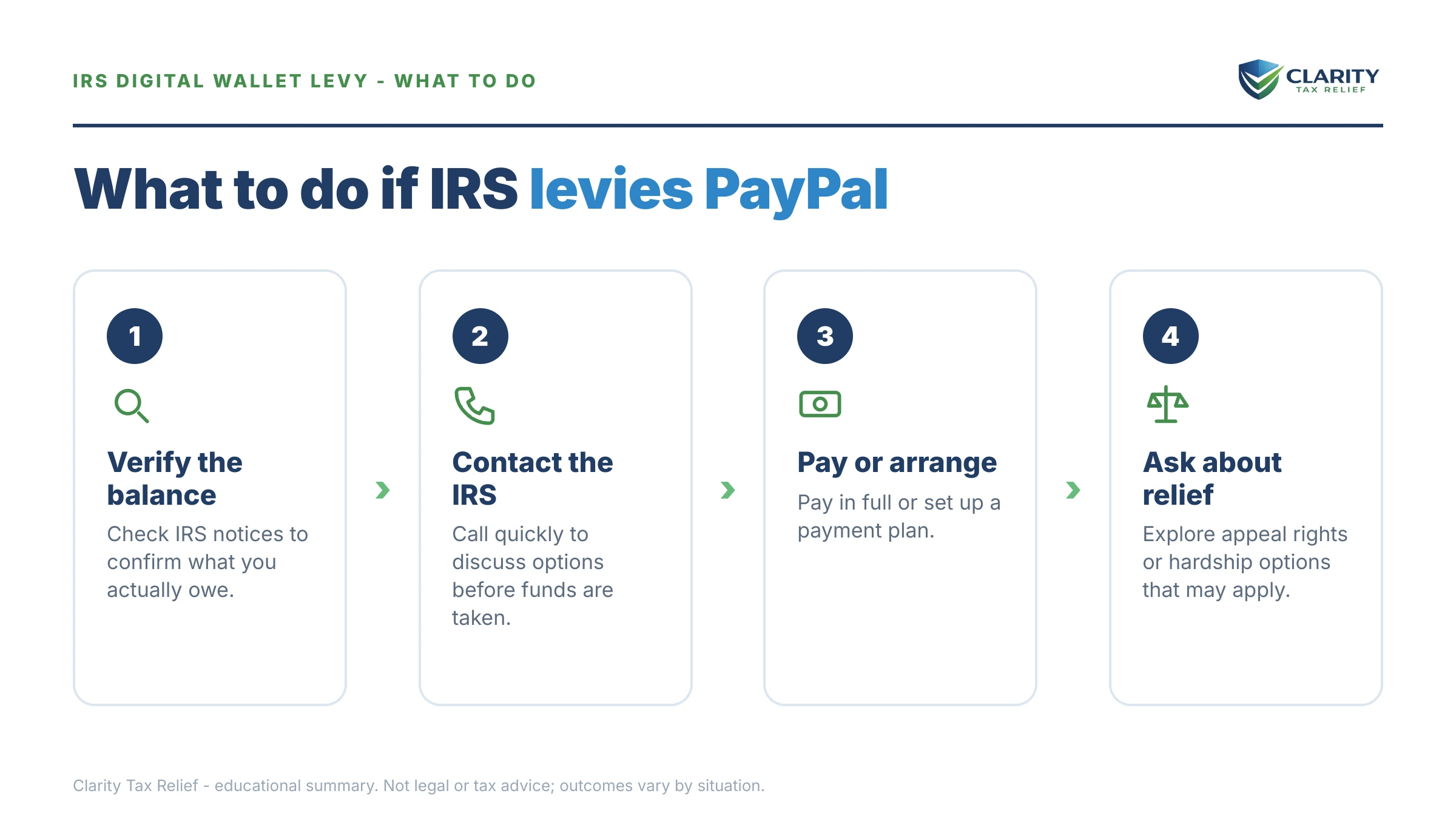
- Confirm the balance and check for a levy — log into your IRS online account, then check PayPal/Venmo for a hold or levy notice.
- Find your levy clock in the latest notice — locate your LT11 or Letter 1058 date; the IRS generally waits 30 days after it, and if your balance is held at a partner bank, the 21-day bank-levy holding period generally applies before funds leave — though whether a payment-app balance gets that statutory hold can depend on how the funds are held.
- Reroute incoming income going forward — because the levy is a one-time snapshot, direct new deposits off the levied account so the next dollar isn't sitting there for a second levy.
- Request a levy release — call the IRS (or have your representative call) to request release on hardship grounds under IRC §6343 or because a resolution is in place.
- Set up a resolution that stops future levies — an installment agreement, Currently Not Collectible status, or an Offer in Compromise ends enforced collection while it stays current.
- Address any tax lien before you refinance — if a lien is recorded, file Form 14134 for a subordination so your lender can take first priority.
When you can handle this yourself — and when you shouldn't
You can often handle this alone if the balance is small, you agree with it, and you can either pay within 180 days or set up a streamlined installment agreement online for a balance under $50,000. A single frozen Venmo balance with a manageable debt behind it is a call-the-IRS-and-set-up-a-plan situation.
Experienced help changes the outcome when a levy is actively freezing income you live on, when you owe more than $50,000, when you have unfiled years, when your income runs through a business PayPal account, or when a lien is in the way of a refinance or sale. In those cases the order you fix things — returns first, then penalties, then the balance, then the lien — determines what you end up paying and whether the loan closes. If a levy already pulled funds, a professional can also file to get an IRS levy released faster than most people manage on hold.
Terms on your notice, decoded
- Levy vs. lien — a levy takes property (your balance); a lien is a legal claim that secures the debt and can block a sale or refinance. See lien vs. levy.
- Form 668-A — the Notice of Levy the IRS serves on a third party like PayPal to seize funds held for you.
- 21-day hold — the period a bank-held balance is frozen after a levy before funds turn over, giving you time to act. More in the IRS bank levy 21-day rule.
- CDP rights — Collection Due Process, your right to appeal a levy within 30 days of a final notice via Form 12153.
- CSED — the Collection Statute Expiration Date; the IRS has 10 years from assessment to collect, and appeals, offers, or bankruptcy can pause that clock.
PayPal and Venmo levy questions, answered
Can the IRS take money from my PayPal or Venmo account?
Yes. The IRS can levy a PayPal or Venmo balance the same way it levies a bank account, using a Notice of Levy (Form 668-A) served on the platform under IRC 6331. Because both apps hold customer funds in FDIC-insured partner banks, the balance is treated as reachable property. The IRS generally must first send a final notice — LT11 or Letter 1058 — and wait 30 days.
Will the IRS drain my whole Venmo balance?
A levy captures whatever balance is sitting in the account the moment it is served, up to the amount you owe. If your Venmo balance is $300 that day, the IRS takes $300 — not future deposits. A payment-app levy is a one-time snapshot, not a continuous grab, so money that arrives after the levy is served is not automatically caught by that same levy.
Does the IRS have to warn me before levying PayPal?
In almost every case, yes. Before levying, the IRS must send a Final Notice of Intent to Levy (LT11 or Letter 1058) and give you 30 days to request a Collection Due Process hearing using Form 12153. The main exception is a jeopardy levy, where the IRS believes collection is at risk and can act faster. If you never received a final notice, the levy may be improper.
Is a PayPal levy one-time or continuous?
A levy on a PayPal or Venmo balance is one-time — it reaches only the funds held when the levy is served, like a bank levy. A wage garnishment, by contrast, is continuous and repeats each pay period. The catch is that the IRS can serve a new levy later, so a single snapshot doesn't end the problem if the underlying debt is unresolved.
Can the IRS levy PayPal if I only use it for personal transfers?
Yes. It doesn't matter whether you use the account for business or to split dinner with friends — if the money is yours and you owe the IRS, the balance is leviable property. The 1099-K reporting threshold of $20,000 and 200 transactions affects only what gets reported to the IRS, not whether the IRS can reach a balance you already have.
What about my PayPal business account receiving customer payments?
A business PayPal balance is fully reachable, and the exposure is larger because more money flows through it. The IRS can also serve a levy on money owed to you as accounts receivable in some situations. If your business income lands in PayPal, reroute incoming payments off the levied account and get a resolution in place before the IRS serves a second levy.
How do I get back money PayPal already sent the IRS?
If the balance was held in a partner bank, there is typically a 21-day hold before funds leave — call the IRS immediately and request a release, especially if the levy causes hardship. Once funds are actually turned over, you can request a return of levied property, but it is far harder to recover money than to stop it during the hold window.
Does the 1099-K threshold change whether the IRS can levy?
No. The 2026 reversion of the 1099-K threshold to $20,000 and 200 transactions changes only when a payment app reports your income — it does nothing to shield a balance from levy. Old tax debt from years when more income was reported still exists and remains collectible for the full 10-year collection statute.
Your next 24 hours
- Find the date on your latest notice. On an LT11 or Letter 1058, that date starts the 30-day levy clock; if funds are already frozen, note when the hold began.
- Gather three things: your most recent IRS notice, a screenshot of your PayPal/Venmo balance and any hold, and last year's return so you can confirm the balance.
- Get a free case review. Use the 2-minute form or call (888) 825-7779 — if money is frozen, the 21-day hold is your window to request a release before it leaves.
This guide is general information, not tax or legal advice for your specific situation. Eligibility for IRS programs depends on individual facts and circumstances; no outcome is guaranteed.