
IRS Levies
Wrongful Levy: How to Get Back Money the IRS Seized in Error (2026)
The short answer: a wrongful levy means the IRS seized money or property that belongs to someone who doesn't owe the tax. You have 2 years from the levy date to file a written wrongful levy claim under IRC §6343(b), and the IRS must return wrongfully taken money with interest once you prove ownership.
Your balance dropped — or a freeze letter from your bank landed — over a tax debt that isn't yours. Maybe it's your brother's balance, a co-owner's, or a name mix-up, but right now your money is sitting in someone else's IRS collection file. That's precisely the situation the wrongful levy rules were written for, and the recovery path is more concrete than most people expect.
The levy itself is a one-page IRS form served on whoever holds your money. The image below shows exactly what that paperwork looks like and where the levy date sits — that single date starts every clock in this article, so find it before you do anything else.
⏱ Your deadline: you have 2 years from the date of the levy to file a wrongful levy claim with the IRS. And if the levy hit a bank account, the bank holds the funds for 21 days before remitting them — the only window in which your money can be stopped before it ever leaves.
Why the IRS took your money for someone else's tax debt
A wrongful levy is the IRS seizing property that belongs to a third party — someone other than the taxpayer named on the levy form. The IRS doesn't investigate ownership before it levies. Form 668-A simply orders the bank, broker, or other holder to freeze whatever the named debtor can legally draw on.
That mechanical process is how innocent money gets swept in. A bank levy attaches to 100% of any account the debtor can withdraw from — including the entire balance of a joint account, no matter who actually deposited the money.
The most common ways it happens:
- Joint accounts. You added a relative for convenience, the relative owes, and your savings got frozen. This is the single most frequent wrongful levy fact pattern — see our guide to joint bank accounts with family and IRS levies.
- Business and personal blur. An owner owes personally and the company account gets hit, or the reverse. If the entity is genuinely separate, that's a wrongful levy — our page on an IRS levy on a business bank account covers the business side.
- You hold money for someone else. Custodial accounts, a club or team treasury, escrowed funds, a deceased person's account you administer.
- Identity and name mix-ups. A similar name or a transposed taxpayer ID puts the levy on the wrong person entirely.
- Nominee and alter-ego levies. Sometimes the IRS levies your property on purpose, claiming you hold it for the real debtor. That's not an error — it's a legal determination you have to disprove, and it's covered separately below.
One caution before you assume your levy is wrongful: in community-property states, the IRS can often lawfully reach one spouse's earnings and accounts for the other spouse's debt. A spouse's claim can fail where a sibling's or parent's would succeed — our guide to whether the IRS can take your spouse's bank account walks through that line. And in rare cases the IRS levies with no warning at all under a jeopardy levy, which has its own expedited review rights.
Wrongful levy vs. erroneous levy: which one you have
A wrongful levy takes the wrong person's property; an erroneous levy takes the right taxpayer's property in the wrong way. The distinction decides which remedy you use, so get it right before you write anything.
If the levy is aimed at you, for your assessed debt, it isn't a wrongful levy — even if the balance is disputed, already paid, or the levy skipped a required notice. Those are erroneous-levy and release problems with their own paths: proof of payment, a release request, a Collection Appeals Program appeal, or an economic hardship release under §6343(a) if the levy leaves you unable to pay basic living expenses. If it's your paycheck being taken for your own debt, start with our full guide on how to stop an IRS wage garnishment — this page is for people whose property was taken for someone else's debt.
What happens if you do nothing after a wrongful levy
Wrongfully levied money doesn't come back on its own — the IRS applies it to the debtor's balance and moves on unless someone with standing objects. The stages run in a fixed order, and each one closes a door:
- Levy served. The bank freezes the entire balance the debtor can access. Nothing has left the bank yet — this is the cheapest moment to act.
- The 21-day hold ends. The bank remits the funds to the IRS and they're applied to the other person's tax debt. Recovery now shifts from a phone call to a written claim measured in months. (The hold and what it does and doesn't protect are covered in our guide to the IRS bank levy and the 21-day rule.)
- Seized physical property is advertised and sold. For a vehicle, equipment, or real estate, a public notice of sale sets the date. Once a buyer takes the property, you can generally recover only the sale proceeds — not the asset.
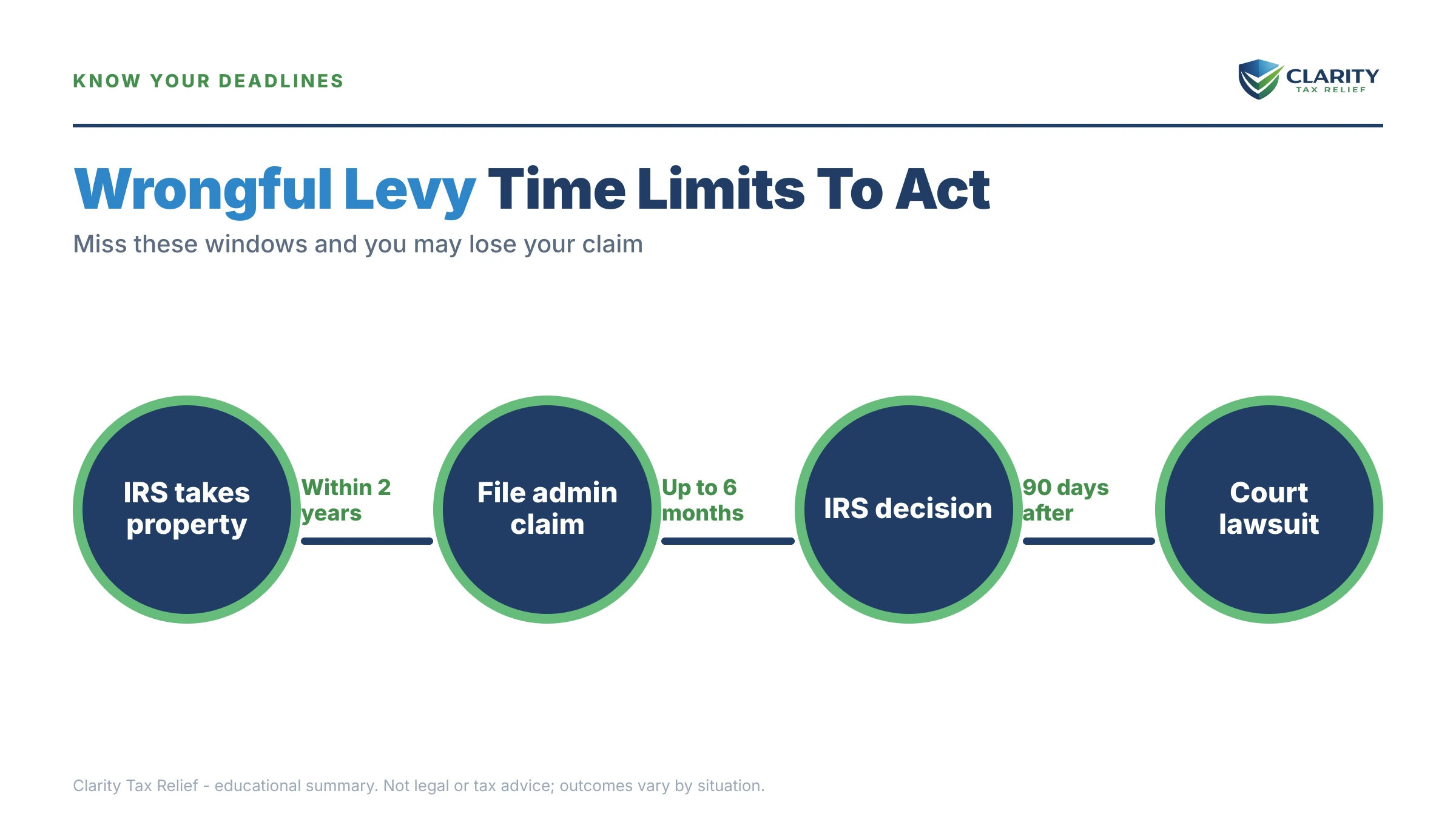
- 2 years from the levy date. The window to file an administrative wrongful levy claim closes, and with it the lawsuit deadline under §7426 (unless a timely claim extended it).
- After the window. Your money stays permanently applied to someone else's tax debt. Third parties cannot file a refund claim or refund suit later — §7426 was the exclusive court remedy, and it's gone.
| Clock | Window | The right at stake |
|---|---|---|
| Bank levy hold | 21 days from the day the bank receives the levy | Stopping your share before it ever leaves the bank — a call plus proof of ownership can release it |
| Notice of sale (physical property) | The sale date printed on the public notice | Recovering the property itself; after the sale you generally recover money, not the asset |
| Administrative wrongful levy claim | 2 years from the levy date | The IRS returning your property, or your money plus interest, under §6343(b) |
| Wrongful levy lawsuit (§7426) | 2 years from the levy date; a timely claim extends it to the shorter of 12 months from filing or 6 months from disallowance | Your only court remedy as a third party — barred permanently once it closes |
The IRS is holding money that isn't the debtor's?
Get your levy paperwork reviewed free. If you're inside the 21-day bank hold, hours matter — the funds haven't left yet. If they've already moved, your 2-year claim window is running. An experienced tax professional will map the fastest recovery path for your exact situation.
Your options for getting wrongfully levied money back
IRC §6343(b) requires the IRS to return wrongfully levied property — or the money, with interest — when a third party proves ownership. Which path you take depends on whose property was taken and how far the levy has progressed:
| Your situation | The right remedy | Where it's decided |
|---|---|---|
| Your money or property taken for someone else's debt | Written wrongful levy claim under §6343(b) | IRS Advisory Group; then federal district court if needed |
| Joint account levied for a co-owner's debt | Wrongful levy claim plus proof of which deposits are yours | IRS Advisory Group |
| Business account levied for an owner's personal debt (or the reverse) | Wrongful levy claim, if the entity and owner are genuinely separate | IRS Advisory Group |
| The IRS says you're a "nominee" for the debtor | Contest the nominee determination — evidence, not just title | Advisory/Counsel; §7426 suit as backstop |
| You ARE the taxpayer and the levy causes hardship | §6343(a) hardship release — not a wrongful levy claim | ACS or your assigned revenue officer |
| You ARE the taxpayer and the debt is wrong or already paid | Levy release request or CAP appeal (Form 9423) | Collections; IRS Appeals |
The phone-call release (fastest). While the bank still holds the funds, call the number printed on the levy and explain that the money belongs to a non-liable third party. Have your proof ready to fax or upload — statements showing your direct deposits, a title, an account agreement. The IRS can instruct the bank to release your share before remittance, which turns a months-long claim into a days-long fix.
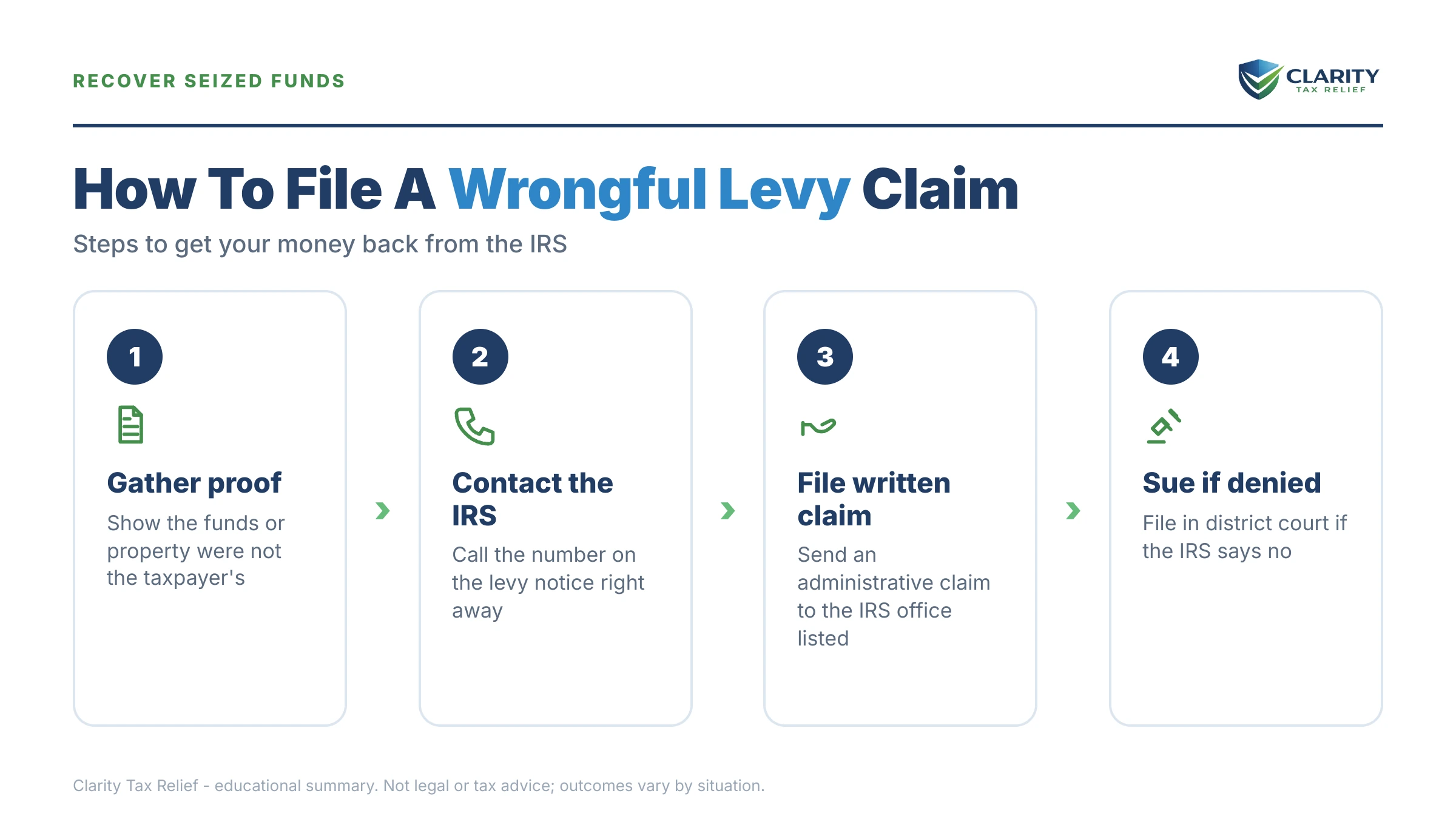
The administrative claim (the standard path). There is no numbered form. Your claim is a letter mailed to the IRS Advisory Group office for the state where the levy was served (addresses are in IRS Publication 4235), and it must contain:
- Your name, address, and daytime phone number;
- A detailed description of the levied property (account number, vehicle VIN, legal description);
- Your ownership interest and its basis — with the proof attached, not promised;
- The name and address of the taxpayer named on the levy (and their taxpayer ID if you know it);
- The IRS office that issued the levy and the date of the levy — both printed on Form 668-A;
- A copy of the levy form itself, if you have it.
If the claim succeeds, the IRS returns the specific property if it still holds it, or the money — plus interest at the federal overpayment rate from the date the IRS received the funds — under §6343(c).
The CAP appeal (fast, but final). A third party can also challenge a levy through the Collection Appeals Program using Form 9423. CAP decisions come quickly, but they're binding with no court review afterward. When real money is at stake, the written claim preserves more rights, because it keeps the lawsuit door open.
The §7426 lawsuit (the backstop). If the IRS denies or ignores your claim, a third party can sue the United States in federal district court to recover the property. It's the exclusive judicial remedy for non-taxpayers, and the deadline is unforgiving: 2 years from the levy, extended by a timely administrative claim to the shorter of 12 months from filing or 6 months from disallowance.
One scope note: all of this is federal. If a state agency levied your money for someone else's state tax debt, the state's own third-party claim procedure controls — start with that agency directly, not the IRS process described here.
Say the debt is $41,800 — and $9,600 of the seized money is yours
Here's a clearly hypothetical example with the math shown. Say your brother drove for gig apps for three years and never filed; the IRS built substitute returns and assessed $41,800 against him. Years ago you added him to your savings account so he could help with your mother's bills. A Form 668-A hits the bank, and the entire $12,400 balance freezes.
Break the balance down: your payroll direct deposits over the past 18 months account for $9,600 of it; his occasional transfers account for $2,800. Inside the 21-day hold, you call the number on the levy and fax statements tracing your deposits. Outcome: the IRS releases your $9,600 before remittance and keeps the $2,800 — which really is his money, lawfully applied to his $41,800 balance.
If the 21 days had already passed, the same proof goes into a written claim to the Advisory Group instead, and the IRS returns $9,600 plus overpayment-rate interest running from the day it received the funds. Either way, your recovery doesn't fix his problem — a debtor with unfiled years needs his own plan, starting with our guide for people who haven't filed taxes in 3 years.
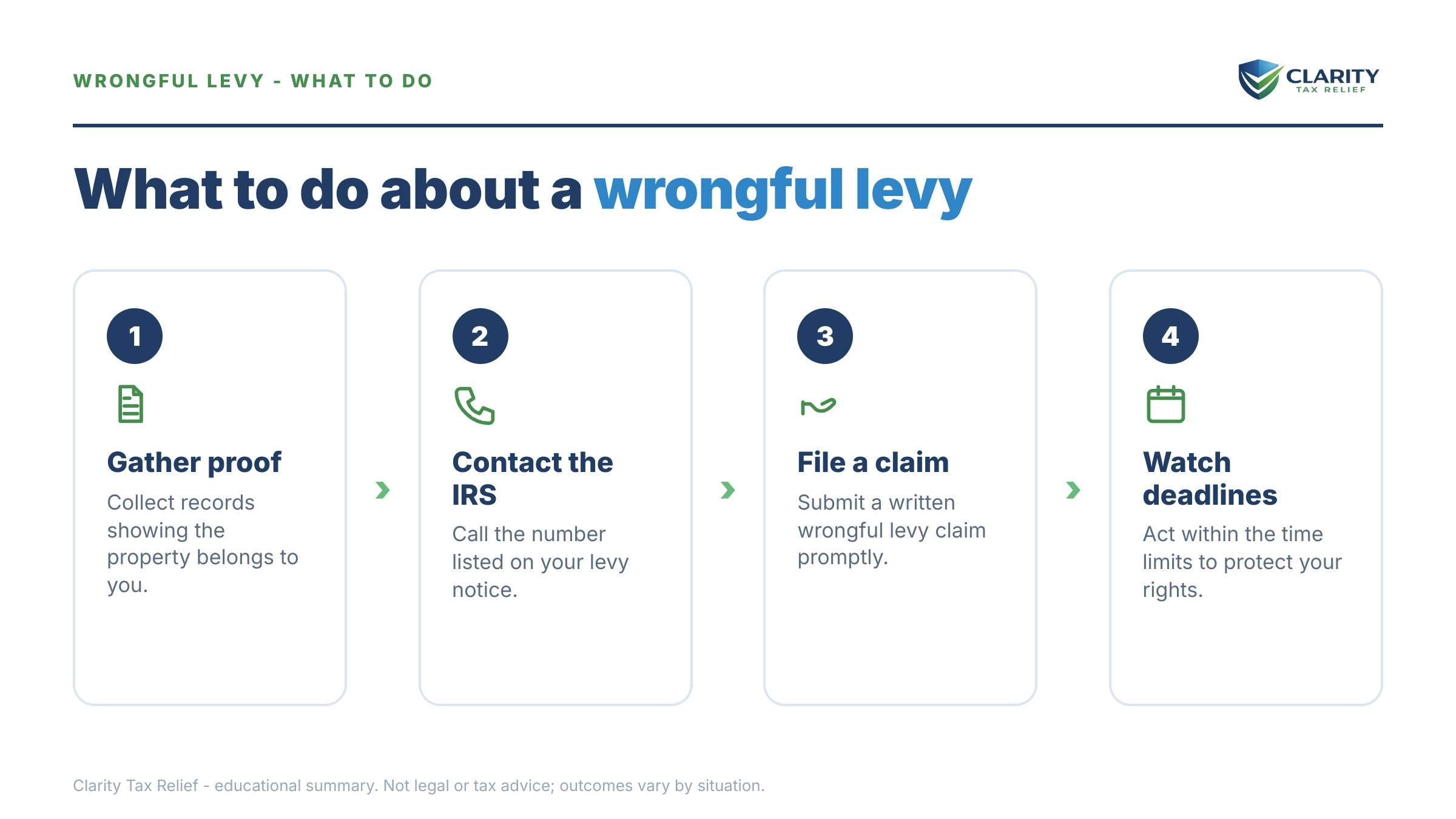
How to file a wrongful levy claim, step by step
- Find the levy date. Pull out the levy paperwork — Form 668-A, or the copy your bank sent with its freeze letter — and locate the date of levy. It starts both the 21-day bank hold and your 2-year claim window.
- Call the number on the levy today if funds haven't left the bank. Inside the 21-day hold, the IRS can instruct the bank to release your share before it is ever remitted — the fastest recovery that exists.
- Gather your ownership proof. Bank statements showing your direct deposits, titles, deeds, purchase receipts, or account agreements — whatever traces the money or property to you rather than the debtor.
- Mail a written wrongful levy claim to the IRS Advisory Group. Include your name and address, a description of the property, your ownership basis with proof attached, the taxpayer named on the levy, the IRS office that issued it, and the levy date.
- Escalate before your window closes. If the claim is denied or stalls, file a Collection Appeals Program request or a §7426 lawsuit in federal district court — no later than 2 years from the levy, extended only by a timely administrative claim.
When you can handle this yourself — and when help changes the outcome
Many wrongful levy claims are genuinely do-it-yourself. If it's a single joint account, your deposits are cleanly traceable through statements, and you're inside — or close to — the 21-day hold, a well-organized phone call and letter often resolve it without professional fees.
Experienced help earns its cost when the facts get adversarial or the clock gets short: the IRS has labeled you a nominee or alter ego and you must disprove a legal theory, not just show title; seized physical property has a sale date approaching; business and personal funds are commingled and the IRS is arguing the entity is a shell; the amount is large enough that a §7426 suit is realistically on the table; or your 2-year window is months from closing and the claim has to be right the first time. In 2026, with IRS staffing down sharply, claims sit longer and follow-up matters more — the automated levies never slowed down, but the humans who decide claims did. And if the person who actually owes is in your household, resolving their balance is what prevents the next levy; if the IRS took money from an account that's actually yours for your own debt, start instead with our guide for when the IRS took money out of your bank account.
Terms on your levy paperwork, decoded
- Wrongful levy — the IRS seizing property that belongs to someone other than the taxpayer who owes; the third party's remedy is a §6343(b) claim.
- Erroneous levy — a levy against the correct taxpayer that shouldn't have happened (debt paid, procedure skipped); fixed by release requests and appeals, not a wrongful levy claim.
- Form 668-A — the one-time notice of levy served on banks and other holders of money; the levy date printed on it starts your 2-year clock.
- Advisory Group — the IRS unit that receives and decides wrongful levy claims; the office for your state is listed in Publication 4235.
- Nominee / alter ego — the IRS's legal theory that property titled to you really belongs to the debtor, allowing a deliberate levy on your assets.
- §7426 suit — a third party's lawsuit against the United States in federal district court to recover wrongfully levied property; the exclusive court remedy for non-taxpayers.
For the IRS's own framing of levies and releases, see the agency's levy overview at IRS.gov. If your claim is stuck in a backlog while a deadline approaches, the Taxpayer Advocate Service can intervene when IRS delay is causing harm.
Wrongful levy questions, answered
What is a wrongful levy?
A wrongful levy is an IRS seizure of money or property that belongs to someone other than the taxpayer who owes the tax. The remedy is a written claim under IRC §6343(b), filed within 2 years of the levy date, asking the IRS to return the property or the money with interest. It is different from a levy that hits the right taxpayer but violates procedure — that is an erroneous levy, with different fixes.
How long do I have to file a wrongful levy claim?
You have 2 years from the date of the levy to file the administrative claim or a wrongful levy lawsuit. Filing a timely administrative claim extends the lawsuit deadline to the shorter of 12 months from the date you filed the claim or 6 months from the date the IRS disallows it. Miss the 2-year window with no claim on file and both remedies are barred permanently.
Is there an IRS form for a wrongful levy claim?
No. A wrongful levy claim is a written letter — there is no numbered IRS form for it. Your letter must include your name and address, a description of the property, proof of your ownership interest, the name of the taxpayer on the levy, the IRS office that issued it, and the levy date. Mail it to the IRS Advisory Group office for the state where the levy was served, listed in IRS Publication 4235.
Can the IRS levy a joint bank account if only one owner owes?
Yes. A bank levy attaches to the entire balance of any account the debtor can draw on, including joint accounts — the bank does not sort out whose deposits are whose. The non-liable co-owner's remedy is a wrongful levy claim proving which funds are theirs, usually with statements showing their own direct deposits. Acting within the 21-day bank hold can stop your share before it is ever sent to the IRS.
Does the IRS pay interest on money it returns after a wrongful levy?
Yes. Under IRC §6343(c), when the IRS returns money taken by wrongful levy it must add interest at the federal overpayment rate, running from the date the IRS received the money to the date it is returned. Interest applies to levied cash and to proceeds from property the IRS sold. It does not cover consequential losses like bounced-payment fees or a deal that fell through.
What if the IRS already sold the property it seized?
You can usually still recover, but in money rather than the property itself. Once seized property is sold to a buyer, the IRS generally returns an amount equal to the sale proceeds, not the asset. That is why physical property — a vehicle, equipment, real estate — demands the fastest response: get your claim in before the sale date printed on the public notice of sale if you possibly can.
What is a nominee levy?
A nominee levy is when the IRS deliberately seizes property titled in your name because it believes you are holding it for the real debtor — for example, a house or account a relative who owes transferred to you. It is not a mistake; it is an IRS legal determination, and fighting it means disproving the nominee theory, not just showing title. These cases almost always warrant an experienced tax professional or attorney.
Can I sue the IRS over a wrongful levy?
Yes. IRC §7426 lets a third party — never the taxpayer who owes — sue the United States in federal district court to recover wrongfully levied property. It is the exclusive court remedy for third parties, and the suit must be filed within 2 years of the levy, extended if you filed a timely administrative claim. Most cases resolve at the claim stage; the lawsuit is the backstop, not the first move.
Your next 24 hours
- Find the date of levy on the Form 668-A or the freeze letter your bank sent. Count forward: are you still inside the 21-day hold? How much of your 2-year claim window remains?
- Pull your ownership proof — the last 12–24 months of bank statements showing your deposits, plus any titles, deeds, or account agreements that trace the property to you rather than the debtor.
- Get a free case review — call (888) 825-7779 or use the 2-minute form. If you're inside the 21-day hold, call today, not this week; once the bank remits, recovery becomes a written claim measured in months instead of a phone call measured in days.
This guide is general information, not tax or legal advice for your specific situation. Eligibility for IRS programs depends on individual facts and circumstances; no outcome is guaranteed.