
IRS Levies & Seizures
IRS Levy on Accounts Receivable: How It Works and How to Stop It (2026)
The short answer: an IRS levy on accounts receivable is a Form 668-A order sent straight to your customers, requiring them to pay the IRS — not you — everything they owed you on the date the levy was served. It's a one-time levy, not a continuous one, and it can often be released before your clients remit.
Your best client just called, apologetic and a little rattled: they got official paperwork from the IRS ordering them to send your unpaid invoices to the government instead of you. That's an IRS levy on accounts receivable, and it hits two things at once — your cash flow and your reputation. Both are recoverable, and the sequence for recovering them is below.
The document your clients received is Form 668-A, and it works differently from a wage garnishment or a bank levy. The image below shows exactly what this levy paperwork looks like and where the figures that control your case sit on the page.
⏱ Your real clock: an accounts receivable levy has no 21-day holding period — your clients must remit what they owed you, and once they pay, that money is applied to your balance and is very hard to recover. If you're still inside the 30-day window on an LT11 or Letter 1058, filing Form 12153 can stop the levy before it's ever served.
Why the IRS levies accounts receivable
The IRS levies accounts receivable when a taxpayer has a final-noticed balance and no employer paycheck to garnish — Form 668-A goes straight to the customers who owe you money. If you're self-employed, a contractor, or a retiree doing 1099 work, your invoices are your paycheck, and the IRS knows it.
It also knows exactly who your customers are. Every client who filed a 1099-NEC or 1099-K reporting payments to you handed the IRS a ready-made mailing list of levy targets. The IRS doesn't have to guess who owes you money — it pulls the payer names from its own records.
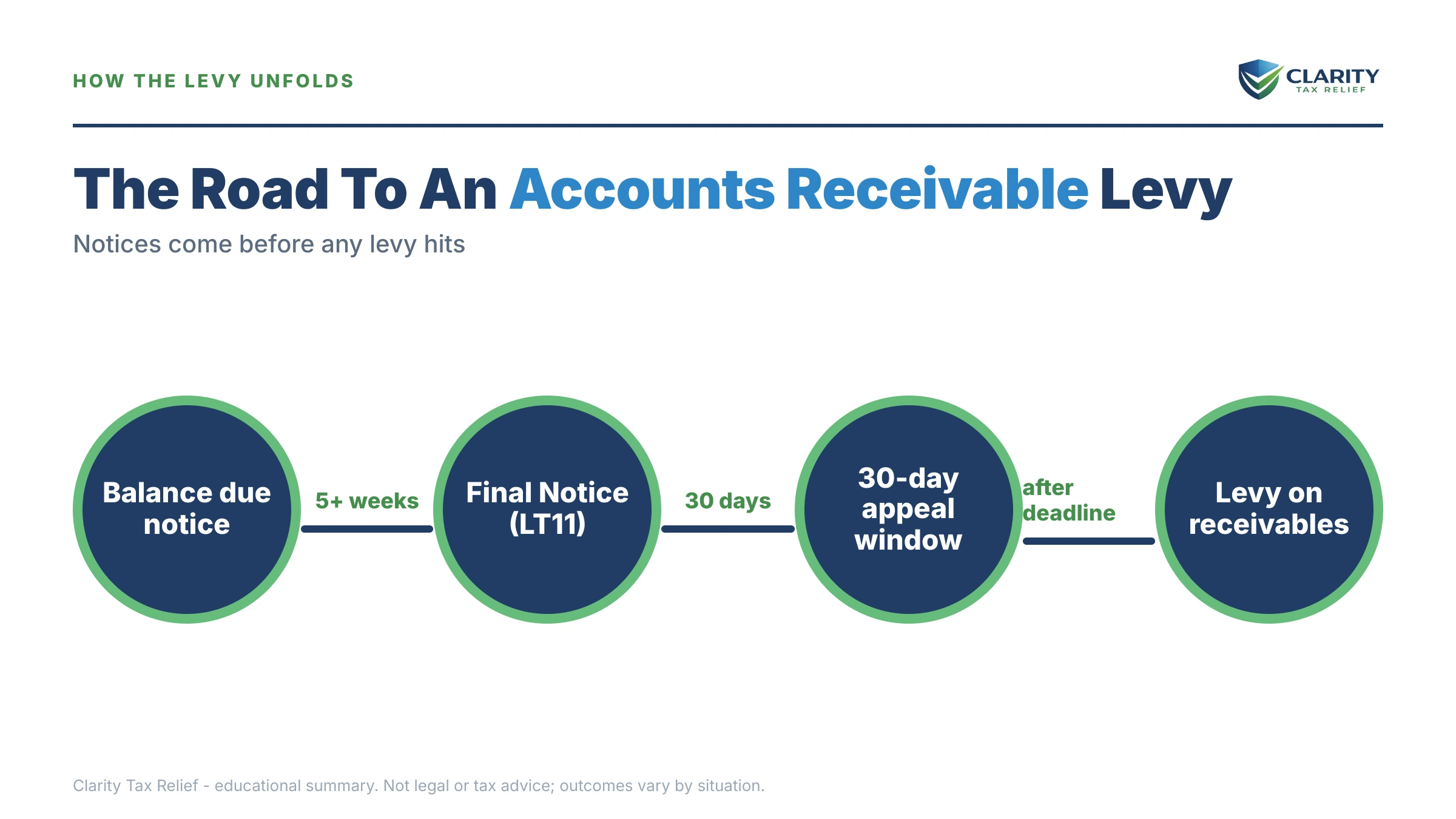
Before this levy could legally issue, the IRS had to send you a final notice — LT11 or Letter 1058 — and wait 30 days. If those notices went to an old address, or arrived while you were dealing with something bigger, the levy can feel like it came from nowhere. Legally, though, the warning stage is over; you're now in the enforcement stage, where the response is different.
What an IRS levy on accounts receivable actually takes
Form 668-A reaches only the money your customers owed you on the day it was served — it is a one-time levy, not a continuous one. An invoice that was outstanding on the service date belongs to the IRS. Work you perform and bill afterward creates a new obligation the old levy cannot touch.
That's the sharpest difference from a wage levy, which keeps taking every paycheck until released, and from a bank levy with its 21-day hold, which gives you a built-in window before funds leave. With receivables there is no hold: your client is expected to remit what it owed you, and most do quickly.
Why do clients comply so fast? Because the law leaves them no choice. A customer who ignores the levy and pays you anyway becomes personally liable to the IRS for that amount plus a 50% penalty under IRC §6332(d). And a customer who honors the levy is legally discharged from owing you anything for that invoice — you cannot sue them, because paying the IRS counts as paying you.
The same one-time mechanics apply to any IRS levy on a 1099 contractor: each 668-A is a snapshot, and the IRS can take a new snapshot whenever it wants. That's why the levy already served is rarely the whole problem — the re-levy risk is.
There's one more cost the form doesn't print: every client who receives a 668-A now knows you owe the IRS. For a consultant, tradesperson, or professional whose business runs on trust, that quiet reputational hit is often worse than the dollars.
Deadlines and rights around a receivables levy
Most of your leverage exists at two moments: before the levy is served, and before your clients remit. This table shows what each stage gives you — and what passes with it.
| Notice or event | Your window | The right at stake |
|---|---|---|
| CP504 — intent to levy your state refund | Before the next notice issues | Resolving here keeps you out of levy territory entirely |
| LT11 / Letter 1058 — final notice of intent to levy | 30 days from the notice date | A Collection Due Process hearing via Form 12153 — levies generally pause while it's heard |
| Form 668-A served on your clients | Until each client remits | A levy release can still reach the client before the money moves |
| Clients remit payment | Ongoing | Funds are applied to your balance; the fight shifts to preventing the next levy wave |
One exception to the 30-day warning: a jeopardy levy, which the IRS can serve without the usual notice when it believes collection is at immediate risk. It's rare, and it comes with its own expedited review rights.
What happens if you do nothing
An unresolved accounts receivable levy is the middle of the IRS collection sequence, not the end. Left alone, enforcement widens in a predictable order:
- Clients remit. Everything they owed you on the levy date goes to the IRS and is applied to your balance — minus nothing for your rent, groceries, or payroll.
- The IRS re-serves. Fresh 668-A levies land as your new invoices mature, and each wave tells more of your client list that you owe the IRS. See how a second levy after a release happens.
- Bank accounts get hit. A separate levy freezes your business or personal account, with a 21-day hold before the funds leave. A levy on a business bank account often lands in the same enforcement cycle as receivable levies.
- Federal payments follow. The Federal Payment Levy Program can take up to 15% of your Social Security — continuously, every month, on top of the invoice levies.
- Lien and passport. A federal tax lien attaches to everything you own, and at $66,000 or more (the 2026 threshold) the IRS can certify your debt to the State Department, putting your passport at risk.
None of this requires a human at the IRS to decide anything. Even with the IRS workforce down roughly 27% after the 2025 cuts, these levies are generated by automated systems that never stopped running — the machine escalates on schedule whether or not anyone answers the phone.
Clients already got the 668-A?
The release has to reach them before their payment reaches the IRS. Send us the levy paperwork and an experienced tax professional will map your fastest release path — free, confidential, no pressure. Call (888) 825-7779 or use the 2-minute form.
Your options after an accounts receivable levy
Every resolution that stops a wage garnishment also releases a receivables levy — the full playbook is in our guide on how to stop IRS wage garnishment; here's how each path applies to invoices specifically, by balance size:
| What you owe | Realistic paths | What the IRS requires |
|---|---|---|
| $10,000 or less | Guaranteed installment agreement; full pay | All required returns filed; the plan pays the balance in full |
| $10,001–$25,000 | Streamlined installment agreement — no financial statement | Returns filed; balance paid over up to 72 months |
| $25,001–$50,000 | Streamlined agreement, online setup up to 72 months | Direct-debit enrollment is usually required at the top of this band |
| $50,001 and up | Installment agreement with financials, partial-pay plan, Currently Not Collectible, or an Offer in Compromise | Form 433-F disclosure; note passport certification applies above $66,000 |
Short-term full pay. If you can clear the balance within 180 days, a short-term plan costs $0 to set up and ends enforcement. Interest and penalties keep accruing until paid.
Installment agreement. A monthly plan releases the levy once accepted. Under $50,000, streamlined terms mean no financial disclosure; above it, the IRS wants Form 433-F and may accept a partial-pay plan that runs to the end of the collection statute.
Currently Not Collectible. If IRS allowable-expense math shows you can't pay anything without hardship — common on fixed retirement income — collection pauses while the 10-year collection statute keeps running. Our guide to IRS hardship on Social Security covers the fixed-income version, and you can estimate how much collection time remains on your debt with our CSED Calculator.
Economic hardship release. Separate from any payment plan, IRC §6343 requires the IRS to release a levy that prevents you from meeting basic living expenses — the hardship levy release is often the fastest lever when the levy has choked off the income you live on.
Offer in Compromise. Real, but means-tested: the IRS accepted roughly 1 in 5 offers in FY2024, and acceptance turns entirely on whether your assets and future income can cover the debt. The $205 application fee and 20% lump-sum down payment are both waived if your AGI is at or below 250% of the federal poverty level — a threshold many retirees on Social Security actually meet.
Say you owe $76,400: a worked example
Say you're 68, drawing $2,300 a month in Social Security, and doing part-time bookkeeping that bills about $3,000 a month. Years of unpaid self-employment tax have grown to $76,400, and the IRS just served 668-A levies on your three active clients, who owed you $9,200, $4,800, and $3,100.
All three remit. That's $17,100 gone — applied to the debt, dropping the balance to roughly $59,300 — and your next two months of living money with it. Now run the options math:
- Streamlined plan? Not yet. $59,300 is above the $50,000 online threshold. Paying down another $9,300 would qualify you — but $50,000 over 72 months is roughly $695 a month before accruing interest and penalties, likely unaffordable on this income.
- Financial-disclosure route. Form 433-F showing $5,300 in monthly income against IRS allowable living expenses may support a much smaller partial-pay plan — or Currently Not Collectible if the math shows nothing left over.
- Offer in Compromise. With minimal assets and income that's mostly Social Security, the collectible amount the IRS calculates could be far below $59,300 — and at this income level the fee and down payment are likely waived. Whether you qualify depends entirely on the numbers; roughly four in five offers are rejected, so run the math before filing.
This is hypothetical, but the shape is typical: above $50,000 on a fixed income, the disclosure-based paths usually beat the sticker-price payment plan.
How to respond to an accounts receivable levy, step by step
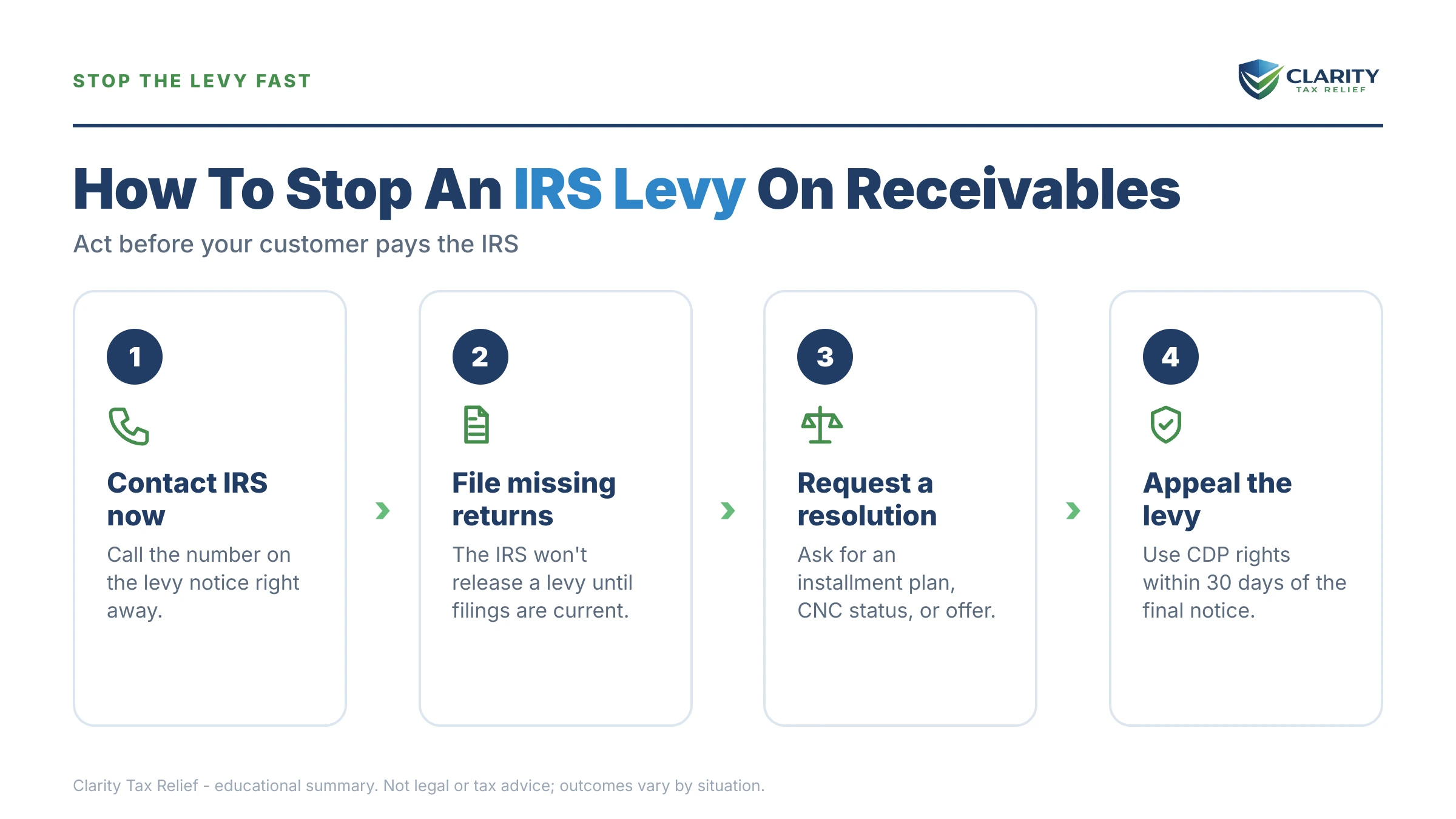
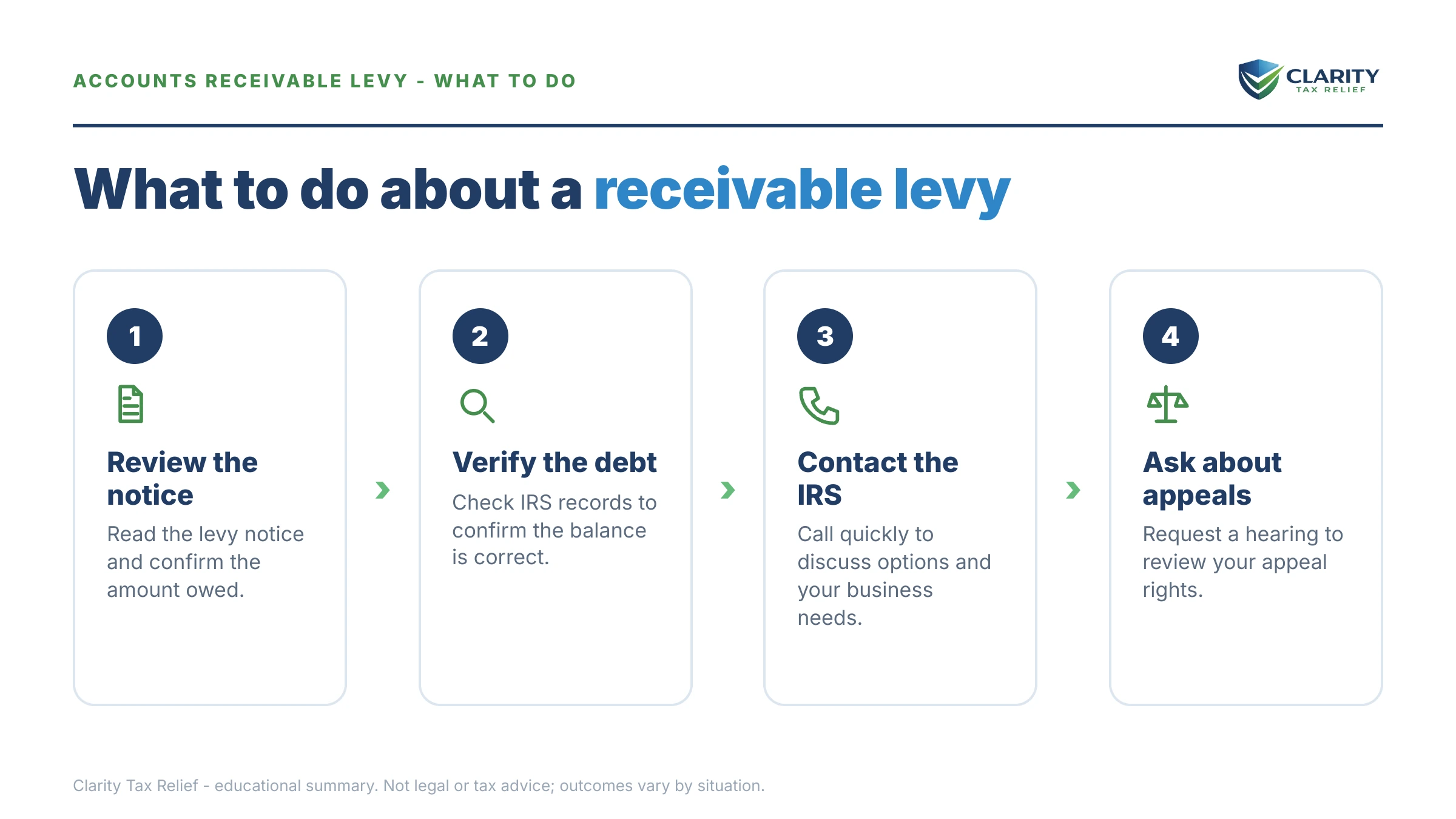
- Call the number on the levy paperwork. Confirm the levy date, which clients received Form 668-A, and your exact current balance — you can't negotiate what you can't see.
- File any missing returns. The IRS will not release a levy while required returns are unfiled; getting compliant is the price of admission for every resolution.
- Complete Form 433-F. List your income, monthly expenses, and assets so you can propose a resolution on the same call instead of waiting for another levy wave.
- Propose the resolution that fits and request a release. Ask for full pay, an installment agreement, Currently Not Collectible status, or an economic-hardship release — and ask the IRS to fax the levy release to every client that was served.
- Confirm the release in writing and resolve the balance. Send a copy of the release to each affected client, then finish the underlying resolution so the IRS has no reason to serve a fresh levy.
When you can handle this yourself — and when help changes the outcome
You can handle a receivables levy yourself when the balance is under $50,000, your returns are all filed, and a streamlined payment plan genuinely fits your budget — one phone call plus the IRS payment plans page can get the levy released without paying anyone anything.
Experienced help earns its cost in the harder versions: a balance above $50,000 where the 433-F presentation decides between a crushing plan and CNC, multiple unfiled years that block any release, a business whose payroll depends on the levied invoices, or offer math on a fixed income. In those cases, how the financials are framed — which expenses the IRS allows, which assets it counts — often changes the monthly number by hundreds of dollars.
Be wary of anyone promising to make the debt vanish. There is no "pennies on the dollar" program — that phrase is marketing, not law. Every real path runs through the same means-tested IRS programs described above.
Terms on your levy paperwork, decoded
- Form 668-A: the Notice of Levy the IRS serves on a third party — here, your customers — to seize money they hold that belongs to you.
- Fixed and determinable: the legal test for what the levy grabs — obligations that already existed on the service date, even if payable later.
- §6332(d) penalty: the rule making a client who pays you instead of the IRS liable for the levied amount plus 50% — the reason clients always comply.
- CDP hearing: the Collection Due Process appeal you can request within 30 days of a final notice (Form 12153), which generally pauses levy action.
- Economic hardship release: the IRC §6343 requirement that the IRS release a levy preventing you from paying basic living expenses.
- CSED: the Collection Statute Expiration Date — generally 10 years from assessment, though appeals, offers, and bankruptcy pause the clock.
If money was taken that never belonged to you — for example, funds actually owed to someone else — a wrongful levy claim is the recovery route. For payment mechanics and current balances, use IRS.gov/payments; if the levy is causing hardship and normal channels stall, the Taxpayer Advocate Service can intervene.
Accounts receivable levy questions, answered
Is an IRS levy on accounts receivable one-time or continuous?
It's a one-time levy. Form 668-A reaches only the money your customers owed you on the day it was served — invoices you issue for new work afterward aren't covered. The catch is that the IRS can serve fresh levies as often as it wants while your balance is unpaid, so many people get hit in waves until they set up a resolution.
What happens if my client pays me instead of the IRS after getting the levy?
Your client becomes personally liable to the IRS for the amount they should have turned over, plus a penalty of 50% of that amount under IRC §6332(d). That's why even loyal, long-term clients comply immediately. Never ask a customer to ignore a levy — you'd be asking them to take on your tax debt plus half again.
How much warning does the IRS give before levying receivables?
Before most levies, the IRS must send a final notice — LT11 or Letter 1058 — and wait 30 days, during which you can request a Collection Due Process hearing on Form 12153. That request generally pauses the levy while your case is heard. The exception is a jeopardy levy, which the IRS can serve without the usual notice when it believes collection is at risk.
How fast can an accounts receivable levy be released?
A release can happen in days — sometimes on a single phone call — but only before your clients send the money. You'll need to be current on filed returns and either set up a payment arrangement, prove economic hardship, or show the levy was improper. Once a client remits, those funds are applied to your balance and are very hard to recover.
Can the IRS levy my Social Security and my receivables at the same time?
Yes. The Federal Payment Levy Program can take up to 15% of your Social Security benefit continuously while separate Form 668-A levies hit your customer invoices. The two systems run independently, so resolving one doesn't automatically stop the other — a single resolution such as an installment agreement, hardship status, or an accepted offer is what shuts both down.
Will the IRS levy invoices I haven't sent yet?
Not with the levy already served — Form 668-A only attaches to obligations that were fixed and determinable on its service date. Work you invoice later creates a new obligation the old levy can't reach. But the IRS knows this and can re-serve levies on the same clients, so the protection is temporary unless you resolve the balance.
Can I sue my customer for paying the IRS instead of me?
No. IRC §6332(e) discharges a customer who honors a levy from any obligation to you for the amount they turned over — legally, paying the IRS counts as paying you. Their payment is credited against your tax balance, so you do get the benefit of the money; you just never touch it.
Your next 24 hours
- Find the levy date and the balance on the Form 668-A your client received (ask them to forward it) — that date determines exactly which invoices are caught and which are still yours.
- Gather your last filed return, a list of every outstanding invoice with amounts and clients, and your monthly income and expense figures — everything a release negotiation will need on the first call.
- Get a free case review before your clients remit — once their payments reach the IRS, that money is applied and the leverage moves to preventing the next wave. Call (888) 825-7779 or use the form at the top of this page.
This guide is general information, not tax or legal advice for your specific situation. Eligibility for IRS programs depends on individual facts and circumstances; no outcome is guaranteed.