
IRS Levies
IRS Levy on an Independent Contractor: How 1099 Levies Work and How to Stop One (2026)
The short answer: an IRS levy on independent contractor income is usually a one-time levy (Form 668-A). It seizes only what a client owes you on the day it's served — but it can take 100% of that payment, with no exempt amount. The IRS can re-serve levies on every client until you set up a resolution.
A client just told you the IRS ordered them to send your money to the Treasury instead of you — or you're holding the final notice warning that's about to happen. Either way, your next invoice is what's at risk now. The good news: an IRS levy on an independent contractor follows specific mechanics, and those mechanics give you real, fast ways to stop it.
The form your client receives is Form 668-A, and it looks nothing like the letters you've been getting. The image below shows exactly what that document looks like and where to look — so you know precisely what landed on your client's desk.
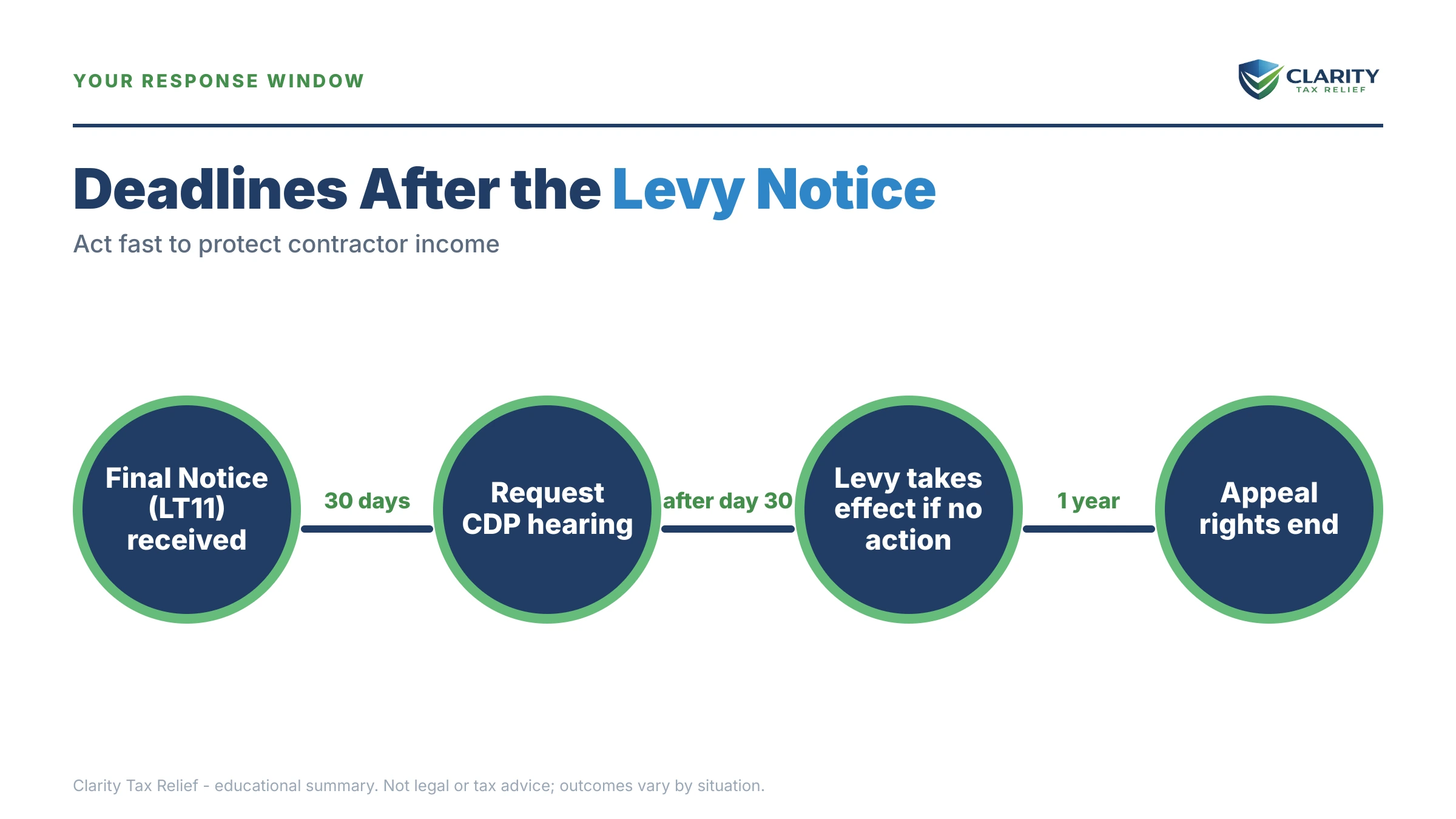
⏱ Your deadline: you have 30 days from the date on your LT11 or Letter 1058 before the IRS can levy your client payments. Filing Form 12153 inside that window pauses levy action and preserves your appeal rights. If a levy has already been served, the real clock is your next client payment cycle — the IRS can re-serve at any time.
Why the IRS is levying your 1099 income
The IRS knows exactly who pays you: every Form 1099-NEC your clients file lists their name, address, and taxpayer ID next to your income. When your balance goes unresolved through the full notice sequence, the collection system pulls that filing history and mails levies straight to the businesses on it. No court order is required — the levy power comes from the final notice you already received.
For contractors, the debt itself usually traces to one of three things: no withholding on your pay so the April bill arrived all at once, missed quarterly estimated payments, or a CP2000 that added tax after a 1099 you didn't report. Whatever the origin, once the balance is assessed and the final notice window passes, your client list becomes the IRS's collection map. If the question you're really asking is whether this is legal at all, the answer is yes — can the IRS garnish 1099 income covers the legal basis in more detail.
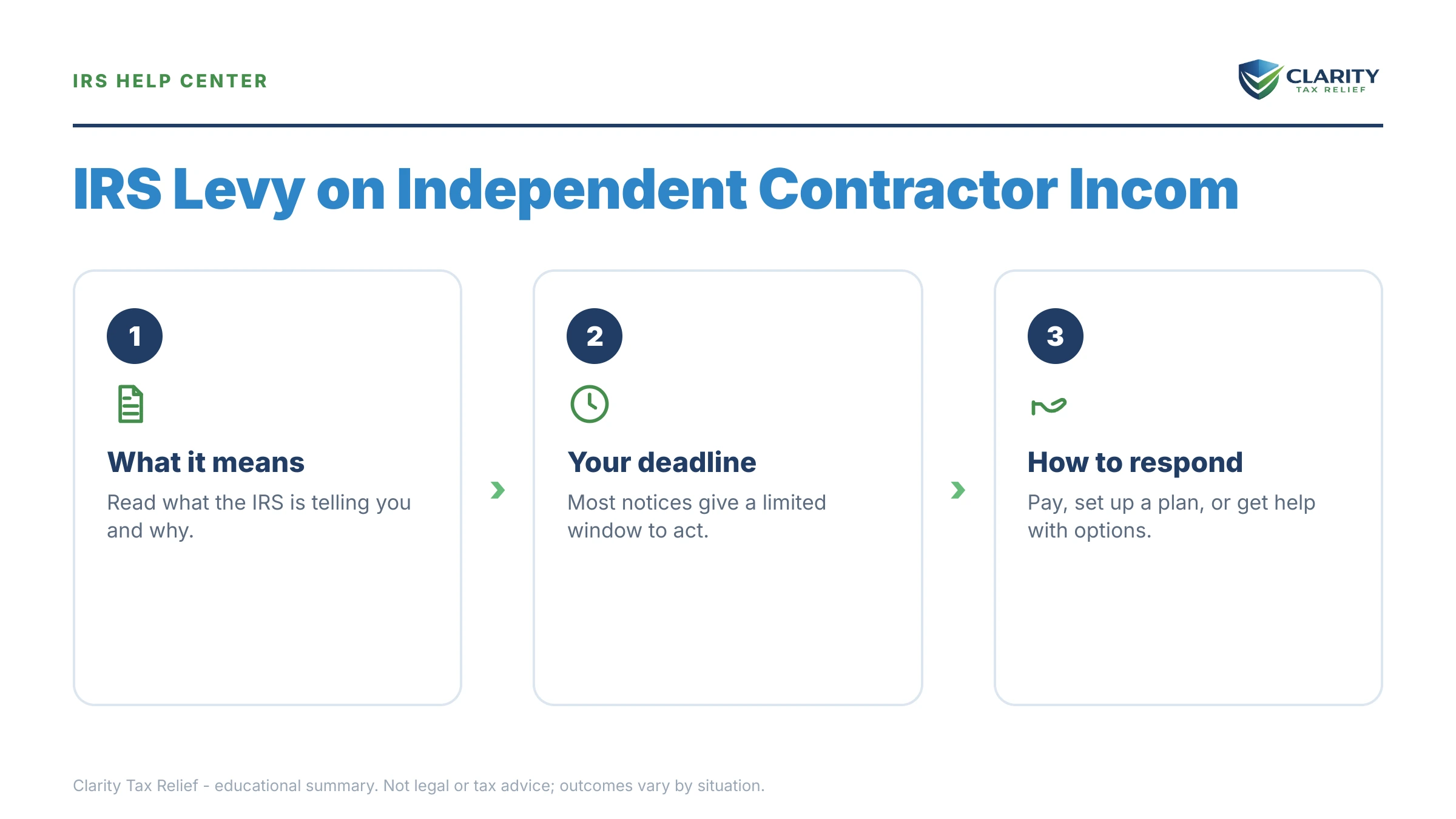
One-time vs. continuous: how a levy hits 1099 pay differently
A levy on contractor pay (Form 668-A) captures only the money a client owes you on the day it's served — but it captures 100% of it, with no exempt amount. That's the trade that defines your situation, and it cuts both ways.
Compare that to a W-2 employee. A wage levy uses Form 668-W, attaches to every future paycheck automatically until released, and leaves the employee a protected exempt amount under Publication 1494. Your levy has neither feature: it doesn't renew itself, and it doesn't leave you anything from the payment it catches. If part of your income is W-2 wages, that portion is treated differently — you can estimate what a continuous wage levy would leave you with our IRS Wage Garnishment Calculator, and the shared playbook lives in our guide on how to stop IRS wage garnishment.
Three details decide how much a 668-A actually grabs:
- It reaches money already owed. Invoices your client has received but not paid are captured. Work you haven't performed yet generally is not — the client's obligation to you must exist when the levy arrives.
- "Fixed and determinable" future payments are the exception. A retainer, a signed installment contract, or scheduled milestone payments the client is already obligated to make can be attached even though the cash hasn't moved yet.
- Re-service is unlimited. A one-time levy that catches nothing today can be served again next month, on the same client or a new one. If you invoice on business terms with recurring receivables, see how an IRS levy on accounts receivable can choke off cash flow entirely.
One more consequence unique to contractors: the levy is served on your client, so your client learns about your tax debt whether you wanted them to or not. They must comply — a payer who ignores a levy becomes personally liable for the amount, plus a potential 50% penalty. Don't ask a client to "hold off." They legally can't.
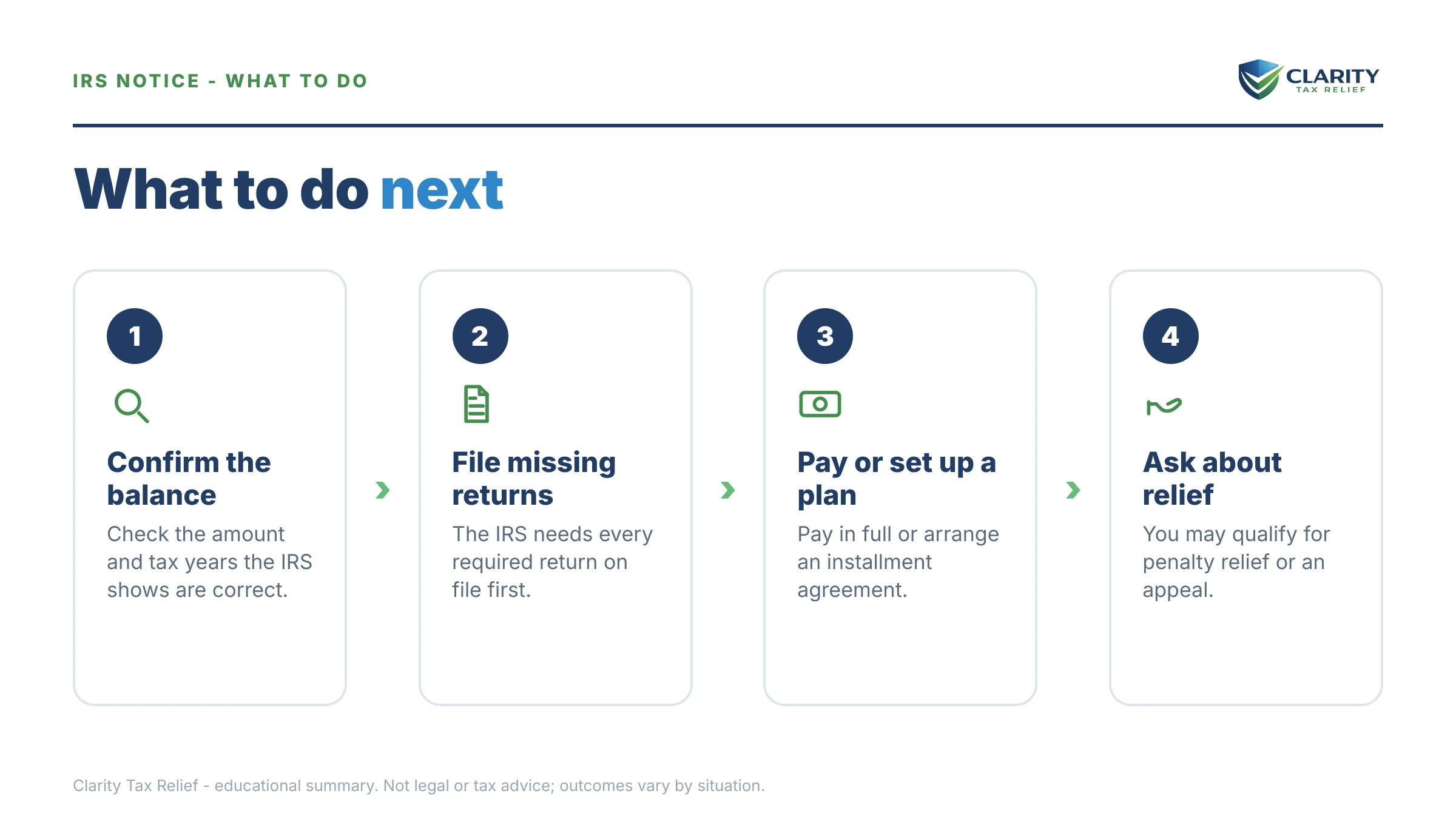
What happens if you ignore the final notice
A levy never arrives first: at least four notices, ending with an LT11 notice or Letter 1058 and a 30-day window, come before any client is touched. Here's the sequence, and what each stage costs you:
- CP14 — the first bill. Typically about 21 days to pay before reminders start. Penalties and interest are already accruing monthly.
- CP501 / CP503 — reminders. Still just bills, but the balance grows with each one.
- CP504 — intent to levy your state refund. The IRS can now seize your state tax refund, and a federal tax lien filing becomes more likely.
- LT11 / Letter 1058 — final notice. This starts the 30-day clock and your Collection Due Process rights. It's the last legally required stop before enforcement.
- Levies go out. Form 668-A to the clients on your 1099 filing history; a bank levy on your accounts — see the IRS bank levy 21-day rule for why frozen funds don't leave immediately; and the IRS can levy PayPal and Venmo balances too.
- Re-levies and lien filing. The system keeps serving levies and may record a Notice of Federal Tax Lien — a public filing that matters enormously if you're planning to refinance (more on that below).
In 2026, don't count on the sequence stalling. IRS staffing fell roughly 27% in 2025, which makes a human hard to reach — but these levies are generated by automated systems that never stopped running.
| Notice or action | Response window | What you lose if it passes |
|---|---|---|
| CP14 (first bill) | Typically 21 days from the notice date | The cheapest exit — penalties and interest compound and reminders begin |
| CP504 (intent to levy) | The date printed on the notice | Your state tax refund becomes seizable; a lien filing grows more likely |
| LT11 / Letter 1058 (final notice) | 30 days from the notice date | Collection Due Process rights (Form 12153) — the pre-levy appeal that pauses collection |
| Form 668-A served on a client | Immediate upon service | The full payment the client owes you that day; release then requires a resolution or documented hardship |
Final notice in hand — or a client already levied?
Get your levy notice reviewed free before the 30-day final-notice window closes — or, if a client has already been served, before the next payment cycle runs. An experienced tax professional will map your fastest release path in one call.
Your options to stop a 1099 contractor levy — and what each costs
Every option below stops new levies once it's in place, and most can get an existing levy released. Which one fits depends on your cash flow and what your finances show:
| Option | What it costs | How fast levy action stops | The catch |
|---|---|---|---|
| Pay in full | Balance plus accrued penalties and interest; no fee | Immediately | Only realistic if raising the cash doesn't create a new hardship |
| Short-term plan (up to 180 days) | $0 setup; interest and penalties continue | Days once approved | The full balance must clear within 180 days |
| Streamlined installment agreement (≤ $50,000) | Modest online setup fee; interest continues, failure-to-pay penalty drops to 0.25%/month while active | Days to weeks; release can be requested once approved | Missing payments defaults the agreement and restarts enforcement |
| Currently Not Collectible | $0; requires financial disclosure (Form 433-F) | After the IRS reviews your finances | The debt keeps growing; the IRS revisits when income rises |
| Offer in Compromise | $205 fee + 20% down on lump-sum offers (both waived with low-income certification) | Levies generally pause while a processable offer is pending; decisions take months | Roughly 1 in 5 offers were accepted in FY2024 — home equity counts heavily against you |
| Hardship levy release (IRC §6343) | $0; requires proof the levy prevents basic living expenses | Can be days in a documented true hardship | Releases the levy, not the debt — see levy causing hardship |
| CDP hearing (Form 12153) | $0 | Levy action pauses while the hearing is pending | Only available within 30 days of the LT11 / Letter 1058 |
Two edge cases worth naming. If you file jointly and the debt is from a joint return, levies can reach either spouse's client payments and accounts — resolving the balance protects both of you. And bankruptcy's automatic stay does halt levies while a case is open (does bankruptcy stop an IRS levy explains how), but for a mid-five-figure income-tax balance it's rarely the proportionate tool.
What resolving $16,400 actually looks like: a worked example
Say you owe $16,400 from two years of underpaid self-employment tax, and you're a few months out from refinancing your house. Here's the arithmetic on each realistic path — all figures hypothetical:
- Do nothing: the 30-day final-notice window passes and the IRS serves Form 668-A on your two biggest clients. One owes you $5,200 on an open invoice — the entire $5,200 goes to the Treasury, with no exempt amount. Your balance drops to about $11,200, but both clients now know about your tax debt, and the IRS can file a Notice of Federal Tax Lien that surfaces in your refinance title search.
- Streamlined installment agreement: $16,400 ÷ 72 months ≈ $228/month minimum. Interest and a reduced 0.25%/month failure-to-pay penalty keep accruing, so the payoff runs close to the full term at the minimum. Levy risk ends as soon as the agreement is approved.
- Pay it down faster: at $700/month, the balance clears in roughly two years, cutting total interest substantially versus the 72-month minimum.
- Offer in Compromise: probably not your tool. An offer must exceed what the IRS could collect from your income and assets — and if your refinance appraisal shows, say, $60,000 of home equity, your collection potential already dwarfs $16,400. Honest answer: with meaningful equity, a payment plan beats chasing a settlement.
For the refinance itself, sequence matters. Getting onto a direct-debit agreement before a lien is filed is the cleanest protection; balances of $16,400 sit under the $25,000 direct-debit threshold where, after qualifying payments, you may qualify to have a filed lien withdrawn via Form 12277. If a lien has already been recorded, refinancing with an IRS lien walks through subordination and payoff-at-closing options — it's a solvable problem, but a slower one.
How to respond to an IRS contractor levy, step by step
- Find your final notice. Check whether you've received an LT11 or Letter 1058 and note the notice date — your 30-day Collection Due Process window runs from that date, not from when you opened the envelope.
- File Form 12153 if you're inside 30 days. Requesting a Collection Due Process hearing pauses levy action and preserves your appeal rights while you negotiate a resolution.
- Verify the balance. Log into your IRS online account and confirm the amount, the tax years, and whether any levies have already been issued.
- Open a resolution before the window closes. Set up a payment plan, request Currently Not Collectible status, or submit an Offer in Compromise — enforcement generally pauses once an agreement is in place or a processable offer is pending.
- Request release of any levy already served. Contact the IRS with your resolution or hardship documentation and ask that the release be faxed directly to your client or bank.
The CDP step deserves emphasis: it's the single strongest right in the whole sequence, and it expires. Our Form 12153 CDP hearing guide covers what to write and what a hearing can actually get you.
When you can handle this yourself — and when help changes the outcome
Plenty of contractor levy situations are genuinely DIY. If you agree with the balance, no levy has been served yet, and you can either full-pay within 180 days or afford the streamlined monthly payment, set the plan up yourself on the IRS payment plans page — it takes an afternoon and no fee beyond setup. A single tax year with a clean filing history is the easiest version of this problem.
Experienced help earns its cost when the stakes or complexity rise: a levy already sitting on a client's desk (release negotiation plus managing the client relationship), multiple unfiled years that must be filed before the IRS will approve anything, a balance you dispute, offer math complicated by home equity, or business payroll debt layered on top of personal tax. And if a levy is causing immediate, provable hardship and you can't get the IRS on the phone, the Taxpayer Advocate Service exists for exactly that — free.
Terms on your levy notice, decoded
- Levy vs. lien: a levy takes property (a payment, a bank balance); a lien is a recorded claim against everything you own — the thing a refinance title search finds.
- Form 668-A: the one-time levy served on a client or bank, capturing what's owed to you on that day.
- Form 668-W: the continuous wage levy used against W-2 employees — it repeats every payday but leaves an exempt amount.
- Fixed and determinable: a future payment the client is already legally obligated to make; the exception that lets a one-time levy reach money not yet paid.
- CDP (Collection Due Process): your 30-day right after the final notice to appeal before levies begin, requested on Form 12153.
- §6343 release: the law requiring the IRS to release a levy that creates economic hardship or when a resolution is in place.
IRS levy independent contractor: your questions, answered
Can the IRS levy independent contractor income?
Yes. The IRS can serve a levy (Form 668-A) directly on any business that pays you, and that business must send the IRS whatever it owes you on the day the levy arrives. It finds your clients through the 1099-NEC and 1099-K forms they file. The main limit: the levy generally reaches only payments already owed to you, not future invoices for work you haven't performed yet.
Is an IRS levy on a 1099 contractor continuous?
Usually no. A wage levy on a W-2 employee (Form 668-W) is continuous until released, but a levy on contractor pay is typically a one-time seizure of what the client owes you at that moment. The exception is a contract with fixed, determinable future payments — a retainer, for example — which the levy can attach. The IRS can also simply re-serve the levy on the same client again and again until you resolve the balance.
How much of my 1099 pay can the IRS take?
Up to 100% of what a client owes you when the levy is served. The exempt amounts in Publication 1494 that protect part of an employee's paycheck apply only to continuous wage levies — a one-time levy on contractor pay carries no exempt amount. That makes a 1099 levy harsher per payment than a W-2 garnishment, even though it doesn't automatically repeat.
Will my clients find out I owe the IRS?
Yes. The levy is served directly on the client, so they learn about your tax debt the moment it arrives — and they are legally required to comply or become liable for the amount themselves, plus a potential 50% penalty. That business-relationship damage is often the most expensive part of a contractor levy, which is why acting inside the 30-day final-notice window matters so much.
Can the IRS levy my bank account too if I'm self-employed?
Yes, and it often does both. A bank levy freezes the funds in your account on the day it's served, with a 21-day hold before the bank sends the money to the IRS — that window is your chance to get it released. Business and personal accounts are both reachable if you operate as a sole proprietor, because you and the business are the same taxpayer.
How fast can a levy on 1099 income be released?
A release can happen within days once a resolution is in place — an installment agreement, Currently Not Collectible status, or a documented economic hardship under IRC §6343 all qualify. The IRS can fax the release directly to your client. The slow part is usually the financial review, so having your income, expense, and invoice records ready shortens the timeline more than anything else.
Can I have clients pay me through a payment app or a new LLC to avoid the levy?
Rerouting payments rarely works and can make things worse. Payment platforms file 1099-K forms above the $20,000 / 200-transaction threshold, the IRS can levy PayPal and Venmo balances, and deliberately moving income to defeat a levy can create far more serious exposure than the debt itself. A resolution that stops levies legally — often a payment plan you can set up online — is cheaper and safer than any workaround.
Your next 24 hours
- Find the date on your LT11 or Letter 1058 and count 30 days forward. Write that deadline somewhere you'll see it — every option on this page is easier inside that window.
- Gather four things: the notice itself, your last filed return, a list of open invoices and the clients who owe them, and a rough monthly income-and-expense picture. You can verify your exact balance anytime at IRS.gov/payments.
- Get a free case review — call (888) 825-7779 or use the 2-minute form at the consultation page — before the CDP window closes or a levy reaches your next client payment.
This guide is general information, not tax or legal advice for your specific situation. Eligibility for IRS programs depends on individual facts and circumstances; no outcome is guaranteed.