
IRS Collections
IRS Jeopardy Levy: When the IRS Seizes Assets Without Notice — and How to Fight Back (2026)
The short answer: a jeopardy levy is an emergency IRS seizure of wages, bank accounts, or property with no advance warning, allowed only when the IRS believes collection is in immediate danger. You can fight it: demand expedited IRS Appeals review within 30 days under IRC §7429, and request a post-levy Collection Due Process hearing.
Your bank account is frozen, your employer got a levy notice, and no LT11 or final warning ever showed up in your mail. That's a jeopardy levy — the one levy the tax code lets the IRS serve before notifying you, reserved for cases where it believes waiting 30 days would let the money disappear. It is rare, it requires sign-off from IRS Chief Counsel, and it comes with the fastest appeal rights anywhere in the tax code.
Unlike every other collection action, the fight here happens after the seizure — which means the clocks started the day the levy hit, not the day you find this page. The paperwork that follows the levy is what starts those clocks; the image below shows what this post-levy notice looks like and where to look for your appeal-rights language.
⏱ Your deadlines: if a bank account was levied, the bank must hold the funds for 21 days before sending them to the IRS. Separately, you have 30 days from the IRS's written statement of its jeopardy grounds to demand expedited Appeals review under IRC §7429 — check the dates printed on your notice and count from those.
Why the IRS issued a jeopardy levy against you
A jeopardy levy is the one levy the IRS can serve without sending a final notice first — and it cannot issue without written approval from IRS Chief Counsel. That approval requirement exists because the levy skips the due-process sequence Congress built for everyone else, so the IRS has to be able to defend it in court on short notice.
To get that approval, the IRS must believe at least one of three things about you:
- Flight. You appear to be preparing to leave the United States quickly, or to conceal yourself, before the debt can be collected.
- Asset dissipation. You appear to be hiding, transferring, retitling, or spending down assets to put them beyond the government's reach — moving savings offshore, deeding property to relatives, converting accounts to cash or crypto.
- Imperiled solvency. Your financial condition appears to be collapsing (apart from the tax debt itself), so that waiting through the normal notice sequence would leave nothing to collect.
A related provision, IRC §6867, lets the IRS treat large amounts of cash with no identified owner the same way — that's how jeopardy procedures show up in cash-seizure cases. But for most readers, the trigger was a transaction: a big wire, a property transfer, or account activity that looked like assets heading for the exit right after an assessment posted.
The paperwork you receive afterward — typically Letter 2439, Notice of Jeopardy Levy and Right of Appeal, plus a written statement of the facts the IRS relied on — is your roadmap. Keep every page; the appeal windows below run from those documents.
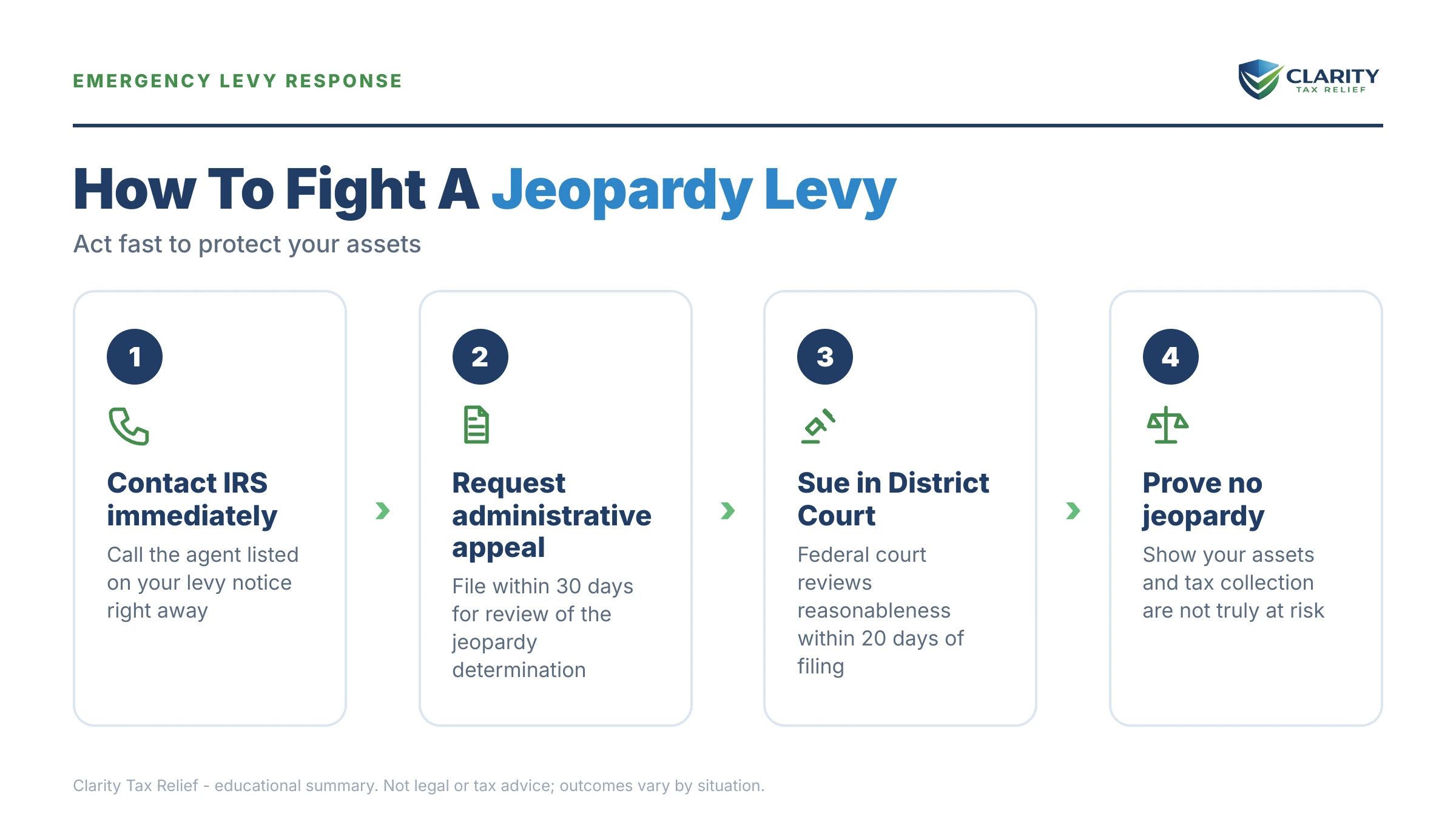
Jeopardy levy vs. jeopardy assessment vs. regular levy
A jeopardy assessment puts tax on the books instantly; a jeopardy levy seizes property to collect it; a regular levy requires a final notice and a 30-day wait first. These often get mixed up, and the difference matters for which defenses you have.
A jeopardy assessment under IRC §6861 skips the normal deficiency process — the IRS assesses first and lets you dispute later. A jeopardy levy is the collection half: seizure without the LT11/Letter 1058 warning and 30-day wait that a normal levy requires. You can get one without the other — the IRS can jeopardy-levy a balance that was assessed years ago through ordinary channels. Either way, IRC §7429 expedited review applies, and your Form 12153 CDP hearing rights are delayed, not eliminated: the IRS must offer you the hearing within a reasonable time after the levy instead of before it.
If your account was levied and you're not sure which kind hit you, check the notice. A levy that followed an LT11 you ignored is a regular levy with different (and fewer) remedies — our guide to whether the IRS can freeze your bank account without notice walks through how to tell them apart.
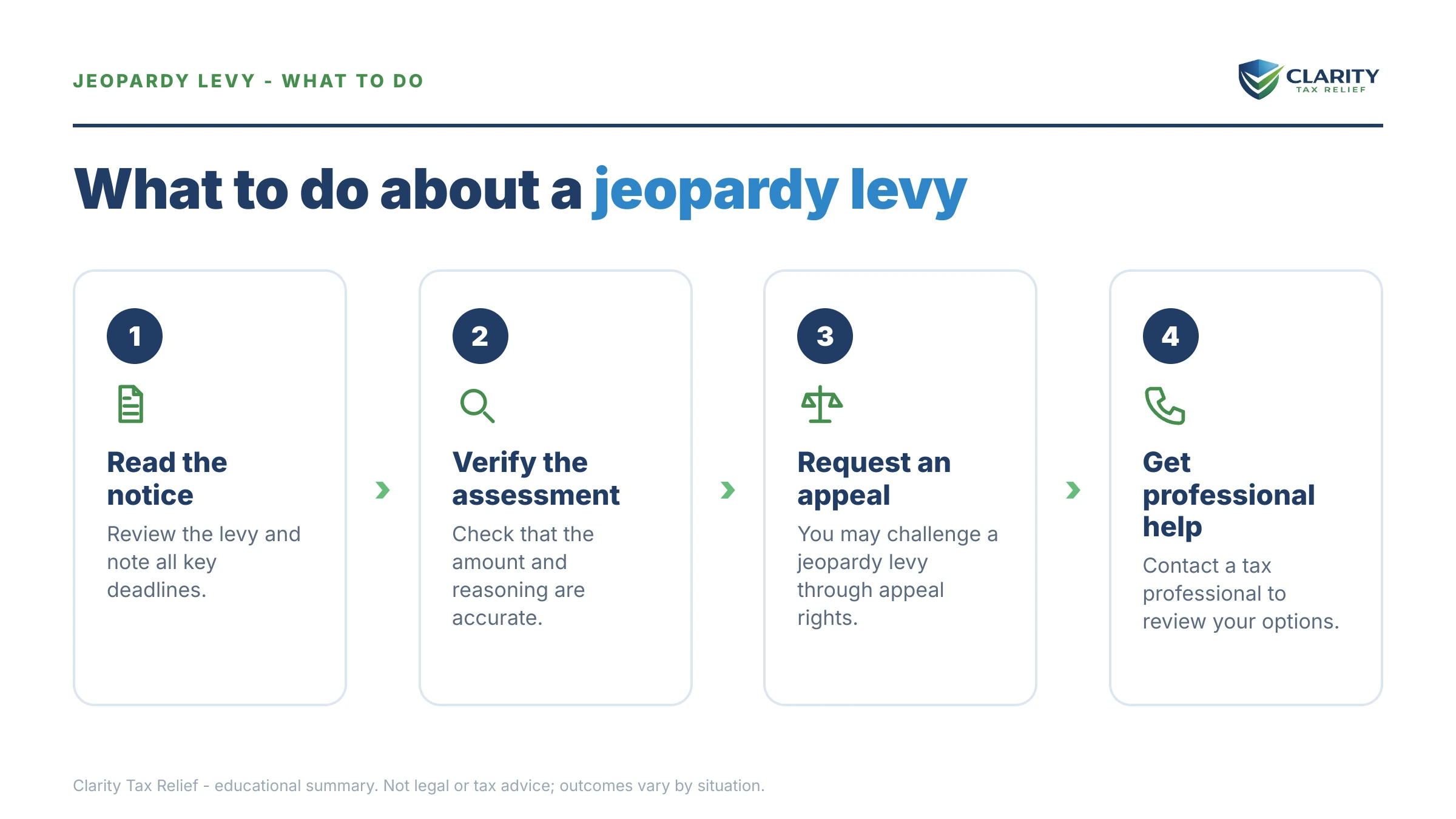
What happens if you do nothing after a jeopardy levy
After a jeopardy levy, a bank must hold seized funds for 21 days before remitting them to the IRS — once that window closes, the money is applied to your debt and is far harder to recover. Inaction doesn't pause anything else, either. Here's the sequence:
- Day of the levy — bank funds freeze; a wage levy attaches to your next paycheck. The IRS must send its written statement of jeopardy grounds within 5 days.
- The 21-day hold runs out — the bank remits the frozen funds to the Treasury. Your best leverage window is gone.
- The wage levy keeps going — unlike a bank levy, a wage levy is continuous. It takes a slice of every paycheck until it's formally released, not just once.
- Your §7429 window closes — 30 days after the written statement, you lose the expedited Appeals review and the fast track to federal district court.
- Your CDP window closes — miss the 30-day deadline on the post-levy CDP notice and you lose the path to Tax Court review, leaving only a weaker "equivalent hearing."
- Collection widens — the IRS can pursue other accounts, your state refund, and property, while interest and the failure-to-pay penalty keep accruing monthly. Above $66,000 (the 2026 threshold), passport certification for tax debt is also on the table.
| Clock | Window | What you lose if it passes |
|---|---|---|
| IRS written statement of its jeopardy grounds | Due to you within 5 days of the levy | Nothing — this is the IRS's obligation. Request it in writing if it never arrives. |
| Demand IRS Appeals review (IRC §7429) | 30 days from the written statement | The expedited administrative review where the IRS must justify the levy |
| Sue in federal district court (IRC §7429) | Within 90 days of the earlier of the Appeals determination or the 16th day after you requested IRS review (IRC 7429(b)(1)) | The fastest judicial review in the tax code — the court decides on an expedited schedule |
| Bank remits levied funds | 21 days after the levy reaches the bank | The chance to release the funds before they leave your account |
| Post-levy CDP hearing (Form 12153) | 30 days from the CDP notice the IRS sends after the levy | Tax Court review and a formal forum for collection alternatives |
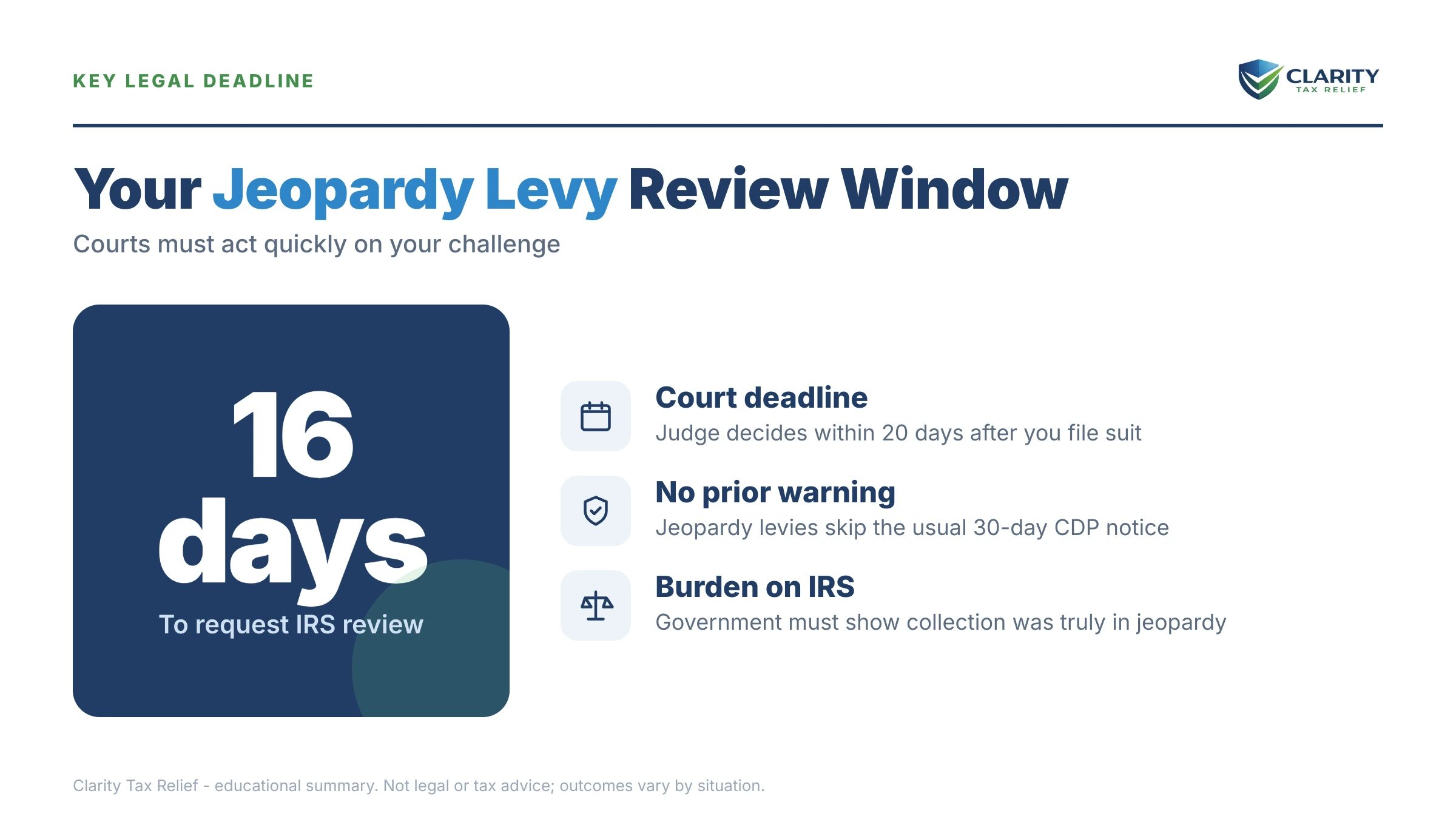
Hit with a jeopardy levy right now?
The 21-day bank hold and the 30-day §7429 window are already running. Send us your levy notice and an experienced tax professional will map every deadline and defense you have left — free, confidential, same day.
Your options after a jeopardy levy
Every standard IRS resolution — payment agreement, hardship status, Offer in Compromise — can still release a jeopardy levy once it's in place. The jeopardy label changes how fast you must move and who you're dealing with (a revenue officer and Counsel, not the automated system), but it doesn't take your options off the table.
- Challenge the levy itself (§7429). If the jeopardy determination was unreasonable — the "offshore transfer" was a documented home purchase, the "flight risk" was a work trip — Appeals or a district court can order the levy abated and funds returned. Critically, the IRS bears the burden of proving the levy was reasonable.
- Installment agreement. A monthly plan typically gets levies released once accepted. Above $50,000 you'll need Form 433-F financial disclosure rather than the streamlined online setup. Interest and penalties keep accruing during the plan.
- Hardship release. If the levy leaves you unable to pay basic living expenses, IRC §6343 requires release — see levy causing hardship for the standard and proof. Pairing this with Currently Not Collectible status pauses collection entirely, though the debt remains.
- Offer in Compromise. If your assets and income genuinely can't cover the debt, an OIC settles it for what the IRS could realistically collect. It's means-tested — per IRS Data Book figures, the IRS accepted roughly 1 in 5 offers in FY2024 — and in a jeopardy case the IRS will scrutinize any recent asset transfers hard.
- Wrongful levy claim. If the levy grabbed money or property belonging to someone else — a joint account funded by a parent, a spouse's separate assets — that person can file a wrongful levy claim to get it back.
- Bankruptcy. The automatic stay halts collection, but it's a last resort with its own rules — does bankruptcy stop an IRS levy covers when it helps and when it doesn't.
If a wage levy is part of the action, remember it's continuous — only a small exempt amount of each paycheck is protected and the rest goes to the IRS until release. You can estimate how much of each paycheck a wage levy can reach with our IRS wage garnishment calculator, and the broader release playbook lives in our guide to how to stop IRS wage garnishment.
| Balance owed | Realistic resolution paths | What changes at this level |
|---|---|---|
| Under $10,000 | Guaranteed installment agreement; full pay within 180 days | Jeopardy levies are almost unheard of here — verify you didn't simply miss an LT11 |
| $10,000–$25,000 | Streamlined installment agreement; hardship release if the levy broke your budget | No financial disclosure normally needed for the plan itself |
| $25,001–$50,000 | Online plan up to 72 months (direct debit at the top of the band); OIC if income is low | Last tier where you can set up a plan without full financials |
| $50,001–$100,000 (a $68,500 debt sits here) | Non-streamlined installment agreement with Form 433-F; OIC; CNC; §7429 challenge | Financial disclosure required; above $66,000, passport certification becomes possible |
| Over $100,000 | Revenue-officer-negotiated agreement; asset review; representation strongly advised | Jeopardy determinations and enforced collection are most common at this level |
A worked example: fighting a jeopardy levy on $68,500
Say you owe $68,500 — a single W-2 employee with balances from two audited years. After the assessment posted, you wired a large sum to a foreign account (in reality, a property deposit). The IRS read it as asset flight and served a jeopardy levy: your checking account, holding $11,200, froze the same morning your employer received a continuous wage levy. This is a hypothetical — but here's how the math and the clocks would run:
- The bank money: $11,200 is frozen under the 21-day hold. Win a release by day 20 — through a §7429 challenge, hardship showing, or an accepted agreement — and it stays yours. Miss it, and the funds are applied, dropping the balance to $57,300 while the wage levy keeps taking each paycheck.
- The challenge: the wire has a paper trail (purchase contract, escrow records), so a §7429 protest filed inside 30 days puts the burden on the IRS to prove asset flight was a reasonable read. That's a genuinely winnable posture.
- The fallback: at $68,500 you're above the $50,000 online-plan ceiling, so an installment agreement means Form 433-F financials. If the IRS accepts roughly a six-year payoff, that's about $68,500 ÷ 72 ≈ $951 per month — before the interest and 0.5%-per-month late-payment penalty that keep accruing until paid.
- The passport angle: $68,500 exceeds the 2026 certification threshold of $66,000, so getting into an agreement also heads off passport certification.
For balance-specific strategy in this range, see I owe the IRS $75,000.
How to respond to a jeopardy levy, step by step
- Calendar every deadline. Pull the levy date from your notice and write down three clocks: the 21-day bank hold, the 30-day window to demand IRC §7429 Appeals review, and the 30-day window to file Form 12153 after your post-levy CDP notice arrives.
- Get the IRS's written justification. The IRS must give you a written statement of the information it relied on within 5 days of the jeopardy levy. If you haven't received it, request it in writing immediately — your §7429 clock runs from this statement.
- Demand expedited Appeals review under §7429. File a written protest with the IRS within 30 days explaining why the levy was unreasonable or the amount inappropriate. Appeals must act quickly, and if it rules against you, you can sue in federal district court on an expedited schedule.
- File Form 12153 for a Collection Due Process hearing. The jeopardy exception delays your CDP rights; it doesn't erase them. Filing on time preserves Tax Court review and forces a settlement officer to consider collection alternatives like a payment plan or hardship status.
- Propose a resolution the IRS can accept. Submit Form 433-F financials with a concrete proposal — an installment agreement, hardship release, or offer — because levies are typically released once an acceptable agreement is in place.
When you can handle this yourself — and when you shouldn't
A jeopardy levy is one of the few IRS actions where professional representation almost always changes the outcome. The honest exception is narrow: if the levy caught a small balance you agree you owe, the seized funds nearly cover it, and you can full-pay or set up a simple plan within the 21-day hold, you can reasonably handle the calls yourself.
Everything else favors experienced help, fast. A §7429 protest is a legal argument about reasonableness, built on documents, filed against a determination Chief Counsel already signed off on — and it has to be assembled in days, not months. The same goes if the levy hit a business bank account and payroll is at risk, if the seized funds belong partly to someone else, or if the underlying assessment itself is wrong. In 2026, with IRS staffing down roughly 27% per TIGTA reporting, even reaching the right revenue officer before your windows close is half the battle — an experienced tax professional with a power of attorney can usually get there faster than you can.
Terms on your notice, decoded
- Jeopardy assessment — an emergency assessment under IRC §6861 that puts tax on the books immediately, before the normal dispute process.
- IRC §7429 review — the expedited appeal built specifically for jeopardy actions: Appeals review on demand, then fast-track federal district court, with the IRS carrying the burden of proving the levy was reasonable.
- Collection Due Process (CDP) — your right to an independent Appeals hearing (requested on Form 12153) with Tax Court review; in jeopardy cases it comes after the levy instead of before.
- 21-day hold — the period a bank must sit on levied funds before remitting them to the Treasury; your release window.
- Chief Counsel approval — the written sign-off from the IRS's legal arm required before any jeopardy levy can issue.
- CSED — the Collection Statute Expiration Date, generally 10 years from assessment; appeals and offers can pause it.
Jeopardy levy questions, answered
Can the IRS really levy my bank account without any warning?
Yes, but only in jeopardy cases. Normally the IRS must send a final notice of intent to levy (LT11 or Letter 1058) and wait 30 days before touching your money. A jeopardy levy is the narrow exception: when the IRS believes collection is in immediate danger, it can seize first and provide your notice and appeal rights afterward. It still needs IRS Chief Counsel approval before acting.
What triggers an IRS jeopardy levy?
One of three findings: you appear to be preparing to leave the country or hide, you appear to be hiding, transferring, or dissipating assets to put them out of the government's reach, or your financial solvency appears endangered apart from the tax debt itself. Large offshore transfers, sudden retitling of property, and cash-heavy activity right after an assessment are the fact patterns that most often produce one.
How do I get my money back after a jeopardy levy?
Move inside the windows. Demand expedited Appeals review under IRC §7429 within 30 days of the IRS's written statement, and if a bank account was levied, act within the 21-day hold before the bank remits the funds. A hardship release under IRC §6343, a payment agreement, or a successful §7429 challenge can each get the levy released — and if the levy grabbed property that belongs to someone else, that person can file a wrongful levy claim.
How common are jeopardy levies?
They are rare. A jeopardy levy requires approval from IRS Chief Counsel, and the IRS must be prepared to defend its reasonableness in federal district court on an expedited schedule. The overwhelming majority of levies are ordinary ones that follow the standard notice sequence — if your account was levied, confirm which type you received before assuming the worst.
Who has the burden of proof in a jeopardy levy appeal?
The IRS does, on the core question. In a §7429 proceeding, the government must prove that making the jeopardy levy was reasonable under the circumstances. You carry the burden only on the separate question of whether the amount assessed is appropriate. That is a taxpayer-friendly allocation — it is one of the few collection fights where the IRS has to justify itself first.
What is the difference between a jeopardy assessment and a jeopardy levy?
A jeopardy assessment (IRC §6861) puts the tax on the books immediately, skipping the normal deficiency procedures; a jeopardy levy actually seizes property to collect it. They often arrive together, but not always — the IRS can jeopardy-levy a balance that was assessed normally. Both trigger the same §7429 expedited review rights, and both require high-level approval before they issue.
Does the 21-day bank hold apply to a jeopardy levy?
Yes. When any IRS levy reaches a bank account, the bank must hold the funds for 21 days before sending them to the Treasury. That hold exists precisely so errors and hardships can be fixed before the money leaves. In a jeopardy case those 21 days are your most valuable window — a release obtained on day 20 keeps the funds in your account.
Can bankruptcy stop a jeopardy levy?
Filing bankruptcy triggers the automatic stay, which halts IRS collection — including levies — while the case is open. But it is a serious step with lasting consequences, some tax debts survive it, and funds already remitted to the IRS may be hard to recover. Bankruptcy can make sense when a jeopardy levy lands on top of broader insolvency; get advice before filing solely to stop a levy.
Your next 24 hours
- Find two dates on your notice: the levy date and the date of the IRS's written statement of its jeopardy grounds. Count 21 days from the first (bank hold) and 30 days from the second (§7429 appeal) — those are your real deadlines.
- Gather your proof: the levy notice and written statement, bank statements showing where the "suspicious" money actually went, your last filed return, and current pay stubs. Documentation is what wins §7429 challenges.
- Get the levy reviewed before the 21-day hold runs out: the 2-minute form or (888) 825-7779. An experienced tax professional can tell you the same day whether to fight the jeopardy determination, push a hardship release, or negotiate an agreement — and which order to do it in.
For where a jeopardy action fits in the IRS's broader enforcement machinery, see the IRS collection process step by step. Primary sources: the IRS's overview of paying balances and levy releases at IRS.gov/payments, the IRS Independent Office of Appeals, and — if a levy is causing hardship the IRS won't address — the Taxpayer Advocate Service.
This guide is general information, not tax or legal advice for your specific situation. Eligibility for IRS programs depends on individual facts and circumstances; no outcome is guaranteed.