
IRS Notices
CP297A Notice: The IRS Has Levied Your Business — What to Do Now (2026)
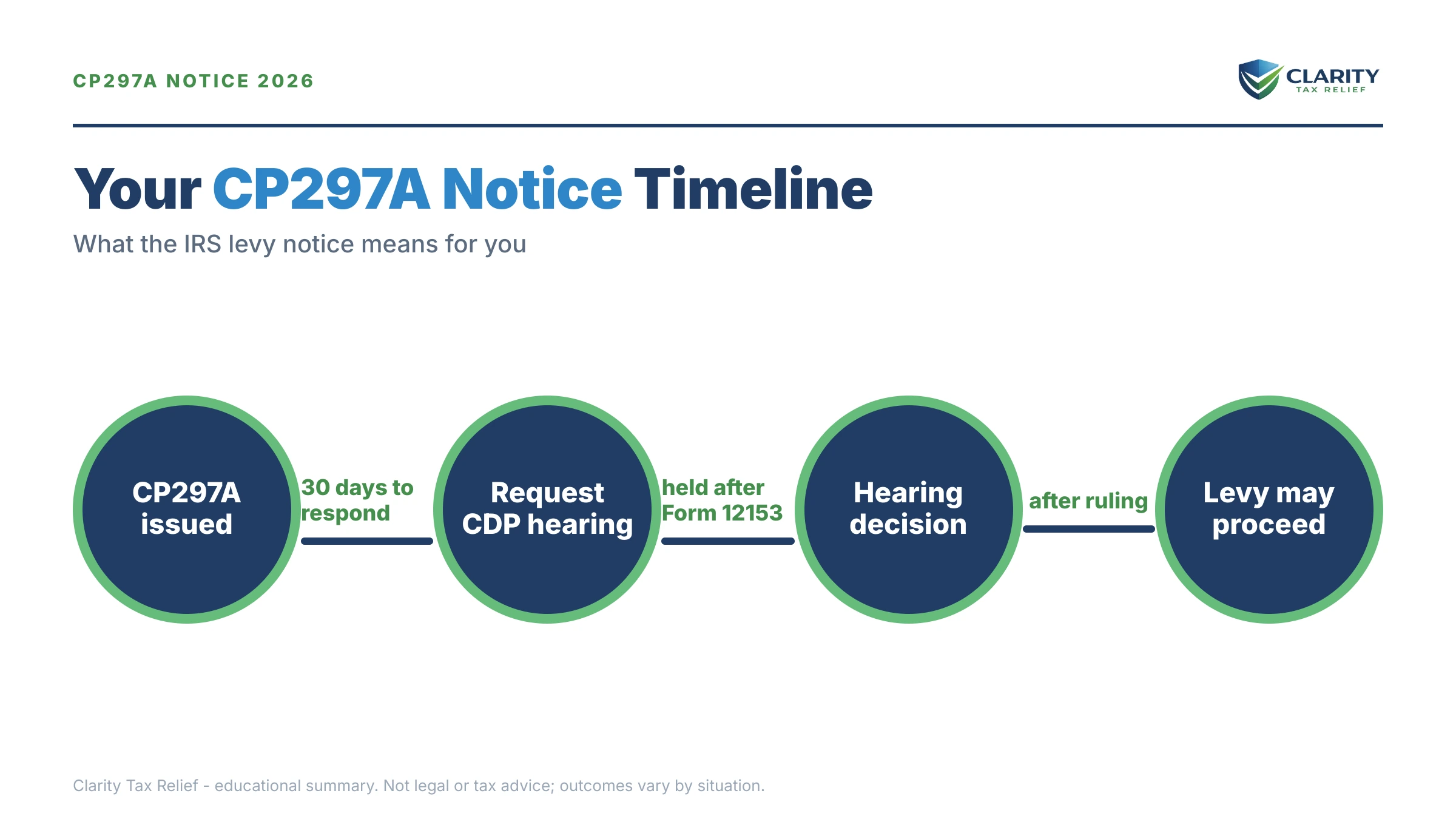
The short answer: a CP297A notice means the IRS has already issued a levy against your business — it is not a warning, the levy is in effect. You have 30 days from the notice date to request a Collection Due Process hearing on Form 12153 while you work to get the levy released.
Maybe you found out before the letter arrived — a deposit that never hit the account, a contractor payment that came up short, a call from your bank. Then the CP297A landed and confirmed it: the IRS levied first and is explaining your rights second. That order feels backward, and for this one notice, it legally is. The good news is that the same law that let the IRS move first also hands you an immediate, powerful appeal right — if you use it inside the window.
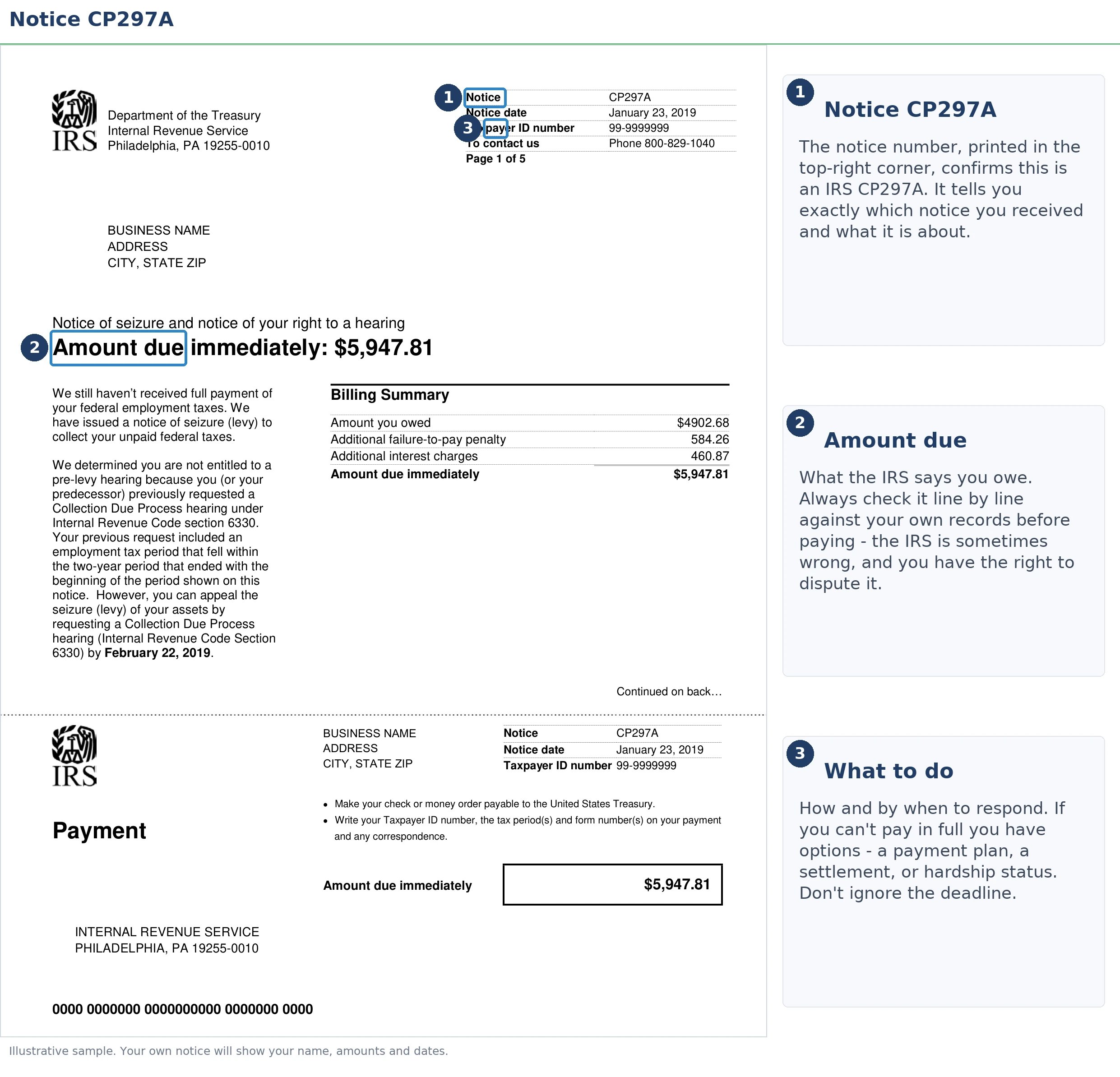
The notice date and the tax periods the levy covers sit in specific spots on page one, and your hearing deadline runs from that date — the image below shows exactly what a CP297A looks like and where to find each of those items.
⏱ Your deadline: you have 30 days from the date printed on your CP297A to file Form 12153 and preserve your Collection Due Process rights, including the ability to take a disagreement to Tax Court. And if a bank account was levied, the bank holds those funds only 21 days before sending them to the IRS.
What a CP297A notice actually tells you
A CP297A notice means the IRS has already served a levy against your business and is notifying you of your hearing rights after the fact — the reverse of the normal collection order. Most businesses that receive one owe employment taxes, and the balance usually traces back to 941 back taxes — quarters where payroll was run but the withheld taxes never made it to the Treasury.
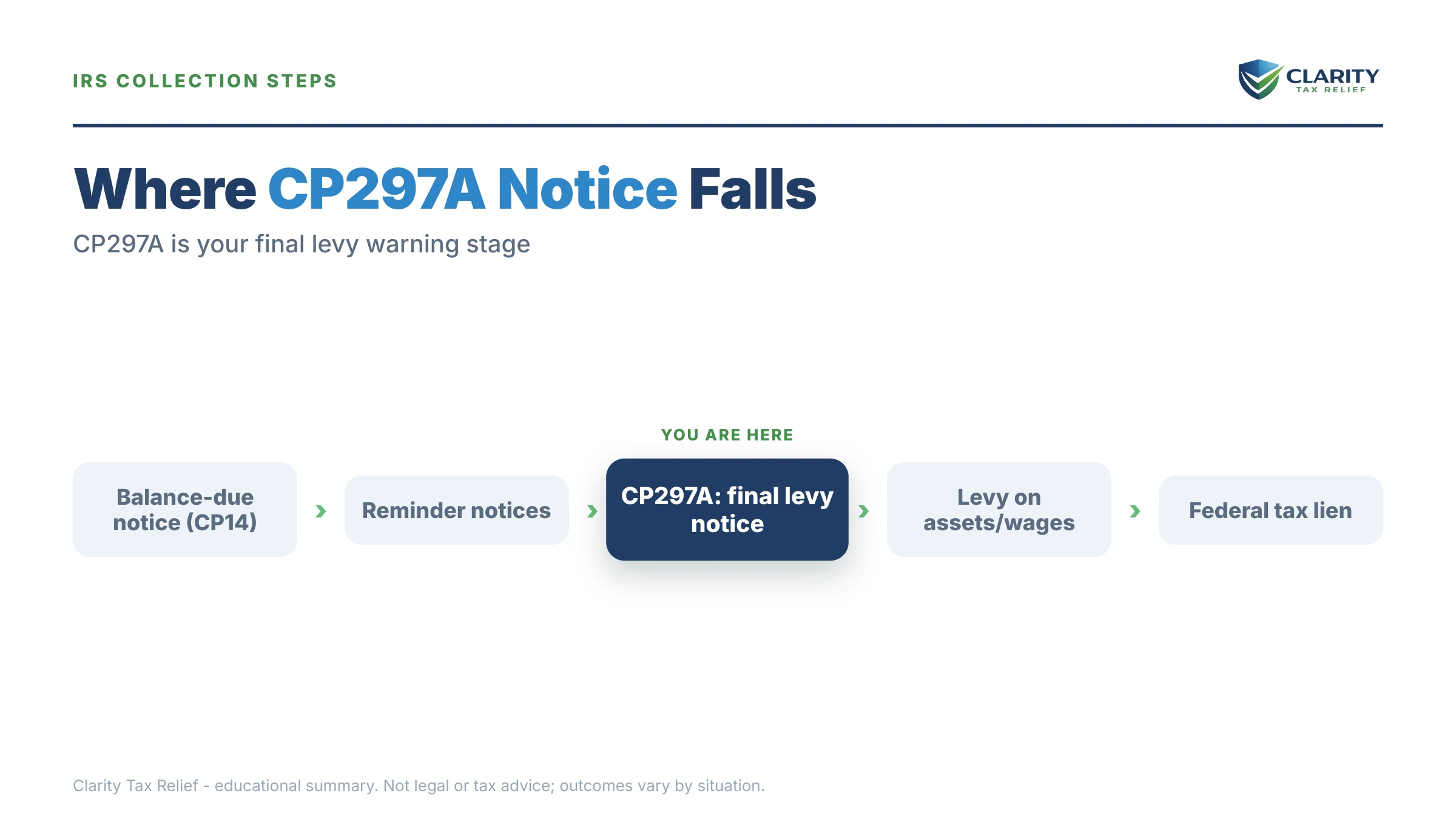
Normally the IRS must offer a hearing before levying. Its sibling notice does exactly that: a CP297 notice is the pre-levy final warning, with a 30-day window before anything is seized. The CP297A exists for the situations where Congress allowed the IRS to skip that step. There are four:
- A levy on your state tax refund. The IRS may intercept a state refund first and grant hearing rights afterward.
- A federal contractor levy. If your business is paid by the federal government, those payments can be levied without advance CDP notice.
- A disqualified employment tax levy. If the business already had collection due process rights for employment taxes in the recent past — generally within the prior two years — the IRS can levy the new quarters without a fresh pre-levy hearing. This is how the IRS attacks pyramiding payroll taxes, where a business keeps accruing new quarters while owing old ones.
- A jeopardy levy. Rare, and reserved for cases where the IRS believes collection is at immediate risk.
Whichever trigger applies to you, the CP297A does two things at once: it confirms enforcement has begun, and it opens a 30-day door to challenge it. If you're still not sure why the IRS is writing to you at all, our guide to why did I get a letter from the IRS covers the broader notice system; everything below is specific to this one.
| Notice | What it means | Your window |
|---|---|---|
| CP161 | First business bill — a balance is due, no enforcement yet | The pay-by date printed on the notice |
| CP504B notice | Intent to levy — the IRS can seize your state refund and is preparing further action | 30 days under IRC §6331(d) |
| CP297 | Final notice of intent to levy — hearing rights offered before any seizure | 30 days to request a CDP hearing pre-levy |
| CP297A | A levy has already been issued — hearing rights granted after the fact | 30 days to request a CDP hearing post-levy; levy stays active meanwhile |
What happens if you ignore a CP297A
Ignoring a CP297A lets an active levy keep taking business money while your 30-day hearing window quietly expires. Nothing about this notice pauses on its own — the sequence from here runs in stages:
- The current levy runs its course. If a bank account was hit, the frozen funds transfer to the IRS after the 21-day hold. If the levy reached a state refund or federal contractor payments, those dollars are simply gone unless you win them back.
- The hearing window closes. After day 30, you lose the Collection Due Process hearing and its path to Tax Court. An equivalent hearing remains available for a limited time, but it carries no judicial review.
- New levies follow. The IRS can serve additional levies on other sources — including an IRS levy on accounts receivable, which reroutes your customers' payments straight to the government and can strangle cash flow faster than any bank levy.
- The debt goes personal. On employment tax balances, the IRS opens a Trust Fund Recovery Penalty investigation and sends Letter 1153 to owners, officers, and anyone else deemed a responsible person — turning the business's debt into their debt.
- Liens and seizure. A federal tax lien attaches to business assets, and in persistent cases the IRS can move on equipment, inventory, or the business itself.
One 2026 reality worth naming: the IRS workforce shrank by roughly 27% in 2025, according to Treasury Inspector General for Tax Administration (TIGTA) reporting, so reaching a human to fix this takes longer than it used to — but the levies on your account were issued by automated systems that never slowed down. Waiting for the IRS to call you is not a strategy.
Holding a CP297A with the levy already running?
Send us a photo of the notice. An experienced tax professional will map exactly what was levied, whether a release is realistic, and how to use your hearing rights — free, before the 30-day window closes.
Your options after a CP297A levy
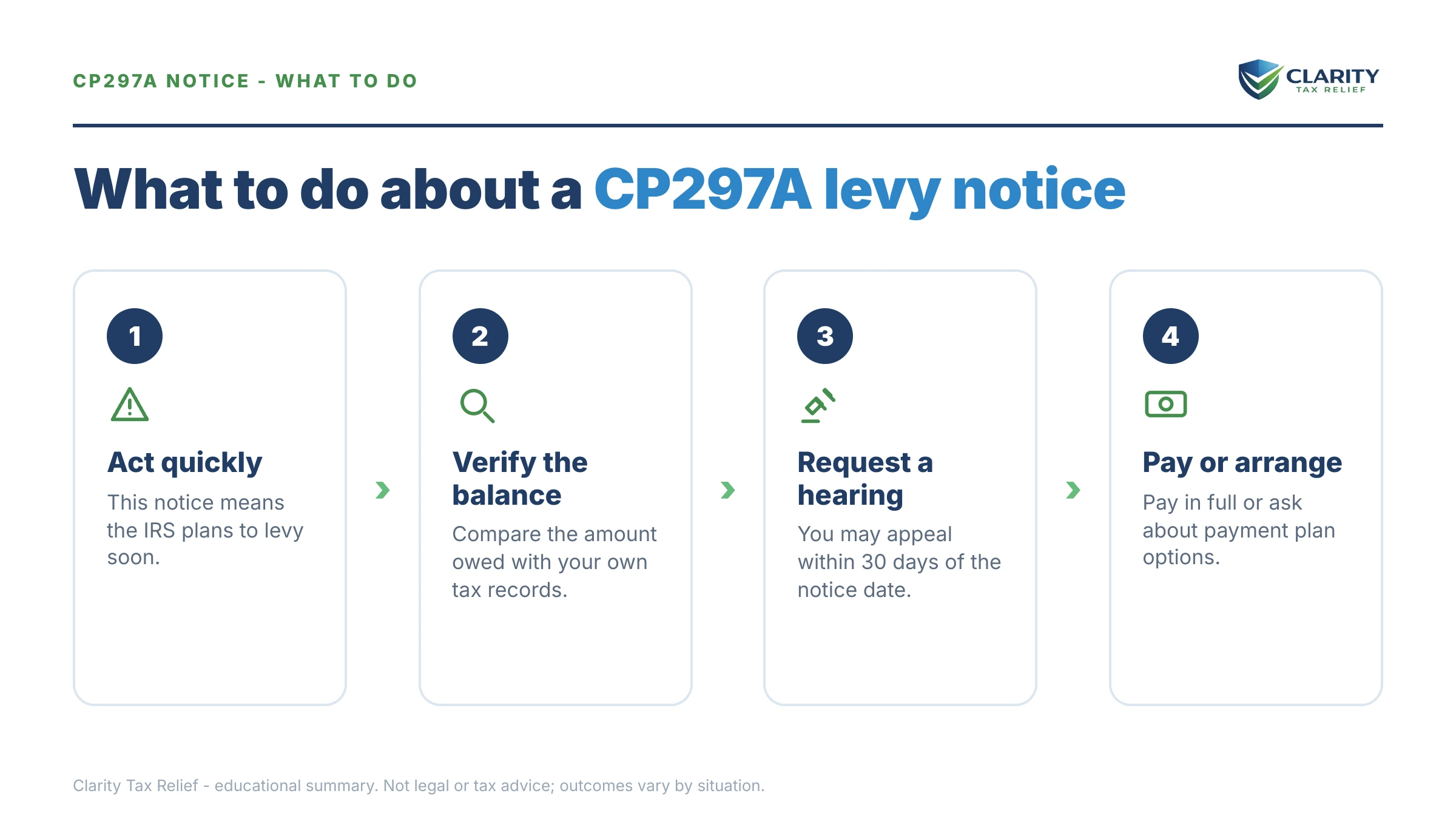
Every path to releasing a CP297A levy runs through one of five moves — payment, a payment plan, a hardship release, an offer, or the hearing itself. Which one fits depends on the business's cash flow and how much of the debt is employment tax:
- Full payment. Pays the balance and ends the levy. Realistic only if the number on the notice is small relative to the business's liquidity.
- An installment agreement. For an operating business with payroll debt, the rules differ from individual plans — thresholds, terms, and the financial disclosure required are covered in our guide to the business payroll tax payment plan. Once the IRS accepts an agreement, it will often release the levy, because a levy defeats the purpose of a plan it just approved.
- Economic-hardship release. If the levy prevents the business from meeting basic operating obligations — payroll, rent, utilities — IRC §6343 requires the IRS to release it. Our guide to a levy causing hardship walks through what the IRS needs to see.
- An offer in compromise. Real but narrow for businesses: $205 application fee, 20% down on lump-sum offers, and the IRS accepted roughly 1 in 5 offers in FY2024, per IRS data. The low-income fee waiver is based on individual AGI, so it generally doesn't help an operating business. An offer makes sense only when the numbers genuinely show the IRS could never collect in full.
- The CDP hearing itself. Filing Form 12153 puts a settlement officer between you and the collection machine. You can propose any of the options above in the hearing, dispute the underlying amounts in some cases, and — critically — the hearing generally blocks new levy action on the covered periods while it's pending. Our Form 12153 CDP hearing guide covers the form line by line.
| Option | Upfront cost | Typical timeline | Effect on the levy |
|---|---|---|---|
| CDP hearing (Form 12153) | Free | Several months to a decision | Generally blocks new levy action on covered periods; release can be negotiated in the hearing |
| Full payment | The balance on the notice | Immediate | Levy releases once the account is satisfied |
| Business installment agreement | Setup fee varies; financials often required | Weeks to approval | IRS will often release the levy once an agreement is in place |
| Hardship release (§6343) | Free; financial proof required | Days to weeks with documentation ready | Levy must be released if it creates economic hardship — debt remains |
| Offer in compromise | $205 fee + 20% down on lump-sum offers | Months; auto-accepted if no decision within 2 years, with narrow exceptions - a returned or rejected offer stops the clock, and time during court disputes does not count | Collection generally pauses while the offer is under review |
A worked example: $31,200 in payroll debt behind a CP297A
Say you and your spouse file jointly and run a small S-corporation together, and the business fell $31,200 behind across three quarters of Form 941 taxes before the CP297A arrived. Here's what the math looks like:
- The clock cost: the failure-to-pay penalty accrues at 0.5% per month — about $156 per month on a $31,200 balance — plus compounding interest, on top of any failure-to-deposit penalties already assessed.
- A payment plan: on a 24-month agreement, $31,200 ÷ 24 = $1,300 per month, with penalties and interest continuing to accrue on the shrinking balance until it's paid.
- The personal exposure: suppose roughly $19,500 of the $31,200 is trust fund taxes — the income tax and employee FICA withheld from paychecks. The IRS can assess that portion personally against each of you as responsible persons. Because you file jointly, that assessment reaches your shared refund and personal accounts, not just the business.
The takeaway from the math: on a debt this size, the monthly plan payment is usually survivable — it's the trust fund exposure and the active levy that do the real damage if the notice sits in a drawer.
How to respond to a CP297A, step by step
Speed matters more on this notice than almost any other, because the levy is already collecting while you decide:
- Find the notice date — locate the notice date and the tax periods on page one of the CP297A; your 30-day hearing clock runs from that date, not from the day you opened the envelope.
- File Form 12153 — complete and send it within 30 days to preserve your Collection Due Process rights, naming the collection alternative you want considered.
- Map what was levied — identify exactly what the levy reached (bank account, receivables, contractor payments, or a state refund) and note the 21-day hold date if a bank account was hit.
- Assemble your financials — gather filed 941s, recent bank statements, and a current profit-and-loss so you can credibly propose a payment plan, hardship release, or offer.
- Get a professional review — have an experienced tax professional review the notice before the window closes if trust fund taxes, multiple quarters, or the survival of the business are at stake.
When you can handle a CP297A yourself
Not every CP297A needs professional help — and it's worth being honest about which is which. You can likely handle this alone if the levy only intercepted a state tax refund, you agree with the balance, and the business can pay it off or set up a straightforward plan by calling the number on the notice and paying through IRS.gov/payments. In that scenario, the levy already did its worst and the fix is administrative.
Experienced help changes outcomes when the stakes are structural: a bank or receivables levy is choking operating cash, the debt spans multiple 941 quarters, some of those returns are unfiled, or the trust fund portion puts you and your spouse personally in the IRS's sights. A CDP hearing is also a strategic proceeding — what you ask for, and how you document it, determines what the settlement officer can approve. Those are the cases where the fee for representation is small next to what a mishandled hearing or an unnecessary Trust Fund Recovery Penalty assessment costs.
Terms on your CP297A, decoded
- Levy vs. lien: a levy takes property (money in an account, payments owed to you); a lien is a legal claim against property that secures the debt without taking anything yet.
- Collection Due Process (CDP) hearing: your statutory right to have the IRS Independent Office of Appeals review the levy and consider alternatives — with Tax Court review if you disagree with the outcome.
- Equivalent hearing: the consolation version available after the 30-day window — same review, but no right to go to Tax Court afterward.
- Disqualified employment tax levy: a levy for payroll taxes issued without a new pre-levy hearing, allowed because the business had CDP rights for employment taxes in the recent past.
- Trust fund taxes: the withheld income tax and employee FICA the business held "in trust" for the government — the portion that can be assessed personally against responsible individuals.
- CSED: the Collection Statute Expiration Date — generally 10 years from assessment, though hearings, offers, and bankruptcy can pause the clock.
CP297A questions, answered
What is a CP297A notice from the IRS?
A CP297A tells your business that the IRS has already issued a levy on its property or payment streams and that you now have the right to a Collection Due Process hearing. It is different from most collection notices because the enforcement has already started. You have 30 days from the notice date to file Form 12153 and preserve your full appeal rights, including Tax Court review.
What is the difference between CP297 and CP297A?
A CP297 warns that the IRS intends to levy and gives you a 30-day window to request a hearing before any levy happens. A CP297A arrives after a levy has already been issued — usually on a state tax refund, federal contractor payments, or under a disqualified employment tax levy — and grants the same hearing rights after the fact. The letter A effectively means already levied.
Can I stop the levy after receiving a CP297A?
Yes — a CP297A levy can be released, but it will not release itself. The fastest paths are full payment, an installment agreement the IRS accepts, or a demonstrated economic-hardship release under IRC §6343. Filing Form 12153 within 30 days also puts your case in front of a settlement officer who can consider release alternatives, and it generally blocks new levy action on the covered periods while the hearing is pending.
How do I request a CDP hearing for a CP297A notice?
Complete Form 12153, Request for a Collection Due Process or Equivalent Hearing, and mail or fax it to the address on your CP297A within 30 days of the notice date. List the tax periods shown on the notice and the collection alternative you want considered — a payment plan, an offer in compromise, hardship status, or a dispute of the amount. Keep proof of timely mailing; the postmark controls.
Why did the IRS levy my business without warning first?
The law allows a levy before a hearing in a few specific situations: a levy on your state tax refund, a levy on federal contractor payments, a jeopardy levy, or a disqualified employment tax levy — used when the business already had collection due process rights for employment taxes in the recent past, generally within the prior two years. In each of those cases, the CP297A restores your hearing rights immediately after the levy.
Will the CP297A levy take money already in my business bank account?
If a bank account was levied, the bank freezes the funds on hand and holds them for 21 days before sending them to the IRS. That 21-day window is your best chance to negotiate a release — through a payment arrangement, proof of hardship, or your hearing request. A bank levy is one-time, reaching only what was in the account the day it was served; a levy on receivables or wages keeps taking money until released.
Can I be personally liable for the payroll taxes behind a CP297A?
Yes, if the debt includes trust fund taxes — the income tax and FICA withheld from employee paychecks. The IRS can assess the Trust Fund Recovery Penalty against any responsible person who willfully failed to pay those amounts over, including owners, officers, and sometimes bookkeepers or check-signers. That assessment turns a business debt into a personal one, which is why resolving the business account quickly matters so much.
What happens if I miss the 30-day CP297A deadline?
You lose the right to a Collection Due Process hearing with Tax Court review, but you are not out of options. You can still ask for an equivalent hearing for a limited period, propose an installment agreement, seek a hardship levy release, or submit an offer in compromise directly. The levy stays in force while you do, though — so every week of delay costs the business money the IRS has already reached.
Your next 24 hours
- Find the notice date and tax periods on page one of your CP297A, and write your Form 12153 deadline — 30 days from that date — somewhere you'll see it.
- Gather the notice, your filed 941s, and your last three months of business bank statements, and note exactly what the levy reached and any 21-day bank hold date.
- Get a free case review before the window closes — send us the notice through the 2-minute form or call (888) 825-7779, and an experienced tax professional will map your fastest release path and hearing strategy.
If you want to verify anything independently first: the IRS's payment plans page covers official plan options, and the Taxpayer Advocate Service can intervene when a levy is causing immediate economic harm and normal channels stall.
This guide is general information, not tax or legal advice for your specific situation. Eligibility for IRS programs depends on individual facts and circumstances; no outcome is guaranteed.