
Business Tax Debt
Pyramiding Payroll Taxes: What the IRS Does About It — and How to Stop the Spiral (2026)
The short answer: pyramiding payroll taxes means a business withholds Social Security, Medicare, and income tax from employee paychecks but repeatedly fails to deposit it, stacking each new quarter's debt on top of the last. The IRS treats that withheld money as your employees' money — pyramiding triggers revenue officer assignment, personal liability, and potential criminal referral.
You made payroll every time — your people got paid — but the deposit that was supposed to follow each check never went to the IRS, and now the quarters have stacked into a number you can't look at. Here's the part that matters: pyramiding has a specific off-ramp, and the businesses that take it early almost always resolve this civilly. The map is below.
⏱ Your clock: there is no single "pay by" date on a pyramiding case — the clock is every payroll you run. Each new payroll without a deposit adds a fresh federal tax deposit penalty of up to 15% on that liability, plus daily-compounding interest. And once Letter 1153 arrives proposing the Trust Fund Recovery Penalty against you personally, you have exactly 60 days to protest it.
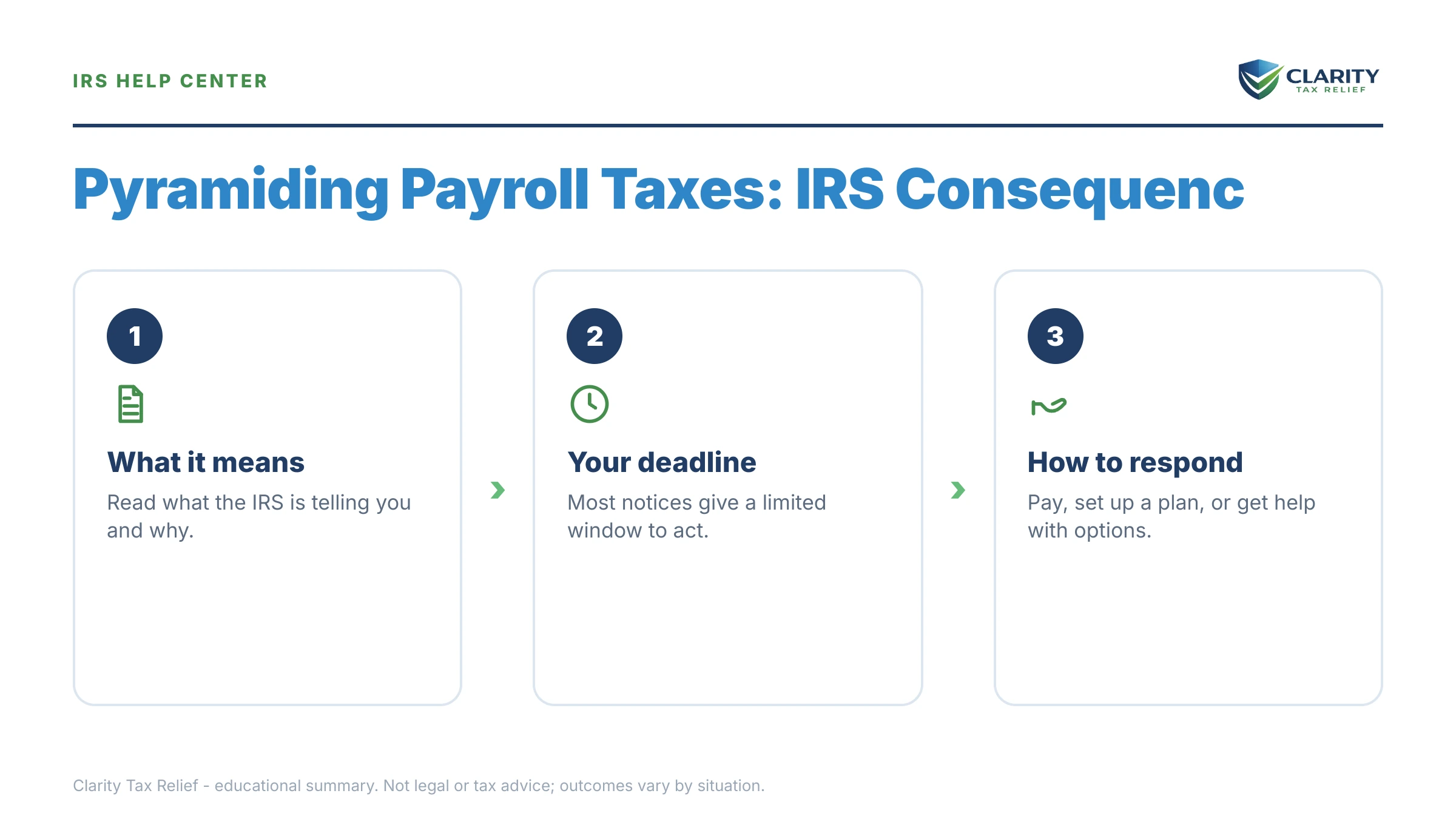
What pyramiding payroll taxes means to the IRS
Pyramiding is the IRS's term for a repeating pattern: a business accrues new unpaid payroll tax quarter after quarter while older quarters are still unpaid. One missed quarter is a delinquency. Two or more consecutive quarters of new debt stacking on old debt is pyramiding — and it changes how your case is handled inside the IRS.
The reason it's treated so severely is whose money it is. The income tax and the employee half of FICA you withhold from paychecks never belonged to the business. It's held "in trust" for your workers and the government. In the IRS's view, spending it on rent, fuel, or your own draw isn't late payment — it's using other people's tax money to float the business.
That's why pyramiding cases skip the polite automated treatment an income-tax balance gets. Repeat non-deposit is the single most common reason a case is pulled out of the automated system and assigned to a field revenue officer — a human collector with the power to levy, seize, and recommend criminal referral. If a business balance simply sits unpaid, you get letters; if it keeps growing, you get a person. Our guide to 941 back taxes covers ordinary business balances; this page covers what happens when the pattern repeats.
Pyramiding also isn't limited to big companies. It shows up constantly in businesses that grew fast out of solo work — a courier who hired two drivers, a cleaner who put a crew on W-2 — where payroll started before anyone learned the deposit rules. The entity type doesn't shield you either: an LLC or corporation doesn't stop the trust fund portion from reaching you personally, as our guide to whether you're personally liable for payroll taxes explains.
The real cost: a worked example at $27,500
A pyramided balance is never just the tax — deposit penalties, filing penalties, and daily interest ride on every quarter. Say you built a two-driver delivery company out of your own gig work, ran payroll for three years, and never made a deposit or filed a Form 941. The numbers might look like this (hypothetical, rounded):
- Per quarter: about $1,000 withheld income tax + $615 employee FICA + $675 employer FICA ≈ $2,290 of 941 liability.
- Twelve quarters: roughly $27,500 of unpaid tax.
- Failure-to-deposit penalty at the 10% tier (deposits more than 15 days late): about $2,750 — rising toward 15% on quarters where a demand notice goes unanswered.
- Failure-to-file penalty on the unfiled 941s, at 5% per month up to 25%: as much as $6,875.
- Running total: roughly $37,000 before interest, which compounds daily on top.
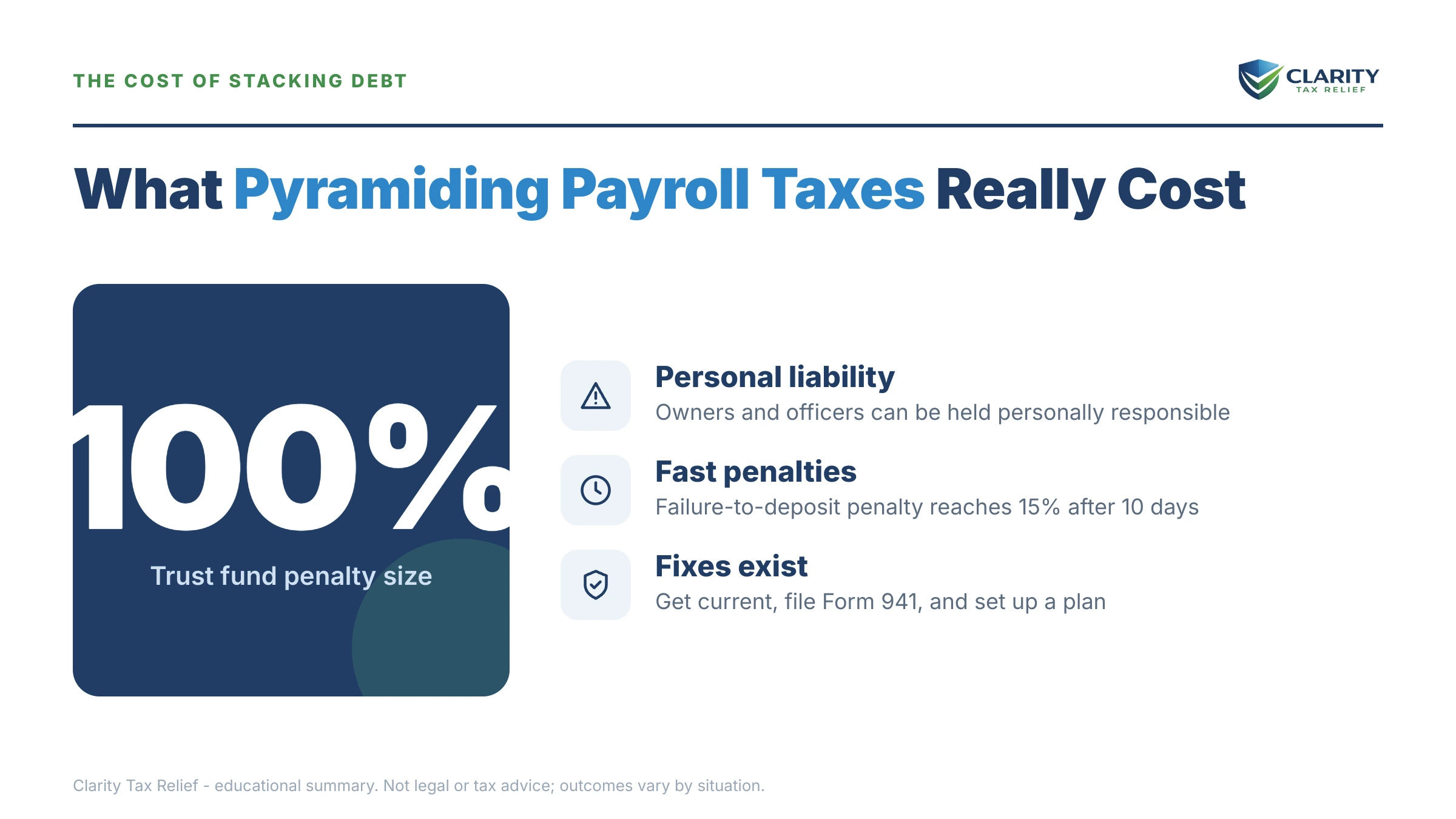
Now the part that follows you home. Of that $27,500, about $19,400 is trust fund money — the withheld income tax plus the employee half of FICA. That slice can be assessed against you personally through the Trust Fund Recovery Penalty, dollar for dollar, no matter what happens to the business. The employer's ~$8,100 share and the penalties generally stay with the entity.
Want to see how the penalties and interest stack on your own quarters? Our Penalty & Interest Calculator estimates the growth so you can see what waiting actually costs.
What happens if the pyramiding continues
A pyramiding case escalates from computer-generated bills to a human collector faster than any other kind of IRS debt. The sequence runs in stages — and each stage closes options the previous one left open:
- Deposit penalties post automatically. Each late or missed deposit picks up the federal tax deposit penalty at 2%, 5%, 10%, or 15% depending on how late it is. Unfiled quarters add failure-to-file penalties on top.
- Balance-due notices arrive — CP161-type bills, then the CP504B intent-to-levy notice for businesses. These are still automated, but the pattern is now visible in the system.
- A revenue officer is assigned. Because the balance keeps growing, the case is routed to the field. Expect an unannounced or scheduled visit, a demand for proof of current deposits, and hard deadlines. Our guide to a revenue officer payroll taxes visit covers the first 24 hours.
- The TFRP investigation opens. The officer identifies everyone who controlled the money — owners, officers, check-signers — and schedules Form 4180 interviews to decide who gets assessed personally.
- Letter 1153 proposes the penalty against you. You have 60 days to protest before the trust fund portion becomes your personal debt.
- Final notice, then levy. An LT11 or Letter 1058 starts a 30-day clock with Collection Due Process appeal rights (Form 12153). After that: bank levies (a 21-day hold before funds leave), accounts-receivable levies that cut off your cash flow, and asset seizure.
- The endgame for persistent pyramiding: business shutdown by seizure, a Department of Justice injunction requiring timely deposits or barring you from running payroll — and, for willful cases, referral to criminal investigation. Willful failure to pay over withheld taxes is a felony under IRC §7202. Here's when the IRS refers a case to criminal investigation.
One 2026 reality check: the IRS workforce shrank roughly 27% in 2025, and phone help is genuinely harder to reach — but the deposit penalties, notices, and levy authorizations in this sequence are generated by systems that never stopped running. Understaffing slows your ability to fix this by phone; it does not slow the escalation.
Quarters stacking up on your 941s?
Every payroll you run without depositing adds penalty on top of penalty — and moves you closer to a revenue officer and personal Trust Fund Recovery Penalty assessment. Get your payroll balances reviewed free before the next quarter closes: an experienced tax professional will map the trust fund exposure and the fastest way to stop the spiral.
| Stage / notice | Your window | What's at stake if it passes |
|---|---|---|
| Missed federal tax deposit | Penalty tiers at 1–5, 6–15, and 15+ days late | Penalty climbs 2% → 5% → 10%; catching up early keeps it at the low tier |
| Demand notice on unpaid deposits | 10 days from the notice | Penalty jumps to the 15% tier on that liability |
| Form 4180 interview request | Scheduled by the revenue officer | Your answers determine who is personally assessed; you may have representation |
| Letter 1153 (TFRP proposed) | 60 days to protest | Silence lets the trust fund portion become your personal debt |
| LT11 / Letter 1058 (final notice) | 30 days to request a CDP hearing (Form 12153) | Losing the window means levy can proceed without a pre-levy appeal |
| Bank levy served | 21-day hold before funds leave | Last realistic chance to negotiate release before the money is gone |
Your options to stop pyramiding and resolve the debt
Every IRS resolution program for pyramided payroll tax has the same entry requirement: the pyramiding must stop first. No installment agreement, offer, or hardship status will be approved while new quarters keep accruing unpaid — which is why current-quarter deposits, not the old balance, are the first move.
| Option | Who can use it | The trade-off |
|---|---|---|
| Get current + pay in full | Any business with the cash or credit to clear the balance | Stops all escalation immediately; penalties and interest stop growing |
| IBTF-Express installment agreement | Trust-fund-type balance of $25,000 or less, full-paid within 24 months (direct debit required from $10,000–$25,000) | No financial statement required — but you must stay current on every new deposit |
| Regular in-business installment agreement | Balances above $25,000; requires Form 433-B financials | A revenue officer reviews assets and income; interest and penalties keep accruing during the plan |
| Business offer in compromise | Rare; only after full deposit and filing compliance, when the IRS's own math shows it can't collect in full | $205 fee, deep financial disclosure, heavy scrutiny on trust-fund debt; roughly 1 in 5 offers of all types were accepted in FY2024 |
| Penalty abatement | Reasonable cause (Form 843) for the deposit and filing penalties; the new Automatic Exemption from Penalty (AEP) begins applying some relief automatically starting summer 2026 | Reduces the penalty layer only — the withheld tax itself is never abated |
| Chapter 13 / bankruptcy | Owners facing an assessed TFRP alongside other debts | Trust fund taxes are priority debt that survives discharge; a plan can structure payment, not erase it |
Notice where the $27,500 example lands: just $2,500 above the IBTF-Express line. A business that can pay the balance down to $25,000 — or abate enough penalty to get there — can often move from revenue-officer-managed collection into a streamlined 24-month agreement with no financial statement. That kind of threshold play is exactly where strategy changes the outcome. The details live in our guide to the business payroll tax payment plan (IBTF-Express), and if the TFRP lands on you personally after a wind-down, chapter 13 irs back taxes covers how a repayment plan handles priority tax debt. For the general playbook on negotiating any balance with the IRS, see how to settle tax debt yourself.
How to respond to pyramided payroll taxes, step by step
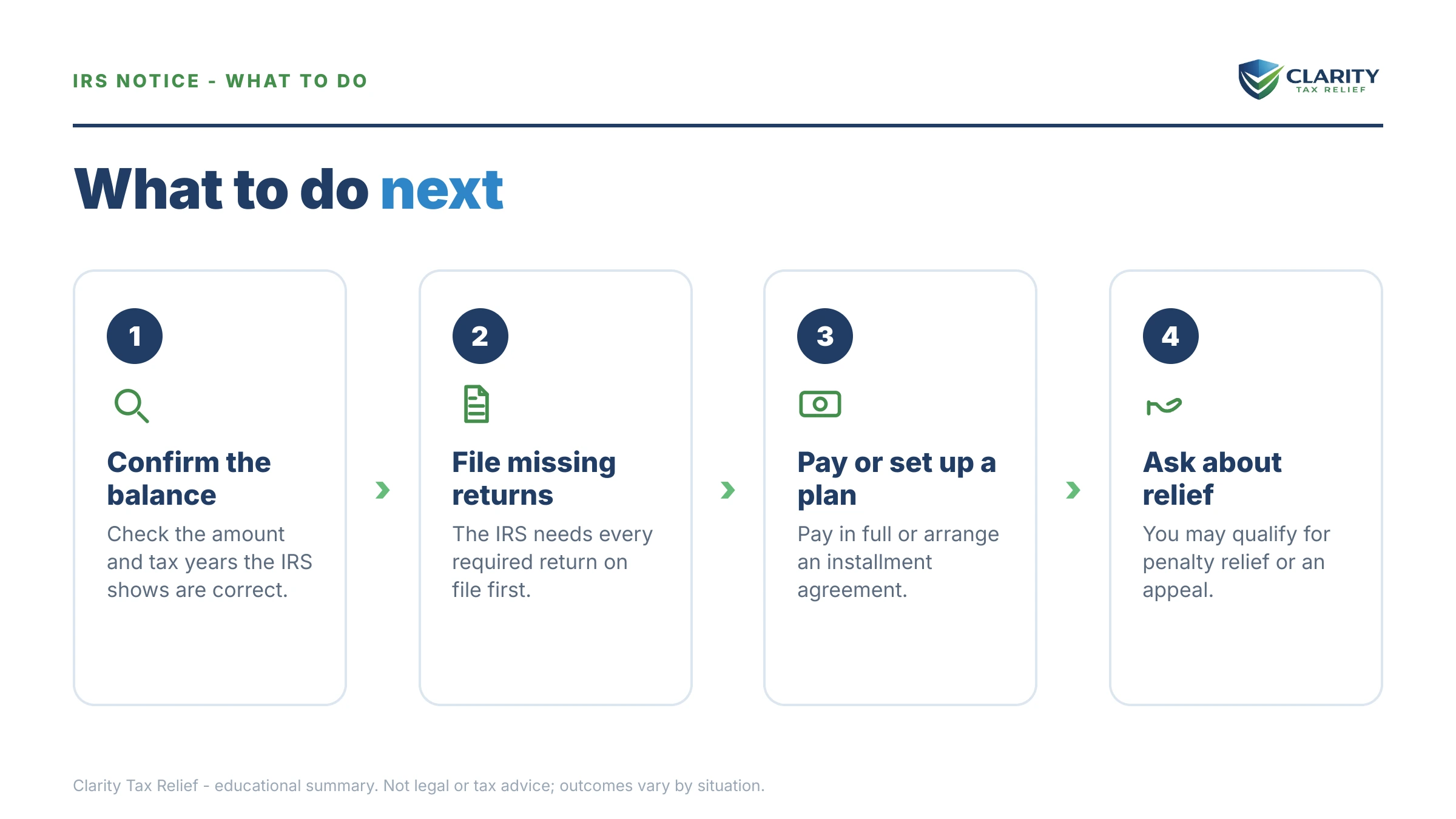
- Deposit the current quarter's taxes first. Starting with your very next payroll, deposit every dollar you withhold through EFTPS. The IRS will not negotiate any resolution on old quarters while new unpaid ones keep accruing — current compliance is the ticket into every program.
- File every missing Form 941, even quarters you can't pay. The failure-to-file penalty runs 5% per month — ten times the 0.5% failure-to-pay rate — so filing immediately caps the fastest-growing cost even if you send no money with the returns.
- Pull your exact balance for every quarter. Get business account transcripts and break each quarter into tax, penalty, and interest, and split the tax between the trust fund portion (withheld income tax plus the employee half of FICA) and the employer's share. Every strategy decision depends on that split.
- Designate voluntary payments to the trust fund portion in writing. When you send voluntary payments, state in writing that they apply to the trust fund portion of specific quarters. Designated payments shrink your personal Trust Fund Recovery Penalty exposure; undesignated ones get applied wherever the IRS chooses.
- Set up a payment arrangement before enforcement forces one. If you can get the balance to $25,000 or less, an In-Business Trust Fund Express installment agreement can full-pay it within 24 months without a financial statement. Above that, expect Form 433-B financials and a revenue officer's review.
- Prepare before any Trust Fund Recovery Penalty interview. If a revenue officer schedules a Form 4180 interview, your answers about who controlled the money and signed the checks decide who gets assessed personally. You have the right to representation — get advice before that conversation, not after.
When you can handle this yourself — and when help changes the outcome
Not every payroll shortfall needs professional help, and a pyramiding pattern caught early is far more DIY-able than one a revenue officer has already found. You can reasonably handle this yourself if:
- You're behind one or two quarters, all 941s are filed, and the balance is under $25,000 — set up deposits through EFTPS, then request an IBTF-Express agreement directly.
- The business has the cash flow to stay current going forward and chip at the old quarters.
- No revenue officer has been assigned and no TFRP letters have arrived.
Experienced help genuinely changes outcomes when: a revenue officer is already on the case; a Form 4180 interview or Letter 1153 is in play (who gets personally assessed, and for how much, is decided right there); you have three or more years of unfiled 941 returns to reconstruct; more than one person signed checks and the IRS may assess the wrong people; you're weighing whether to dissolve business owe irs-style — winding down while limiting what follows you personally; or there's any sign of criminal interest. Payment designation, penalty abatement, and TFRP defense each move real dollars, and they interact — the order you do them in matters.
Terms on your payroll notices, decoded
- Pyramiding — the IRS's word for accruing new unpaid payroll tax quarter after quarter while old quarters remain unpaid.
- Trust fund taxes — the withheld income tax plus the employee half of Social Security and Medicare; money held in trust for employees, never the business's to spend.
- Trust Fund Recovery Penalty (TFRP) — the IRC §6672 assessment that makes responsible individuals personally liable for 100% of the trust fund portion.
- Responsible person — anyone with the authority and duty to collect and pay over the taxes: owners, officers, and sometimes bookkeepers or check-signers.
- Federal tax deposit (FTD) — the required electronic payment of each payroll's taxes through EFTPS, on your assigned deposit schedule — separate from filing the quarterly 941.
- Designated payment — a voluntary payment you direct, in writing, to a specific quarter and portion (trust fund vs. employer share), instead of letting the IRS choose.
Pyramiding payroll taxes: FAQs
What does pyramiding payroll taxes mean?
Pyramiding means a business withholds Social Security, Medicare, and federal income tax from employee paychecks but repeatedly fails to deposit that money with the IRS, so each new quarter's unpaid liability stacks on top of the last. The IRS treats it differently from ordinary tax debt because the withheld money legally belongs to your employees, not the business. A single missed quarter is delinquency; a repeating pattern is pyramiding.
Is pyramiding payroll taxes a criminal offense?
It can be. Willful failure to collect or pay over withheld taxes is a felony under IRC Section 7202, punishable by up to five years in prison per count. Criminal referral is most likely when withholding continues quarter after quarter while the owner keeps paying themselves, suppliers, or other creditors instead of the IRS. Most cases that get addressed early are resolved civilly — through payment arrangements and the Trust Fund Recovery Penalty — not prosecution.
How many missed quarters count as pyramiding?
There is no statutory number, but the IRS generally treats two or more consecutive quarters of accruing new payroll liability while older quarters remain unpaid as a pyramiding pattern. What matters most is direction: a business paying down old quarters while staying current is a collection case, while a business adding new unpaid quarters is a pyramiding case that gets routed to a field revenue officer. Three years of unpaid quarters, like twelve stacked 941 periods, is squarely in that category.
Can the IRS shut down a business for pyramiding payroll taxes?
Yes. A revenue officer can levy the business bank account and accounts receivable, seize business assets, and — in persistent pyramiding cases — the Department of Justice can ask a federal court for an injunction requiring timely deposits or barring the owner from operating a business that runs payroll. Shutting a pyramiding business down can actually be the IRS's preferred outcome, because every additional quarter of operation creates new unpaid trust fund debt.
Am I personally liable for my company's pyramided payroll taxes?
If you were a responsible person who willfully failed to pay over the withheld taxes, yes — the IRS can assess the Trust Fund Recovery Penalty under IRC Section 6672 against you personally for 100% of the trust fund portion. That reaches owners, officers, and sometimes bookkeepers or check-signers, regardless of whether the business is an LLC or corporation. The employer's own share of FICA and the penalties generally stay with the business.
Will closing or dissolving the business erase pyramided payroll taxes?
No. Closing stops new quarters from accruing — which genuinely helps — but the trust fund portion follows the responsible people personally through the Trust Fund Recovery Penalty, and the IRS has 10 years from assessment to collect it. If you're considering winding down, the order of steps matters: final returns, payment designations, and TFRP exposure should all be mapped before you dissolve, not after.
Can pyramided payroll taxes be settled with an offer in compromise?
Rarely, and only after the pyramiding stops. The IRS will not consider an offer while a business is behind on current deposits or has unfiled returns, and offers on trust-fund debt face extra scrutiny because the money was withheld from employees. Across all offer types the IRS accepted roughly 1 in 5 offers in FY2024, so treat an OIC as a possibility to evaluate honestly — never a plan to count on.
Your next 24 hours
- Count the quarters. Pull your payroll records and list every quarter with an unfiled 941 or an unmade deposit, with the approximate liability for each. That list — not the scary total — is what every fix is built from.
- Gather three things: your payroll registers (or payroll app reports), business bank statements showing what was withheld, and every IRS notice you've received — CP161, CP504B, Letter 1153, anything with a letterhead.
- Get the free case review. Call (888) 825-7779 or use the 2-minute form. An experienced tax professional will separate your trust fund exposure from the business's share and map the fastest route to current compliance — because every payroll you run before this is fixed adds new penalty to the pile.
Two references worth bookmarking as you work through this: the IRS's own overview of employment taxes for businesses, the EFTPS deposit system where current-quarter compliance starts, and the payment options at IRS.gov/payments.
This guide is general information, not tax or legal advice for your specific situation. Eligibility for IRS programs depends on individual facts and circumstances; no outcome is guaranteed.