
IRS Enforcement
When Does the IRS Refer a Case to Criminal Investigation? The Honest Answer (2026)
The short answer: the IRS refers a case to Criminal Investigation (CI) only when it finds firm indications of willful fraud — deliberate concealment, false documents, or lies told to agents — not because you owe money. Unpaid tax debt, even a large balance, stays civil. CI opens only a few thousand investigations a year, almost all involving intentional deception.
So if you're a 1099 contractor lying awake because you owe $61,200 and haven't filed in a few years, wondering "when does the IRS refer to criminal investigation" — here is the honest calibration: your fear is understandable, but your debt is not the danger. The IRS handles owed money with bills, liens, and levies. It reserves criminal referrals for people who actively deceive it.
That distinction — deception versus debt — is the entire subject of this guide. Understanding exactly where the line sits tells you what to fix first, and it's better news than you expect.
⏱ The real clock: there is no criminal-referral countdown printed anywhere — but two things run against you monthly. Unfiled returns accrue a failure-to-file penalty of 5% of the unpaid tax per month, up to 25%, and the voluntary-compliance options that protect you only work before the IRS contacts you first.
When does the IRS refer to criminal investigation? The real triggers
The IRS refers a case to Criminal Investigation when a civil employee — usually a revenue agent in an audit or a revenue officer in collections — finds "firm indications of fraud," meaning evidence you acted willfully, not just carelessly or brokenly.
Willfulness has a specific legal meaning: the voluntary, intentional violation of a known legal duty. Forgetting a 1099, botching your mileage deduction, or filing honest returns you can't pay does not meet it. Knowing what the law required and choosing to deceive does.
Examiners are trained to look for what the IRS calls badges of fraud. The most common:
- Two sets of books, or business records that contradict the return.
- False documents — fabricated invoices, altered receipts, phony W-2s or deductions.
- Concealed income — routing customer payments to hidden or nominee accounts, skimming cash, titling assets in others' names.
- Destroyed records once an audit begins.
- False statements to the agent — lying during the exam is itself a badge of fraud and often the tipping point.
- A repeated pattern — large, unexplained understatements across multiple years rather than one bad year.
Referrals also come from outside the audit stream: whistleblower and informant tips (frequently ex-spouses and ex-business partners), data the IRS receives from banks and foreign institutions, and other agencies' financial-crime cases. On the collection side, the classic criminal pipeline is pyramiding payroll taxes — repeatedly withholding tax from employees' paychecks and keeping it, quarter after quarter, despite warnings.
What almost never triggers a referral: a CP2000 income mismatch, a math-error notice, an honest audit adjustment, or a balance you filed accurately and simply can't pay. Those live and die on the civil side — the worst-case civil outcome for careless-but-not-willful conduct is the civil fraud penalty or the 20% accuracy penalty, which are expensive but not criminal.
Does owing $61,200 make you a criminal target? What the amount actually means
No dollar amount automatically triggers a criminal referral — the IRS selects criminal cases by conduct, not by balance. Even the $66,000 figure you may have seen in 2026 headlines is a civil consequence (passport certification for seriously delinquent debt), not a criminal threshold.
Here is how balance size actually maps to what the IRS does:
| What you owe | Criminal risk from the balance alone | What the IRS realistically does |
|---|---|---|
| Under $25,000 | None | Automated notices; streamlined payment plans available online |
| $25,000–$100,000 | None from the amount itself | Automated collection escalating to lien filing and levy; possible revenue officer at the top of the band |
| $100,000+ | Still none from the amount — but scrutiny rises | Revenue officer assignment; high-income non-filer sweeps if returns are missing; passport certification above $66,000 |
| Any amount + willful concealment | This is where referrals happen | Civil case suspended; fraud referral to Criminal Investigation |
Notice what that table implies: a contractor who hid $30,000 in cash jobs has more criminal exposure than a filer who honestly owes $500,000. The IRS prosecutes deception because deception is what threatens the voluntary filing system.
A worked example: $61,200, three unfiled years, and where the real damage is
Say you're a 1099 contractor who owes roughly $61,200 across three unfiled years — about $20,400 per year. Your clients filed 1099s, so the IRS already knows the income exists. Nothing about that picture is criminal if you come forward first. The damage is financial, and it compounds:
- Failure-to-file penalty: 5% of the unpaid tax per month, capped at 25% per year. At the cap, that's about $5,100 per year ($20,400 × 25%) — roughly $15,300 across all three years.
- Failure-to-pay penalty: 0.5% per month continues on top, plus daily-compounding interest on everything.
- Resolution math: at $61,200 you're above the $50,000 ceiling for a fully online 72-month installment agreement. You'd either submit financial disclosure, or pay the balance down by about $11,200 to slip under $50,000 — where a streamlined plan runs roughly $695–$850/month over 72 months as penalties and interest continue to accrue.
You can rough out your own penalty and interest totals with our IRS penalty and interest calculator. The point of the math: the cost of waiting is measured in thousands of dollars, not in handcuffs — unless you hide, and then the calculus changes.
How a civil tax case turns criminal: the referral sequence
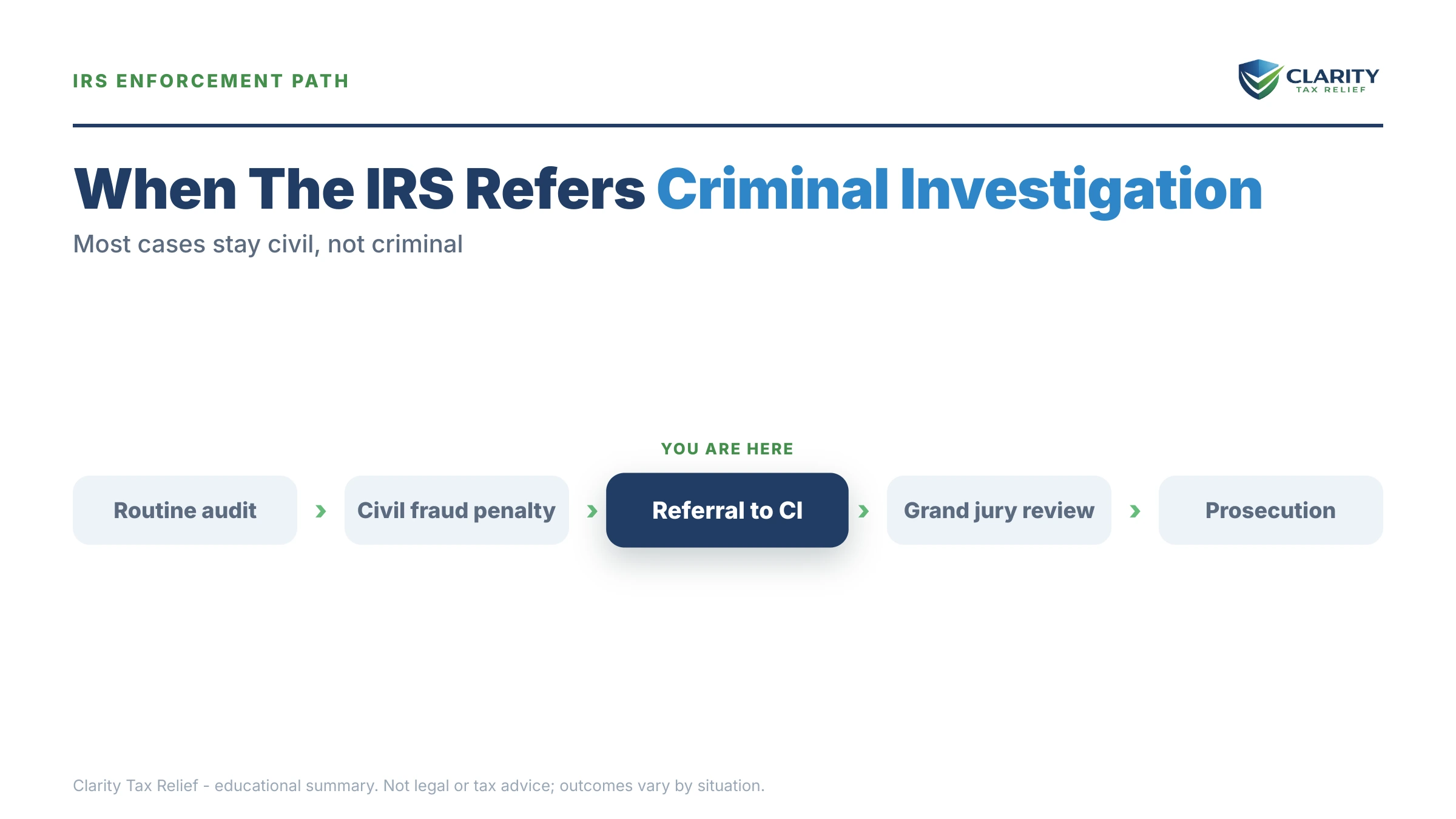
A criminal tax case almost never starts as one — it escalates out of a civil matter in a defined sequence. Here is the path, stage by stage:
- A civil case opens. An audit, a collection case, an underreporter match — routine, and overwhelmingly it ends here with an adjustment or a bill.
- The examiner spots badges of fraud. Contradictory records, hidden accounts, or a lie told during the exam. The agent consults a fraud technical advisor before going further.
- The civil case is quietly suspended and referred. With firm indications of fraud, the agent stops the civil work and sends a fraud referral (Form 2797) to Criminal Investigation. Nobody tells you — an audit that suddenly goes silent for months is the classic warning sign, which is why an exam with skeletons underneath is called an eggshell audit.
- CI opens a subject criminal investigation. Two special agents — armed federal law-enforcement officers — interview your bank, your clients, your preparer, sometimes you. Their arrival, in person and in pairs, is unmistakable; the IRS doesn't open criminal cases by phone call or text.
- Referral to the Department of Justice. If CI recommends prosecution, DOJ's Tax Division reviews it and can take it to a grand jury. Charges typically run under IRC §7201 (evasion — a felony, up to 5 years per count), §7206(1) (false return — up to 3 years), or §7203 (willful failure to file — up to 1 year per unfiled year).
- Prosecution. By this stage the government has spent years building the file; CI's published conviction rate for prosecuted cases has historically hovered around 90 percent.
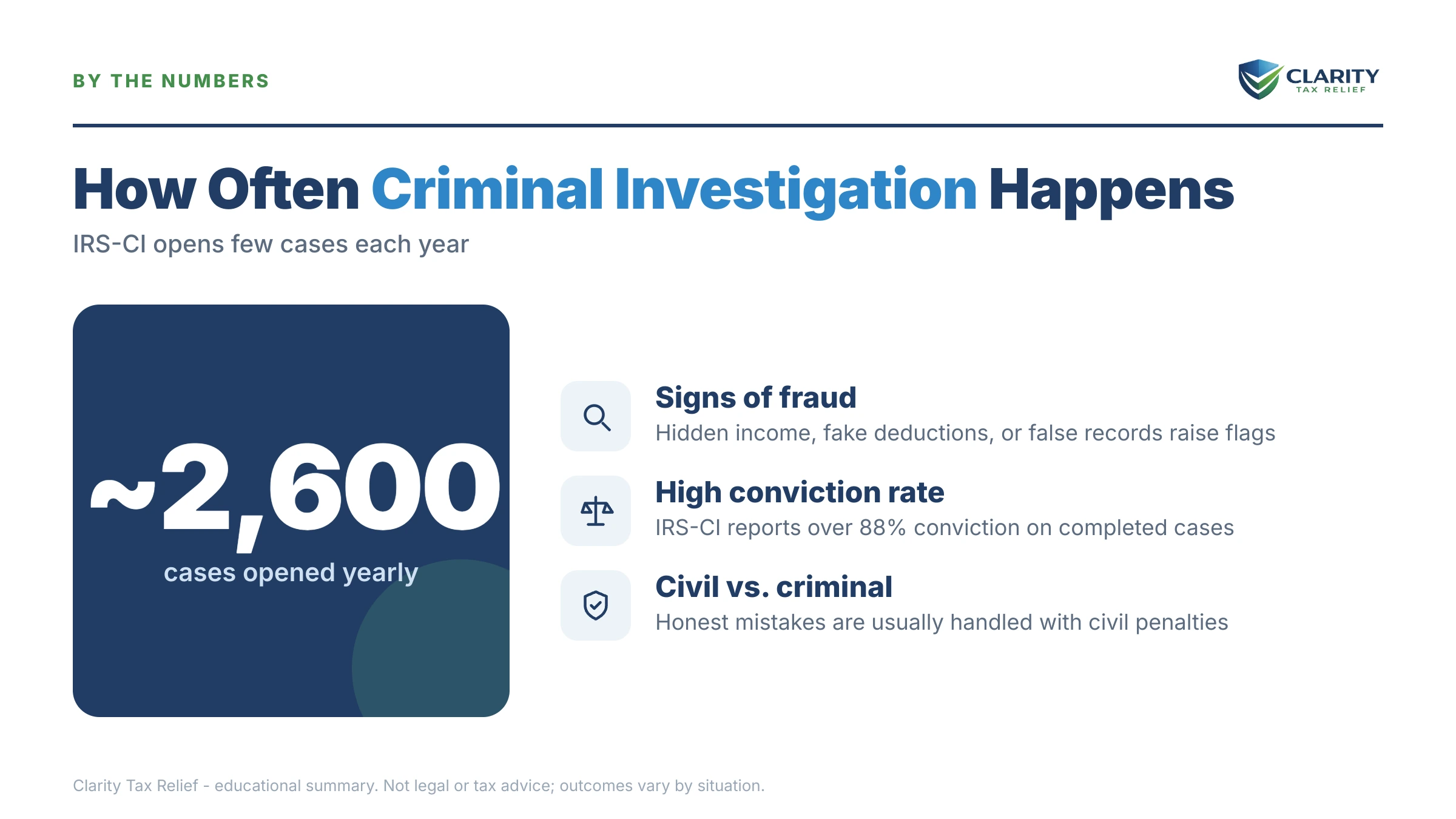
Keep the funnel in perspective: against more than a hundred million individual filers, CI opens only a few thousand investigations a year — the full numbers are in our IRS criminal investigation statistics breakdown. The system is built to keep cases civil. Your job is simply not to give it a reason to do otherwise.
Unfiled years and a growing balance — worried where this is heading?
The safest moment to come forward is before the IRS reaches out first, and penalties are compounding monthly in the meantime. An experienced tax professional will review your unfiled years and balance — free, confidential, judgment-free — and map the civil path out.
Your options: how to stay on the civil track (or get back on it)
Every path below keeps or returns your case to the civil side, where the tools are payment plans and settlements — the full DIY playbook for the money side is in how to settle tax debt yourself. What differs here is how each option affects criminal exposure:
| Option | Best when | Effect on criminal exposure |
|---|---|---|
| File old returns voluntarily, before IRS contact | Non-filers whose conduct was careless or avoidant, not deceptive — most readers of this page | The strongest single protection; longstanding IRS practice favors taxpayers who come forward first |
| IRS Voluntary Disclosure Practice (Form 14457) | Conduct that was genuinely willful — hidden cash, offshore accounts, unreported crypto | Designed to result in no criminal referral when the disclosure is timely, truthful, and complete — a strong track record, though not a legal guarantee |
| Quiet disclosure (amending and hoping nobody notices) | Never recommended where conduct was willful | Can backfire badly — an amended return admitting large omissions, filed without protection, can itself draw scrutiny; see why quiet disclosure is risky |
| Payment plan, hardship status, or Offer in Compromise (after filing) | A balance you can't pay in full — like the $61,200 example above | None — debt resolution is purely civil; the IRS accepted roughly 1 in 5 offers in FY2024, so eligibility is real but means-tested |
| Do nothing | Never | Penalties compound toward the 25% cap, the assessment window on unfiled years never closes, and every voluntary-compliance protection expires the day the IRS contacts you first |
One structural fact worth knowing: the criminal statute of limitations for most tax offenses is six years, but for an unfiled return the practical exposure lingers because the civil assessment window never starts until you file. Filing is what starts every clock running in your favor.
How to respond, step by step
- File every missing return — voluntary filing before IRS contact is the single strongest fact separating civil cases from criminal ones.
- Stop any concealment now — no more unreported cash, nominee accounts, or padded deductions; ongoing conduct is what turns old mistakes into current crimes.
- Never lie to anyone from the IRS — false statements to an examiner or agent are a fresh federal offense and a classic badge of fraud.
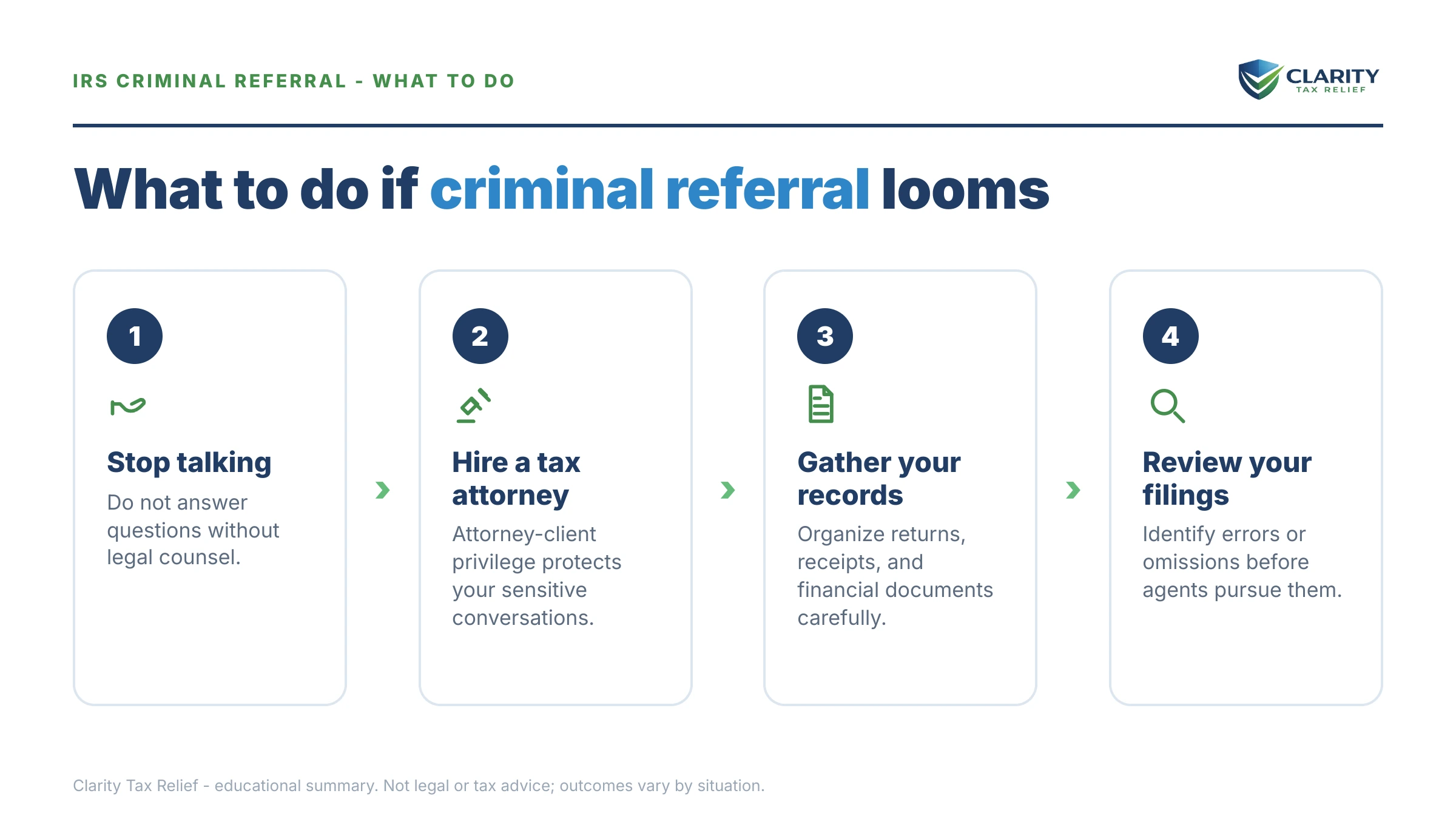
- Get representation before answering questions — if special agents have appeared, or your conduct was willful, speak through a tax attorney whose communications are privileged.
- Resolve the balance through a civil program — a payment plan, hardship status, or Offer in Compromise closes the debt on the civil track where it belongs.
When you can handle this yourself — and when the calculus changes
Most people who search this question can resolve their situation without criminal counsel, because their problem is a debt, not a deception. You can confidently handle it yourself when:
- You filed honest returns and simply owe a balance — set up a payment plan and move on.
- You have a few unfiled years, your income was all on 1099s or W-2s the IRS already has, and you have (or can reconstruct) your records.
- Your worry is driven by the size of the number, not by anything you hid.
Experienced help changes the outcome — and the type of help matters — when:
- Special agents have contacted you, your bank, your clients, or your preparer. Stop talking and retain a tax attorney immediately; conversations with an attorney are privileged in ways conversations with a preparer are not. Here's when you need a tax attorney versus other professionals.
- Your conduct was willful — unreported cash businesses, offshore accounts, crypto you knew was taxable, income routed through others. The Voluntary Disclosure Practice exists for exactly this, and it should be run through counsel.
- You're already under audit with problems underneath it — an eggshell audit is the highest-stakes moment to say the wrong thing.
- Payroll taxes were withheld and not paid over — trust-fund money is the conduct the IRS treats most harshly on both the civil and criminal side.
The full guide to what happens if CI does make contact — what agents can ask, what you must and must not do — is in our companion piece on the IRS criminal investigation process.
Terms in this world, decoded
- Willfulness — the voluntary, intentional violation of a known legal duty; the element that separates every criminal tax charge from a civil mistake.
- Badges of fraud — the specific behaviors (false records, concealment, lies) examiners are trained to flag as evidence of willfulness.
- Firm indications of fraud — the internal threshold that requires a civil agent to suspend the case and refer it for criminal evaluation.
- Form 2797 — the Referral Report of Potential Criminal Fraud Cases, the paperwork that moves a case from civil hands to CI.
- Special agent — a CI criminal investigator with a badge and arrest authority; different from the revenue agents (audits) and revenue officers (collections) you'd otherwise meet.
- Eggshell audit — a civil audit conducted over a return with undisclosed criminal problems beneath it; the highest-risk setting for a false statement.
- Voluntary Disclosure Practice (VDP) — the formal IRS program (via Form 14457) for willful taxpayers to come forward before the IRS finds them.
Criminal referral questions, answered
How do I know if the IRS has referred me to Criminal Investigation?
The IRS does not send a letter announcing a criminal referral. The two classic signs are a civil audit or collection case that suddenly goes silent for months with no explanation, and a visit from two CI special agents who identify themselves, show badges, and read you a statement of your rights. If either happens, stop answering questions and get representation before saying anything more.
Does owing a lot of money to the IRS trigger a criminal investigation?
No. There is no dollar threshold that converts a tax debt into a criminal case — referrals are driven by evidence of willful deception, not balance size. Even the $66,000 threshold you may have read about is a civil consequence (passport certification), not a criminal one. A taxpayer who owes $500,000 from honestly filed returns has less criminal exposure than one who hid $30,000 in cash income.
Can you go to jail for not paying taxes you already reported?
Not for simple inability to pay — filing an accurate return and owing a balance you cannot cover is a civil collection matter, handled through liens, levies, and payment programs. The exception is willful evasion of payment: hiding assets, moving money into nominee accounts, or lying about your finances to collection officers can be charged under IRC §7201. Honest brokenness is safe; active concealment is not.
Can you go to jail for not filing tax returns?
It is legally possible — willful failure to file is a misdemeanor under IRC §7203, punishable by up to one year per unfiled year — but prosecution is reserved for egregious, willful cases, often high earners with many years unfiled who ignored direct IRS contact. The practical protection is simple: taxpayers who come forward and file before the IRS contacts them are almost never referred. Filing late is dramatically safer than staying hidden.
What percentage of IRS audits turn into criminal cases?
A tiny fraction. Criminal Investigation opens only a few thousand new investigations a year across a country of over a hundred million filers, and most of those originate from fraud leads, informants, or related financial-crime cases rather than routine audits. An ordinary correspondence audit or CP2000 mismatch essentially never goes criminal. The audits that do escalate involve badges of fraud — false documents, concealed income, or lies told to the examiner.
Should I talk to IRS special agents if they show up at my door?
Be polite, take their business cards, and say your representative will contact them — then stop talking. You are not required to answer questions on the spot, and anything you say can be used in the investigation. Critically, making a false statement to a federal agent is itself a felony, so a nervous, inaccurate answer can create a new crime even where none existed. Silence plus counsel is the safe combination.
Is it too late for voluntary disclosure once the IRS is already auditing me?
Usually, yes — timeliness is a core requirement of the IRS Voluntary Disclosure Practice. A disclosure generally must arrive before the IRS has opened an examination or investigation of you and before it has received your information from a third party such as an informant or a data leak. That is exactly why waiting is the most expensive strategy: the option that best protects willful taxpayers expires the moment the IRS gets there first.
Your next 24 hours
- Write down exactly what's unresolved: which years are unfiled, which have balances, and whether anything on a filed return was knowingly wrong. That one list determines whether your path is routine filing or a protected disclosure.
- Gather your income records: 1099s, bank statements, and any IRS letters you've received. Missing forms can be reconstructed from IRS wage and income transcripts — you don't need perfect records to start.
- Get a free, confidential case review: call (888) 825-7779 or use the 2-minute form. Every month of waiting adds failure-to-file penalties toward the 25% cap and interest on top — and coming forward before the IRS contacts you is the protection that matters most.
For primary sources, see the IRS's own overview of its Criminal Investigation division, and its civil-side payment options at IRS.gov/payments. If you're facing IRS action you believe is unfair, the independent Taxpayer Advocate Service is a free resource.
This guide is general information, not tax or legal advice for your specific situation. Eligibility for IRS programs depends on individual facts and circumstances; no outcome is guaranteed.