
IRS Programs
IRS Voluntary Disclosure: How the VDP Works in 2026 (and Who Actually Needs It)
The short answer: IRS voluntary disclosure — the Voluntary Disclosure Practice, or VDP — lets people who willfully failed to report income or file returns come forward through Form 14457 before the IRS finds them. In exchange for a truthful, timely, complete disclosure, cooperation, and payment, IRS Criminal Investigation generally does not recommend prosecution.
Nobody searches "irs voluntary disclosure" by accident. You already know your old returns weren't just wrong — they were wrong on purpose, or close enough that you can't honestly call it a mistake — and you're weighing whether coming forward makes things better or worse. Done through the right door, it makes things dramatically better. Done through the wrong door, it can hand the IRS a signed confession.
Here's what makes the VDP different from every other IRS fix on this site: it runs through IRS Criminal Investigation (CI), not the collections side. Its whole purpose is trading a known civil price for protection against criminal referral. The application is Form 14457, a two-part document — and the image below shows you exactly what it looks like and where the parts that decide your case appear.
⏱ Your real clock: the VDP has no printed deadline — eligibility ends the moment the IRS gets to you first. When an exam opens, a criminal investigation starts, or the IRS receives your information from a third party (a bank, a crypto exchange answering a summons, a whistleblower), the door closes for good. Interest on the unpaid tax compounds daily in the meantime.
Why the IRS voluntary disclosure door exists — and who it's for
The Voluntary Disclosure Practice is the only formal IRS channel for people whose noncompliance was willful — deliberate, not accidental — to come forward and largely take prosecution off the table. It replaced the old Offshore Voluntary Disclosure Program (OVDP) after that program closed in September 2018, and unlike the OVDP, it isn't offshore-only: it covers unreported domestic cash and business income, false deductions, employment tax fraud, unfiled returns, foreign accounts, and — since Form 14457 was revised — unreported digital assets.
The word doing all the work is willful. The current Form 14457 requires you to acknowledge, in writing, that your conduct was willful. That admission is the price of admission — and it's why choosing the VDP when you didn't need it is an expensive mistake, and skipping it when you did need it is a dangerous one.
If your failure was an honest error — you didn't know foreign accounts were reportable, a preparer botched it, you misunderstood crypto rules — you likely don't need the VDP at all. Non-willful paths like the streamlined offshore procedures or simply choosing to voluntarily file old tax returns cost far less. The comparison table further down puts every path side by side.
One naming trap worth clearing up front: the ERC voluntary disclosure program is a completely separate initiative for businesses repaying improper Employee Retention Credit claims. Same word, different program, different terms — this article covers the CI-run VDP for individuals and businesses with willful tax noncompliance.
The rule that decides everything: the IRS can't already know
A voluntary disclosure only counts as voluntary if it arrives before the IRS has your information from any other source. That's the "timeliness" requirement, and it's binary — there is no partial credit, no grace period, and no way to undo a missed window. There's also a second absolute rule: the income must come from legal sources. Money from illegal activity is never eligible, period.
These are the events that end eligibility. Any one of them, and the VDP is off the table for those years:
| Event | What it looks like in real life | What you lose |
|---|---|---|
| IRS receives third-party information about you | A foreign bank reports your account under FATCA; a crypto exchange turns over customer lists under a John Doe summons; a whistleblower or ex-spouse files a tip | Timeliness — even if no letter has reached you yet |
| A civil examination opens | An audit letter (Letter 566, CP2000, or similar) is issued for any year, any issue | VDP eligibility entirely — not just for the audited year |
| A criminal investigation begins | CI special agents contact you, your bank, or your associates | Everything — at this point you need defense counsel, not a disclosure |
| The IRS gets your data from a related enforcement action | Your promoter, preparer, or offshore bank is under investigation and its records name you | Timeliness, often without you ever knowing it happened |
| The income came from illegal sources | Any criminally derived funds | Eligibility from the start — the VDP never applies |
The 2026 twist: the IRS workforce shrank roughly 27% in 2025, so a human may take longer to work your file — but the data feeds that kill eligibility are automated and never stopped. FATCA reporting arrives from foreign banks on schedule, the 1099-K threshold still routes $20,000/200-transaction platform data into matching, and exchange summons productions land in bulk. You're not racing an agent. You're racing a database.
What the Voluntary Disclosure Practice costs: the standard terms
Under the VDP's standard framework, you resolve a six-year disclosure period and pay one civil fraud penalty on a single year instead of facing fraud penalties on every year. Here's the full package you're agreeing to:
- Disclosure period: generally the most recent six tax years. You file or amend accurate returns for each of them.
- Tax and interest: paid in full on all six years, with interest compounding daily from each year's original due date.
- Civil fraud penalty: 75% of the underpayment — but generally applied only to the one year with the highest tax liability, not all six. Examiners can expand it if you fail to cooperate.
- Willful FBAR penalty (offshore cases): typically asserted for the single highest-balance year under FBAR penalty guidelines, rather than stacked across every year.
- Cooperation: full and ongoing — records, interviews if requested, and a truthful narrative of the willful conduct in Part II of Form 14457.
- Closing agreement: the case ends with a signed Form 906, which fixes the terms and gives you finality.
Full payment is expected. If you genuinely can't pay, the VDP doesn't shut you out — Form 14457 lets you request a payment arrangement, backed by complete financial statements. Once the liability is assessed, the ordinary toolbox applies; see the best way to pay the IRS for how those arrangements compare, and the how to settle tax debt yourself hub for the general resolution landscape. Just know this: claiming inability to pay while hiding assets destroys the very protection you came for.
A worked example: $27,500 in unreported tax
Say you're a renter who's already fighting an IRS levy on one assessed year — and the levy is what finally forced the bigger truth into the open: from 2020 through 2025 you knowingly left cash side income off your returns, and the unreported tax across those six years totals $27,500. This is hypothetical, but the math is how the VDP actually prices out:
- Year-by-year unreported tax: 2020: $3,100 · 2021: $4,000 · 2022: $4,600 · 2023: $5,200 · 2024: $7,200 · 2025: $3,400 = $27,500 total.
- Civil fraud penalty under the VDP: 75% of the single highest year only — 0.75 × $7,200 = $5,400.
- Interest: compounds daily from each year's due date; on the older years it adds a meaningful slice — realistically several thousand dollars here.
- Rough all-in under the VDP: $27,500 + $5,400 + interest ≈ the high $30,000s, payable in full or through a documented arrangement.
Now the counterfactual. If the IRS builds this case itself, the fraud penalty isn't confined to one year: 75% × $27,500 = $20,625 — a $15,225 swing on penalties alone — plus the real possibility of criminal referral, where the money stops being the worst part. And because fraudulent returns have no statute of limitations on assessment, those years never close on their own. The existing levy year, by the way, still needs its own fix — the VDP resolves the disclosed years, not a debt already assessed; see how to get an IRS levy released for that track.
What happens if you stay hidden
Willful noncompliance doesn't stay in equilibrium — it moves through a known sequence, and every stage removes an option you have today:
- Third-party data arrives. W-2/1099 matching, 1099-Ks above the $20,000/200 threshold, FATCA feeds from foreign banks, and summons productions from exchanges flow in automatically. The moment your data lands, timeliness is gone — often before you know it.
- The automated systems flag the mismatch. An underreporter notice or exam letter is issued. From the instant that exam opens, VDP eligibility is dead — you're now defending, not disclosing.
- The exam turns dangerous. When an auditor spots badges of fraud — patterns of omitted income, false records — the civil exam becomes an eggshell audit, and a fraud referral becomes possible.
- Criminal Investigation takes over. Special agents don't send bills; they build cases. What contact from IRS Criminal Investigation means — and what not to say — is its own survival guide.
- Assessment or prosecution. Civil fraud penalties on every open year (and fraud years are always open), willful FBAR penalties where they apply, and in the worst cases indictment. For where the civil/criminal line actually sits, see when the IRS refers cases to criminal investigation.
The stages don't run on a fixed calendar — some people sit undetected for years, others get flagged the season a new data feed comes online. That unpredictability is exactly the problem: you can't see the event that ends your eligibility coming.
Carrying this and the IRS hasn't contacted you yet?
That window — before any exam, notice, or third-party report — is the only one the Voluntary Disclosure Practice exists for. Get a free, confidential review of which path back actually fits your facts before the data gets there first.
IRS voluntary disclosure vs. your other paths back
The VDP is the most expensive compliance path because it buys the most protection — and it's the wrong choice for most people whose conduct wasn't actually willful. Here's the full menu:
| Path | Who it's for | Typical penalty terms |
|---|---|---|
| Voluntary Disclosure Practice (Form 14457) | Willful conduct, legal-source income, IRS hasn't found you yet | 6-year disclosure; 75% civil fraud penalty on one year; willful FBAR penalty on one year if offshore; protection against criminal referral |
| Streamlined offshore procedures (SFOP) | Non-willful conduct + meets the non-residency test | Tax and interest on 3 years of returns; 0% offshore penalty |
| Streamlined domestic offshore (SDOP) | Non-willful conduct, U.S. resident, filed returns each year | Tax and interest; 5% miscellaneous offshore penalty on year-end foreign asset values |
| Late FBAR filing (the former Delinquent FBAR Submission Procedures were removed June 30, 2026) | Missed FBARs but all income was reported and tax paid | Late FBARs can still be e-filed through FinCEN with an explanation; penalties are not automatic when account income was reported and taxed, but there is no longer a guaranteed penalty-free program |
| File or amend normally | Non-willful domestic errors or unfiled years | Standard penalties and interest; abatement often available |
| Quiet disclosure | Honestly? No one | Full penalty exposure, a known audit flag, and zero criminal protection |
The fork in this table is a legal judgment, not a vibe. "Willful" in tax law includes deliberate blindness — arranging your affairs so you wouldn't have to know. Certifying non-willfulness on a streamlined filing when your facts say otherwise converts a fixable problem into a fresh false statement, which is exactly the trap the quiet-disclosure route falls into from the other direction.
How to make an IRS voluntary disclosure, step by step
- Assess willfulness under privilege. Talk to an experienced tax attorney before you file, amend, or mail anything — attorney-client privilege protects that conversation, and the willful-versus-non-willful call decides which path you take.
- Confirm you're still eligible. Verify that no exam or investigation is open, the IRS hasn't received your information from a third party, and every dollar involved came from legal sources.
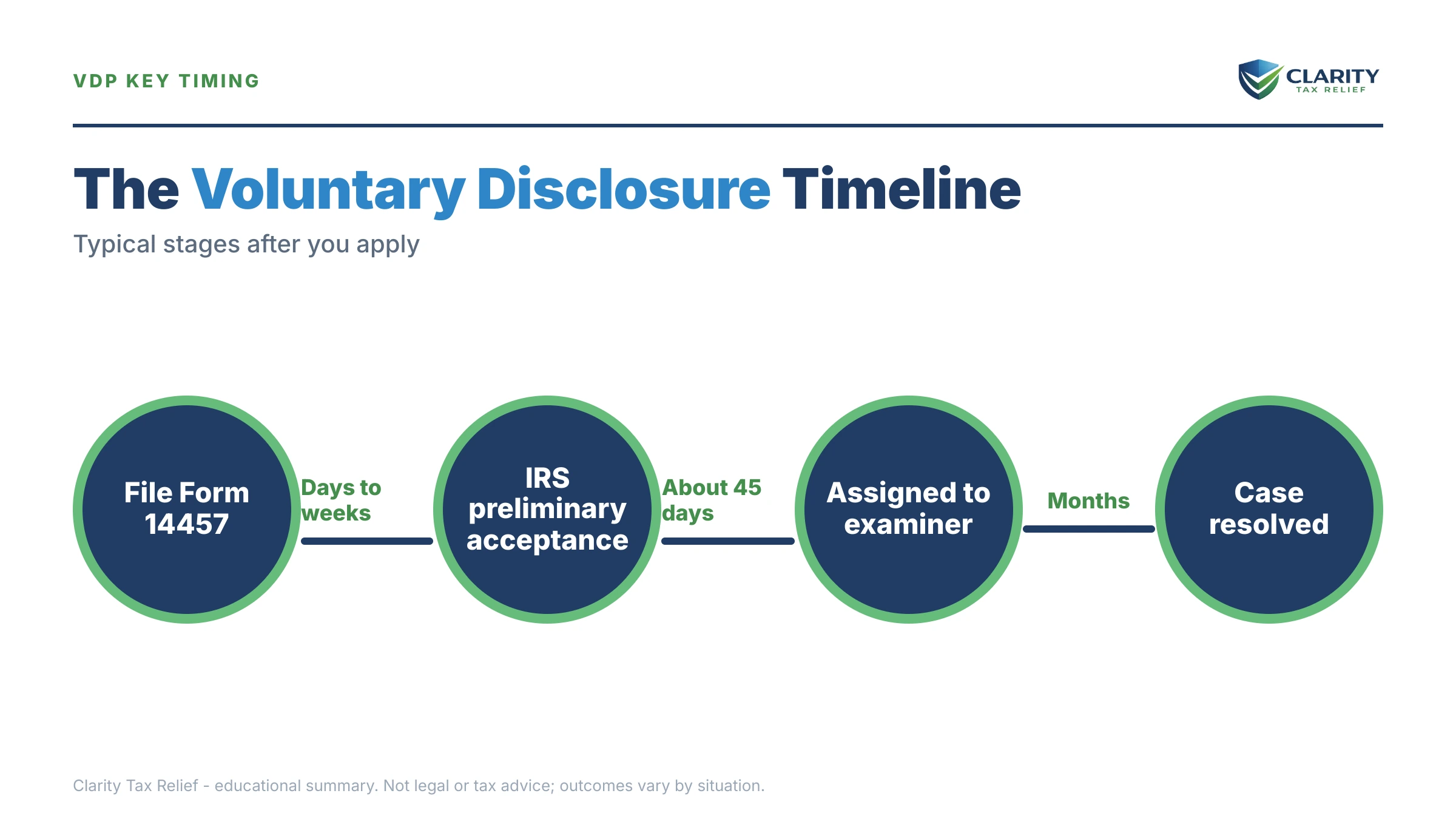
- Submit Form 14457 Part I for preclearance. Send the preclearance request to IRS Criminal Investigation identifying yourself and the noncompliance; CI confirms whether you're timely before you disclose the details.
- Complete Part II and prepare six years of returns. After preclearance, submit the full application — including a narrative of the willful conduct — generally within 45 days, and prepare accurate returns for the disclosure period.
- Cooperate, pay or arrange payment, and close the case. Work with the assigned examiner, pay the tax, interest, and penalties or document a payment arrangement, and sign the closing agreement that ends the case.
Note the sequence built into the form itself: Part I gets you cleared before you hand over the story. That two-stage design exists so you don't confess details to CI only to learn you were already disqualified.
When you can handle this yourself — and when you truly can't
Plenty of "I need to come clean" situations don't need the VDP or professional help at all. If your errors were honest — a missed 1099, unfiled years you simply avoided out of fear, foreign accounts you didn't know were reportable — you can usually file or amend on your own, request penalty relief, and set up payments; the how to settle tax debt yourself hub walks that whole track. Non-willful offshore cases with clean facts often fit the streamlined procedures without drama.
The VDP is the opposite case. You are voluntarily identifying yourself to Criminal Investigation and signing an admission of willful conduct — and the accountant-client privilege that covers EAs and CPAs under §7525 does not extend to criminal matters. That's why VDP cases are quarterbacked by experienced tax attorneys, often with an accountant working under the attorney's privilege umbrella. This is also true for the borderline calls: if you genuinely can't tell which side of the willfulness line you're on, that analysis alone is worth doing with an experienced tax professional before any paper moves — because the paper, once filed, picks your path for you.
Terms on Form 14457, decoded
- Willfulness — a voluntary, intentional violation of a known legal duty; includes deliberately avoiding learning the truth, not just outright lying.
- Preclearance — Part I of Form 14457: CI's confirmation that you're timely and eligible before you disclose the substance.
- Civil fraud penalty — the 75% penalty under IRC §6663 (or §6651(f) for fraudulent failure to file); under the VDP it's generally confined to your single highest-tax year.
- FBAR — FinCEN Form 114, the annual report of foreign financial accounts; willful failures carry some of the harshest penalties in the system.
- Closing agreement (Form 906) — the binding contract that ends a VDP case and locks in the negotiated terms.
- Quiet disclosure — filing amended or delinquent returns without entering any formal program; for willful facts, it's an audit flag with no protection attached.
IRS voluntary disclosure questions, answered
Does IRS voluntary disclosure guarantee I won't be prosecuted?
No — the VDP is a practice, not a statutory amnesty, so there is no legal guarantee. In practice, IRS Criminal Investigation generally does not recommend prosecution for taxpayers whose disclosures are timely, truthful, and complete, and who cooperate and pay or arrange to pay. The protection collapses if you conceal accounts, understate income during the process, or the income came from illegal sources, which is never eligible.
What penalties do I pay under the Voluntary Disclosure Practice?
You generally pay one civil fraud penalty — 75% of the underpayment — applied only to the single year with the highest tax liability in the six-year disclosure period, instead of fraud penalties on every year. If undisclosed foreign accounts are involved, a willful FBAR penalty typically applies to the one highest-balance year as well. Examiners keep discretion to expand penalties if you fail to cooperate.
What's the difference between voluntary disclosure and the streamlined procedures?
Willfulness. The streamlined procedures are certified under penalty of perjury as non-willful — an honest mistake or misunderstanding — and cost either 0% (foreign) or 5% (domestic) in offshore penalties. The VDP is for conduct that was deliberate, and it trades a higher civil price for protection against criminal referral. Filing streamlined when your conduct was actually willful is itself a false statement and can make things dramatically worse.
Is there a deadline to apply for IRS voluntary disclosure?
There is no calendar deadline — the deadline is the IRS itself. You are eligible only while your disclosure is 'timely': before the IRS opens a civil exam or criminal investigation, and before it receives your information from a third party such as a bank, a crypto exchange responding to a summons, or a whistleblower. Once any of those happens, the option is gone permanently for those years.
What if I can't pay everything I owe under the VDP?
You can still make a voluntary disclosure. Full payment is expected, but if you genuinely can't pay, Form 14457 lets you request a payment arrangement — you'll need to submit complete financial statements and propose terms. The IRS treats good-faith arrangements as satisfying the cooperation requirement; hiding assets while claiming inability to pay destroys your protection.
Does the VDP cover cryptocurrency and domestic income, or just offshore accounts?
It covers both. Since the OVDP closed in 2018, the current Voluntary Disclosure Practice handles domestic issues — unreported cash or business income, false deductions, employment tax fraud — and offshore issues alike, and Form 14457 now includes a dedicated digital-assets section for unreported crypto. The eligibility and penalty framework is the same regardless of where the income came from, as long as its source was legal.
Can I just quietly amend my old returns instead of using the VDP?
If your conduct was willful, a quiet disclosure is the most dangerous option on the list. Amended returns showing large, multi-year increases are a known audit flag, they hand the IRS a signed roadmap of the understatement, and they carry none of the VDP's protection against criminal referral. For genuinely non-willful errors, amending normally is fine — the risk is misjudging which side of that line you're on.
Your next 24 hours
- Check for contact — privately. Log in to your IRS online account and look for exam activity or new notices on any year, and note (for yourself only) which years and income sources are involved. Do not call the IRS or mail anything yet.
- Gather your records. Pull copies of your last six years of filed returns, plus bank, platform, exchange, or foreign-account statements showing the unreported income. Collect them; send them to no one.
- Get the willfulness call made before the paper moves. Book a free case review — the 2-minute form or (888) 825-7779 — while no exam is open and no third-party report has landed, because that's the only window in which every path on this page is still available to you.
Primary sources: the IRS's own overview of the Criminal Investigation Voluntary Disclosure Practice, the official Form 14457 page, and IRS.gov/payments for paying assessed balances.
This guide is general information, not tax or legal advice for your specific situation. Eligibility for IRS programs depends on individual facts and circumstances; no outcome is guaranteed.