
Offshore & International
Streamlined Domestic Offshore Procedures (SDOP): The 5% Path Back Into Compliance (2026)
The short answer: the streamlined domestic offshore procedures (SDOP) let non-willful U.S. residents fix unreported foreign accounts and income by amending three years of returns, filing six years of FBARs, certifying non-willfulness on Form 14654, and paying a 5% penalty on the highest year-end balance — instead of far larger FBAR penalties.
Maybe your foreign bank just emailed asking for a W-9. Maybe a new tax preparer asked "any foreign accounts?" and your stomach dropped. Either way, you now know the account you've had abroad for years was supposed to be on your U.S. filings — and you've read horror stories about $10,000-per-year penalties.
Here's the reframe: the IRS built the streamlined domestic offshore procedures specifically for people whose mistake was honest. For most non-willful filers, the total cost is a fraction of the penalty exposure you're imagining — and the whole process runs on one certification form.
That form is Form 14654, and everything in your case flows through it. The image below shows you exactly what it looks like and where the figures that set your penalty go.
⏱ Your real clock: SDOP has no filing deadline — but eligibility ends the instant the IRS opens a civil examination of any of your tax years, even one unrelated to foreign accounts. Because foreign banks report U.S. account holders to the IRS under FATCA, the safe window is measured by how fast you act, not a date on a calendar.
Why the streamlined domestic offshore procedures exist — and why you need them now
Under FATCA, banks in more than 100 countries report their U.S. account holders' names, account numbers, and balances directly to the IRS. That data feed is why "nobody will ever know" stopped being true years ago — and why your foreign bank suddenly wants a W-9 or threatens to close your account.
U.S. residents owe two separate reporting duties most people have never heard of. First, the FBAR (FinCEN Form 114) is required any year your foreign accounts combined top $10,000 at any point — even for one day, even if the money isn't yours alone. Second, Form 8938 penalty exposure kicks in when foreign assets cross higher thresholds (starting at $50,000 year-end for unmarried U.S. residents). Missing either, or leaving the account's interest income off your 1040, is what SDOP fixes.
SDOP is the U.S.-resident half of the IRS's streamlined filing compliance procedures. If you live abroad instead, the streamlined offshore procedures (SFOP) are the better door — same paperwork, 0% penalty. And if you're a citizen overseas who stopped filing entirely, start with our guide to expat back taxes instead, because SDOP won't accept non-filers at all.
Streamlined domestic offshore eligibility: the three tests you must pass
The streamlined domestic offshore procedures have three eligibility tests: you live in the U.S., you filed original returns for the last three years, and your conduct was non-willful. Miss any one and this door is closed — so check all three before you touch a form.
- You fail the non-residency test. You didn't spend 330+ full days outside the U.S. in any of the last three years, and your abode is in the U.S. (If you did, SFOP applies and your penalty drops to zero.)
- You filed original returns for each of the three most recent years. SDOP only accepts amended returns. A U.S.-resident non-filer cannot use SDOP — that situation needs a different sequence, usually delinquent returns plus penalty-relief strategy.
- Your failure was non-willful — negligence, mistake, or a good-faith misunderstanding of the rules. You'll certify this in writing, under penalties of perjury, with a factual narrative explaining how the accounts came to be and why they went unreported.
Two disqualifiers catch people off guard. An open IRS examination of any year — even a Schedule C audit that has nothing to do with foreign accounts — makes you ineligible. And facts that look willful (moving money between accounts to stay hidden, telling a bank you're not a U.S. person, using entities to obscure ownership) belong in the IRS voluntary disclosure practice, not streamlined. Filing a false non-willful certification is how a 5% problem becomes a criminal one.
One more edge case: on jointly filed returns, both spouses sign Form 14654 and both certify non-willfulness. If one spouse knew and the other didn't, get advice before either of you signs anything.
The 5% penalty, with the actual math
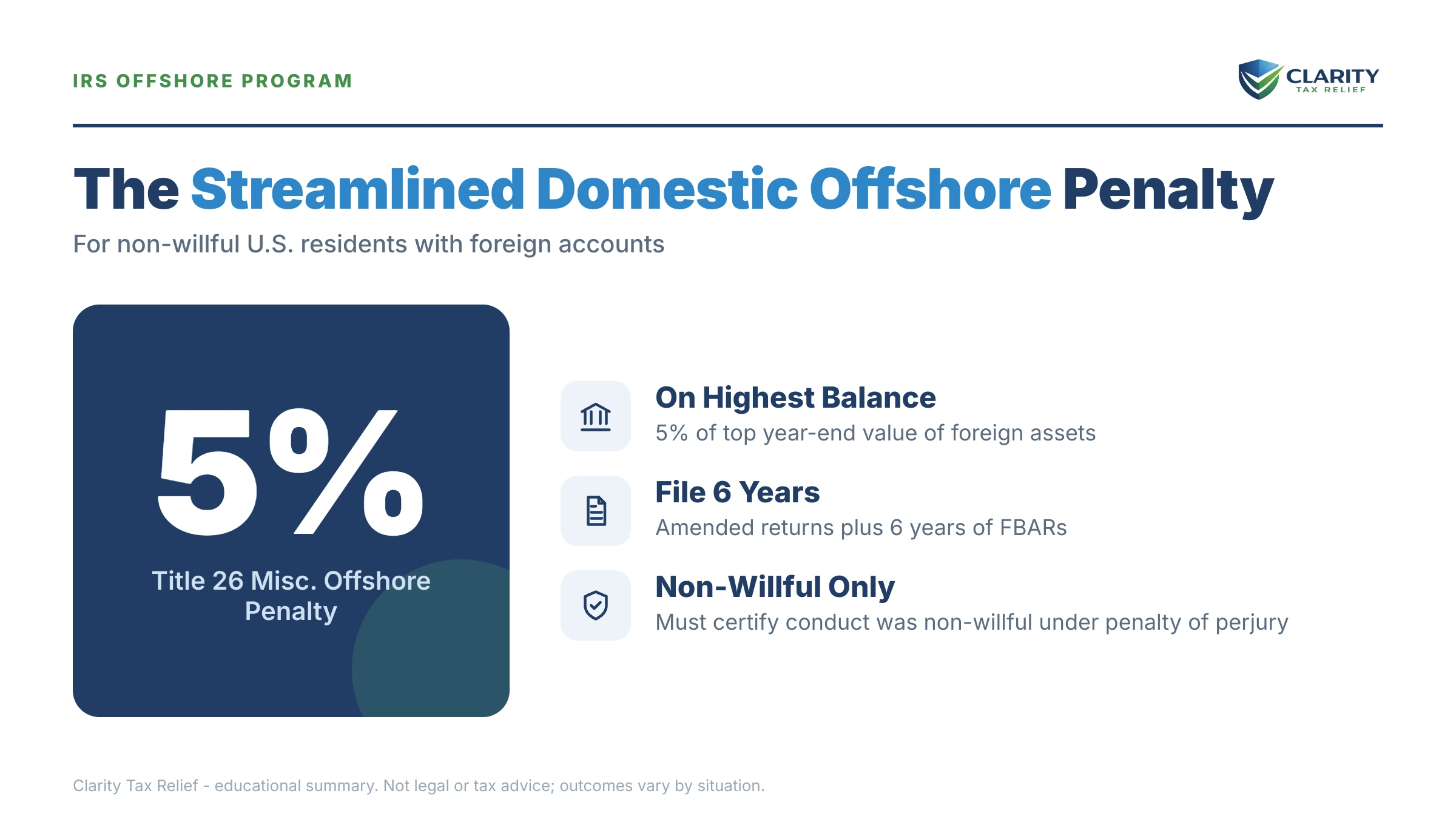
The streamlined domestic offshore penalty is 5% of the highest aggregate year-end balance of your foreign financial assets across the covered years — the six FBAR years and three return years. Two details in that sentence save people money: it's the year-end snapshot, not the intra-year peak, and it's the single highest year, not a sum of all six.
What goes in the base: any foreign asset that should have been on an FBAR or Form 8938 but wasn't — plus any asset whose income you didn't report, even if the account itself was properly disclosed. That last one surprises people who filed FBARs but skipped the interest income.
Say you're a 1099 web developer who's invoiced German clients for years and kept the euros in a Frankfurt account. Your highest combined year-end balance across the six years was $27,500, and the account earned about $700 a year in interest you never put on your 1040. Here's the whole bill, hypothetically:
- Miscellaneous offshore penalty: 5% × $27,500 = $1,375
- Back tax: $700 × 3 amended years = $2,100 of income; at a 22% marginal rate, roughly $462 in tax
- Statutory interest on each year's underpayment — modest on numbers this size; you can estimate it with our Penalty & Interest Calculator
All-in, that contractor is looking at roughly $1,850 plus interest — call it under $2,100. Compare the exam route on the same account: six unfiled FBARs, each carrying a statutory non-willful penalty of $10,000 (inflation-adjusted upward each year), plus a 20% accuracy-related penalty on the tax, plus potential Form 8938 penalties. Even after the Supreme Court's Bittner decision capped non-willful FBAR penalties at per-report rather than per-account, the examined version of this exact fact pattern runs well into five figures. The streamlined version costs less than one year's worth of one penalty.
One requirement to plan for: the package must include full payment of the tax, interest, and 5% penalty when you mail it. If your total is large enough that full payment is genuinely out of reach, that changes the strategy — the sequencing options are covered in our guide to how to settle tax debt yourself, and it's a conversation to have before the package goes out, not after.
What happens if you do nothing
Doing nothing means betting that the IRS never matches its FATCA data to your return — a bet that gets worse every year the data sits in its systems. The sequence when the match happens runs in stages:
- FATCA reporting. Your foreign bank transmits your name, taxpayer ID, and balances. This has likely already happened.
- Compliance contact. The IRS sends a soft letter about foreign accounts — often a Letter 6291 — signaling your account data is on file. At this point your clean-disclosure options start narrowing fast.
- Civil examination opens. The streamlined door closes permanently for you. Now every penalty is on the table at full statutory rates: FBAR penalties per unfiled report, the 20% accuracy-related penalty, information-return penalties.
- Willfulness review. Examiners look for signs you knew — and "willful blindness" counts. Willful FBAR penalties run to the greater of $100,000 (inflation-adjusted) or 50% of the account balance, per year. The full breakdown is in our guide to willful vs non-willful FBAR penalties.
- Criminal referral in egregious cases. Rare, but the difference between rare and impossible is exactly what the non-willful paperwork trail protects.
One more trap on the do-something-but-quietly side: amending old returns without using an official program — a quiet disclosure — waives none of the penalties and flags the very issue you're trying to fix. If you're going to disclose, use the front door.
Have an unreported foreign account right now?
Your streamlined eligibility ends the moment the IRS opens an exam — and FATCA means your account data is likely already in its systems. Get your foreign-account situation and non-willful facts reviewed free, before the paperwork commits you to anything: call (888) 825-7779 or use the 2-minute form.
SDOP vs. every other offshore disclosure path
SDOP is one of several official IRS offshore disclosure routes, and picking the wrong one either overpays the penalty or voids your protection. The match depends on three questions: where do you live, was the failure willful, and did you actually underreport income?
| Path | Who it fits | Offshore penalty | Key requirement |
|---|---|---|---|
| Streamlined Domestic Offshore (SDOP) | U.S. residents, non-willful, unreported foreign income | 5% of highest year-end balance | Original returns filed for last 3 years; no open exam |
| Streamlined Foreign Offshore (SFOP) | Non-willful taxpayers who meet the non-residency test | 0% | 330+ days outside the U.S. in one of last 3 years |
| Late FBAR e-filing via FinCEN | All income was reported and taxed — only FBARs missing | No automatic penalty | E-file late FBARs with an explanation; the dedicated Delinquent FBAR Submission Procedures ended June 30, 2026 |
| Delinquent international information returns | Missing forms like 5471/3520 but no unreported income | $0 with reasonable cause | Reasonable-cause statement attached to each late form |
| Voluntary Disclosure Practice | Willful conduct — criminal exposure needs managing | Substantially higher, negotiated | Preclearance from IRS Criminal Investigation |
| Quiet disclosure (not a program) | No one — it's a trap, not a path | Nothing waived; full exposure remains | — |
The 5%-vs-0% line is worth a hard look before you file. If you spent even one of the last three years mostly abroad — a long contract overseas, a year with family — you may meet the non-residency test for the foreign version and owe no offshore penalty at all. On a large balance, that single eligibility question is worth more than everything else in the filing. And if your foreign holdings include exchange accounts or wallets, read our guide to offshore crypto reporting before you compute anything, because what counts as a "foreign financial account" for crypto is still unsettled.
How to file under the streamlined domestic offshore procedures, step by step
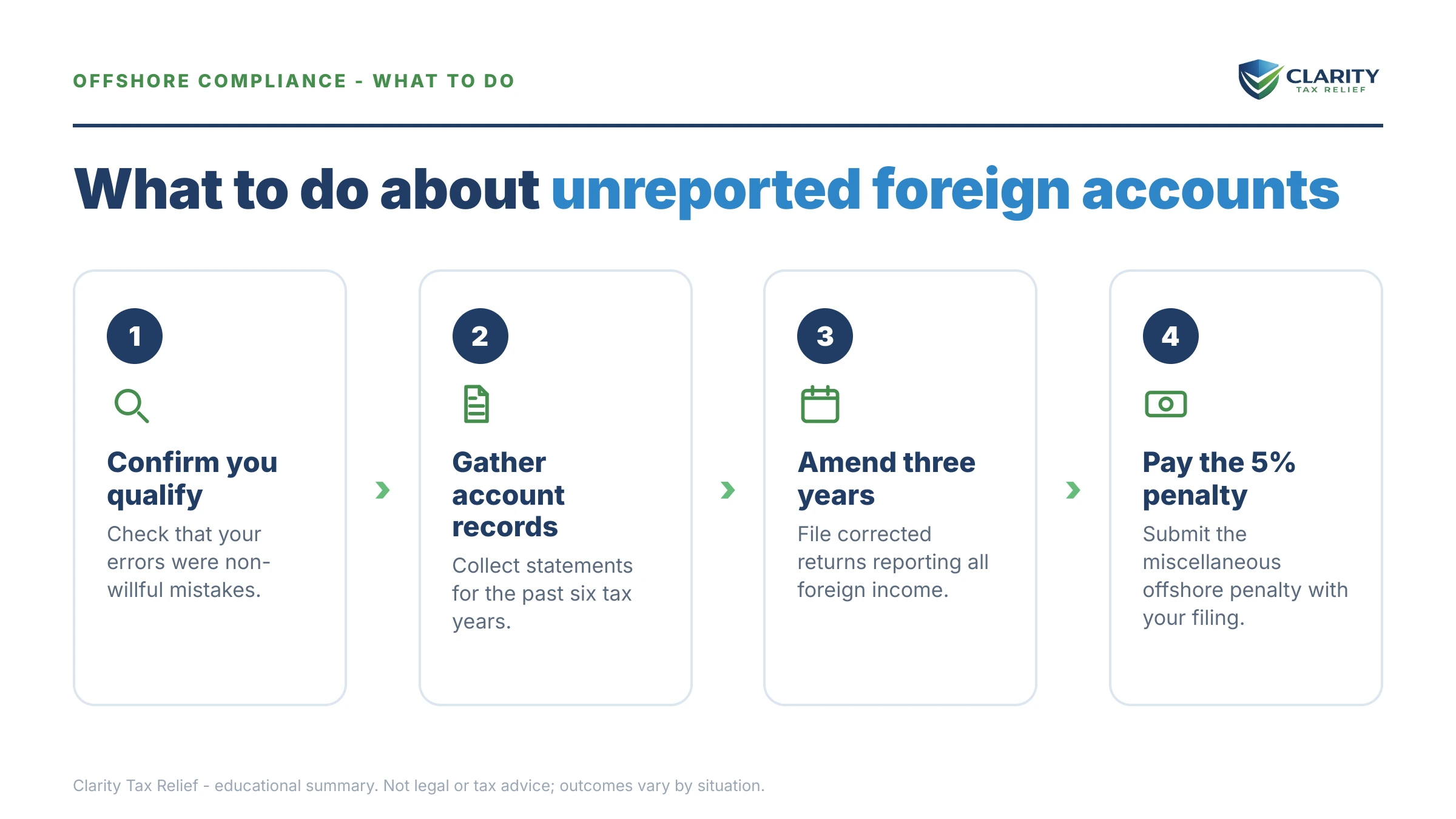
- Confirm your eligibility — verify all three tests before anything else: your conduct was non-willful, you filed original returns for each of the last three years, and the IRS has not opened an examination of any of your tax years.
- Gather six years of foreign account records — pull statements showing the year-end balance of every foreign account and asset for the last six years, plus records of the interest, dividends, or gains each one earned.
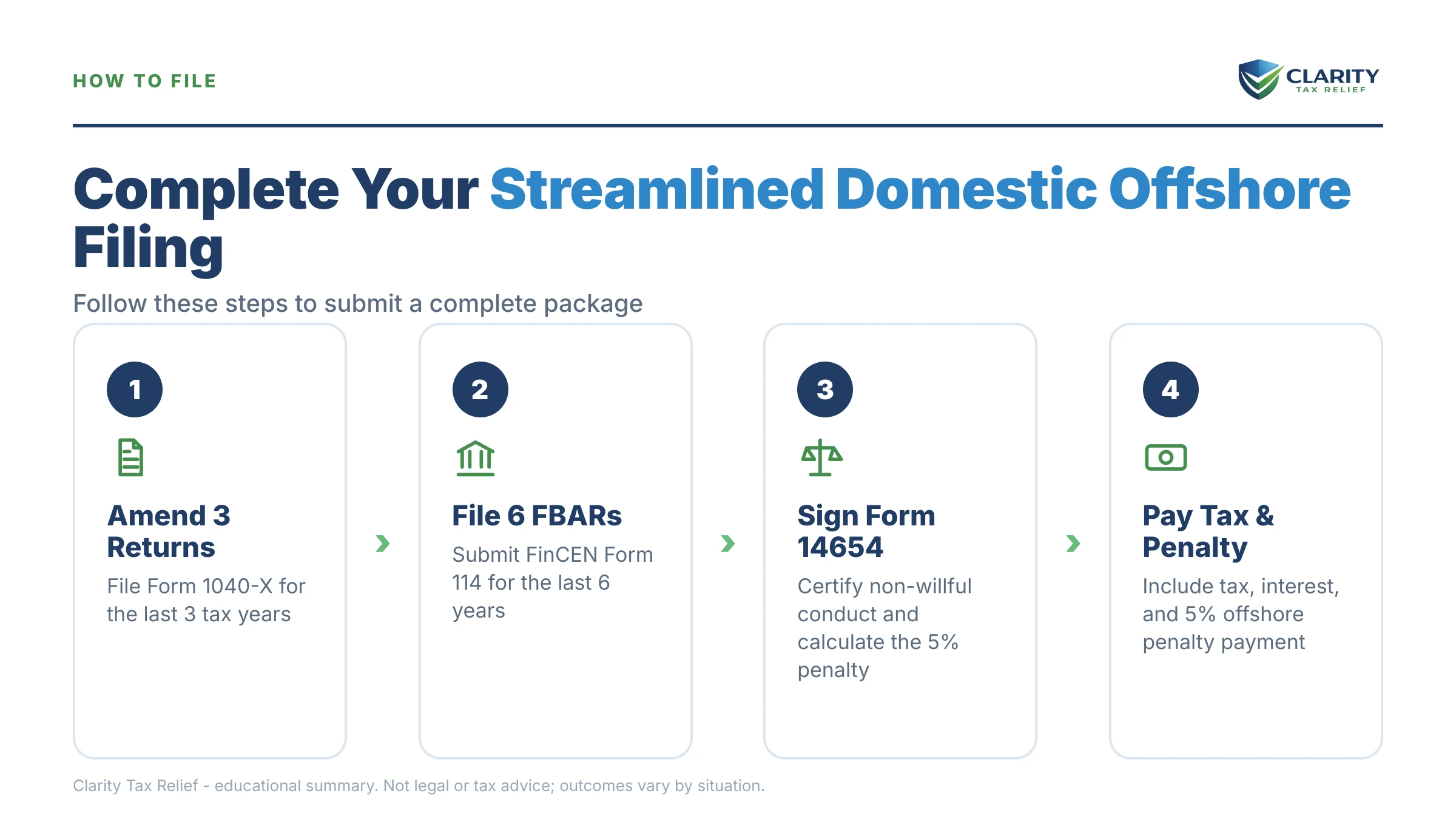
- Amend the last three years of returns — prepare a Form 1040-X for each covered year reporting the foreign income, attach any required international information returns (Form 8938, 3520, or 5471), and write "Streamlined Domestic Offshore" in red ink at the top of each amended return.
- File six years of FBARs electronically — submit a FinCEN Form 114 for each of the six covered years through FinCEN's BSA E-Filing System, selecting the streamlined filing explanation for the late submissions.
- Complete Form 14654 and pay in full — write your non-willfulness statement, compute the 5% miscellaneous offshore penalty, sign the certification, and mail the complete package to the IRS streamlined unit with full payment of tax, interest, and the penalty.
The package travels together — amended returns, certification, and payment in one mailing, with the FBARs filed separately online. Here's the complete checklist:
| Item | Years covered | Key detail |
|---|---|---|
| Form 1040-X amended returns | 3 most recent filed years | "Streamlined Domestic Offshore" written in red at the top of each |
| International information returns (8938, 3520, 5471 as applicable) | Same 3 years | Attached to the amended returns they belong to |
| FBARs (FinCEN Form 114) | 6 most recent years | E-filed through FinCEN's BSA system, not mailed with the package |
| Form 14654 certification | One signed original, copies attached to each amended return | Non-willful narrative + the 5% penalty computation |
| Payment | All covered years | Full tax + statutory interest + 5% penalty, included with the mailing |
The narrative on Form 14654 is where cases are won or lost. It needs specific facts — how the account was opened, who advised you, what you understood about your obligations — not a generic "I didn't know." Too thin and the certification invites scrutiny; too much unvetted detail and you can accidentally write willfulness into your own file. If your history includes a Form 5471 penalty exposure (a foreign corporation) or foreign gifts and trusts, the narrative and the attachments get technical fast.
When you can handle this yourself — and when you shouldn't
Not every offshore fix needs professional help, and the cheapest correct answer is sometimes no program at all. You can reasonably handle it yourself when all of your foreign income was actually reported and taxed and only the FBAR forms are missing — you can still e-file the late FBARs through FinCEN with an explanation, and penalties aren't automatic when the account income was reported and taxed, though the IRS removed the dedicated Delinquent FBAR Submission Procedures on June 30, 2026, so there's no longer a guaranteed penalty-free program. Our didn't file FBAR penalty guide walks through it. A single small account with clearly innocent facts and simple interest income is also a manageable DIY streamlined filing for a careful person.
Experienced help changes the outcome when any of these are true: the facts have willfulness gray areas (you saw a bank form mentioning U.S. reporting, or a preparer once asked and you said no); the assets include entities, trusts, foreign pensions, or crypto; the balances are large enough that the 5% base calculation and the SDOP-vs-SFOP residency question move real money; or the IRS has already sent anything mentioning foreign accounts. The certification is signed under penalties of perjury — it's the one document in tax practice where "close enough" can create criminal exposure, and it's worth a professional read before your signature goes on it.
Terms on Form 14654, decoded
- Non-willful conduct — negligence, inadvertence, mistake, or a good-faith misunderstanding of the law. You didn't know; you didn't hide.
- FBAR (FinCEN Form 114) — the annual foreign-account report required when your foreign accounts combined exceed $10,000 at any point in the year. Filed with FinCEN, not with your tax return.
- Miscellaneous offshore penalty — the 5% Title 26 penalty that replaces FBAR, accuracy-related, and information-return penalties in an SDOP filing.
- Foreign financial asset — foreign bank and investment accounts and certain other foreign holdings that count toward the 5% penalty base.
- Quiet disclosure — amending old returns without an official program. The IRS treats it as a red flag, not a fix, and it waives nothing.
- Certification under penalties of perjury — the legal weight behind Form 14654. A knowingly false statement carries criminal exposure, which is why the narrative deserves care.
The IRS's official program terms live on its streamlined filing compliance procedures page, and late FBARs are filed through FinCEN's BSA E-Filing System. Payments accompanying the package follow the standard IRS payment rules at IRS.gov/payments.
Streamlined domestic offshore FAQs
Who qualifies for the streamlined domestic offshore procedures?
You qualify to apply if you meet three tests: you fail the non-residency test (you live in the U.S.), you filed original tax returns for each of the last three years, and your failure to report foreign income and accounts was non-willful. You're disqualified the moment the IRS opens a civil examination of any of your tax years — even one unrelated to foreign accounts.
What is the 5% penalty in the streamlined domestic offshore procedures?
It's the Title 26 miscellaneous offshore penalty: 5% of the highest aggregate year-end balance or value of your foreign financial assets across the six-year FBAR period and three-year return period. On a $27,500 peak balance, that's $1,375. In exchange, the IRS waives FBAR penalties, accuracy-related penalties, and failure-to-file and failure-to-pay penalties on the amended years.
What is the difference between streamlined domestic and streamlined foreign offshore procedures?
Residency and price. The foreign version (SFOP) is for taxpayers who meet the non-residency test — physically outside the U.S. at least 330 full days in one of the last three years — and it carries a 0% offshore penalty. The domestic version (SDOP) is for U.S. residents and carries the 5% penalty. SFOP also accepts original delinquent returns, while SDOP only accepts amendments to returns you already filed.
Can I use the streamlined domestic offshore procedures if I never filed tax returns?
No. SDOP requires that you filed an original return for each of the three most recent years — it only accepts amended returns. A U.S.-resident non-filer generally has to file the delinquent returns through normal channels and request penalty relief, or use the IRS Voluntary Disclosure Practice if there's willfulness in the picture. An experienced tax professional should sequence this before anything is mailed.
Does a streamlined filing protect me from audit or prosecution?
Not automatically. There is no closing agreement — your amended returns can still be examined like any others, and the IRS can challenge your non-willful certification. Form 14654 is signed under penalties of perjury, so a false certification converts a 5% civil problem into willful-penalty and potential criminal exposure. Accurate, honest filings are the protection.
Is there a deadline to file under the streamlined domestic offshore procedures?
There's no fixed calendar deadline, but the window can close two ways: the IRS opens an examination of any of your years, which disqualifies you instantly, or the IRS ends the program itself — it terminated the OVDP program in 2018 with only months of warning. Since foreign banks already report U.S. account holders under FATCA, waiting means betting the IRS's computers stay slow.
Does the 5% penalty apply to crypto held on foreign exchanges?
It depends on how the asset is held, and the reporting rules for crypto are still unsettled. FinCEN has proposed — but not finalized — adding crypto to FBAR reporting, while foreign accounts that hold both cash and crypto may already be reportable, and Form 8938 can apply separately. If foreign exchanges are part of your picture, get the classification right before you compute the penalty base.
How long does streamlined domestic offshore processing take?
The IRS does not send an acceptance letter — for most filers, silence is the good outcome. Your payment will post, the amended returns process, and you'll only hear back if something is selected for review or the certification is questioned. Keep proof of mailing and copies of the full package, because the package itself is your record of compliance.
Your next 24 hours
- Find your highest year-end balance. Pull the December statement for every foreign account for each of the last six years and add each year's totals. The single largest year sets your 5% penalty — knowing that number turns fear into arithmetic.
- Gather your paper trail. Your last three filed returns, records of foreign interest or investment income, and any bank correspondence — especially anything asking about your U.S. status, since it bears on the non-willful narrative.
- Get the eligibility questions answered free. Whether you belong in SDOP, the 0% foreign version, or simply e-filing late FBARs through FinCEN is the whole ballgame — and your eligibility only survives while no exam is open. Use the 2-minute form or call (888) 825-7779 for a free, confidential review before anything gets mailed.
This guide is general information, not tax or legal advice for your specific situation. Eligibility for IRS programs depends on individual facts and circumstances; no outcome is guaranteed.