
IRS Letters
IRS Letter 6291: The Foreign Account Compliance Letter, Explained (2026)
The short answer: Letter 6291 is an IRS foreign-account compliance letter. A foreign bank has reported an account in your name under FATCA, and the IRS's records don't show matching FBAR or Form 8938 filings. It isn't a bill or an audit — but it's your last easy chance to fix foreign reporting before penalties start.
You've filed every return on time, and now the IRS is writing to you about a bank account in another country — without naming the bank, the balance, or a single dollar amount it wants. That vagueness is deliberate, and the situation is fixable. What follows is exactly what the IRS knows, what it expects you to do, and the order to do it in.
Letter 6291 doesn't look like a normal IRS bill — there's no amount due and no payment stub. The image below shows what the letter looks like and where to look for the parts that actually tell you something, including whether your copy references specific tax years. (If you want the general map of why the IRS sends mail at all, our guide to why did I get a letter from the IRS covers that. Everything on this page is specific to Letter 6291.)
⏱ The clock that matters: most versions of Letter 6291 print no hard deadline — but the streamlined compliance programs that cap offshore penalties at 5% or zero are only available until the IRS opens an examination. Nobody warns you before that happens. If your copy does print a response date, that date controls.
Why you got Letter 6291
Letter 6291 exists because of FATCA: foreign financial institutions in more than 100 jurisdictions now report their U.S. account holders' names, account numbers, and balances directly to the IRS. The IRS matches that data against your tax returns and FBAR filings. When it finds an account with no matching disclosure, Letter 6291 goes out.
Three situations produce most of these letters. First, you held a foreign account whose combined value crossed $10,000 at some point in a year but never filed the FBAR (FinCEN Form 114). Second, you filed returns but left off foreign income — interest, dividends, or business receipts deposited abroad. Third, it's a false alarm: the account never crossed the threshold, you did report it, or it's a joint account with a relative overseas that the bank tagged to your Social Security number.
What Letter 6291 is not: an audit, a penalty assessment, or a demand for payment. It belongs to the same family of "soft letters" as the crypto-focused IRS Letter 6173 — the IRS telling you it holds third-party data and inviting you to correct your filings before it acts on that data. When you compare your copy to the image below, note which tax years, if any, it references. That tells you exactly where to start digging.
What happens if you ignore Letter 6291
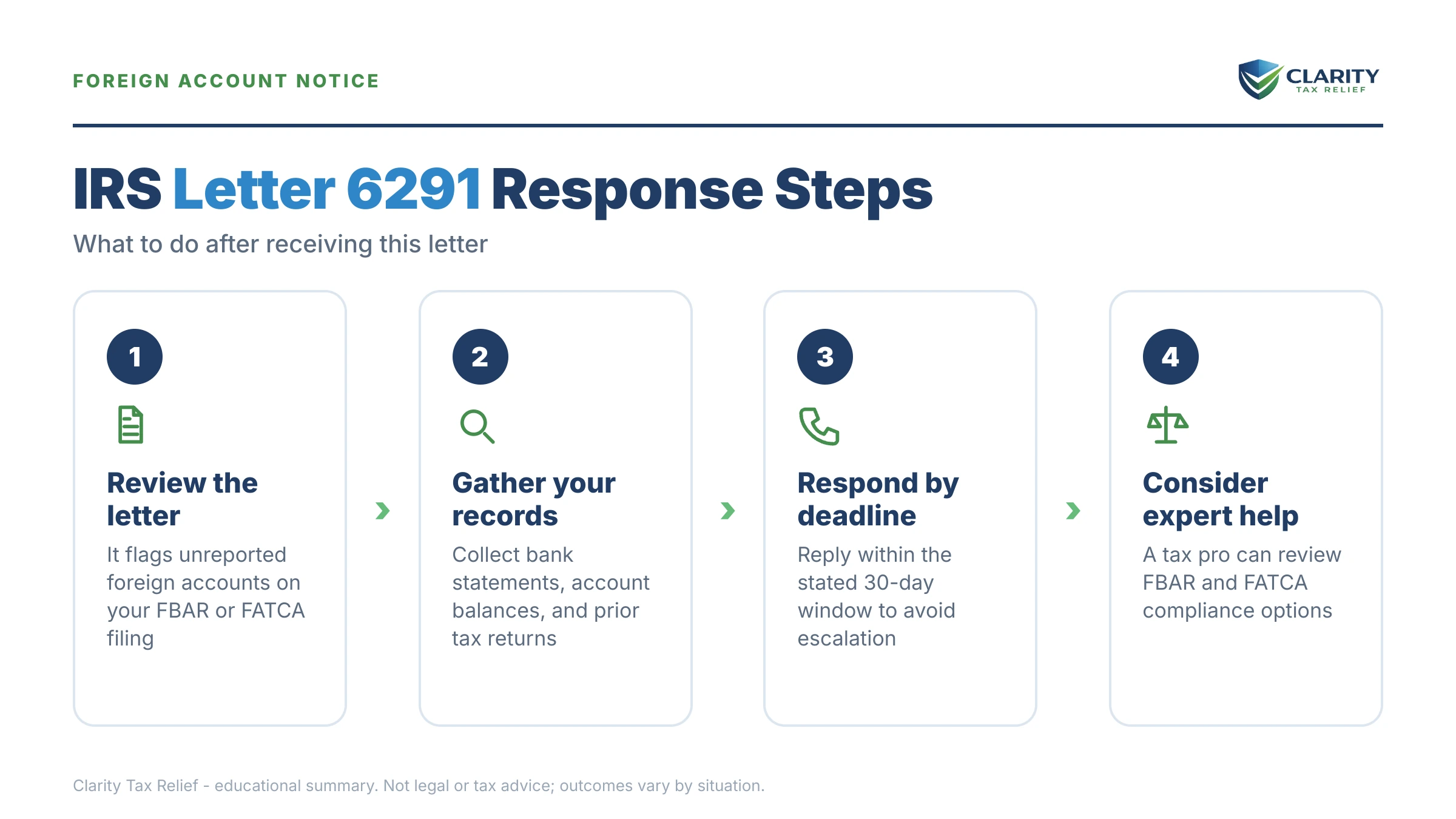
Ignoring Letter 6291 doesn't close the file — the FATCA data stays matched to your Social Security number, and your returns can be routed to examination at any time afterward. The sequence runs in stages, and each stage takes options off the table:
- Letter 6291 arrives — a data mismatch is flagged, nothing is assessed. Every compliance path is still open. You are here.
- The file sits, flagged — non-response doesn't reset anything. The foreign-bank data remains in your account record and feeds the IRS's exam-selection process.
- A civil examination opens — an examiner can develop FBAR penalties, Form 8938 penalties, income adjustments, and a 20% accuracy-related penalty. The moment the exam opens, streamlined eligibility ends permanently for every covered year.
- Penalties are assessed — non-willful FBAR penalties run up to $10,000 per unfiled year (indexed for inflation), and willful findings run to the greater of roughly $100,000 or 50% of the account balance, per year. Form 8938 failures add $10,000 per year, with up to $50,000 more for continued failure.
- Collection begins — assessed balances enter the ordinary collection stream, escalating through demand notices to a final intent-to-levy notice like Letter 1058, which carries real lien and levy power.
Two legal clocks make waiting expensive. The government has six years to assess FBAR penalties for each unfiled year. And if a required Form 8938 was never filed, the statute of limitations on your entire return for that year generally never starts running — the IRS can reach back indefinitely until the form is filed. In 2026, with IRS staffing down sharply, the humans are harder to reach — but this matching program is automated, and it never stopped.
Holding Letter 6291 right now?
The IRS already has your account data — the only question is whether you correct the reporting on your terms or wait for an examiner to do it on theirs. The streamlined programs that cap offshore penalties close permanently once an exam opens. Get your letter and filing history reviewed free by an experienced tax professional — (888) 825-7779 or the 2-minute form.
Your options after Letter 6291
The IRS maintains several formal paths back into foreign-account compliance, and the right one turns on two questions: was any tax underpaid, and was your conduct willful?
| Path | Who it fits | What it costs |
|---|---|---|
| Late FBAR filing (the penalty-free DFSP program was removed June 30, 2026) | All foreign income was reported and tax paid — only the FBAR forms are missing | E-file the late FBARs through FinCEN with an explanation; penalties are not automatic when the account income was reported and taxed, but there is no longer a guaranteed penalty-free program |
| Streamlined Foreign Offshore (SFOP) | Non-willful conduct and you meet the non-residency test (living outside the U.S.) | 0% offshore penalty; pay tax and interest on 3 years of amended returns |
| Streamlined Domestic Offshore (SDOP) | Non-willful conduct, U.S. resident | 5% of the highest year-end aggregate balance of the unreported assets, plus tax and interest on 3 years |
| Voluntary Disclosure Practice (VDP) | Conduct that was willful — you knew the rules and chose not to report | Substantially higher civil penalties, but a structured path that manages criminal exposure |
| Quiet disclosure (don't) | No one — it's a shortcut, not a program | No penalty protection, and a heightened exam risk right after a compliance letter |
If your only failure is the form itself — every dollar of foreign income already appears on your returns — know that the IRS removed the Delinquent FBAR Submission Procedures on June 30, 2026. Late FBARs can still be e-filed through FinCEN with an explanation, and penalties are not automatic when the account income was reported and taxed — but there is no longer a guaranteed penalty-free program. If income was missed, the streamlined programs are the workhorses: three years of amended returns, six years of FBARs, and a signed non-willfulness certification — Form 14654 for U.S. residents under the streamlined domestic offshore program, Form 14653 for those abroad under the streamlined offshore procedures.
If your history is willful — you knew about the reporting rules and deliberately skipped them — the streamlined certification is not available to you (it's signed under penalty of perjury), and the IRS voluntary disclosure practice is the honest route. And whatever you do, resist the urge to simply file amended returns without a program: a quiet disclosure after a compliance letter is the highest-risk move on this list.
FBAR vs. Form 8938: the two tests this letter points at
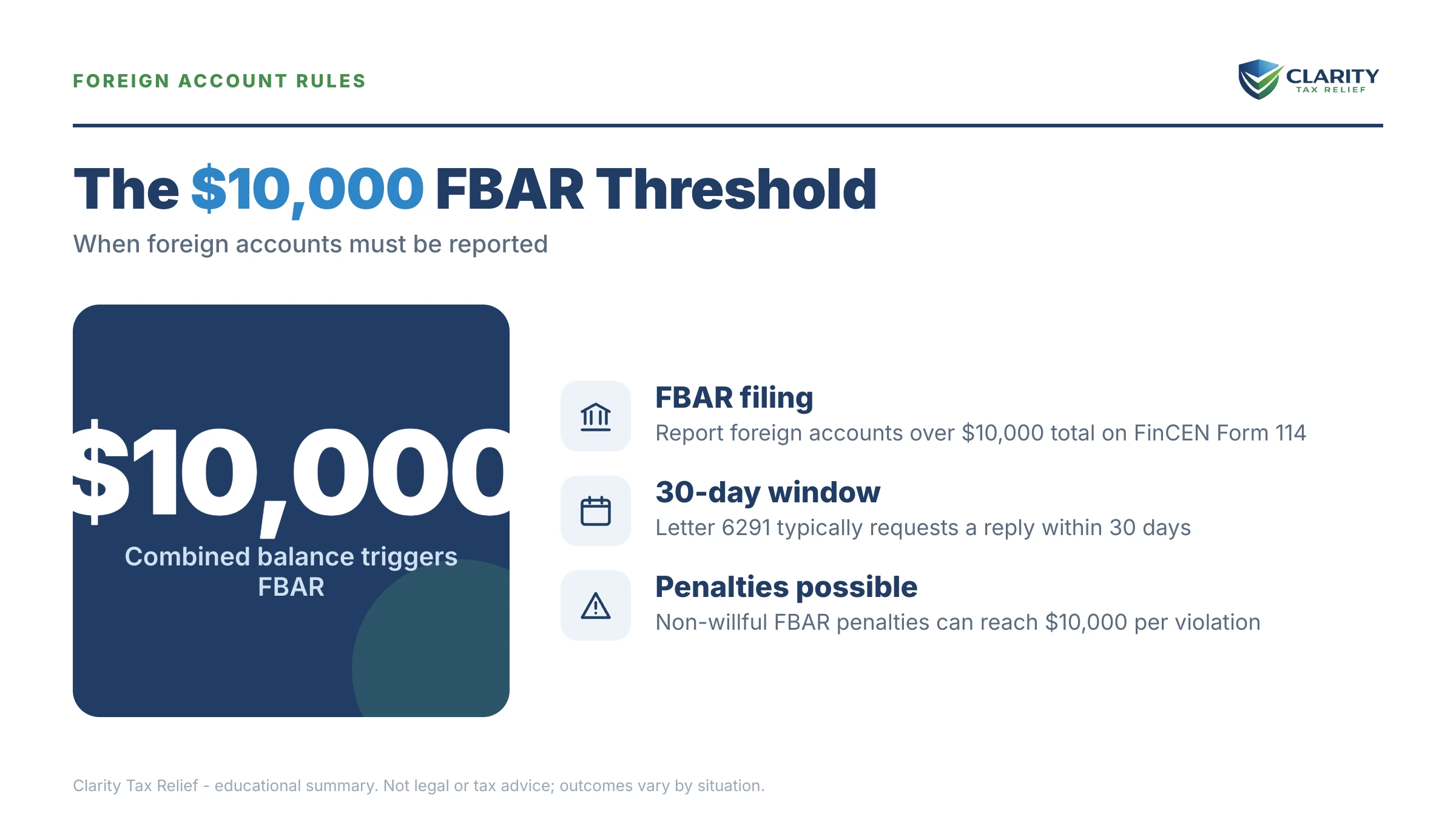
The FBAR filing threshold is $10,000 in combined foreign-account value at any moment during the year — far lower than most people assume, and separate from the Form 8938 test that lives on your tax return. Letter 6291 implicitly asks about both, and many recipients owe one form but not the other.
| Question | FBAR (FinCEN Form 114) | Form 8938 (FATCA) |
|---|---|---|
| Filing threshold | Combined foreign accounts over $10,000 at any point in the year | $50,000 at year-end or $75,000 anytime (single, U.S. resident); doubled if married filing jointly; higher again if living abroad |
| Where it's filed | Electronically with FinCEN's BSA system — not with your tax return | Attached to your Form 1040 |
| Penalty if missed | Up to $10,000 per non-willful year (indexed); far more if willful | $10,000, plus up to $50,000 for continued failure — and the return's statute of limitations may never close |
| Signature-authority accounts | Yes — counted even if the money isn't yours | No — only assets you hold an ownership interest in |
Full penalty detail for each form lives in our FBAR penalty guide and the Form 8938 penalty guide. The takeaway for Letter 6291: run both tests for every year, because the answer often differs year to year and form to form.
What Letter 6291 could cost: the math on a $54,600 account
On a $54,600 foreign account, the streamlined domestic offshore penalty is $2,730 — while worst-case non-willful assessments after an examination can exceed the account's entire balance. Here's a clearly hypothetical example that shows why acting first changes everything.
Say you're a self-employed web developer — a sole proprietor with clients in Germany — who kept a euro account there for the last five years. Its highest year-end balance was $54,600. Your client payments were already on Schedule C, so no business tax was missed. But the account earned about $1,900 a year in interest you never put on Schedule B — $5,700 over the three most recent years — and you never filed an FBAR or Form 8938. (At $54,600, you crossed both tests: the $10,000 FBAR line by a mile, and the $50,000 single-filer Form 8938 year-end line by $4,600. Form 8938 has a second prong — more than $75,000 at any time during the year — which this account never reached, but crossing either prong triggers the filing requirement, and the year-end test alone does it here.)
Path A — do nothing and get examined. Non-willful FBAR penalties can reach $10,000 per unfiled year, indexed higher for inflation, and the government can assess up to six years of them: potentially $60,000 or more. Form 8938 failures add up to $10,000 per missed year. On top sits the tax on $5,700 of interest (roughly $1,368 at a 24% bracket), a 20% accuracy-related penalty on that tax, and compounding interest. Examiners have mitigation guidelines and rarely stack every maximum — but once an exam owns the file, you don't control the number.
Path B — file a streamlined domestic submission now. The offshore penalty is 5% of the highest year-end balance: 5% × $54,600 = $2,730. Add the ~$1,368 of tax on the missed interest across three amended returns, plus interest on that tax — you can estimate the tax-side interest with our Penalty & Interest Calculator — and the all-in cost lands around $4,500. The accuracy penalty is not imposed under the streamlined terms. Same facts, same account: roughly $4,500 versus a downside measured in tens of thousands. The only variable is who moves first.
Details that change your answer
A handful of facts can swing which path — and which price — applies to your Letter 6291.
- Married filing jointly: the Form 8938 thresholds double to $100,000 at year-end or $150,000 anytime for U.S. residents. A couple's $54,600 account may skip Form 8938 entirely — while the $10,000 FBAR test still applies unchanged.
- Living abroad: you may meet the non-residency test for SFOP, which drops the offshore penalty to zero, and the Form 8938 thresholds rise substantially. Our expat back taxes guide covers the full catch-up sequence for Americans overseas.
- A foreign entity, not just an account: if the "account" is really your ownership in a foreign corporation or partnership, Form 5471-type information returns enter the picture, each carrying its own $10,000-per-form penalty regime. That's professional-help territory, full stop.
- Signature authority only: if you can sign on a foreign account that isn't your money — a parent's account, an overseas employer's — the FBAR still counts it, but Form 8938 generally doesn't. This is one of the most common false-alarm patterns behind Letter 6291.
How to respond to Letter 6291, step by step
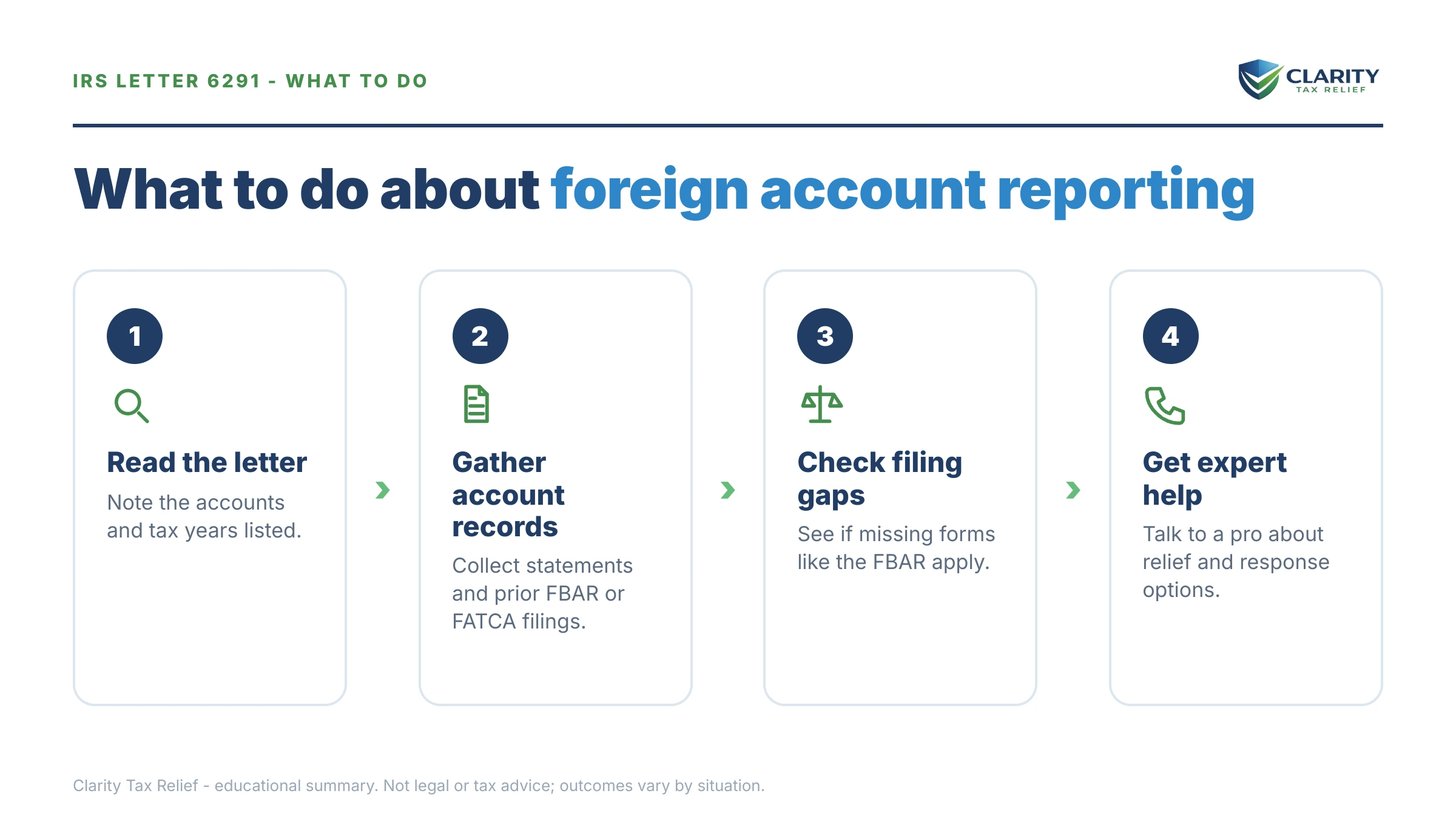
- Pull your foreign account records. Get year-end and highest-balance statements for every non-U.S. account — bank, brokerage, pension, even accounts you only hold signature authority over — going back at least six years.
- Run both filing tests. The FBAR applies if your accounts' combined value ever topped $10,000 during a year; Form 8938 applies at $50,000 year-end or more than $75,000 at any time during the year (single, U.S. resident), with higher thresholds if you're married or living abroad.
- Compare against what you actually filed. Check whether each required FBAR was filed through FinCEN's BSA e-filing system, and whether the foreign income — interest, dividends, business receipts — appears on the matching returns.
- Choose a formal compliance path. If all income was reported, late FBARs can still be e-filed through FinCEN with an explanation — penalties are not automatic when the income was reported and taxed, though the IRS removed the penalty-free Delinquent FBAR Submission Procedures on June 30, 2026, so there is no longer a guaranteed penalty-free program. If income was missed, the streamlined programs cap the cost. Never file a quiet disclosure.
- File completely and keep proof. A streamlined submission means three years of amended returns, six years of FBARs, and a signed non-willfulness certification (Form 14654 for U.S. residents, Form 14653 from abroad). Keep copies of everything, including the letter.
When you can handle Letter 6291 yourself
Not every Letter 6291 needs professional help — and being honest about that line is the point of this section. You can likely handle it yourself when your accounts never crossed the $10,000 FBAR threshold in any year (verify with statements, keep the proof with the letter, done), or when every dollar of foreign income was already on your returns and only the FBAR forms are missing — late FBARs can still be e-filed through FinCEN with a short explanation, and penalties are not automatic when the income was reported and taxed, though since the IRS removed the Delinquent FBAR Submission Procedures on June 30, 2026, there is no longer a guaranteed penalty-free program.
Experienced help changes outcomes when income went unreported across multiple years, when anything about your history is gray on willfulness (you'd heard of the FBAR and skipped it anyway), when a foreign entity, trust, or pension sits behind the account, or when the balance is large enough that the gap between a 5% streamlined penalty and a 50% willful penalty is measured in six figures. The streamlined certification is a sworn narrative signed under penalty of perjury — the single most consequential document in the whole process — and it's the one place where drafting experience genuinely pays for itself.
Terms on your letter, decoded
- FBAR: the annual Report of Foreign Bank and Financial Accounts (FinCEN Form 114), required once your combined foreign balances top $10,000 at any point in a year.
- FATCA: the 2010 law that makes foreign banks report U.S. account holders to the IRS — the data source that generated your Letter 6291.
- Form 8938: the tax-return version of foreign-asset reporting, with its own higher thresholds and its own $10,000 penalty.
- Non-willful vs. willful: the line between not knowing or forgetting and knowingly hiding — it determines whether penalties are capped in the thousands or measured as half the account, per year.
- Quiet disclosure: filing amended returns and late FBARs outside any formal program; it carries no penalty protection and draws exam attention.
- Streamlined procedures: the IRS's formal catch-up programs for non-willful taxpayers — three years of returns, six years of FBARs, and an offshore penalty of 5% (domestic) or zero (foreign).
Letter 6291 questions, answered
Is Letter 6291 an audit?
No — Letter 6291 is a compliance letter, not an examination. Nobody has opened a case file, proposed a penalty, or assessed a balance. That distinction matters legally: because you are not under exam, the streamlined compliance programs that cap or eliminate offshore penalties are generally still available to you. Once the IRS converts the letter into an examination, they are not.
Do I have to respond to Letter 6291?
Check your copy — most versions of Letter 6291 don't demand a written reply by a set date, but some request one, and any printed response date controls. Either way, the letter's real demand isn't a reply; it's action. The IRS expects you to review your foreign account reporting and correct any missed FBARs, Forms 8938, or unreported income through a proper compliance path.
Why did the IRS send me Letter 6291?
Because a third party — almost always a foreign financial institution reporting under FATCA — told the IRS you hold or held a foreign account, and the IRS's records don't show matching disclosures from you. The mismatch may be a real compliance gap, or it may be a false alarm: an account that never crossed the $10,000 FBAR threshold, or one you did report. The letter itself can't tell the difference; your records can.
Can I still use the streamlined procedures after getting Letter 6291?
Generally yes. The streamlined procedures require that you are not under IRS civil examination or criminal investigation, and a soft letter like 6291 is neither. But the window is one-directional: if the IRS opens an exam of any year before you file your streamlined submission, eligibility ends permanently. That's why the practical answer to Letter 6291 is to move before the IRS does.
What are the penalties for not filing an FBAR?
Non-willful failures carry a penalty of up to $10,000 per unfiled report (indexed higher for inflation), applied per year under the Supreme Court's Bittner decision. Willful failures are far worse: the greater of roughly $100,000 (indexed) or 50% of the account balance, per year, plus possible criminal exposure. The government has six years to assess FBAR penalties for each unfiled year.
What if I already reported all my foreign accounts and income?
Then Letter 6291 may require nothing beyond verification. Pull your filed FBARs from the BSA e-filing system, confirm every account and every year was covered, and confirm the foreign income appears on your returns. Keep that proof with the letter. If a response date is printed on your version, reply confirming your compliance rather than ignoring it.
My foreign account is closed now — can I ignore Letter 6291?
No. FBAR and Form 8938 obligations attach to each year the account existed above the threshold, and closing the account doesn't erase past years. In fact, a recently closed account can look worse if an examination follows. Late FBAR filing and the streamlined paths remain available for closed accounts, and the penalty math is the same.
Should I just quietly amend my returns and file the old FBARs?
That's called a quiet disclosure, and it's the one move experienced practitioners consistently warn against after a letter like this. Quiet disclosures carry no penalty protection, and amended international returns filed right after an IRS compliance letter are exactly the kind of filings that get flagged for exam. The formal paths — late FBAR filing through FinCEN with an explanation, or the streamlined programs — cost little more and buy real protection.
Your next 24 hours
- Read your copy of Letter 6291 and note two things: whether it lists specific tax years, and whether it prints a response date. Many versions don't — but if yours does, that date controls your timeline.
- Gather the paper the decision turns on: year-end and highest-balance statements for every foreign account (six years back if you can get them) and your last three filed tax returns.
- Get a free case review — call (888) 825-7779 or use the 2-minute form — while you're still outside an examination and every compliance path, including the streamlined programs, remains open to you.
This guide is general information, not tax or legal advice for your specific situation. Eligibility for IRS programs depends on individual facts and circumstances; no outcome is guaranteed.