
International & Offshore
Delinquent FBAR Procedures Ended June 30, 2026: What to Do Now
The short answer: the IRS removed the Delinquent FBAR Submission Procedures from irs.gov on June 30, 2026. You can still e-file past-due FBARs (FinCEN Form 114) through FinCEN's BSA E-Filing System with a statement explaining the late filing, and penalties are not automatic when all income from the foreign accounts was reported and taxed — but the formal no-penalty program no longer exists, so consider the streamlined procedures or professional advice before you file.
You were pulling bank statements for your refinance application when it clicked: that account you left open overseas crossed $10,000 at some point — and you've never once filed an FBAR. A quick search turned up penalty numbers that made your stomach drop. Take a breath: if you paid tax on the account's income all along, your situation is still very fixable — but the official program built for it, the delinquent FBAR submission procedures, was taken down from irs.gov on June 30, 2026, so the path now runs directly through FinCEN.
Three facts drive everything on this page. The FBAR is FinCEN Form 114 — a Bank Secrecy Act report filed separately from your tax return, which is exactly why so many preparers never mention it. The filing trigger is a combined $10,000 across all foreign accounts at any moment in the year. And even with the formal procedures gone, filing a late FBAR carries no fee and no tax, and penalties are not automatic when your returns already reported the foreign income.
Because the FBAR isn't an IRS form, most people have never actually seen one. The image below shows exactly what FinCEN Form 114 looks like and where to look — including the late-filing section where you select a reason and add your explanation statement.
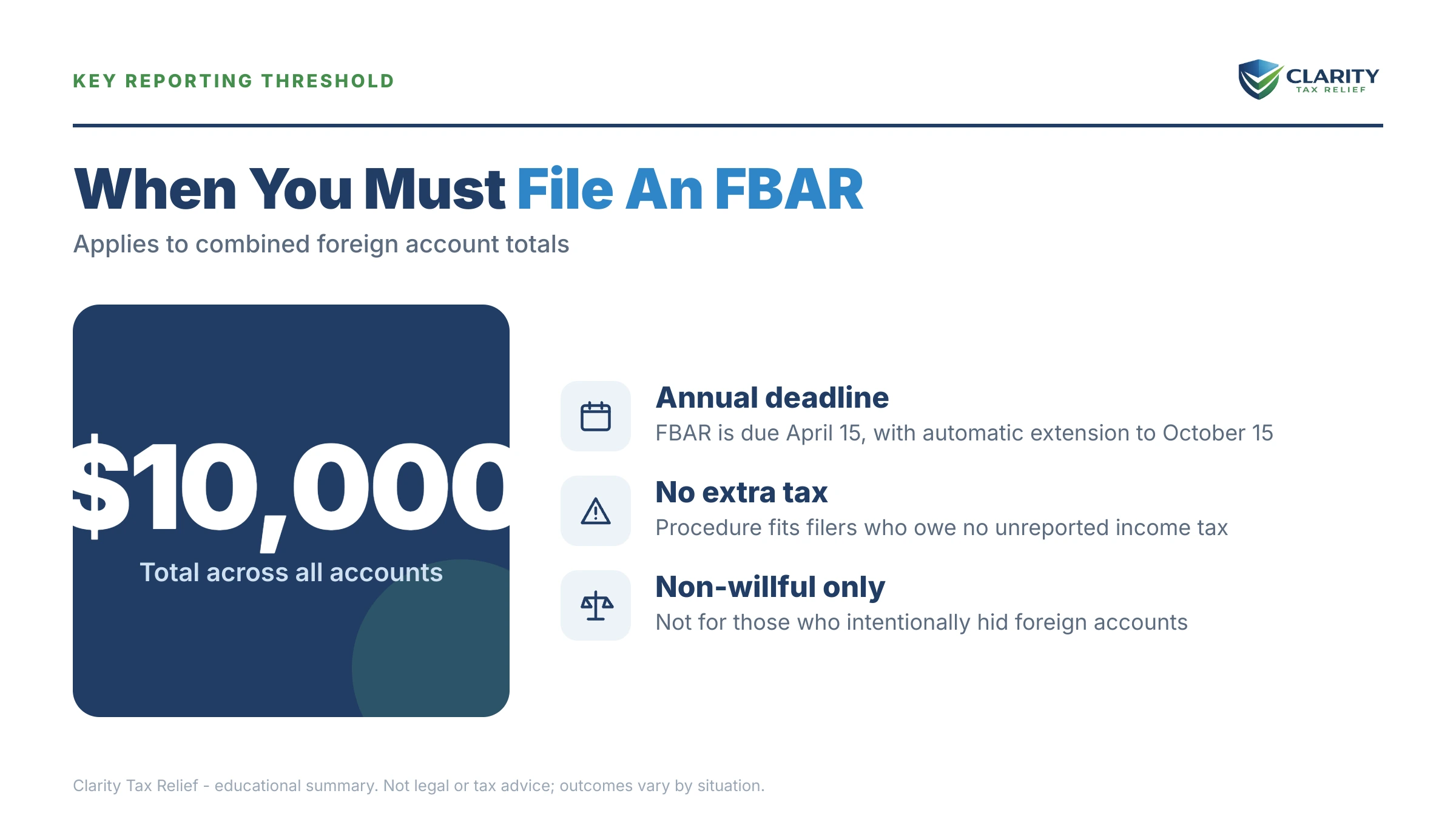
⏱ What changed: on June 30, 2026, the IRS removed the Delinquent FBAR Submission Procedures page from irs.gov. Late FBARs can still be e-filed through FinCEN at any time with an explanation statement — but filing before the IRS contacts you about the accounts remains critical. The government has 6 years from each FBAR's due date to assess penalties for that year, and this year's FBAR is due April 15 with an automatic extension to October 15.
Why you have delinquent FBARs in the first place
An FBAR is required whenever the combined value of your foreign financial accounts exceeds $10,000 at any point in a calendar year. Not $10,000 per account — $10,000 across all foreign accounts combined, even for a single day. Two accounts holding $6,000 each puts you over, and both must be reported at their highest value for the year.
The trap is structural. FinCEN Form 114 is filed on a Treasury e-filing site, not attached to your 1040, so tax software and many preparers never surface it. The most common victims are exactly your situation: someone who worked abroad and left an account open, inherited a parent's overseas account, or kept a pension or savings account from a former home country.
Here's the part that decides your path: did the account's income — interest, dividends, gains — appear on your U.S. tax returns? If yes, you're the person the delinquent FBAR submission procedures were built for, and even with that program gone, the same clean-income facts still work in your favor when you file late through FinCEN. If any of it went unreported, you need the streamlined offshore procedures instead, and using the wrong door can cost you the protection of the right one.
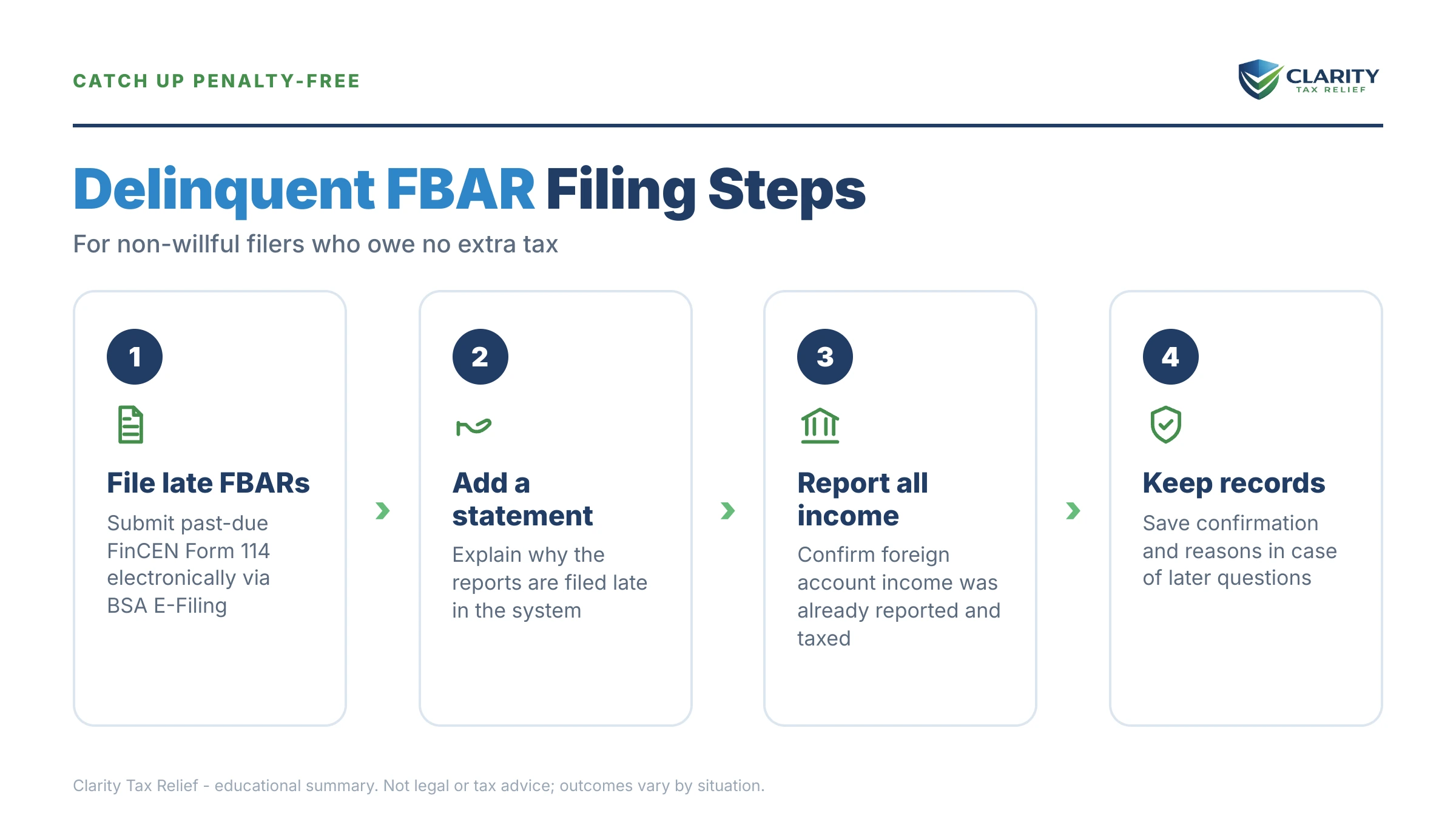
What the delinquent FBAR submission procedures were — and what to do now
Until June 30, 2026, the procedures had three eligibility conditions, all of which had to be true on the day you filed. You hadn't filed one or more required FBARs. You weren't under an IRS civil examination or criminal investigation for the years involved. And the IRS hadn't already contacted you about the delinquent FBARs.
The program then added a fourth test: you properly reported, and paid all tax on, the income from the foreign accounts being reported. Meet all four, and the IRS's stated position was that it would not impose a penalty for the late filings. With the procedures removed from irs.gov, that formal statement is gone — but the mechanics survive. Late FBARs can still be e-filed through FinCEN's BSA E-Filing System with a reason and a brief explanation statement, there's no filing fee and nothing to pay, and penalties are not automatic when all the account income was reported and taxed. What you no longer have is a published program to point to, which is exactly why a professional review of your facts — or the streamlined procedures, if any income went unreported — is worth considering before you file.
Two edge cases worth naming. Married couples: spouses generally each file their own FBAR; one spouse can cover both only when every reportable account is jointly owned and the other spouse signs a Form 114a authorization — if you each had separate accounts, you may each have delinquent filings. Signature authority: if you could sign on a foreign account you didn't own — a relative's account, an employer's — that alone can trigger a filing requirement, even though none of the money was yours.
What happens if you ignore delinquent FBARs
Unfiled FBARs don't fade away — foreign banks report your accounts to the IRS under FATCA whether you file or not. The sequence that follows runs on data matching, and each stage strips away options you have today:
- Your bank reports you. Foreign financial institutions transmit U.S. account holders' names, balances, and income to the IRS under FATCA. The government's copy of your account data exists regardless of what you file.
- Matching flags the gap. IRS systems compare FATCA data against your returns and FBAR filings. Foreign interest on Schedule B next to an unchecked foreign-account box in Part III is an easy automated hit — and in 2026, this matching is automated even while IRS phone lines are thinner than ever.
- A contact letter arrives. An inquiry like Letter 6291 asks about your foreign accounts. The moment it lands, your chance to come forward proactively is gone — and getting ahead of that letter is the single cheapest move in offshore compliance.
- Examination and assessment. An examiner can assess non-willful penalties for each unfiled report still open under the six-year statute. The statutory figure is $10,000 per late report, indexed for inflation, so the current figure runs higher — applied per report, not per account, after the Supreme Court's Bittner decision.
- Willful findings and collection. If the facts suggest you knew and hid — or you mislead the examiner once contacted — willful FBAR penalties reach the greater of an inflation-adjusted $100,000 or 50% of the account balance, per year, and the government can sue to reduce assessed penalties to a court judgment.
These are the clocks running underneath that sequence:
| Clock | What it is | What happens when it runs out |
|---|---|---|
| June 30, 2026 | The date the IRS removed the Delinquent FBAR Submission Procedures from irs.gov | The formal program ended; late FBARs are now filed directly through FinCEN with an explanation |
| April 15, auto-extended to Oct 15 | Each year's FBAR due date — the extension is automatic, no request needed | That year's FBAR becomes delinquent after October 15 |
| The moment the IRS contacts you | An exam notice or foreign-account inquiry such as Letter 6291 | The window to come forward proactively closes for those years |
| 6 years from each FBAR's due date | The government's window to assess FBAR penalties for that year (31 U.S.C. §5321) | Penalty exposure for that specific year closes |
| 2 years after a penalty is assessed | The government's window to sue to collect an assessed FBAR penalty | An unresolved assessment can become a federal court judgment |
Found unfiled FBARs while your refinance is pending?
Filing late FBARs through FinCEN costs nothing — but with the formal delinquent-procedures program gone since June 30, 2026, getting the approach right matters more than ever, and the chance to act proactively ends the moment the IRS's FATCA matching reaches out first. An experienced tax professional will review your accounts and returns free, confirm whether you pass the clean-income test, and map the exact filings you need.
Late FBAR filing vs. streamlined vs. voluntary disclosure
There are four real paths back into offshore compliance, and the right one is decided by two questions: was the income reported, and was the failure willful? This table is the sorting hat:
| Path | Built for | What it costs | What disqualifies you |
|---|---|---|---|
| Late FBAR filing via FinCEN (formerly the Delinquent FBAR Submission Procedures, removed from irs.gov June 30, 2026) | All foreign-account income already reported and taxed; only the FBARs are missing | No fee and no tax to file; penalties are not automatic when all account income was reported and taxed | Unreported income, or IRS exam/contact before you file |
| Streamlined Foreign Offshore (SFOP) | Non-willful conduct plus unreported foreign income, taxpayer meets the non-residency test | 0% offshore penalty; back tax and interest on 3 amended return years | Willful conduct; failing the foreign-residency test |
| Streamlined Domestic Offshore (SDOP) | Non-willful conduct plus unreported foreign income, U.S.-resident taxpayer | 5% of the highest year-end offshore balance, plus back tax and interest | Willful conduct; original returns for the period never filed |
| IRS Voluntary Disclosure Practice | Willful conduct with real criminal exposure | Substantial negotiated civil penalties — in exchange for managed criminal risk | Nothing formally, but it's costly overkill for genuinely non-willful cases |
| Quiet disclosure (filing late with no procedure) | No one — it reads as concealment, not correction | Full penalty exposure stays open on every year | Not a real program; it invites the scrutiny it tries to avoid |
Two cautions. First, resist the shortcut of a quiet disclosure — slipping amended returns in without the proper procedure forfeits the protections and can look like an attempt to hide the pattern; a late FBAR filed with a truthful explanation statement is different from a quiet disclosure. Second, if catching up on foreign income under streamlined leaves you with a balance you can't pay at once, the payment-plan and settlement toolbox is a separate subject — our guide on how to settle tax debt yourself covers those options end to end.
A worked example: three missed FBARs on a $31,200 account
Say you kept a savings account in Germany from a work assignment, and it peaked at $31,200 in its best year. It earned about $260 in interest annually, which your preparer dutifully reported on Schedule B each year — but nobody checked the Part III foreign-account box or filed an FBAR for the three years the account topped $10,000. Now you're refinancing your house and want nothing lurking in federal records. Here's the math on each path:
- If you file late through FinCEN now: three FinCEN Form 114s, each with a one-line late-filing explanation. There's no fee and no tax, and because the income was already reported and taxed, penalties are not automatic — this is the fact pattern the old delinquent FBAR procedures were built for, and those clean-income facts still matter.
- If you wait and get examined instead: three unfiled reports × a non-willful penalty of up to $10,000 each (indexed for inflation, so higher in practice) = $30,000+ of exposure — roughly the entire account, for paperwork.
- If an examiner concludes willfulness — say, because you ignored a contact letter and gave misleading answers — the ceiling per year becomes the greater of an inflation-adjusted $100,000 or 50% of the balance. Even one willful year at 50% of $31,200 is $15,600, and willful penalties stack year by year.
The refinance angle matters here too: filing late FBARs by itself touches neither your credit nor your loan file. An assessed penalty that the government reduces to a federal judgment is a very different animal for a homeowner. In this fact pattern, acting first is what keeps a paperwork problem from becoming a five-figure one. (If you're also juggling an existing IRS balance into a mortgage, see can I refinance with an IRS lien.)
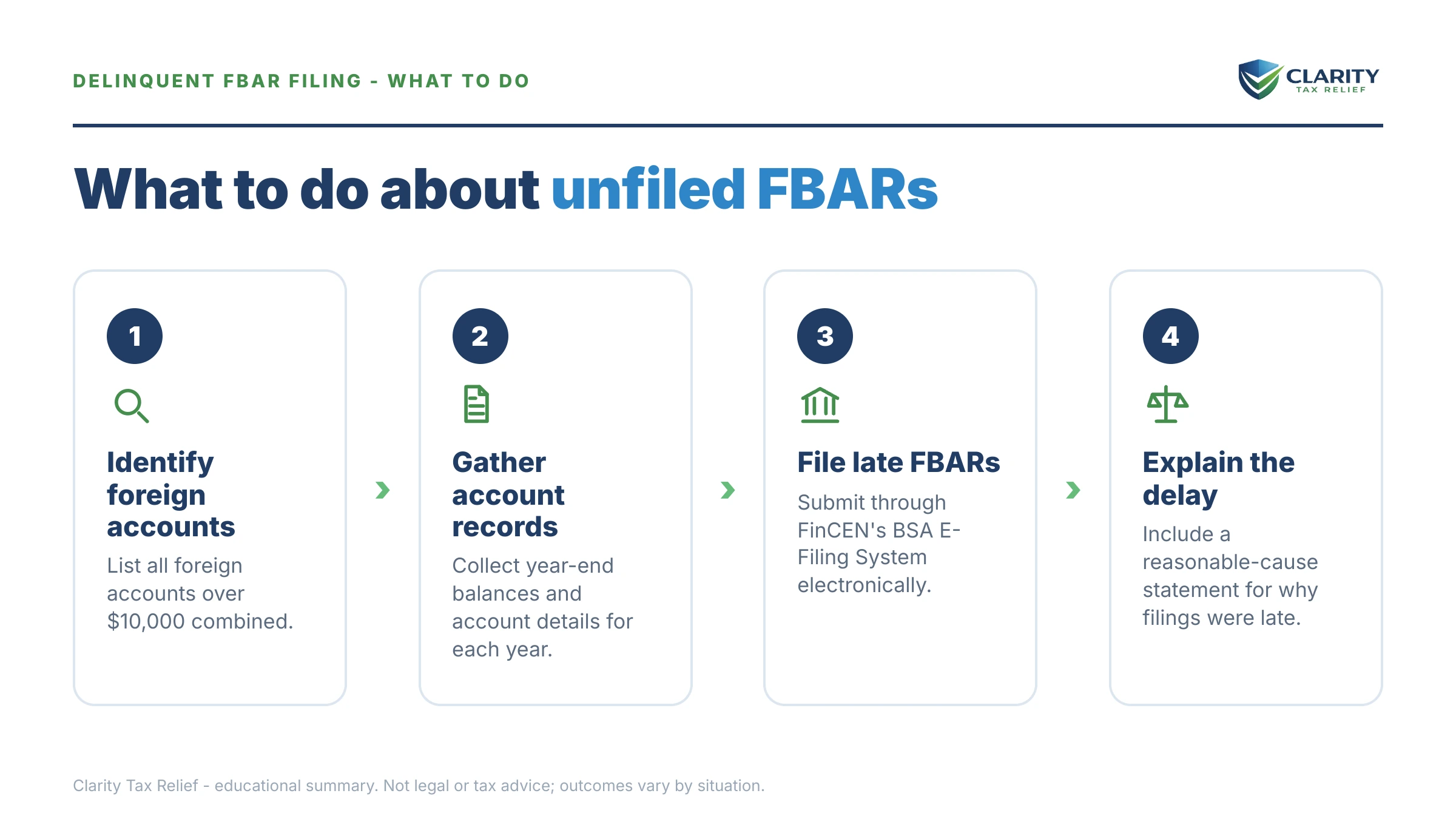
How to file delinquent FBARs, step by step
Even though the IRS's formal procedures ended June 30, 2026, the full filing is still done online through FinCEN — no paper, no mailing, and for most people no more than an afternoon. The image in this guide shows what the form looks like so nothing on the filing screen surprises you.
- Confirm the clean-income test — pull your filed returns for each missed year and verify every dollar of foreign-account interest, dividends, or gains appears on them. If anything is missing, stop and evaluate the streamlined procedures instead.
- Assemble account records — find each foreign account's highest balance for every delinquent year and convert it to U.S. dollars using the Treasury year-end exchange rate.
- Complete one FinCEN Form 114 per year — prepare a separate FBAR for each delinquent year still open under the six-year penalty statute, listing every reportable account for that year.
- E-file through FinCEN with a late-filing explanation — submit each form on FinCEN's BSA E-Filing System, select the reason for filing late, and add a brief, truthful statement.
- Save confirmations and fix the current year — keep every filing acknowledgment, then calendar this year's FBAR, due April 15 with an automatic extension to October 15, so the problem never repeats.
When you can handle this yourself — and when help changes the outcome
The clean case can still be a do-it-yourself project. If you have one or two ordinary bank accounts, every year's interest sits on your filed Schedule B, and you've had zero IRS contact, the FinCEN filing itself is a form-filling exercise. That said, with the formal delinquent-procedures program removed on June 30, 2026, a quick professional review of your facts before you file is cheap insurance — there's no longer a published IRS program to point to if questions come later.
Experienced help earns its cost when the facts get less clean: any income that never hit a return (the streamlined-versus-late-filing call, and the non-willfulness certification that comes with it); potential willfulness indicators like moving money between accounts or telling a banker to hold mail; foreign entities, trusts, or gifts that drag in Form 5471 or Form 3520 penalty exposure; a missed Form 8938 penalty question on top of the FBAR; balances on foreign crypto platforms, where offshore crypto reporting rules are still unsettled; or any letter from the IRS about foreign accounts already in hand. In those cases, the choice of approach — made once, before anything is filed — is the whole ballgame.
Terms on your FBAR filing, decoded
- FBAR / FinCEN Form 114 — the annual Report of Foreign Bank and Financial Accounts, filed with the Treasury's Financial Crimes Enforcement Network, not with your tax return.
- Aggregate balance — the combined value of all your foreign accounts at any single moment in the year; passing $10,000 even for a day triggers the filing duty for every account.
- Non-willful — a failure caused by negligence, mistake, or genuine ignorance of the rule, penalized per late report rather than per account.
- Willful — a knowing or reckless violation, carrying penalties up to the greater of an inflation-adjusted $100,000 or half the account balance, per year.
- FATCA — the law requiring foreign banks to report U.S. account holders to the IRS, which is how unfiled FBARs eventually surface on their own.
- Quiet disclosure — filing late forms without using an official procedure; it preserves full penalty exposure and can read as concealment.
Delinquent FBAR questions, answered
What were the delinquent FBAR submission procedures?
They were an IRS compliance path for people who reported and paid tax on all their foreign-account income but never filed the FBAR itself. Filers submitted the past-due FinCEN Form 114s electronically with a brief statement explaining the late filing, and the IRS's stated position was that no penalty would be imposed when those conditions were met. The IRS removed the procedures from irs.gov on June 30, 2026.
Will the IRS penalize me for filing delinquent FBARs?
Penalties are not automatic. The IRS has long declined to penalize late FBARs when the income from the accounts was properly reported and taxed and the filer wasn't already under examination or contacted about the missing FBARs. With the formal procedures removed on June 30, 2026, no specific outcome can be promised — the filings can be reviewed through normal channels, so accuracy matters. Inflate nothing and omit nothing.
How many years of delinquent FBARs should I file?
File every required year still open under the FBAR penalty statute — in practice, up to the six most recent due years, because the government has six years from each FBAR's due date to assess a penalty. If you've missed fewer years, file only those. Only file for years your accounts actually exceeded the $10,000 aggregate threshold.
What reason should I select for filing my FBAR late?
The BSA e-filing system asks you to select a reason for the late filing from a dropdown — options like not knowing you had to file — plus an "Other" choice with a short explanation box. Tell the truth in plain language. Don't draft an elaborate legal argument; a factual sentence or two is enough, and anything misleading can undermine your position.
Do I need the streamlined procedures instead of the delinquent FBAR procedures?
You need streamlined — not just late FBAR filings — if any income from the foreign accounts never made it onto your U.S. returns. The foreign version carries a 0% offshore penalty for taxpayers who meet the non-residency test; the domestic version costs 5% of the highest year-end offshore balance. Both require certifying your conduct was non-willful.
Is there a deadline to use the delinquent FBAR procedures?
The procedures themselves ended when the IRS removed them from irs.gov on June 30, 2026. Late FBARs can still be e-filed through FinCEN at any time with an explanation statement, but the practical clocks haven't changed: filing before the IRS contacts you about the accounts matters, and each year's penalty exposure stays open for six years from that FBAR's due date.
Do I owe any tax or fee when I file a late FBAR?
No. The FBAR is an information report, not a tax form — filing it creates no tax, no interest, and there is no filing fee. Penalties are not automatic either, particularly when all the account's income was reported and taxed. Money is only at stake if the account's income was never reported (back tax under streamlined) or if penalties are assessed after IRS contact.
What if I also skipped Form 8938?
Form 8938 (FATCA reporting) is a separate IRS form with its own penalties and higher thresholds — filing a late FBAR doesn't fix it. If you were required to attach it and all income was reported, the fix generally means filing the missed form with a reasonable-cause statement. Get a professional review first, because the 8938 penalty rules differ from the FBAR's.
Your next 24 hours
- Find your peak balances. Pull each foreign account's statements for the past six years and mark every year the combined value crossed $10,000 — those are your delinquent years. The official rules live on the IRS FBAR page, and filing happens on FinCEN's BSA E-Filing System.
- Gather your filed returns. Confirm the accounts' interest and dividends appear on Schedule B for each year — that one check decides whether streamlined or a straightforward late FinCEN filing is your path. Note that the IRS's dedicated Delinquent FBAR Submission Procedures page was removed from irs.gov on June 30, 2026, so don't be alarmed when you can't find it.
- Get a free case review. Send your account list and returns through the 2-minute form or call (888) 825-7779. The chance to act proactively lasts only until the IRS's FATCA matching contacts you first — filing before that letter arrives is the entire strategy.
This guide is general information, not tax or legal advice for your specific situation. Eligibility for IRS programs depends on individual facts and circumstances; no outcome is guaranteed.