
International & Crypto
Offshore Crypto Reporting: What the IRS Requires in 2026
The short answer: offshore crypto reporting covers three duties in 2026. Crypto income is always taxable, no matter where the exchange sits. Form 8938 generally applies once foreign-exchange holdings top $50,000 (single filer, year-end). And the FBAR's $10,000 trigger applies when the account also holds regular currency. Past years can usually be fixed through streamlined disclosure.
You opened an account on an overseas exchange years ago — maybe it listed coins the U.S. platforms didn't, maybe it was set up during your marriage and landed in your column after the divorce. Now you've read that foreign accounts have to be disclosed, and you're not sure whether crypto counts or how many years back the problem reaches. It does have a clean fix — and the fix is cheapest while the IRS hasn't contacted you yet.
Two things make offshore crypto reporting unusual: crypto-only foreign accounts sit in an FBAR gray zone that FinCEN has publicly said it intends to close, while Form 8938 already reaches foreign-exchange crypto at $50,000 for a single filer. The image below shows exactly which forms are in play and where your numbers go, so you can match your own situation as you scroll.
⏱ The real clocks: annual FBARs are due April 15, with an automatic extension to October 15 — no request needed. For past years, the deadline isn't printed on any letter: the streamlined path closes the moment the IRS contacts you or opens an exam first, and interest on any unpaid tax keeps accruing until it's paid.
Why crypto on a foreign exchange is an IRS problem
Holding crypto on a foreign exchange creates up to three separate obligations: income tax, an FBAR filed with FinCEN, and Form 8938 filed with your return. Most people conflate them, and the confusion is where the penalties live. Reporting the income does not disclose the account; disclosing the account does not report the income. Each has its own form, its own threshold, and its own penalty.
The income duty has no threshold at all. Every sale, swap, staking reward, and interest payment is taxable the year it happens, whether the platform is in Austin or the Seychelles, and whether or not any form ever arrives. U.S.-based brokers now issue Form 1099-DA on your trades; foreign exchanges send nothing — which changes what the IRS sees, not what you owe. If your platform is U.S.-based and the issue is only unreported trades, that's a different problem — see didn't report crypto taxes.
There's also a trap printed on page one of your tax return: the digital-asset question. Answering "No" while holding and trading offshore crypto converts a paperwork lapse into evidence of intent. A false answer on the 1040's digital-asset question is the single fact most likely to turn a fixable problem into a willfulness problem.
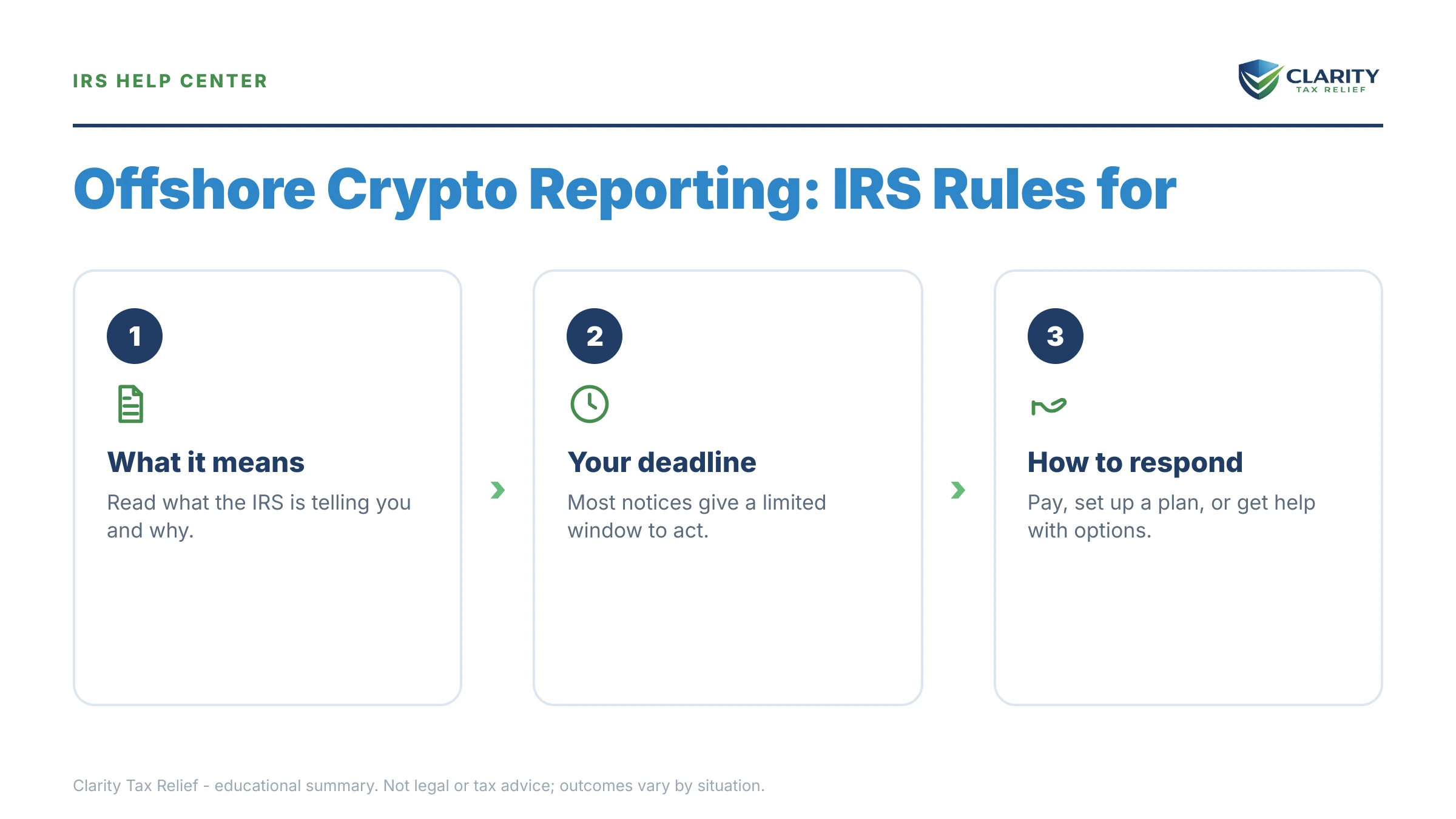
Offshore crypto reporting rules: which forms apply in 2026
Three forms do almost all the work in offshore crypto reporting, and each switches on at a different dollar amount. Here is the full map for a single U.S. resident — the filing status matters, as you'll see below.
| Form | 2026 trigger (single U.S. resident) | Does foreign-exchange crypto count? |
|---|---|---|
| Form 1040 + Form 8949 / Schedule D | No threshold — all income and disposals | Yes — always, everywhere |
| FBAR (FinCEN Form 114) | $10,000 aggregate across foreign accounts at any point in the year | Gray zone for crypto-only accounts; yes when the account also holds regular currency |
| Form 8938 (FATCA) | $50,000 at year-end or $75,000 at any point | Generally yes when a foreign exchange custodies the account; a self-custodied wallet generally no |
| Form 3520 | Gifts from a foreign person over $100,000 | Yes — crypto gifts and inheritances count at fair market value |
The FBAR gray zone. FinCEN's regulations don't yet list virtual currency as a reportable account type, and FinCEN said so in writing — while announcing its intent to amend the rules. But the moment your foreign exchange account holds euros, dollars, or any fiat alongside coins, it's a hybrid account, and the ordinary $10,000 rule applies. Because the rule is in motion and the downside of guessing wrong is a five-figure FBAR penalty, the conservative practice most experienced tax professionals follow is simple: file the FBAR anyway. It costs nothing, and it starts the statute of limitations running in your favor.
The Form 8938 side is not gray. Crypto held in an account with a foreign financial institution — which is what a custodial foreign exchange is — is generally treated as a specified foreign financial asset. Coins in a hardware wallet you control are generally not, because there's no account with any institution. The dividing line is custody, not geography.
Divorce cuts your thresholds in half. Married filing jointly, the 8938 trigger for U.S. residents is $100,000 at year-end or $150,000 at any point. File single or head of household, and it drops to $50,000 / $75,000. An account that was legally invisible to Form 8938 on your last joint return can become fully reportable on your first return alone — with nothing about the account changing at all. If you received the account in the settlement, the reporting duty arrives with it, whatever the decree says about who handles taxes.
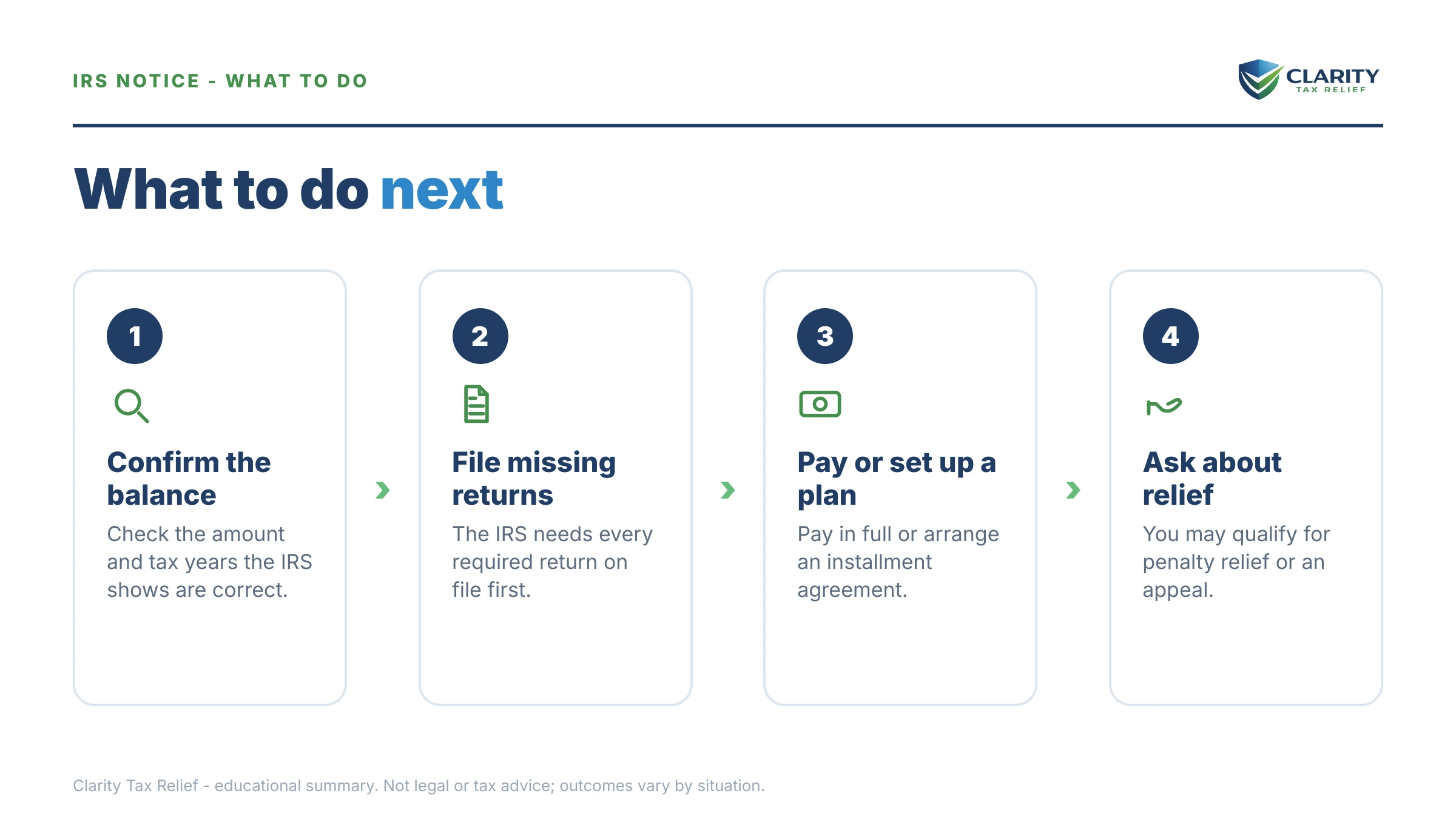
What happens if you never report offshore crypto
Offshore crypto non-reporting doesn't escalate on a mailed-notice schedule — it escalates when data arrives, and the data is arriving. The sequence runs in stages, and your options shrink at each one:
- The IRS gets the data. John Doe summonses have already pulled customer records from major exchanges, blockchain analytics firms map wallet addresses to identities, and more than 60 countries have committed to the OECD's Crypto-Asset Reporting Framework — under which foreign exchanges begin sharing account information with tax authorities starting with 2026 data.
- Soft letters arrive. Letters 6174 and 6174-A tell you the IRS believes you have digital-asset transactions; IRS Letter 6173 demands a signed response under penalties of perjury. Once any of these arrives, the voluntary-disclosure window is closing.
- The mismatch becomes a bill. A CP2000 proposal or a full examination reconstructs the unreported gains — using the exchange's numbers, not yours, and often assuming zero cost basis.
- The penalty stack lands. A missed Form 8938 penalty starts at $10,000 and grows by $10,000 per 30 days after IRS notice (up to $50,000 more), plus a 40% accuracy penalty on tax tied to the undisclosed asset. Where the FBAR applies, non-willful penalties start around $10,000 per report; willful penalties run to the greater of $100,000 or 50% of the balance, per year.
- Assessment becomes collection. The balance enters the ordinary machine — liens, bank levies, wage levies — and every amnesty-style path in the table below is off the menu, because they all require that you came forward first.
The order matters more than the speed. Nothing in this sequence requires a human to find you; the data-matching and notice systems run automated, even with IRS staffing down roughly 27% since 2025.
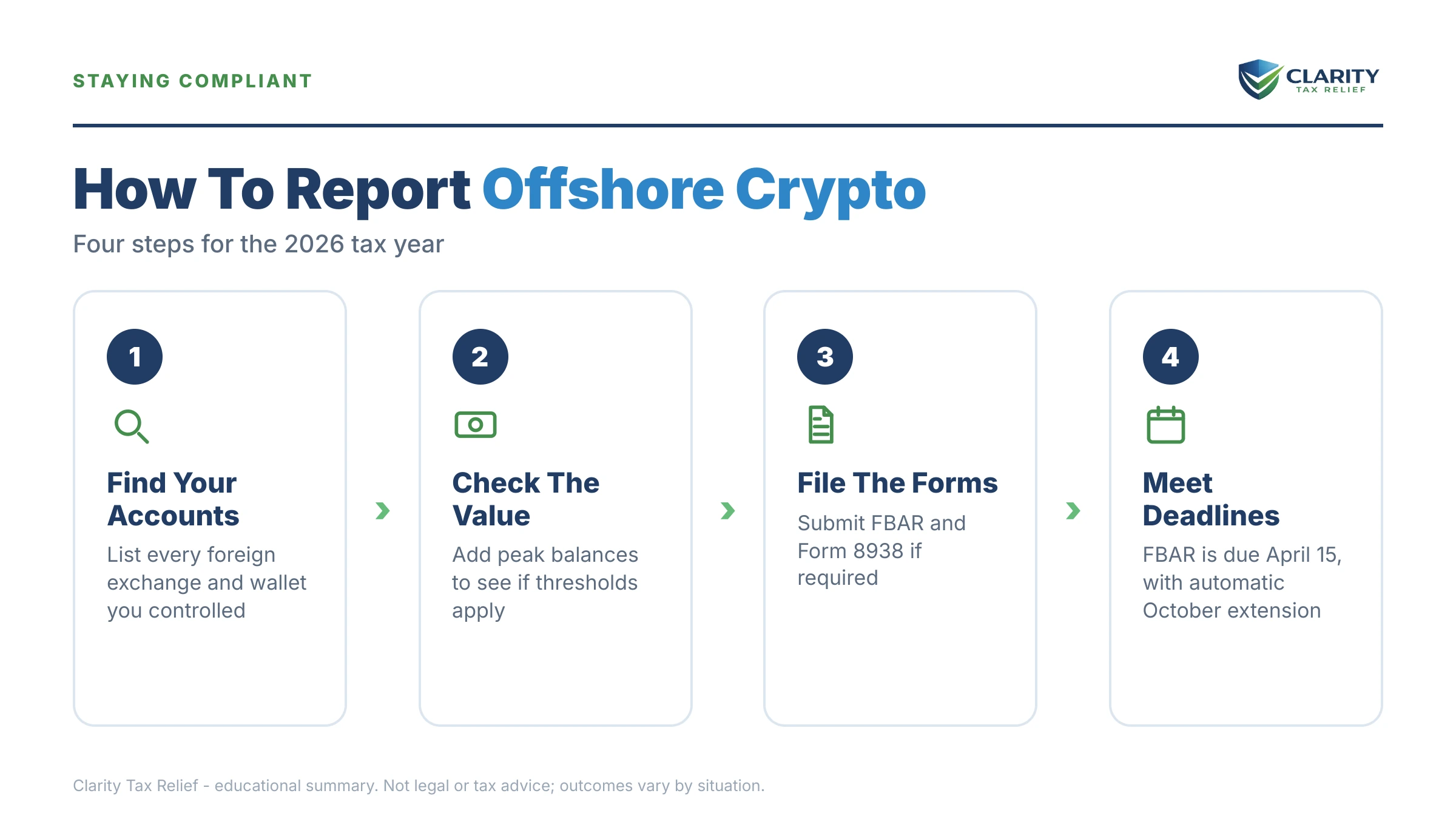
Unreported crypto on a foreign exchange?
The streamlined path only stays open while you come forward before the IRS contacts you. Get your accounts and open years reviewed free by an experienced tax professional — which path you qualify for, and what it would cost, before anything is filed.
Your options for fixing unreported offshore crypto
The IRS maintains formal disclosure paths for exactly this situation, and the right one depends on two facts: whether tax was actually missed, and whether the failure was willful. Non-willful means you didn't know and had no reason to know — carelessness qualifies; deliberately hiding does not.
| Disclosure path | Who it fits | Penalty cost |
|---|---|---|
| Late FBAR e-filing through FinCEN with an explanation (the IRS removed the Delinquent FBAR Submission Procedures June 30, 2026) | All income was reported and tax paid — only the FBAR forms were missed | Penalties are not automatic when the income was reported and taxed, but there is no longer a guaranteed penalty-free program |
| Streamlined Domestic Offshore (SDOP) | U.S. residents whose failure was non-willful, with unreported income | 5% of the highest year-end foreign-asset balance, plus back tax and interest |
| Streamlined Foreign Offshore (SFOP) | Non-willful filers who meet the non-residency test | 0% offshore penalty; back tax and interest still due |
| Voluntary Disclosure Practice (VDP) | Conduct that was — or could be seen as — willful | Substantial negotiated penalties, in exchange for protection against criminal referral |
| Quiet disclosure (just amending) | Nobody — it flags the very years it tries to bury | Full penalty exposure remains, plus lost streamlined eligibility |
The IRS removed the Delinquent FBAR Submission Procedures on June 30, 2026, but if you reported every dollar of crypto income and only the account forms are missing, late FBARs can still be e-filed through FinCEN with a short explanation — penalties are not automatic when the income was reported and taxed, though there is no longer a guaranteed penalty-free program. The streamlined domestic offshore path adds three years of amended returns, six years of FBARs, and a Form 14654 certification that the failure was non-willful — signed under penalties of perjury, which is why the willfulness question deserves honest analysis before you sign. Filers who meet the non-residency test use the streamlined offshore procedures instead and skip the 5% penalty entirely — but note that path lives at streamlined foreign offshore procedures; full IRS terms are on the official streamlined filing compliance procedures page.
If the facts lean willful — a false "No" on the digital-asset question year after year, moving coins between exchanges to avoid U.S. platforms' reporting — IRS voluntary disclosure is the path built to keep a civil problem civil. And the shortcut everyone is tempted by, simply amending returns without any program, is the quiet disclosure the IRS specifically watches for.
Whatever the path, any resulting balance is then ordinary tax debt with ordinary solutions — payment plans, hardship status, and in narrow cases settlement. That side of the problem is covered in how to settle tax debt yourself, and the mechanics of paying are compared in best way to pay the IRS.
A worked example: $68,500 offshore after a divorce
Say you divorced in 2025 and kept the couple's account on a foreign exchange, now worth $68,500 at year-end. This is hypothetical, but the math is exactly what a review would run.
On your joint returns, the account never crossed the $100,000 married-filing-jointly year-end threshold, so Form 8938 never applied. On your first single return, the threshold is $50,000 — and $68,500 clears it. Same account, new duty. If the account ever held fiat over $10,000 alongside the coins, the FBAR applied too, in every one of those years.
Now add the income side. Suppose staking rewards and small gains totaling $9,000 went unreported across three years. At a 24% rate, that's roughly $2,160 in back tax, plus failure-to-pay penalties at 0.5% per month and daily interest — you can estimate that side with our IRS Penalty & Interest Calculator.
Fix it through SDOP and the offshore penalty is 5% of the highest year-end balance: 5% × $68,500 = $3,425. Total cost of coming forward: roughly $2,160 tax + $3,425 penalty + interest — call it under $6,500.
Wait to be found instead, and the arithmetic inverts: a $10,000 Form 8938 penalty, a 40% accuracy penalty on the tax (about $864), and — if the FBAR applied and the IRS argues willfulness — exposure up to 50% × $68,500 = $34,250 per year. Coming forward first isn't just safer; on these numbers it's five to ten times cheaper.
How to fix offshore crypto reporting, step by step
- Inventory every offshore account and wallet. List each foreign exchange and wallet you've used, then download the full transaction history and year-end balance statement for every open year while you still have login access — exchanges shut down, and records disappear with them.
- Run the threshold math for each year. Compare your highest combined balance and year-end values against the $10,000 FBAR trigger and the Form 8938 thresholds for your filing status in that year — remember the thresholds change if your filing status changed.
- Reconstruct the unreported income. Calculate gains, losses, staking rewards, and interest for each year you didn't report. Whether any tax was actually missed determines which disclosure path you're eligible to use.
- Choose the disclosure path that matches your facts. If no tax was missed, e-file the late FBARs through FinCEN with an explanation (the IRS removed the Delinquent FBAR Submission Procedures on June 30, 2026); use the streamlined procedures if the failure was non-willful, and the Voluntary Disclosure Practice if willfulness is a genuine question — never a quiet disclosure.
- File the package, pay or arrange payment, and stay current. Submit the returns, FBARs, and certification together, pay what you can, and set up a payment plan for any balance. Then report every account and answer the digital-asset question honestly going forward.
The IRS's own rules for the account report are on its FBAR page, and its current digital-asset guidance lives at IRS.gov/filing/digital-assets.
When you can handle this yourself — and when you shouldn't
Not every offshore crypto situation needs professional help. If your foreign holdings sit below every threshold and you've reported all the income, you have no disclosure problem — answer the digital-asset question honestly, keep records, and file the forms in any year you cross a line. If you reported all your income and only missed FBAR forms, the fix is genuinely DIY-friendly: e-file the late FBARs through FinCEN with a brief explanation — penalties are not automatic when the income was reported and taxed, though since the IRS removed the Delinquent FBAR Submission Procedures on June 30, 2026, there is no longer a guaranteed penalty-free program. You can also set up an IRS online account setup to confirm nothing has been assessed against you yet.
Experienced help changes the outcome in four situations. First, anywhere willfulness is arguable — the non-willful certification is signed under penalties of perjury, and signing it wrongly makes things worse, not better. Second, multiple years of unreported gains needing basis reconstruction across dead or offshore platforms. Third, any case where a Letter 6173, a summons notice, or an exam letter has already arrived — the amnesty math changes completely. Fourth, divorce-tangled ownership, where who held, controlled, and must report the account across the joint and single years needs to be established before anything is filed.
Terms on the forms, decoded
- FBAR (FinCEN Form 114) — the annual foreign-account report filed with FinCEN, not the IRS, triggered at $10,000 in combined foreign-account value at any point in the year.
- FATCA / Form 8938 — the IRS's own foreign-asset disclosure, attached to your tax return, with thresholds that depend on filing status and where you live.
- Willful vs. non-willful — the line between penalties measured in thousands and penalties measured in half your account: non-willful means you didn't know and had no reason to know.
- Streamlined filing compliance procedures — the IRS's formal catch-up programs for non-willful offshore failures, with a 5% penalty domestically and 0% for qualifying non-residents.
- Quiet disclosure — amending old returns or filing late forms outside any program, hoping nobody notices; the IRS screens for it specifically.
- CARF — the OECD's Crypto-Asset Reporting Framework, under which foreign exchanges begin sharing customer account data with tax authorities, starting with 2026 information.
Offshore crypto reporting questions, answered
Do I have to report crypto held on a foreign exchange to the IRS?
Yes — the income side is never optional. All crypto gains, staking rewards, and trading income are taxable and must go on your Form 1040 regardless of where the exchange is based. Separately, if the account's value crosses the Form 8938 threshold — $50,000 at year-end for a single U.S. resident — the account itself generally must be disclosed too.
Does cryptocurrency count for FBAR in 2026?
An account holding only crypto sits in a regulatory gray zone: FinCEN has said current FBAR rules don't yet name virtual currency as reportable, but it announced its intent to change them. If the same foreign account also holds regular currency and the combined value tops $10,000 at any point in the year, an FBAR is required. Most experienced tax professionals recommend filing either way, because filing costs nothing and not filing risks five-figure penalties.
What is the Form 8938 threshold for offshore crypto?
For a single U.S. resident, Form 8938 applies when specified foreign financial assets exceed $50,000 on the last day of the year or $75,000 at any point during it. Married filing jointly doubles those to $100,000 and $150,000, and taxpayers living abroad get higher limits. Crypto held in an account with a foreign exchange is generally counted; coins in a self-custodied wallet generally are not, because there is no account with a foreign institution.
Can the IRS see my foreign crypto exchange account?
Increasingly, yes. The IRS has used John Doe summonses to pull customer records from major exchanges, blockchain analysis ties wallet addresses to identities, and more than 60 countries have committed to the OECD's Crypto-Asset Reporting Framework, under which foreign exchanges begin sharing account data with tax authorities starting with 2026 information. The safe assumption is that offshore no longer means invisible.
What are the penalties for not reporting a foreign crypto account?
The stack can dwarf the tax itself. A missed Form 8938 carries a $10,000 penalty, rising by $10,000 per 30 days (up to $50,000 more) after an IRS notice, plus a 40% accuracy penalty on tax tied to the undisclosed asset. Where the FBAR applies, non-willful violations start around $10,000 per report, and willful violations run to the greater of $100,000 or 50% of the account balance — per year.
Can I just start reporting my offshore crypto this year and ignore the old years?
That approach — a quiet disclosure — is one of the riskiest moves available. Suddenly reporting a large foreign account with no explanation flags the earlier years rather than burying them, and it forfeits the penalty protection the streamlined procedures offer. If past years are clean of unreported income, late FBARs can still be e-filed through FinCEN with an explanation — penalties are not automatic when the account income was reported and taxed, though the IRS removed the penalty-free Delinquent FBAR Submission Procedures on June 30, 2026; if income was missed, streamlined disclosure caps the damage.
Does divorce change my offshore crypto reporting thresholds?
Yes — Form 8938 thresholds are cut in half when you stop filing jointly. An account worth $68,500 was below the $100,000 joint year-end threshold but is well above the $50,000 single threshold, so the same account can become reportable the first year you file alone. Assets received in a divorce settlement also arrive at your new filing status's thresholds, so check the year you take ownership.
Your next 24 hours
- Log into every foreign exchange you've ever used and download the full transaction history and year-end balance statements — do this first, before anything else, while you still have access.
- Gather your last three years of tax returns and any FBARs you've filed, plus divorce settlement documents showing when the account became yours — the threshold math turns on those dates.
- Get a free case review — the streamlined paths only stay open while you come forward before the IRS contacts you, and interest on any missed tax accrues until it's resolved. Use the 2-minute form or call (888) 825-7779; an experienced tax professional will tell you which path fits your facts before anything is filed.
This guide is general information, not tax or legal advice for your specific situation. Eligibility for IRS programs depends on individual facts and circumstances; no outcome is guaranteed.