
Tax Debt Help
Crypto Tax Debt Help: How to Fix What You Owe the IRS in 2026
The short answer: crypto tax debt help starts with two moves. First, confirm the IRS's number is right — many crypto bills are inflated because the IRS matched gross proceeds with zero cost basis. Then resolve the corrected balance through a payment plan, hardship status, penalty relief, or an Offer in Compromise if your finances qualify.
Maybe it started with an exchange 1099 you never saw, or a CP2000 that priced every sale as pure profit — and now the letters mention levies while you're renting, with no home equity to borrow against, on a balance bigger than anything you actually cashed out. Here's the part the notices don't say: crypto tax debt is one of the few IRS debts that often shrinks before you negotiate it, because the assessed number is frequently wrong in the IRS's favor.
This guide is the full map: how the IRS built your number, how to correct it, which letters carry real enforcement power, and every realistic way to resolve what's left. The image below shows you exactly what the IRS's crypto letters look like and where your situation sits on the escalation path — worth a glance before you decide anything.
⏱ The clocks that are running: interest compounds daily and the failure-to-pay penalty adds 0.5% per month to your balance whether or not you respond. And if you've received an LT11 or Letter 1058, you have 30 days from the date on that letter to request a Collection Due Process hearing before the IRS can levy your wages, bank account, or exchange account.

Why you owe taxes on crypto — and why the bill is often wrong
Most crypto tax debt comes from income the IRS can see but a basis it cannot. U.S. exchanges report customer sales to the IRS — starting with 2025 transactions, on Form 1099-DA — and the IRS's computers match those reports against your return. When you didn't report the sales, the system proposes tax through a CP2000 notice or, if you never filed at all, assesses it for you.
Here's the trap specific to crypto: exchange reporting often shows what you sold for, not what you paid. If you bought a coin for $18,000 and sold it for $20,000, your real gain is $2,000 — but a zero-basis match taxes the full $20,000. Multiply that across a year of trades and the IRS's number can be several times your true liability.
Three other crypto-specific triggers create these debts:
- Ordinary income you didn't expect: staking rewards, mining income, and airdrops are generally taxable when received — before you ever sell.
- Transfers that look like sales: moving coins between your own wallets and exchanges isn't a taxable event, but it can show up as proceeds in third-party data, inflating a proposed assessment.
- Real gains with no cash left: you sold high, rebought, and the market dropped. The tax on last year's gain is still due even though the portfolio that produced it is gone.
If your situation is "I traded for years and never put any of it on a return," start with our guide to what to do if you didn't report crypto — the filing-first sequence there feeds directly into the resolution options below.
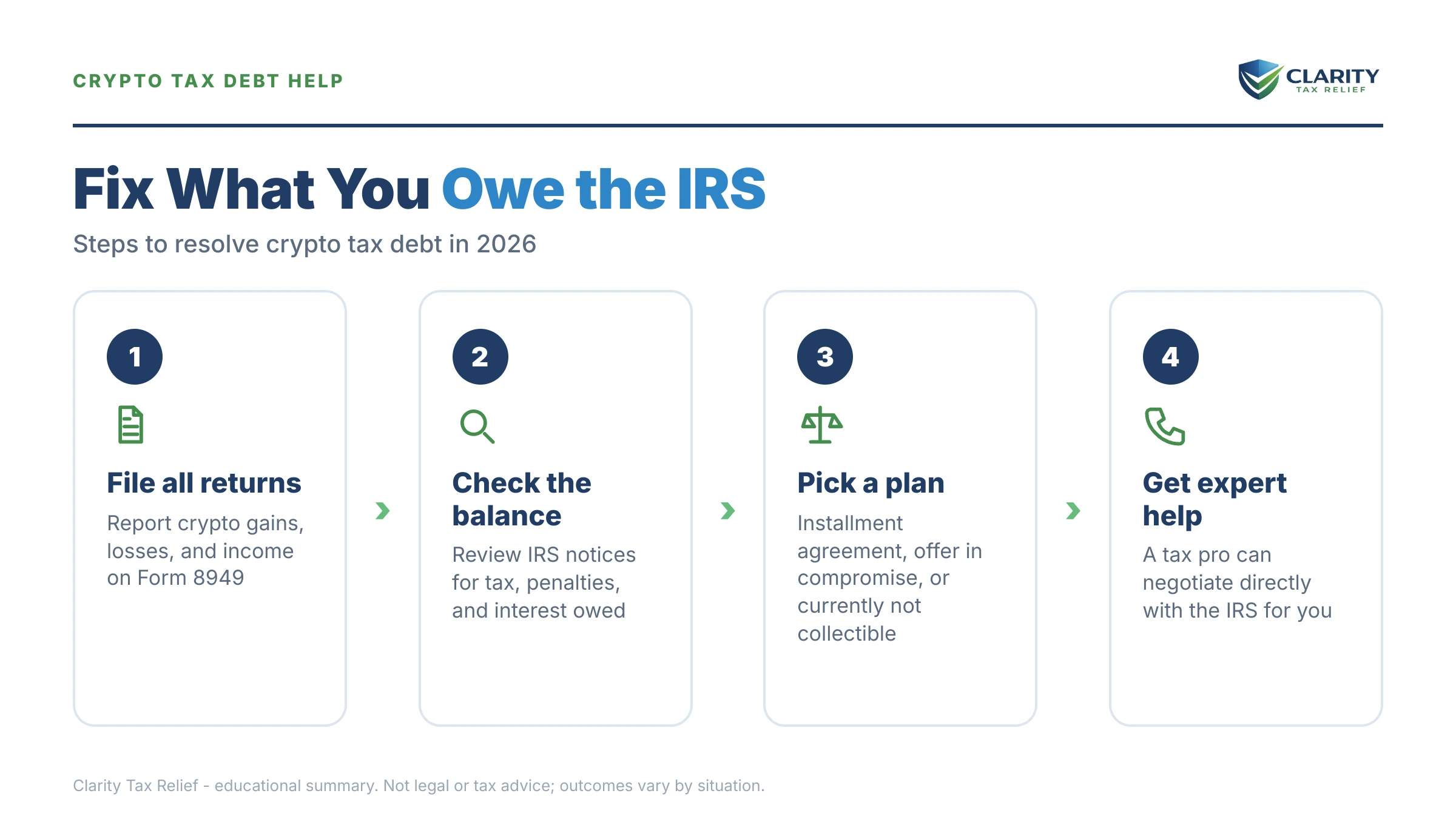
Step zero: make sure the crypto number is even right
Correcting an inflated crypto assessment is often worth more than any relief program. Before you set up a payment plan on $60,000, find out whether the real number is $19,000.
Rebuild your cost basis trade by trade on Form 8949. Export your transaction history from every exchange you used, pull wallet activity from blockchain explorers for on-chain moves, and let crypto tax software do the matching if the volume is high. Your IRS wage and income transcript shows exactly what third parties reported under your SSN — that's the number you're correcting against.
Then use the right vehicle for the correction:
- CP2000 still open? Respond by the deadline on the notice with your Form 8949 and basis documentation — you're disputing a proposal, not an assessed debt, and this is the cheapest stage to fix it.
- Already assessed? You can often amend a return to reduce the tax debt, or request audit reconsideration with the reconstructed records. Penalties and interest recalculate downward with the tax.
- Records genuinely gone? A documented good-faith reconstruction — reasonable methods, explained in writing — is far stronger than accepting a zero-basis assessment by default.
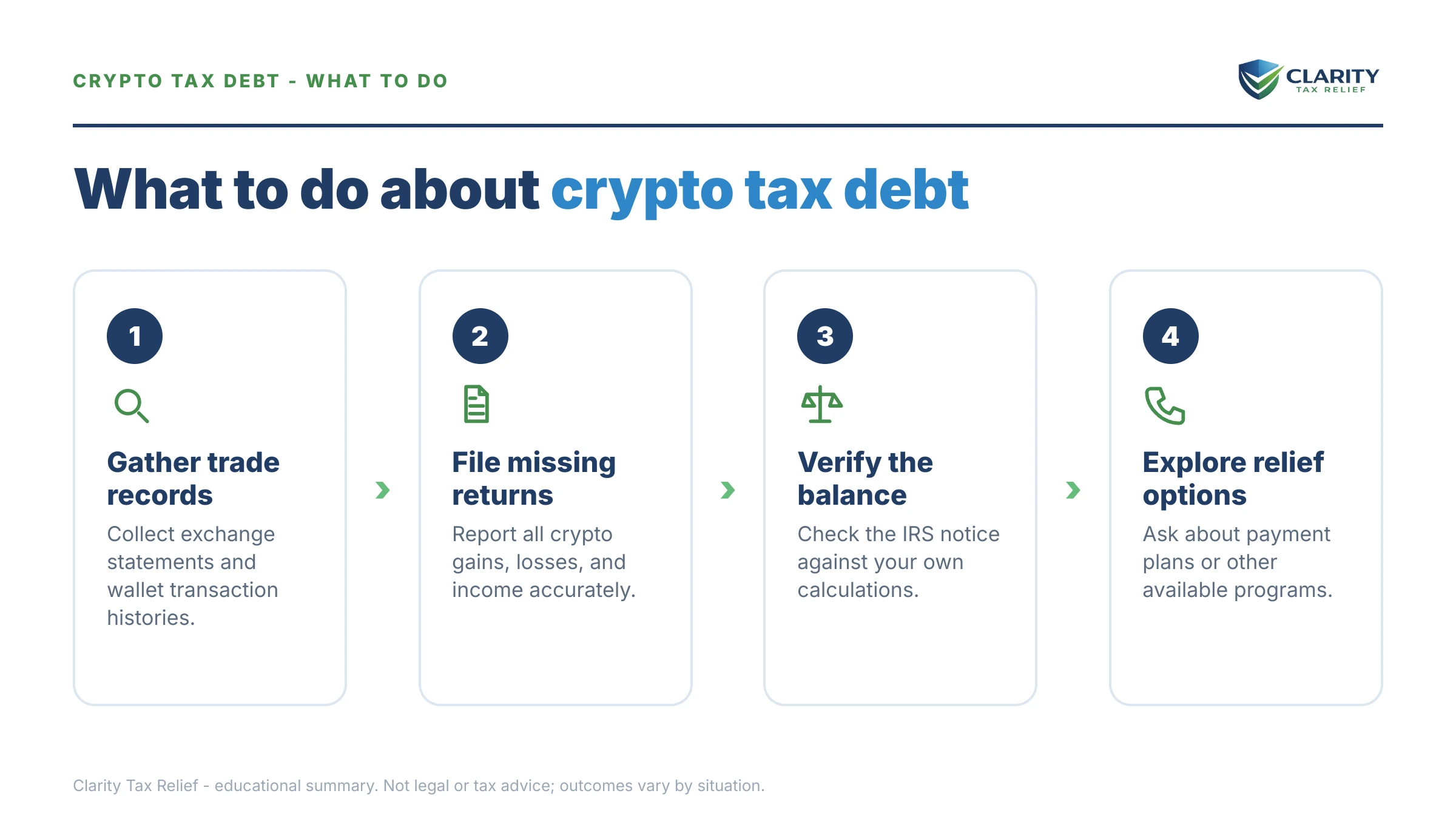
The IRS crypto letters, decoded
The IRS uses a distinct set of letters for digital assets, and they carry very different weight. A Letter 6174 requires nothing; a Letter 6173 requires a sworn response; an LT11 precedes an actual levy.
| Letter / notice | What it means | Response required? |
|---|---|---|
| Letter 6174 / 6174-A | Educational — the IRS believes you have crypto accounts and is reminding you of reporting rules | No, but review your filings; the IRS is telling you it's looking |
| Letter 6173 | The IRS wants returns filed or amended — or a sworn statement that you're compliant | Yes, by the printed date, under penalty of perjury |
| CP2000 | Proposed tax from matching exchange reports against your return — often zero-basis | Yes — agree, or dispute with Form 8949 and basis records |
| CP14 → CP501/CP503 | The debt is assessed; these are bills and reminders, growing monthly | Pay or arrange a resolution; no enforcement yet |
| CP504 | Intent to levy your state tax refund under IRC §6331(d); a lien filing becomes likely | Act now — the next letter carries full levy power |
| LT11 / Letter 1058 | Final Notice of Intent to Levy — wages, bank accounts, and exchange accounts are reachable after 30 days | Yes — request a CDP hearing within 30 days to pause levy action |
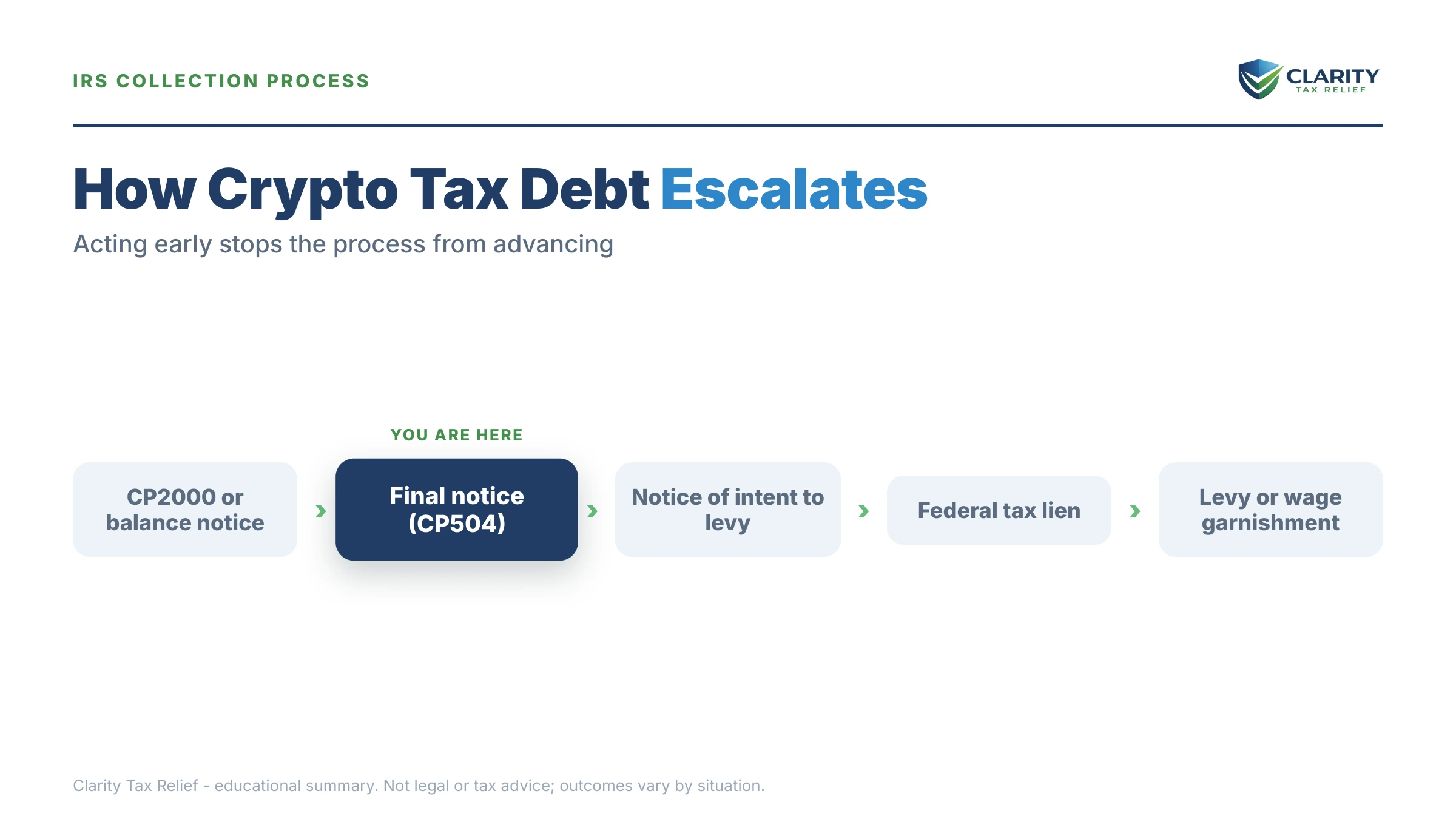
What happens if you ignore crypto tax debt
Crypto tax debt escalates on the same automated collection track as any IRS balance — the machine doesn't care that the money came from tokens. The sequence runs in this order:
- Assessment. The debt goes on the books — through a CP2000 you didn't answer, a return the IRS filed for you, or your own return filed without payment. Interest and the failure-to-pay penalty start here.
- Billing cycle. CP14, then CP501 and CP503 reminders. No enforcement yet, but the balance compounds every month you wait.
- CP504. The IRS can now seize your state tax refund, and a federal tax lien — a public claim against everything you own, including your crypto — becomes a real possibility.
- LT11 / Letter 1058. The final notice. It opens a 30-day window to request a Collection Due Process hearing; once that window closes, levies are authorized.
- Enforcement. A bank or exchange levy freezes funds with a 21-day hold before the money leaves; a wage levy is continuous until released; and at $66,000 of certified debt (the 2026 threshold), passport denial or revocation enters the picture.
One 2026 reality makes this worse, not better: the IRS workforce shrank roughly 27% in 2025, so reaching a human is harder than ever — but the notices, liens, and levies are generated by automated systems that never stopped running. Silence doesn't buy time; it just moves you down the list.
Crypto letters escalating toward a levy?
Send us what you're holding — the notices and your exchange history. An experienced tax professional will check whether your balance is inflated by zero-basis matching and map your options before enforcement starts. If you have an LT11, the 30-day hearing window on it is real — don't let it lapse.
Crypto tax debt help: your real resolution options
Once the number is corrected, every standard IRS resolution program applies to crypto tax debt — with one twist: your remaining coins are an asset the IRS counts. (For the general mechanics of each program, see our pillar on how to settle tax debt yourself; here's how each one plays with crypto.)
| Option | Who qualifies | Cost and the crypto catch |
|---|---|---|
| Short-term payment plan | Anyone who can pay in full within 180 days | $0 setup; interest and penalties continue. Good fit if you're planning a deliberate coin sale to raise the cash. |
| Guaranteed installment agreement | Balance of $10,000 or less, returns filed, payoff within 3 years | IRS must accept; small setup fee. Simplest path for small balances. |
| Streamlined installment agreement | Up to $50,000 — set up online over as long as 72 months | No financial disclosure required, so your crypto holdings aren't examined. Setup fee is lowest with online direct debit. |
| Currently Not Collectible | Paying anything would prevent basic living expenses (Form 433-F review) | Collection pauses; debt and interest remain. Meaningful crypto holdings usually defeat the hardship claim — they're an asset you could liquidate. |
| Offer in Compromise | Assets plus future income genuinely can't cover the debt before the CSED | $205 fee + 20% down on lump-sum offers (both waived with low-income certification, AGI ≤ 250% of poverty). Remaining crypto is valued into your offer. |
| Penalty relief (FTA / AEP) | Clean compliance history in the prior 3 years, or reasonable cause | Free. Removes penalties, not tax or interest — often thousands on a multi-year crypto debt. |
| Bankruptcy | Older income-tax debt meeting the age and filing tests | Court costs and credit impact; recent crypto tax years generally don't qualify for discharge. |
A few crypto-specific notes on the big three:
Payment plans. Under $50,000 (after correction — another reason to fix the number first), you can set up a streamlined agreement online without anyone reviewing your wallet. Once a plan is active, the failure-to-pay penalty rate drops to 0.25% per month, and enforcement stops as long as you stay current.
Offer in Compromise. The IRS decides offers on Reasonable Collection Potential — your net asset equity plus a multiple of your monthly disposable income. Your coins go in the asset column at current value. If the math genuinely shows the IRS can't collect the full balance, an offer is real; the IRS accepted roughly 1 in 5 offers in FY2024, and an offer left undecided for 2 years is accepted automatically — with narrow exceptions: a returned or rejected offer stops the clock, and time during court disputes does not count. You can estimate your own numbers with our Offer in Compromise Calculator before spending anything on the application.
Penalty relief. If this crypto debt is your first slip after three clean years, first-time penalty abatement can strip the penalties from a year. And starting in summer 2026, the IRS's new Automatic Exemption from Penalty (AEP) begins applying qualifying relief automatically — no request needed — so check whether penalties on your account have already been reduced before you pay them.
If the debt is truly unpayable and old enough, chapter 7 vs 13 tax debt rules are worth understanding — but for most crypto debts, which are recent, bankruptcy discharges little of the tax itself.
How much you owe on crypto changes the playbook
The balance band you land in — after correcting the number — determines which doors are open without a full financial disclosure.
| Corrected balance | Realistic options | Watch out for |
|---|---|---|
| Under $10,000 | Pay in full, 180-day plan, or a guaranteed installment agreement | Don't ignore it just because it's small — the escalation track is identical |
| $10,000 – $25,000 | Streamlined plan online; penalty abatement often cuts the total meaningfully | A federal tax lien becomes more likely if you stall into CP504 territory |
| $25,000 – $50,000 | Streamlined 72-month plan (direct debit); OIC only if finances are genuinely tight | Direct debit is effectively required at the top of this band |
| $50,000 – $66,000 | Non-streamlined agreement with financial disclosure (Form 433-F), OIC, or CNC | The IRS now sees your crypto holdings in the financials |
| Over $66,000 | Same tools, but structured carefully — often with professional representation | Passport certification at $66,000 (2026); six figures can draw a revenue officer |
A worked example: $31,200 in crypto tax debt as a renter facing a levy
Say you owe $31,200 from two years of unreported exchange gains, you rent your apartment, and the letters have reached the levy-warning stage. This is hypothetical, but the math is how the options actually compare.
First, the defensive move. If an LT11 has arrived, file Form 12153 within the 30-day window. That pauses levy action while your hearing is pending — you negotiate from stability instead of from a frozen account.
Option 1 — streamlined installment agreement. At $31,200 you're under the $50,000 line, so you can set up a direct-debit plan online with no financial disclosure. The floor is $31,200 ÷ 72 ≈ $434 a month, but the IRS sets the payment so the balance plus ongoing interest retires within the term — expect something closer to $480–$520. Once the plan is active, the failure-to-pay penalty drops to 0.25% per month and levy risk ends while you stay current.
Option 2 — pay it down faster. At $650 a month, the same debt clears in roughly four and a half years instead of six, and the interest saved runs well into four figures. Every extra dollar early is a dollar that stops compounding.
Option 3 — an Offer in Compromise, if the finances truly support it. As a renter you have no home equity — the asset that sinks most offers. Suppose your remaining crypto and savings total $4,500, your take-home pay is $3,600, and IRS allowable living expenses for your area come to $3,450. Disposable income is $150 a month; a lump-sum offer multiplies that by 12. Reasonable Collection Potential: $4,500 + ($150 × 12) = $6,300 — the minimum a viable offer would need to show, with a $205 fee and 20% down ($1,260) unless you qualify for low-income certification. That only works if your budget genuinely is that tight; overstate your expenses and the offer fails after months of waiting.
Which path wins depends on one honest question: is the $150-a-month budget real, or could you actually sustain $500? The IRS will run the same math you just did.
If a levy is already in motion
An IRS levy can reach your paycheck, your bank account, and accounts at U.S.-based crypto exchanges — a levy attaches to property held for you by third parties. But every levy has pressure points:
- Before it starts: the LT11/Letter 1058 opens a 30-day window to file a Form 12153 CDP hearing request. Filed on time, it generally pauses levy action while your case is heard — and it pauses the 10-year collection clock too, a trade-off worth knowing.
- Bank or exchange levy landed: funds sit frozen for 21 days before they're sent to the IRS. That window is for getting the levy released — by proving hardship, setting up an agreement, or showing the assessment is wrong.
- Wage levy running: it's continuous until released, taking most of each check above a small exempt amount. Getting into an installment agreement or hardship status is the standard release path.
For a renter, the paycheck and the exchange account are usually the only two things the IRS can efficiently grab — which means an active resolution protects essentially everything you have.
Situations that change the answer
You trade at high volume or full-time. Hundreds or thousands of transactions across DEXs, wallets, and exchanges is a reconstruction project before it's a debt problem — our guide to crypto trader back taxes covers rebuilding a high-frequency history.
Your gains came from NFTs. NFT flips follow the same property rules but with messier valuation and marketplace reporting — see NFT taxes owed.
You used foreign exchanges. Accounts on non-U.S. platforms can raise separate international reporting questions on top of the income itself — start with offshore crypto reporting before you file anything.
You're married. A joint return makes both spouses fully liable for the crypto debt, even if only one traded. Filing separately going forward protects the non-trading spouse's refund and income from the existing joint years' collection reach — worth modeling before the next return.
Multiple years are unfiled. File first, resolve second — the IRS won't approve any agreement or offer while required returns are missing, and the failure-to-file penalty (5% per month) dwarfs the failure-to-pay penalty (0.5%) — though in months where both apply, the failure-to-file portion drops to 4.5% (5% combined).
Your state wants its cut too. States tax the same gains, run their own collection machinery on their own timelines, and aren't bound by any deal you cut with the IRS. Resolve them as a separate track with the state agency directly.
When you can handle crypto tax debt yourself
Plenty of crypto debts don't need professional help. You can reasonably handle it yourself when:
- You agree with the IRS's number (or can verify it against your own records), the balance is under about $25,000, and a streamlined online plan fits your budget;
- It's a single tax year with clean exchange records and a straightforward Form 8949;
- Your only ask is penalty abatement after three clean years — a phone call or short letter.
Experienced help tends to change the outcome when: a levy is pending or active; the IRS assessed zero-basis gains across multiple years and you need reconstruction plus audit reconsideration; the corrected balance still exceeds $50,000; foreign exchanges or several unfiled years are involved; or you're weighing an Offer in Compromise, where the RCP math and expense documentation decide everything. In those cases the fee is usually small against the swing in what you end up paying.
If your facts land on that second list — a levy in motion, or years of trades the IRS priced at zero basis — have an experienced tax professional review your notices free: start the 2-minute form or call (888) 825-7779.
Terms on your IRS letters, decoded
- Cost basis — what you paid for a coin, including fees; only the amount above it is taxable gain.
- Form 8949 — the form where each crypto sale's proceeds, basis, and gain or loss are reported line by line.
- Form 1099-DA — the broker form U.S. exchanges use to report your digital-asset sales to the IRS, starting with 2025 transactions.
- Lien vs. levy — a lien is a legal claim against your property; a levy is the actual taking of money or assets.
- CDP rights — your Collection Due Process right to a hearing (via Form 12153) before a levy, triggered by the LT11/Letter 1058.
- CSED — the Collection Statute Expiration Date: generally 10 years from assessment, extendable by offers, bankruptcy, and appeals.
Crypto tax debt questions, answered
Can the IRS really see my crypto trades?
Yes. U.S. exchanges report customer activity to the IRS — starting with 2025 transactions, sales are reported on Form 1099-DA — and the IRS has used John Doe summonses to pull historical records from major platforms. Every Form 1040 also asks the digital-asset question under penalty of perjury. Assume the IRS has, or can get, your trade history; the real question is whether its version includes your cost basis, which is where most inflated bills come from.
Can I settle crypto tax debt for less than I owe?
Sometimes — through an Offer in Compromise, which is means-tested, not marketing. The IRS accepted roughly 1 in 5 offers in FY2024, and acceptance turns on whether your assets and future income genuinely can't cover the balance before the collection statute runs. Your remaining crypto counts as an asset in that math. If you have significant holdings or disposable income, a payment plan is the realistic path, not a settlement.
Do I have to sell my crypto to pay the IRS?
No program forces a sale, but your holdings count against you. In an Offer in Compromise, crypto is valued as an asset; in a payment-plan review, large holdings may prompt the IRS to ask why you aren't liquidating. Many people sell some coins deliberately — a planned sale at a known gain often beats a levy hitting the account at the worst possible time. Model the tax hit of the sale itself before you do it.
Can the IRS levy my Coinbase or Kraken account?
A levy reaches property held for you by third parties, and U.S.-based exchanges respond to IRS levies much like banks do. Before any levy, the IRS must send a final notice — LT11 or Letter 1058 — and give you 30 days to request a Collection Due Process hearing on Form 12153. Filing that request on time generally pauses levy action while your case is heard, which is why the 30-day window matters more than anything else on the letter.
Will I go to jail for not reporting crypto?
Almost certainly not if you fix it voluntarily. Criminal cases target willful, sustained concealment — hiding assets, lying to agents, falsifying records — not people who misunderstood basis rules or missed a 1099. The civil path (file, correct, resolve the balance) is how the overwhelming majority of unreported-crypto cases end. Coming forward before the IRS contacts you is the strongest protection you have.
Does crypto tax debt expire after 10 years?
Yes — the IRS generally has 10 years from assessment to collect (the CSED), after which unpaid balances become uncollectible. But the clock pauses during an Offer in Compromise, bankruptcy, and certain appeals, so the real date is often later than year ten. Waiting out the statute also means living under lien and levy risk the entire time, which is rarely workable for someone earning a paycheck the IRS can reach.
What's the difference between Letter 6173 and Letter 6174?
Letter 6174 (and 6174-A) is educational — the IRS believes you have crypto accounts and is reminding you of the reporting rules; no response is required. Letter 6173 requires a response by the printed date: you must file or amend returns, or sign a statement of compliance under penalty of perjury. Treat a 6173 as an examination warning — responding carelessly, or not at all, is how these escalate into audits and assessments.
What if I lost my exchange records or the exchange shut down?
You can usually rebuild the history. Your IRS wage and income transcript shows what was reported under your SSN, blockchain explorers preserve on-chain transactions permanently, and crypto tax software can reconstruct basis from wallet addresses and exported exchange data. Where records are genuinely gone, a documented good-faith reconstruction is far better than letting the IRS assess gross proceeds with zero basis — a reasonable, well-explained method generally holds up in a CP2000 response or audit.
Can crypto tax debt affect my passport?
Yes, once it's large enough. The IRS certifies seriously delinquent tax debt to the State Department at $66,000 for 2026 (the threshold adjusts for inflation), which can block passport issuance or renewal. Getting into an installment agreement, an accepted offer, or a pending CDP hearing generally prevents or reverses certification. If you're anywhere near the threshold and travel matters to you, resolve the account before certification happens — reversing it takes longer than avoiding it.
Your next 24 hours
- Find your place on the escalation track. Pull out every IRS letter you've received and check the top-right corner for the notice number — a 6174 means review, a CP2000 means respond, an LT11 means the 30-day hearing clock is running.
- Gather your evidence. Export transaction history from every exchange and wallet you've used, and download your IRS wage and income transcript — together they show whether the IRS's number includes your real cost basis.
- Get the balance and the options reviewed free. Interest and penalties on this debt accrue every month either way — send your notices through the 2-minute form or call (888) 825-7779 and find out whether your crypto bill should shrink before you pay a dollar of it.
Primary sources worth bookmarking: the IRS's official payment portal at IRS.gov/payments, the IRS payment plans and installment agreements page, and — if a levy is causing immediate hardship and you can't get traction — the independent Taxpayer Advocate Service.
This guide is general information, not tax or legal advice for your specific situation. Eligibility for IRS programs depends on individual facts and circumstances; no outcome is guaranteed.