
Back Taxes
Crypto Trader Back Taxes: How to Rebuild the Number and Resolve the Debt in 2026
The short answer: crypto trader back taxes usually start with an exchange reporting your gross proceeds — not your profit — to the IRS. Fix the number first: reconstruct your cost basis across every exchange and wallet, then resolve the corrected balance through a payment plan, hardship status, or — rarely — an Offer in Compromise before automated collection escalates.
You're mid-refinance, the lender wants two years of clean tax history, and an IRS notice just landed claiming you owe a five-figure sum on crypto trades — a number that looks nothing like what you actually made. Here's the part almost nobody tells traders: the IRS's figure is usually built from gross sale proceeds with zero cost basis, which means it's often dramatically overstated — and provably so. That makes crypto trader back taxes one of the few tax debts where the first move isn't a payment plan. It's arithmetic.
This guide walks through why the IRS's crypto number comes out wrong, how to reconstruct thousands of trades even when an exchange has vanished, and how to resolve whatever balance survives the correction — with your refinance timeline in mind. The image below shows exactly what the IRS paperwork behind a crypto tax bill looks like and where to look for the figures that drive it.
⏱ Your clock: there is no single statutory deadline on crypto back taxes — the deadline that controls is the response date printed on whichever notice you're holding. Meanwhile the balance grows every month: the failure-to-file penalty runs 5% per month (up to 25%), the failure-to-pay penalty runs 0.5% per month, and interest compounds on top of both.
Why you owe crypto trader back taxes (and why the number is usually inflated)
Crypto trader back taxes are almost always born from a data mismatch: exchanges report what you sold, not what you earned. Starting with 2025 transactions, U.S. exchanges send the IRS Form 1099-DA showing your gross proceeds — the total dollar value of everything you sold — and in earlier years many exchanges reported through Form 1099-K or 1099-MISC. If your return didn't include a Form 8949 tying basis to those sales, the IRS's automated underreporter system treats every dollar of proceeds as taxable gain.
For a high-frequency trader, that math is catastrophic. Churn $30,000 of capital through 2,000 trades and your gross proceeds can easily exceed $150,000 — even in a year you lost money. The IRS computer doesn't know that. It sees $150,000 of "unreported income" and proposes tax, a penalty, and interest on all of it.
Three other trader-specific mechanics feed the debt:
- Crypto-to-crypto trades are taxable. The IRS treats crypto as property, so swapping ETH for SOL is a sale of ETH at that moment's dollar value. Traders who "never cashed out" still generated hundreds of taxable events.
- Short-term gains are taxed at ordinary rates. Positions held under a year — which is nearly everything a trader touches — get no capital-gains discount.
- No withholding, no estimates. Nothing was withheld from any trade, and most traders never made quarterly estimated payments, so penalties stack on the unpaid tax from day one.
One quirk cuts in your favor: under current law the wash-sale rule doesn't apply to crypto, because it's classified as property rather than a security. Losses from rapid sell-and-rebuy cycles generally count — the opposite of the trap that creates day-trading tax debt in stock accounts. If you also flipped NFTs, that activity carries its own reporting wrinkles covered in our guide to NFT taxes owed, and if any of your volume ran through a non-U.S. exchange, offshore crypto reporting rules may add FBAR and Form 8938 exposure on top of the income tax.
The IRS crypto letters, in order of severity
The IRS uses a specific sequence of letters for crypto, and each one demands a different response. IRS Letter 6174 and 6174-A are educational nudges that require no reply; IRS Letter 6173 demands a signed response by the date printed on it. The workhorse, though, is the CP2000 notice — the automated proposal that turns exchange data into a proposed bill.
| Letter / notice | What it means | Response required? |
|---|---|---|
| Letter 6174 / 6174-A | The IRS believes you had crypto activity and is reminding you of reporting rules | No reply required — but review your returns and amend if they were wrong |
| Letter 6173 | The IRS believes you had unreported crypto income and demands compliance | Yes — signed response by the printed date, under penalty of perjury |
| CP2000 | Automated proposal: exchange-reported proceeds didn't match your return | Yes — agree, dispute, or correct by the response date printed on it |
| CP3219A | Statutory notice of deficiency — the formal 90-day letter | 90 days to petition Tax Court, or the proposed amount is assessed |
| CP14 | The assessed balance is now a bill in collection | Pay or arrange payment — typically within about 21 days |
Step zero: fix the number before you negotiate it
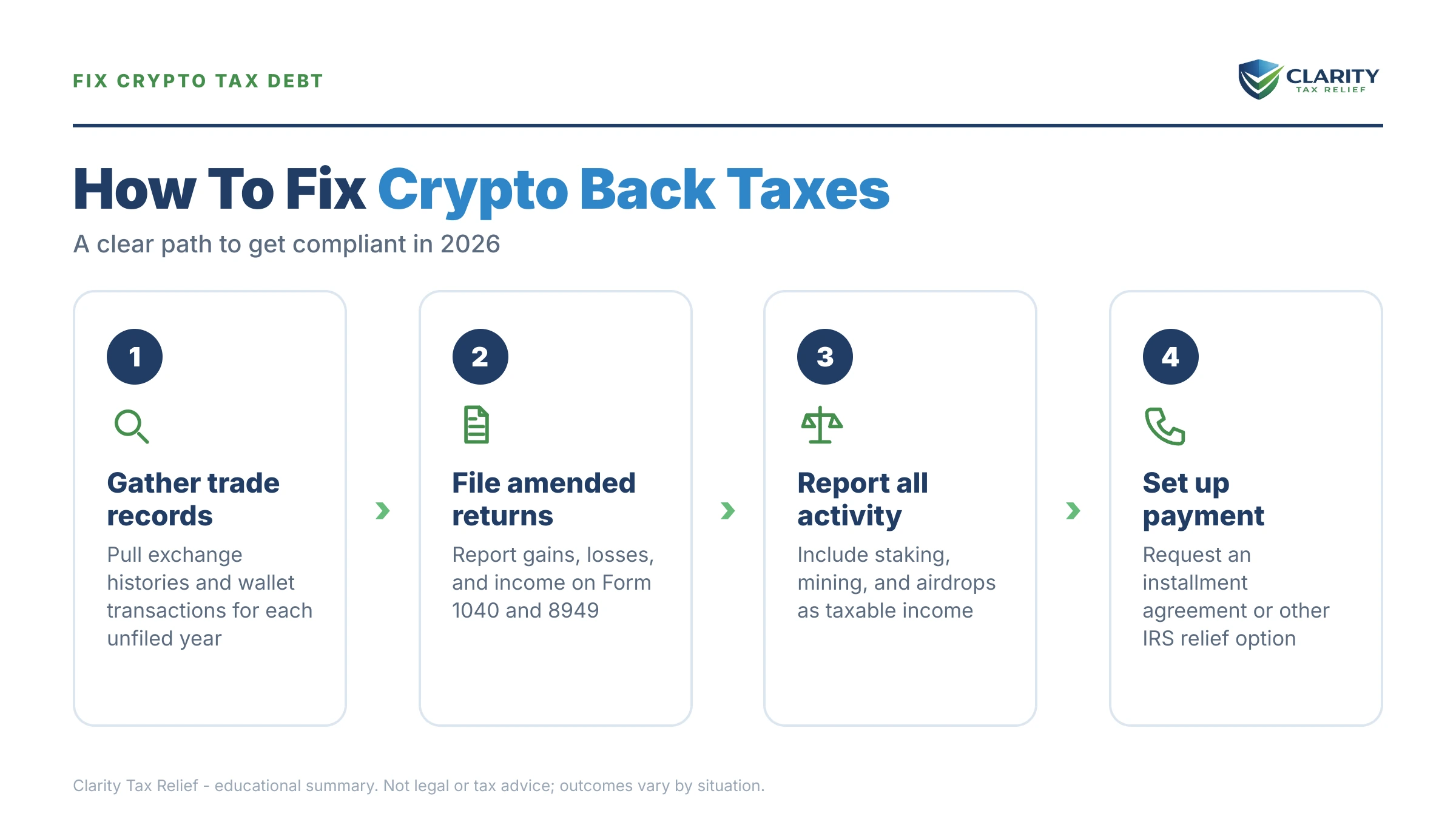
Cost-basis reconstruction is the single biggest lever in a crypto trader's case — it routinely shrinks the IRS's proposed figure more than any relief program could. The IRS's number assumes zero basis; your job is to prove what you actually paid for every coin you sold. That means assembling:
- Complete trade exports from every exchange you ever used — including closed accounts, and including the CSVs, not just the annual summary.
- Every wallet address, so transfers between your own wallets aren't misread as sales. This is one of the most common inflation errors in crypto software and IRS proposals alike.
- DeFi, staking, and airdrop history, which creates both income events and basis in the coins you later sold.
- Your IRS wage and income transcript for each year, so you know exactly which third-party figures you must reconcile against.
If an exchange has collapsed or locked you out, the blockchain itself is your backup — on-chain history is permanent, and a documented reconstruction using one consistent method is what the IRS expects when originals are gone. Note that for 2025 and later, basis must be tracked wallet-by-wallet rather than pooled across accounts, so the method you pick for old years should be one you can carry forward.
Where the corrected math lands determines the paperwork. If a CP2000 is open, you respond with the corrected Form 8949 and Schedule D rather than filing a new return. If the year hasn't been flagged yet, or the tax was already assessed at the inflated figure, you may be able to amend a return to reduce tax debt or request audit reconsideration. Either path can also knock out the 20% accuracy-related penalty, which is computed on the understatement — shrink the understatement and the penalty shrinks with it.
What happens if you ignore crypto back taxes
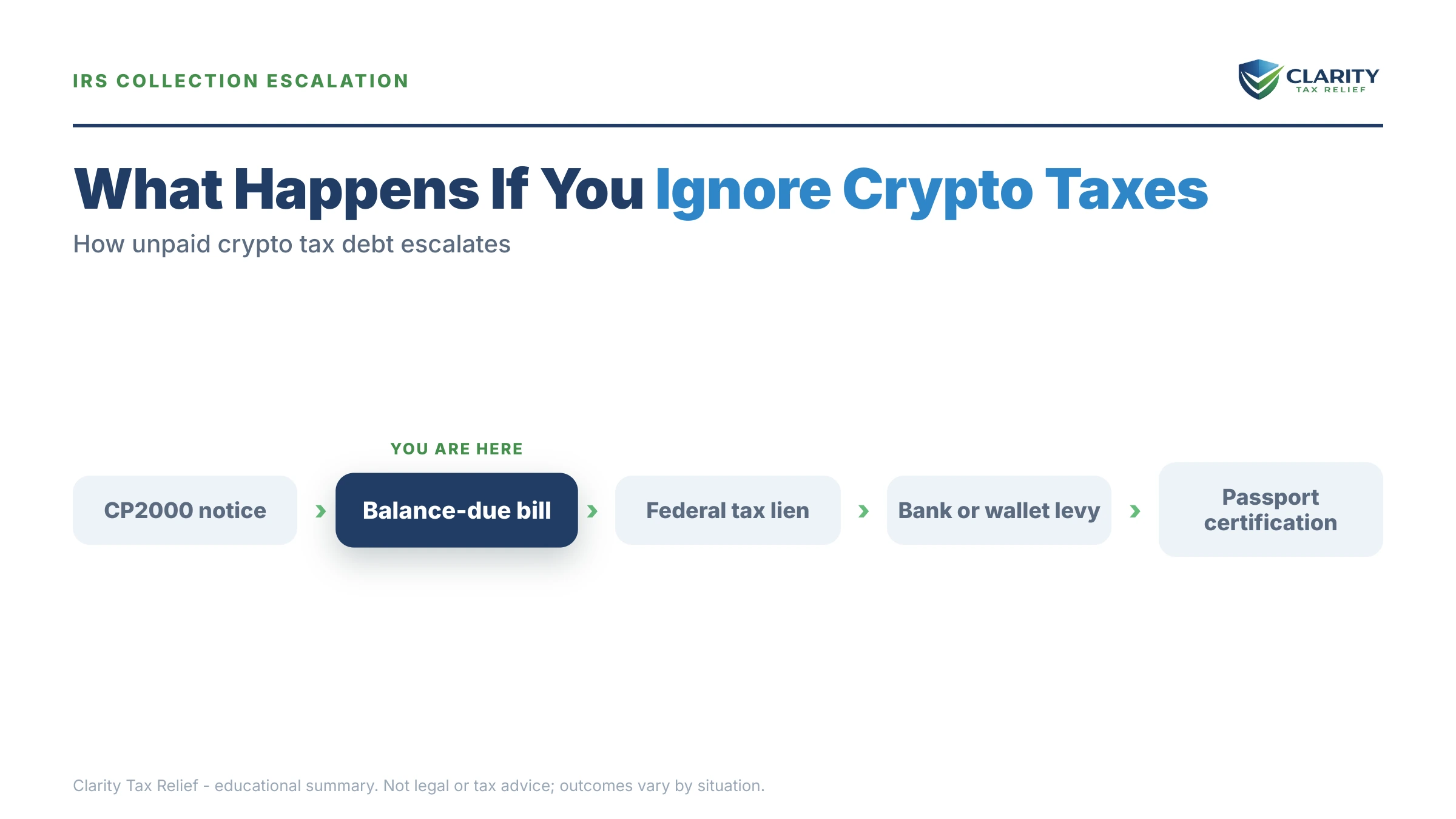
An ignored crypto mismatch moves from a polite letter to enforceable debt in a fixed, automated sequence. IRS staffing fell roughly 27% in 2025, which makes humans harder to reach — but the matching, assessment, and levy systems are software, and they never stopped. Here is the escalation path, stage by stage:
- Soft contact: Letter 6174, 6174-A, or 6173 arrives, or transcript code 922 posts — the underreporter unit has your exchange data.
- Proposed change: a CP2000 proposes tax, the accuracy penalty, and interest on the zero-basis figure. This is the cheapest moment to fight, because nothing is assessed yet.
- The 90-day letter: ignore the CP2000 and a CP3219A follows, opening the 90-day letter and Tax Court petition window. Let those 90 days pass and the inflated amount becomes legally assessed debt.
- Assessment and billing: code 290 posts, a CP14 bill arrives, and you typically have about 21 days before reminders begin. A Notice of Federal Tax Lien becomes possible from this point — the event that surfaces in your refinance title search.
- Reminder cycle: CP501 and CP503 arrive while penalties and interest compound monthly.
- CP504: the IRS states its intent to levy your state tax refund under IRC §6331(d).
- LT11 / Letter 1058: the final notice starts a 30-day clock and your Collection Due Process rights (Form 12153). After it, the IRS can levy bank accounts — funds are held 21 days before they leave — and garnish wages continuously until released. If unpaid balances across years pass $66,000 (the 2026 threshold), passport certification enters the picture too.
Every stage you wait costs real money on top of the risk. You can estimate what your specific balance is accruing month by month with our Penalty & Interest Calculator.
Staring at a crypto tax notice — or a scary transcript?
Send us the notice and we'll pull your IRS transcripts, check the basis math behind the number, and map your options — free and confidential. Interest compounds monthly and a filed lien can stall a refinance, so the review is worth doing before the next notice, not after.
Your options for the corrected balance
Once the number is right, the IRS offers several resolution paths, and eligibility is mostly mechanical — set by the size of the balance and your finances. The full DIY playbook for each program lives in our guide on how to settle tax debt yourself; here is how the options map to a trader's balance:
| Option | Who typically qualifies | Cost & terms |
|---|---|---|
| Pay in full | Anyone | Stops all penalty and interest accrual immediately; no fee |
| Short-term payment plan | Can pay the full balance within 180 days | $0 setup; interest and penalties continue until paid |
| Streamlined installment agreement | Assessed balance ≤ $50,000, all returns filed | Up to 72 months, set up online, no financial statement; accrual continues |
| Guaranteed installment agreement | Balance ≤ $10,000 with a clean filing/payment history | The one plan the IRS must accept if you meet the conditions |
| Non-streamlined agreement | Balance over $50,000 | Requires a Form 433 financial statement; payment is negotiated |
| Currently Not Collectible | Allowable living expenses consume your income | Collection pauses; debt and accrual remain, and a lien filing is likely |
| Offer in Compromise | Assets plus future income genuinely below the balance | $205 fee and 20% down on lump-sum offers (both waived with low-income certification); roughly 1 in 5 accepted in FY2024 |
| Penalty relief | Clean prior 3 years (First-Time Abate) or reasonable cause | Removes penalties, not tax; starting summer 2026, Automatic Exemption from Penalty (AEP) applies many exemptions with no request needed |
Two trader-specific honesty checks. First, an Offer in Compromise is means-tested: if you own a home with equity — the very thing you're refinancing — your reasonable collection potential often exceeds the debt, which makes an offer a poor fit no matter what an ad promised. Second, "hardship" status doesn't erase anything; the balance keeps growing and the IRS revisits your finances. For most traders with income, the streamlined installment agreement is the realistic workhorse.
A worked example: $27,500 in crypto back taxes during a refinance
Say you traded heavily in 2024, your exchange reported $138,000 of gross proceeds, and your return had no Form 8949. The CP2000 proposes roughly $46,900 — tax on the full proceeds plus the 20% accuracy penalty and interest. This is hypothetical, but the mechanics are exactly what traders see.
Reconstruction tells a different story. Your exports and wallet history show $103,700 of documented basis, leaving a true net short-term gain of $34,300. The corrected math lands like this:
- Additional tax on $34,300 at your ordinary rate: about $21,400
- Accuracy-related penalty (20% of the corrected understatement): about $4,280
- Interest to date: about $1,820
- Corrected balance: roughly $27,500 — a cut of nearly $19,400 from the proposal, before any penalty-relief request
Now the resolution math. At $27,500 you're under the $50,000 streamlined ceiling: $27,500 ÷ 72 months is about $382/month as a floor, and budgeting more makes sense because interest and the 0.5% monthly late-payment penalty keep accruing until the balance hits zero — paying it off in 36 months instead of 72 meaningfully shrinks the total cost. An Offer in Compromise almost certainly fails here: if your home has, say, $90,000 of tappable equity, the IRS's collection-potential math sees far more than $27,500 available. The refinance itself may actually be your cheapest exit — cash-out proceeds at mortgage rates typically beat carrying IRS accrual — but only if the debt doesn't derail the loan first, which is the next section.
Crypto tax debt and your refinance: the lien problem
An IRS balance doesn't appear on your credit report, but a filed Notice of Federal Tax Lien appears in your title search — and most lenders won't close over one. The sequencing here matters more than anything else in your case:
- No lien filed yet: get into an installment agreement quickly. Lenders commonly proceed when a federal tax debt is in a formal agreement with documented on-time payments, and an agreement in good standing makes a lien filing far less likely. Our guide to whether you can refinance with an IRS lien covers what underwriters actually look for.
- Lien already filed: a refinance can still close through tax lien subordination — Form 14134 asks the IRS to let the new mortgage take priority, which the IRS often grants when the refinance helps you pay the tax. Build extra weeks into your rate lock; subordination is not an overnight process.
- Timing the application: if the debt isn't assessed yet (you're still at the CP2000 stage), resolving the notice with corrected numbers before assessment keeps the whole issue out of collection — and out of your title search — entirely.
What the codes on your transcript mean for a crypto case
Your IRS account transcript tells you exactly which stage your crypto case has reached — often weeks before the corresponding letter arrives. These are the codes traders see most:
| Code | What it means on a crypto account | Your move |
|---|---|---|
| 922 | Underreporter review — exchange data didn't match your return | Pull your wage & income transcript and start basis reconstruction now, before the CP2000 lands |
| 420 / 424 | Return routed toward examination rather than automated matching | Organize records and consider representation before first contact |
| 971 | A notice was issued | Match the code date to the letter in your mailbox to identify the stage |
| 290 | Additional tax assessed — the proposal became collectible debt | Amendment or audit reconsideration may still correct it; the 10-year collection clock starts here |
| 276 / 196 | Failure-to-pay penalty and interest posted | Penalty relief (FTA, AEP, or reasonable cause) may remove the 276 amounts |
| 582 | Notice of Federal Tax Lien filed | Critical for a refinance — plan for subordination or payoff before underwriting |
| 530 | Account placed in Currently Not Collectible status | Collection is paused, but expect periodic financial review and continued accrual |
How to respond to crypto trader back taxes, step by step
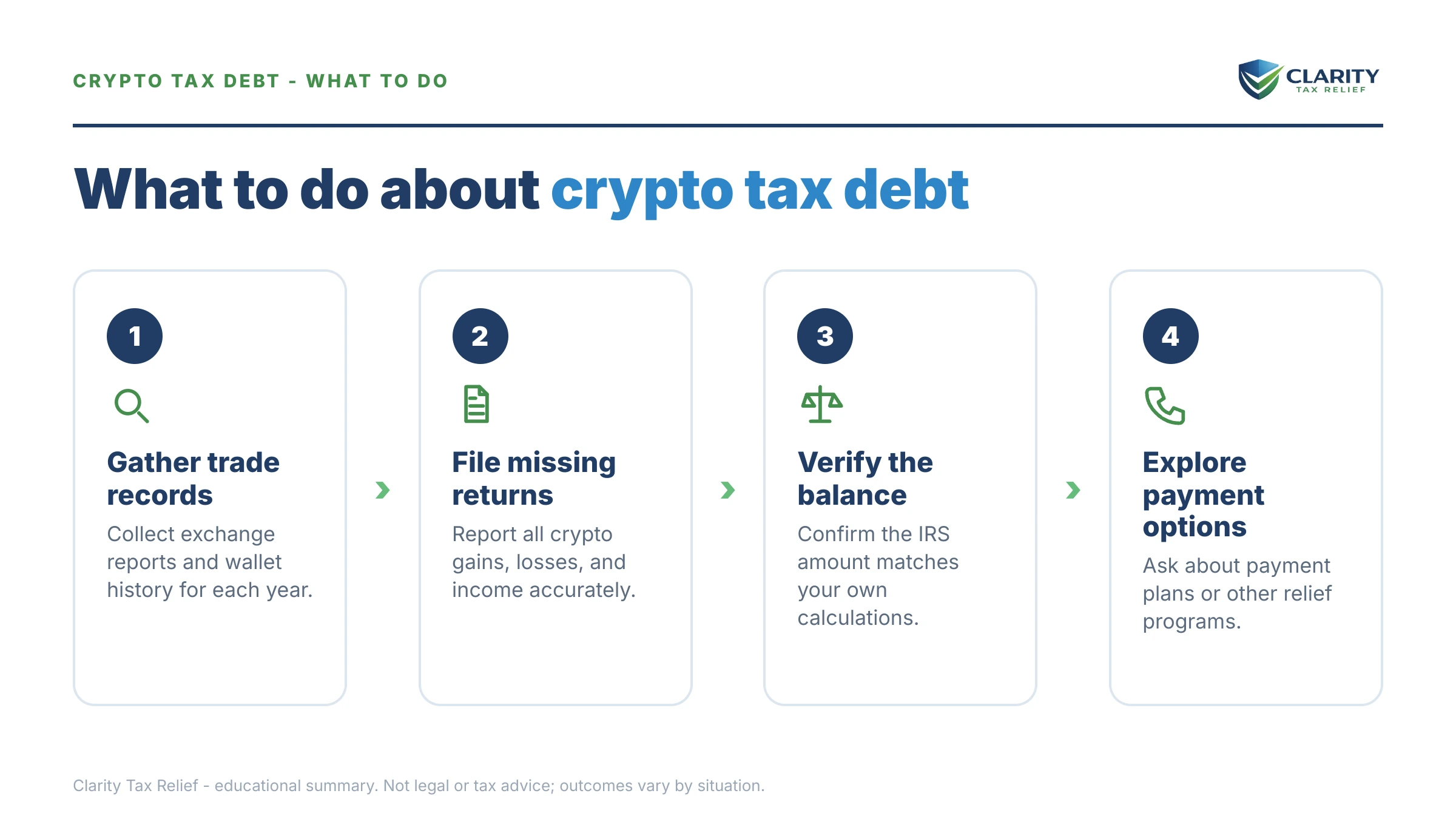
- Pull your IRS records. Log into your IRS online account and request the wage and income transcript for every year in question — it shows exactly what exchanges reported about you.
- Export every trade. Download the full CSV history from each exchange, list every wallet address, and capture DeFi and NFT activity before platforms purge old data.
- Rebuild your cost basis. Run the complete history through crypto tax software or a professional reconstruction and produce a corrected Form 8949 and Schedule D for each year.
- Answer the live notice. Respond to a CP2000 with the corrected figures, file amended returns for years the IRS hasn't flagged yet, or request audit reconsideration if the tax was already assessed.
- Resolve the corrected balance. Pay in full if you can; otherwise set up the payment plan, hardship status, or offer that actually fits your finances before the notice sequence escalates.
- Stay compliant going forward. Start quarterly estimated payments and wallet-by-wallet basis tracking so next April doesn't rebuild the same debt.
When you can handle this yourself — and when help changes the outcome
Plenty of crypto back-tax cases are genuinely DIY-able, and it would be dishonest to pretend otherwise. You can likely handle it alone if:
- You traded on one U.S. exchange, its tax report is complete, and the corrected balance is one you can pay within 180 days;
- The notice is a first CP2000 whose corrected math you agree with, and a streamlined online payment plan covers the rest;
- Your only fix is a simple penalty-relief request on an otherwise clean history.
Experienced help tends to change the dollar outcome when the reconstruction itself is the battle: trades scattered across multiple exchanges and self-custody wallets, a defunct platform holding part of your history, several unfiled or misfiled years stacked together, DeFi or margin activity the software mislabels, or a case that has already reached the 90-day letter or assessment — where procedure, not arithmetic, determines whether the corrected number ever gets accepted. It also matters when a refinance clock is running and lien strategy has to be sequenced against underwriting. If your situation is simpler than a trader's — a few sales you just never reported — our broader guides on crypto tax debt help and didn't report crypto taxes may fit better than this one.
Terms on your notice, decoded
- Gross proceeds: the total dollar value of everything you sold — the figure exchanges report, with no subtraction for what you paid.
- Cost basis: what you paid for a coin, including fees; the number that turns proceeds into actual gain or loss.
- Form 1099-DA: the digital-asset broker form exchanges file with the IRS, starting with 2025 transactions.
- Specific identification: a basis method that lets you designate which units you sold — powerful for traders, but it requires records to back it up.
- Statutory notice of deficiency: the CP3219A "90-day letter" — your last stop before a proposed amount becomes assessed debt.
- Notice of Federal Tax Lien: the public filing that attaches the IRS's claim to your property and surfaces in a refinance title search.
If reconstructing three years of trades while a rate lock ticks down sounds like a second full-time job, an experienced tax professional can carry the IRS side of it — start with a free crypto case review or call (888) 825-7779.
Crypto trader back taxes: your questions answered
How does the IRS know about my crypto trades?
U.S. exchanges report your gross proceeds directly to the IRS — on Form 1099-DA starting with 2025 transactions, and often on Forms 1099-K or 1099-MISC in earlier years. The IRS has also won court orders (John Doe summonses) forcing exchanges to hand over customer records, and every Form 1040 asks the digital-asset question under penalty of perjury. Matching that data against your return is automated, so silence rarely lasts.
Do I owe taxes on crypto if I never cashed out to dollars?
Yes — every trade of one coin for another is a taxable event, because the IRS treats crypto as property. Swapping ETH for SOL is a sale of your ETH at its dollar value in that moment, even if no cash ever touched your bank account. This is why high-frequency traders can owe real tax for a year their portfolio actually ended down.
Do wash sale rules apply to crypto?
No — under current law the wash-sale rule applies to securities, and the IRS classifies crypto as property, so selling at a loss and immediately buying back generally still books the loss. That is the opposite of the trap stock day traders hit. Congress has repeatedly proposed extending wash-sale rules to digital assets, so confirm the rule for the specific year you are amending.
What if my exchange shut down and I lost my trade records?
You can usually still rebuild the history. Public blockchains preserve every on-chain transaction permanently, old exchange emails often contain trade confirmations, and your IRS wage and income transcript shows exactly what was reported about you. A reconstruction built from those sources, using one documented and consistent method, is exactly what the IRS expects when original records are gone.
Can I get a payment plan on crypto back taxes?
Yes. Balances of $50,000 or less generally qualify for a streamlined installment agreement — up to 72 months, set up online, no detailed financial statement. Under $10,000, a guaranteed installment agreement is available if you meet the filing and payment conditions. Interest and a monthly late-payment penalty keep accruing until the balance is paid, so a shorter plan is always cheaper.
Will the IRS settle crypto tax debt for less than I owe?
Only when the math shows you genuinely can't pay — the IRS accepted roughly 1 in 5 Offers in Compromise in FY2024. The offer amount is driven by your assets plus future income, so a trader with home equity or a rebounding portfolio usually shows more collection potential than the debt itself, which sinks the offer. Anyone promising you a settlement before seeing your finances is selling, not advising.
Can I go to jail over unreported crypto?
Owing crypto taxes is a civil matter; criminal cases require willful conduct the government can prove — like answering the Form 1040 digital-asset question 'No' while actively trading, or moving coins offshore after receiving IRS letters. Coming forward voluntarily, filing accurate amended returns, and arranging payment weighs strongly against criminal referral. Fixing it before the IRS finds it is the single best move you can make.
Will crypto back taxes stop me from refinancing my house?
The debt alone won't appear on your credit report, but a filed Notice of Federal Tax Lien shows up in the title search, and most lenders won't close over one. If a lien is already filed, Form 14134 lien subordination lets the new mortgage take priority so the refinance can fund. If no lien exists yet, getting into a payment agreement early is the cleanest way to keep the title clear.
How many years back can the IRS go on crypto trades?
Normally three years from when you filed, but six years if you omitted more than 25% of your gross income — easy to trigger when gross proceeds from trading were left off entirely. If you never filed a return, or the IRS can show fraud, there is no time limit at all. Collection is separate: once tax is assessed, the IRS has 10 years to collect it.
Your next 24 hours
- Find the controlling date and figure. On whatever IRS letter you're holding, locate the response date and the "proposed amount due" or balance — then note which stage of the sequence above it matches. The IRS's own explainer at Understanding your CP2000 notice shows where each figure sits on the underreporter proposal.
- Gather your raw materials. The notice itself, your filed return for that year, exchange CSV exports, a list of every wallet address, and — if you're refinancing — your loan officer's timeline, so lien strategy can be sequenced against underwriting. If you already know the corrected balance and just need a plan, the official IRS payment plans page and IRS.gov/payments are where DIY setup happens.
- Get the numbers checked before you agree to anything. A free case review — the 2-minute form at claritytaxrelief.com/#consult or (888) 825-7779 — tells you whether the IRS's crypto figure survives a basis reconstruction and which resolution path protects your refinance. Interest and penalties accrue monthly either way, so the review costs nothing but waiting does.
This guide is general information, not tax or legal advice for your specific situation. Eligibility for IRS programs depends on individual facts and circumstances; no outcome is guaranteed.