
Tax Debt by Situation
Day Trading Tax Debt: What to Do When Trading Left You Owing the IRS (2026)
The short answer: day trading tax debt usually comes from wash-sale disallowances, a cross-year blowup, or a CP2000 built on gross proceeds instead of real gains. Verify the number first — broker-reported figures are often wrong — then resolve the true balance through a payment plan, hardship status, or an Offer in Compromise.
You checked your brokerage app a thousand times last year, but the number that finally stopped you cold came from the IRS — a balance that doesn't match anything you actually took home. Maybe you even ended the year down, and the government still says you owe tens of thousands. That disconnect has a technical explanation, and in many cases a fix that shrinks the bill before you pay a dime.
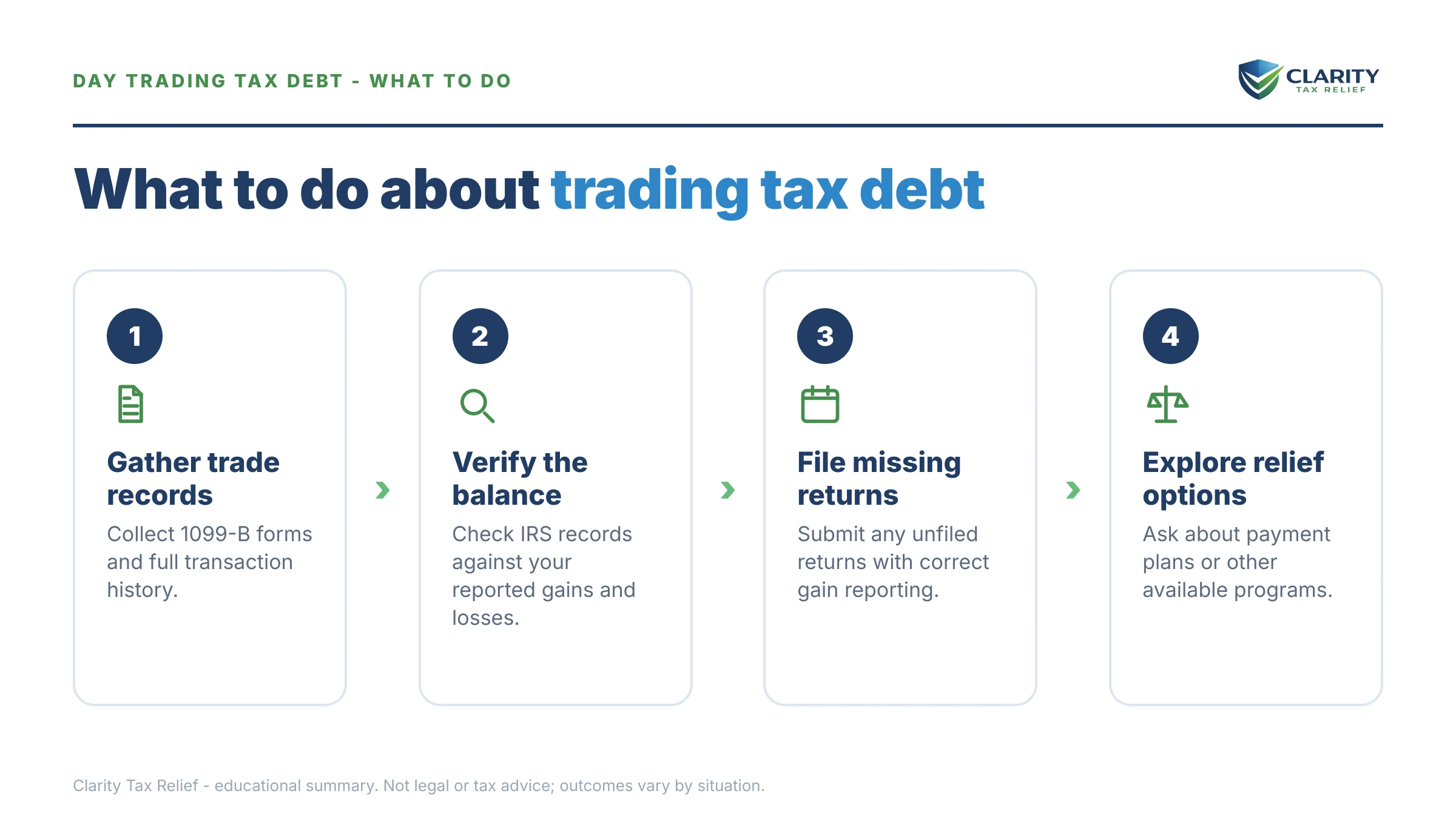
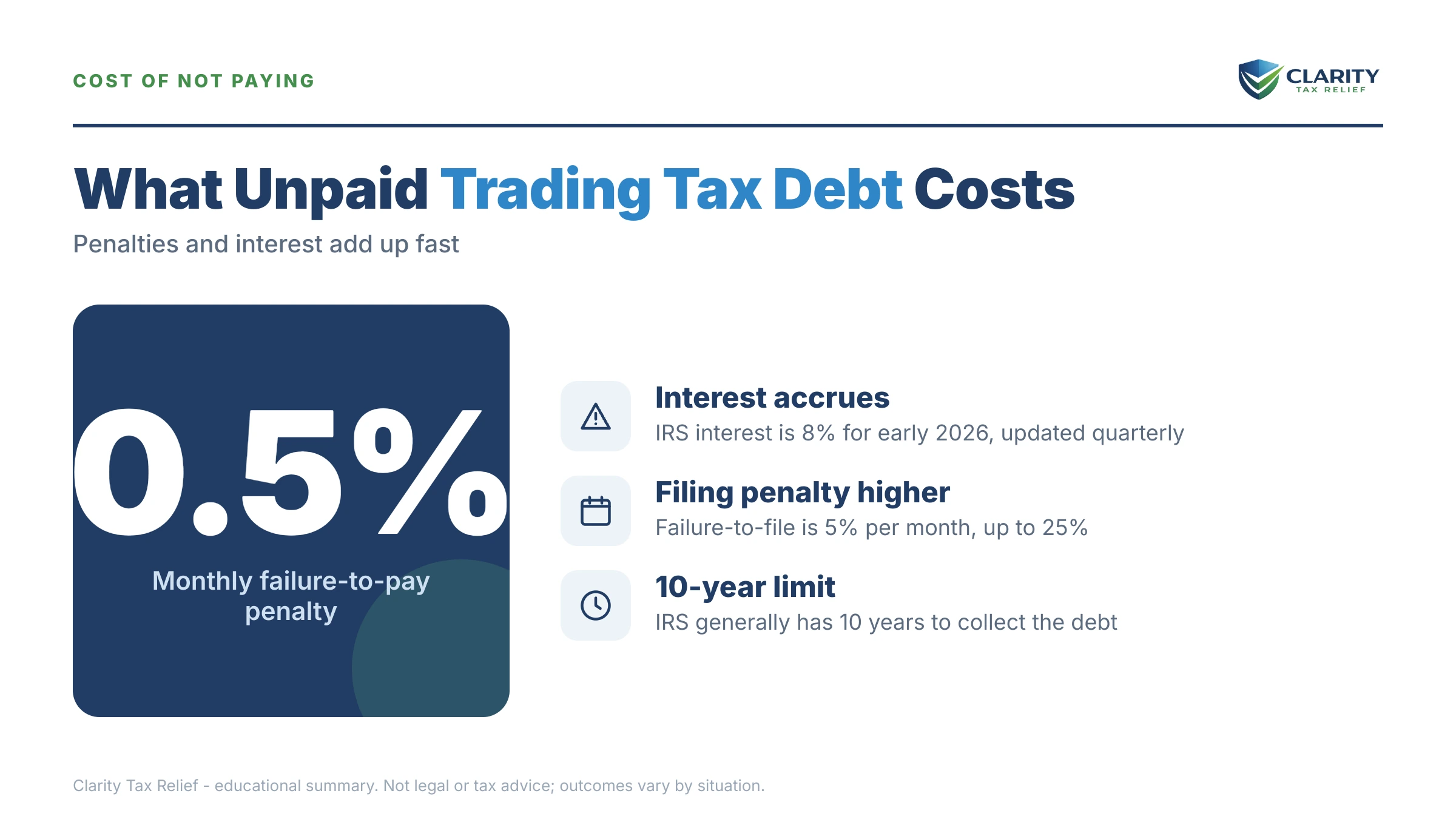
⏱ The clock that's actually running: there's no single response deadline on day trading tax debt itself, but the failure-to-pay penalty adds 0.5% of the balance every month, interest compounds on top, and once your certified debt exceeds $66,000 (the 2026 threshold), the IRS can flag your passport. If you're holding a specific notice, the date printed on it controls.
Why day trading creates tax debt you never saw as profit
Day trading can generate a five-figure tax bill even in a year you lost money, because the wash sale rule and the $3,000 capital-loss limit separate what you owe from what you actually made. Three traps do most of the damage.
Trap 1: the wash sale rule. Under IRC §1091, if you sell a security at a loss and buy a substantially identical one within 30 days before or after, the loss is disallowed for now — it's added to the basis of the replacement shares instead. Day traders re-enter the same tickers dozens of times a week, triggering this constantly. Within a single year the disallowed losses often work themselves out. But if you're still holding replacement shares on December 31, those losses are locked out of this year's return and pushed into next year. Your 1099-B can show taxable gains far above your real profit — or taxable income in a year you were net down.
Trap 2: the cross-year blowup. Capital gains are taxed in the calendar year you realize them. If you ran the account up in one year and gave it back the next, the tax on year one is fully owed — and year two's losses offset only $3,000 of ordinary income per year, with the rest carried forward. The money that would have paid the tax is gone, but the tax isn't.
Trap 3: the CP2000 built on gross proceeds. If you didn't report your trades — or didn't attach Form 8949 — the IRS's underreporter system matches your broker's 1099-B against your return and, for older or noncovered positions, may treat total sale proceeds as pure gain. A high-frequency trader can turn over millions in proceeds on a modest account, so the proposed tax can be absurdly larger than reality. Our CP2000 notice guide covers the mechanics; the key here is that this number is a proposal, not a verdict.
If you trade as a 1099 contractor, there's a fourth layer: nothing was withheld from either income stream. Your contracting income carries 15.3% self-employment tax on top of income tax (trading gains do not — see the FAQs), so skipping quarterly estimated taxes on both streams stacks underpayment penalties onto an already inflated balance.
| Trap | Why it inflates the bill | Your fix |
|---|---|---|
| Wash sales held across Dec 31 | Disallowed losses deferred to next year; taxable gain exceeds real profit | Verify broker adjustments across all accounts; correct Form 8949; plan year-end exits |
| Cross-year blowup | Year-one gains fully taxed; year-two losses capped at $3,000/yr against ordinary income | Debt is real — resolve via payment plan, PPIA, CNC, or OIC based on current finances |
| CP2000 on gross proceeds | IRS counts sale proceeds as gain when basis is missing | Respond by the printed date with a complete Form 8949 showing cost basis |
| No withholding on 1099 + trading income | Underpayment and failure-to-pay penalties stack on both streams | Penalty abatement where eligible; start quarterlies now |
First: is the number even right?
Day trading balances are wrong more often than almost any other kind of IRS debt, because they depend on basis math the IRS often doesn't have. Before negotiating anything, spend a weekend auditing three things.
Check the broker's wash-sale adjustments. Brokers only track wash sales within a single account and only on identical securities. If you traded the same ticker across two brokerages, or in a taxable account and an IRA, the 1099-B can be wrong in either direction — and you're allowed to correct it on Form 8949 with your own trade-level records.
If the return you filed carried an inflated gain, you can amend the return to reduce the tax debt before setting up any payment arrangement. Never negotiate a payment plan on a number you haven't verified — you'd be financing tax you don't owe.
Check any open CP2000. If the balance is still a proposal, respond with basis documentation by the date printed on the notice. If you already missed that window and received a statutory notice of deficiency, the 90-day letter and Tax Court petition path is your last stop before the amount becomes a legally assessed debt — that 90-day deadline is rigid.
Check what years are actually assessed. Your IRS account transcript shows each year's assessed balance and start date. The IRS generally has 10 years from assessment to collect (the CSED), so knowing when each year was assessed shapes the whole strategy. And if some of your trading was in digital assets, the reconstruction problem is different enough that it has its own playbook — high-frequency crypto records rarely match what exchanges reported.
What happens if you ignore day trading tax debt
An assessed trading debt enters the same automated collection sequence as any other IRS balance — and the automation didn't slow down when the IRS cut roughly 27% of its workforce in 2025. Notices, liens, and levies are machine-issued; the sequence runs whether or not a human ever reads your file:
- CP14 and reminder notices (CP501/CP503) — bills, with the balance growing monthly. No enforcement yet, but the cheapest window to act.
- CP504 — intent to levy your state refund — the IRS can seize your state tax refund, and a federal tax lien becomes a live risk. A lien attaches to everything you own, including your brokerage account.
- LT11 / Letter 1058 — final notice of intent to levy — starts a 30-day clock and your Collection Due Process rights (Form 12153). After it passes, levies can begin.
- Levy stage — bank and brokerage accounts can be levied (funds are typically held 21 days before they're sent to the IRS). For a contractor, the IRS can also levy your client payments — can the IRS garnish 1099 income explains why a levy on a client captures the entire invoice, not a percentage.
- Passport certification — once certified debt passes $66,000 (2026 threshold), the State Department can deny or revoke your passport. See passport revoked for tax debt — a $92,700 balance is already past this line.
Staring at a trading tax bill that doesn't match reality?
Get your day-trading tax debt reviewed free before the next notice escalates. We'll check whether wash-sale math inflated the balance and map every resolution option — penalties and interest are compounding every month you wait.
Your options for resolving day trading tax debt
Once the balance is verified, the IRS has a defined menu of resolutions, and eligibility is mostly a function of how much you owe and what your finances show. The general DIY sequencing — verify, get compliant, then pick a program — is covered in our guide to how to settle tax debt yourself; here's how each option maps to a trading-sized debt.
| Option | Who qualifies | Fit at a $92,700 balance |
|---|---|---|
| Short-term plan (up to 180 days) | Anyone who can full-pay within 180 days; $0 setup | Only if a windfall or account liquidation covers it |
| Streamlined installment agreement | Balance ≤ $50,000; up to 72 months, set up online, no financials | Only after paying the balance below $50,000 |
| Non-streamlined installment agreement | Balances above $50,000; requires financial disclosure (Form 433-F) | The default path — see IRS payment plan over $50,000 |
| Partial-pay installment agreement | Finances show you can't full-pay before the CSED | Strong fit if the blowup gutted your income |
| Currently Not Collectible | Paying anything would prevent basic living expenses | Fits if contracting income has also dried up — see Currently Not Collectible status |
| Offer in Compromise | Offer must meet or beat your Reasonable Collection Potential; $205 fee, 20% down on lump-sum (both waived at AGI ≤ 250% of poverty) | Possible when assets and income genuinely can't cover $92,700 |
| Penalty abatement (FTA / AEP / reasonable cause) | Clean prior 3 years for FTA; AEP becomes automatic starting summer 2026 | Worth pursuing on almost every trading debt — penalties are a big slice |
One honest note on the Offer in Compromise: it's real, but it's math, not mercy. The IRS accepted roughly 1 in 5 offers in FY2024, and a funded brokerage account counts as an asset that raises your Reasonable Collection Potential. Read how an offer in compromise works before spending anything pursuing one.
| Option | Upfront cost | Typical timeline |
|---|---|---|
| Short-term plan | $0 setup; interest + penalties continue | Set up same day online; done within 180 days |
| Installment agreement (any type) | Setup fee applies (lower online/direct debit; waived or reduced for low income); interest + penalties continue | Streamlined: same day online. Above $50k: weeks, after financial review |
| Currently Not Collectible | $0; requires Form 433-F financials | Weeks to establish; IRS re-reviews when income recovers |
| Offer in Compromise | $205 fee + 20% down on lump-sum offers (both waived with low-income certification) | Commonly many months; auto-accepted if the IRS doesn't decide within 2 years, with narrow exceptions - a returned or rejected offer stops the clock, and time during court disputes does not count |
| Penalty abatement | $0 | Phone or written request; AEP applies automatically starting summer 2026 |
A worked example: $92,700 owed after a blowup year
Say you're a 1099 contractor who realized $148,000 in short-term trading gains through November of one year, made no estimated payments on either income stream, then gave most of the gains back the following spring. By the time the return is filed and penalties post, the assessed balance is $92,700 — and this year's losses only offset $3,000 of ordinary income annually going forward. Here's the math on each path:
- Straight installment agreement: $92,700 ÷ 72 months ≈ $1,288/month — before continued interest and the 0.5%/month failure-to-pay penalty, so the payment the IRS actually calculates will be higher. Because the balance is over $50,000, expect to submit Form 433-F financials.
- Pay down to streamlined: putting $42,700 toward the balance drops you to $50,000, unlocking the online 72-month plan at roughly $695/month plus accruals — no financial disclosure. Only sensible if liquidating what's left of the account doesn't destroy your ability to earn.
- Offer in Compromise: suppose contracting now nets $6,400/month against $5,600 in IRS-allowable expenses — $800/month disposable. A lump-sum offer is roughly $800 × 12 = $9,600 in future income, plus asset equity (say $8,400 left in the brokerage account and $3,000 of car equity = $11,400), for a Reasonable Collection Potential around $21,000. An offer at or above that number is credible; well below it, expect rejection.
- Penalty relief: if $9,000 of the $92,700 is failure-to-pay penalty and your prior three years were clean, first-time abatement could remove that slice — and interest charged on it. You can gauge how much of your own balance is penalties and interest with our IRS penalty & interest calculator. See first-time penalty abatement for the mechanics.
This is a hypothetical illustration — your allowable expenses, equity, and eligibility depend entirely on your actual finances.
How to respond to day trading tax debt, step by step
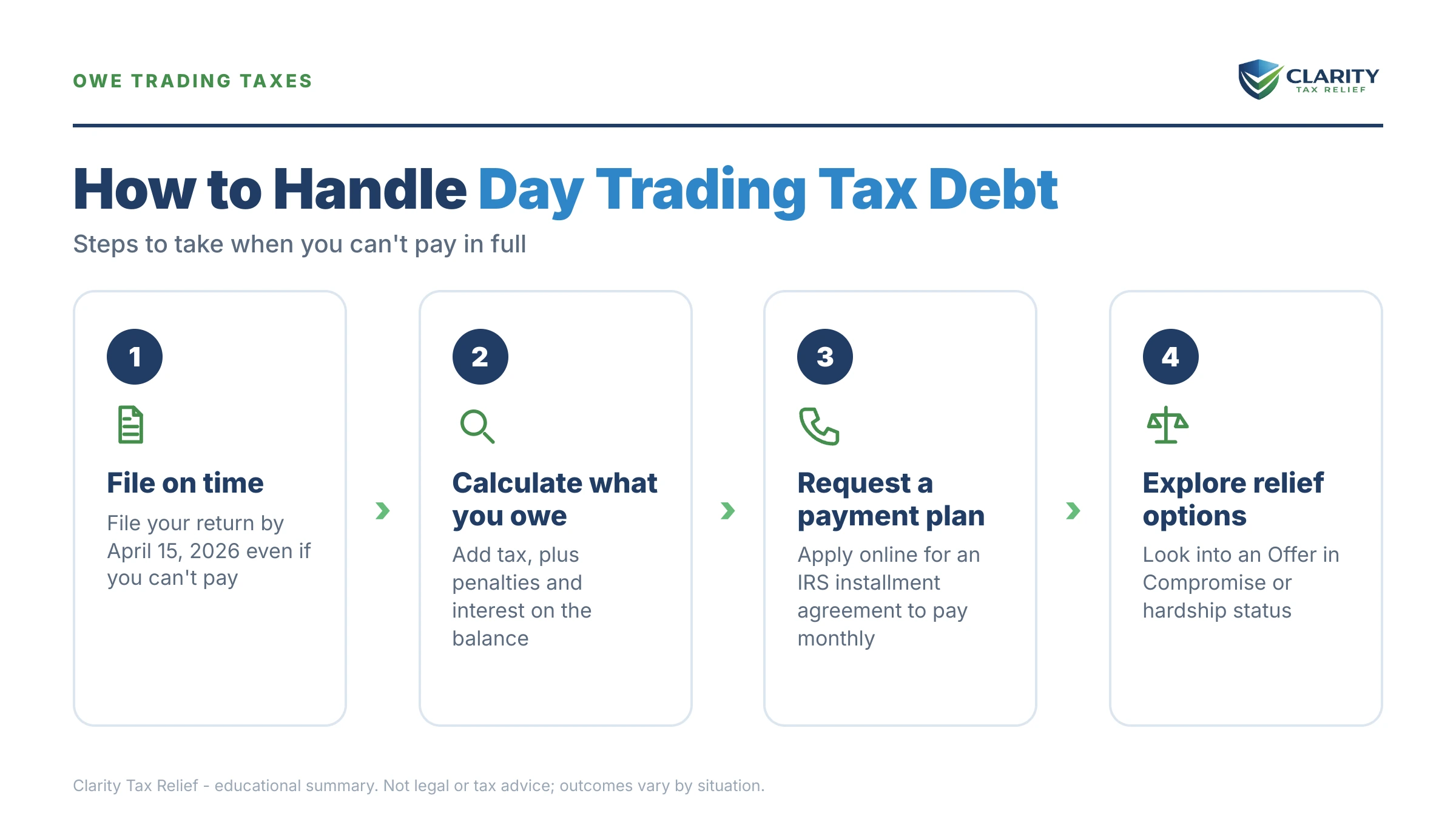
- Pull your IRS transcripts. Get your account transcript and wage-and-income transcript online to confirm the assessed balance, which years it covers, and what the IRS's copies of your 1099-Bs show.
- Audit the trading math. Compare your broker's wash-sale adjustments on the 1099-B against your own Form 8949 across all accounts — if the taxable gain is overstated, amend the return before negotiating payment.
- File anything unfiled and answer any open notice. Respond to a CP2000 by its printed date with basis documentation, and get missing returns in — the IRS won't approve most resolutions until you're filing-compliant.
- Choose and set up your resolution. Pick the option that matches your finances — installment agreement, partial-pay plan, Currently Not Collectible, or an Offer in Compromise — and submit it before the notice sequence escalates to a levy.
- Fix the withholding gap for this year. Start quarterly estimated payments on both your contracting income and any realized trading gains so next April doesn't restart the cycle.
When you can handle this yourself — and when help changes the outcome
Plenty of day trading tax debt is genuinely DIY territory. If the balance is under $50,000, your Form 8949 matches your broker's numbers, and you agree you owe it, the streamlined online payment plan takes about twenty minutes and no professional will materially improve on it. Same if you can full-pay within 180 days — set up the short-term plan and move on.
Experienced help earns its cost in specific situations: wash-sale reconstruction across multiple brokerages (where the taxable gain itself is in dispute), a CP2000 or 90-day letter with a live deadline, a balance over $50,000 where the financial disclosure determines your payment, OIC math involving a still-funded trading account, multiple unfiled years, or a levy already in motion. In those cases the order of operations — correct the number, clear the penalties, then negotiate the remainder — routinely changes what you end up paying, and getting it backwards can't always be undone.
If the debt is old enough and large enough that bankruptcy is on the table, compare Chapter 7 vs 13 tax debt treatment before assuming either works — recent trading years usually fail the timing tests for discharge.
Stopping next year's bill: quarterlies and the §475(f) election
The single best defense against a repeat is treating realized gains as taxed the moment they happen. Set aside a fixed percentage of every realized gain and every contractor invoice, and send quarterlies on both — the underpayment penalty applies per quarter, so catching up in April doesn't erase it.
Active traders who qualify for trader tax status can also consider the Section 475(f) mark-to-market election, which eliminates wash-sale headaches and the $3,000 loss cap by treating trading gains and losses as ordinary. The catch: the election generally must be made by April 15 of the year you want it to take effect — it cannot be applied retroactively to the year that already blew up, and it has real downsides (no capital-gain treatment on winners). This is a decision to run past an experienced tax professional, not a checkbox. The IRS's own overview is at Tax Topic 429, Traders in Securities.
Terms on your statements and IRS letters, decoded
- Wash sale: selling at a loss and rebuying a substantially identical security within 30 days before or after — the loss is deferred, not deducted now.
- Substantially identical: the same stock or option on it; the standard the IRS uses to decide whether your rebuy triggered §1091.
- Form 8949 / Schedule D: where every trade's proceeds, basis, and adjustments are reported — the document that corrects a wrong 1099-B.
- 1099-B: your broker's report of sale proceeds and (usually) basis to you and the IRS; the source data behind CP2000 matching.
- Mark-to-market (§475(f)): an election treating trading positions as sold at year-end at fair value, converting gains and losses to ordinary and switching off wash sales.
- CSED: the Collection Statute Expiration Date — generally 10 years from assessment, though appeals, offers, and bankruptcy pause the clock.
Day trading tax debt questions, answered
Do I owe taxes on day trading even if I lost money overall?
Yes, it's possible — and it's the most common day-trader tax shock. Capital gains are taxed in the calendar year you realize them, so big gains in one year followed by losses the next still produce a full tax bill, and the later losses only offset $3,000 of ordinary income per year. Wash-sale disallowances can also push a losing year's taxable income above zero if you kept rebuying the same tickers into January.
How does the wash sale rule create tax debt?
When you sell a security at a loss and buy a substantially identical one within 30 days before or after, the loss is disallowed for now and added to the basis of the replacement shares. Active traders trigger this constantly by re-entering the same tickers. If replacement shares are still held on December 31, those losses are pushed into the next tax year — so your taxable gain can be far higher than your actual profit.
What if I never reported my trades and got a CP2000?
Respond by the date printed on the notice — a CP2000 built from broker 1099-Bs often treats your gross sale proceeds as pure gain, which can overstate the real number many times over. Send a completed Form 8949 showing your cost basis for every trade, and the proposed amount usually drops dramatically. If you ignore it, the proposal becomes a CP3219A Notice of Deficiency with a 90-day Tax Court clock, and then an assessed debt.
Can I settle day trading tax debt with an Offer in Compromise?
Only if the math works — the IRS accepts an offer when the amount you propose equals or exceeds your Reasonable Collection Potential, which is your monthly disposable income times a multiplier plus the equity in your assets, including your brokerage account. The application fee is $205 with 20% down on lump-sum offers, both waived if your AGI is at or below 250% of the poverty level. The IRS accepted roughly 1 in 5 offers in FY2024, so run the numbers honestly before applying.
Is day trading income subject to self-employment tax?
No — trading gains are capital gains, not self-employment income, even for very active traders, so no 15.3% SE tax applies to them. Your 1099 contracting income, on the other hand, is fully subject to self-employment tax. If you're estimating what you owe across both income streams, keep them separate: the contractor income carries SE tax and the trading gains carry ordinary short-term capital gains rates.
Can day trading tax debt be discharged in bankruptcy?
Sometimes, but only for older years. Income tax is generally dischargeable in Chapter 7 only if the return was due at least 3 years ago, was filed at least 2 years ago, and the tax was assessed at least 240 days ago — so a recent blowup year almost never qualifies yet. Chapter 13 can restructure the debt into a 3-to-5-year plan even when discharge isn't available. Compare both routes before deciding.
Will the IRS levy my brokerage account for tax debt?
Yes — after the final notice of intent to levy (LT11 or Letter 1058) and the 30-day window that follows, the IRS can levy brokerage accounts just like bank accounts. Levied funds are typically held 21 days before being sent to the IRS, which is your window to negotiate a release. For a 1099 contractor, the IRS can also levy payments your clients owe you, capturing entire invoices.
Your next 24 hours
- Find the real number. Log into your IRS online account and note the assessed balance for each year — then pull the matching 1099-B and check whether wash-sale adjustments inflated it.
- Gather three documents: the filed return (or the unfiled year's records), your broker's full 1099-B and trade history, and any IRS notice you've received with its printed date.
- Get a free case review. Send us what you found at the 2-minute form or call (888) 825-7779 — an experienced tax professional will tell you whether the balance can be reduced before it's negotiated, while penalties and interest are still compounding monthly.
For payment logistics, the IRS's own pages at IRS.gov/payments and payment plans and installment agreements are the authoritative starting points; if the IRS's own delays are causing you harm, the Taxpayer Advocate Service is an independent avenue.
This guide is general information, not tax or legal advice for your specific situation. Eligibility for IRS programs depends on individual facts and circumstances; no outcome is guaranteed.