
IRS Notices
IRS CP2000 Notice: What It Means and How to Respond (2026)
The short answer: a CP2000 notice means the IRS matched income reported by banks, brokers, and pension payers against your tax return and found a mismatch. It proposes additional tax — it is not a bill and not an audit. You typically have 30 days from the notice date to agree, partially agree, or dispute it.
You filed months ago, expected nothing, and now several pages of IRS tables claim your return "doesn't match the information reported to us" — with a proposed amount due big enough to swallow months of retirement income. Here's the part the notice buries: that number is a computer's opening position, calculated with zero knowledge of your cost basis, rollovers, or charitable IRA gifts. It is frequently wrong in ways you can document — and this page walks you through proving it.
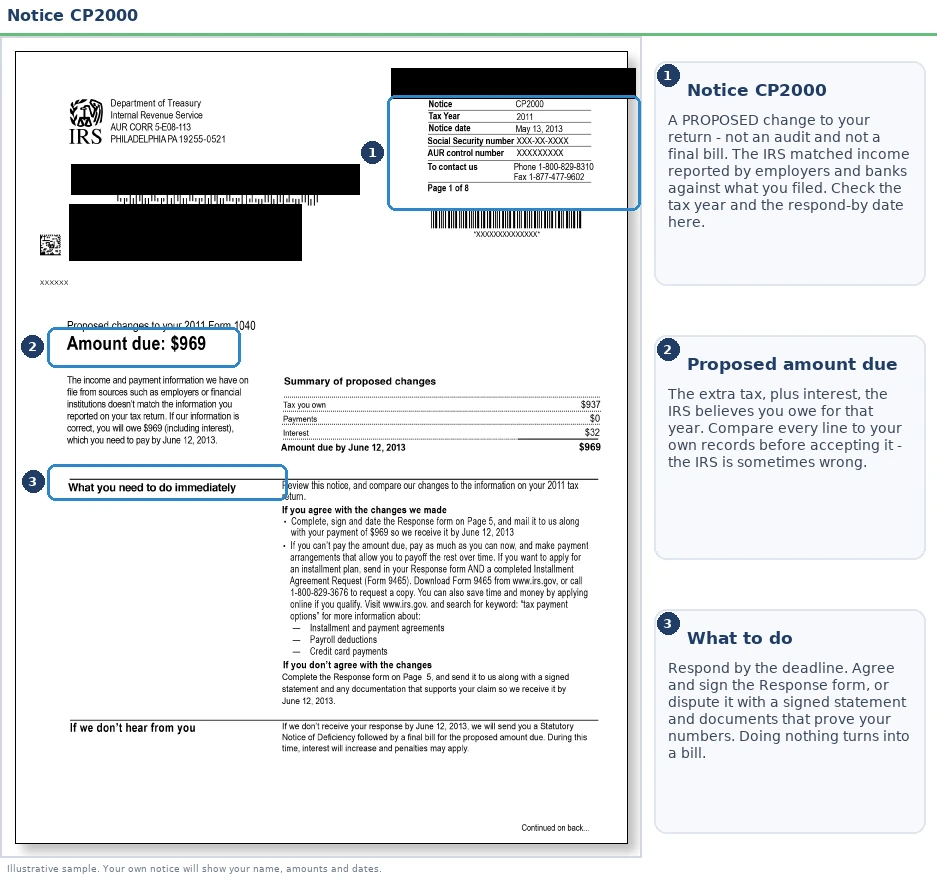
Three numbers on this notice control everything: the notice date, the response deadline, and the proposed amount due. The image below shows exactly what a CP2000 looks like and where each of those numbers sits, so you can find yours before reading further. (If you're still not sure why the IRS wrote to you at all, our guide to why did I get a letter from the IRS maps every letter type — this page covers only the CP2000.)
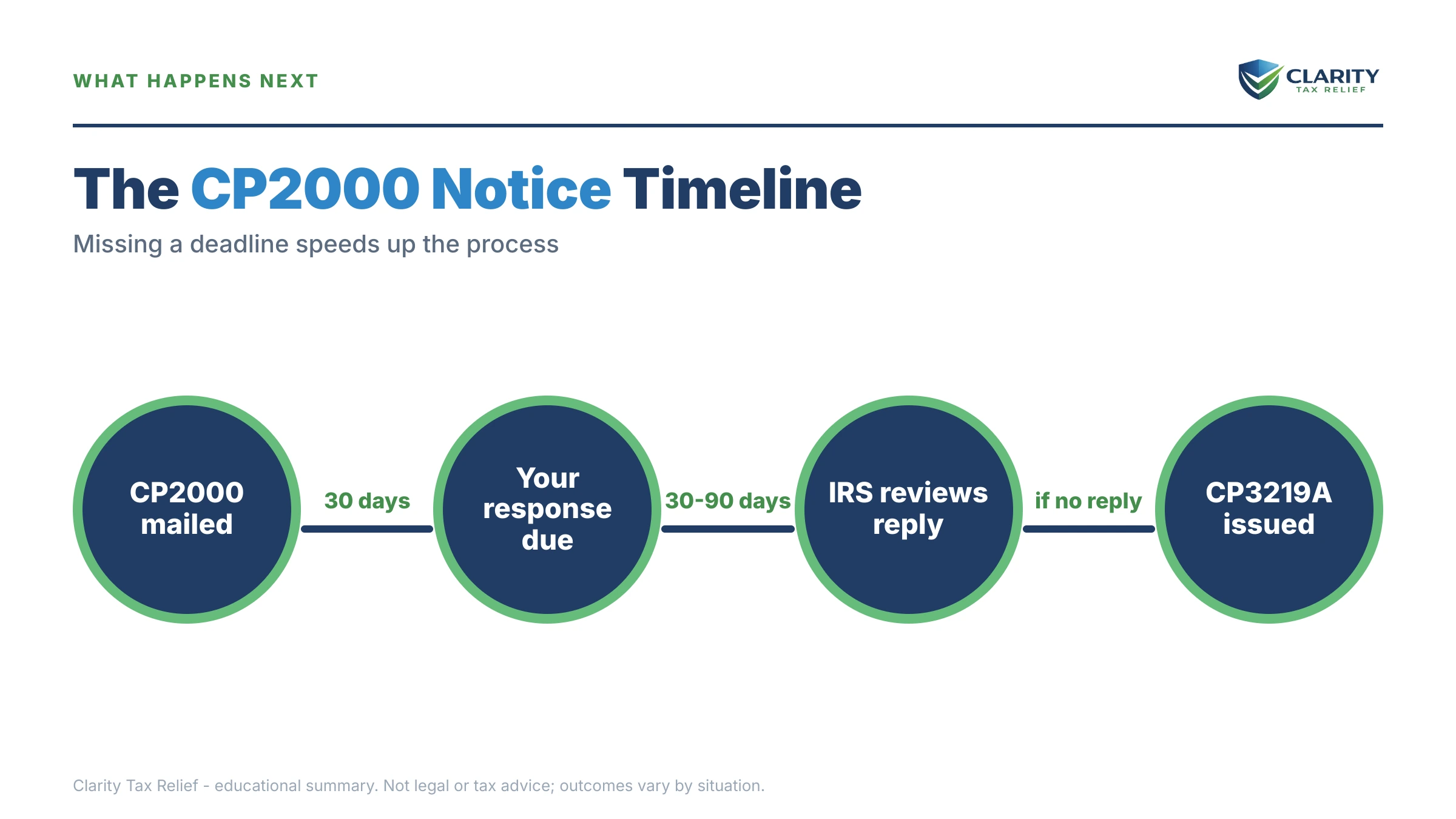
⏱ Your deadline: the response date printed on page 1 of your CP2000 — typically 30 days from the notice date. Miss it and the case moves toward a CP3219A Statutory Notice of Deficiency, which starts a strict 90-day Tax Court clock. Interest on any tax you actually owe keeps running the entire time.
Why you got a CP2000 from the IRS underreporter unit
A CP2000 notice is generated when the IRS Automated Underreporter (AUR) program finds income on a W-2, 1099, or SSA-1099 that doesn't appear to be on your tax return. Every payer — your bank, your brokerage, your IRA custodian, the Social Security Administration — sends the IRS a copy of the form they sent you. A computer lines those copies up against your return, usually a year or more after you filed. Anything it can't match becomes a proposed change.
No human decided you did something wrong. There is no examiner, no audit file, no suspicion of fraud. There is a mismatch — and mismatches happen to careful filers constantly. For retirees especially, the most common triggers are:
- A 1099-R that didn't make the return — a pension that started mid-year, an IRA custodian that changed hands, or a distribution your preparer never saw.
- A rollover counted as taxable — you moved an IRA between institutions, but the AUR computer read the 1099-R as a cash-out.
- A qualified charitable distribution (QCD) — the 1099-R reports the full amount you sent to charity from your IRA; the exclusion is invisible to the matching computer, so it flags the whole thing as unreported income.
- A 1099-B with no cost basis — your brokerage reported gross sale proceeds, and the computer taxed the entire sale as if you paid $0 for the shares.
- A forgotten 1099-INT or 1099-DIV — a matured CD, a moved account, a 1099 you weren't expecting at all.
- The Social Security cascade — every dollar of added income can make more of your SSA-1099 benefits taxable, so the proposal often taxes income you did report correctly, at a higher level.
Two things a CP2000 is not. It's not a math-error correction — those arrive as a CP11 notice (balance due) or CP12 notice (refund change), and they change your return immediately, no proposal stage. And it's not the gentler opening inquiry either — that's the CP2501 notice, which flags a mismatch without computing full dollar amounts. A CP2000 sits in between: specific numbers, but still negotiable.
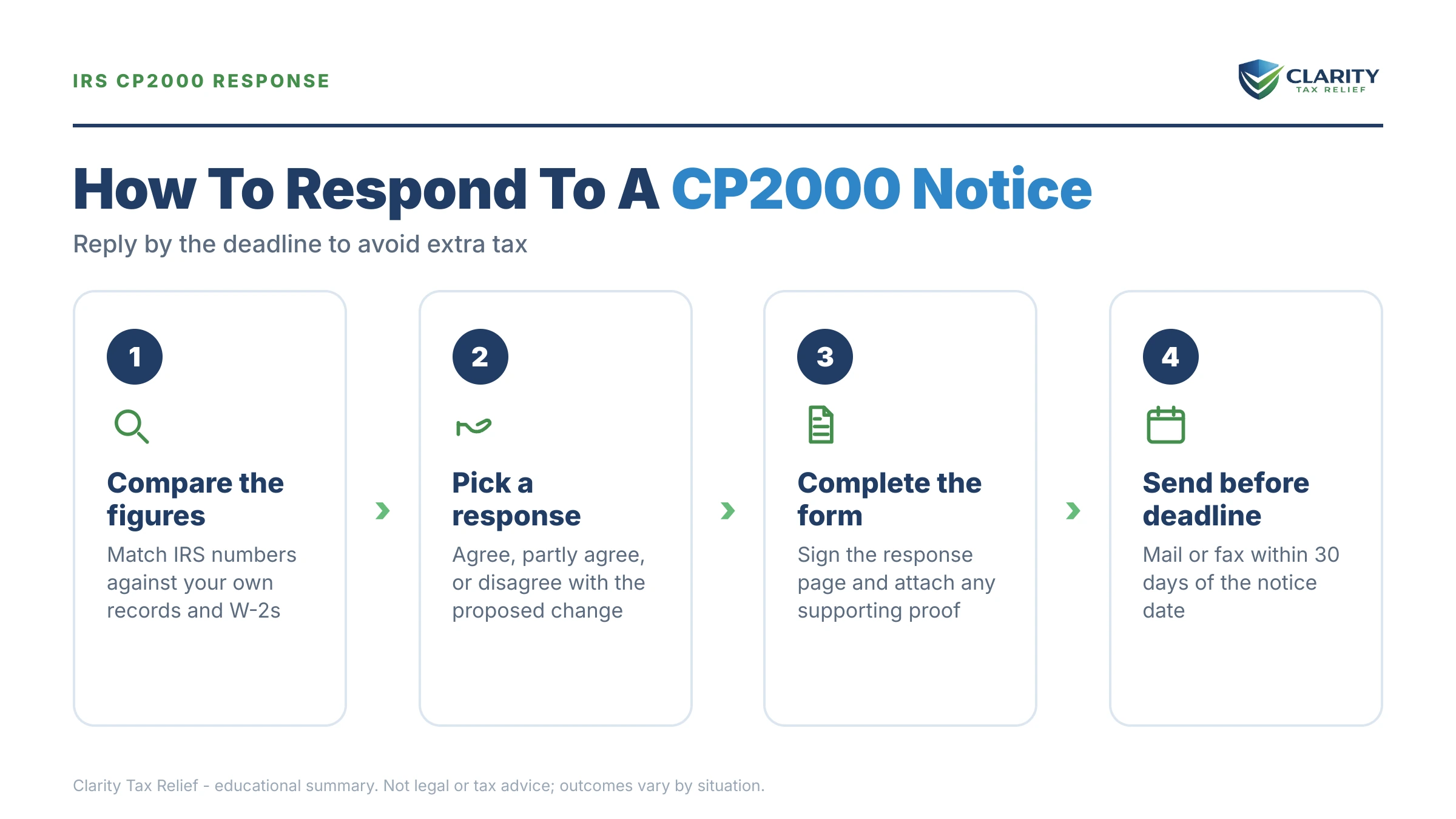
Why the CP2000 proposed amount is so often wrong
The AUR computer calculates the proposed tax using only the payer's numbers — it knows nothing about your cost basis, rollover paperwork, or charitable intent. That design guarantees systematic overstatement in three situations:
Securities sales. When a 1099-B shows gross proceeds without basis, the computer treats the entire sale price as gain. If you sold $15,000 of a fund you bought for $13,600, your real gain is $1,400 — but the proposal taxes all $15,000.
Retirement account movements. Trustee-to-trustee transfers, 60-day rollovers, and QCDs all produce a 1099-R that can look like taxable income to a matching program. Your account statements prove otherwise.
Stacked penalties and interest. Many CP2000s add the 20% accuracy-related penalty for substantial understatement, plus interest running from the return's original due date. Both are computed on the overstated tax — so shrinking the income correction shrinks them automatically. If you want a sense of how much of your proposed balance is penalty and interest rather than tax, our IRS penalty & interest calculator can estimate the split.
None of this means every CP2000 is wrong. Sometimes the missing 1099 is real and the number is right. The point is that you should never assume the printed amount is correct — verify it line by line first.
A worked example: an $8,900 CP2000 on retirement income
Say you're retired, living mostly on Social Security, and a CP2000 proposes $8,900 for a prior tax year. The notice lists two items missing from your return: a $24,000 IRA distribution on a 1099-R and $15,000 of mutual-fund sale proceeds on a 1099-B. The AUR math (hypothetical figures) stacks up like this:
- Additional tax on $39,000 of "unreported" income, plus newly taxable Social Security: $7,150
- Accuracy-related penalty at 20% of the tax: $1,430
- Interest from the return's original due date: $320
- Total proposed: $7,150 + $1,430 + $320 = $8,900
Now look closer. Your brokerage statements show you paid $13,600 for the fund shares — so the real gain is $1,400, not $15,000. And $12,000 of that IRA distribution went straight to your church as a qualified charitable distribution, which is excludable. A partial-agreement response with those documents attached asks the IRS to recompute on roughly $13,400 of genuinely taxable income instead of $39,000 — and the tax, the 20% penalty, and the interest all fall with it.
And if the recomputed balance is still more than you can pay at once? A balance in this range fits online payment plans: spread over 72 months, even the full $8,900 works out to roughly $124 a month before accruing interest and late-payment penalty. More on those options below.
What happens if you ignore a CP2000 notice
An unanswered CP2000 becomes legally assessed tax — the proposal hardens into a debt the IRS can collect by force. The sequence is automated and runs in a fixed order:
- The response date passes. The IRS treats silence as disagreement-by-default and moves the case forward. Interest on any tax actually owed keeps compounding.
- A CP3219A arrives. The CP3219A Notice of Deficiency — the "90-day letter" — is your last chance to dispute the amount without paying it first, by petitioning Tax Court within 90 days. That deadline is statutory; nobody at the IRS can extend it.
- The tax is assessed. If the 90 days pass, the proposed tax, the accuracy penalty, and all accrued interest post to your account as a legal debt. Your dispute rights narrow sharply — from "prove your case by mail" to "pay first, argue later."
- Collection begins. A bill arrives, then escalating collection notices, ending in a final notice of intent to levy. At that point the IRS can file a lien, levy bank accounts, and — critical for retirees — take up to 15% of monthly Social Security benefits through the Federal Payment Levy Program.
One 2026 reality worth knowing: the IRS workforce shrank roughly 27% in 2025, which means slower humans — but the AUR system, the deficiency notices, and the levies are all automated. The machine escalates on schedule whether or not anyone ever reads your file.
| Stage | What the IRS sends | What changes for you |
|---|---|---|
| Proposal | CP2000 (sometimes preceded by a CP2501) | Respond by the printed date — typically 30 days. Nothing is assessed yet; every option is open. |
| Final proposal | CP3219A Statutory Notice of Deficiency | A strict 90-day clock to petition Tax Court begins — your last pre-payment dispute right. |
| Assessment | Tax, penalty, and interest post to your account | The proposal is now a legal debt; a balance-due bill follows. |
| Collection | Escalating notices ending in a final intent to levy | Liens, bank levies, and up to 15% of Social Security via the Federal Payment Levy Program become possible. |
Holding a CP2000 with the clock running?
Get it reviewed free before your response date passes — the deadline printed on page 1 is real, and your options narrow at each stage after it. An experienced tax professional will tell you whether to agree, partially agree, or dispute, and exactly what proof to send.
Your three ways to answer a CP2000 — and what each requires
Every CP2000 comes with a response form offering three positions: agree in full, partially agree, or disagree in full. Which box you check determines everything that follows — including whether you owe the accuracy penalty at all.
| Your position | What you send | Watch out for |
|---|---|---|
| Agree in full | The signed response form, plus payment or a payment-plan request. The IRS assesses the amount and closes the case. | Only sign after verifying every line item — an agreed assessment is very hard to unwind. If married filing jointly, both spouses sign. |
| Partially agree | The response form marked "partially agree," a short letter itemizing what's right and wrong, and documents for each disputed item. | Expect a recomputed proposal months later. Address the accuracy penalty separately — ask for its removal with your reasonable-cause facts. |
| Disagree in full | The response form marked "disagree," a point-by-point explanation, and proof: basis statements, rollover confirmations, QCD receipts, or a payer's corrected 1099. | Silence from the IRS is not agreement — follow up. If a CP3219A arrives anyway, calendar the 90-day Tax Court deadline immediately. |
Two deep-dives if you already know your position: our CP2000 disagree guide walks through building the dispute package, and our CP2000 response letter sample gives you the exact wording and structure to adapt. One rule applies to all three paths: do not file Form 1040-X in response to a CP2000. The IRS says so on the notice itself — an amended return filed into an open underreporter case creates a second, parallel file and can add months of confusion.
If you agree but can't pay the CP2000 amount
Agreeing with a CP2000 and paying it are two separate decisions — sign the agreement to stop the penalty math from getting worse, then pick the payment path that fits. (Full walkthrough: CP2000 — agree but can't pay.) The realistic options:
- Short-term plan — up to 180 days to pay in full, $0 setup fee. Best when a CD is maturing or an RMD is coming that will cover it.
- Guaranteed installment agreement — for balances of $10,000 or less, the IRS's own rules make a guaranteed installment agreement available when you meet its filing and payment conditions. Our $8,900 example fits under this ceiling.
- Streamlined online plan — balances up to $50,000 can be spread over as long as 72 months online, no financial statement required. Interest and the 0.5%-per-month late-payment penalty continue while you pay.
- Currently Not Collectible status — if your Social Security and pension barely cover living expenses, the IRS can pause collection entirely. The debt remains and interest accrues, but no levy touches your benefits while the hardship holds.
- Penalty relief — the 20% accuracy-related penalty isn't covered by first-time abatement, but it can be removed for reasonable cause: you relied on a payer's incorrect form, a preparer's error, or records you had no way to know were incomplete. Failure-to-pay penalties that accrue after assessment have their own relief paths, including the new Automatic Exemption from Penalty rolling out in summer 2026.
How to respond to a CP2000, step by step
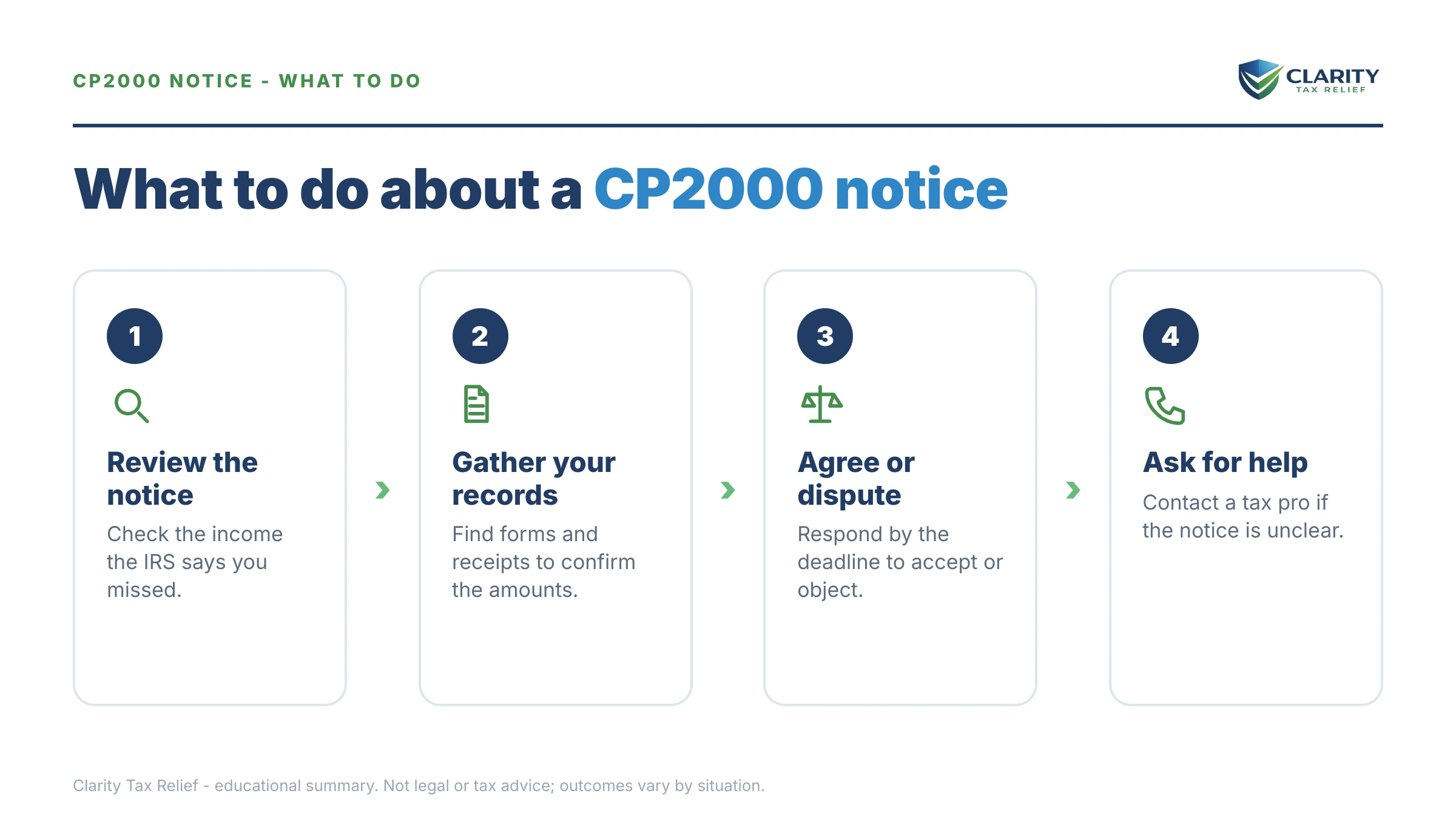
- Verify the match. Pull the tax year's return plus every 1099, W-2, and SSA-1099, and compare each item the CP2000 lists against what you actually reported.
- Check the IRS's math. Confirm cost basis, rollovers, QCDs, and withholding were credited — the proposed amount is a computer's estimate and is often overstated.
- Choose your response. Mark agree, partially agree, or disagree on the response form included with the notice — never file an amended return instead.
- Attach your proof. Include broker statements, rollover confirmations, corrected 1099s, or QCD acknowledgments for every item you dispute.
- Send it before the response date. Mail or fax the response to the address on the notice, keep copies of everything, and use certified mail so you can prove the postmark.
- Arrange payment for anything you agree with. Pay online at IRS.gov/payments or set up a payment plan — even a plan started today stops the case from rolling into enforced collection.
What your transcript shows during a CP2000 review
An open underreporter case appears on your IRS account transcript as code 922 — often before the CP2000 itself arrives in the mail. If you check your transcript while the case is open, here's how to read what you see:
| Code | What it means | What to do |
|---|---|---|
| 922 | An underreporter (AUR) review of that tax year has been opened. | Watch the mail for a CP2501 or CP2000 and start gathering that year's income documents now. |
| 971 | A notice was issued — often the CP2000 itself. | Match the 971 date to the notice date on your letter; the response clock runs from that date. |
| 570 | A hold on the account, often freezing any refund while the review is open. | Nothing to fix directly — resolving the CP2000 resolves the hold. |
| 290 | Additional tax was assessed — the case closed against you, or you agreed. | If you never responded, ask about audit reconsideration or dispute rights; if you agreed, arrange payment. |
| 291 | The assessment was reduced — your documentation was accepted. | Keep the closing letter with your records for that tax year permanently. |
When you can handle a CP2000 yourself
Most single-issue CP2000s don't require professional help. You can confidently handle it yourself when:
- The notice is right — you really did miss one 1099 — and you can pay the balance or set up a simple online plan;
- The fix is one clean document, like a broker statement showing cost basis or a custodian letter confirming a rollover;
- The amount is small enough that the accuracy penalty wasn't proposed at all.
Experienced help genuinely changes outcomes in a narrower set of cases: the CP3219A has already arrived and the 90-day Tax Court clock is running; multiple tax years have open underreporter cases; the mismatch involves self-employment income (which adds SE tax the computer may compute wrong); a 1099 in your name is identity theft or belongs to someone else; or the balance is genuinely unpayable on a fixed income and the real question is hardship status versus a plan. In those situations, the order and framing of your response can change what you ultimately pay — and a wrong first move (like an unnecessary 1040-X) is expensive to undo. If the IRS misses your deadline while you've met yours and the case stalls for many months, the Taxpayer Advocate Service exists for exactly that.
Terms on your CP2000, decoded
- AUR (Automated Underreporter): the IRS computer program that matches payer-reported income against tax returns and generates CP2000s — no human examiner involved.
- Proposed amount due: the tax, penalty, and interest the IRS suggests you owe — not an assessed debt until you agree or the dispute window closes.
- Response form: the tear-off page inside your CP2000 where you mark agree, partially agree, or disagree — the only correct way to answer the notice.
- Accuracy-related penalty: a 20% penalty under IRC §6662 for substantial understatement, removable with a reasonable-cause showing.
- Statutory Notice of Deficiency (90-day letter): the CP3219A that follows an unresolved CP2000; it opens your one fixed window to petition Tax Court before assessment.
- Information return: any payer-filed form — W-2, 1099-R, 1099-B, SSA-1099 — the IRS uses as its side of the match. The full IRS explainer for this notice is at Understanding your CP2000 notice.
If your response date is days away — or a CP3219A has already landed on top of the CP2000 — a free review with an experienced tax professional takes minutes to arrange: request a free case review or call (888) 825-7779.
CP2000 questions, answered
Is a CP2000 notice an audit?
No. A CP2000 comes from the IRS's Automated Underreporter program, which is a computer document-matching process, not an examination of your books and records. No auditor is assigned to your case, and responding to it does not open an audit. It can still add real tax and penalties, so treat the response deadline seriously.
Should I file an amended return to answer a CP2000?
No — the IRS specifically asks you not to file Form 1040-X in response to a CP2000. Use the response form attached to the notice instead, marking whether you agree, partially agree, or disagree. Filing an amended return alongside an open underreporter case can cross wires and delay resolution by months. If other corrections are needed, explain them in your response.
What happens if I ignore a CP2000 notice?
The proposal becomes real tax. If you don't respond by the date on the notice, the IRS issues a CP3219A Statutory Notice of Deficiency, which gives you 90 days to petition Tax Court. If that window also passes, the tax is assessed, a bill arrives, and the automated collection sequence — with liens and levies at the end of it — begins.
Can I just pay the amount on my CP2000?
You can, but verify the numbers first. AUR proposals routinely overstate tax — most often because a 1099-B is taxed at gross proceeds with zero cost basis, or a rollover was counted as a taxable distribution. Spend an hour matching each line item before paying; agreeing to an overstated amount is very hard to unwind later.
Does a CP2000 include penalties?
Often, yes. Many CP2000s propose a 20% accuracy-related penalty for substantial understatement, and interest runs from the original due date of the return. The accuracy penalty can be contested with a reasonable-cause explanation — for example, you relied on a payer's incorrect form — so it's worth addressing directly in your response rather than accepting by default.
Can the IRS take my Social Security over a CP2000?
Not at this stage. A CP2000 is a proposal, and no levy can happen until the tax is assessed and the IRS sends a final notice of intent to levy. If the debt is eventually assessed and ignored, the Federal Payment Levy Program can take up to 15% of monthly Social Security benefits — one more reason to resolve the case at the proposal stage.
What if I agree with the CP2000 but can't pay?
Sign the response form agreeing, then set up payment separately. Balances under $10,000 generally fit the guaranteed installment agreement, and balances up to $50,000 can be spread over as long as 72 months online. Interest and the late-payment penalty keep accruing on a plan, but enforcement stops. If paying anything would create hardship on a fixed income, currently-not-collectible status may apply.
What is the difference between a CP2501 and a CP2000?
A CP2501 is the softer opening question — it flags a mismatch and asks you to explain, usually without computing a full proposed tax. A CP2000 goes further: it calculates specific additional tax, penalties, and interest. Some cases start at CP2501 and escalate; others go straight to CP2000. Both come from the same Automated Underreporter program and use the same response process.
How do I know my CP2000 is real and not a scam?
A genuine CP2000 arrives by postal mail, shows the tax year and a notice date, and directs payment only to the United States Treasury or IRS.gov. The IRS will not email, text, or call you about it first. You can confirm the case exists by checking your IRS online account or transcript, where an open underreporter review typically appears as code 922.
How long does the IRS take to answer a CP2000 response?
Expect months, not weeks. The IRS acknowledges responses and then issues either a closing letter, a revised proposal, or a request for more information — and 2026 staffing cuts have stretched those timelines further. If your response window is expiring while you wait, a mailed response postmarked by the deadline protects you. Follow up if you hear nothing after a few months.
Your next 24 hours
- Find the two dates on page 1 of your CP2000 — the notice date and the response deadline — plus the tax year it covers, and write the deadline where you'll see it.
- Gather that year's paperwork: your filed return and every 1099-R, 1099-B, 1099-INT/DIV, and SSA-1099 — especially any statement showing cost basis, a rollover, or a QCD.
- Get a free case review before the response date: the 2-minute form at claritytaxrelief.com/#consult or (888) 825-7779. One call tells you whether to agree, partially agree, or dispute — while all three doors are still open.
This guide is general information, not tax or legal advice for your specific situation. Eligibility for IRS programs depends on individual facts and circumstances; no outcome is guaranteed.