
1099 & Self-Employment
Got a 1099 I Wasn't Expecting: What to Do Now (2026)
The short answer: a 1099 you weren't expecting means a payer reported income to the IRS under your Social Security number — the IRS already has its copy. Verify the form type, the amount, and the taxpayer ID first. If it's wrong, request a corrected 1099 in writing. If it's right, report it with your expenses subtracted. Never simply leave it off.
The envelope wasn't even from the IRS — it was from a client, a payment app, or a bank, and inside is a form with a dollar figure you never budgeted a tax bill for. If your first reaction was "I got a 1099 I wasn't expecting — is this even right?", that instinct is exactly correct: your first job is verification, not payment. The one fact that changes everything is that the payer filed an identical copy with the IRS, so the question isn't whether to deal with this form. It's how to deal with it for the least money.
Before anything else, figure out which 1099 you're holding and whether its numbers are even accurate. The image below shows you exactly what this form looks like and where to find the three things that matter — the box amount, the payer's ID, and the taxpayer ID it's tied to.
⏱ The real clock: a 1099 has no printed response deadline, but once April 15 passes, any unpaid tax on that income accrues a 0.5%-per-month failure-to-pay penalty plus interest — and if the income never appears on a return, the IRS's matching system will eventually bill you for tax on the full form amount with zero expenses subtracted.
Got a 1099 I wasn't expecting — why did it happen?
A surprise 1099 means a payer told the IRS it paid you money — most commonly $600 or more in nonemployee compensation, reported on Form 1099-NEC. Businesses face their own penalties for failing to issue these forms, so even a client you invoiced once in February will often send one.
For a self-employed sole proprietor, the usual triggers are:
- A small or forgotten gig. A one-off project, a referral fee, a subcontract — anything that crossed $600 generates a form, even if you'd mentally filed it under "not real income."
- Reimbursements grossed into Box 1. Some clients lump expense reimbursements, materials, or pass-through costs into the compensation box. The form looks inflated because, from your side, it is.
- A payment platform crossed the reporting line. Card processors and apps issue Form 1099-K once you pass the 1099-K $20,000 threshold for 2026 — $20,000 and more than 200 transactions.
- A lender wrote off a debt. Cancelled credit card, auto, or business debt of $600+ arrives as a 1099-C, and yes, the tax code generally treats it as income — see 1099-C cancelled debt taxes for the exclusions that can zero it out.
- Someone used your number. A payer typo'd a taxpayer ID, or someone worked under your Social Security number. That's a dispute, not a debt.
- A job you thought was employment wasn't — on paper. If you worked set hours under someone's control and got a 1099-NEC instead of a W-2, you may be misclassified. The 1099 but should be W-2 (Form SS-8) route can shift the employer's share of payroll tax back where it belongs.
Which 1099 did you get? A 60-second decoder
The letters after "1099" decide which schedule the income lands on and how it's taxed — a 1099-NEC carries self-employment tax, while a 1099-C may carry none at all. Find your form here first:
| Form | Why you got it | Your first move |
|---|---|---|
| 1099-NEC | A business paid you $600+ as a nonemployee (contractor, freelancer, sole proprietor) | Match it to your invoices and deposits; report on Schedule C with expenses subtracted |
| 1099-K | A payment app or card processor handled $20,000+ across 200+ transactions | Reconcile the gross figure — it includes refunds, fees, and sometimes personal transfers |
| 1099-MISC | Rents, royalties, prizes, or "other income" | Check which box is filled — different boxes land on different schedules |
| 1099-C | A lender cancelled $600+ of your debt | Test the insolvency exclusion before assuming it's taxable |
| 1099-G | Unemployment compensation or a state tax refund | If you never claimed unemployment, report the fraud to the state and request a corrected form |
| 1099-R | A retirement account distribution | Check the distribution code — rollovers and some transfers aren't taxable |
Is the 1099 wrong? How to dispute it
You are required to report your correct income — not the face value of an incorrect form — and payers get 1099s wrong constantly. The most common errors worth fighting:
- Timing mismatches. A check cut December 30 that you deposited January 3 shows up on the old year's form. Small timing gaps usually aren't worth a war, but document them — you'll report the income in the year you actually received it.
- Double reporting. If a client paid you by card or app and issued a 1099-NEC for the same money, the same dollars can appear on two forms. Reconcile carefully so you report the income once, not twice.
- Inflated amounts. Reimbursements, refunds you issued, and processing fees inside a 1099-K's gross figure aren't profit. Your Schedule C is where the gross gets reduced to reality.
- Not your income at all. Wrong SSN, a name mix-up, or identity theft. If someone earned money under your number, file the Form 14039 identity-theft affidavit and keep copies of everything.
To dispute a wrong form, contact the payer in writing — email is fine — state the correct figure and why, and ask for a corrected 1099. Payers fix errors by filing a new version with the "CORRECTED" box checked, which replaces the bad number in IRS records.
If the payer refuses or has gone out of business, don't just leave the form off your return — that's what triggers the matching machine. Instead, report the full amount the IRS has on file, then back out the erroneous portion on your return with documentation supporting the adjustment. The IRS sees a match; you pay tax only on what's real.
What a surprise 1099 actually costs — the math, worked out
Self-employment income on a 1099-NEC gets taxed twice: 15.3% self-employment tax on roughly 92.35% of your net profit, plus regular income tax at your bracket on top. That combination is why the self-employment tax shock hits first-time and surprise 1099 recipients so hard — and why your expenses are the single biggest lever you control.
Say you're a sole proprietor and a client sends a 1099-NEC for $31,200 you'd mentally written off as scattered project income. This is a hypothetical, but the arithmetic is real (rounded, and ignoring smaller adjustments):
- If you report the gross with no expenses: SE tax ≈ $31,200 × 92.35% × 15.3% ≈ $4,400. Income tax at a 22% bracket on the remainder ≈ $6,400. Total: roughly $10,800.
- If you document $8,700 of expenses (mileage, software, supplies, phone, home office): net profit drops to $22,500. SE tax ≈ $22,500 × 92.35% × 15.3% ≈ $3,100. Income tax ≈ $4,600. Total: roughly $7,700.
That's about $3,100 saved by an afternoon of expense reconstruction — at this bracket, every $1,000 of documented expense cuts the combined bill by roughly $350. This is also exactly what the IRS's matching program will not do for you: if the computer assesses the income later, it taxes the gross.
What happens if you ignore a surprise 1099
An unreported 1099 doesn't slip through — the IRS matches every information return to your Social Security number by computer, and the sequence that follows a mismatch is fully automated. Here is the order of what happens, stage by stage:
- You file without it (or don't file at all). Nothing happens immediately — the payer's copy just sits in IRS systems waiting to be matched.
- The Automated Underreporter program flags the mismatch. This typically surfaces a year or more after you file, which is why these bills feel like ambushes.
- A CP2000 notice proposes tax on the full 1099 amount — no Schedule C, no expenses, no mileage — often with a 20% accuracy-related penalty stacked on top, plus interest running back to the original due date.
- No response becomes an assessment. Ignore the CP2000 and its follow-up deficiency notice, and the proposed amount becomes a legal debt on your account.
- Collection notices begin. The assessed balance enters the standard sequence — first bill, reminders, then intent-to-levy notices with real seizure power behind them. If you've already got a CP14 and can't pay, you're at the front end of that sequence now.
All the while, failure-to-pay penalties and interest compound monthly. You can estimate how fast your balance grows with our Penalty & Interest Calculator — the number is usually motivating.
| Point in time | What happens | Your move or right |
|---|---|---|
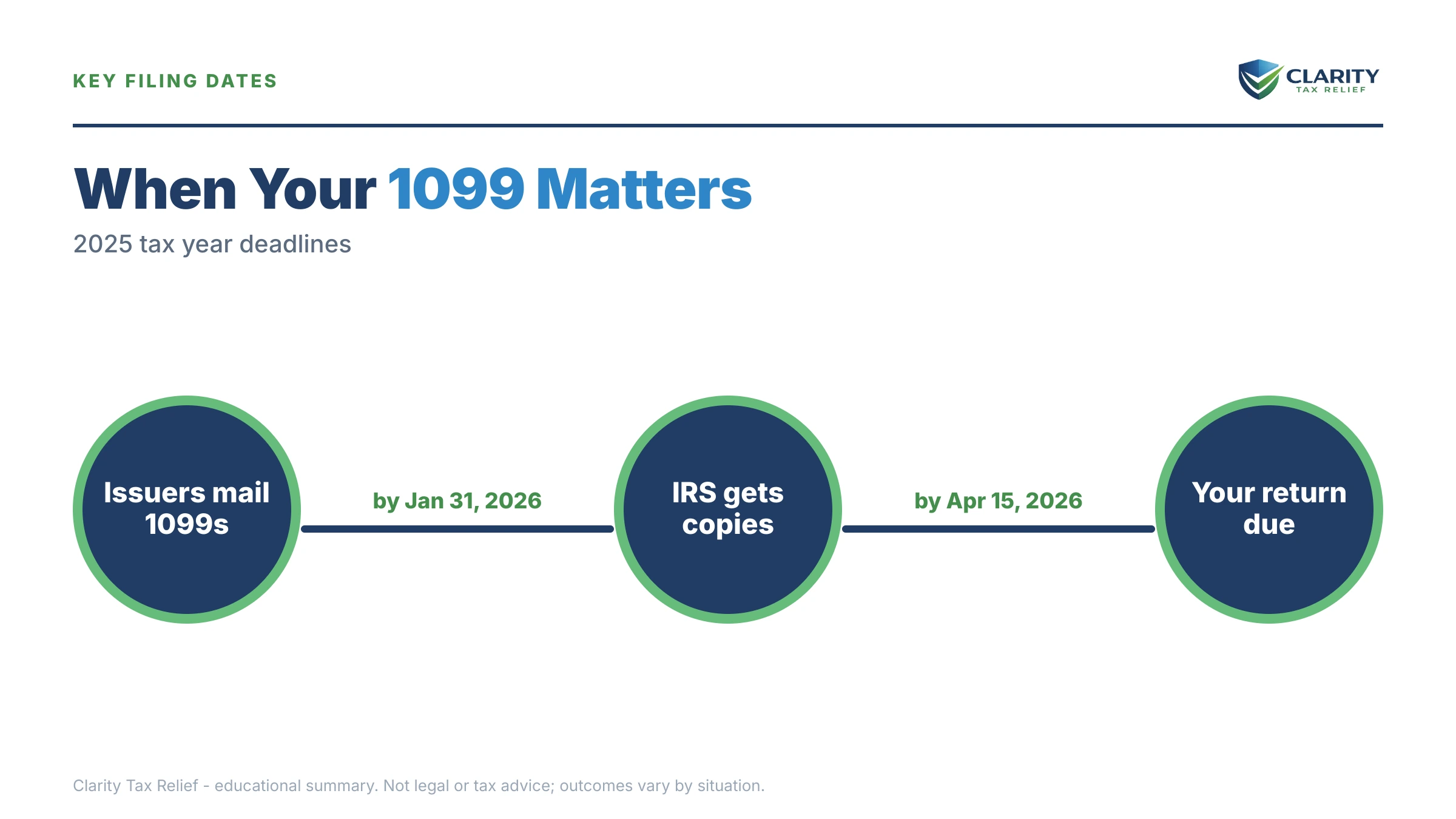
| January 31 | Payers must furnish most 1099s (including 1099-NEC) to recipients | Spot an error early and request a corrected form before filing season peaks |
| Late winter | The payer files its copy with the IRS | The IRS now holds the number whether or not you agree with it |
| April 15 | Filing and payment deadline | An extension moves filing to October 15 — payment is still due April 15 |
| After you file | Automated Underreporter matching runs against your return | Report the income accurately and no mismatch ever fires |
| A year or more later | A CP2000 proposes tax on any unreported 1099, expenses excluded | Respond by the date printed on the notice (typically about 30 days) to dispute before assessment |
| ~3 years from filing | The window to amend and claim a refund closes | File Form 1040-X while you still can — in either direction |
Surprise 1099 turned into a bill you didn't budget for?
Send us the form. An experienced tax professional will verify it's even correct, find the expenses that shrink it, and map your payment options — free and confidential, before penalties and interest add another layer.
Your options when the 1099 creates a bill you can't pay
Every IRS resolution program is open to a balance created by a surprise 1099 — the debt's origin doesn't limit your options, your finances do. The full DIY playbook lives in our guide to how to settle tax debt yourself; here's the menu at a glance:
| Option | Who's eligible | What it costs / what to know |
|---|---|---|
| Pay in full | Anyone | Free via IRS Direct Pay; stops penalty and interest growth immediately |
| Short-term plan (up to 180 days) | Balance you can clear within 6 months | $0 setup fee; interest and the 0.5%/month penalty continue until paid |
| Long-term installment agreement | Up to $50,000 → set up online, up to 72 months | Setup fee applies (reduced with direct debit); interest and penalties keep accruing |
| Guaranteed installment agreement | $10,000 or less, filings current | The IRS must accept it when the criteria are met — the official program name, not a promise about anything else |
| Currently Not Collectible | Financials show paying would prevent basic living expenses | Collection pauses; the debt and interest remain and the IRS reviews periodically |
| Offer in Compromise | Assets plus future income genuinely can't cover the debt | $205 fee and 20% down on lump-sum offers (both waived with low-income certification); the IRS accepted roughly 1 in 5 offers in FY2024 |
| Penalty relief | Clean compliance history for the prior 3 years | Removes penalties, not tax or interest; see below on 2026's automatic version |
Two notes worth money. First, if this is your first slip after years of clean filing, first-time penalty abatement can wipe the penalties — and starting summer 2026, the IRS's Automatic Exemption from Penalty (AEP) begins applying similar relief automatically, no request needed. Second, if you're going the monthly-payment route, you can set up an IRS payment plan online in under an hour; you don't need to reach a human, which matters when IRS phone staffing is at historic lows.
How to respond to a surprise 1099, step by step
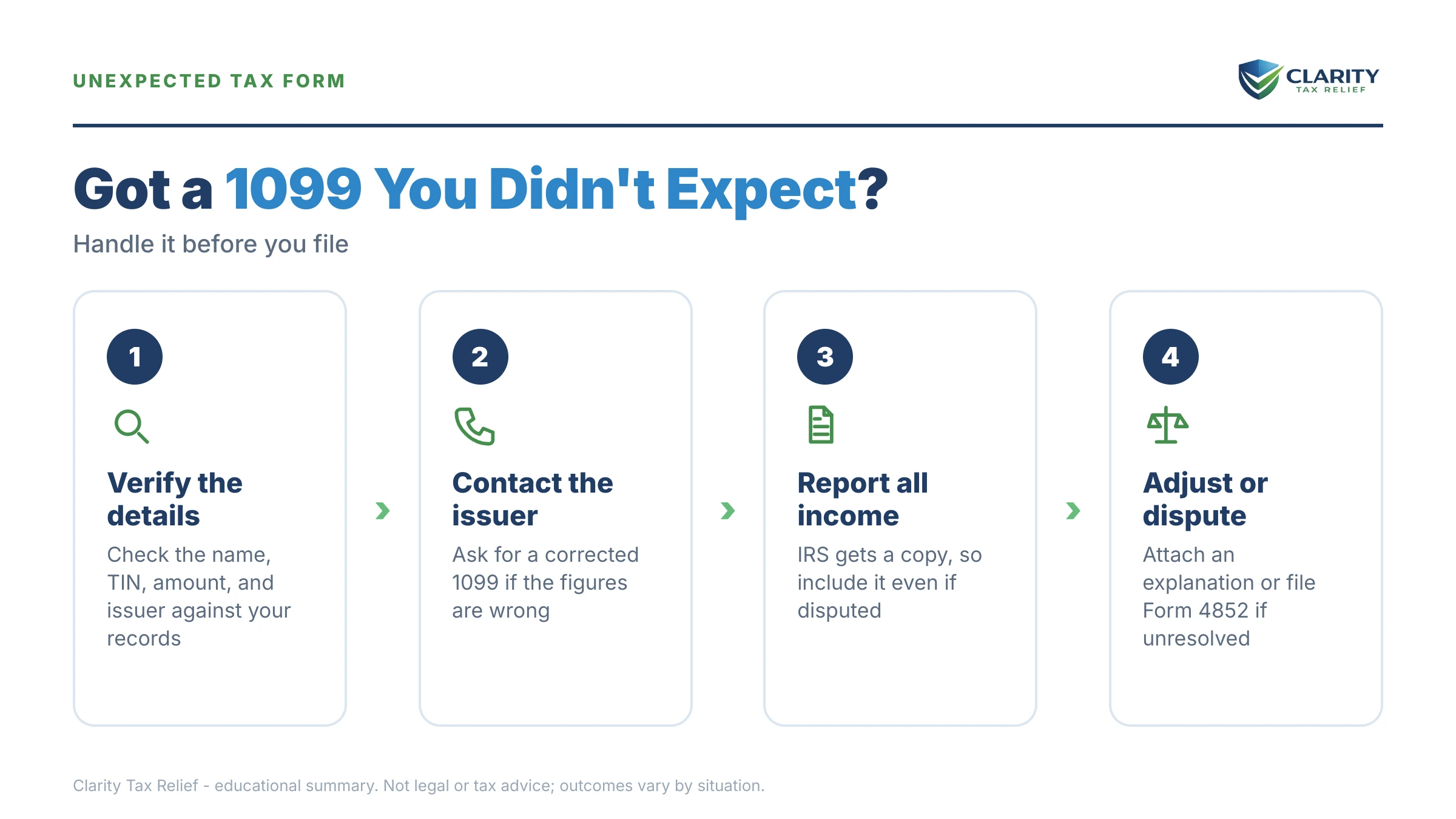
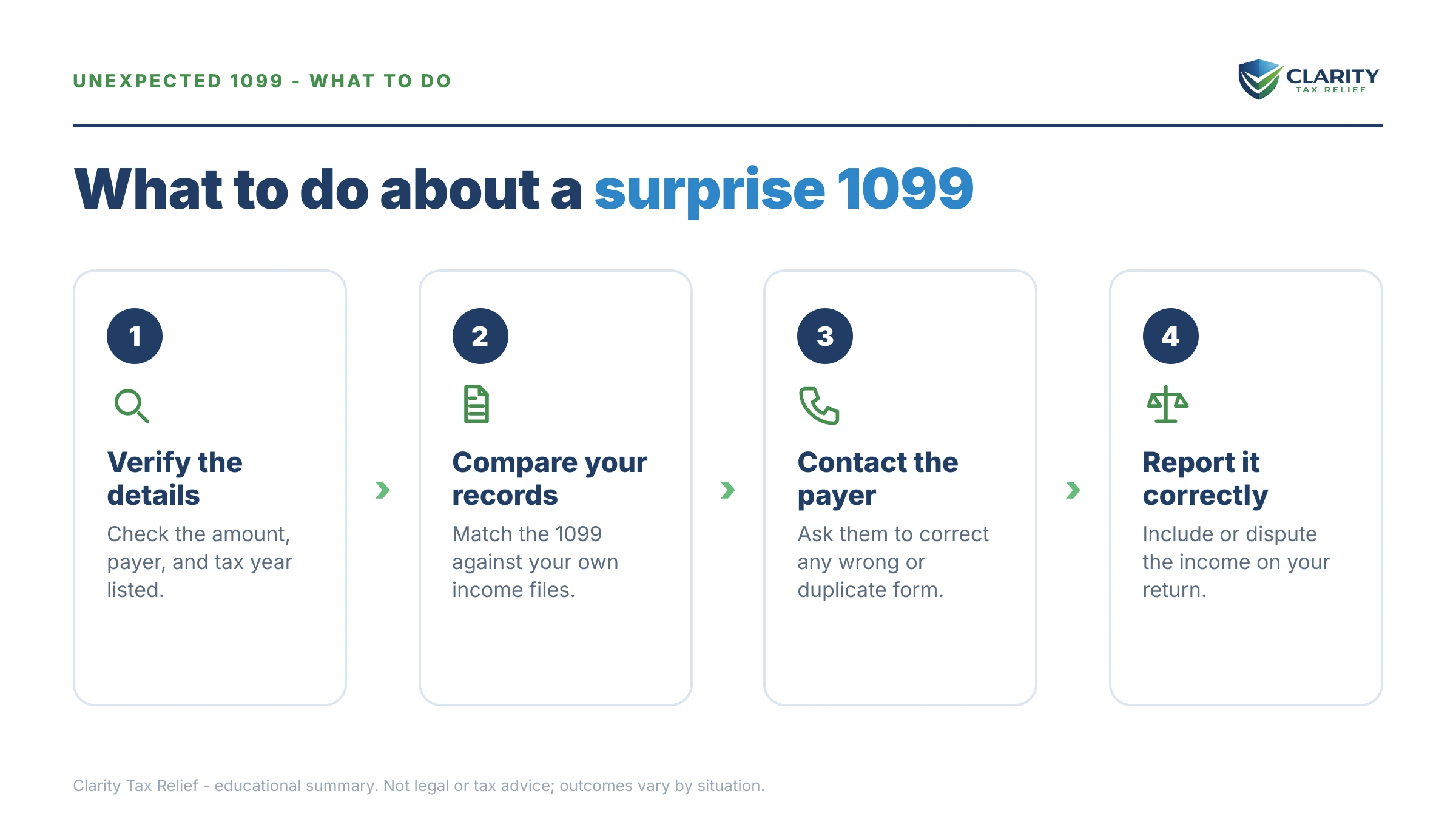
- Identify the form and the numbers: Note which 1099 it is (NEC, K, MISC, C, G, or R), the box amount, the tax year, and whether the Social Security number or EIN printed on it is yours.
- Verify the amount against your records: Pull bank deposits, invoices, and app payout reports for that payer and reconcile to the dollar. Flag timing differences and amounts that appear on more than one form.
- Request a corrected 1099 in writing if it's wrong: Email or mail the payer's issuing department, state the correct figure and why, and keep proof of the request. Payers fix errors by filing a version with the CORRECTED box checked.
- Report the income on the correct schedule: For a sole proprietor, 1099-NEC and business 1099-K income goes on Schedule C. Report your accurate numbers even if the corrected form hasn't arrived yet, and keep the documentation.
- Subtract every legitimate business expense: Mileage, supplies, software, home office, phone — each documented dollar reduces both income tax and 15.3% self-employment tax.
- Arrange payment before the balance escalates: Pay at IRS.gov/payments, or set up a payment plan the same day you file so the automated collection sequence never starts.
When you can handle this yourself — and when help changes the outcome
Most surprise 1099s don't need professional help. Handle it yourself when the form is accurate, you have your expense records, and you can either pay by April 15 or comfortably qualify for a short-term or streamlined online payment plan. That describes the majority of these situations, and paying a firm to file a Schedule C you could file yourself is money wasted.
Experienced help changes the outcome in a narrower set of cases: a CP2000 has already arrived taxing the gross amount and you need expenses accepted after the fact; the income genuinely isn't yours and the payer won't cooperate; the 1099 surfaced alongside multiple unfiled years; you're fighting misclassification with real payroll-tax dollars at stake; or the resulting balance is large enough that the difference between resolution options is thousands of dollars. If you're stuck in IRS processing limbo on a dispute, the Taxpayer Advocate Service is also a free, independent escalation path.
One more forward-looking fix: if 1099 income is now part of your life, learn how much to set aside for side-hustle taxes and pay quarterlies — the surprise only has to happen once.
Terms on your 1099, decoded
- Information return: any form (1099, W-2) a payer files to tell the IRS about money it paid you — the IRS's copy is what powers matching.
- Automated Underreporter (AUR): the IRS computer program that compares every information return against your tax return and flags gaps.
- CP2000: the notice AUR sends proposing extra tax on income that appeared on a 1099 but not on your return.
- Corrected 1099: a replacement form the payer files with the "CORRECTED" box checked — the only way to change the number in IRS records.
- Backup withholding: 24% the payer must withhold from your payments if you never provided a valid taxpayer ID on Form W-9.
- TIN: taxpayer identification number — your SSN or EIN. A 1099 with someone else's TIN error on it is their income problem, not yours, once corrected.
Surprise 1099 questions, answered
What should I do if I get a 1099 I wasn't expecting?
Verify it before you react: confirm the form type, the dollar amount, and that the Social Security number or EIN on it is actually yours. The payer already sent a copy to the IRS, so ignoring it isn't an option. If the numbers are right, report the income with your expenses subtracted; if they're wrong, request a corrected 1099 from the payer in writing.
Will the IRS know if I don't report a 1099?
Yes. The IRS's Automated Underreporter program matches every information return against the income on your tax return, by Social Security number. When a 1099 doesn't appear on your return, the system generates a CP2000 notice proposing tax on the full amount — with none of your expenses subtracted — often with a 20% accuracy-related penalty added. The notice typically arrives a year or more after you file.
Can I dispute a 1099 that's wrong?
Yes. Contact the payer in writing, explain the error, and ask for a corrected 1099 — payers file a version with a 'CORRECTED' box checked. If the payer refuses or has disappeared, report the form's full amount and then back out the incorrect portion on your return with documentation to support it. Never just leave a filed 1099 off your return; that triggers automated matching.
What if the 1099 reports income that isn't mine?
Don't pay tax on money you never received. First check whether the payer simply used the wrong taxpayer ID and ask for a corrected form. If someone worked under your Social Security number, that's identity theft — file Form 14039, the identity-theft affidavit, with the IRS and keep a copy of everything you send. The IRS can flag your account so the phantom income isn't assessed against you.
How much tax will I owe on a surprise 1099-NEC?
For a sole proprietor, plan on roughly 25-40% of the net profit, depending on your bracket. Self-employment tax runs 15.3% on about 92.35% of net earnings, and regular income tax stacks on top at your marginal rate. Every documented business expense — mileage, supplies, software, phone — reduces both taxes, which is why reporting the 1099 with a full Schedule C almost always beats letting the IRS tax the gross amount.
I already filed my return and then got a 1099 — do I need to amend?
Only if the income is missing from the return you filed. If you already reported the money — many self-employed people report income they never got a form for — no amendment is needed. If it's missing, file Form 1040-X and pay the extra tax before the IRS's matching program finds the gap; amending voluntarily generally avoids the 20% accuracy-related penalty a CP2000 can carry.
Do I owe taxes on a 1099-K from PayPal or Venmo?
Only on business income. For 2026 the federal 1099-K threshold is back to $20,000 and more than 200 transactions, so a form means substantial payment volume. Personal transfers — rent splits, gift repayments — aren't taxable even if they appear in the gross figure, and personal items sold at a loss create no tax. You may need to reconcile the gross amount on your return so it matches IRS records.
What happens if the surprise 1099 creates a bill I can't pay?
File the return anyway — the failure-to-file penalty is 5% per month, ten times the 0.5% failure-to-pay penalty. Then pick a resolution: balances under $50,000 can go on an online installment agreement of up to 72 months, a short-term plan gives you 180 days at no setup fee, and genuine hardship or low collectability opens Currently Not Collectible status or an Offer in Compromise.
Your next 24 hours
- Find three things on the form: which 1099 it is, the box amount, and the taxpayer ID — confirm the SSN or EIN is yours and the tax year is right. (The IRS's own overview of the most common form is at About Form 1099-NEC.)
- Gather your records for that payer: bank statements, invoices, app payout reports — plus last year's return and whatever expense records you have. An hour of reconciling now decides whether you pay tax on the gross or the net.
- Get a free case review: if the form is wrong, the income isn't yours, or the bill is bigger than you can pay, call (888) 825-7779 or use the 2-minute form. Penalties and interest on unpaid tax accrue every month the balance sits — the earliest fix is always the cheapest one.
This guide is general information, not tax or legal advice for your specific situation. Eligibility for IRS programs depends on individual facts and circumstances; no outcome is guaranteed.