
IRS Notices
Got a CP14 and Can't Pay? Every Real Option in 2026
The short answer: if you got a CP14 and can't pay, nothing gets levied yet — a CP14 is the IRS's first bill, and you typically have 21 days from the notice date to set up an arrangement instead of paying in full. A payment plan, hardship status, or penalty relief each stops the escalation.
The bill is bigger than anything in your budget — maybe it's the first return you've filed since the divorce, one income where there used to be two, and a balance built when your life looked completely different. Take a breath: the IRS does not expect a check you don't have. It expects a response, and every response that counts can be set up this week. This guide maps each one, with the real numbers.
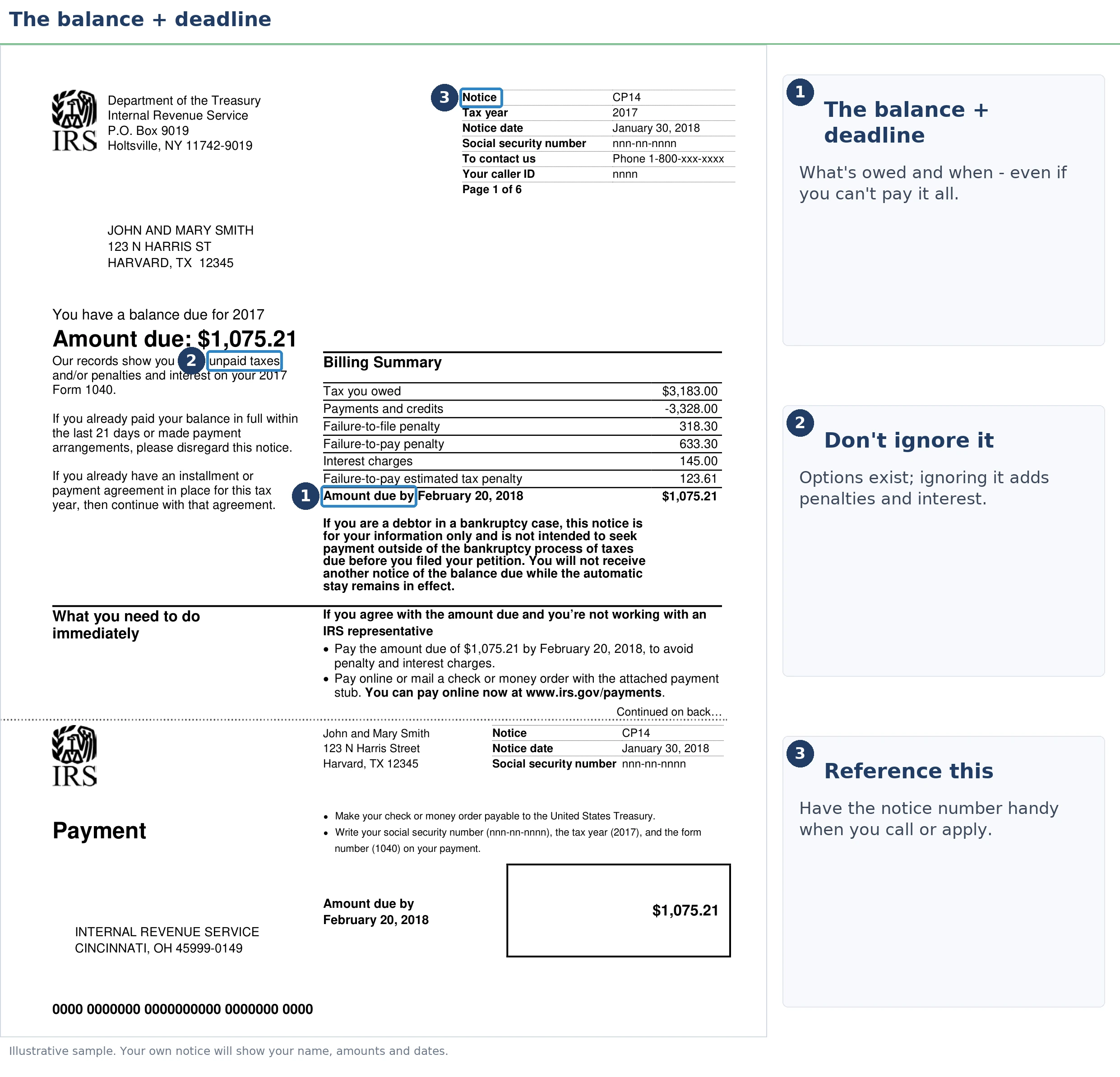
One thing to know before you read further: the CP14 itself tells you almost nothing about your options — the image below shows you exactly what this notice looks like and where the figures that drive every decision (the pay-by date and the penalty breakdown) actually sit.
⏱ Your deadline: the pay-by date printed on your CP14 — typically 21 days from the notice date. Missing it doesn't trigger a levy, but interest and the 0.5% monthly late-payment penalty keep compounding, and the IRS's automated system queues the next notice. Any arrangement set up by that date stops the sequence.
Why you got a CP14 you can't pay
A CP14 means the IRS processed your return and its records show an unpaid balance — it is a bill, not an audit, and it is the cheapest notice in the collection sequence to resolve. Nobody is questioning your deductions or investigating you. The system simply compared what your return says you owe against what was paid, and found a gap.
For most people who can't pay, the gap has an ordinary cause: withholding set for a two-income household that no longer exists, a filing status that changed mid-year, self-employment income with no quarterly payments behind it, or a joint-year balance that surfaced after the split. The notice shows the tax year, the tax itself, and the penalties and interest already added — read the breakdown box before anything else, because penalties are often the most fixable piece.
This page is specifically about what to do when you can't pay the number on the notice. For the full anatomy of the letter itself — every box, every scam-check, the already-paid scenario — see our complete CP14 notice guide.
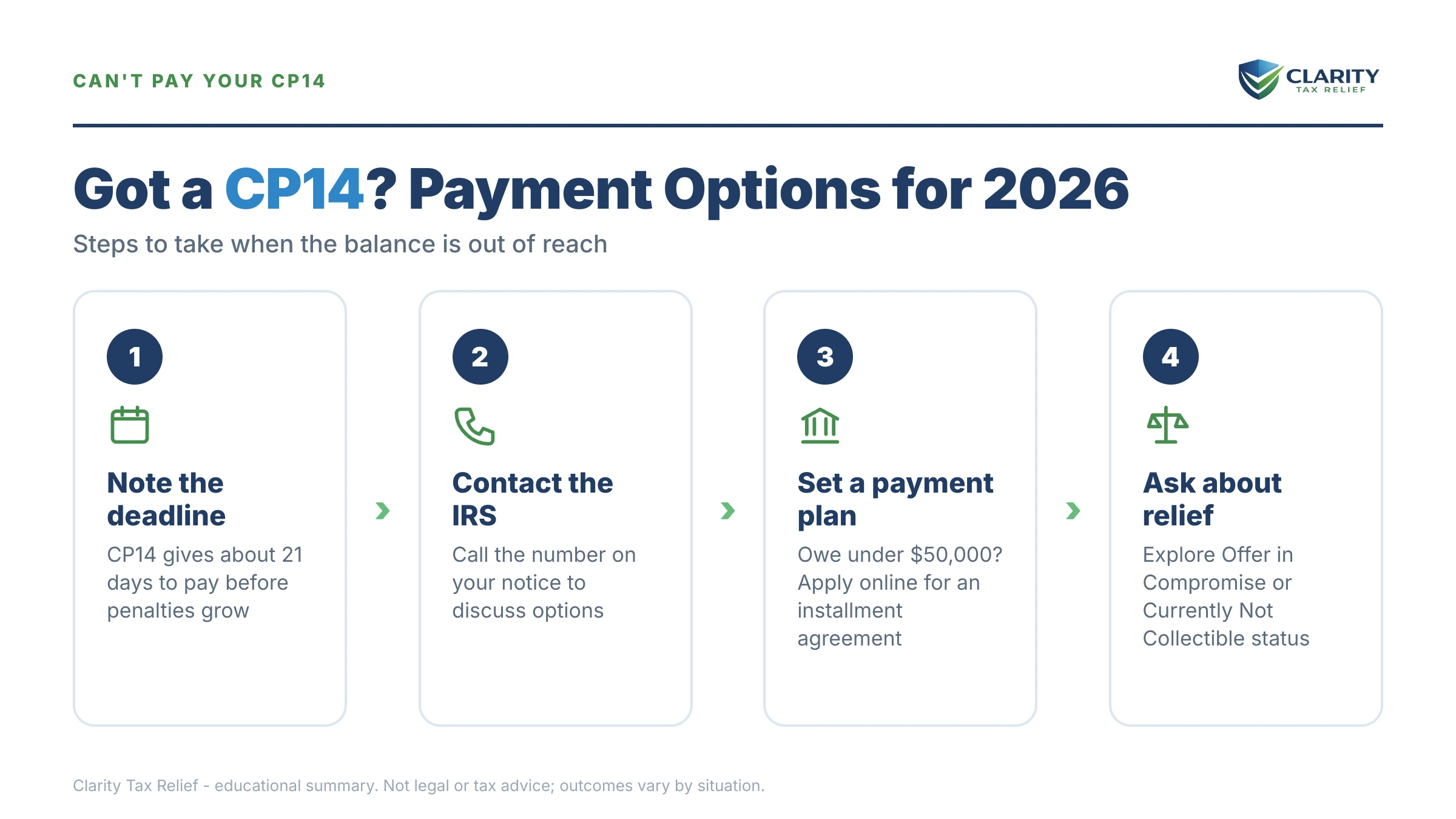
What happens if you ignore a CP14 you can't pay
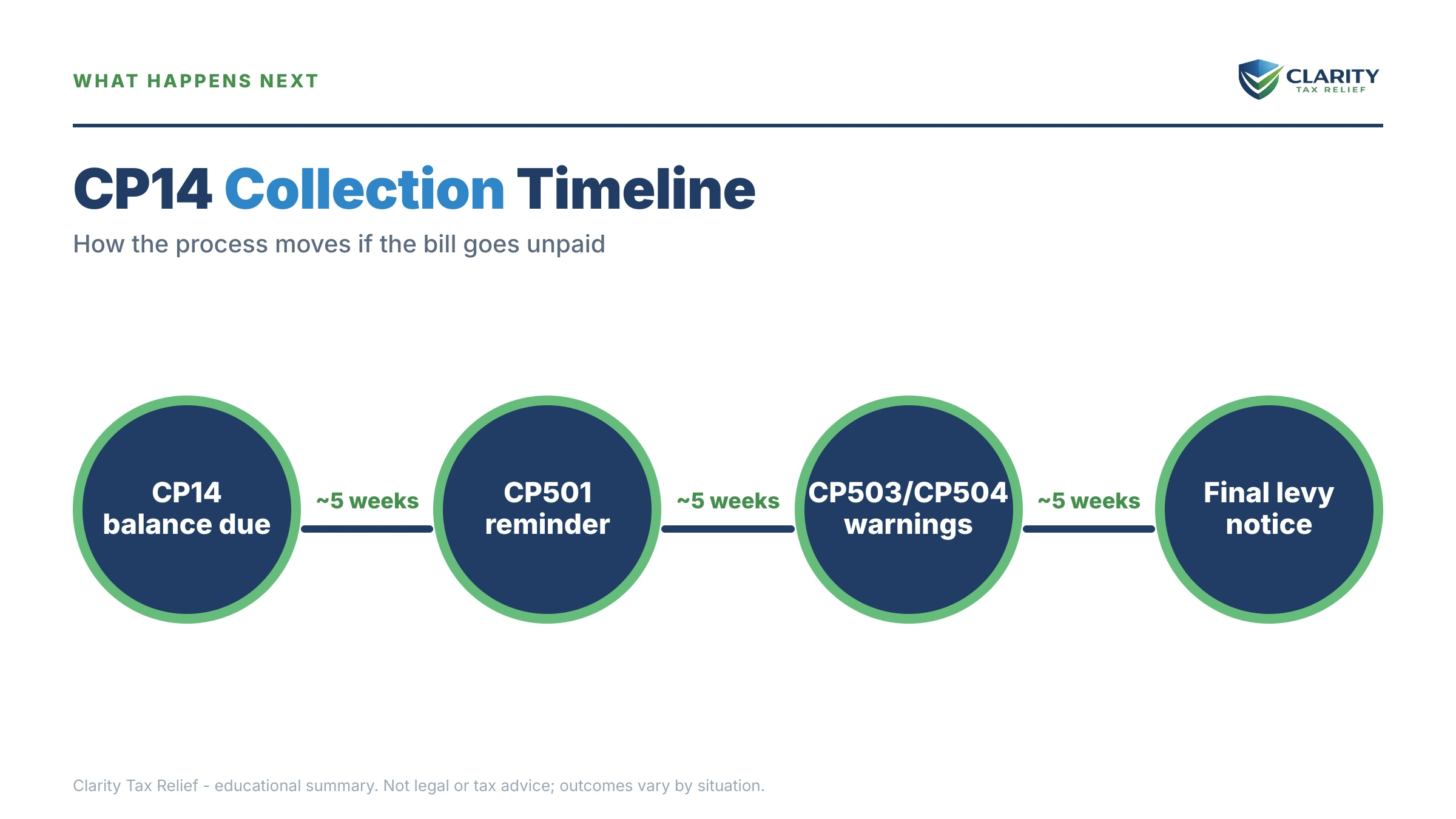
Ignoring a CP14 does not trigger an immediate levy — it triggers an automated notice sequence that ends in one. Each letter arrives a few weeks after the last, with a bigger balance and more enforcement power behind it:
- CP14 — the first bill. You are here. No enforcement power yet; maximum options.
- CP501 and CP503 — reminder notices. Still just bills, but the 0.5% monthly penalty and daily interest have been compounding the whole time.
- CP504 notice — Notice of Intent to Levy under IRC §6331(d). The IRS can now seize your state tax refund, and a federal tax lien becomes a live possibility.
- LT11 notice or Letter 1058 — the final notice of intent to levy. This starts a 30-day clock and your Collection Due Process rights (requested on Form 12153). After it runs, the IRS can garnish wages and levy bank accounts.
- Levy — a bank levy freezes funds for a 21-day hold before the money leaves; a wage levy is continuous, hitting every paycheck until released.
Don't count on 2026's IRS staffing cuts to slow this down. The workforce shrank roughly 27% in 2025, which makes it harder to reach a human — but every notice in that sequence is generated by automated systems that never stopped running. Understaffing delays your help, not your escalation.
| Stage | Response window | What the IRS can do |
|---|---|---|
| CP14 (first bill) | Typically 21 days — the pay-by date printed on the notice | Nothing yet; balance grows with penalties and interest |
| CP501 / CP503 reminders | Date printed on each notice | Still no enforcement; balance keeps compounding |
| CP504 — intent to levy | Date printed on the notice | Seize your state tax refund; lien filing becomes likely |
| LT11 / Letter 1058 — final notice | 30 days, with CDP appeal rights via Form 12153 | After 30 days: wage garnishment, bank levy |
| Active levy | Bank funds held 21 days before transfer; wage levy is continuous | Take pay, bank balances, and up to 15% of Social Security |
Holding a CP14 you can't pay?
Get it reviewed free before the pay-by date on your notice passes. An experienced tax professional will confirm the balance is right, run the plan math, and tell you which option actually fits your budget — no pressure, no obligation.
Got a CP14 and can't pay in full? Your real options
The IRS cannot demand a payment you can't make — every CP14 balance has at least four resolution paths, and eligibility is set by your balance and your budget, not by how scared you are. The notice presents "pay now" as the only choice; here is the actual menu. (For the full do-it-yourself walkthrough of each program, our guide on how to settle tax debt yourself covers the mechanics in depth.)
| Option | Who qualifies | Setup cost | What it does |
|---|---|---|---|
| Short-term payment plan | Can pay in full within 180 days | $0 | Buys time; stops escalation; accruals continue |
| Guaranteed installment agreement | Balance of $10,000 or less, compliant filer | Modest fee (lowest online with direct debit) | IRS must accept; pay within 3 years |
| Streamlined installment agreement | Up to $50,000; direct debit required above $25,000 | Modest fee (lowest online with direct debit) | Up to 72 months; no financial disclosure needed |
| Currently Not Collectible | Paying would leave you unable to cover basic living costs | $0 (financial statement required) | Pauses all collection; debt remains and accrues |
| Offer in Compromise | Assets + future income can't cover the debt | $205 + 20% down (waived with low-income certification) | Settles for the collectible amount; ~1 in 5 accepted in FY2024 |
| Penalty relief (FTA / AEP) | Clean compliance the prior 3 years, or reasonable cause | $0 | Removes penalties; shrinks the balance itself |
Short-term plan: up to 180 days, no setup fee
If money is coming — a house sale closing, a retirement distribution, a bonus — the short-term plan is the cheapest arrangement the IRS offers. You get up to 180 days with a $0 setup fee, enforcement stops, and you avoid committing to years of monthly payments. The catch: the full balance must be gone by day 180, and interest plus the late-payment penalty accrue the whole time.
Installment agreement: the workhorse for balances under $50,000
A streamlined installment agreement covers balances up to $50,000 with terms up to 72 months, no financial disclosure required, and online approval. Two thresholds inside it matter enormously: at $10,000 or under, the guaranteed installment agreement means the IRS must accept a 3-year plan if you're otherwise compliant; above $25,000, streamlined approval requires direct-debit payments from your bank account. Interest and penalties keep accruing on the declining balance — a plan is not a freeze, it's a truce.
Currently Not Collectible: when there's genuinely nothing to send
If paying the IRS anything would mean skipping rent, utilities, or food, Currently Not Collectible status pauses collection entirely. You demonstrate the hardship with income and expense figures — usually Form 433-F — measured against the IRS's allowable living expense standards. The debt doesn't disappear and interest still accrues, but levies stop and the 10-year collection statute keeps running. This is the path built for the reader who lost a job and can't pay the IRS, or whose budget is consumed by medical bills that make IRS debt unpayable.
Offer in Compromise: real, means-tested, and slower than the ads admit
An Offer in Compromise settles the debt for the most the IRS could realistically collect — your asset equity plus a multiple of your monthly disposable income. It's genuine relief when the math works, but it is strictly means-tested: the IRS accepted roughly 1 in 5 offers in FY2024. The application costs $205 with 20% down on lump-sum offers, both waived if your income is at or below 250% of the federal poverty level, and offers the IRS doesn't decide within 2 years are accepted automatically, with narrow exceptions — a returned or rejected offer stops the clock, and time during court disputes does not count. Read how an offer in compromise works before spending a dime pursuing one — and be wary of anyone who promises acceptance before seeing your finances.
Penalty relief: the fastest way to shrink the number itself
Penalties are the one part of a CP14 balance that can simply be removed. First-time penalty abatement applies if your prior three years were clean — no penalties, all returns filed — and it wipes the failure-to-pay penalty for the year in question. Starting summer 2026, the IRS's new Automatic Exemption from Penalty (AEP) begins applying comparable relief automatically, with no request needed, so check your account before assuming you must apply. Reasonable-cause relief covers illness, disaster, and other events outside your control — a divorce alone rarely qualifies, but the hospitalization or job loss that came with it might.
What a $31,200 CP14 balance actually costs on each path
Say you owe $31,200 — a balance from your last joint year that arrived, in your name, the summer after the divorce was final. Here's the arithmetic on each path, all figures approximate and hypothetical:
- Do nothing: the failure-to-pay penalty runs 0.5% per month — about $156 a month on $31,200 — with interest compounding daily on top. Waiting six months adds roughly $1,000+ before enforcement even starts. You can estimate your own trajectory with our IRS Penalty & Interest Calculator.
- Short-term 180-day plan: $31,200 ÷ 6 ≈ $5,200 a month — realistic only if equity from the marital home sale or another lump sum is landing soon.
- 72-month streamlined plan: $31,200 ÷ 72 ≈ $434 a month before accruals. Because the balance is over $25,000, direct debit is required.
- The partial-payment tactic: pay $6,300 up front and the balance drops to $24,900 — under the $25,000 line, so direct debit is no longer mandatory, and the 72-month floor falls to roughly $346 a month. One payment changes which tier you're in.
- Offer in Compromise sketch: suppose your only equity is $2,500 in a car and $500 in savings, and after allowable living expenses on one income you have $100 a month left. A lump-sum offer is measured at equity plus 12 months of that disposable income: $3,000 + $1,200 = an offer around $4,200. If your disposable income were $600 a month instead, the math jumps past $10,000 — and if it full-pays the debt within the statute, the offer gets rejected. The math decides, not the marketing.
| Path | Approx. monthly cost | The catch |
|---|---|---|
| Do nothing | $0 paid; ~$156+/mo added | Escalates toward state-refund seizure, then levy |
| 180-day short-term plan | ~$5,200 | Full payoff required by day 180 |
| 72-month streamlined plan | ~$434 + accruals | Direct debit mandatory above $25,000 |
| Pay $6,300, then 72-month plan | ~$346 + accruals | Requires the up-front lump sum |
| Currently Not Collectible | $0 | Must prove hardship; balance keeps growing |
| Offer in Compromise | Varies with equity + disposable income | Means-tested; ~1 in 5 accepted in FY2024 |
The divorce wrinkle: whose CP14 is this, really?
A divorce decree does not move a tax debt — if the balance comes from a joint return, the IRS can collect all of it from either ex-spouse, regardless of what the decree assigns. The IRS was not a party to your divorce, so a decree saying "he pays the 2024 taxes" binds him to you, not to the IRS. Our guide to who pays IRS debt after divorce walks through enforcing the decree in family court while protecting yourself with the IRS in parallel.
Two carve-outs matter. If the balance traces to your ex's income, business, or errors — and you didn't know and had no reason to know — innocent spouse relief can remove your liability entirely; there's also a separation-of-liability path that splits a joint debt between divorced spouses. Don't set up a payment plan on a balance you might not legally owe until you've ruled these out — agreeing to pay first makes relief harder to argue later.
And if this CP14 comes from your first return filed single, the debt is yours alone — but the fix includes the future, too: update your W-4 now so next April doesn't produce a second CP14 on top of the plan you're about to start.
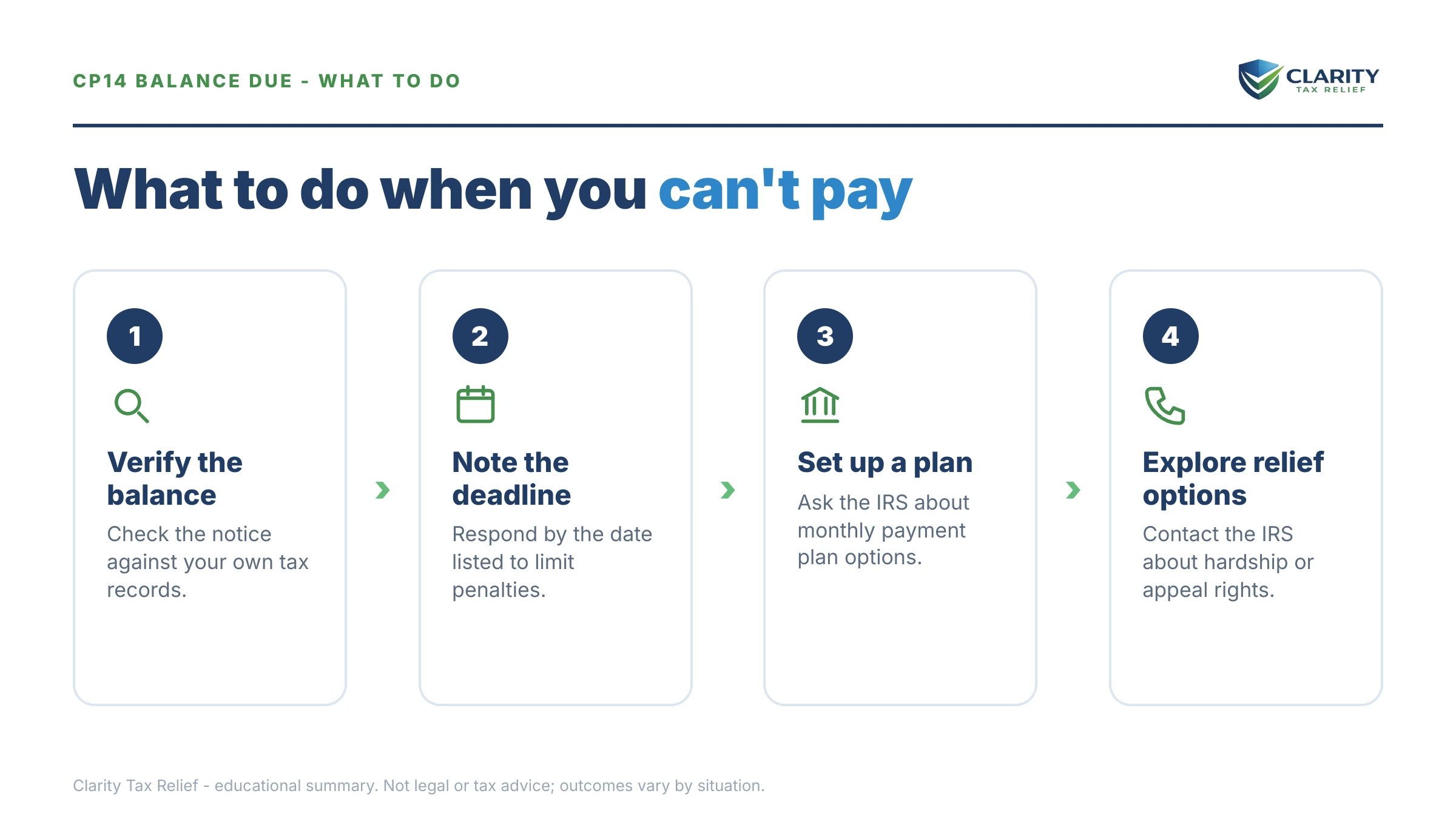
How to respond to a CP14 you can't pay, step by step
- Verify the balance before you commit to it. Log into your IRS online account and match the CP14 against your filed return — payments cross in the mail with CP14s constantly, and you should never set up a plan on a number you haven't confirmed.
- File any return you haven't filed. The failure-to-file penalty runs 5% per month — ten times the 0.5% failure-to-pay rate — so file every unfiled return now even though you can't pay. (The math is spelled out in file even if you can't pay.)
- Pay whatever you can before the pay-by date. Every dollar shrinks the base that penalties and interest are calculated on, and dropping a balance below $25,000 or $10,000 unlocks easier payment-plan tiers.
- Choose the resolution path that fits your budget. Pick the 180-day plan if money is coming, a streamlined installment agreement for steady income, Currently Not Collectible for genuine hardship, or an Offer in Compromise when the math supports it.
- Set it up online before the deadline. Apply through the IRS Online Payment Agreement tool or mail Form 9465 — an arrangement in place by the pay-by date stops the notice sequence. Our walkthrough of the IRS payment plan online process covers every screen, and the official terms live on the IRS payment plans page.
- Request penalty relief once the plan is set. With a clean three-year compliance history, first-time abatement can remove the failure-to-pay penalty — and starting summer 2026, the IRS's Automatic Exemption from Penalty applies some relief with no request at all.
When you can handle this yourself — and when help changes the outcome
Most people with one tax year, a confirmed balance, and steady income can resolve a CP14 themselves online in under an hour. If your balance is under $25,000, the streamlined application asks almost nothing, the guaranteed tier under $10,000 can't be refused, and the 180-day plan is a few clicks. Doing it yourself costs you the setup fee and nothing more.
Experienced help changes outcomes in specific situations: a joint-year balance where innocent spouse or separation-of-liability relief is on the table, multiple years or unfiled returns (the order you fix them in changes the total), Offer in Compromise math — where a miscounted asset or expense can double a required offer — and any case where a CP504 or LT11 has already arrived and the clock is short. The honest test: if the balance is right, the year is single, and a plan payment fits your budget, do it yourself. If any of those three is shaky, get a second set of eyes first.
If your CP14 sits on top of a joint-return year, an unfiled year, or more than one balance, a free case review can map the sequence before you lock anything in — call (888) 825-7779 or use the 2-minute form.
Terms on your CP14, decoded
- Notice date: the date printed at the top right — every deadline on the letter counts from it, not from the day you opened it.
- Failure-to-pay penalty: 0.5% of the unpaid tax per month, capped over time, charged on top of interest.
- Statutory interest: interest the law requires on unpaid tax, set quarterly and compounded daily — it can't be negotiated away, only stopped by payment.
- Installment agreement: the IRS's formal name for a monthly payment plan; while it's current, enforcement stops.
- Levy vs. lien: a levy takes property (wages, bank funds); a lien is a legal claim against property that secures the debt. A CP14 involves neither — yet.
- CSED: the Collection Statute Expiration Date — the IRS generally has 10 years from assessment to collect, though appeals, offers, and bankruptcy pause the clock.
The IRS's own plain-language page for this letter is at Understanding your CP14 notice, and if the system mishandles your case — a payment applied to the wrong year that nobody will fix, for instance — the independent Taxpayer Advocate Service exists for exactly that.
CP14 can't-pay questions, answered
What happens if I get a CP14 and can't pay anything at all?
Nothing is seized because of the CP14 itself — it's a bill, not a levy. If you truly can't pay anything, ask for Currently Not Collectible status, which pauses collection while your hardship lasts. You'll need to show your income and living expenses, usually on Form 433-F, and the balance keeps growing with interest — but levies and garnishments stop.
How long do I have to respond to a CP14?
Typically 21 days from the notice date, and the exact pay-by date is printed on the front of your notice. Missing it doesn't trigger a levy, but interest and the 0.5% monthly late-payment penalty keep accruing while the IRS's automated system queues the next notice. Setting up any payment arrangement by that date stops the escalation.
Can I set up an IRS payment plan online for a CP14 balance?
Yes — most people with a CP14 can apply online in about 20 minutes. Balances of $50,000 or less qualify for a streamlined installment agreement of up to 72 months, though balances over $25,000 must be paid by direct debit. Short-term plans of up to 180 days have no setup fee at all.
Will the IRS settle my CP14 for less than I owe?
Only through an Offer in Compromise, and only when the IRS's own math shows it could never collect the full balance from your assets and income before the collection statute runs. The application costs $205 and lump-sum offers require 20% down, though low-income certification waives both. The IRS accepted roughly 1 in 5 offers in FY2024, so treat any 'settle for less' pitch skeptically.
Does a CP14 mean the IRS is about to garnish my wages?
No. Wage garnishment can't start until the IRS sends a final notice of intent to levy — the LT11 or Letter 1058 — and gives you 30 days to respond. A CP14 sits several notices earlier in the sequence. That gap is your window: as long as your arrangement stays in good standing, the IRS pauses the escalating levy-notice stream — but missing a payment or adding a new unpaid balance can restart it (via a CP523 default notice).
Should I pay part of my CP14 even if I can't pay it all?
Yes, if you can do it without skipping rent or essentials. Every dollar you pay shrinks the base the 0.5% monthly penalty and daily interest are calculated on. On a $31,200 balance, paying it below $25,000 also removes the direct-debit requirement for a streamlined payment plan — a partial payment can literally change which options you qualify for.
My divorce decree says my ex pays this — why is the CP14 in my name?
Because the IRS is not bound by your divorce decree. If the balance comes from a joint return, both ex-spouses remain liable for the full amount no matter what the decree says. Your remedies are enforcing the decree against your ex through the divorce court, or asking the IRS for innocent spouse relief if the debt traces to your ex's income or errors.
Will a payment plan stop penalties and interest on my CP14?
No — interest and the late-payment penalty continue to accrue on the unpaid balance even while you're on an installment agreement. What the plan stops is enforcement: no levies, no escalating notices, no state-refund seizure, as long as you pay on time. Penalty relief, such as first-time abatement, is requested separately and can remove penalties already charged.
What if the amount on my CP14 is wrong?
Don't pay a balance you don't owe, and don't set up a plan on the wrong number. Compare the notice against your IRS online account and your filed return — payments cross in the mail with CP14s constantly, especially after a name or address change following a divorce. If it's wrong, respond in writing with proof of payment or the corrected figures, and keep copies of everything.
Your next 24 hours
- Find two things on the notice: the pay-by date at the top and the penalty-and-interest breakdown box — those two numbers decide which option fits and how much of the balance is removable.
- Gather three documents: the CP14 itself, your filed return for that year, and a rough monthly budget (income in, essentials out) — that's everything any option on this page requires.
- Get the free case review before the pay-by date passes: send a photo of your CP14 through the 2-minute form or call (888) 825-7779 — an experienced tax professional will run the plan math against your actual budget while the full menu of options is still on the table.
This guide is general information, not tax or legal advice for your specific situation. Eligibility for IRS programs depends on individual facts and circumstances; no outcome is guaranteed.