
1099 & Worker Classification
1099 but Should Be W-2: How Form SS-8 and Form 8919 Fix It (2026)
The short answer: if you were paid on a 1099 but should be W-2, Form SS-8 asks the IRS to officially rule you an employee. You don't wait for the answer: file Form 8919 with your tax return and pay only the 7.65% employee share of Social Security and Medicare — not the full 15.3% self-employment tax.
You retired, took a part-time position to stay busy, and did everything they asked — their schedule, their office, their supervisor. Then a Form 1099-NEC arrived instead of a W-2, and your tax software bolted a self-employment tax bill onto income you thought was just wages. Here's the part the software doesn't tell you: if you were really an employee, roughly half of that tax was never yours to pay — and two free IRS forms move it back where it belongs.
Form SS-8 runs several pages of questions about how you actually worked, and the answers decide everything. The image below shows exactly what the form looks like and where the questions that carry the most weight sit, so you'll know what you're walking into before you start.
⏱ Your real clock: Form SS-8 itself has no filing deadline — but Form 8919 must go in with your tax return by the April filing deadline. For earlier years where you already paid full self-employment tax, the refund window generally closes three years after you filed that year's return.
Why you got a 1099 when you worked like an employee
Businesses save roughly 7.65% of every worker's pay — plus unemployment insurance and workers' comp — by calling that worker a contractor instead of an employee. That's the entire economics of misclassification: the employer's share of Social Security and Medicare gets shifted onto your tax return, along with the quarterly-payment burden and none of the benefits.
The label on your paperwork doesn't decide your status. The IRS uses the common-law test, which looks at three things: behavioral control (did they direct how, when, and where you worked, train you, supervise you?), financial control (did they set your rate, reimburse expenses, provide equipment — or did you invest in your own tools and market to other clients?), and the relationship (ongoing and indefinite, or project-based? Core to their business, or peripheral?).
If the honest answers point toward "they controlled the work," you were likely a common-law employee no matter what the contract says. This is rampant in certain industries — salons and barbershops are a classic example (see hair stylist taxes owed 1099) — and it also hits retirees who get "brought back as a consultant" doing the identical job they retired from. If the form itself surprised you and you're not even sure why it exists, start with got a 1099 I wasn't expecting.
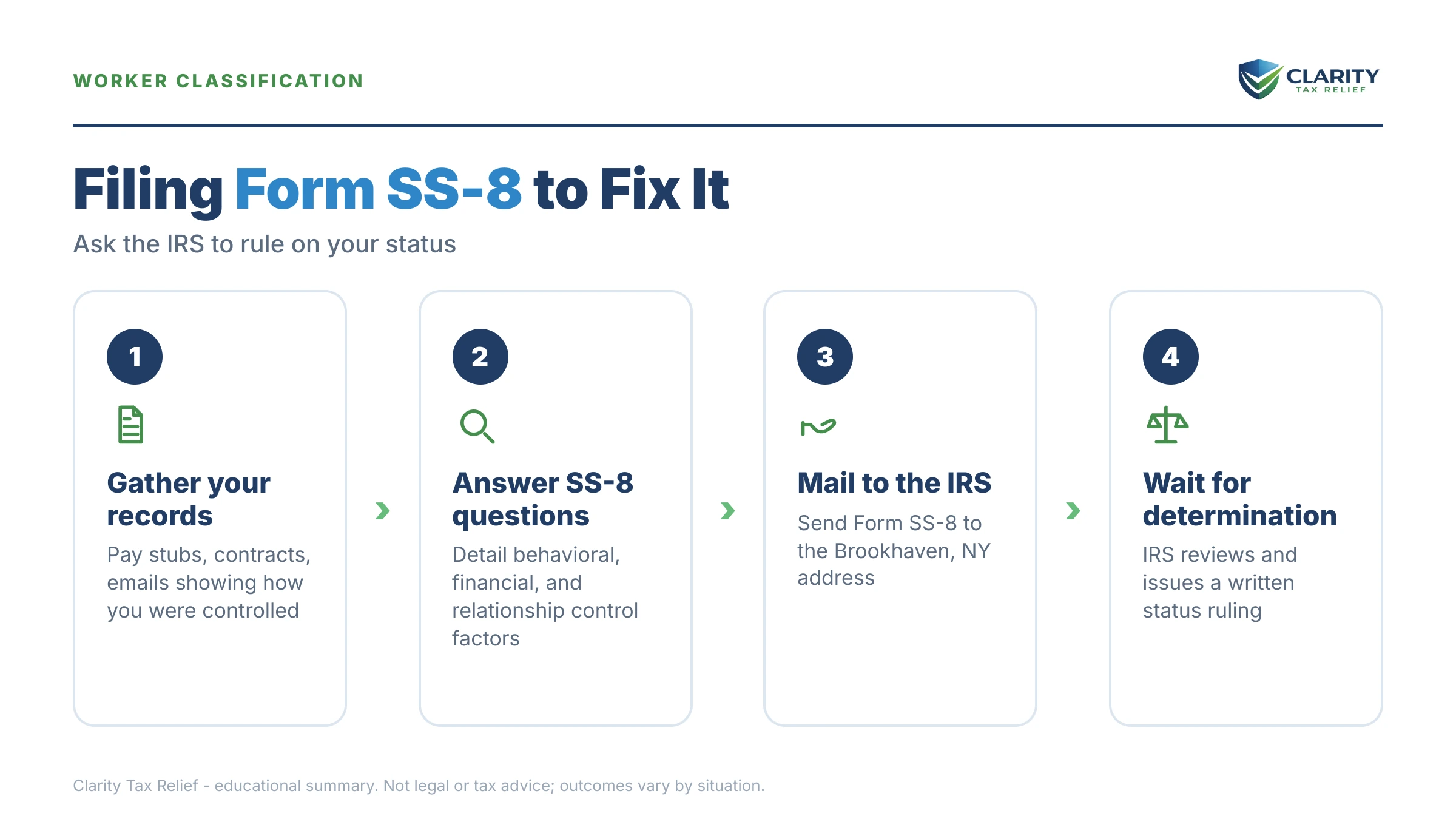
1099 but should be W-2: what Form SS-8 actually does
Form SS-8 is a free IRS determination request — the IRS reviews how you actually worked and issues an official ruling on whether you were an employee or an independent contractor. There's no filing fee and no deadline. You describe the behavioral, financial, and relationship facts; the IRS then sends the firm its own questionnaire and weighs both sides before ruling.
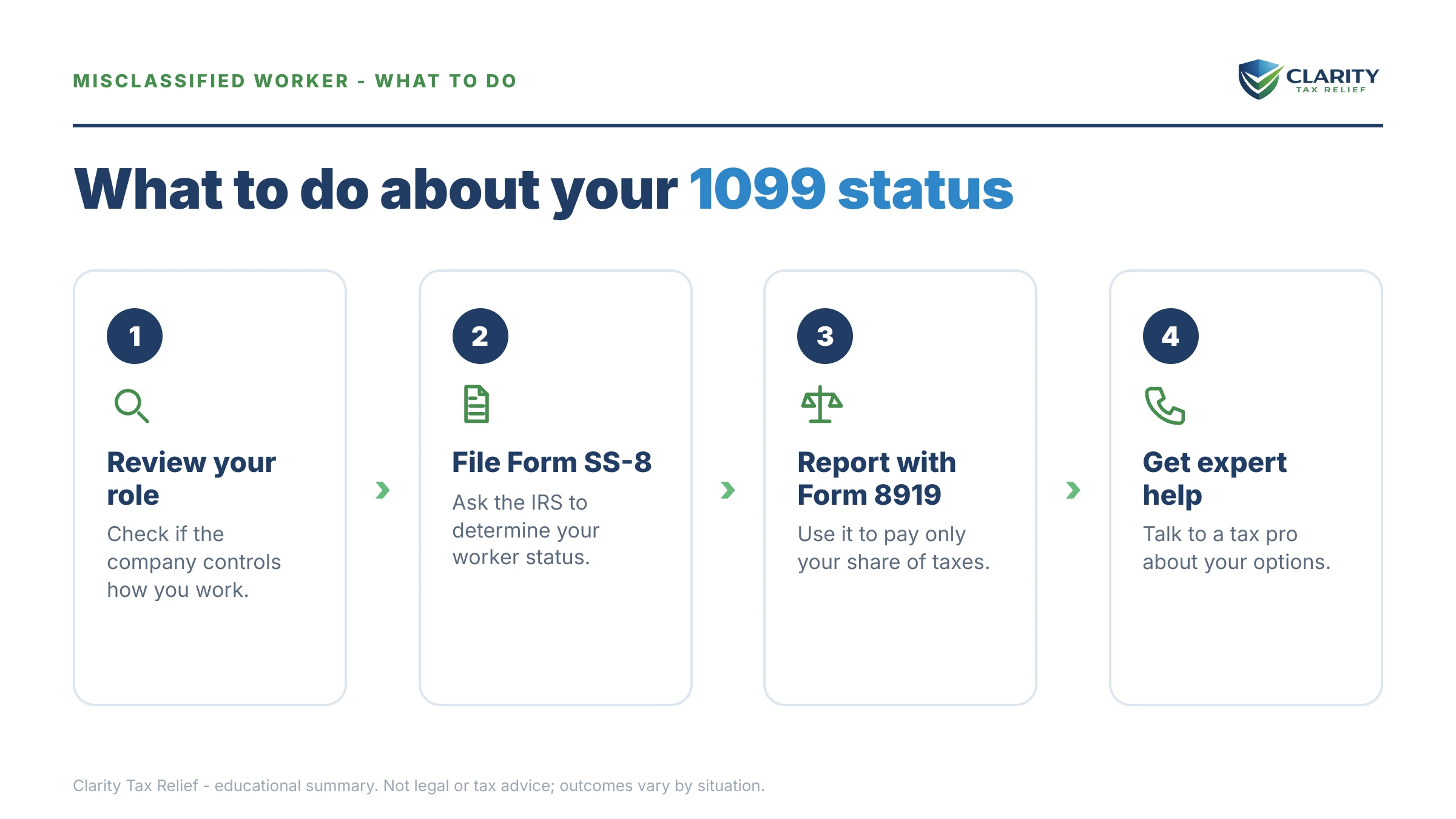
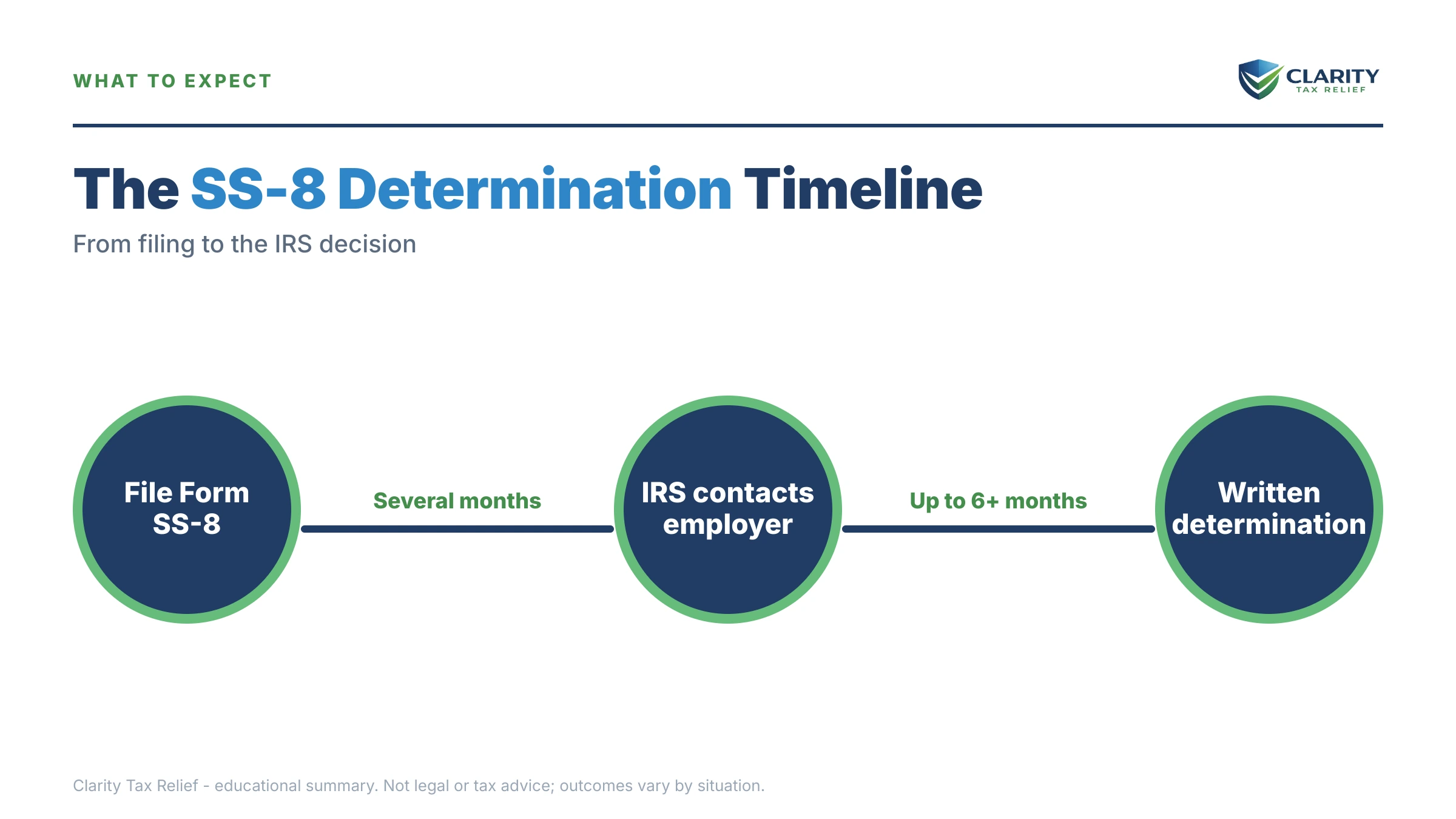
Two things to know before you file. First, SS-8 is not anonymous — the firm will learn you requested the determination, which is why many workers file after the job ends. Second, determinations are slow; the IRS itself warns they can take six months or more, and there's no formal appeal if you disagree with the outcome.
That delay is why Form 8919 exists. It's the companion form that goes with your Form 1040 now: it reports the 1099 pay as wages and computes only the 7.65% employee share of Social Security and Medicare, instead of routing the income through Schedule SE at 15.3%. You tell the IRS why you're using it with a one-letter reason code:
| Code | When to use it |
|---|---|
| A | The IRS already sent you an SS-8 determination ruling you an employee of this firm. |
| C | Other IRS correspondence told you the firm should have treated you as an employee. |
| G | You filed Form SS-8 and haven't received a determination yet — the most common code, and why you never wait to file your return. |
| H | The firm gave you both a W-2 and a 1099 for the same work in the same year, and the 1099 pay should have been wages. |
One boundary worth naming: SS-8 fixes the payroll-tax split. It does not create a W-2 out of thin air — if a genuine employer simply never sent the W-2 you earned, that's a different fix, covered in employer didn't send W2.
The 15.3% vs. 7.65% math: what this is worth on $83,100
Misclassification roughly doubles your Social Security and Medicare tax, because self employment tax makes you pay both the employee and employer halves. Here's the math, clearly hypothetical:
Say you're 68, drawing Social Security, and a former employer brought you back as a "consultant" at $83,100 for the year — same desk, same manager, same 8:30 start. Two ways that income can be taxed:
- Schedule SE (contractor): $83,100 × 92.35% = $76,743 of net earnings; × 15.3% = about $11,742 in self-employment tax — before a dollar of income tax.
- Form 8919 (misclassified employee): $83,100 × 7.65% = about $6,357.
The difference — roughly $5,385 — is the employer's share of Social Security and Medicare, moved off your return and back to where the law puts it. (Contractors do get to deduct half the SE tax, which softens the gap slightly, but it comes nowhere near closing it.)
| 1099-NEC amount | Schedule SE (15.3%) | Form 8919 (7.65%) | Difference |
|---|---|---|---|
| $10,000 | ≈ $1,413 | ≈ $765 | ≈ $648 |
| $25,000 | ≈ $3,532 | ≈ $1,913 | ≈ $1,619 |
| $50,000 | ≈ $7,065 | ≈ $3,825 | ≈ $3,240 |
| $83,100 | ≈ $11,742 | ≈ $6,357 | ≈ $5,385 |
Figures assume no business-expense deductions; Schedule SE amounts apply the 92.35% net-earnings adjustment. If the same job was misclassified across multiple years, multiply the difference by each open year — that's real money, and part of it may still be recoverable.
There's a second stake for anyone on or near Social Security: Form 8919 credits the pay to your Social Security earnings record as wages. If you're still building your benefit — or protecting a spouse's survivor benefit — that credit matters beyond this year's tax bill.
What happens if you ignore it (or just pay the full SE tax)
Doing nothing with a misclassified 1099 costs you one of two ways: quietly overpaying the employer's 7.65% share, or an IRS matching notice at the full 15.3% rate plus penalties. The sequence runs like this:
- You file Schedule SE because the software said so. On $83,100 that's about $5,385 of someone else's tax on your return — every year the arrangement continues.
- Or you leave the 1099 off the return entirely. The payer's copy went to the IRS too. The document-matching computer catches the gap and mails a CP2000 notice proposing tax at the full contractor rate, plus a possible accuracy penalty.
- The proposed amount assesses if you don't respond. Once assessed, it's a legal debt with interest compounding daily — you can estimate what the added penalties and interest would run with our IRS Penalty & Interest Calculator.
- An unpaid balance enters the collection pipeline. Bills, reminders, then intent-to-levy notices — and for retirees, the Federal Payment Levy Program can take up to 15% of each Social Security check until the debt is resolved. If you're already there, see retired and owe back taxes.
None of that requires a human at the IRS to look at your file — matching notices and levies are automated, and the 2026 staffing cuts changed nothing about the machine's pace. The classification question, by contrast, does get human review — but only if you raise it.
Holding a 1099 you know should have been a W-2?
Before you file and overpay thousands in self-employment tax, let an experienced tax professional review your facts against the IRS control test — free, confidential, and specific to your situation, including prior years you may still be able to reclaim.
Your options, compared
There are five realistic paths, and the right one depends on your facts — who controlled the work — and your timing:
| Path | When it fits | What it costs you |
|---|---|---|
| Schedule SE — pay as a contractor | You genuinely controlled the work: your hours, your tools, multiple clients | Full 15.3% SE tax (≈ $11,742 on $83,100), minus expense deductions |
| Form SS-8 + Form 8919 (code G) | The firm controlled how, when, and where you worked; no ruling yet | $0 to file both; 7.65% employee share now (≈ $6,357 on $83,100) |
| Form 8919 (code A or C) | The IRS has already ruled or written that you were an employee | 7.65% employee share, with the determination as backup |
| Amend prior years (1040-X + 8919) | The same job was misclassified in earlier years and you paid full SE tax | $0 to file; recovers the employer-share overpayment for years still inside the refund window |
| Payment plan on a balance already assessed | A CP2000 or filed return created a debt you can't pay at once | Setup fee varies by plan type; interest and penalties accrue until paid |
On the amended-return path, the three-year clock is unforgiving — the oldest year expires first, so check whether you can still get a refund from 3 years ago before anything else. If a balance already exists and you're weighing payment plans, hardship status, or settlement, the mechanics of each are covered in our guide to how to settle tax debt yourself — this page stays focused on the classification fix itself.
One path that is not yours: the employer-side cleanup. The firm faces its own exposure — back employment taxes, penalties, and the Section 530 defense — which is a separate fight over the firm's own 941 back taxes. Your SS-8 filing may trigger that review, but its cost lands on the business, not on you.
How to respond, step by step
- Test your facts against the IRS control factors. Ask who controlled how, when, and where you worked — if the firm set your hours, trained you, and supervised the work, you look like an employee.
- Gather your documentation. Collect the 1099-NEC, any contract or offer letter, work schedules, training materials, and emails showing supervision.
- File Form SS-8 with the IRS. Complete the determination request and mail it in — there is no fee and no filing deadline, but earlier is better.
- File Form 8919 with your tax return. Use reason code G, pay the 7.65% employee share, and file by the April deadline — do not wait for the SS-8 answer.
- Amend earlier years if they were misclassified too. File Form 1040-X with Form 8919 for each open year, generally within three years of the original filing.
- Respond to the IRS determination when it arrives. If the IRS rules you an employee, keep the letter with your records; if it rules you a contractor, the self-employment tax difference becomes due.
Watch one trap in step four: the same dollars must never appear on both Form 8919 and Schedule SE. Report each payer's income one way or the other — doubling up creates a phantom balance that takes months to unwind.
When you can handle this yourself
Both forms are free, and many people file them without help. You can reasonably go it alone if: this is one payer and one tax year, the control facts clearly favor you (set schedule, their equipment, direct supervision), and you're comfortable answering the SS-8's detailed questions honestly and completely. The official instructions live at About Form SS-8 and About Form 8919, and any balance you do owe can be paid directly at IRS.gov/payments.
Experienced help changes the outcome when the facts are murkier or the stakes are stacked: several misclassified years with refund clocks expiring at different times; a CP2000 already in motion proposing tax at the full SE rate; genuinely mixed facts (some control, some independence) where how the SS-8 narrative is framed matters; a balance already assessed that you can't pay on a fixed income; or a situation where you're still working for the firm and need to sequence the filing carefully. Honest rule of thumb: the clearer your facts and the smaller the dollars, the less you need anyone — the moment multiple years or active IRS notices enter the picture, a professional review before you file usually pays for itself.
Terms on these forms, decoded
- Common-law employee: a worker the firm has the right to control — how, when, and where the work is done — regardless of what the contract calls them.
- SS-8 determination: the IRS's official ruling on your worker status, issued after reviewing questionnaires from both you and the firm.
- Form 8919: the form that reports misclassified 1099 pay as wages and computes only the 7.65% employee share of Social Security and Medicare.
- Self-employment tax: the 15.3% Social Security and Medicare tax genuine contractors pay — both halves, employee and employer, on Schedule SE.
- Form 1099-NEC: the information return businesses file to report nonemployee compensation — the document that started this whole problem.
- Section 530 relief: a safe harbor that can shield a business from reclassification liability if it had a reasonable basis and treated similar workers consistently — it affects the firm's exposure, not your right to file SS-8 or 8919.
1099-vs-W-2 and SS-8 questions, answered
Can I file Form SS-8 anonymously?
No. The IRS sends the firm its own SS-8 questionnaire and identifies the worker who asked for the determination, so the business will know you filed. Many workers wait until the job has ended to file, which changes nothing about the tax outcome. If you're still working there, weigh the relationship carefully — but remember the alternative is paying the employer's 7.65% share yourself every year.
How long does an SS-8 determination take?
There is no fixed timeline, and the IRS itself warns that determinations can take at least six months. That delay is exactly why Form 8919 exists: reason code G lets you file your return and pay only the employee share while the SS-8 is pending. You never have to hold your tax return waiting on the ruling.
Do I have to wait for the SS-8 decision before filing my taxes?
No — file on time. Attach Form 8919 to your Form 1040, enter reason code G (SS-8 filed, no determination yet), and pay the 7.65% employee share of Social Security and Medicare. If the IRS later rules you were a contractor, you'd owe the difference up to the 15.3% self-employment rate, so keep that possibility in mind when budgeting.
What's the difference between Form 8919 and Schedule SE?
Schedule SE computes the full 15.3% self-employment tax that genuine independent contractors owe — both the employee and employer halves. Form 8919 computes only the 7.65% employee share for people who were treated as contractors but were really employees. On $83,100, that's roughly $11,742 versus $6,357 — the same pay, taxed two very different ways depending on which form fits your facts.
Will the company get in trouble if I file SS-8?
Possibly. If the IRS rules its workers were employees, the firm can owe back employment taxes, penalties, and interest — though Section 530 relief protects some businesses that had a reasonable basis and treated workers consistently. That liability is the firm's problem, not yours; filing SS-8 doesn't put you on the hook for their share.
Can I get back self-employment tax I paid in earlier years?
Often, yes. If the same job was misclassified in prior years and you paid full SE tax on it, you can amend with Form 1040-X and Form 8919 to reclaim the employer-share overpayment. The refund window generally closes three years after you filed the original return, so the oldest year expires first — start there.
Does filing Form 8919 affect my Social Security benefits?
It helps them. Form 8919 makes sure the wages are credited to your Social Security earnings record just like W-2 wages. The income affects your benefits the same way in either classification: it can make more of your benefits taxable, and if you're under full retirement age, both wages and net self-employment earnings count toward the annual earnings test.
What if the IRS decides I really was an independent contractor?
Then self-employment tax applies and you'd owe the difference between the 15.3% SE rate and the 7.65% you paid through Form 8919, plus interest on the shortfall. You'd also be able to deduct legitimate business expenses on Schedule C, which can shrink that number. If the resulting balance is more than you can pay, IRS payment plans and hardship options exist.
Your next 24 hours
- Find the number. Pull out the 1099-NEC and locate box 1 (nonemployee compensation) and the payer's name and EIN — those figures drive everything on Forms SS-8 and 8919.
- Gather your proof. Last year's tax return, the contract or offer letter, work schedules, training materials, and a few emails showing who directed the work. Ten documents beat ten pages of explanation.
- Get the free review. Send us what you have through the 2-minute form or call (888) 825-7779. An experienced tax professional will tell you whether your facts support the employee position, which years are still open to amend, and what to file first — before the employer's share of the tax quietly becomes yours again this filing season.
This guide is general information, not tax or legal advice for your specific situation. Eligibility for IRS programs depends on individual facts and circumstances; no outcome is guaranteed.