
Filing Problems
Employer Didn't Send W2? What to Do and How to File in 2026
The short answer: if your employer didn't send your W-2 by January 31, contact payroll first, then call the IRS at 800-829-1040 after the end of February. Your April 15, 2026 filing deadline doesn't move — if the form never arrives, file on time using Form 4852 and your final pay stub.
Everyone else got their W-2 weeks ago. Yours never came — the company changed payroll providers, or folded, or still has the apartment you moved out of last spring on file — and the filing deadline doesn't care whose fault that is. Here's the part that changes everything: you don't need the paper to file, because the IRS almost certainly already has your numbers.
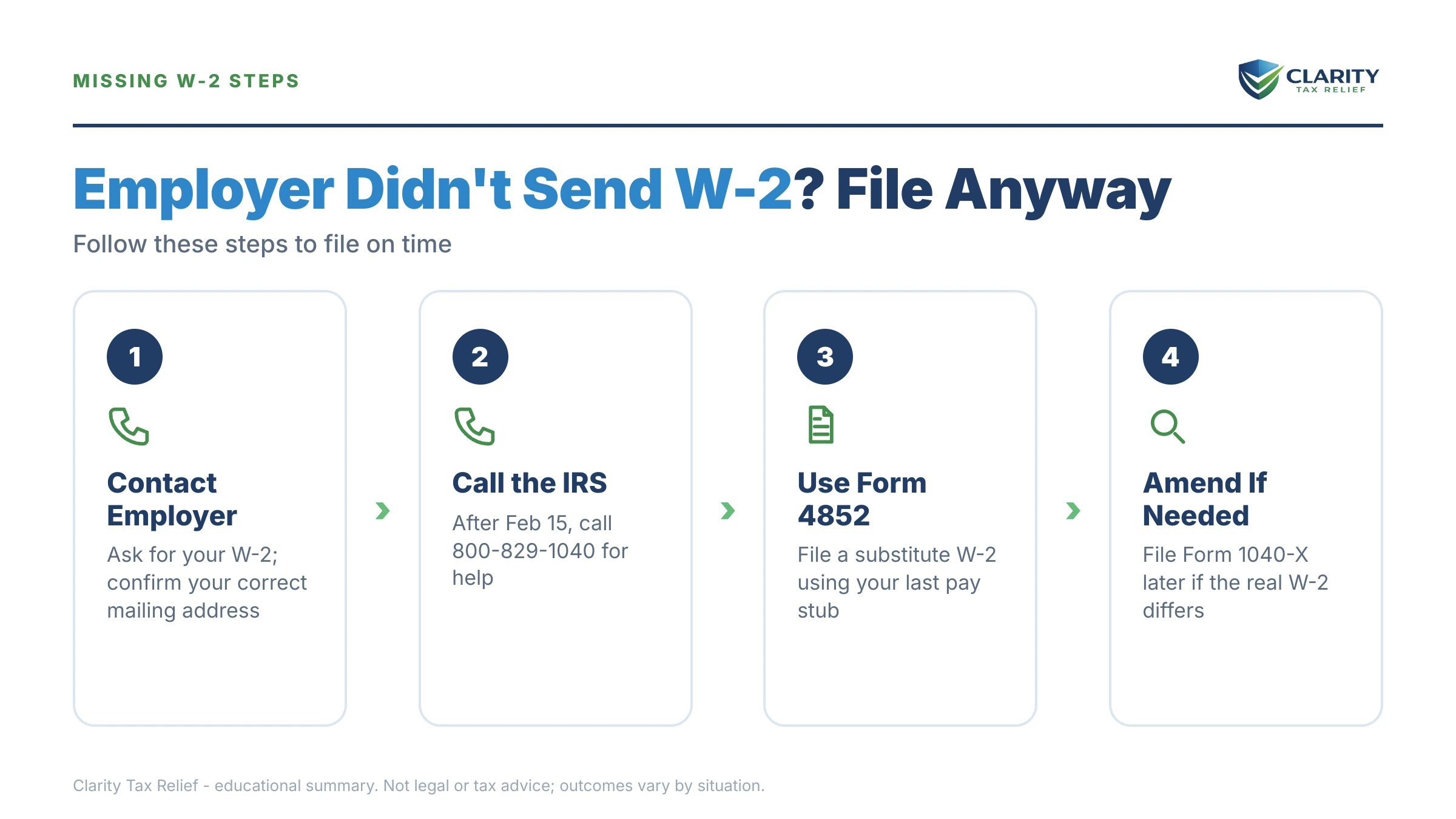
If the form never surfaces, Form 4852 is how you file anyway, straight from your final pay stub — the image below shows you exactly what that form looks like and where your numbers go.
⏱ Your deadline: April 15, 2026 — a missing W-2 does not extend it. Your employer's deadline to furnish the form was January 31, 2026. If it still hasn't arrived by the end of February, the IRS will contact the employer for you — but you must file on time, with or without the paper.
Why your employer didn't send your W-2
Employers were required to furnish 2025 W-2s by January 31, 2026 — and a W-2 that never arrives is usually a delivery failure, not a refusal. Before assuming the worst, run through the common causes:
- You moved. The W-2 went to your old address and wasn't forwarded. This is the single most common cause — and the one that quietly creates multi-year problems for renters who move often.
- It's electronic. If you ever clicked "consent to electronic delivery," the W-2 is sitting in a payroll portal, not your mailbox — and the notification email went to a work address you can no longer access.
- The company closed or changed payroll providers. The form often still exists; it just has no one mailing it. The payroll company usually filed it with the Social Security Administration anyway.
- You were paid as a contractor. If they controlled your schedule, tools, and work, you may have been misclassified. That's a different fix — see our guide to being 1099 but should be W2 (SS-8).
- You worked in someone's home. Nannies and caregivers paid without a W-2 are often dealing with an employer who never ran payroll at all — the household-employer side of that problem is covered in nanny tax back taxes.
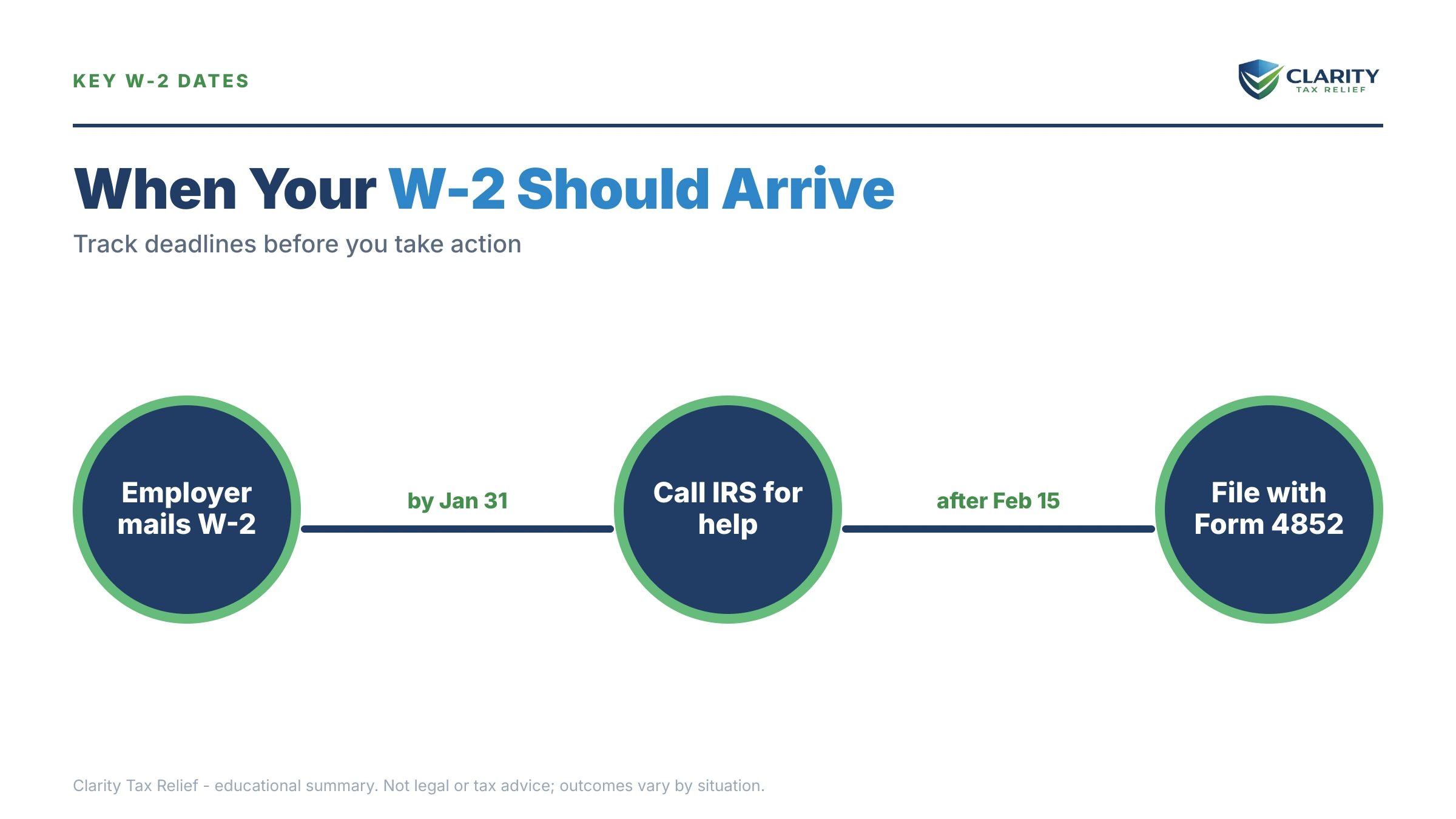
Whatever the cause, the calendar below is your map. Each date changes what your best move is.
| Date | What it means | Your move |
|---|---|---|
| January 31, 2026 | Employer's legal deadline to furnish 2025 W-2s | Check mail, email, and any payroll portal you've ever used |
| Early–mid February | Most "missing" W-2s are address or portal problems | Contact payroll/HR, confirm your address, request a reissue |
| End of February | IRS threshold for stepping in | Call 800-829-1040 — the IRS contacts the employer and sends you Form 4852 |
| April 15, 2026 | Filing deadline — a missing W-2 does not extend it | File with Form 4852, or file Form 4868 for a filing (not payment) extension |
| Mid-2026 | 2025 wage data generally complete on IRS transcripts | Pull your wage and income transcript; amend with 1040-X if your 4852 numbers were off |
| October 15, 2026 | Extended filing deadline | Last day to file if you took the extension |
What happens if you skip filing because the W-2 never came
A missing W-2 never excuses a missing return — and not filing is the single most expensive response to this problem. The failure-to-file penalty runs 5% of the unpaid tax per month, ten times the 0.5% failure-to-pay penalty. Here's the sequence if the return never goes in:
- The deadline passes. The failure-to-file penalty starts at 5% of any unpaid tax per month, up to 25% — plus interest. Compare: if you'd owe $2,400, filing without paying costs about $12/month in failure-to-pay penalty; not filing costs about $120/month. The full math is in failure to file penalty vs failure to pay.
- Non-filer notices arrive. A CP59 ("we have no return from you"), then sterner unfiled-return notices. Your employer already told the IRS what you earned, so the system knows you should have filed.
- The IRS files for you. A Substitute for Return (SFR) is built from employer-reported wages — filed as single, standard deduction only, no dependents, no credits. It's the most expensive version of your return that the law allows. See the IRS filed a substitute return for me.
- A 90-day deficiency notice follows. If you don't respond or petition Tax Court, the inflated SFR balance becomes a legally final assessment.
- Collection begins. Bills, then a final notice of intent to levy with a 30-day clock, then wage garnishment or a bank levy with its 21-day hold before funds leave.
One more clock runs even if you're owed money: if your withholding means a refund, there's no failure-to-file penalty — but the refund itself expires. You generally have three years to claim it, as we explain in can I still get a refund from 3 years ago. You can estimate what delay is costing you with our penalty and interest calculator.
Missing W-2s turned into unfiled years or a levy notice?
Get your situation reviewed free before the failure-to-file penalty adds another 5% this month. We pull your IRS wage records, reconstruct the returns, and map the fastest path to stopping enforcement — no pressure, no obligation.
How to get your wage numbers without the W-2
The IRS keeps a copy of every W-2 your employer filed — the wage and income transcript shows it, free, from your IRS online account. That single fact rescues most missing-W-2 situations, current year and old years alike. Your sources, best to last resort:
- Payroll portals. ADP, Paychex, Gusto, and Workday keep W-2s downloadable even after you leave a job. Try every login you've ever had before doing anything harder.
- Your IRS wage and income transcript. For prior years, this is the gold mine — every W-2 and 1099 reported under your SSN. One honest caveat: 2025 data often isn't complete on transcripts until mid-2026, so for this spring's return the transcript may not help before April 15. Walkthrough: IRS wage and income transcript.
- Older years and Social Security copies. For records going back further — including actual W-2 copies from the SSA — see how to get old W2 for back taxes.
- Your final pay stub + Form 4852. When nothing else surfaces in time, Form 4852 is the on-time path. It's a one-page substitute W-2 — the image on this page shows where the wage and withholding lines sit. Use your final 2025 stub's year-to-date figures, but subtract pre-tax items (401(k) contributions, health premiums) that a real W-2 would exclude from Box 1 wages.
If you're untangling old years, the account transcript for each year tells you where you stand. These are the codes you'll actually see:
| Code | What it means | What to do |
|---|---|---|
| 806 | Withholding from W-2s/1099s credited to your account | Proof the IRS has your withholding even though the paper never reached you |
| 150 | A return posted — yours, or an IRS substitute | Check for an SFR notation; a substitute return usually overstates what you owe |
| 570 | Hold on the account | Often a withholding mismatch when Form 4852 numbers differ from employer filings — wait for the notice before reacting |
| 599 | Return secured | The IRS received your late-filed return for that year — the replacement is in process |
| 971 | Notice issued | Match the date to a letter in your mail and read it before assuming the worst |
When missing W-2s become back taxes — or a levy
An IRS substitute return taxes you as single with no credits — which is why unfiled W-2 years almost always show balances bigger than what you'd actually owe. If your missing-W-2 problem is years old and the IRS is now threatening to take your paycheck, the fix isn't negotiating the SFR number. It's replacing it.
Say the IRS says you owe $41,800. Hypothetically: you rent, you moved twice between 2021 and 2023, the W-2s chased old addresses, you never filed — and the IRS filed SFRs assessing $15,900 (2021), $13,700 (2022), and $12,200 (2023), each computed as single with no dependents. Now a final notice of intent to levy is on your kitchen counter. Your wage and income transcripts show all three W-2s. Filing real returns as head of household with two kids drops those years to, say, $6,800 + $5,900 + $5,200 = $17,900 — less than half the SFR figure, before any penalty relief.
And $17,900 is under the $50,000 line, so a streamlined installment agreement can be set up online for up to 72 months: $17,900 ÷ 72 ≈ $249/month before accruing interest. Entering that agreement — with all returns filed — is typically what gets a pending wage levy addressed. Numbers vary with your facts; the mechanics don't.
Two rights matter at this stage. The LT11 notice starts a 30-day window to request a Collection Due Process hearing on Form 12153, which pauses levy action while your case is heard. And if a bank levy has already hit, the IRS bank levy 21 days hold means the money hasn't left yet — there's still a window to act. A wage levy has no such buffer: it's continuous, every paycheck, until released.
If you end up owing: your options in 2026
Every IRS resolution program requires your returns to be filed first — which is why recovering the wage records above is step one, not a side quest. Once the real numbers are in, here's what fits where. (The full DIY playbook for each program is in how to settle tax debt yourself.)
| Option | Who qualifies | Cost & trade-offs |
|---|---|---|
| Short-term payment plan | Any balance you can clear within 180 days | $0 setup; interest and the 0.5%/month late-pay penalty run until paid |
| Guaranteed installment agreement | Balance of $10,000 or less, compliant filing history | Approval is required by law; typically repaid within three years |
| Streamlined installment agreement | Balance of $50,000 or less | Online setup, up to 72 months, no detailed financial disclosure |
| Currently Not Collectible | Income barely covers IRS allowable living expenses (Form 433-F) | Collection pauses; debt remains, interest accrues, refunds are kept |
| Offer in Compromise | Assets and income genuinely can't cover the debt — means-tested | $205 fee, 20% down on lump-sum offers (both waived with low-income certification); IRS accepted roughly 1 in 5 offers in FY2024 |
| Penalty relief | Clean compliance in the prior 3 years (First-Time Abate), or reasonable cause | Can remove failure-to-file/pay penalties; starting summer 2026 the automatic AEP applies without a request |
Two edge cases change the picture. If you're worried about paying at all, file anyway — should I file if I can't pay shows why the return itself is 90% of the battle. And if some old years have no records at all, reconstruction is still possible; that's a transcript-first project, and if the trail is truly cold, an experienced tax professional can pull records by power of attorney and rebuild from there.
How to respond when your employer didn't send your W2, step by step
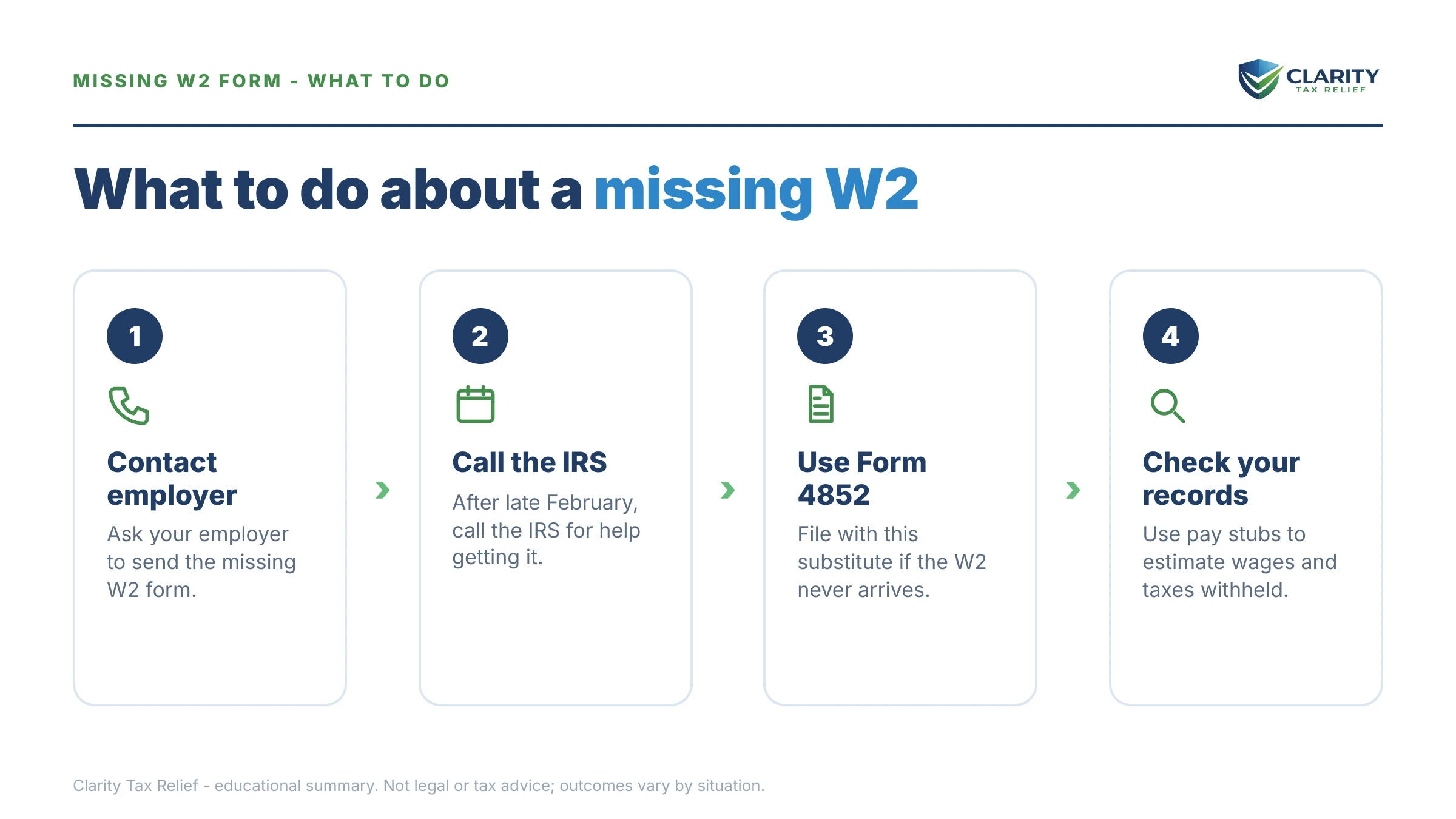
- Contact your employer's payroll or HR. Request a reissued W-2 and confirm the mailing address and email they have on file — most missing forms are delivery failures, not refusals.
- Check your online payroll portal. ADP, Paychex, Gusto, and Workday keep W-2s available for download, even after you've left the job.
- Call the IRS at 800-829-1040 after the end of February. The IRS will contact your employer, open a missing-W-2 case, and send you Form 4852 with instructions.
- File by April 15 using Form 4852 if the W-2 never arrives. Build your wage and withholding numbers from your final 2025 pay stub, adjusting for pre-tax deductions.
- Amend with Form 1040-X if the real W-2 shows different numbers. Only amend when the difference actually changes your tax or refund.
- File any missing back years from wage and income transcripts. Replacing IRS substitute returns with real ones is what shrinks old balances and gets levy action addressed.
The official form details are at the IRS's About Form 4852 page, and transcripts come from IRS Get Transcript.
When you can handle this yourself
Most current-year missing-W-2 problems are a DIY fix. If it's one employer, one year, and either a payroll portal or a reachable HR department exists, you don't need anyone — request the reissue, file on time, done. Even a straight Form 4852 filing is manageable if you have your final pay stub and follow the pre-tax adjustments above. And if a modest balance results, setting up a payment plan online yourself is straightforward (the IRS's own payment plans page covers it).
Experienced help changes outcomes in a narrower set of situations: a levy is already in motion or a final notice's 30-day window is running; multiple years are unfiled and SFR-assessed, where filing order and penalty-relief strategy change what you ultimately pay; the employer withheld taxes but never remitted them, so your withholding credit has to be proven from pay stubs; or the real fight is misclassification, where an SS-8 determination affects both the tax and the relationship. In 2026 there's a practical reason too: the IRS workforce shrank roughly 27% in 2025, so fixing an account by phone is slower than ever — while the automated levy systems never slowed down.
Terms on your paperwork, decoded
- Form 4852: the one-page IRS substitute for a W-2 that lets you file on time using your own records, usually a final pay stub.
- Wage and income transcript: the IRS's free record of every W-2 and 1099 filed under your SSN for a given year.
- Box 1 wages: your taxable wages after pre-tax deductions — usually lower than the year-to-date gross on your pay stub.
- Substitute for Return (SFR): a return the IRS files for a non-filer using employer data — single status, no credits, maximum tax.
- Code 806: the transcript entry crediting you with the withholding your employers reported, even if you never got the paper.
- Failure-to-file penalty: 5% of unpaid tax per month, capped at 25% — the penalty that makes not filing far worse than not paying.
Missing W-2 questions, answered
What is the deadline for an employer to send a W-2 in 2026?
Employers were required to furnish 2025 W-2s by January 31, 2026, by mail or electronically if you consented. If yours hasn't arrived by mid-February, contact payroll first — most missing W-2s trace to a wrong address or an unopened payroll-portal email, not a refusal. After the end of February, the IRS will contact the employer for you.
Can I file my taxes without a W-2?
Yes. Form 4852, Substitute for Form W-2, lets you file on time using your best available records — usually your final pay stub of the year. You report the wages and federal withholding from the stub and explain how you calculated them. Expect a slower refund, because the IRS verifies Form 4852 numbers against what your employer reported.
Can I use my last pay stub instead of a W-2?
You can use it as the source for Form 4852, but you can't type pay-stub numbers into a return as if they came from a W-2. Watch for items your stub includes in year-to-date gross that a W-2 would subtract — pre-tax 401(k) contributions and health premiums lower Box 1 wages, and missing that adjustment overstates your tax.
What if my employer went out of business and never sent W-2s?
The path is the same, and often easier than people fear: the payroll company usually filed the W-2 with the Social Security Administration even if your mailed copy never went out. Pull your IRS wage and income transcript to see exactly what was reported, and fall back on Form 4852 only if nothing was filed at all.
Is my employer penalized for not sending my W-2?
Yes — the IRS charges employers per-form penalties for late or missing W-2s, and the penalty grows the longer the form is late. But that penalty is the employer's problem, not your remedy: it doesn't extend your April 15 deadline or excuse a late return. Report the missing form when you call the IRS at 800-829-1040.
My employer withheld taxes but never sent them to the IRS. Do I still get credit?
Generally yes. If your pay stubs show federal income tax withheld, you're credited with that withholding even if the employer never remitted it — the IRS pursues the employer for the missing deposits, not you — as long as your pay stubs show the tax actually came out of your checks (keep them, especially the final stub of the year; you'll use them for Form 4852 if the W-2 never arrives). Keep every pay stub as proof, because your wage and income transcript may show nothing at all for that employer.
What if my W-2 arrives after I already filed with Form 4852?
Compare it to what you filed. If the wages and withholding match, do nothing. If they differ enough to change your tax or refund, file Form 1040-X to amend — you generally have three years from the filing deadline to claim any additional refund the correction produces.
Should I have gotten a W-2 or a 1099?
If the business set your schedule, supervised your work, and provided the tools, you were likely an employee owed a W-2 — even if they paid you as a contractor. A 1099 shifts roughly 15.3% self-employment tax onto you. Form SS-8 asks the IRS to rule on your status, and Form 8919 lets you pay only the employee share.
Your next 24 hours
- Find your final 2025 pay stub (or log into every payroll portal you've ever used). The year-to-date gross and federal withholding lines are your Form 4852 numbers if the W-2 never comes.
- Gather your records: last year's return, any IRS letters you've received, and — if back years are involved — your IRS online account login so the wage and income transcripts can be pulled.
- Get a free case review. If missing W-2s have become unfiled years, SFR balances, or a levy notice, call (888) 825-7779 or use the 2-minute form — penalties and interest accrue monthly until the returns are in, so the cheapest version of this fix is the one you start today.
This guide is general information, not tax or legal advice for your specific situation. Eligibility for IRS programs depends on individual facts and circumstances; no outcome is guaranteed.