
Back Taxes
Nanny Tax Back Taxes: How to Fix Unpaid Household Employer Debt in 2026
The short answer: nanny tax back taxes are unpaid Schedule H household employment taxes — roughly 15.3% Social Security and Medicare plus a small federal unemployment tax on your nanny's cash wages. Because Schedule H rides on your personal Form 1040, the debt is yours personally, and you fix it by amending each year, issuing W-2s, and choosing a payment or penalty-relief option.
You run payroll for your business twice a month and never miss a deposit. But the person who watches your kids has been paid by check or Venmo, off the books — and now she's filed for unemployment, or your preparer finally asked the question, and the arrangement everyone called "normal" has a dollar figure attached. The strange part of this debt is that it never touched a payroll form: it belongs on Schedule H, attached to your personal Form 1040, and that one fact controls everything about how you fix it.
That's genuinely good news. Business payroll debt carries trust-fund exposure, revenue officers, and personal-assessment fights. Household employer debt is 1040 debt — it qualifies for every individual payment plan and relief program, and it almost never goes criminal when you come forward voluntarily. The image below shows you exactly what Schedule H looks like and where the household employment tax gets computed, so you can see what should have been on your returns all along.
⏱ Your real clock: unpaid nanny taxes have no notice-printed deadline yet — the clock is the accrual. The failure-to-pay penalty adds 0.5% of the balance every month (up to 25%), interest compounds daily on top, and every additional year you employ the nanny off the books stacks another year of tax onto the pile.
Why you owe nanny tax back taxes in the first place
A household employer owes about 15.3% in Social Security and Medicare taxes on a nanny's cash wages once those wages cross an annual threshold — $2,800 for 2025, adjusted each year for inflation. It doesn't matter how you paid: cash, check, Zelle, and Venmo all count identically. If you never withheld the nanny's 7.65% employee share, you're on the hook for both halves — the full 15.3% — plus federal unemployment tax (FUTA) if you paid $1,000 or more in any calendar quarter.
The reason business owners in particular get blindsided: household payroll and business payroll are two separate legal worlds. Your company's 941s, your payroll service, your bookkeeper — none of them cover a worker in your home. A nanny, housekeeper, in-home caregiver, or private chef is a household employee under the common-law control test: she works in your home, on your schedule, using your rules. That makes a 1099 the wrong form and "she's basically a contractor" the wrong answer — the details of that trap live in our guide to the worker misclassification penalty.
One thing you likely do not owe: federal income tax withholding. Household employers aren't required to withhold income tax unless the nanny asked and you agreed. Your back-tax exposure is the employment taxes — FICA and FUTA — not her income tax bill, which is hers.
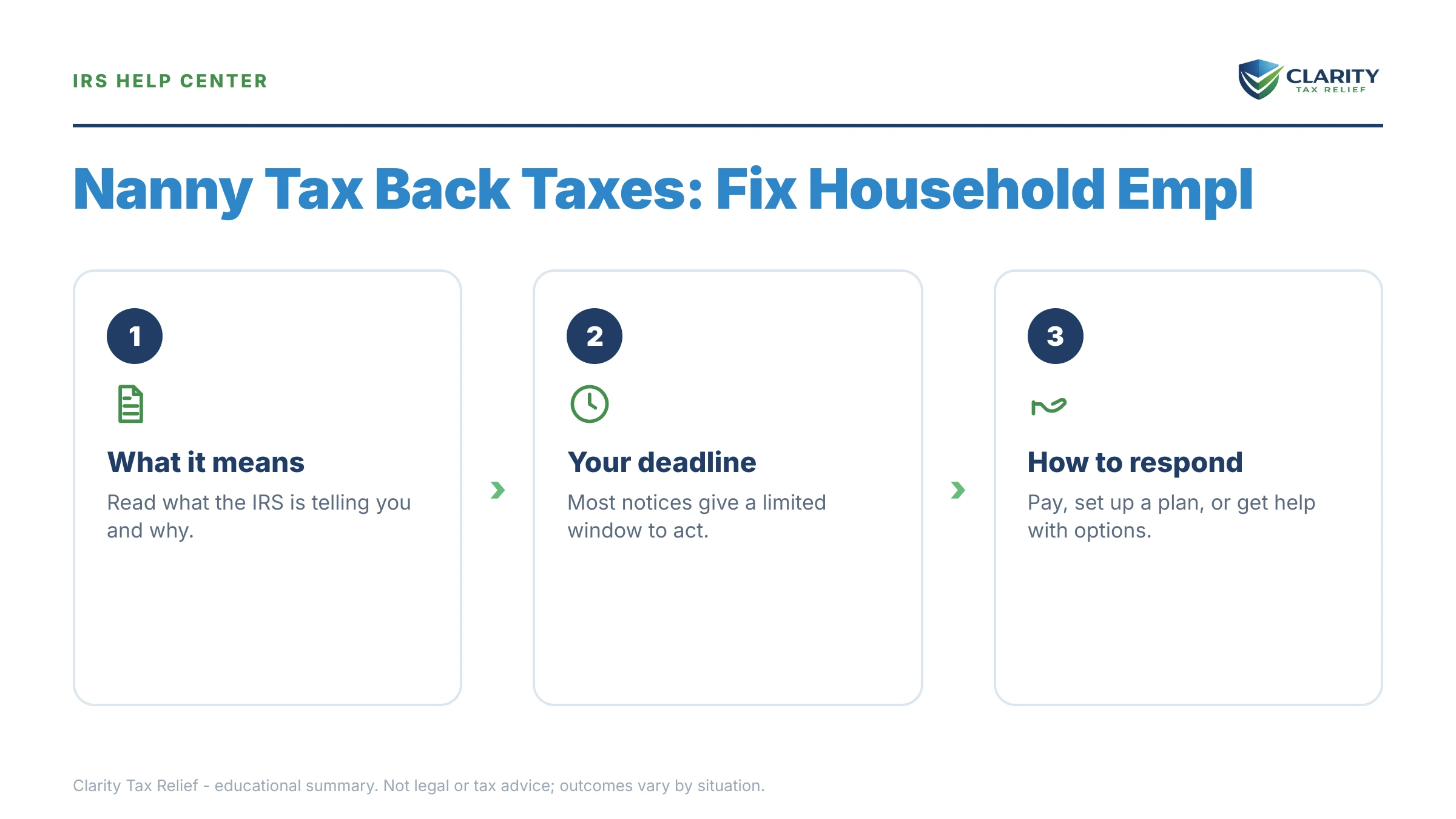
How the IRS finds unpaid nanny taxes
Most nanny tax back taxes surface from one of five paper trails, not from an audit hunting for them. Knowing which one is live in your case tells you how much time you realistically have:
- An unemployment claim. The nanny loses the job and files with the state. The state looks for your household-employer account, finds none, opens an assessment — and states share wage findings with the IRS. This is the single most common trigger.
- The childcare credit or dependent care FSA. Form 2441 requires your care provider's name and Social Security number. If you claimed the credit (or ran a $5,000 dependent care FSA through your company) while paying off the books, you handed the IRS a cross-check it can run automatically.
- The nanny's own tax return. If she reports the wages to earn Social Security credits — or files Form SS-8 arguing she was an employee, not a 1099 contractor — the IRS comes looking for the employer's side of the tax.
- A dispute. Divorces, injury claims, and bad terminations all create motivated reporters who know exactly how you paid.
- Spillover from your business. An exam of your company's books can surface personal checks or payroll entries to a caregiver that don't belong there.
Notice what's not on the list: waiting it out. None of these triggers expire, and the wage records that prove the arrangement — your own bank statements — never go away.
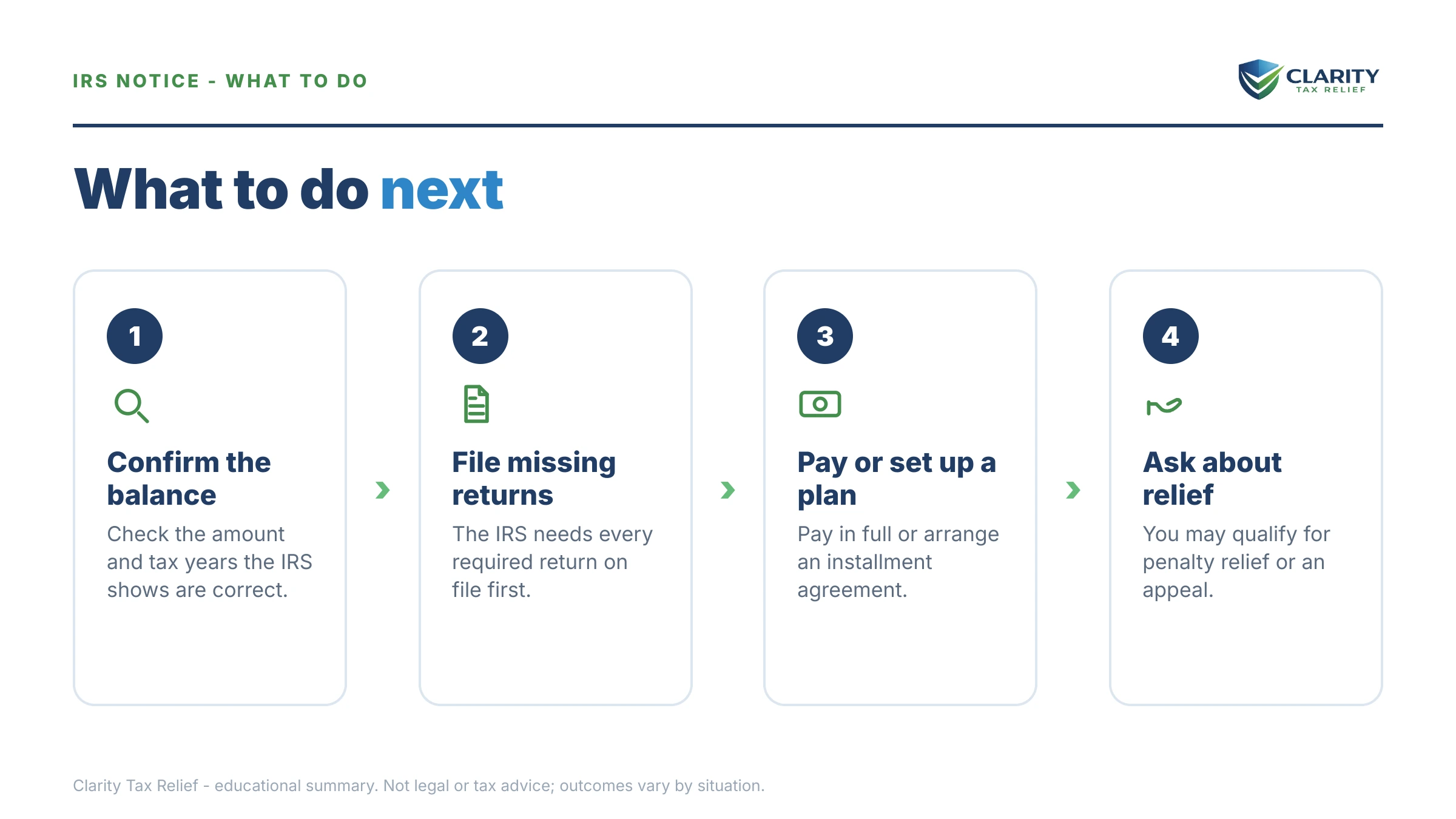
What you actually owe: the 2026 nanny tax math
Unpaid nanny taxes break into three federal pieces, and the Schedule H image in this guide shows where each one lands on the form. Here's the full reference math:
| Tax | Rate | When it applies |
|---|---|---|
| Social Security | 12.4% of cash wages (6.2% employer + 6.2% employee) | Wages to one worker exceed the annual threshold ($2,800 in 2025; adjusted yearly — see Publication 926) |
| Medicare | 2.9% of cash wages (1.45% + 1.45%) | Same annual threshold as Social Security |
| FUTA (federal unemployment) | 6% of the first $7,000 in wages — typically 0.6% after the state credit | You paid $1,000+ in any calendar quarter |
| Federal income tax withholding | Not required | Only if you and the nanny agreed to withhold |
| State unemployment insurance | Varies by state | Most states require registration at a modest quarterly wage level — check your state agency |
Two nuances matter when you reconstruct old years. First, if you never withheld the employee's share, you can either recover it from the nanny (awkward, often impossible after the fact) or absorb it — most employers fixing back years absorb it. Second, if you pay her share for her, that amount counts as additional taxable income to her, though not as additional FICA wages. Get these details right on the W-2s or you'll be correcting them twice.
On top of the tax itself come the additions: the failure-to-pay penalty at 0.5% per month, daily-compounding interest, potentially the 20% accuracy-related penalty on filed returns that omitted Schedule H, and per-form penalties for the W-2s that were never issued.
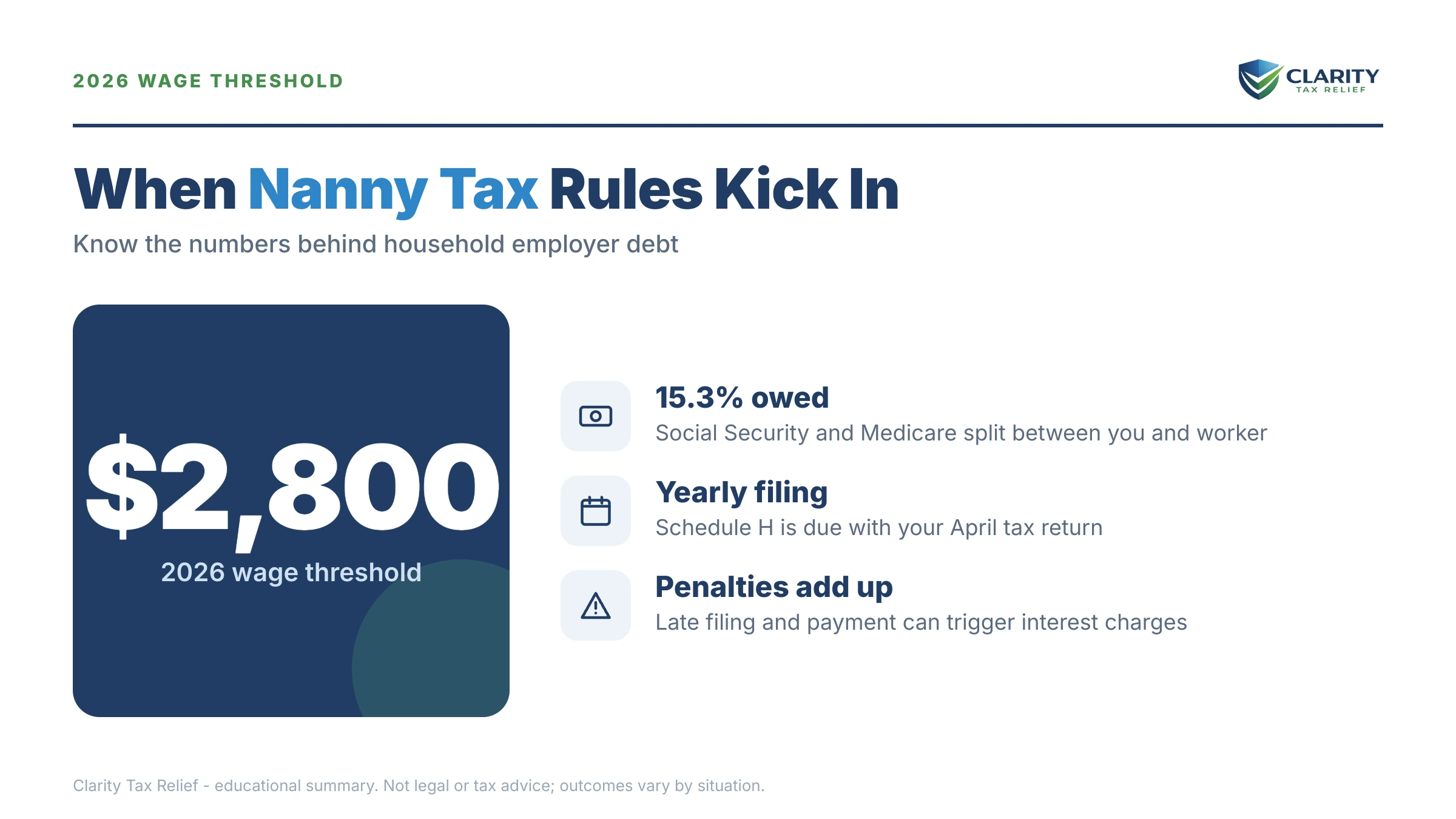
What happens if you ignore nanny tax back taxes
Once assessed, nanny tax debt collects exactly like personal income tax debt — through the IRS's automated individual notice stream, which escalates in a fixed sequence:
- Discovery and assessment. A CP2000 underreporter notice, an exam adjustment, or your own amended returns put the balance on your account. From this moment, penalties and interest run.
- CP14 — the first bill. You get roughly 21 days from the notice date to pay or arrange payment before the sequence advances (only 10 business days if the balance is $100,000 or more). This is the cheapest exit point — see our CP14 notice guide.
- CP501 and CP503 — reminders. Still just bills, but each cycle adds another month of penalty and interest.
- CP504 — intent to levy. The IRS can now seize your state tax refund under IRC §6331(d), and a federal tax lien becomes a live possibility. A lien is public and shows up in lending files — a real problem for a business owner who borrows.
- LT11 / Letter 1058 — final notice. A 30-day clock starts, along with Collection Due Process appeal rights (Form 12153). After it runs, the IRS can levy bank accounts — personal and, for a sole proprietor, business accounts — and garnish income.
Two parallel tracks make household-employer cases uglier than the notice stream alone. The state runs its own unemployment-insurance assessment on its own schedule, with its own penalties. And if multiple years plus your other tax balances push the total past $66,000 (the 2026 threshold), the IRS can certify the debt to the State Department and block your passport renewal. Meanwhile your nanny is missing Social Security earnings credits for every uncorrected year — which is often what sends her to the SS-8 process in the first place.
One more 2026 reality: the IRS workforce shrank about 27% in 2025, so reaching a human is harder than ever — but the notice and levy systems are automated and never slowed down. Silence doesn't buy safety; it just buys accrual.
Behind on nanny taxes and not sure how far back it goes?
Get your household-employer situation reviewed free before another month of penalties and interest posts. We'll scope the years, the real balance, and the cleanest fix — confidential, no pressure.
Your options for resolving household employer back taxes
Because Schedule H debt is personal 1040 debt, every individual resolution program is on the table — a genuine advantage over business payroll debt. Which one fits depends on the assessed balance and your finances:
| Option | Typically fits when | Key numbers |
|---|---|---|
| Pay in full | You have the cash — stops all accrual immediately | $0 setup; pay at IRS.gov |
| Short-term payment plan | You can clear the balance within 180 days | Up to 180 days, $0 setup fee |
| Streamlined installment agreement | Balance ≤ $50,000 — set up online, no financial statement | Up to 72 months; interest and reduced penalty continue |
| Guaranteed installment agreement | Balance ≤ $10,000 with clean filing history | Approval is required by law when the criteria are met |
| Offer in Compromise | Assets and income genuinely can't cover the debt | $205 fee, 20% down on lump-sum offers (both waived with low-income certification); ~1 in 5 accepted in FY2024 |
| Currently Not Collectible | Any payment would prevent basic living expenses | Pauses collection; debt and interest remain |
| Penalty abatement | Clean prior compliance or reasonable cause | Removes penalties, not tax; interest on abated penalties falls with them |
A few honest calibrations for this specific debt. An Offer in Compromise is means-tested, and a household with the income to employ a full-time nanny usually shows too much collection potential to qualify — don't let anyone sell you a settlement before running the math. Currently Not Collectible is similarly rare for this profile. Bankruptcy occasionally intersects with old 1040 balances, but recently assessed tax rarely discharges — the timing tests are covered in Chapter 7 vs 13 tax debt.
Penalty relief is where household employers win most often. If the three years before your earliest bad year were clean, first-time penalty abatement can wipe that year's penalties on request. Starting summer 2026, the IRS's new Automatic Exemption from Penalty (AEP) begins applying qualifying relief automatically — but don't wait on it for old years. And reasonable cause is a real argument here: "my preparer never asked about household help" and "my payroll service told me it was handled" are exactly the fact patterns that get penalties removed. The general mechanics of negotiating all of this on your own live in our guide to how to settle tax debt yourself.
Worked example: resolving $27,500 in nanny tax back taxes
Say you paid a full-time nanny $43,000 a year in 2023, 2024, and 2025 — by check, no withholding, no Schedule H. Here's the reconstruction, hypothetically:
- Social Security + Medicare: 15.3% × $43,000 = $6,579 per year (both halves, since nothing was withheld)
- FUTA: 0.6% × the first $7,000 = $42 per year
- Three years of tax: 3 × $6,621 ($6,579 FICA + $42 FUTA per year) ≈ $19,863
- Accuracy-related penalty exposure (20%): ≈ $3,970 across the three amended years
- Failure-to-pay penalties + interest to date: ≈ $3,650 and growing monthly
Total: roughly $27,500. Because that's under $50,000, you'd qualify for a streamlined installment agreement online — about $382/month spread over 72 months at minimum, though interest keeps running, so paying $600–$800/month retires it years sooner and far cheaper. Two levers change the number before you ever agree to it: first-time abatement could remove the 2023 failure-to-pay penalty if your prior three years were clean, and once an installment agreement is active, the monthly failure-to-pay rate drops from 0.5% to 0.25%. You can estimate your own penalty and interest buildup with our Penalty & Interest Calculator before you talk to anyone.
How to respond to nanny tax back taxes, step by step
- Reconstruct the wages. Pull bank statements, Venmo/Zelle history, and check registers to total exactly what you paid your nanny in each uncorrected year.
- Get an EIN. Apply free in minutes at IRS.gov — you need it to file Schedule H and issue W-2s (sole proprietors with business employees can use their existing EIN).
- File or amend each year. Attach Schedule H through Form 1040-X for filed years, and issue Form W-2 (or W-2c) to your nanny for every corrected year.
- Register with your state. Open a household-employer account with your state's unemployment agency and settle the back contributions on the state's schedule.
- Request penalty relief before paying. Ask for first-time abatement on your earliest qualifying year and raise reasonable cause where a preparer or payroll service never asked about household help.
- Set up your payment resolution. Choose full payment, a 180-day short-term plan, or a streamlined installment agreement — whichever fits the final assessed balance.
Order matters. Amending first and negotiating second means the balance you're arranging payment on is the real one — and an amended return done right can also correct related errors, like a childcare credit claimed with the wrong provider details. The mechanics of that repair are covered in amend return to reduce tax debt.
The business-owner trap: keep household payroll off your company books
Household wages are never a deductible business expense — no matter what entity you run. The tempting shortcut of adding the nanny to company payroll creates a second, worse problem: her wages get deducted against business income, which means an improper deduction, an amended business return, and an examiner's easy question about what else on the books is personal.
There is one legitimate crossover. Under Publication 926, a sole proprietor with business employees may report household employment taxes on the business's Forms 941 and 940 instead of Schedule H — same tax, different form, and the wages still aren't deductible. That's a convenience for go-forward compliance, not a fix for back years.
Keep the risk profile straight, too. Your company's own payroll debt is a different animal entirely — 941 balances carry trust-fund exposure that can be assessed against you personally and survive the business. If the company is also behind, that fire outranks this one; see construction payroll tax debt for how the IRS treats an operating business's 941 problem. Household debt, by contrast, is already personal, already fixable through individual programs, and doesn't threaten your company — as long as you keep the two payrolls separate from here on.
When you can handle this yourself — and when help changes the outcome
Plenty of nanny tax cleanups are genuinely DIY. If it's one or two years, you have clean payment records, the total tax lands under $10,000–$15,000, and no notice has arrived yet, you can reasonably: get the EIN, prepare Schedule H with your amended returns, issue the W-2s, register with your state, and set up a payment plan online. Publication 926 walks through every calculation, and voluntary correction before contact is the strongest position you'll ever hold.
Experienced help earns its cost in the harder patterns: three or more uncorrected years, a state assessment already open (state and IRS fixes need to be sequenced, not improvised), a nanny who was issued 1099s (the misclassification overlay changes the paperwork), a dispute with the former nanny, sloppy records that need defensible reconstruction, or a combined balance heading toward levy notices or the $66,000 passport threshold. The order of operations — returns, then penalties, then the payment arrangement — routinely changes what you pay by thousands, and it's easy to get backwards alone.
If you'd rather have an experienced tax professional scope your household-employer cleanup before you file anything, a free review takes one call: (888) 825-7779 or the 2-minute form.
Terms on your Schedule H, decoded
- Schedule H: the one-page attachment to Form 1040 where household employment taxes are calculated and added to your personal tax bill.
- Household employee: anyone who works in or around your home under your control — nanny, housekeeper, caregiver — regardless of what you called the arrangement.
- FICA: the combined 15.3% Social Security and Medicare tax, split half-and-half between employer and employee — unless nothing was withheld, in which case you owe both halves.
- FUTA: federal unemployment tax — 6% of the first $7,000 in wages, usually reduced to 0.6% by the credit for state unemployment contributions.
- Common-law control test: the IRS's standard for employee status — who controls what work is done and how. A label or a 1099 doesn't override it.
- EIN: the Employer Identification Number you need to file Schedule H and issue W-2s, obtained free from the IRS.
For the primary sources behind every figure here, see IRS Publication 926, the Household Employer's Tax Guide, the official About Schedule H (Form 1040) page, and IRS.gov/payments for every payment and plan option. If you're in California, household employers register on the state side with the EDD — details in California EDD payroll tax.
Nanny tax back taxes: your questions answered
Do I owe nanny taxes if I paid my babysitter or nanny in cash?
Yes, if you paid any one household worker cash wages over the annual threshold — $2,800 for 2025, adjusted each year — you owe Social Security and Medicare tax regardless of how you paid. Cash, check, Venmo, and Zelle all count the same. Occasional babysitters under the threshold, your spouse, your parent (in most cases), and your child under 21 are the main exceptions.
Can I go to jail for not paying nanny taxes?
Almost certainly not — unpaid nanny taxes are a civil debt in nearly every case, resolved with amended returns, penalties, and interest. Criminal exposure requires willful evasion, like lying to investigators or fabricating records after the fact. Coming forward voluntarily and filing the missing Schedule H forms is exactly what keeps a payroll mistake on the civil side.
How many years of back nanny taxes do I have to fix?
Plan on correcting every year you paid a household employee above the threshold, which for most families means the last three to six years. The IRS generally expects six years of compliance from non-filers, but each situation differs — and the state unemployment side may have its own lookback. An experienced tax professional can help you scope the cleanest number of years for your facts.
Can I just give my nanny a 1099 instead of a W-2?
No. A nanny who works in your home, on your schedule, under your direction is a common-law employee, not an independent contractor — the IRS applies a control test, not a label. Issuing a 1099 adds a worker-misclassification problem on top of the unpaid tax and shifts your 7.65% employer share onto her unfairly. The fix is a W-2 (or W-2c) for each year.
Will the IRS find out about my nanny if she files for unemployment?
Very often, yes. An unemployment claim naming you as the employer triggers the state to look for your unregistered household-employer account, and states share wage data with the IRS. This is the single most common way off-the-books nanny arrangements surface — usually right after the job ends, when you have the least goodwill left to negotiate with.
Is nanny tax debt eligible for an Offer in Compromise?
Yes. Because Schedule H taxes are assessed on your personal Form 1040, the debt qualifies for every individual resolution program, including an Offer in Compromise. Approval is means-tested — the IRS accepted roughly 1 in 5 offers in FY2024 — and a household with the income to employ a nanny usually shows too much collection potential to qualify. Payment plans and penalty relief are the more realistic paths for most families.
Do I need an EIN to pay back nanny taxes?
Yes — filing Schedule H and issuing W-2s requires an Employer Identification Number, even though the tax lands on your personal return. Applying is free and takes minutes at IRS.gov. One nuance: a sole proprietor with business employees may use the existing EIN and report household employment taxes on Form 941 — but the nanny's wages are still never a deductible business expense.
What penalties apply to unpaid nanny taxes?
Expect the failure-to-pay penalty at 0.5% per month (capped at 25%), daily-compounding interest, and potentially the 20% accuracy-related penalty if your filed returns omitted Schedule H. Late W-2s carry separate per-form information-return penalties. First-time abatement can remove penalties for your earliest year if the prior three years were clean, and reasonable-cause arguments work when a payroll service or preparer error caused the miss.
Does my business payroll service handle my nanny's taxes?
Not unless you specifically set up a separate household-employer account — standard business payroll runs do not cover a household employee. Worse, routing your nanny through company payroll creates a second problem: her wages get deducted as a business expense, which they never legally are, so you'd need to amend the business return too. Household payroll must stay on the household side, reported on Schedule H.
Do I owe state nanny taxes too?
Almost certainly. Most states require household employers to register and pay state unemployment insurance once wages cross a modest quarterly threshold, and some also expect income tax withholding registration. The state side runs on its own rules and timelines, separate from the IRS — in California, for example, household employers register with the EDD. Contact your state workforce or revenue agency for exact figures.
Your next 24 hours
- Total what you actually paid. Pull bank statements and payment-app history and add up your nanny's wages for each uncorrected year — that number drives everything else.
- Gather your paperwork. Your filed 1040s for those years, the nanny's full name, SSN, and address, and any letter that's already arrived from the IRS or your state.
- Get a free household-employer case review. Every month you wait adds another 0.5% penalty plus daily interest to the balance — call (888) 825-7779 or use the 2-minute form and we'll map the years, the real number, and the cleanest way out.
This guide is general information, not tax or legal advice for your specific situation. Eligibility for IRS programs depends on individual facts and circumstances; no outcome is guaranteed.