
Bankruptcy & Tax Debt
Chapter 7 vs 13 Tax Debt: Which Bankruptcy Chapter Actually Helps in 2026?
The short answer: for Chapter 7 vs 13 tax debt, Chapter 7 can erase older income tax in a matter of months — but only tax that passes the 3-year, 2-year, and 240-day tests. Chapter 13 repays priority taxes over 3–5 years while blocking levies. Neither chapter discharges trust-fund payroll taxes.
You're weighing chapter 7 vs 13 tax debt because a bankruptcy attorney, a lender, or a late-night search told you bankruptcy might reach debts the IRS won't budge on. If part of what you owe is payroll tax from your business, the honest answer up front: that portion will follow you through either chapter. It's a discouraging thing to read — but it also means the real question isn't "which chapter," it's "which debts go where," and that question has a precise, testable answer you can work through today.
⏱ The clock that's actually running: there's no printed deadline on this decision, but interest and the 0.5%-per-month failure-to-pay penalty accrue on your balance every month you deliberate, and IRS collection notices keep escalating toward levy. One twist can work in your favor — waiting can age a recent tax year past the 3-year discharge test, turning nondischargeable debt into dischargeable debt.
Chapter 7 vs 13 tax debt: how each chapter treats what you owe
Chapter 7 erases qualifying debt in months; Chapter 13 restructures it into a 3-to-5-year court-supervised repayment plan. That single difference drives everything else about how each chapter handles the IRS.
In Chapter 7, income taxes that meet the timing tests below are discharged along with credit cards and medical bills — your personal liability for them ends. Taxes that don't qualify pass through the case untouched and go straight back into IRS collection when it closes, usually within four to six months.
In Chapter 13, nothing is erased on day one. Instead, your debts are sorted into classes: priority tax claims must be paid 100% through the plan, while older, nonpriority tax rides along with your other unsecured debt and gets paid only whatever percentage your disposable income supports — the unpaid remainder is discharged when you complete the plan. The trade: you're committed to monthly payments for 3–5 years, but the IRS cannot levy you the entire time.
| Question | Chapter 7 | Chapter 13 |
|---|---|---|
| Who can file | Individuals who pass the means test (income below the state median, or low disposable income); business entities can file but get no discharge | Individuals with regular income, under the chapter's debt limits; corporations and LLCs cannot file |
| Qualifying older income tax | Discharged — liability erased | Treated as nonpriority; paid partially, remainder discharged at plan completion |
| Recent / priority tax | Survives the case in full | Must be paid 100% through the plan — but spread over 3–5 years with levies blocked |
| Trust-fund payroll tax / TFRP | Never discharged | Never discharged; paid in full through the plan |
| Typical timeline | Roughly 4–6 months | 3 or 5 years |
| Collection protection | Automatic stay during the case only | Automatic stay for the entire plan |
| Non-exempt assets | Can be sold by the trustee to pay creditors | You keep assets; plan payments substitute for liquidation |
The three timing tests that decide what's dischargeable at all
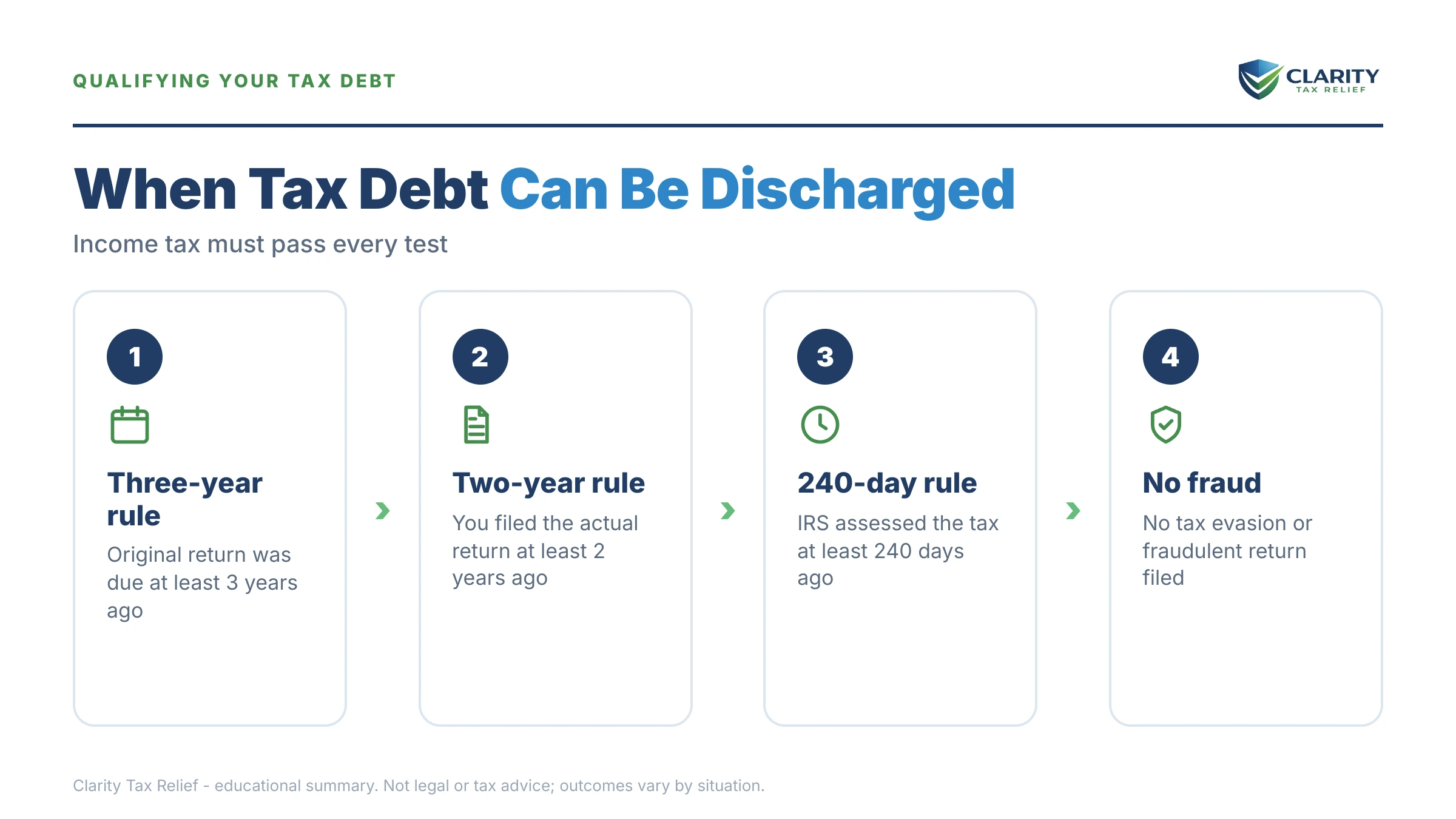
An income-tax debt can only be discharged — in either chapter — if it passes three timing tests measured from your petition date. This is where most chapter 7 vs 13 comparisons are won or lost, so run each tax year through all three:
- The 3-year rule: the return was due (including any extension) more than three years before you file bankruptcy. This is why recent taxes aren't dischargeable no matter which chapter you pick.
- The 2-year rule: you actually filed the return more than two years before the petition. If the IRS filed a substitute return for you and you never filed your own, most courts treat that year as never dischargeable — the full rule is covered in our guide to unfiled returns and bankruptcy.
- The 240-day rule: the tax was assessed at least 240 days before filing. A recent audit assessment or amended-return balance can restart this window even on an old year.
Fraudulent returns and willful evasion fail permanently — those taxes are never discharged. Penalties generally follow the tax they're attached to. And the timing math itself gets extended by things like prior bankruptcies and offers in compromise, which is why the petition date is a strategic decision, not a formality. The full mechanics live in our deep-dive on discharge taxes in bankruptcy.
One more asterisk: a federal tax lien recorded before you file survives both chapters. Discharge ends your personal liability, but the lien stays attached to property you owned on the petition date — the IRS can still collect from your home equity. See does bankruptcy remove tax lien for how that plays out after the case.
| Type of tax debt | Chapter 7 | Chapter 13 |
|---|---|---|
| Income tax passing all three timing tests | Discharged | Nonpriority — paid in part, rest discharged at completion |
| Income tax from the last 3 years | Survives in full | Priority — paid 100% through the plan |
| Trust-fund payroll tax (withheld from employees) | Survives in full | Priority — paid 100% through the plan |
| Trust Fund Recovery Penalty assessed against you | Survives in full | Survives; paid through the plan |
| Tax on years you never filed (or IRS substitute returns) | Generally survives | Generally survives; returns must be brought current to confirm a plan |
| Tax tied to fraud or willful evasion | Never discharged | Never discharged |
| Penalties attached to dischargeable tax | Discharged with the tax | Typically treated as nonpriority |
| Federal tax lien recorded pre-petition | Survives against your property | Survives; secured portion addressed in the plan |
Payroll taxes: the debt neither chapter erases
The trust-fund portion of payroll tax — money withheld from your employees' paychecks — is nondischargeable in Chapter 7 and Chapter 13 alike. Courts treat it as your employees' money that you held for the government, so no bankruptcy chapter releases it. If your business fell behind on 941 back taxes, this is the piece of your balance that bankruptcy cannot solve.
It gets more personal than that. When a business misses trust-fund deposits, the IRS can assess the Trust Fund Recovery Penalty against any "responsible person" — owner, officer, sometimes a check-signer — moving the debt from the company to you individually. That personal TFRP assessment survives your personal Chapter 7 and must be paid in full inside a Chapter 13 plan.
Entity structure matters too. Chapter 13 is individuals only — your LLC or corporation cannot file it. The entity can file Chapter 7, but business entities receive no discharge; liquidation just winds the company down while your personal TFRP exposure remains. If the balance sits inside an incorporated business, start with our guide to c corporation tax debt before assuming bankruptcy is the lever.
Where Chapter 13 still earns its keep for a business owner: it forces the IRS to accept trust-fund repayment over up to five years at a court-confirmed monthly amount, with the automatic stay blocking levies on your accounts and receivables the whole time. That's often more breathing room than the IRS would volunteer on its own.
What happens if you do nothing while you decide
IRS collection doesn't pause while you research bankruptcy — the notice machine keeps moving until a petition is actually filed. The typical sequence for a balance like yours:
- Balance-due notices keep arriving for each year and each quarter you owe, with interest and penalties recalculated on every one.
- A federal tax lien can be filed against everything you own — and once recorded, it will survive any bankruptcy you file afterward.
- For payroll debt, a TFRP investigation begins: the IRS interviews responsible people and proposes the penalty against you personally, converting business debt into personal debt.
- A final notice of intent to levy (LT11 or Letter 1058) starts a 30-day clock; after it runs, the IRS can levy bank accounts (funds are held 21 days before they leave) and garnish income continuously.
Filing either chapter triggers the automatic stay, which stops IRS levies the moment the petition hits the docket. But there's a cost to using bankruptcy as a pause button: the 10-year collection statute (CSED) is suspended during the case, and the IRS generally gets extra time added afterward, so surviving debt lives longer. If part of your balance is already old, estimate your expiration dates with our CSED Calculator before you hand the IRS more runway.
Sorting business and personal tax debt before a bankruptcy decision?
Before you commit to a 5-year plan — or a filing that won't touch your payroll debt — let an experienced tax professional map which parts of your balance are dischargeable, which survive, and whether an IRS-only option costs less. Interest is accruing either way; the review is free.
Your options compared: both chapters and the IRS-only alternatives
Bankruptcy is one of five realistic paths for a tax debt, and for many balances it's not the cheapest one. The IRS's own programs — payment plans, hardship status, and settlement — resolve most debts without a court filing; we walk through every one in how to settle tax debt yourself. Here's how the full menu compares:
| Option | Typical timeline | Out-of-pocket cost | Best fit |
|---|---|---|---|
| Chapter 7 | Roughly 4–6 months | Court filing fee plus attorney fees (varies by market) | Older income tax passing all three tests, plus other unsecured debt; means test passed |
| Chapter 13 | 3 or 5 years | Filing fee, attorney fees, plus a trustee commission on plan payments | Priority or trust-fund tax you need to repay under levy protection while keeping assets |
| IRS installment agreement | Set up within weeks; up to 72 months for balances ≤ $50,000 | Modest setup fee; interest and penalties continue | You can afford monthly payments and want the simplest fix |
| Offer in Compromise | Commonly many months; auto-accepted if the IRS doesn't decide within 2 years, with narrow exceptions - a returned or rejected offer stops the clock, and time during court disputes does not count | $205 fee + 20% down on lump-sum offers (waived with low-income certification) | Assets and income genuinely can't cover the debt before the CSED |
| Currently Not Collectible | Weeks to establish; reviewed periodically | $0; interest still accrues | Paying anything would create hardship; the debt waits while you recover |
The Offer in Compromise deserves special mention because it can reach the one debt bankruptcy can't: trust-fund assessments. It's means-tested and the IRS accepted roughly 1 in 5 offers in FY2024, so it's no shortcut — but if your collection potential is genuinely low, it settles debt no chapter would discharge. The full decision framework is in bankruptcy or offer in compromise.
A worked example: $16,400 with payroll tax in the mix
Say you're a small-business owner who owes $16,400 total: $9,400 in Trust Fund Recovery Penalty from missed payroll deposits, and $7,000 in personal income tax from a return that was due in April 2022, filed on time, and assessed that summer. This is hypothetical — but the math is how the real analysis works:
- Chapter 7: the $7,000 income tax passes all three timing tests (due 3+ years ago, filed 2+ years ago, assessed 240+ days ago) and is discharged in roughly four to six months. The $9,400 TFRP survives. You'd then put it on a payment plan — about $131/month over 72 months before accruing interest.
- Chapter 13: a 60-month plan pays the $9,400 TFRP in full — about $157/month plus the trustee's commission — while the $7,000 rides as nonpriority debt, paid only at whatever percentage your budget supports, with the remainder discharged at completion. Levies are blocked for all five years.
- No bankruptcy: a streamlined installment agreement on the full $16,400 runs roughly $228/month over 72 months while penalties and interest continue — no court, no attorney fees, no bankruptcy on your record.
Notice what drives the answer: it's not the total, it's the mix. If the $16,400 were all qualifying old income tax, Chapter 7 might erase nearly everything. Because more than half is trust-fund debt, bankruptcy solves less than half the problem — and the alternatives suddenly look competitive.
How to decide between Chapter 7 and Chapter 13 for tax debt, step by step
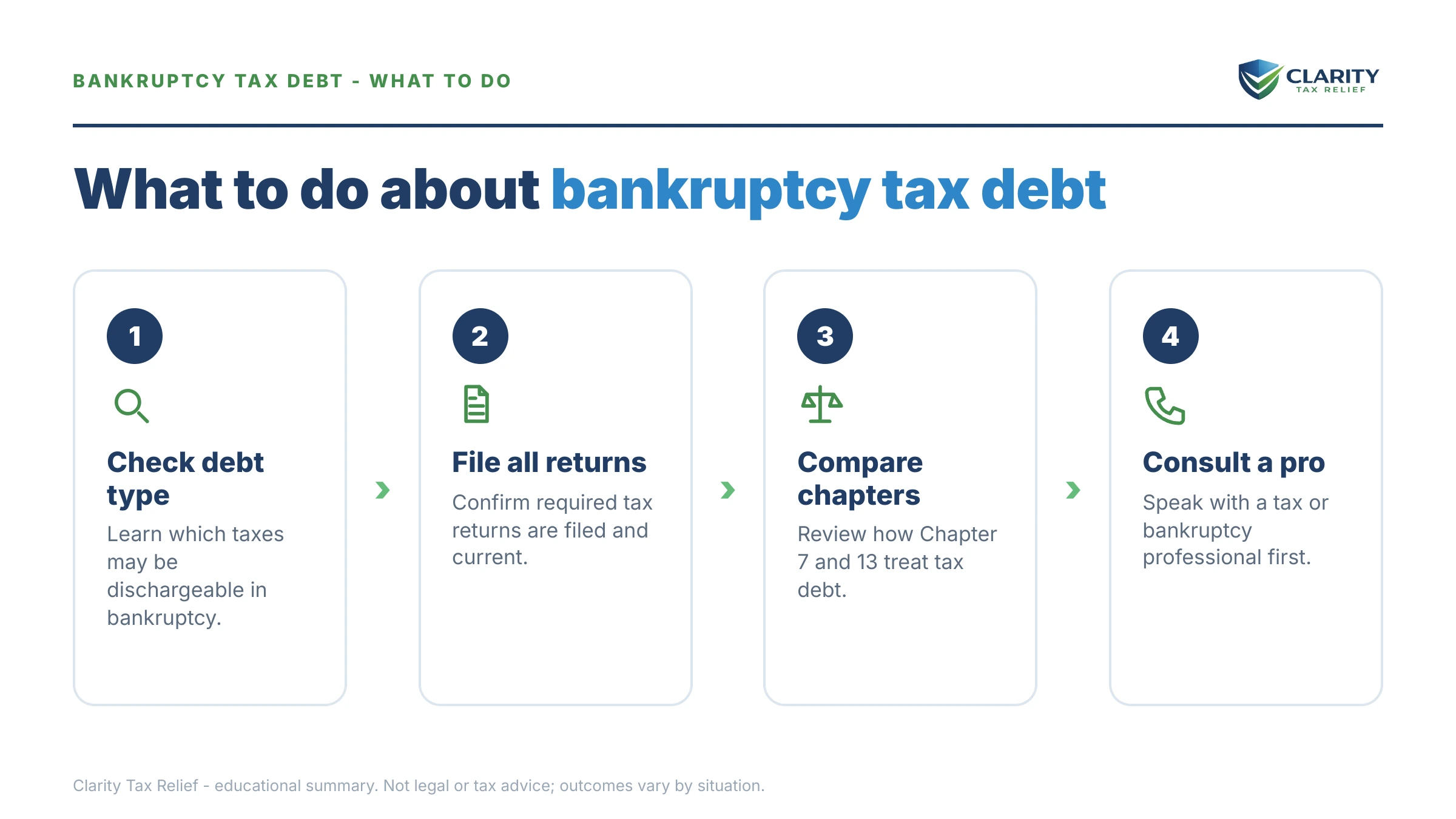
- Pull your IRS account transcripts. Get an account transcript for every year you owe so you can see exact assessment dates, filing dates, and balances — the raw data for every test below.
- Sort each year's debt by type. Separate ordinary income tax from trust-fund payroll tax, the Trust Fund Recovery Penalty, and penalties — each is treated differently in each chapter.
- Run the 3-year, 2-year, and 240-day tests. For each income-tax year, check whether the return was due 3+ years ago, was filed 2+ years ago, and the tax was assessed 240+ days ago. Only years passing all three can be discharged.
- Price the IRS-only alternatives. Compare an installment agreement, Offer in Compromise, and hardship status before assuming bankruptcy is necessary — for many balances they are cheaper and less disruptive.
- Meet with a bankruptcy attorney and an experienced tax professional together. Bankruptcy is a court proceeding a tax firm cannot file for you; the best outcomes come from timing the petition around the tax rules, which takes both perspectives.
When you can handle this yourself — and when the mix demands help
If your tax debt is small, recent, and purely income tax, you probably don't need bankruptcy or a professional at all. A balance you can clear within 180 days qualifies for a $0-setup short-term plan, and balances under $10,000 generally fit a guaranteed installment agreement — both set up online in an afternoon, no court, no attorney, no credit-report event.
Experienced help earns its fee when the picture looks like this article's example: payroll and personal debt tangled together, a TFRP investigation open or threatened, multiple years (especially unfiled ones — Chapter 13 generally requires your last four years of returns to be filed before a plan is confirmed), a levy already in motion, or a lien about to be recorded that would survive any later filing. In those cases, the sequencing — file returns first, time the petition around the 240-day window, protect the entity — changes the dollar outcome, not just the paperwork.
And to be direct about our role: Clarity Tax Relief resolves tax debt through IRS programs; only a bankruptcy attorney can file a petition for you. What we can do is tell you honestly, before you pay anyone, whether your debt mix makes bankruptcy worth that conversation.
Terms you'll hear, decoded
- Automatic stay: the court order, effective the instant you file, that halts IRS levies, garnishments, and most collection for the life of the case.
- Priority tax claim: tax debt (recent income tax, trust-fund payroll tax) that can't be discharged and must be paid in full in a Chapter 13 plan.
- Trust-fund tax: money withheld from employees' paychecks that the business holds for the government — the portion no bankruptcy erases.
- Discharge: the court order ending your personal liability for qualifying debts; liens recorded beforehand survive it.
- Means test: the income screen for Chapter 7 — comparing your income to your state's median and your disposable income after allowed expenses.
- CSED: the Collection Statute Expiration Date — the end of the IRS's 10-year window to collect, which bankruptcy pauses and extends.
Chapter 7 vs Chapter 13 tax questions, answered
Is Chapter 7 or Chapter 13 better for tax debt?
It depends on what kind of tax you owe. Chapter 7 is usually better when most of your debt is older income tax that passes the 3-year, 2-year, and 240-day timing tests — it can be erased in a few months. Chapter 13 is usually better when the debt is recent or priority tax (including trust-fund payroll tax), because it forces the IRS to accept a 3-to-5-year repayment plan and stops levies while you pay.
Does Chapter 7 completely wipe out IRS debt?
Only some of it. Income tax qualifies for discharge when the return was due more than three years ago, was actually filed more than two years ago, and the tax was assessed at least 240 days before your bankruptcy petition. Recent tax, trust-fund payroll tax, taxes tied to fraud, and years where you never filed a return all survive Chapter 7.
Can payroll taxes be discharged in bankruptcy?
The trust-fund portion — money withheld from employees' paychecks — cannot be discharged in Chapter 7 or Chapter 13. If the IRS has assessed the Trust Fund Recovery Penalty against you personally, that assessment survives both chapters too. In Chapter 13, the trust-fund debt must be paid in full through your plan; the non-trust-fund portion of employment tax may receive better treatment depending on its age.
Does filing bankruptcy stop an IRS levy or garnishment?
Yes — the automatic stay takes effect the moment your petition is filed, and it halts IRS levies, wage garnishments, and most collection activity for the life of the case. The protection is temporary in Chapter 7 (typically a few months) and lasts the full 3-to-5-year plan in Chapter 13. Any debt that isn't discharged goes back into collection when the case ends.
Does bankruptcy remove a federal tax lien?
No. A lien recorded before you file survives bankruptcy and stays attached to property you owned on the filing date, even if your personal liability for the tax is discharged. That means the IRS can still collect from equity in your home or other assets covered by the lien. Getting the lien released or withdrawn is a separate process after the case.
Does bankruptcy pause the IRS 10-year collection clock?
Yes. The 10-year collection statute (CSED) is suspended while the automatic stay is in place, and the IRS generally gets additional time added afterward. So if your debt was three years from expiring and you spend five years in a Chapter 13 plan that doesn't pay it off, the IRS regains that time on the surviving balance. Weigh this carefully if part of your strategy is waiting out the statute.
Can my LLC or corporation file Chapter 13 for its tax debt?
No — Chapter 13 is only available to individuals with regular income. A corporation or LLC can file Chapter 7, but business entities don't receive a discharge; liquidation just winds the company down. Meanwhile, the trust-fund share of any payroll tax can be assessed against you personally through the Trust Fund Recovery Penalty and follows you regardless of what happens to the entity.
Should I try an Offer in Compromise instead of bankruptcy?
Often yes — an Offer in Compromise resolves tax debt without a bankruptcy on your record, and it can reach debt that bankruptcy can't, including trust-fund assessments. But the IRS accepted only about 1 in 5 offers in FY2024, the application costs $205 plus a 20% down payment on lump-sum offers (both waived for low-income applicants), and review commonly takes many months. Compare both paths with a professional before committing to either.
Your next 24 hours
- Pull your transcripts. Log into your IRS online account and note the assessment date and balance for every year and quarter you owe — the timing tests can't be run without them.
- Gather three documents: your most recent tax return, any IRS notices you've received (especially anything mentioning a lien, levy, or the Trust Fund Recovery Penalty), and a rough monthly income-and-expenses picture.
- Get the debt mix mapped free. Call (888) 825-7779 or use the 2-minute form — an experienced tax professional will sort which parts of your balance bankruptcy could reach, which survive either chapter, and what the IRS-only paths would cost, while interest is still accruing on all of it.
For primary-source reading: the federal courts publish plain-language overviews of both chapters at uscourts.gov, the IRS's payment-plan terms are at IRS.gov payment plans, and every payment method is listed at IRS.gov/payments.
This guide is general information, not tax or legal advice for your specific situation. Bankruptcy decisions should be made with a bankruptcy attorney licensed in your state. Eligibility for IRS programs depends on individual facts and circumstances; no outcome is guaranteed.