
Bankruptcy & Tax Debt
Are Recent Taxes Dischargeable? Why New Tax Debt Survives Bankruptcy (2026)
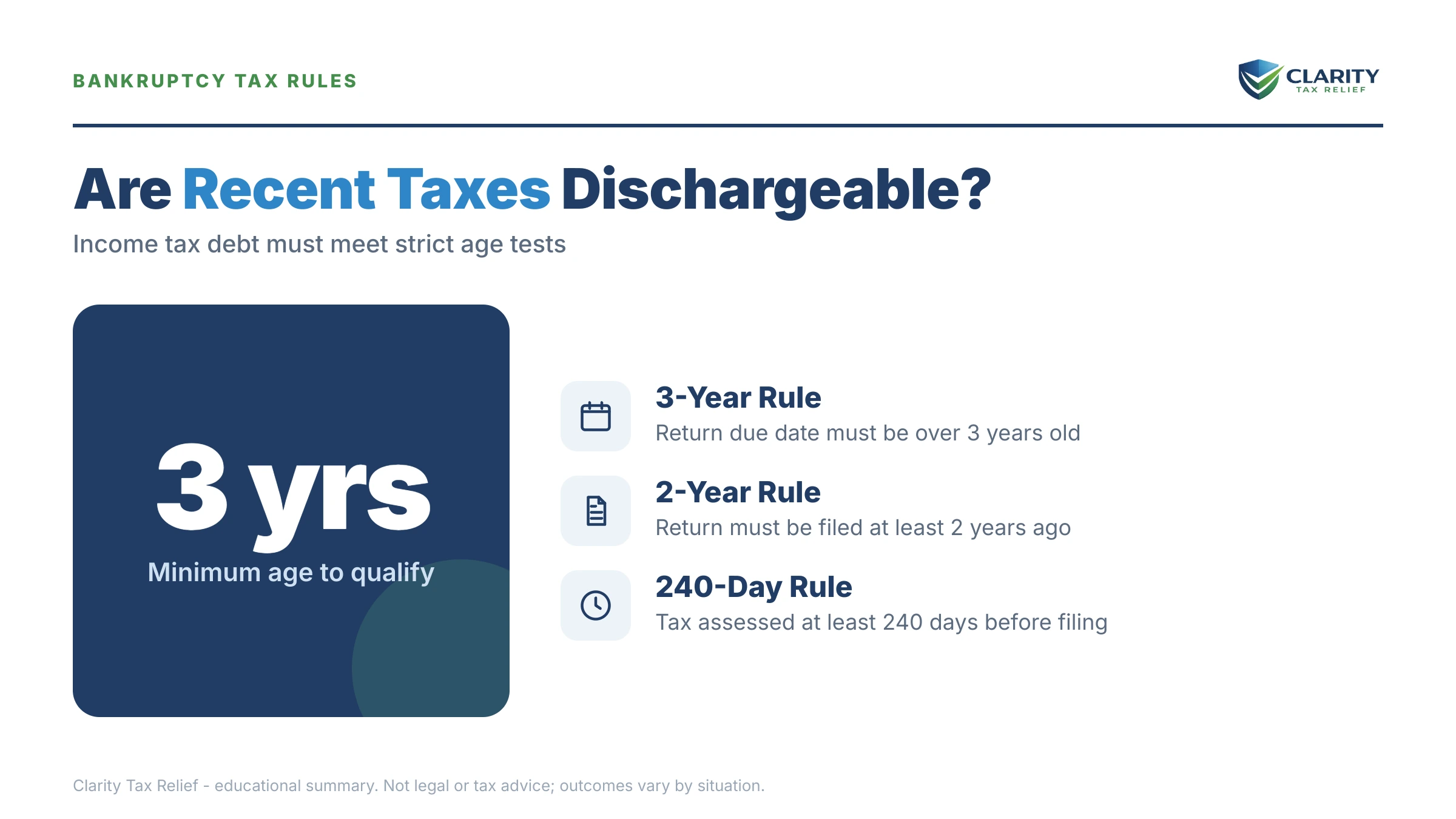
The short answer: are recent taxes dischargeable? Generally, no. Federal income tax survives bankruptcy unless the return was due more than 3 years ago, actually filed more than 2 years ago, and assessed at least 240 days before your petition. Taxes from the last three filing years are "priority" debts that Chapter 7 does not discharge.
You searched whether bankruptcy could clear your tax debt, and for a few minutes it sounded like the exit. Then you hit the fine print: every rule points backward in time. Bankruptcy can reach old tax debt — and yours is new, three gig years, some not even filed yet. Here's the honest map: exactly why recent taxes don't qualify, the specific date each of your years could qualify, and what actually protects you in the meantime.
⏱ The clock that matters: none of the discharge clocks are running on an unfiled tax year. The 2-year test starts only on the day you actually file that return — and until you file, the failure-to-file penalty grows at 5% per month, up to 25% of the balance.
Are recent taxes dischargeable? What the 2026 rules actually say
Federal income tax is dischargeable in bankruptcy only when the return was due more than 3 years before the petition, filed more than 2 years before it, and assessed at least 240 days before it — recent taxes fail at least one of those tests by definition.
The Bankruptcy Code draws the line with two sections working together. Section 507(a)(8) makes income taxes for returns due within the last three years priority tax claims, and Section 523(a)(1) says priority taxes are not discharged. That's the whole reason "recent" is fatal: the law deliberately protects the government's newest assessments.
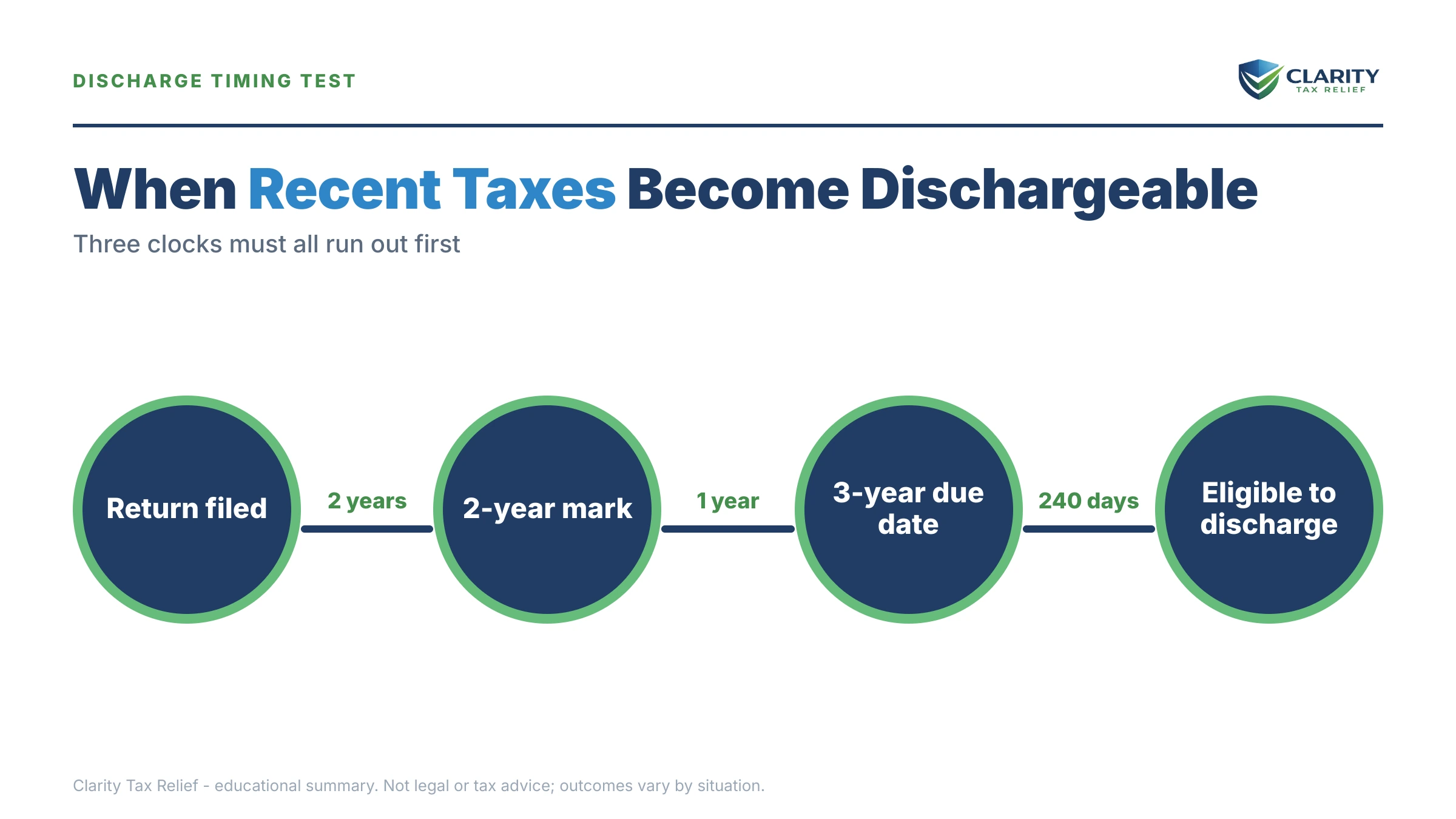
Three separate clocks must all have run out on the day you file the petition:
- The 3-year rule. The return's due date — including extensions — must be more than 3 years before the petition. An October 15 extension pushes this date six months later, even if you filed in April.
- The 2-year rule. You must have actually filed the return more than 2 years before the petition. This clock never starts on an unfiled year.
- The 240-day rule. The IRS must have assessed the tax at least 240 days before the petition. A fresh audit assessment or CP2000 adjustment restarts this one even on an old year.
You qualify only on the latest of the three dates — and there's a fourth condition on top: no fraudulent return and no willful attempt to evade the tax for that year. The full mechanics live in our guide to how to discharge taxes in bankruptcy; this page focuses on the situation most readers are actually in — debt too new to pass.
Two categories never qualify at any age. Trust-fund taxes — money withheld from employees' paychecks — survive every bankruptcy chapter no matter how old they are; if your debt includes 941 back taxes, bankruptcy is not the tool. And taxes tied to a fraud finding are permanently excluded. One piece of good news for anyone comparing exits: a bankruptcy discharge, unlike a creditor writing off a credit card, does not generate taxable cancellation-of-debt income the way a 1099-C cancelled debt does.
The three timing tests, applied to a 2026 filing
For a bankruptcy petition filed in late 2026, only tax years 2022 and earlier can pass the 3-year test — 2023, 2024, and 2025 all fail it automatically.
The 3-year test is the one you can compute from a calendar, because it runs from the return's statutory due date, not from anything you did:
| Tax year | Return due (no extension) | 3-year test first met | In a late-2026 Chapter 7 |
|---|---|---|---|
| 2022 | April 18, 2023 | April 18, 2026 | Passes — if the 2-year and 240-day tests are also met |
| 2023 | April 15, 2024 | April 15, 2027 | Fails — too recent |
| 2024 | April 15, 2025 | April 15, 2028 | Fails — too recent |
| 2025 | April 15, 2026 | April 15, 2029 | Fails — too recent |
If you filed an extension for any year, add six months: an extended 2022 return was due October 16, 2023, so its 3-year test isn't met until October 2026. And remember the "latest date wins" rule — passing the 3-year test means nothing for a year you filed late or never filed, because the 2-year clock runs separately.
One more trap: tolling. A prior bankruptcy case, a pending offer in compromise, or a collection due process appeal pauses these lookback periods while it's active and adds extra time on top. People who file a petition two weeks too early because of an old OIC they forgot about lose the discharge for that year entirely. This is calendar law — days matter.
Why unfiled years make recent taxes even harder to discharge
An unfiled tax year can never be discharged, because the 2-year test counts from the date the return was actually filed — a clock that hasn't started for you yet.
If you're the reader we wrote this for — gig income, three years behind — this is the section that matters most. Every month those returns stay unfiled, three things get worse:
First, the discharge window doesn't move an inch closer. File all three returns today and the 2-year clock finally starts; wait another year and the earliest possible discharge date slides back a year with you.
Second, the IRS may file for you. When the IRS prepares a substitute for return, it assesses tax using your gross 1099 totals with no mileage, no expenses, no deductions — and most bankruptcy courts hold that an SFR-assessed year is permanently nondischargeable, even decades later, though a minority of courts (notably the Eighth Circuit) disagree, so the outcome depends on where you file — confirm with a bankruptcy attorney in your circuit. Some federal appeals courts go further and treat any late-filed return as barring discharge forever. The filing requirement has its own guide: unfiled returns bankruptcy.
Third, unfiled years are where the scary questions live. Owing money is civil; willfully refusing to file is where criminal exposure theoretically sits — though prosecution targets deliberate evasion, not people catching up voluntarily. If that fear is what's kept you frozen, read can you go to jail for not filing taxes — the honest answer is calming, and it points the same direction as everything else here: file now.
What happens if you just wait
Doing nothing doesn't age the debt toward discharge — it moves you through the IRS enforcement sequence while the discharge clocks sit frozen.
For unfiled years with a growing balance, the stages run in this order:
- Non-filer notices. The IRS's automated systems match your 1099-K and 1099-NEC filings against its records and start mailing requests for the missing returns.
- Substitute for return. If you don't respond, the IRS computes the tax itself from gross income — typically the worst possible number — and proposes an assessment. Once that assessment posts, most courts treat the year as never dischargeable.
- The collection sequence. With a balance assessed, the standard billing notices begin, escalating to a final notice of intent to levy. From there the IRS can garnish wages, levy bank accounts, and intercept payment-app and contractor income.
- The clocks work against you. Through all of it, the failure-to-pay penalty adds 0.5% per month, interest compounds daily, and any tolling event — an appeal, a prior bankruptcy, a pending offer — pushes the earliest discharge date even further out.
And in 2026, don't count on the IRS being too shorthanded to notice. The workforce shrank roughly 27% in 2025, per TIGTA reports, but non-filer matching, substitute returns, and levies are automated — the humans got harder to reach while the machine kept running.
Three years unfiled and a balance that grows every month?
Get a free review of your unfiled years and your real discharge timeline before the IRS files a substitute return that locks the debt in permanently. An experienced tax professional will map your options — no pressure, no invented urgency.
Your options while the debt is too recent to discharge
A tax debt that can't be discharged yet can still be managed five different ways — and the right one depends on your income, not your fear level.
| Option | Who it fits | The trade-off |
|---|---|---|
| Short-term payment plan | You can pay in full within 180 days | $0 setup; interest and the 0.5%/month penalty continue until paid |
| Streamlined installment agreement | Assessed balance ≤ $50,000, all returns filed | Up to 72 months online; setup fee; interest and penalties keep accruing |
| Currently Not Collectible | Paying anything would leave you unable to cover basic living costs | Collection pauses; the debt and interest remain and the IRS reviews periodically |
| Offer in Compromise | Assets plus future income are genuinely below what you owe | $205 fee (waived with low-income certification); roughly 1 in 5 offers accepted in FY2024, per IRS data |
| Chapter 13 bankruptcy | Steady income; need the automatic stay against levies | Recent priority tax paid 100% over 3–5 years; penalties often paid only in part |
| Wait, then Chapter 7 | All three timing tests will pass; returns filed; no fraud issues | Years of accruing interest first; any tolling event extends the wait |
A few specifics the table can't hold. A streamlined installment agreement is the workhorse for balances like yours — under $50,000, set up online, no financial disclosure required. Chapter 13 deserves a real look when a levy is imminent: it doesn't discharge recent tax, but the automatic stay stops garnishment on day one and converts the debt into a court-supervised plan. And if your gig income has genuinely cratered, an offer can beat both — our comparison of bankruptcy or offer in compromise walks through which facts favor which door.
What about simply outlasting the IRS? The collection statute does expire 10 years after assessment — but on an unfiled year, the 10-year clock hasn't started, because nothing has been assessed. Once you file and the tax posts, you can estimate each year's expiration with our CSED Calculator; just know that appeals, offers, and bankruptcies pause that clock too.
One state-side note: state income taxes follow the same federal bankruptcy timing tests, but state collection outside bankruptcy runs on its own rules — California's Franchise Tax Board, for example, can collect for 20 years. If you owe both, resolve them as two separate problems.
Worked example: $13,600 across three unfiled gig years
Say you drove and delivered through 2023, 2024, and 2025, never filed, and the returns would show $5,200, $4,400, and $4,000 due — $13,600 total. This is hypothetical, but the math is real.
Penalties first. The failure-to-file penalty runs 5% per month and caps at 25%. Filing everything in July 2026, the 2023 and 2024 returns are past the cap — roughly $1,300 and $1,100 added — while 2025, about three months late, picks up roughly $600. Call it about $3,000 in filing penalties alone, before the ongoing 0.5%/month late-payment penalty and daily compounding interest.
Now the discharge calendar, assuming you file all three returns in July 2026 and the IRS assesses them within a few weeks:
- 240-day test: met by roughly spring 2027 for all three years.
- 2-year test: met in July 2028 for all three years.
- 3-year test: met April 2027 for 2023, April 2028 for 2024 — and not until April 15, 2029 for 2025.
So the earliest Chapter 7 that could reach all three years is one filed after mid-April 2029 — nearly three years away, and only if no offer, appeal, or prior case tolls the clocks and no substitute return poisoned a year first. Meanwhile the balance grows every month you wait.
Compare the direct route: $13,600 on a 72-month streamlined agreement is about $189/month before accruing interest and penalties — realistically somewhat more to actually retire the balance. And if your gig income is low enough that AGI falls at or below 250% of the federal poverty level, an offer in compromise comes with the $205 fee, the 20% down payment, and payments during review all waived. For most people in this exact spot, resolving now beats waiting three years for a discharge that one misstep can erase.
How to respond when your taxes are too recent to discharge, step by step
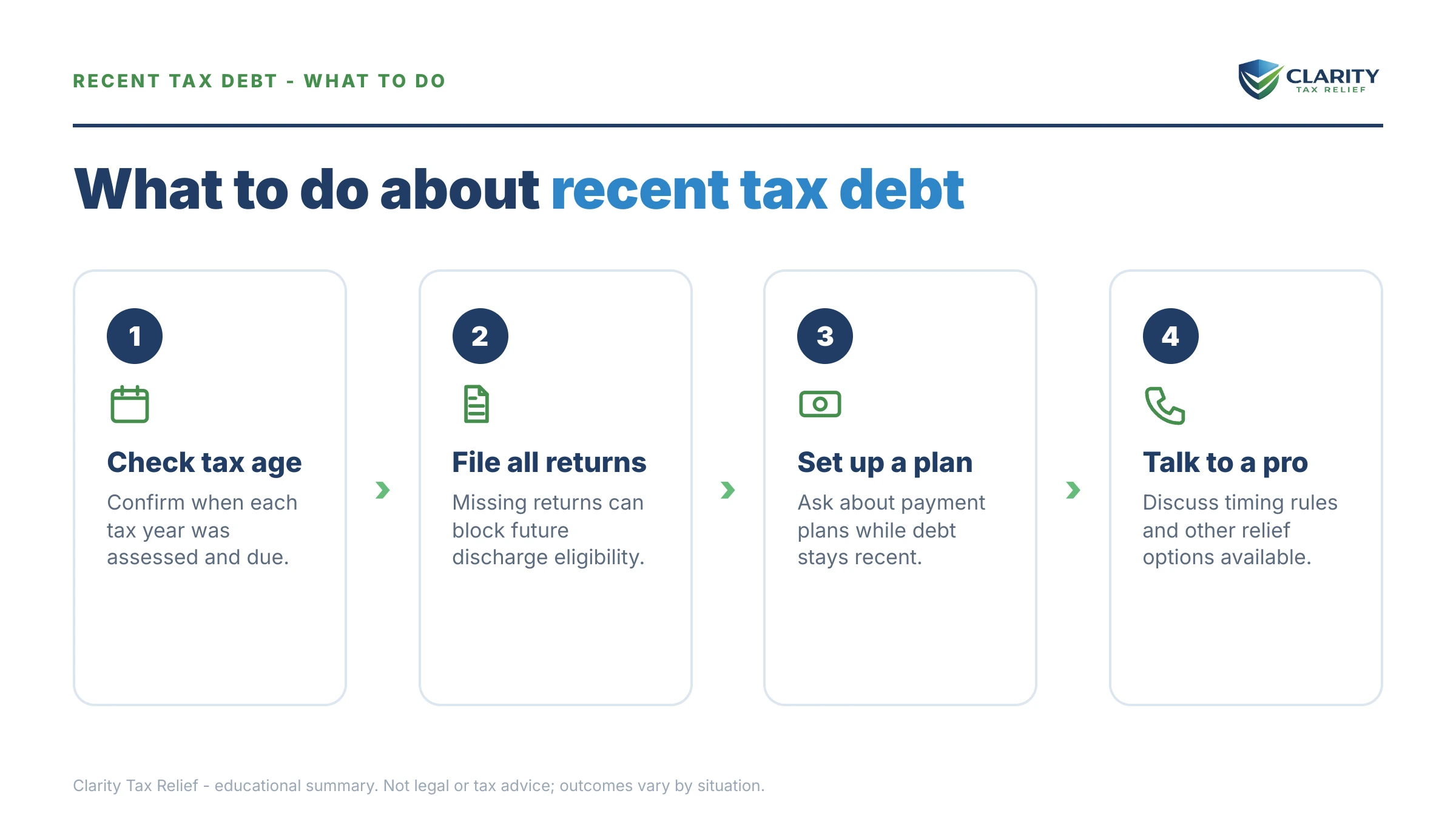
- File the missing returns. File every unfiled year now — the 2-year discharge clock starts only when a return is actually on file, and filing stops the 5%-per-month failure-to-file penalty.
- Pull your IRS account transcripts. Confirm what the IRS has assessed for each year and check whether any substitute-for-return activity has started.
- Map each year against the three timing tests. Mark the return due date plus 3 years, the filing date plus 2 years, and the assessment date plus 240 days; the latest date is that year's earliest possible discharge date.
- Put interim protection in place. Set up a payment plan, hardship status, or an offer in compromise so levies never start while the calendar runs.
- Get a combined tax-and-bankruptcy review before filing any petition. One tolling event, substitute for return, or lien changes the answer, and a petition filed weeks too early wastes the discharge entirely.
When you can handle this yourself
Plenty of recent-tax situations don't need professional help — and knowing which is which saves you money.
Handle it yourself if: you owe for one recent year you agree with, you can pay within 180 days or fit a streamlined plan, and there are no unfiled returns. Setting up a payment plan takes minutes at the IRS payment plans page, and our DIY hub on how to settle tax debt yourself covers every self-service program in one place. If money is tight, the Taxpayer Advocate Service and low-income taxpayer clinics offer free help.
Get experienced help when the calendar and the law intersect: multiple unfiled years with SFR activity on the transcript, a levy already in motion, business or payroll debt mixed in, or a genuine bankruptcy-versus-offer decision where the timing math decides thousands of dollars. Discharge planning is one of the few areas of tax resolution where being off by a single day permanently changes the outcome — that's exactly the situation where a second set of eyes earns its fee.
Terms in the discharge rules, decoded
- Discharge — the bankruptcy court order that ends your personal legal obligation to pay a qualifying debt.
- Priority tax claim — a tax the Bankruptcy Code ranks ahead of ordinary debts; priority taxes survive Chapter 7 and must be paid in full in Chapter 13.
- Petition date — the day your bankruptcy case is filed; every timing test is measured backward from this single date.
- Tolling — events (a prior bankruptcy, a pending offer in compromise, certain appeals) that pause the 3-year, 2-year, and 240-day clocks and add extra time.
- Substitute for Return (SFR) — a return the IRS prepares for a non-filer using gross income and no deductions; most courts treat SFR-assessed years as never dischargeable.
- Automatic stay — the immediate freeze on levies, garnishments, and most collection that takes effect the moment any bankruptcy is filed.
Recent taxes and bankruptcy: questions people ask
Can Chapter 7 discharge taxes from last year?
No. Taxes for a return due within the past three years are priority claims under Section 507(a)(8) of the Bankruptcy Code, and Chapter 7 cannot discharge them regardless of your income. A 2025 return was due April 15, 2026, so that year cannot pass the 3-year test until April 2029 at the earliest. Filing Chapter 7 sooner leaves the tax fully intact when the case closes.
How old does tax debt have to be before bankruptcy can discharge it?
The return must have been due more than 3 years before your petition, actually filed more than 2 years before it, and the tax assessed at least 240 days before it — you qualify only on the latest of those dates. Tolling events, like a prior bankruptcy or a pending offer in compromise, pause the clocks and add extra time. There also can't be fraud or willful evasion on the year in question.
Does Chapter 13 get rid of recent tax debt?
No — recent income taxes are priority claims, and a Chapter 13 plan must pay them in full over three to five years. What Chapter 13 does provide is the automatic stay, which stops levies and garnishments while the case is open, and better treatment of penalties, which usually become general unsecured claims paid only in part. It is a structured repayment tool for recent tax, not a discharge of it.
Can taxes ever be discharged if I never filed the return?
Not until you file — the 2-year test runs from the date the return is actually filed, so an unfiled year can never qualify. If the IRS files a substitute for return and assesses the tax first, most courts treat that year as permanently nondischargeable. In some federal circuits, even a return filed one day late bars discharge forever. Filing before the IRS files for you preserves the option.
Does bankruptcy at least stop the IRS from collecting recent taxes?
Temporarily, yes. The automatic stay halts levies, garnishments, and most collection activity the moment you file, even on tax that will survive the case. But when the case ends, any tax that failed the timing tests is still owed, collection resumes, and the 10-year collection statute was paused for the length of the case plus additional time — so the wait doesn't run out the IRS's clock.
Are tax penalties and interest discharged even if the tax isn't?
Sometimes. In Chapter 7, penalties can be discharged when the event they relate to is more than three years old, even if the underlying tax survives. In Chapter 13, penalties are usually general unsecured claims paid only in part. Interest follows the tax it sits on: interest on a surviving tax survives, and interest on a discharged tax is discharged with it.
Are payroll or trust-fund taxes ever dischargeable?
No. Withheld income tax and the employee share of FICA — the trust-fund portion of payroll taxes — are priority claims with no age limit, so they survive Chapter 7 and must be paid in full in Chapter 13 no matter how old they are. The same applies to the Trust Fund Recovery Penalty assessed personally against owners and check-signers. Those debts are resolved through payment plans, offers, or hardship status instead.
Does bankruptcy remove an IRS tax lien?
No. A discharge ends your personal liability for a qualifying tax, but a Notice of Federal Tax Lien recorded before the petition survives against property you owned on the filing date. The IRS can't pursue your future wages for a discharged tax, but it can still collect from equity in that pre-petition property. Lien timing is one more reason to map the calendar before filing.
Your next 24 hours
- Find your numbers. Log into your IRS online account and note which years show a balance, which show no return filed, and whether any assessment has posted — that tells you which clocks are running.
- Gather the income records. Pull your 1099-Ks, 1099-NECs, app earnings summaries, and bank statements for each unfiled year so the returns can be prepared with real deductions instead of the IRS's gross numbers.
- Get the free case review. Call (888) 825-7779 or use the 2-minute form — an experienced tax professional will map your discharge dates, your penalty exposure, and the interim option that keeps levies off the table while interest is the only thing still moving.
If you want to read the IRS's own material first, start with IRS.gov/payments for every payment option in one place.
This guide is general information, not tax or legal advice for your specific situation. Eligibility for IRS programs depends on individual facts and circumstances; no outcome is guaranteed.