
Tax Debt & Bankruptcy
Priority Tax Claims in Bankruptcy: Which Tax Debts Survive Discharge (2026)
The short answer: priority tax claims are tax debts bankruptcy law pays first and will not discharge — generally income taxes from returns due within the last 3 years, taxes assessed within 240 days of filing, and all withheld trust-fund payroll taxes. Priority taxes survive Chapter 7 and must be paid 100% through a Chapter 13 plan.
You've run the numbers as a 1099 contractor with no withholding, watched the balance stack across two tax years, and someone — maybe a bankruptcy attorney, maybe a forum — just told you that priority tax claims don't go away in bankruptcy. That's half true. The classification isn't about how much you owe; it's about dates, and the dates are already sitting in your IRS file.
Every test that decides priority status runs off entries on your IRS account transcript — the image below shows what those transcript entries look like and where the key dates sit, so you can follow along with your own numbers.
⏱ Your clock: there's no notice deadline here — the clocks are the 3-year, 240-day, and 2-year tests, counted from your own return due dates, filing dates, and assessment dates. Filing a bankruptcy petition even one week before a clock runs can permanently lock a tax in as a priority claim you'll still owe when the case closes. The petition date is the one date you control.
What makes a tax debt a priority claim
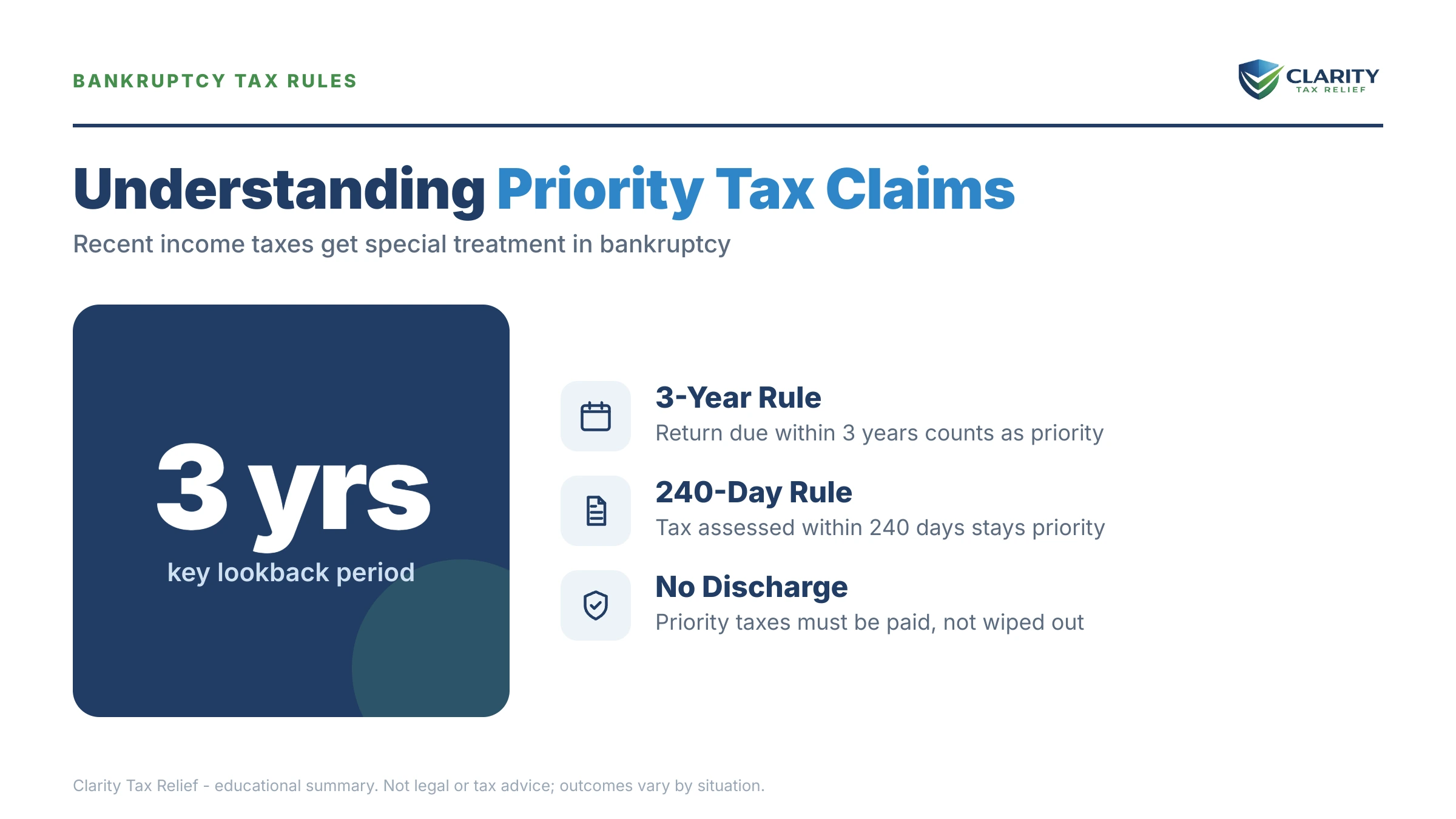
A tax debt is a priority claim under Bankruptcy Code §507(a)(8) when its return was due within 3 years of your petition, it was assessed within 240 days of your petition, or it's a trust-fund tax withheld from someone else's pay. Priority status matters because it controls two things at once: where the tax sits in the payment line, and whether the discharge at the end of your case erases it.
The tests are mechanical. No judge weighs your hardship; the calendar decides:
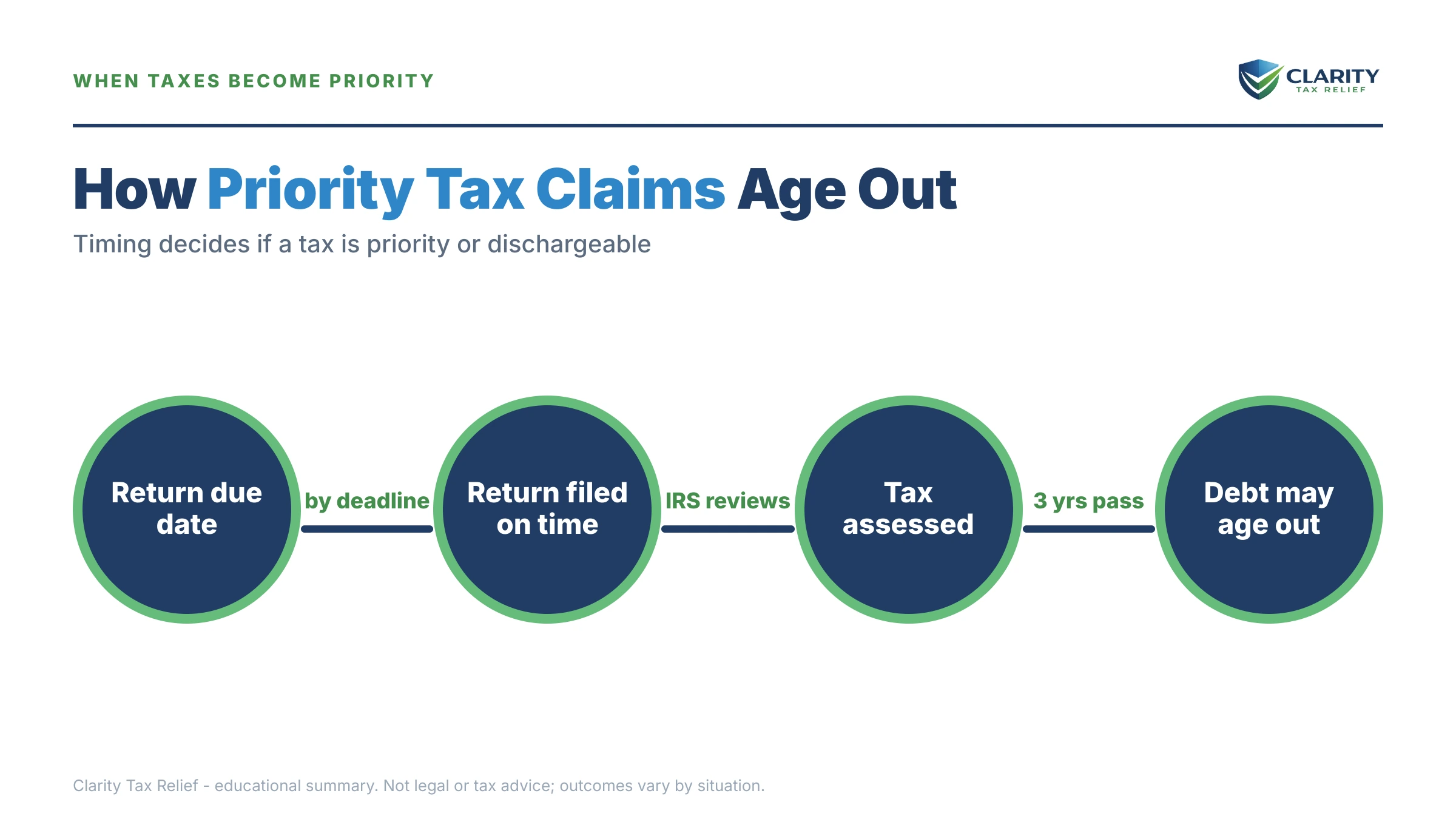
- The 3-year rule. Income tax is priority if the return was last due — including extensions — within 3 years before your petition. File an October extension and the 3-year clock starts in October, not April. This trips up more filers than any other rule.
- The 240-day rule. Tax assessed within 240 days before the petition is priority regardless of the tax year. Assessment is when the tax officially posts to your account — an audit closing, a CP2000 you agreed to, or an amended return can create a fresh assessment on an old year and restart this clock.
- Still-assessable tax. Tax the IRS hasn't assessed yet but still legally can — say, a deficiency case in progress — is priority too. If you're holding a statutory notice of deficiency, see our guide to the 90-day letter and Tax Court petition before you think about a bankruptcy date.
- Trust-fund taxes. Taxes withheld from employees' paychecks — and the Trust Fund Recovery Penalty assessed against you personally — are priority with no time limit, ever. They never age out and never discharge.
Discharge has its own separate screens layered on top: the tax must also pass the 2-year rule (you actually filed the return at least 2 years before the petition) and the fraud test (no fraudulent return, no willful evasion). The full three-part framework is covered in our guide to how to discharge taxes in bankruptcy; this page focuses on the priority classification itself.
| Test | Clock starts | Result if the test fails | What pauses the clock |
|---|---|---|---|
| 3-year rule | Return due date, including extensions | Due within 3 years of petition → priority, nondischargeable | Prior bankruptcy's automatic stay |
| 240-day rule | Assessment date on your transcript | Assessed within 240 days of petition → priority | Pending offer in compromise, plus 30 days after it resolves; prior bankruptcy |
| Still-assessable | No assessment yet (open audit, pending 90-day letter) | Priority until assessed — then the 240-day clock runs | Litigation and appeals extend how long the IRS can assess |
| 2-year rule (discharge screen) | Date you actually filed the return | Filed less than 2 years before petition → nondischargeable | SFR years may never qualify at all, no matter how long you wait |
| Fraud / willful evasion | — | Never dischargeable | Permanent — no clock exists |
How priority tax claims are treated in Chapter 7 vs. Chapter 13
Priority tax claims survive a Chapter 7 discharge in full and must be paid 100% through a Chapter 13 plan before a court will confirm it. Everything else about the two chapters flows from that one rule.
In Chapter 7, the discharge at the end erases only tax debt that has aged out of priority status and passes the 2-year and fraud screens. Priority taxes come through untouched — and interest on them keeps accruing during the case, so the surviving balance is larger the day your case closes than the day you filed. Our guide to whether bankruptcy clears IRS debt walks through the Chapter 7 outcome in detail.
In Chapter 13, priority taxes go into the plan and get paid in full over 3 to 5 years. The upside: the unsecured priority portion is generally paid without new penalties stacking on, and tax penalties are usually demoted to general unsecured claims — often paid only in part, with the rest discharged. For a recent priority balance you can't discharge anyway, Chapter 13 and back taxes can function as a court-protected payment plan the IRS cannot default you out of. Which chapter fits which debt is the whole subject of our Chapter 7 vs 13 tax debt comparison.
One more layer: a recorded federal tax lien changes everything above. A lien filed before your petition rides through the case attached to property you owned on the filing date, even where the underlying tax is discharged — the full mechanics are in does bankruptcy remove tax lien.
| Tax debt | Chapter 7 | Chapter 13 |
|---|---|---|
| Income tax, return due within 3 years | Priority — survives discharge | Priority — paid 100% through the plan |
| Tax assessed within 240 days of petition | Priority — survives discharge | Priority — paid 100% through the plan |
| Trust-fund / withheld payroll taxes (any age) | Never discharges | Priority — paid 100%; never discharges |
| Older income tax passing all timing tests | Discharged | General unsecured — may be paid pennies per dollar of the claim under the plan, remainder discharged |
| Tax penalties | Penalties tied to nondischargeable recent tax generally survive; older penalties can discharge | Generally general unsecured — often partly paid, rest discharged |
| Tax with a recorded federal lien | Personal liability may discharge; lien survives against pre-petition property | Secured up to your equity — paid as a secured claim |
| Fraud, willful evasion, or unfiled years | Never discharges | Never discharges |
What happens if you file before the clocks run
Filing a bankruptcy petition one week too early can convert a soon-to-be-dischargeable tax into a debt you still owe — with more interest — when the case closes. Here's the sequence, stage by stage:
- Petition filed. The automatic stay pauses IRS levies and garnishments immediately — the same stay covered in does bankruptcy stop irs levy — and a bankruptcy freeze posts to your IRS transcript.
- The IRS files its proof of claim. Your balance gets split into secured, priority, and general unsecured pieces. The dates on your transcript decide the split — not your attorney's argument, not your intent.
- The case concludes. In Chapter 7, the discharge erases only the non-priority, non-excepted tax. Every dollar classified as priority is standing there waiting.
- The stay lifts and collection resumes. The IRS picks up where it left off on the surviving tax — and the 10-year collection statute was paused during your case and for six months after the case concludes (IRC 6503(h)), so bankruptcy bought the IRS more time, not less. You can estimate your remaining collection window with our CSED Calculator.
- Any pre-petition lien remains. It still encumbers the property you owned when you filed, surfacing when you try to sell or refinance.
Compare that to the taxpayer who waited three more months for the 3-year clock to run: same debt, same case, radically different outcome. That's why classification comes before strategy.
Not sure which of your tax years are priority claims?
The answer is written in your transcript dates — and interest and penalties keep accruing on every balance while you guess. Send us the years you owe and an experienced tax professional will map your 3-year, 240-day, and 2-year dates free, so you and your attorney can time any filing correctly.
Your options when the tax debt is priority
If your tax is a priority claim, bankruptcy won't erase it — but that doesn't mean full payment on the IRS's schedule is your only path. The complete menu of IRS resolution routes lives in our guide to how to settle tax debt yourself; here's how each one interacts with a priority-classified balance:
| Option | Who is eligible | Cost and trade-off |
|---|---|---|
| Short-term IRS plan | Can pay in full within 180 days | $0 setup; interest and the 0.5%/month late-pay penalty continue until paid |
| Streamlined installment agreement | Balance ≤ $50,000; up to 72 months online | Setup fee applies; roughly $157/month on $11,300 before accruals |
| Guaranteed installment agreement | Tax owed ≤ $10,000 plus other conditions | Paying the balance below the threshold first can unlock it |
| Offer in Compromise | Your assets + future income genuinely can't cover the debt; $205 fee and 20% down on lump-sum offers (both waived with low-income certification) | IRS accepted roughly 1 in 5 offers in FY2024, per IRS data — means-tested, never automatic |
| Currently Not Collectible | Allowable living expenses meet or exceed income | Collection pauses; debt and interest remain; refunds get offset |
| Chapter 7 | Pass the means test; only helps taxes that clear all timing tests | Court and attorney costs; priority taxes survive intact |
| Chapter 13 | Regular income; within debt limits | 3–5 year plan; priority taxes paid 100%, penalties often reduced |
An important comparison many readers skip: an Offer in Compromise doesn't care about the 3-year or 240-day clocks at all — it's pure financial math. A priority tax that bankruptcy can't touch can still be compromised if the IRS's own collectibility formula says the balance exceeds what it could ever collect from you. When the timing rules cut against bankruptcy, that's often the pivot — our bankruptcy or offer in compromise framework walks the decision tree.
And if the balance itself is wrong — a duplicated 1099, unclaimed contractor mileage, a missed home-office deduction — amending a return to reduce a tax debt can shrink the number before you classify it. Just remember: an amended-return assessment can restart the 240-day clock on that year.
A worked example: $11,300 across two tax years
Say you're a 1099 contractor who owes $11,300 in a hypothetical case: $7,800 from your 2021 return (filed on time in April 2022) and $3,500 from your 2024 return (due April 2025). You're weighing a Chapter 7 filing in August 2026.
Run the tests year by year. The 2021 tax: its return was due in April 2022, more than 3 years before an August 2026 petition — the 3-year test passes. It was assessed shortly after filing, so the 240-day test passes. You filed it more than 2 years ago, no fraud. Result: $7,800 is a general unsecured claim, dischargeable. The 2024 tax: its return was due April 2025, well inside 3 years. Result: $3,500 is a priority claim that survives the case in full — and stays priority until roughly April 2028, absent tolling.
Now compare the no-bankruptcy path: the full $11,300 on a 72-month streamlined installment agreement runs about $157/month before interest and the 0.5% monthly failure-to-pay penalty, which keep accruing on the declining balance. The bankruptcy path could cut the tax to $3,500 — but only if the petition lands after April 2025's year is the only one still inside the window, and only if nothing tolled the 2021 clocks. One pending OIC or prior bankruptcy in your history changes the math. That's why the dates get verified, never assumed.
Special cases: 1099 income, payroll taxes, liens, and IRS-filed returns
Self-employment tax is not trust-fund tax. This is the single most common fear among contractors, and it's misplaced. Your SE tax was never withheld from anyone else's paycheck, so it follows the same 3-year/240-day timing rules as ordinary income tax. It can age out of priority status like any other 1040 balance.
If you had workers and withheld from them, the withheld share is trust-fund money — priority forever, personally assessable against you through the Trust Fund Recovery Penalty, and untouchable by any chapter. Only the employer-side portions follow normal timing rules.
If you filed jointly and only you file bankruptcy, your discharge does nothing for your spouse — the IRS can continue collecting the entire joint liability from them.
If the IRS filed a return for you, that substitute for return does not count as your filed return for the 2-year test, and in several circuits a late return filed after the SFR never qualifies for discharge at all. Get real returns on file first — the mechanics are in the IRS filed a substitute return for me and the filing requirement itself in unfiled returns bankruptcy. Recent balances that can't yet pass any test are covered in are recent taxes dischargeable.
How to check your priority tax claim dates, step by step
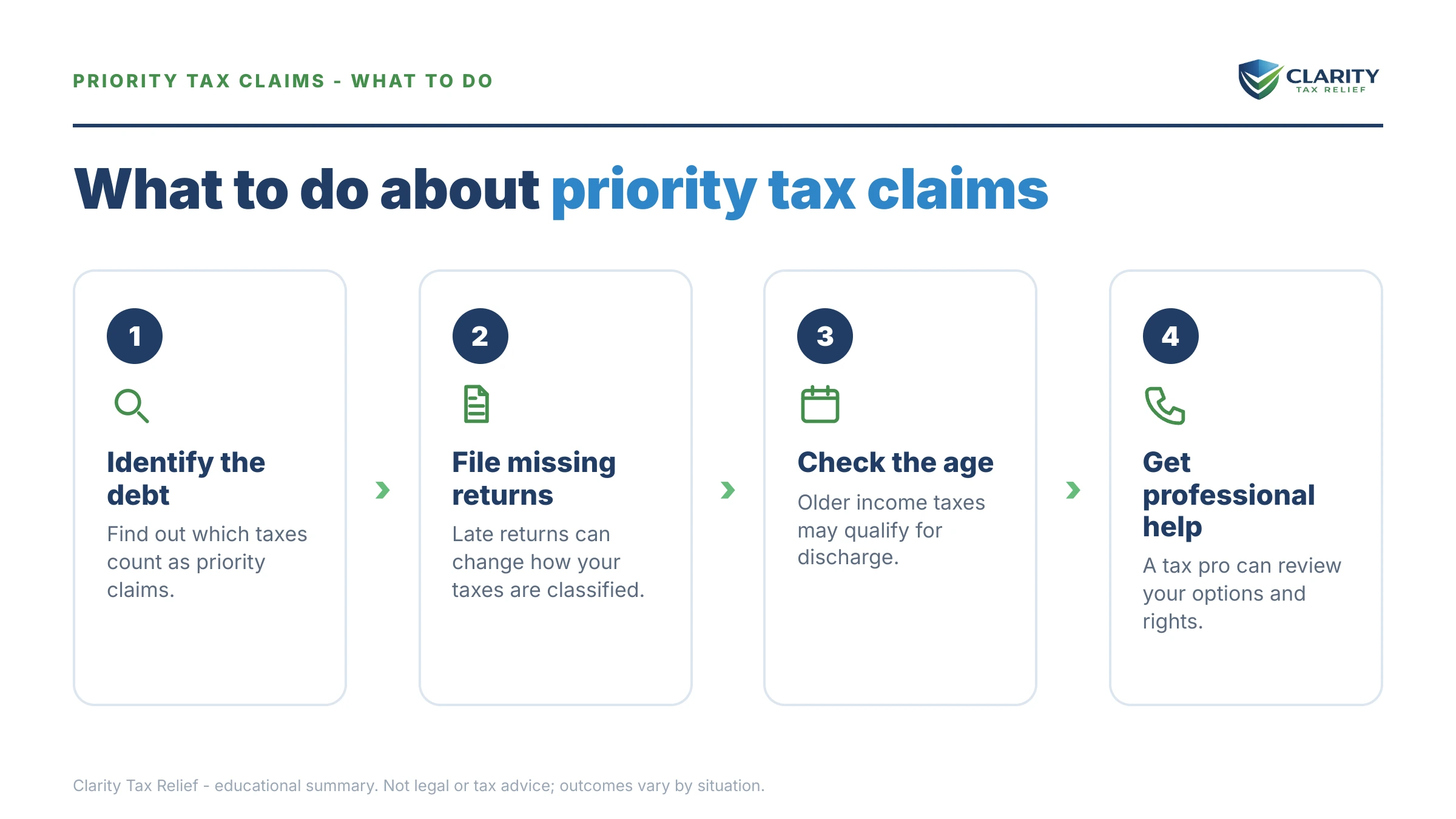
- Pull your IRS account transcript for every year you owe — it's free through your IRS online account and holds every date these tests use.
- Find each return's due date, including any extension you filed — an October extension moves the start of the 3-year clock.
- Locate the assessment dates — the Code 150 line plus any later audit or CP2000 assessment — because those run the 240-day test.
- Confirm when you actually filed each return, and flag any year where the IRS filed a substitute return before you did.
- List every tolling event — a prior bankruptcy case or a pending offer in compromise pauses these clocks and shifts your dates.
- Review the dates before you file with a bankruptcy attorney and an experienced tax professional before you commit to a petition date — the filing date locks in the classification permanently.
When you can handle this yourself — and when you shouldn't
You don't need professional help to pull transcripts and count the clocks on a single, cleanly filed tax year. If your only balance is recent, clearly priority, and small enough to pay within 180 days, skip the bankruptcy analysis entirely — a $0-setup short-term plan resolves it faster and cheaper than any court filing.
Experienced help changes outcomes when the dates are contested or layered: multiple years with different classifications, an SFR or unfiled year in the stack, a prior OIC or bankruptcy that tolled the clocks, a recorded lien, or any trust-fund exposure from workers you paid. And bankruptcy itself is a legal proceeding — the tax-date analysis on this page informs the decision, but the petition belongs with a bankruptcy attorney. The best cases are ones where the tax professional and the attorney compare calendars before anything is filed.
Terms on your bankruptcy paperwork, decoded
- Priority claim — a debt Congress placed near the front of the bankruptcy payment line; priority taxes also survive discharge.
- General unsecured claim — a debt with no collateral and no priority; the category that discharge can actually erase.
- Discharge — the court order ending your personal liability for qualifying debts at the close of the case.
- Automatic stay — the instant freeze on collection (levies, garnishments, lawsuits) that starts the moment you file the petition.
- Proof of claim — the document the IRS files in your case stating what you owe and how it's classified.
- Tolling — events (a prior bankruptcy, a pending offer in compromise) that pause the timing clocks and push your dates later.
Priority tax claim questions, answered
What is a priority tax claim in bankruptcy?
A priority tax claim is a tax debt that Bankruptcy Code §507(a)(8) puts near the front of the payment line and that a discharge does not erase. The main categories are income taxes whose returns were due within 3 years of your bankruptcy filing, taxes assessed within 240 days of filing, and trust-fund taxes withheld from employees. Priority taxes survive Chapter 7 and must be paid in full through a Chapter 13 plan.
Can priority tax claims be discharged in Chapter 7?
No. Priority tax claims are excepted from a Chapter 7 discharge under §523(a)(1)(A), so you still owe them the day your case closes — with interest that kept accruing during the case. Only taxes that have aged out of priority status and also pass the 2-year filing test and the fraud screens can be discharged. The date you file the petition is often the difference.
What is the 240-day rule for tax debts in bankruptcy?
The 240-day rule makes a tax a priority claim if the IRS assessed it within 240 days before your bankruptcy petition. Assessment is the date the tax officially posted to your account — visible on your IRS account transcript — not the date you filed the return. A pending offer in compromise stops this clock and adds 30 days after it resolves, so a recent OIC can keep a tax in priority status longer than you expect.
Which taxes can never be discharged in bankruptcy?
Trust-fund taxes — money withheld from employees' paychecks, including the Trust Fund Recovery Penalty assessed against you personally — are priority claims with no time limit and never discharge. Taxes connected to a fraudulent return or a willful attempt to evade also never discharge, and taxes for years you never filed remain nondischargeable no matter how old they are.
Does Chapter 13 have to pay priority tax claims in full?
Yes. A Chapter 13 plan must provide for full payment of all priority tax claims over the plan's 3-to-5-year term, or the court will not confirm the plan. The trade-off is real: the unsecured priority portion is generally paid without ongoing penalties stacking up, and related tax penalties are usually demoted to general unsecured claims that may be paid only in part.
Does a federal tax lien survive bankruptcy?
A Notice of Federal Tax Lien recorded before your bankruptcy survives the case as a charge against property you owned on the filing date — even if the underlying tax is discharged. Discharge ends your personal liability, but the IRS can still enforce the lien against that property, most commonly when you sell or refinance. If no lien was filed before your petition, discharge usually ends the matter.
Does an IRS substitute for return count for tax discharge?
Generally no. A substitute for return the IRS prepares for you does not count as a filed return for the 2-year discharge test, so tax from an SFR year usually cannot be discharged — and several appellate courts hold that a return you file late, after the SFR, never qualifies. If you have SFR years, file real returns first and get advice on timing before considering bankruptcy.
Does an offer in compromise affect the bankruptcy timing rules?
Yes. A pending offer in compromise tolls the 240-day assessment window, plus 30 days after the offer resolves, and a prior bankruptcy case pauses the priority and discharge clocks while the automatic stay is in effect. That means applying for an OIC and then pivoting to bankruptcy can accidentally extend how long a tax stays priority. Map every tolling event before you pick a filing date.
Your next 24 hours
- Pull your IRS account transcript for every year you owe and circle three dates per year: the return due date, the date you filed, and the Code 150 assessment date.
- Gather the paper — your filed returns, any extension confirmations, any audit or CP2000 letters, and records of any prior bankruptcy or offer in compromise.
- Get a free classification review — the 2-minute form or (888) 825-7779. There's no notice clock on this decision, but interest and penalties accrue on every balance each month, and the day you file a petition permanently fixes which taxes survive. Get the dates right before that day.
For the government's own materials, see the IRS's payment options at IRS.gov/payments, the federal judiciary's bankruptcy resources at USCourts.gov, and — if IRS delays are hurting your case — the independent Taxpayer Advocate Service.
This guide is general information, not tax or legal advice for your specific situation. Eligibility for IRS programs depends on individual facts and circumstances; no outcome is guaranteed. Bankruptcy decisions should be made with a bankruptcy attorney licensed in your state.