
Tax Liens
Does Bankruptcy Remove a Tax Lien? Why the Lien Survives Discharge (2026)
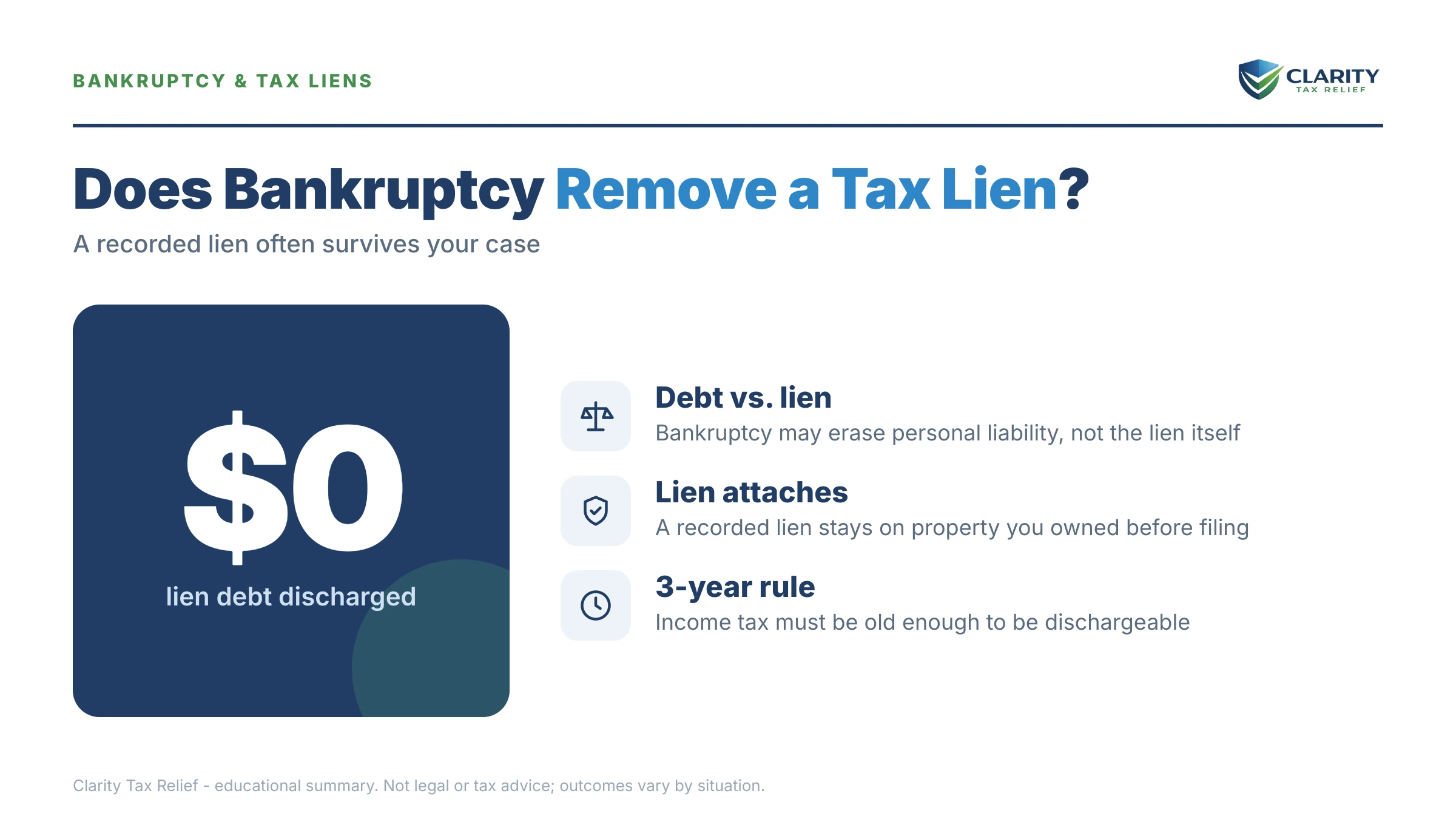
The short answer: no — bankruptcy does not remove a tax lien that was recorded before you filed. A discharge ends your personal obligation to pay qualifying tax debt, but the lien survives against everything you owned on your petition date — home equity, vehicles, even retirement accounts — until it's paid, released, or expires.
You did the hard part: the discharge order came, and the $83,100 the IRS said you and your spouse owed finally felt like history. Then the title company ran its search for your refinance — and the federal tax lien is still sitting on your house. Wondering "does bankruptcy remove a tax lien" at that moment is exactly the right question, and the answer is more nuanced — and more workable — than the title report makes it look.
Here's the map: what the lien can still legally reach, what it can never touch again, how Chapter 7 and Chapter 13 treat it differently, and every route to getting it off your title. The document driving all of this is the recorded Notice of Federal Tax Lien itself — the image below shows exactly what one looks like and where to find the assessment dates and refile deadline that control how long it lives.
⏱ The clock that matters: there's no 30-day response window here — the surviving lien runs until it's satisfied, released, or the collection statute expires. And be careful with that last one: filing bankruptcy paused the IRS's 10-year collection clock for the entire length of your case, plus additional time after it closed — so the lien's self-release date is later than a straight 10-year count suggests.
Why bankruptcy wipes the debt but not the lien
A bankruptcy discharge ends your personal liability for qualifying tax years, but a Notice of Federal Tax Lien filed before your petition survives as a claim against the property you owned that day. Courts have applied this rule for well over a century — the Supreme Court held as far back as Long v. Bullard (1886) that liens "ride through" bankruptcy — and it's the single most misunderstood fact in tax bankruptcy.
The law splits your debt into two things. The personal obligation (lawyers call it in personam) is what lets the IRS garnish wages, levy bank accounts, and chase you as a person. The lien (in rem) is a claim against specific property. Discharge kills the first. It leaves the second standing.
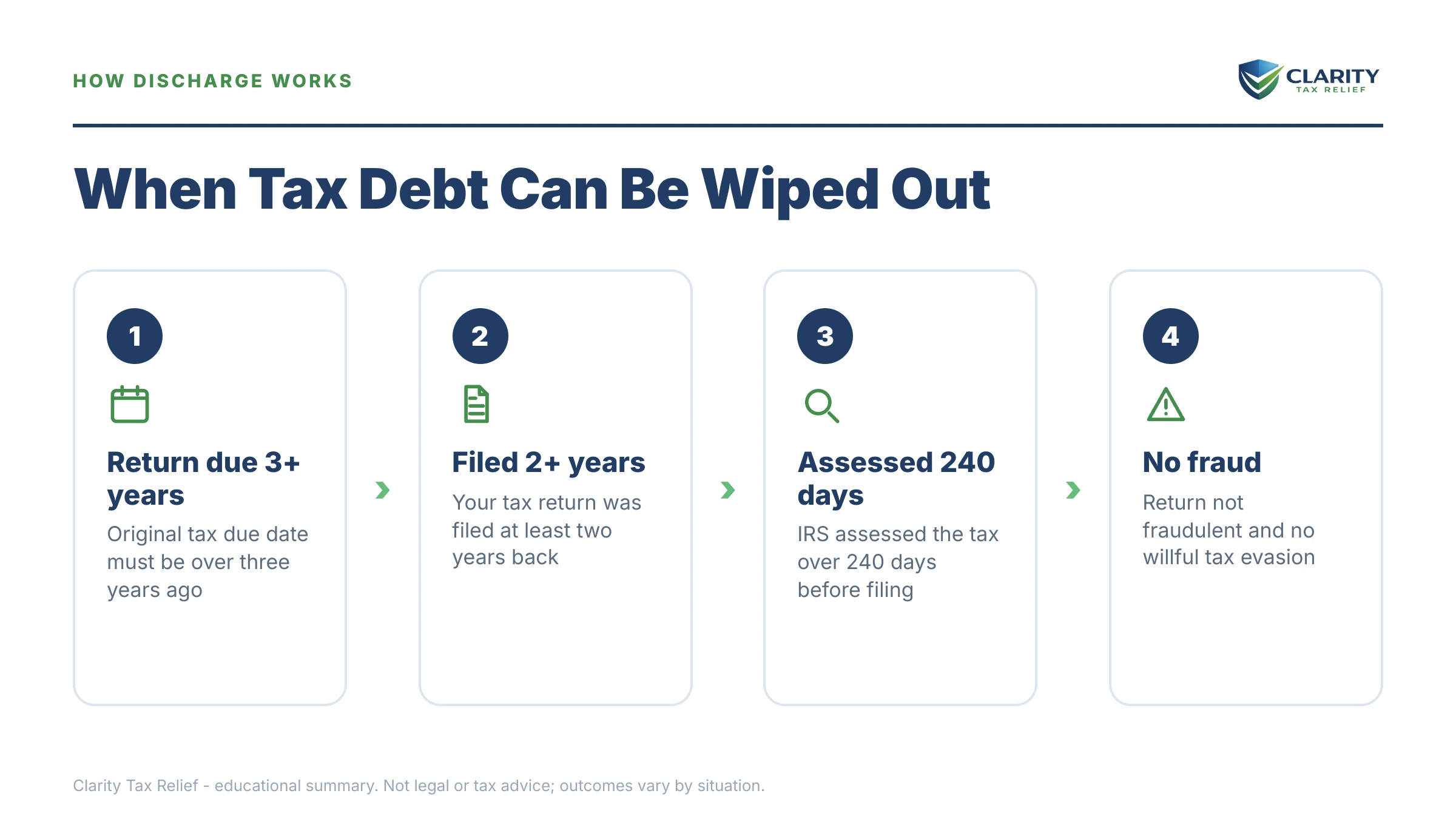
Which tax years are dischargeable at all is its own gate — income taxes generally must pass the 3-year / 2-year / 240-day tests, the return must actually have been filed (see unfiled returns bankruptcy), and certain debts like trust fund payroll taxes are priority tax claims that never discharge. This article assumes at least some of your debt discharged; if none did, both the liability and the lien survive in full.
One critical timing fact: if the IRS never recorded a lien before your petition and the tax was discharged, it can never file one for that debt. The whole problem in this article exists only because the notice hit the county recorder first.
| What's at stake | Lien recorded before filing | No lien recorded before filing |
|---|---|---|
| Personal liability for dischargeable years | Discharged — no garnishment, levy, or personal collection | Discharged — same result |
| Property you owned on the petition date | Lien survives — stays attached to home equity, vehicles, retirement accounts | Free and clear — the IRS cannot file a lien later for discharged years |
| Property and income you acquire after filing | Free — the surviving lien cannot reach it (for discharged years) | Free |
| Nondischargeable years (recent taxes, fraud, unfiled returns, trust fund) | Liability and lien both survive — and can reach new property | Liability survives — the IRS can file a fresh lien after the case |
What the surviving lien can — and can't — reach after discharge
A tax lien that survives bankruptcy is frozen in time: it reaches only the property you owned on the day you filed your petition, and only if the underlying tax was discharged does that limit apply. Everything you earn or buy afterward — new wages, a new house, new savings — is permanently beyond it. That's the good news, and it's substantial.
The harder news is what stays inside the lien's grip:
- Exempt property is not protected. Bankruptcy exemptions — including your homestead exemption — shield property from ordinary creditors, but the Bankruptcy Code expressly carves out properly filed tax liens. The equity you exempted from the trustee is still encumbered by the IRS.
- Retirement accounts. The federal tax lien attaches to 401(k)s and IRAs even though almost no other creditor can touch them. Actual levies on retirement funds are rare, but the lien's claim is real and shows up in payoff math.
- Jointly owned property. If you and your spouse owe jointly and both filed, the lien encumbers both interests in the home as of the petition date. If only one spouse filed, the non-filing spouse's personal liability survives entirely — the IRS can pursue them for the whole balance and reach their share of property, including property acquired later. How state law treats spousal ownership (tenancy by the entirety rules vary) can change the practical result, which is one reason joint debt deserves professional eyes before anyone files.
The lien is also still a public record. Anyone — a lender, a buyer's title company — can find it, which is why it surfaces at the worst moments. Our guide to the tax lien public record shows exactly where it's recorded and how to pull your own copy.
Does bankruptcy remove a tax lien in Chapter 13? (How it differs from Chapter 7)
Chapter 13 is the one bankruptcy route that can end with the lien actually released — because the plan pays the lien's secured value. Here's the mechanical difference:
In Chapter 7, the case is over in a few months, the dischargeable liability is wiped, and the lien rides through untouched. You exit with no personal debt but encumbered pre-petition property, and you deal with the lien afterward using the options below.
In Chapter 13, the IRS's lien claim is split. It's treated as a secured claim only up to the value of your equity on the petition date; anything above that is unsecured. You pay the secured portion through your 3-to-5-year plan, the dischargeable unsecured remainder is paid only in part (or not at all), and when the plan completes, the IRS releases the lien. Fail to complete the plan, and the lien survives just as in Chapter 7.
Which chapter fits a tax-heavy case depends on far more than the lien — income, other debts, what's dischargeable. Our Chapter 7 vs 13 tax debt comparison walks through the decision, and note that during either case the automatic stay applies — does bankruptcy stop IRS levy covers what the stay does and doesn't freeze.
A worked example: $83,100 joint debt, lien filed, then Chapter 7
Say you and your spouse owe $83,100 jointly from 2019 and 2020 returns you filed on time but couldn't pay — old enough to pass the discharge tests — and the IRS recorded a lien before you filed a joint Chapter 7. On your petition date you owned:
- A home worth $295,000 with a $257,000 mortgage → $38,000 equity
- Two paid-off vehicles worth $9,000 combined
- A 401(k) with $18,000
After discharge, the IRS can never garnish your wages, levy your bank account, or touch anything you acquire from here forward for those years. But the lien survives against $38,000 + $9,000 + $18,000 = $65,000 of pre-petition value. That's the key arithmetic: the lien is now worth at most about $65,000 to the IRS — not the full $83,100 — because a lien can never be worth more than the property it attaches to.
Practically, that plays out one of three ways. You sell or refinance, and escrow pays the IRS its lien interest from proceeds. You negotiate a payoff or a tax lien discharge keyed to the equity so a transaction can close. Or you sit tight, and the lien self-releases when the (tolled) collection statute runs — with your title clouded in the meantime.
Run the same couple through Chapter 13 instead: the $65,000 secured portion gets paid through the plan — roughly $1,083 per month over 60 months before interest, on top of other plan obligations — the remaining $18,100 rides as unsecured, and the lien is released at completion. More expensive month to month, but you exit with clean title.
What happens if you ignore the surviving lien
A surviving federal tax lien doesn't escalate the way collection notices do — it waits, and it costs you at the exact moments you can least afford it. Ignore it and this is the sequence:
- Your title stays clouded. Every sale, refinance, or home-equity loan hits the lien in the title search. Deals stall or die — see sell house with IRS lien for how closings actually work around one.
- Nondischarged balances keep growing. If any lien year survived the discharge, interest and penalties continue to accrue on it, and the lien secures the growing total.
- The IRS refiles before self-release. Because your bankruptcy tolled the collection statute, the IRS can — and routinely does — refile the lien notice before its printed self-release date, extending the public encumbrance to match the adjusted deadline.
- Escrow pays the IRS first. When you eventually do sell, the closing agent must satisfy the lien from your proceeds, up to its full secured value, before you see a dollar.
- Administrative enforcement remains legal. The IRS retains the right to enforce the lien against pre-petition equity directly. Seizures of homes are rare and heavily gated — but the exposure is real, especially on non-residence assets.
Discharge in hand but the lien's still on your title?
Send us your discharge order and the recorded lien. An experienced tax professional will map which years survived, what the lien is actually worth against your equity, and the cheapest path to a recorded release — free, confidential, no pressure. Interest keeps accruing on any nondischarged years while the lien sits.
How to remove a tax lien after bankruptcy: every option
There are seven realistic exits from a post-bankruptcy tax lien, and which one fits depends on two numbers: your pre-petition equity and how much of the debt survived. General release mechanics after payment live in our hub on how long for IRS to release a tax lien — here's how each option applies to the post-discharge situation specifically:
| Option | Who it fits | What happens to the lien |
|---|---|---|
| Equity-based payoff | Discharged debt where the lien is worth less than the balance; you want clean title now | Released after the agreed amount tied to your pre-petition equity is paid |
| Certificate of release (Form 668(Z)) | Anyone whose lien is paid, satisfied, or legally unenforceable | IRS must issue the release within 30 days — then it must be recorded |
| Property discharge (Form 14135) | Selling one specific property; IRS takes its equity share from escrow | Lien removed from that property only; survives on everything else |
| Subordination (Form 14134) | Refinancing; the new lender needs priority over the IRS | Lien stays recorded but steps behind the new loan |
| Chapter 13 plan completion | Filers who chose (or convert to) Chapter 13 | Secured portion paid through the plan; lien released at completion |
| Wait out the CSED | Little pre-petition equity; no sale or refinance on the horizon | Lien self-releases when the tolled collection statute expires |
| Offer in Compromise | Nondischarged balances the IRS can't realistically collect in full | Released after all offer terms are completed |
A few notes the table can't hold. Lien withdrawal (Form 12277) — which erases the public filing rather than just releasing it — is generally available only when the filing was improper, withdrawal helps the IRS collect, or you've paid in full under qualifying terms; it's rarely a post-discharge fit, but worth checking if the lien was filed in violation of the automatic stay. The CSED wait is more attractive after bankruptcy than people expect, because the discharge already stripped the IRS's ability to collect from you personally — but compute the tolled deadline first; you can estimate your adjusted collection statute date with our CSED Calculator and confirm it against your transcripts, since the self-release mechanics are covered in does IRS tax lien expire.
| Option | Out-of-pocket cost | Typical timeline |
|---|---|---|
| Equity-based payoff | The lien's equity value — about $65,000 in our example, not the full $83,100 | Release due within 30 days of payment |
| Form 14135 property discharge | No IRS fee; the IRS is paid its share from sale proceeds | Apply several weeks before closing; processed before escrow funds |
| Form 14134 subordination | No IRS fee; normal refinance costs apply | Several weeks of IRS processing before the loan can close |
| Chapter 13 plan | Secured portion plus plan payments | 3–5 years; lien released after completion |
| CSED wait | Nothing out of pocket — but title stays clouded the whole time | Until the tolled 10-year statute runs (later than a straight count) |
| Offer in Compromise (nondischarged years) | $205 application fee (waived with low-income certification) plus the offer amount | Months to over a year of review; lien released after final payment |
Whichever exit you take, the finish line is the same piece of paper: the recorded release. Our guide to the certificate of release of tax lien covers verifying that Form 668(Z) was actually issued and recorded — releases get lost between the IRS and county recorders more often than they should.
How to respond, step by step
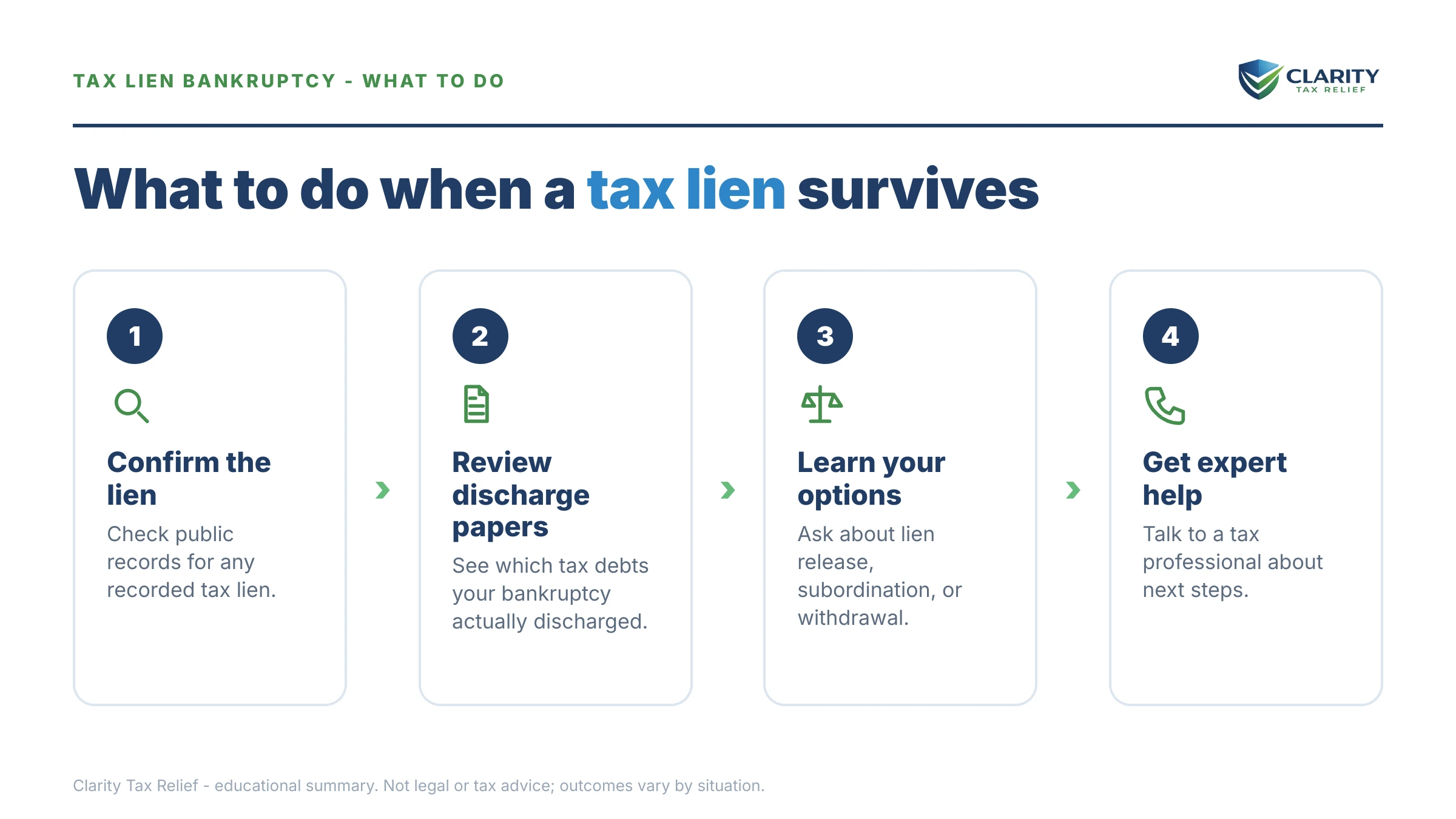
- Pull the recorded lien and your IRS transcripts. Get a copy of the Notice of Federal Tax Lien from your county recorder and request account transcripts for every year it lists, so you can see the assessment dates and any collection-statute tolling from your case.
- Match each lien year to your discharge. Compare the tax years on the lien against your bankruptcy discharge order to determine which liabilities were discharged and which survived — the lien's power is completely different for each group.
- Value your pre-petition assets. List what you owned on your petition date and the equity in each item; for discharged years, that equity is the ceiling on what the lien is actually worth to the IRS.
- Choose your exit. Pick the path that fits your numbers: an equity-based payoff, a Form 14135 discharge to close a sale, subordination to refinance, a Chapter 13 plan payout, or waiting out the adjusted collection statute.
- Demand and record the Certificate of Release. Once the lien is satisfied or unenforceable, the IRS owes you Form 668(Z) within 30 days — follow up until the release is actually recorded where the lien was filed.
When you can handle this yourself
Plenty of post-bankruptcy lien situations don't need professional help. If your pre-petition equity was minimal — an underwater house, older cars, a small retirement balance — the surviving lien is close to worthless to the IRS, and your job is simply to confirm the tolled CSED date and let the lien self-release. If the lien year is already past its statute, requesting the certificate of release yourself is a phone call and a follow-up letter. And if you're completing a Chapter 13 plan, your bankruptcy attorney and the trustee's completion paperwork already carry the release process.
Experienced help changes outcomes in four situations: real equity is on the table (an equity-based payoff is a negotiation, and the opening number matters); a sale or refinance is on a deadline (Form 14135 and 14134 packages get rejected for fixable technical defects, and a rejection can kill a closing date); some years discharged and others didn't (mixed liens require year-by-year strategy — an Offer in Compromise or payment plan on the survivors alongside a lien plan for the discharged years); and only one spouse filed, where the IRS's remaining reach against the non-filing spouse reshapes everything. Those are the cases where the fee is small next to the equity at stake.
If your situation is one of the four above, a free case review will tell you in one call whether the lien is worth negotiating or worth waiting out — before you commit to either.
Terms on your lien paperwork, decoded
- Notice of Federal Tax Lien (NFTL): the public document recorded at your county that makes the IRS's claim visible to lenders and buyers — the lien itself arises earlier, by law, when tax is assessed and unpaid.
- In personam vs. in rem: personal liability (what discharge erases) versus a claim against property (what discharge doesn't touch).
- Discharge — the trap word: a bankruptcy discharge wipes your personal debt; a lien discharge (Form 14135) removes the lien from one specific property. Same word, completely different documents.
- Self-releasing lien: the NFTL contains a "last day for refiling" — if the IRS doesn't refile by then, the lien releases automatically. Bankruptcy tolling usually pushes that date later.
- CSED: the Collection Statute Expiration Date — 10 years from assessment, paused by your bankruptcy for the length of the case plus additional time.
- Exempt property: assets bankruptcy shields from ordinary creditors — but not from a properly filed federal tax lien.
Bankruptcy and tax lien questions, answered
Does Chapter 7 bankruptcy remove an IRS tax lien?
No. Chapter 7 can discharge your personal liability for income taxes that pass the age-based tests, but a Notice of Federal Tax Lien recorded before your petition survives the case. The lien remains attached to everything you owned on the filing date — home equity, vehicles, retirement accounts — until it is paid, released, or expires at the collection statute deadline. It cannot, however, attach to property you acquire after filing if the underlying tax was discharged.
Does Chapter 13 remove a tax lien?
Chapter 13 can effectively remove it, but only by paying it. The lien is treated as a secured claim up to the value of your equity on the petition date; you pay that secured portion through your 3-to-5-year plan, and the IRS releases the lien when the plan is completed. If you don't finish the plan, the lien survives just as it would in Chapter 7.
Can the IRS take my house after bankruptcy discharge?
Legally, a surviving lien lets the IRS enforce against pre-petition home equity, but administrative seizure of a primary residence is rare and requires high-level approval plus court involvement. The far more common outcome is passive: the lien sits on title and gets paid from proceeds when you sell or refinance. If you're facing actual enforcement threats against your home, that's a situation for an experienced tax professional immediately.
Can the IRS file a tax lien after my bankruptcy discharge?
Not for discharged taxes. If no Notice of Federal Tax Lien was recorded before your petition and the tax was discharged, the IRS lost its chance — it cannot file a lien afterward for that debt. But for taxes that survived the bankruptcy (recent years, trust fund penalties, fraud years, years with unfiled returns), the IRS can absolutely file a new lien after your case closes.
Does the surviving lien attach to property I buy after bankruptcy?
No — not if the underlying tax was discharged. The discharge cuts off the lien's ability to reach after-acquired property, so your future wages, new home, and new savings are beyond it. The lien clings only to what you owned on the petition date. The exception is nondischarged tax years: because the personal liability survived, liens for those years reach new property too.
Does a tax lien survive bankruptcy against my 401(k) or IRA?
Yes. The federal tax lien attaches to retirement accounts even though they're protected from ordinary creditors, and bankruptcy exemptions don't defeat it. That said, the IRS levies retirement accounts sparingly and generally only in flagrant cases. In practice the lien's claim on your 401(k) is one more number in a payoff negotiation, not an imminent seizure.
How do I get the tax lien released after bankruptcy?
Get the lien satisfied or shown unenforceable, then demand the paperwork. The IRS must issue a Certificate of Release (Form 668(Z)) within 30 days after the liability is paid, becomes legally unenforceable, or you post a bond. After a completed Chapter 13, or a negotiated equity-based payoff, follow up with the IRS Centralized Lien Operation and confirm the release actually gets recorded in your county.
Does bankruptcy extend the IRS 10-year collection statute?
Yes. The 10-year collection statute (CSED) is paused for the entire time your bankruptcy case is open, plus additional time after it closes. That means a lien tied to a nondischarged balance — and the lien's self-release date — can run well past the original 10-year mark. Pull your account transcripts to compute the adjusted date rather than assuming the clock ran straight through.
Do state tax liens like a California FTB lien survive bankruptcy?
Generally yes — the same principle applies: state liens recorded before your petition survive as claims against pre-petition property. California is notably tougher, because the FTB can collect for 20 years under R&TC §19255, double the IRS window. State rules on dischargeability and lien release procedures differ, so verify your state's process directly with the agency rather than assuming IRS timelines apply.
My spouse and I owe jointly — what if only one of us files bankruptcy?
The discharge protects only the spouse who filed. The IRS can still pursue the non-filing spouse personally for the entire joint balance, and the lien continues to encumber that spouse's property interests without the pre-petition limits. For jointly owned homes, this often means the lien effectively still reaches the whole property. Couples with joint debt usually need to plan the filing decision together.
For state-recorded liens, start with our FTB tax lien guide if California is your issue — the 20-year collection window changes the "wait it out" math entirely. And if you're weighing hardship status instead of (or after) bankruptcy, does CNC stop tax lien explains why hardship status pauses collection but doesn't touch a recorded lien either.
Your next 24 hours
- Find the lien document and your discharge order. On the recorded Notice of Federal Tax Lien, locate the tax years listed and the "last day for refiling" — then set them side by side with the years covered by your discharge.
- Gather your petition-date numbers. Your bankruptcy schedules already list what you owned and what it was worth — pull them, along with your most recent mortgage statement and retirement balances, so the lien's real value can be computed.
- Get the free case review. Call (888) 825-7779 or use the 2-minute form. There's no statutory deadline on a surviving lien — but interest keeps accruing on any nondischarged years, and every month the lien sits recorded is a month you can't cleanly sell, refinance, or borrow.
Primary sources if you want to go deeper: the IRS's overview at Understanding a Federal Tax Lien, payment options at IRS.gov/payments, and the independent Taxpayer Advocate Service if the IRS fails to issue a release it owes you.
This guide is general information, not tax or legal advice for your specific situation. Eligibility for IRS programs depends on individual facts and circumstances; no outcome is guaranteed. Bankruptcy decisions should be made with a bankruptcy attorney; we coordinate the tax side.