
Tax Liens
Tax Lien Public Record: Where Liens Are Filed and How to Search Them (2026)
The short answer: yes — a federal tax lien becomes public record the day the IRS files a Notice of Federal Tax Lien with your county recorder (or your Secretary of State). It no longer appears on credit reports, but lenders, title companies, and data brokers can all find it until it is released, withdrawn, or expires.
Maybe you typed your own name into the county recorder's website. Maybe a title officer called about your refinance, or a sudden flood of official-looking letters from companies you've never heard of tipped you off. Either way, there it is: a recorded federal tax lien with your name on it, visible to anyone who looks. The record is not permanent — there are four distinct legal ways off it. This guide to the tax lien public record covers all of them: where liens are filed, who actually sees them, how to search every index that matters, and how to get yours cleared.
One warning before anything else: the dollar figure printed on the recorded notice is not your payoff amount — it was frozen on the day of filing and ignores every payment and every dollar of interest since. The image below shows exactly what a recorded Notice of Federal Tax Lien looks like and where to find the amount, the tax periods, and the refile date that controls how long it can stay on the books.
⏱ Your deadline: when the IRS files a lien, it must mail you Letter 3172 within 5 business days — and that letter opens a 30-day window to request a Collection Due Process hearing using Form 12153. The exact deadline is printed on your letter; that date controls. If the window already closed, the removal options below still work — the hearing right is the one thing that expires.
Why your tax lien is on the public record
A federal tax lien becomes public record the day the IRS records a Notice of Federal Tax Lien — Form 668(Y) — with the office your state designates under IRC §6323(f). Before that filing, a lien already existed: the moment you were assessed, billed, and didn't pay in full, a statutory lien arose automatically under IRC §6321 against everything you own. But that lien is invisible — no one else can see it.
The public filing exists for one reason: priority. Recording the notice tells every other creditor — your mortgage company, a future lender, a buyer of your home — that the IRS claims a position in your property. That is why the filing goes into the same county index where deeds and mortgages live, searchable by name.
You'll know a filing happened three ways: Letter 3172 arrives by certified mail, code 582 posts to your IRS account transcript, and the recording itself appears in the county index — usually within days. There is no statutory minimum balance, but IRS policy generally reserves routine lien filings for balances of $10,000 or more, and above roughly $50,000 a filing becomes close to standard practice once the notice sequence runs out.
| Stage | What happens | Your window |
|---|---|---|
| Assessment + first bill (CP14) | The statutory lien arises automatically — still invisible to the public | Typically 21 days to pay before reminders start |
| Reminder notices (CP501/CP503) | Balance grows monthly; no public filing yet | Weeks between notices — the cheap window to resolve |
| CP504 / final-demand stage | Account is queued for enforcement; lien filing becomes likely | Set up a resolution before the filing happens |
| NFTL recorded + Letter 3172 | The lien becomes public record; the letter must be mailed within 5 business days | 30 days (printed on the letter) to request a CDP hearing |
| After the window | Lien stays on record until released, withdrawn, or expired | The four removal paths in the options table below |
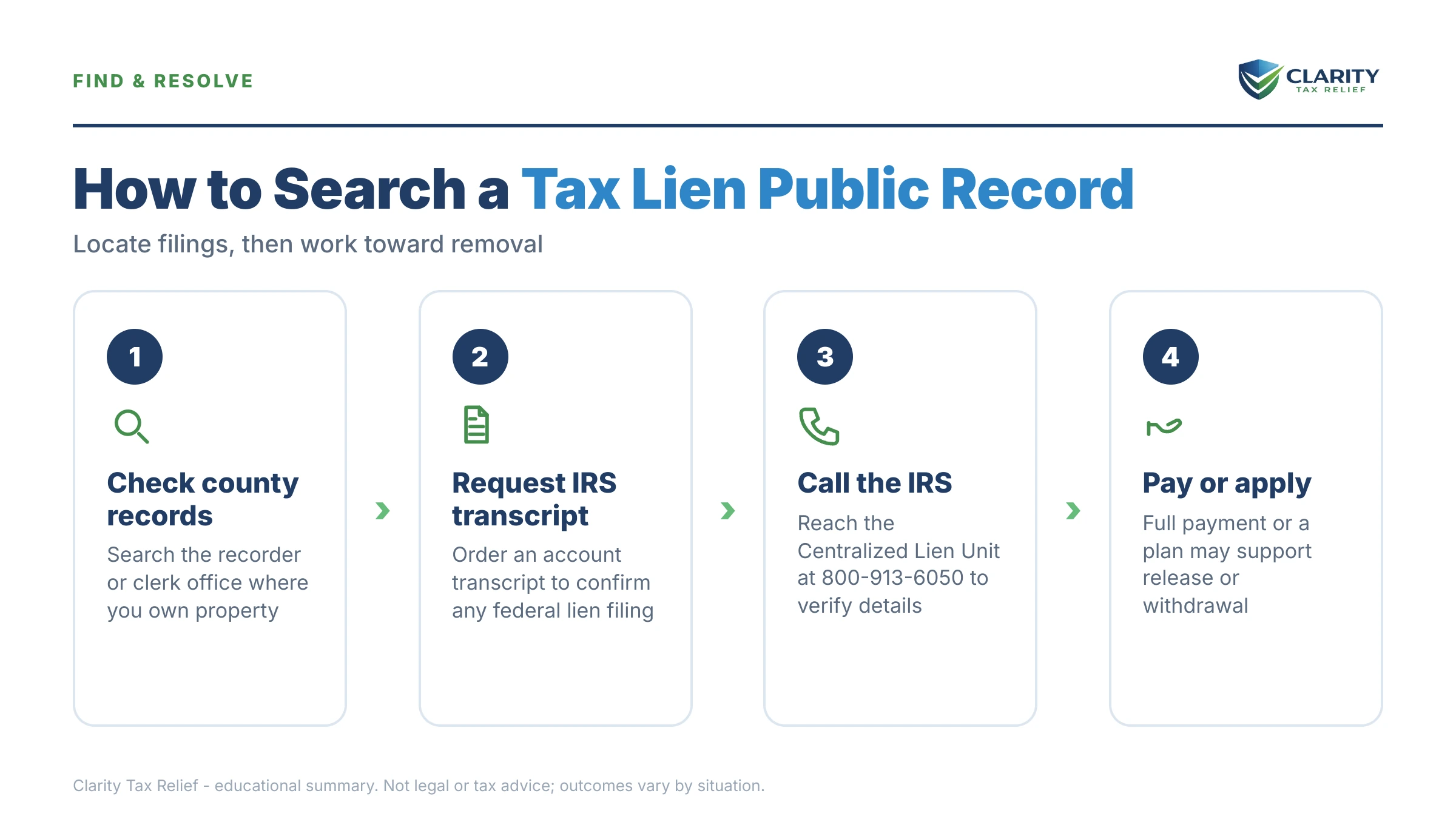
Where the tax lien public record lives — and how to search it
There is no national public database of federal tax liens — every filing lives in a county or state index, searched by name. That surprises almost everyone. The IRS files where the law says your property is: real estate liens go to the county where the property sits, and liens against an individual's personal property go to the county (or state office) where you lived when the notice was filed. Business personal property — a corporation's or partnership's equipment and receivables — usually gets filed with the Secretary of State instead.
Practical consequence: if you've moved, or own property in more than one county, a complete search means checking every county where you've lived or owned real estate. Here's where to look:
| Where to search | What's filed there | How to check |
|---|---|---|
| County recorder / register of deeds (where your real estate sits) | NFTL reaching real property in that county | Search the grantor/grantee or official-records index under your name — most counties are free online or by phone |
| County (or designated office) where you lived at filing | NFTL reaching an individual's personal property | Same index — search the county of your residence on the filing date, not just your current one |
| Secretary of State | NFTL against business personal property of corporations and partnerships | The state's UCC/lien search portal, searched by entity name |
| Your IRS account transcript | Code 582 (lien filed) and code 583 (release/withdrawal) | Free through your IRS online account — the fastest yes/no answer |
| Title or abstract company | A professional multi-county lien and judgment search | Ordered during any sale or refinance — this is how most liens surface at closing |
When you pull the recorded document, read three entries carefully: the kind of tax and tax periods (which years are covered), the unpaid balance of assessment (frozen at filing — your real payoff is on your IRS transcript, not the recording), and the Last Day for Refiling in column (e). That refile date is the document's built-in expiration: if the IRS doesn't refile by then, the notice self-releases by its own terms.
Also check the name. Liens get recorded with misspellings, old addresses, and — for married couples — against one spouse only. A lien filed against your spouse alone attaches to your spouse's property interests, not yours, though jointly owned property gets complicated. And a filing that didn't follow IRS procedure is one of the recognized grounds for having it withdrawn entirely.
State tax liens sit in the same public indexes, under each state's own rules — with their own timelines. California's Franchise Tax Board records an FTB tax lien with county recorders and can collect for up to 20 years under R&TC §19255 — twice the federal window. New York records a tax warrant, which functions as a civil judgment and public lien. Never assume a state lien follows IRS rules; it doesn't.
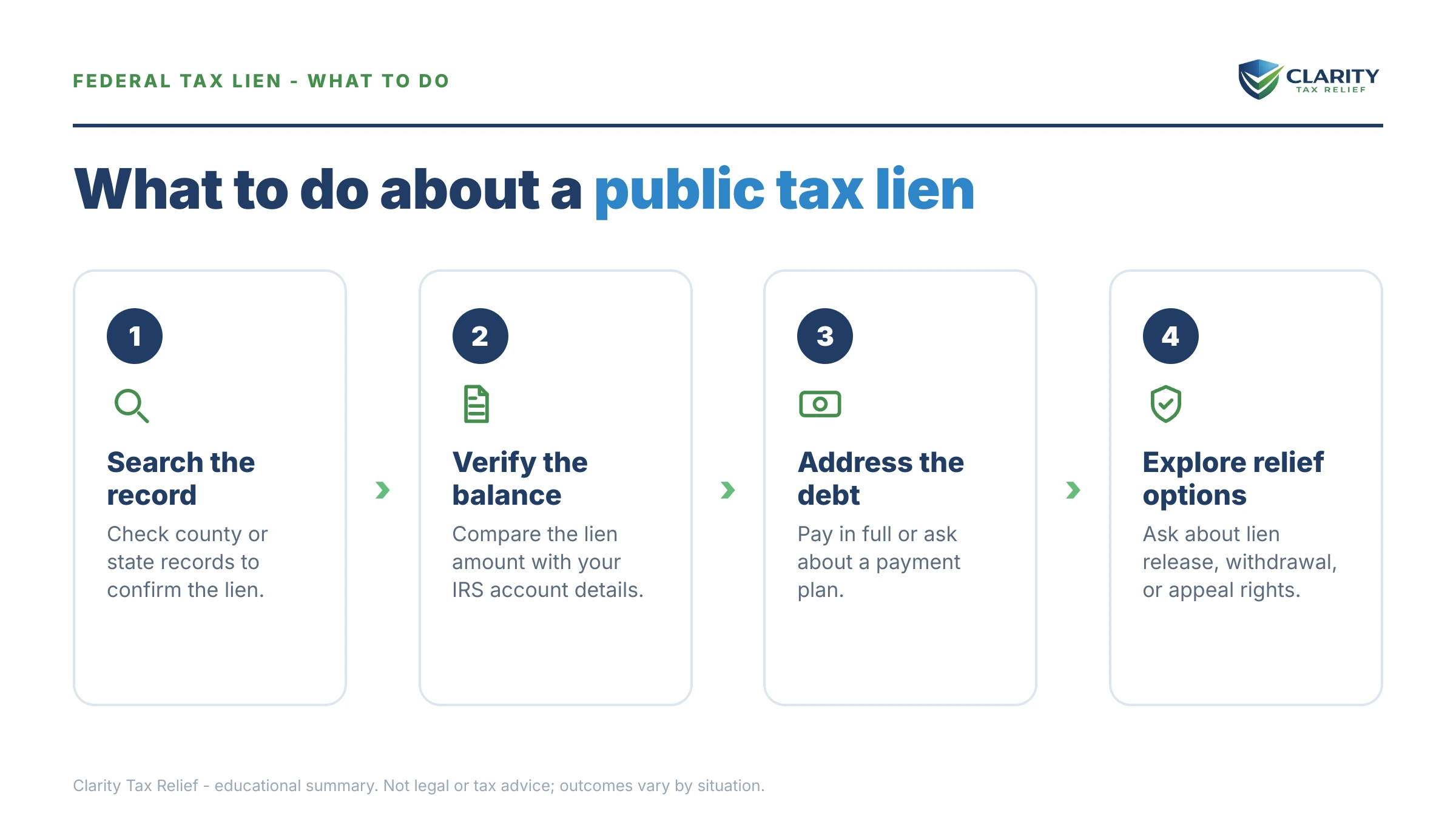
Who actually sees a recorded tax lien in 2026
Since 2018, tax liens have not appeared on consumer credit reports — but every mortgage underwriter and title company still finds them through public-records searches. The credit-bureau removal is real and permanent (the full story is in our guide to a tax lien on credit report), and it means your credit score won't drop from the filing itself. What it does not mean is privacy.
Here's who still finds it, and how:
- Title companies — every sale or refinance triggers a title search that will surface the lien and require it to be paid, discharged, or subordinated before closing. This is the single most common way people discover a lien years after filing. (See selling a house with an IRS lien.)
- Mortgage and business lenders — underwriters run public-records and lien searches separately from credit pulls, and a federal lien in first position is a standard denial reason until it's addressed.
- Background-check and public-records databases — commercial aggregators index new recordings continuously, so employers or licensing boards running deep public-records checks can see it even though a routine credit check won't.
- Data harvesters and lien-chaser mail — within weeks of a filing, expect a wave of alarming letters and calls from companies that scraped the recording. None of that mail is from the IRS. Envelopes mimicking government seals, warnings of imminent seizure, or promises to settle for pennies on the dollar are marketing at best and fraud at worst — a real IRS payment goes only to the United States Treasury or through IRS.gov.
What happens if you ignore a filed tax lien
A recorded federal tax lien attaches to everything you own now and everything you acquire later — and it keeps working silently until it is released, withdrawn, or expires. Ignoring the recording doesn't freeze the situation; it lets several separate clocks keep running:
- The 30-day hearing window closes. Once the deadline on Letter 3172 passes, you lose the Collection Due Process hearing and its path to Tax Court review of the filing. A later "equivalent hearing" exists but carries weaker rights.
- The lien spreads to after-acquired property. An inheritance, a new vehicle, a home you buy next year — the recorded lien attaches to each automatically the moment you acquire it.
- The balance grows toward hard thresholds. Interest and the monthly failure-to-pay penalty keep compounding. A balance of $61,200 sits under the $66,000 passport-certification threshold for 2026 — but accrual alone can push it across within months, putting passport denial on the table.
- The levy track keeps moving separately. A lien is a claim; a levy is a taking — and ignoring the lien lets the levy sequence continue toward a final notice. For Social Security recipients that includes the 15% Social Security levy under the Federal Payment Levy Program.
- Every future transaction collects for the IRS. Sell, refinance, or pass property through your estate, and the lien gets paid from the proceeds before you or your heirs see a dollar.
- Refiling can extend its life. If your collection statute was paused by an appeal, offer, or bankruptcy, the IRS can refile before the Last Day for Refiling and keep the notice on record past the original date.
And in 2026, don't count on the system forgetting. IRS staffing fell roughly 27% in 2025, which makes a human hard to reach — but lien filings, refilings, and levies run on automated systems that never stopped.
A lien just hit your public record?
Get the filing reviewed free. If your Letter 3172 arrived within the last 30 days, you still have hearing rights worth using — and if it didn't, there are four legal paths to get the record cleared. An experienced tax professional will map yours in one call.
Getting a tax lien off the public record: your options
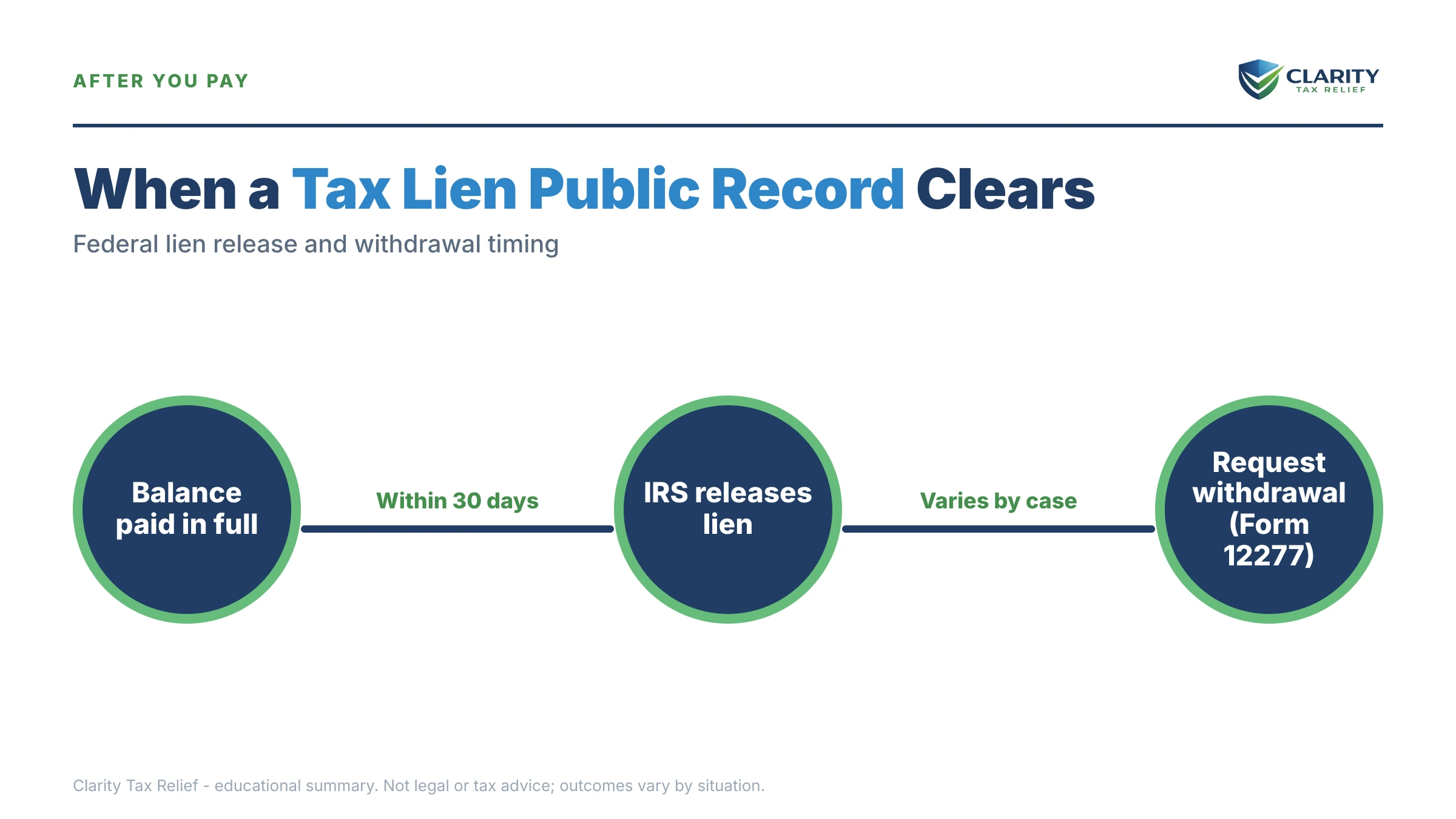
Four legal mechanisms take a federal tax lien off the public record: release, withdrawal, discharge, and expiration at the collection statute. They are not interchangeable — each has its own eligibility test and leaves the record in a different state:
| Option | Form | Who generally qualifies | What the record shows after |
|---|---|---|---|
| Release (full satisfaction) | Form 668(Z), issued by the IRS | Anyone who pays in full or whose liability becomes legally unenforceable | A recorded release within 30 days of satisfaction; the filing history stays visible |
| Withdrawal | Form 12277 | Generally a balance of $25,000 or less on a direct-debit installment agreement, or a filing that didn't follow procedure | The notice is removed as if it had never been filed |
| Discharge (one property) | Form 14135 | Sellers whose sale proceeds — or remaining equity in other property — protect the IRS's position | The lien releases that property only; the record otherwise remains |
| Subordination | Form 14134 | Refinances that send money to the debt or otherwise improve the IRS's odds of collecting | The lien stays public but steps behind the new lender |
| CSED expiration | None — self-releasing | Balances that reach the 10-year collection deadline without tolling or a refile | The NFTL self-releases by its own terms on the printed refile date |
Release is the default: satisfy the debt and the IRS must issue a Certificate of Release within 30 days, by law. In practice the recording step lags, and unrecorded releases derail closings — our hub on how long for the IRS to release a tax lien covers the timeline, and the certificate of release of tax lien guide shows how to prove the lien is gone when a lender asks.
Withdrawal is the stronger outcome for the public record because it erases the notice rather than marking it satisfied. Under the Fresh Start rules, you may qualify with a balance of $25,000 or less and a direct-debit installment agreement in good standing — the full mechanics are in lien withdrawal (Form 12277). Withdrawal is also available when the filing itself was premature or procedurally defective, whatever the balance.
Discharge and subordination don't remove the lien from the record — they unstick a specific transaction. If a sale is pending, a tax lien discharge frees that property; if you're refinancing, a tax lien subordination lets the new lender take first position. Both take IRS review, so file weeks before closing.
Expiration is real but slow: the collection statute runs 10 years from assessment, and an unrefiled lien self-releases when it lapses — with the major caveat that appeals, offers, and bankruptcy pause the clock, and the IRS can refile if time remains. The details are in does an IRS tax lien expire, and you can estimate your own collection deadline with our CSED Calculator.
One path that does not clear the record: hardship status. Currently Not Collectible stops levies, but the IRS can file — and keep — a lien while you're in it. See does CNC stop a tax lien before assuming hardship protection wipes the filing.
Say you owe $61,200: what the public record costs a retiree
Here's a clearly hypothetical example with the math shown. Say you're retired, living on $2,300 a month in Social Security, you own your home outright, and the IRS has recorded a lien for a $61,200 balance built up from underwithheld retirement-account withdrawals.
- The withdrawal path is out of reach for now. Fresh Start withdrawal generally requires a balance of $25,000 or less — you'd have to pay down $61,200 − $25,000 = $36,200 before Form 12277 becomes realistic.
- The payment-plan math is tight. At $61,200 you're above the $50,000 ceiling for a streamlined online agreement, so a plan means financial disclosure — or paying down $11,200 to get under $50,000, where $50,000 ÷ 72 months ≈ $695 a month before accruing interest and penalties. On $2,300 a month of income, that likely fails the affordability test.
- Hardship status is the realistic lever. Fixed income that barely covers allowable living expenses points to Currently Not Collectible — which stops the levy threat, including the 15% FPLP bite that would otherwise take 15% × $2,300 = $345 a month from your benefit. But the lien stays recorded, and interest keeps accruing.
- An offer probably fails on equity, honestly. If the home is worth, say, $310,000 free and clear, the IRS's offer math counts a large slice of that equity — far more than $61,200 — so a doubt-as-to-collectibility offer would likely be rejected despite the low income. Anyone promising otherwise is selling, not advising.
- The passport clock is live. At the 0.5% monthly failure-to-pay penalty ($306 a month on this balance) plus interest at recent rates, the balance grows by roughly $600 or more each month — crossing the $66,000 certification threshold in well under a year of inaction.
The realistic strategy for this profile is often CNC plus the collection statute — protect the monthly income now, let the 10-year clock run, and understand the lien will collect from the home only if it sells before the statute lapses. That trade-off deserves a professional look before you commit to it.
How to respond to a tax lien on the public record, step by step
- Pull the actual filing: Request a copy of the recorded Notice of Federal Tax Lien from your county recorder and confirm the name, tax periods, and amount are actually yours.
- Verify the real balance: Log into your IRS online account and check your transcript — the recorded amount was frozen on the filing date, so the true payoff figure is almost always different.
- Use the 30-day window if it is still open: If your Letter 3172 is dated within the last 30 days, file Form 12153 to request a Collection Due Process hearing before the deadline printed on the letter.
- Choose your removal path: Full payment triggers a release, a balance of $25,000 or less on direct debit may support a withdrawal, a pending sale calls for a discharge, and genuine hardship points to Currently Not Collectible status.
- Confirm the record actually clears: After a release or withdrawal, verify the certificate was recorded in the same county index as the original filing and keep a copy for any future lender or title company.
When you can handle this yourself
Plenty of lien situations don't need professional help. If you've already paid in full, your only job is monitoring: the IRS owes you a release within 30 days, and following up on the recording is a phone call, not a case. If your balance is $25,000 or less and you can sustain a direct-debit installment agreement, the Form 12277 withdrawal request is genuinely a do-it-yourself form. And if the recorded lien plainly isn't yours — wrong person, wrong entity — the county and the IRS both have correction channels you can work directly, with the Taxpayer Advocate Service as a free backstop at taxpayeradvocate.irs.gov if the system stalls.
Experienced help changes outcomes in four situations: a closing date is weeks away and a discharge or subordination package has to be right the first time; the balance is over $50,000 on fixed or hardship-level income, where the CNC-versus-plan-versus-offer math decides what you pay for years; the lien covers multiple tax years and at least one amount is wrong or disputed; or federal and state liens are stacked on the same property, because release order affects who gets paid at closing. Those are the cases where a misstep costs real money.
If the lien was filed while you were already in hardship — or the balance includes a year you dispute — a free review with an experienced tax professional at (888) 825-7779 can map the fastest route off the record before your next sale or refinance forces the issue.
Terms on your lien notice, decoded
- Notice of Federal Tax Lien (Form 668(Y)): the public document the IRS records to announce its claim — the only version of the lien anyone else can see.
- Statutory lien: the automatic, invisible lien that arises the moment you're assessed and don't pay — it exists whether or not anything is ever recorded.
- Certificate of Release (Form 668(Z)): the document the IRS must issue within 30 days of full satisfaction, recorded to mark the lien paid.
- Withdrawal: the stronger remedy that removes the recorded notice as if it had never been filed, requested on Form 12277.
- Last Day for Refiling: the date printed in column (e) of the recorded notice — if the IRS hasn't refiled by then, the notice self-releases by its own terms.
- CSED: the Collection Statute Expiration Date — 10 years from assessment, pausable by appeals, offers, and bankruptcy, and the ultimate deadline behind every lien.
The IRS's own overview lives at Understanding a federal tax lien, and every payment or plan option runs through IRS.gov/payments.
Tax lien public record questions, answered
Are federal tax liens public record?
Yes. A federal tax lien becomes public record when the IRS records a Notice of Federal Tax Lien with the recorder's office in your county (or the Secretary of State for some business property). Anyone can search it — lenders, title companies, employers, and data brokers. The underlying statutory lien exists even before filing, but only the recorded notice is public.
How do I find out if the IRS filed a tax lien against me?
Check your IRS account transcript for code 582, which marks a lien filing, then search your county recorder's index under your name. The IRS also mails Letter 3172 within five business days of filing. There is no single national public database of federal tax liens, so search every county where you own property or have lived.
Do tax liens show up on credit reports in 2026?
No. The three national credit bureaus removed all tax liens from consumer credit reports in 2018, so a lien no longer lowers your credit score directly. But it remains fully visible in the public record, and mortgage underwriters, title companies, and background-check firms search those records separately — which is where a lien still does its damage.
How long does a tax lien stay on the public record?
Until it is released, withdrawn, or self-releases. Pay or otherwise satisfy the debt and the IRS must issue a Certificate of Release within 30 days, which gets recorded alongside the original filing. An unreleased lien generally self-releases when the 10-year collection statute expires — unless the IRS refiles it, and appeals, offers, or bankruptcy can pause that clock.
Can a tax lien be removed from public record without paying in full?
Sometimes. A lien withdrawal requested on Form 12277 can remove the notice from the record entirely — generally when you owe $25,000 or less and set up a direct-debit installment agreement, or when the filing did not follow IRS procedure. A discharge frees one specific property without paying in full. Eligibility is means-tested; neither is automatic.
At what amount does the IRS file a tax lien?
There is no statutory minimum — the IRS can legally file at any balance. In practice, IRS policy generally reserves routine lien filings for balances of $10,000 or more, though a revenue officer can file below that when collection appears at risk. At a balance like $61,200, a filing is close to automatic once the notice sequence runs out.
Can I sell or refinance my house with a tax lien on record?
Yes, but the lien gets handled at closing. In a sale, the title company routes proceeds to the IRS, or you request a lien discharge on Form 14135 for that property. For a refinance, a subordination on Form 14134 lets the new lender take first position. Both need IRS approval weeks before closing, so start early.
Are state tax liens public record too?
Yes — state tax liens sit in the same public indexes, under each state's own rules. California's FTB records liens with county recorders and can collect for up to 20 years under its own statute. New York files a tax warrant, which acts as a civil judgment and public lien. State liens follow state timelines, not the IRS's 10-year clock.
Why am I suddenly getting letters from companies about my tax lien?
Because lien filings are public, data-harvesting companies scrape new recordings daily and mass-mail everyone on the list. Letters warning of imminent seizure with official-looking seals, or promising to settle for pennies on the dollar, are marketing — and often scams. The only mail that matters comes from the IRS itself, and the recorded filing shows exactly what is real.
Your next 24 hours
- Find the key entries on the filing. On the recorded notice or your Letter 3172, locate the tax periods, the unpaid balance of assessment, and — on the recording — the Last Day for Refiling in column (e). Note the date on Letter 3172: if it's within 30 days, your hearing right is still alive.
- Gather your file. Last year's return, the letter, a copy of the county recording, and your income picture — for a retiree, that's the Social Security award letter and any pension or IRA statements.
- Get the free lien review. Call (888) 825-7779 or use the 2-minute form. An experienced tax professional will confirm your real balance, check whether the 30-day window is still open, and tell you which of the four removal paths your numbers actually support — before interest pushes the balance past thresholds like the $66,000 passport line.
This guide is general information, not tax or legal advice for your specific situation. Eligibility for IRS programs depends on individual facts and circumstances; no outcome is guaranteed.