
Tax Liens
Certificate of Release of Tax Lien: Getting Form 668(Z) and Proving the Lien Is Gone (2026)
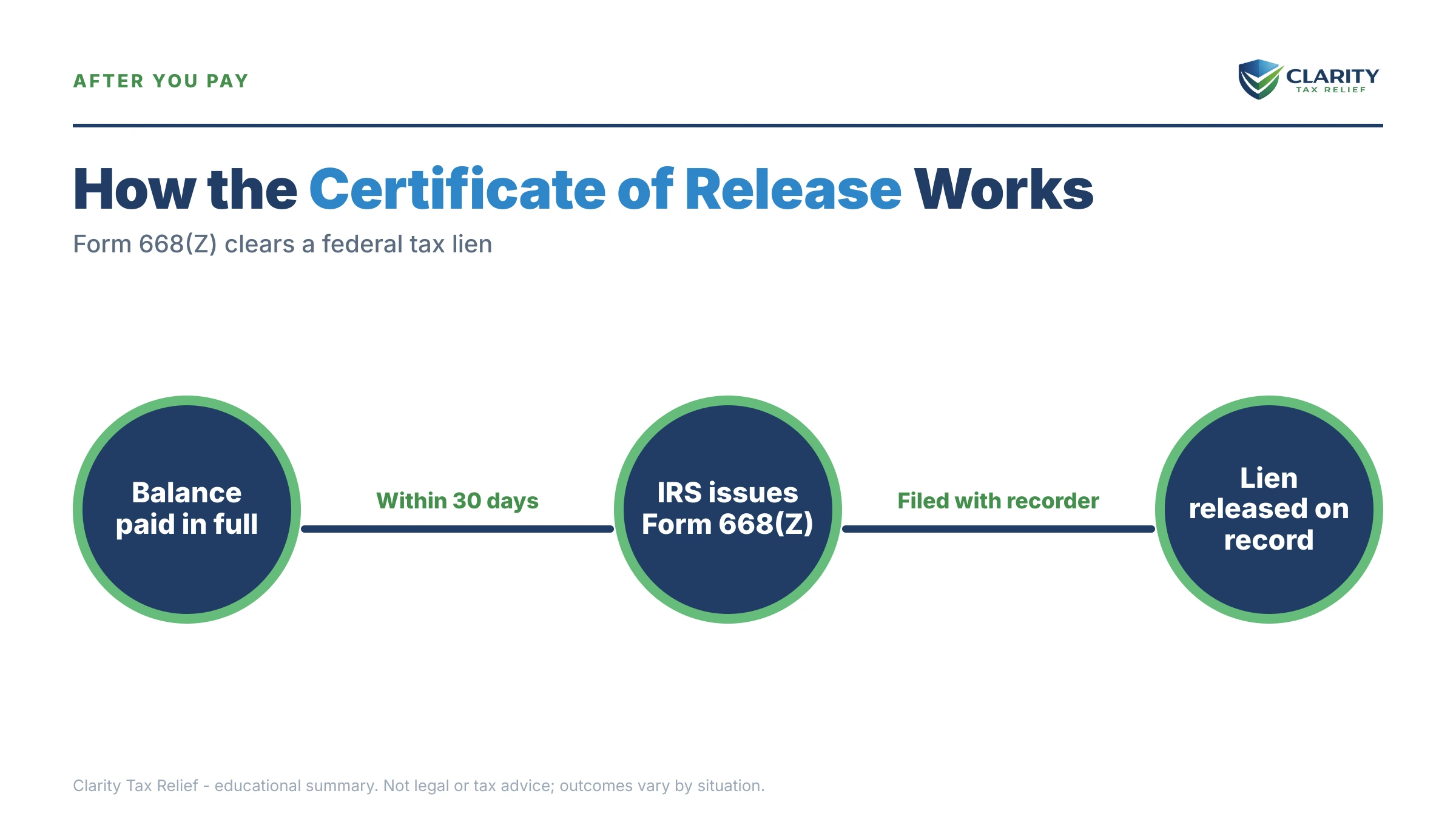
The short answer: a certificate of release of tax lien — IRS Form 668(Z) — is the recorded document proving a federal tax lien no longer attaches to your property. The IRS must issue it within 30 days after you fully pay the debt, the collection statute expires, or a bond is accepted, under IRC §6325(a).
You did the hard part — the balance behind the lien is paid, or should be — and now a title officer, loan underwriter, or bonding company is asking for one specific piece of paper you don't have. The county index still shows an active lien with your name on it. The fix isn't paying anything again; it's getting Form 668(Z) issued, recorded, and into your hands.
This guide covers what the certificate is, the 30-day rule that forces the IRS to issue it, why paid liens stay on the record anyway, and exactly how to demand — and prove — the release. The image below shows you exactly what this certificate looks like and where the fields a lender checks actually sit.
⏱ The clock that matters: the IRS must issue a Certificate of Release of Federal Tax Lien within 30 days after your debt is fully paid, becomes legally unenforceable, or is secured by an accepted bond — that's IRC §6325(a), a legal requirement, not a courtesy. If your account shows $0 and 30 days have passed, you have the right to demand the certificate.
What a certificate of release of federal tax lien actually is
Form 668(Z), the Certificate of Release of Federal Tax Lien, is the document that cancels a recorded Form 668(Y) Notice of Federal Tax Lien. The original notice — the one you learned about through Letter 3172, notice of federal tax lien — told the world the government had a claim on everything you own. The 668(Z) tells the world that claim is over for the tax periods it lists.
The certificate mirrors the original filing: your name, the tax years, and the recording reference of the 668(Y) it releases. The IRS sends it to the same recording office — usually your county recorder, or the secretary of state for liens reaching business assets. A separate release must be recorded in every office where the original lien was filed — if the IRS filed in two counties because you moved, one recorded 668(Z) only clears half the problem.
One distinction saves a lot of confusion: the release extinguishes the lien itself. It is stronger than a payoff letter and different from a withdrawal, discharge, or subordination — each of those is covered below, because asking the IRS for the wrong document is the most common way people lose weeks. For the broader post-payment timeline, see our guide to how long the IRS takes to release a tax lien; this page focuses on the certificate itself and what to do when it doesn't show up.
Why you don't have your certificate yet
Full payment triggers an automatic release — but five specific problems keep paid liens sitting on the public record. If your certificate never arrived, one of these is almost always why:
- Trailing pennies on the account. You paid the balance shown on a notice or transcript, but interest and the failure-to-pay penalty kept accruing daily between that date and your payment. Even a few dollars of leftover accrual keeps the account unsatisfied — and no 668(Z) issues.
- Payment applied to the wrong year. The lien lists specific tax periods. If your payment posted to a different year, the lien's periods still show a balance even though you're out the money.
- Multiple filing locations. The IRS released the lien in one county but the refiled or duplicate notice in another county never got its own certificate.
- Stale address. The IRS recorded the release but mailed your copy to an old address. The record is actually clean — you just don't have the proof, which is a much easier fix.
- Nothing happened that requires a release. Some resolutions don't trigger one. Currently Not Collectible status pauses collection but leaves the lien in place — see does CNC stop a tax lien. A bankruptcy discharge can wipe your personal liability while the lien survives against property you owned when you filed — see does bankruptcy remove a tax lien. And an ordinary installment agreement generally leaves the lien filed until the balance is paid off.
What happens if you never confirm the release
An unreleased lien doesn't levy you or fine you — it quietly blocks transactions, and the public record never cleans itself. Here's the sequence people hit, in order:
- The index keeps showing an active lien. Recorders don't purge federal tax liens on their own; the entry sits there until a release is recorded against it.
- A title search flags it. The first time most people discover the missing certificate is mid-transaction — a home sale or refinance stalls because the search shows the government's claim. If real estate is involved, start with federal tax lien on your house.
- Lenders and underwriters pull the filing directly. Liens left credit reports in 2018, but mortgage lenders, SBA lenders, and bonding companies search the tax lien public record anyway — and an unreleased filing reads as an unpaid debt.
- The deal waits on the IRS. Now you're chasing proof of payment, a duplicate certificate, and county recording while an escrow officer emails you daily. What would have been a routine request becomes an emergency.
- Years pass and the fix gets harder. Payment confirmations get lost, banks purge records, and the recorded 668(Y) is the only document anyone can find. The lien is legally dead but you can't easily prove it.
One 2026 reality check: the IRS workforce shrank roughly 27% in 2025. Lien filings and releases are largely automated, but fixing an account that's a few dollars off — or hunting down a release that never recorded — takes a human, and humans are exactly what the IRS has fewer of. The earlier you start, the less a staffing backlog can cost you.
Paid the debt but the lien still shows on the record?
Until a Certificate of Release is recorded, every title search says you still owe. Send us your lien paperwork — an experienced tax professional will verify your balance actually reads zero, find out whether a 668(Z) was ever issued, and map the fastest path to a clean record. Free and confidential.
Release vs. withdrawal vs. discharge vs. subordination: which document you need
Four different IRS certificates deal with a filed lien, and they solve four different problems. Asking for the wrong one wastes weeks. A release ends the lien for the listed periods; a withdrawal erases the filing from the record; a discharge frees one specific property; a subordination lets a new loan jump ahead of the lien.
| Document | How you get it | What it does | When it applies |
|---|---|---|---|
| Release — Form 668(Z) | Automatic within 30 days of satisfaction; Pub 1450 request if it doesn't issue | Ends the lien for the listed tax periods; the filing history remains in the index | Debt fully paid, collection statute expired, or bond accepted |
| Withdrawal | Apply on Form 12277; discretionary | Removes the notice as if never filed — the cleanest public record | After release, or during a qualifying direct-debit installment agreement, or when filing was improper |
| Discharge | Apply on Form 14135 before closing | Removes one specific property from the lien so it can be sold | Selling property while a balance remains — e.g., IRS gets paid from proceeds or there's no equity |
| Subordination | Apply on Form 14134 before closing | Lets a new or refinanced loan take priority over the lien | Refinancing while a balance remains, when it helps the IRS get paid |
If you've paid in full, ask for both: the mandatory release and a discretionary withdrawal. The release is your legal right; the withdrawal is what makes the public record read as though the lien never existed. The application walkthrough is in our guide to lien withdrawal with Form 12277. If you still owe and a specific transaction is stuck, the paths are tax lien discharge (Form 14135) for a sale and tax lien subordination (Form 14134) for a refinance.
How to get your certificate of release of tax lien, step by step
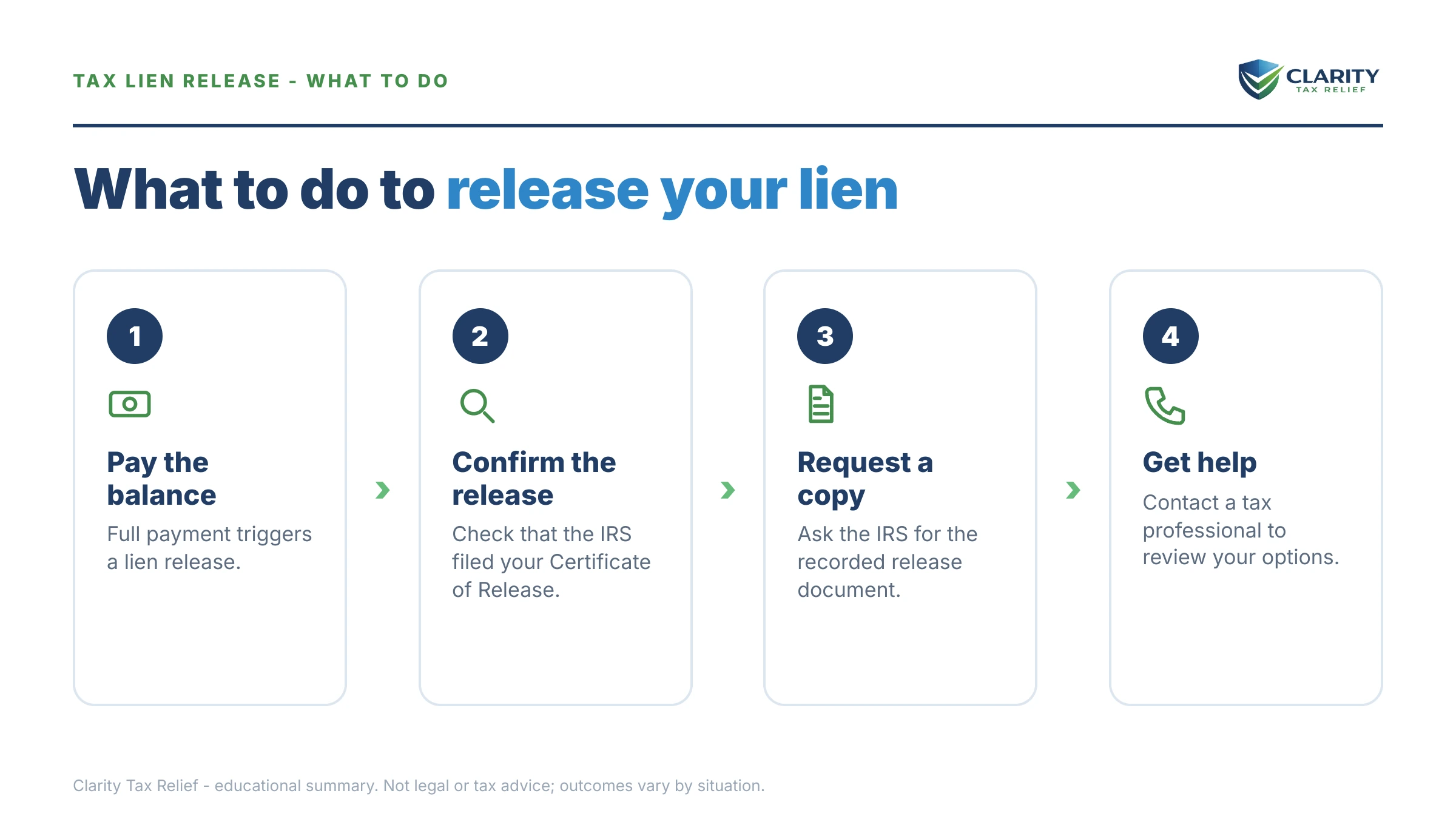
- Confirm your balance is actually zero. Pull your IRS account transcript for every year listed on the lien and look for transaction code 583 — lien released or a $0.00 balance — a leftover $40 of trailing interest is the most common reason a release never issues.
- Locate the original lien filing. Your copy of Letter 3172 or the recorded Form 668(Y) shows the recording office and reference numbers — you need those details, and a separate release must reach every office where the lien was filed.
- Give the 30-day clock a chance to run. Release is automatic after full payment under IRC §6325(a); keep your payment confirmation while the IRS processes Form 668(Z) and mails your copy.
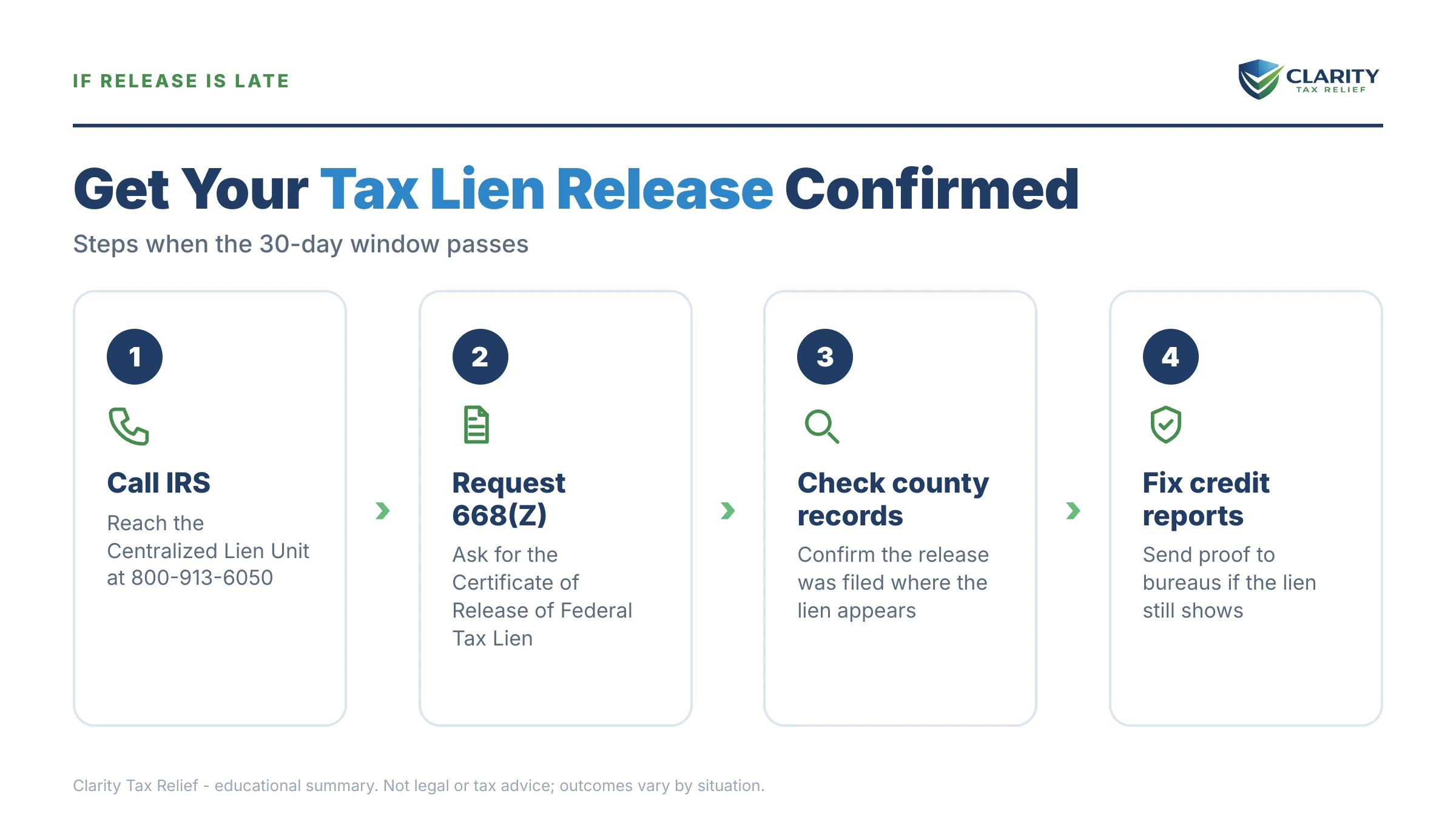
- Request the certificate if it hasn't arrived. Follow the Publication 1450 procedure: send proof of full payment and the lien's recording details to the IRS Centralized Lien Operation, or call to request a copy of a release that was already issued.
- Escalate a missed deadline. Ask for the IRS Collection Advisory group when a closing or loan is at stake, or file Form 911 with the Taxpayer Advocate Service if the account shows paid and nothing moves.
- Record and keep certified copies. Confirm the county recorder actually indexed the 668(Z), then order at least two certified copies — lenders, title companies, and bonding underwriters will ask for them again.
The 30-day rule: your rights when the IRS is late
IRC §6325(a) gives the IRS 30 days from satisfaction of the debt to issue your certificate — and the law gives you teeth when it doesn't. Each trigger event carries a specific obligation, and a specific move if the IRS misses it:
| What happened | What the IRS must do | Your move if it doesn't |
|---|---|---|
| You paid the balance in full | Issue Form 668(Z) within 30 days | Send a Pub 1450 request with payment proof to the Centralized Lien Operation |
| The 10-year collection statute expired, no refile | The lien self-releases by the terms printed on the 668(Y) | Use the recorded 668(Y) itself — its self-release language is your certificate |
| The IRS accepted a bond for the debt | Issue Form 668(Z) within 30 days | Same Pub 1450 request, with the bond acceptance |
| You completed all terms of an offer in compromise | Release the lien once the offer is fully satisfied | Confirm the final payment cleared, then request the certificate with your acceptance letter |
| The lien was filed in error | Issue a release — and you can pursue withdrawal to erase the filing | Contact Collection Advisory; appeal the filing if needed |
| A closing is waiting on the release right now | Expedited processing is available through Collection Advisory | Have escrow submit the payoff and request together, in advance |
If the account clearly shows paid and the IRS still won't act, two escalation tools exist. The Taxpayer Advocate Service takes cases where IRS inaction is causing financial harm — a stalled closing qualifies. And IRC §7432 allows you to sue for actual damages when the IRS knowingly or negligently fails to release a lien — rarely necessary, but it's why a well-documented written demand tends to get answered.
Say your payoff is $7,400: the math that gets the release issued
Here's a hypothetical that mirrors how most stuck releases happen. Say you're a 1099 contractor with a lien on record from a rough year, and your transcript shows $7,400 as of March 1. You scrape the money together and pay exactly $7,400 — on April 15.
The problem: the transcript figure was only good on March 1. The failure-to-pay penalty runs 0.5% per month — on $7,400 that's $37 per month — plus interest compounding daily on top. By April 15, roughly a month and a half later, the account has grown by about $55 in penalty alone, plus interest. Your $7,400 lands, the module shows a small balance still due, the account is not "satisfied" — and no Form 668(Z) ever issues. Six months later a bonding underwriter finds the live lien and your next contract stalls.
The fix costs nothing extra: before paying, get a payoff figure computed through a specific future date (your IRS online account or the Centralized Lien Operation can provide one), pay that amount by that date, and calendar the 30-day release deadline. For a contractor, this matters twice over — the filed lien attaches not just to your house and truck but to business property and receivables, as covered in tax lien on business assets. A $55 shortfall shouldn't be what keeps a $7,400 lien alive on the record.
The self-releasing lien: when the 10-year statute does the work
Every recorded Form 668(Y) contains built-in self-release language tied to the date printed in its "Last Day for Refiling" column. If that date passes and the IRS hasn't refiled the notice, the lien releases automatically — the original filing operates as its own certificate of release, no 668(Z) required. That mechanism, and the refiling trap inside it, is the subject of our guide to whether an IRS tax lien expires.
The underlying driver is the Collection Statute Expiration Date: the IRS generally has 10 years from assessment to collect, as explained in how long the IRS can collect back taxes. But the clock pauses for appeals, a pending offer in compromise, and bankruptcy — so the printed refiling date and your real CSED can differ, and the IRS can refile before the date passes. If you're counting on expiration rather than payment, estimate your own timeline with our CSED Calculator before assuming the lien has died on its own.
Proving the lien is gone: the documents that satisfy lenders
A released lien only helps you if you can prove it — and different gatekeepers accept different proof. Build a small file and you'll never scramble mid-transaction again:
| Proof | Where to get it | What it shows |
|---|---|---|
| Certified copy of recorded Form 668(Z) | County recorder (or secretary of state) where the lien was filed | The release, indexed against the original lien — the gold standard for title companies |
| Account transcript showing code 583 | Your IRS online account | The IRS's internal marker that the lien was released or withdrawn |
| Duplicate certificate from the IRS | Centralized Lien Operation, 800-913-6050 | A replacement copy when yours never arrived or was lost |
| Recorded 668(Y) past its refiling date | The recorder's office — it's already on file | Self-release by the notice's own printed terms when the statute ran out |
| Updated title search | Any title company | Independent confirmation the public index is clear |
One managed expectation: the release does not scrub history. The original 668(Y) filing stays visible in the index forever; the 668(Z) is recorded alongside it. If you want the record to read as though the lien never existed, that's the withdrawal path covered above. Background on how the lien itself works is on the IRS's own page, Understanding a federal tax lien.
State tax liens: a federal 668(Z) won't clear them
A certificate of release of federal tax lien releases exactly one thing: the federal lien it names. If a state agency filed its own lien for state taxes, that filing needs its own release under that state's rules — and state timelines can be dramatically different. California's Franchise Tax Board can collect for 20 years under R&TC §19255, so an FTB tax lien can outlive a federal one by a decade. New York enforces through a tax warrant, which operates as a civil judgment on the public record.
If a title search shows two liens, treat them as two separate projects: confirm which agency filed each, pay or resolve each balance under that agency's rules, and get each release recorded where each lien was filed. Never assume an IRS figure, threshold, or deadline applies to a state — when in doubt, ask the state agency directly.
When you can handle this yourself — and when help changes the outcome
Much of this is genuinely do-it-yourself territory. If your transcript already shows zero and code 583, you're just chasing paper: call the Centralized Lien Operation for a duplicate, order certified copies from the recorder, done. If you're about to pay off a single-year balance, getting a dated payoff figure through IRS.gov/payments and calendaring the 30-day clock requires no professional at all.
Experienced help earns its cost in the messier versions: a payment that posted to the wrong year, liens recorded in multiple counties with only partial releases, a closing or bond renewal on a deadline while the IRS sits past its 30 days, a lien that should have self-released but was refiled, or a remaining balance where the real question is withdrawal, discharge, or subordination strategy — not just paperwork. In those cases the order of operations determines whether your transaction closes on time, and the Taxpayer Advocate route (taxpayeradvocate.irs.gov) works far better with a properly documented file behind it.
If a closing, bond renewal, or loan approval is waiting on this certificate, get a free lien-release review or call (888) 825-7779 — an experienced tax professional can usually tell you in one conversation whether the holdup is a trailing balance, a paperwork gap, or an IRS processing failure.
Terms on your lien paperwork, decoded
- Notice of Federal Tax Lien (Form 668(Y)): the public filing that told creditors the government has a claim on your property — the document your certificate releases.
- Certificate of Release (Form 668(Z)): the recorded document stating the lien no longer attaches for the tax periods listed.
- Last Day for Refiling: the date printed on the 668(Y); if the IRS doesn't refile by then, the notice self-releases by its own terms.
- CSED: Collection Statute Expiration Date — the end of the IRS's 10-year window to collect, pausable by appeals, an offer in compromise, or bankruptcy.
- Withdrawal: removal of the lien notice from the record as if never filed — stronger for your public record than a release, but discretionary.
- Centralized Lien Operation: the IRS unit that files, releases, and issues copies of lien documents — your first call for a missing certificate.
Certificate of release questions, answered
How long does it take to get a certificate of release of federal tax lien?
The IRS is required to issue the certificate within 30 days after your debt is fully paid, becomes legally unenforceable, or is covered by an accepted bond. Add the county recorder's processing time on top — indexing the recorded release can take several more weeks depending on the office. If you're past 30 days with a $0 balance and nothing has been issued, contact the IRS Centralized Lien Operation with your payment proof.
What is IRS Form 668(Z)?
Form 668(Z) is the Certificate of Release of Federal Tax Lien — the document the IRS files to cancel a recorded Form 668(Y) lien notice. It lists the same taxpayer, tax periods, and recording information as the original lien and is sent to the same recording office. If your lien was filed in more than one county, a separate 668(Z) must be recorded in each one.
What is the difference between a lien release and a lien withdrawal?
A release (Form 668(Z)) says the lien no longer attaches because the debt was satisfied or expired — but the public record of the original filing stays in the index. A withdrawal goes further: the IRS removes the notice as if it had never been filed, which is what you want lenders to see. Withdrawal is discretionary and requested on Form 12277; release after full payment is mandatory.
How do I get a copy of my certificate of release?
Order a certified copy from the recording office where the lien was filed — usually the county recorder, or the secretary of state for liens against business assets. If the county has no record of a release, call the IRS Centralized Lien Operation at 800-913-6050 to confirm whether one was issued and request a duplicate. Certified copies are what title companies and bonding underwriters typically accept.
What if the IRS never released my lien after I paid in full?
First confirm the account actually shows zero — a few dollars of trailing interest is the most common culprit. If the transcript shows $0 and 30 days have passed, request the release under the Publication 1450 procedure with proof of payment. If that stalls, the Taxpayer Advocate Service can intervene through Form 911, and IRC §7432 even allows a damages suit when the IRS knowingly fails to release a lien.
Does a federal tax lien release itself after 10 years?
Often, yes. The recorded Form 668(Y) contains self-release language: if the IRS does not refile by the 'Last Day for Refiling' printed on the notice, the lien releases automatically — the original filing becomes its own certificate of release. The catch is tolling: appeals, an offer in compromise, or bankruptcy can pause the 10-year collection statute, and the IRS can refile before the date passes.
Does a certificate of release fix my credit report?
Tax liens were removed from all three major credit bureaus' reports back in 2018, so neither the lien nor the release appears on your credit report today. The release matters elsewhere: county public records, title searches, background-check databases, and lender or bonding underwriting that pulls public filings directly. That is why getting the 668(Z) recorded — and keeping certified copies — still matters.
Can I sell or refinance my house before the release is recorded?
Yes, and it happens at closings every day. If the sale proceeds will pay the IRS, escrow sends the payoff and the release follows; if there isn't enough equity, Form 14135 asks the IRS to discharge the specific property from the lien so the sale can close. For a refinance, Form 14134 subordination lets the new loan take priority. Start either application well before your closing date — they take time to process.
Do state tax liens have their own certificate of release?
Yes — every state runs its own lien and release process, and an IRS Form 668(Z) does nothing for a state filing. California's FTB, for example, can collect for 20 years under R&TC §19255, so its liens can sit far longer than a federal one. If you have both, you need a release from each agency, recorded wherever each lien was filed.
Your next 24 hours
- Find the recording details. Dig out your copy of Letter 3172 or the recorded 668(Y) and note the recording office, the tax periods listed, and the "Last Day for Refiling" date — every request you make will need them.
- Gather your proof. Pull your IRS account transcript for each lien year (look for code 583 or a $0 balance) and collect your payment confirmations in one folder.
- Get a free case review. If the transcript and the public record don't match — or a transaction is waiting on this certificate — call (888) 825-7779 or use the 2-minute form. An experienced tax professional will pinpoint whether you need a payoff, a Pub 1450 request, or an escalation, and remember: any balance still open keeps accruing interest and penalties every month it sits.
This guide is general information, not tax or legal advice for your specific situation. Eligibility for IRS programs depends on individual facts and circumstances; no outcome is guaranteed.