
IRS Transcript Codes
Code 583 on Your IRS Transcript: The Lien Release Indicator, Explained (2026)
The short answer: a code 583 transcript entry means the IRS reversed the lien indicator (code 582) on that tax year — the federal tax lien was released, withdrawn, or the balance was satisfied. It's an internal flag only: the public county record clears when a Certificate of Release or withdrawal certificate is actually recorded.
You've been checking your transcript for weeks — maybe months — waiting for something to move, and today a new line appeared: 583, sitting right under the 582 that's shadowed your account since the lien was filed. If you run your own business, you already know why this line matters: it's the difference between a loan officer saying "yes" and a title search killing the deal. The good news is real. The catch is that 583 is only half the story.
The image below shows you exactly where code 583 sits on an account transcript and how to read the line next to it — including the date that tells you which release path you're on.
⏱ The clock here runs in your favor: under IRC §6325(a), the IRS must issue a Certificate of Release within 30 days after your tax debt is fully paid or becomes legally unenforceable. Code 583 is the transcript trace of that process — but the county recording step can lag weeks behind, and it's the county record that lenders check.
Why a code 583 transcript entry posted to your account
Code 583 posts when the IRS removes the lien indicator from a specific tax year, and it happens for one of four reasons. Which reason applies to you determines what paperwork exists — and what you should go find:
- You satisfied the debt. You paid in full, an accepted offer closed out the balance, or credits wiped it. The IRS issues a Certificate of Release of tax lien (Form 668(Z)) and reverses the 582 flag on each year the lien covered.
- The lien notice was withdrawn. You applied on Form 12277 — often after qualifying with a direct-debit installment agreement at or below $25,000 — and the IRS pulled the Notice of Federal Tax Lien as if it were never filed. The debt may still exist; the flag doesn't.
- The collection statute expired. The 10-year clock (CSED) ran out on that year, the lien self-released by its own terms, and the module was closed out.
- The 582 was posted in error. Less common, but it happens: a lien indicator lands on the wrong module or the wrong taxpayer, and 583 is the correction.
Notice what's not on that list: code 583 never means the IRS is starting something against you. It is a closing entry, not an opening one. If transcript reading is new to you, our guide on how to read IRS account transcript lines covers the column layout; this page covers only what 583 itself does.
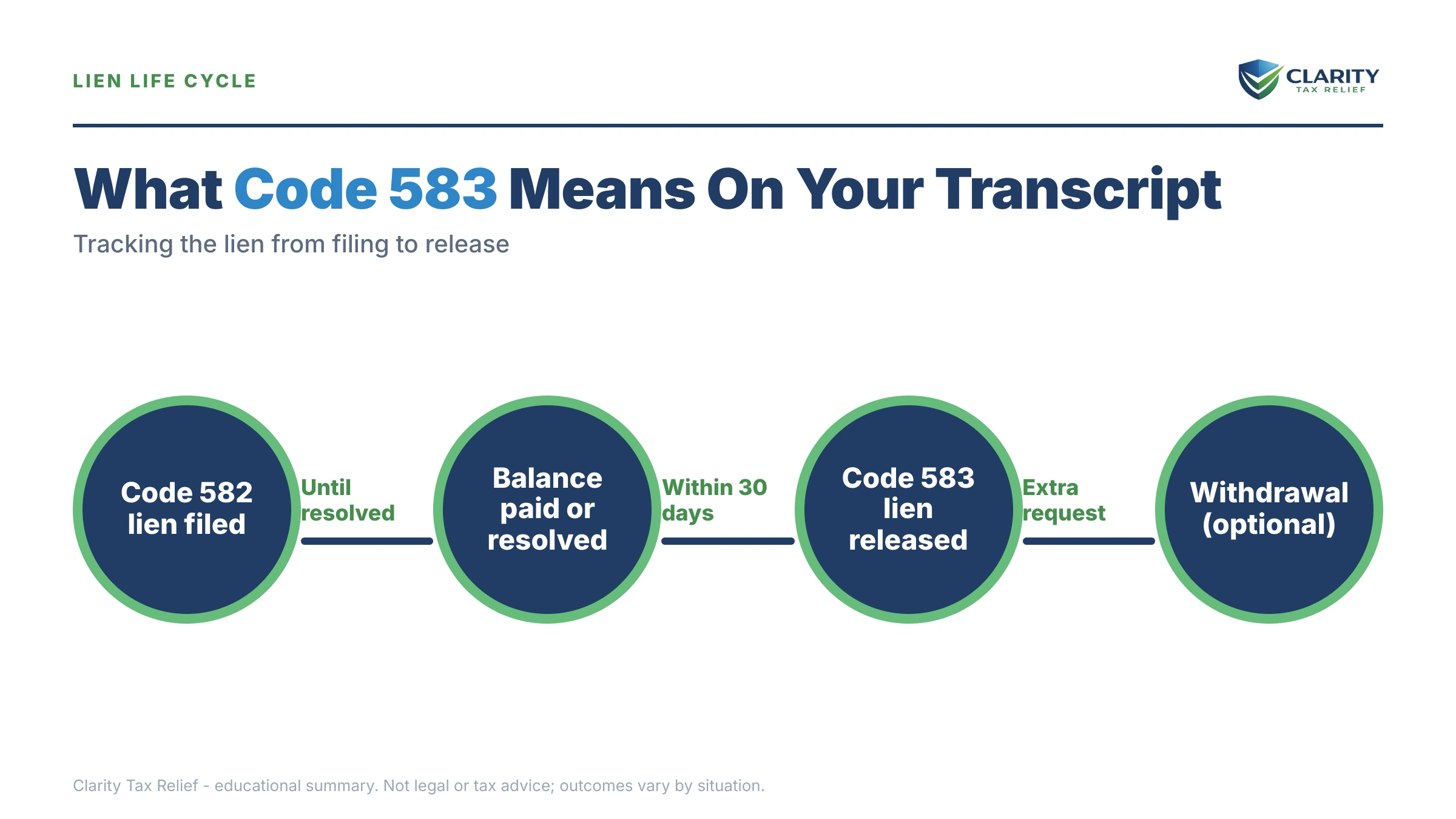
Code 583 vs code 582: the lien codes side by side
Codes 582 and 583 are mirror entries — 582 turns the lien indicator on, 583 turns it off — and they post per tax year, not per lien. That per-year detail trips up more readers than anything else on this topic, because one filed lien often covers several years. Here's the full lien-related code family and what each one asks of you:
| Code | What it means | What to do |
|---|---|---|
| 582 | Lien indicator set — a Notice of Federal Tax Lien covers this year | Confirm which years the filing lists; see our code 582 transcript guide |
| 583 | Lien indicator reversed — released, withdrawn, self-released, or corrected | Identify which trigger applies, then verify the certificate and county record |
| 971 | Notice issued — often Letter 3172, the formal lien-filing notice with appeal rights | Match the 971 date to the letter; see Letter 3172 notice of federal tax lien |
| 520 / 521 | Collection freeze set / released — bankruptcy or litigation, which also pauses the CSED | A code 521 transcript entry near your 583 usually explains a bankruptcy-driven release |
One practical check right now: scroll every year you ever owed. If year one shows 583 but year two still shows a live 582, the lien is still working — and if both years sit on the same filed notice, the public record won't clear until both are resolved.
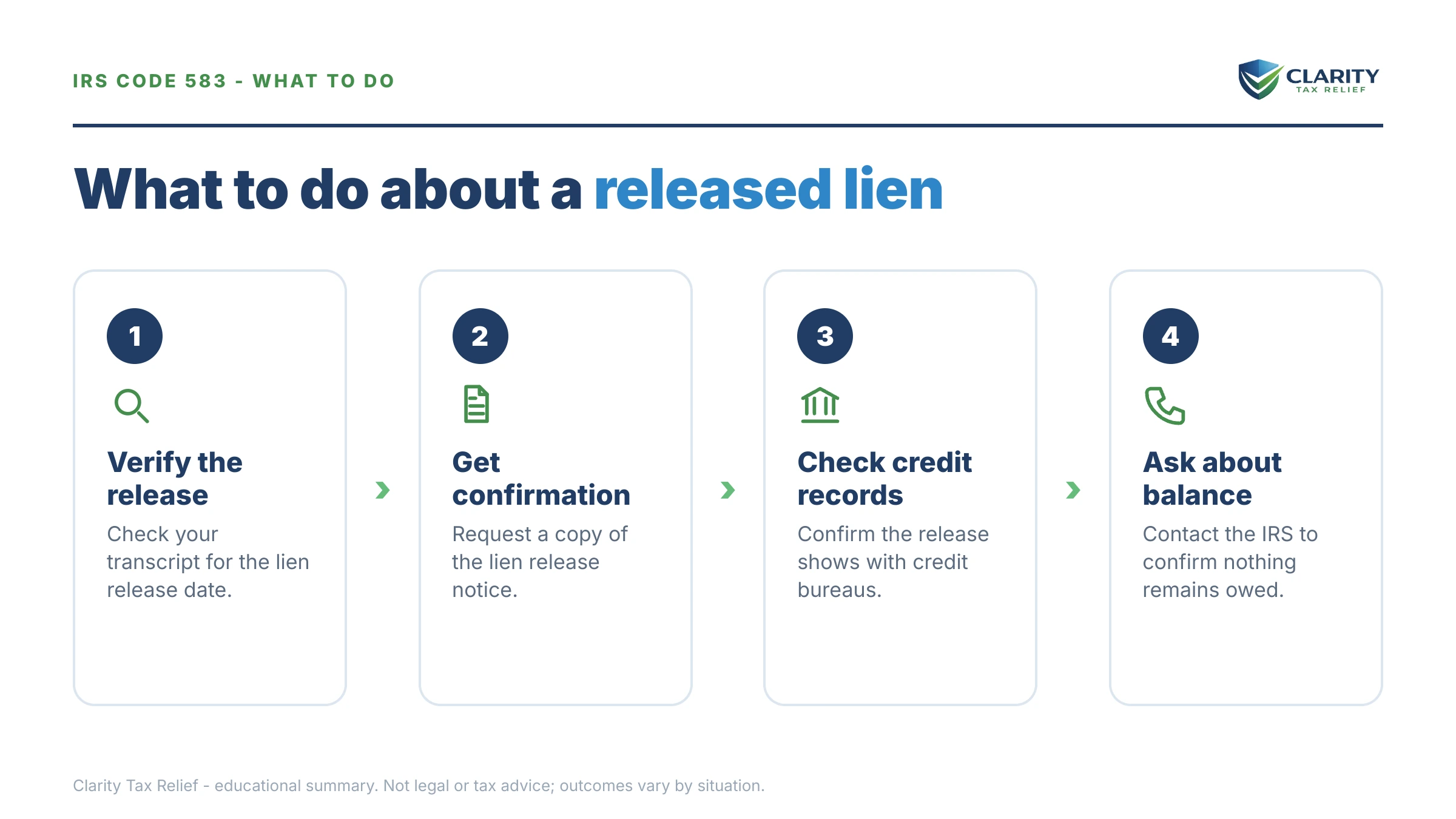
What happens after code 583 posts: the release chain
A code 583 starts a four-step chain, and the chain can stall silently at any link. Nothing pings you if a certificate gets lost — the transcript looks done while the county record stays dirty. Here's the sequence:
- 583 posts to the tax module. The IRS's internal lien indicator is reversed for that year. This is the step you can see today.
- The certificate is issued. The Centralized Lien Operation generates Form 668(Z) (release) or Form 10916(c) (withdrawal) and mails copies to you and to the office where the lien was recorded.
- The county records it. The recorder indexes the release against the original Notice of Federal Tax Lien. Timing varies wildly by county — some record in days, backlogged offices take weeks.
- The public record clears. Only now do title searches and lender checks come back clean. This is the step that actually unlocks a mortgage, refinance, or business loan — how to search it yourself is covered in our tax lien public record guide.
If you do nothing after seeing 583, the most likely failure points are these: the certificate goes to an old address and you never learn it exists; the county never indexes it and a title search two years from now surprises you mid-closing; or the lien covered multiple years and the release never issued at all because one listed period still has a balance. None of these fix themselves. The verification steps below take under an hour and close every gap.
One more edge case worth knowing: if the IRS refiles a lien — which it can do when the collection statute was extended — a fresh 582 can appear after your 583. A new 582 following a 583 is a signal to get your CSED math checked, not to panic.
Code 583 posted — but a lien is still blocking your loan or sale?
The transcript says released; the title search says otherwise. An experienced tax professional can pull your full account, confirm which certificate should exist, and chase down the record that's holding you up — free, confidential, no pressure.
Release, withdrawal, discharge, subordination: which path produced (or can produce) your 583
The IRS has four distinct ways to loosen a lien's grip, and only two of them generate a code 583. If you're reading this before your 583 exists — trying to make one happen — this table is your map:
| Option | Form | When it fits | Timeline |
|---|---|---|---|
| Release (posts 583) | 668(Z), issued by the IRS | Balance paid in full, settled, or legally unenforceable | Certificate due within 30 days of satisfaction; county recording adds weeks |
| Withdrawal (posts 583) | 12277 request → 10916(c) | Direct-debit plan with balance ≤ $25,000 and clean compliance — or after full payment, to erase the filing's history | Varies; weeks to a few months from approval, plus recording |
| Self-release at CSED (posts 583) | None — the lien releases by its own terms | The 10-year collection statute expired without a refile | Automatic in law, but records are rarely updated proactively — verify everything |
| Discharge of one property (no 583) | 14135 | Selling a specific asset while the lien stays on everything else | Apply well before closing — the IRS suggests at least 45 days |
| Subordination (no 583) | 14134 | A lender needs priority so a refinance can close | Apply well ahead of closing; the lien itself stays in place |
Discharge and subordination are property-level tools — the lien indicator stays on your account, so no 583 posts. If that's your actual situation, our guides on sell house with IRS lien and can I refinance with an IRS lien walk through those forms. The full withdrawal process, including the post-payment version, is in IRS lien withdrawal Form 12277.
A worked example: paying off $76,400 and clearing the lien
Say you're a self-employed sole proprietor who fell behind on self-employment tax for two years, and the IRS filed one Notice of Federal Tax Lien listing both. Your payoff breaks down like this (hypothetical figures):
- Year one: $28,400 tax + $4,260 failure-to-pay penalty + $2,490 interest = $35,150
- Year two: $33,900 tax + $4,070 penalty + $3,280 interest = $41,250
- Total to satisfy the lien: $76,400
While you're paying that down on an installment agreement, notice what you can't do: at $76,400 you're well above the $25,000 direct-debit line, so a withdrawal isn't on the table yet — the 582 stays lit until you either pay the balance below $25,000 and qualify, or pay it off entirely.
Now say you clear the full $76,400 on March 9 — a business asset sale funds the payoff. The IRS owes you a Certificate of Release by April 8 (the 30-day statutory window). A 583 posts on each year's module, usually within that same window on your weekly cycle. Then the certificate travels to your county recorder — call it two to six more weeks depending on the office. If your equipment lender wants a clean record by May 1, the transcript alone won't satisfy them; the recorded 668(Z), or a copy of the certificate in hand, will. That's why step three below exists.
When 583 comes from the 10-year statute expiring
Every Notice of Federal Tax Lien contains self-release language: if the IRS doesn't refile by the deadline printed on the form, the lien releases automatically. That deadline tracks the Collection Statute Expiration Date — 10 years from assessment, paused by things like bankruptcy, a pending offer in compromise, or certain appeals, so the real date is often later than year ten. You can estimate where your clock stands with our CSED Calculator, and the mechanics of expiration and refiling are covered in does IRS tax lien expire.
The practical problem with statute-driven 583s: nobody proactively cleans up the county record for you. The law says the lien is gone; the recorder's index still shows the original filing with no release attached. If a title company balks, you (or your representative) request a Certificate of Release based on the expired statute — the IRS must issue it once the liability is legally unenforceable.
How to respond to code 583, step by step
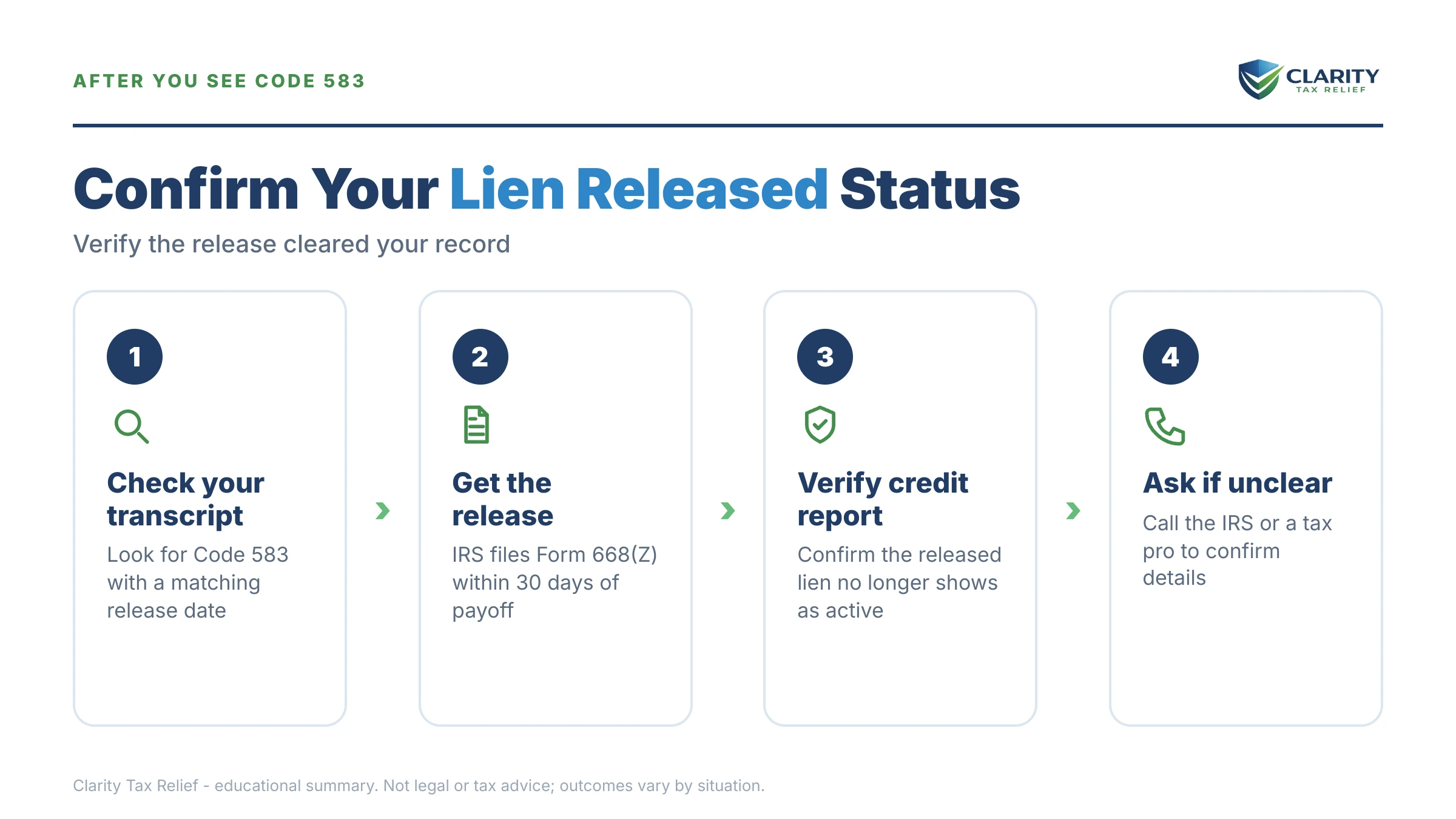
- Pull your full account transcript for every year you owed, confirm the 583 posting and its date, and check each year for a matching code 582.
- Identify why 583 posted — full payment, an approved withdrawal, a bankruptcy discharge, or the collection statute expiring — because each path produces a different certificate.
- Locate your certificate — your Certificate of Release (Form 668(Z)) or withdrawal certificate (Form 10916(c)) is mailed to your last known address — and request a copy from the IRS Centralized Lien Operation if it never arrived.
- Verify the county record at the recorder's office where the original Notice of Federal Tax Lien was filed; if the certificate was issued but never recorded, record it yourself for a small fee.
- Send proof to whoever needs it — your lender, title company, or business creditor — and keep the certificate permanently with your tax records.
When you can handle this yourself
Most code 583 situations need no professional help at all. If you paid a single-year lien in full, the Certificate of Release showed up in your mailbox, and a quick county search shows it recorded — you're done. File the certificate somewhere permanent and move on. Recording a certificate the county missed is also a genuine do-it-yourself task: one visit or mailing, one small recording fee.
Experienced help changes the outcome in a narrower set of cases: a closing or loan funding in the next few weeks with the lien still on title (the sequencing of discharge or expedited-release requests matters); a multi-year or business lien where some periods are paid and others aren't; a 583 that posted on statute-expiration grounds the IRS later disputes because of tolling; or a fresh 582 appearing after your 583, which means a refiled lien and a CSED calculation worth auditing. In those cases, the cost of getting the order of operations wrong is usually a dead deal, not just delay.
Terms on your transcript, decoded
- Code 582: the entry that set the lien indicator on a tax year — the flag your 583 just reversed.
- NFTL (Notice of Federal Tax Lien): the public document recorded at your county that tells the world the IRS has a claim on your property.
- Certificate of Release (Form 668(Z)): the document that formally ends a lien; it must be recorded to clear the public record.
- Withdrawal (Form 10916(c)): removal of the lien notice as if never filed — stronger for lending purposes than a release.
- CSED: the Collection Statute Expiration Date — 10 years from assessment, extendable by events that pause the clock.
- Self-releasing lien: the built-in expiration on every NFTL; if the IRS doesn't refile by the printed date, the lien releases on its own.
Code 583 questions, answered
What does code 583 mean on an IRS transcript?
Code 583 means the IRS reversed the lien indicator (code 582) on that tax year — the agency's internal record no longer flags that year as covered by a filed Notice of Federal Tax Lien. It usually posts because the lien was released after payment, withdrawn, or self-released when the collection statute expired. It does not, by itself, change the county public record.
Does code 583 mean the tax lien is off public records?
No. Code 583 is an internal IRS flag. The public record clears only when a Certificate of Release (Form 668(Z)) or withdrawal certificate (Form 10916(c)) is recorded at the same county office where the original lien was filed. Recording can take several weeks after the certificate is issued, so check the county recorder before assuming a title search will come back clean.
What is the difference between a lien release and a lien withdrawal?
A release means the lien is satisfied or unenforceable — it ends the lien but leaves the original filing visible in the public record's history. A withdrawal (requested on Form 12277) removes the Notice of Federal Tax Lien as if it had never been filed, which reads better to lenders. You can request a withdrawal even after a release if you paid in full and have stayed compliant with your filings.
How long after paying off my balance does code 583 appear?
Under IRC §6325(a), the IRS must issue a Certificate of Release within 30 days after your liability is fully paid or becomes legally unenforceable. The 583 transaction typically posts to your transcript in that same window, on your account's weekly update cycle. County recording of the certificate adds more time — often several additional weeks depending on the recorder's backlog.
Will code 583 improve my credit score?
Not directly, because the credit bureaus removed tax liens from all consumer credit reports back in 2018 — the lien wasn't being scored either way. Where 583 matters is underwriting: mortgage lenders, SBA lenders, and title companies search public records directly, and a recorded release or withdrawal is what clears those searches. Keep the certificate; you will be asked for it.
Can code 583 post even though I still owe the IRS?
Yes. A withdrawal of the lien notice — for example, after qualifying with a direct-debit installment agreement and a balance at or below $25,000 — reverses the lien indicator while the debt itself remains and you keep paying. Code 583 can also post when the 10-year collection statute expires, though that clock pauses for things like bankruptcy, a pending offer in compromise, or certain appeals.
The lien still shows at my county recorder — what do I do?
First confirm the Certificate of Release was actually issued: it is mailed to your last known address, and you can request a copy through the IRS Centralized Lien Operation. If the certificate exists but was never recorded, you can record it yourself at the county for a small fee. If it was never issued and your balance is satisfied, demand it — the law requires the IRS to release satisfied liens.
Does one code 583 clear a lien that covers multiple tax years?
Not necessarily. A single Notice of Federal Tax Lien often lists several tax periods, and codes 582 and 583 post separately on each year's module. The Certificate of Release for that NFTL generally issues only when every period listed on it is satisfied. If you paid off one year but still owe another year named on the same filing, the public lien stays in force.
Your next 24 hours
- Find the 583 date on your transcript — and check every other year you owed for a live 582. The date tells you whether the 30-day certificate window has already run.
- Gather your paper trail: the Certificate of Release or withdrawal certificate if you have it, your payoff confirmation or agreement paperwork, and the county and recording number from the original lien filing (it's on Letter 3172).
- If anything doesn't line up — no certificate, a county record that still shows the lien, or a year that never got its 583 — get a free case review at the 2-minute form or call (888) 825-7779. Every week the record stays uncorrected is a week a lender or title search can stop a deal cold.
For the IRS's own explanation of how liens attach and end, see Understanding a federal tax lien; payment options that get you to a release are at IRS.gov/payments. If a certificate error is causing you real harm and normal channels have failed, the Taxpayer Advocate Service can intervene.
This guide is general information, not tax or legal advice for your specific situation. Eligibility for IRS programs depends on individual facts and circumstances; no outcome is guaranteed.