
IRS Transcript Codes
Code 521 on Your IRS Transcript: The Bankruptcy Freeze Is Released (2026)
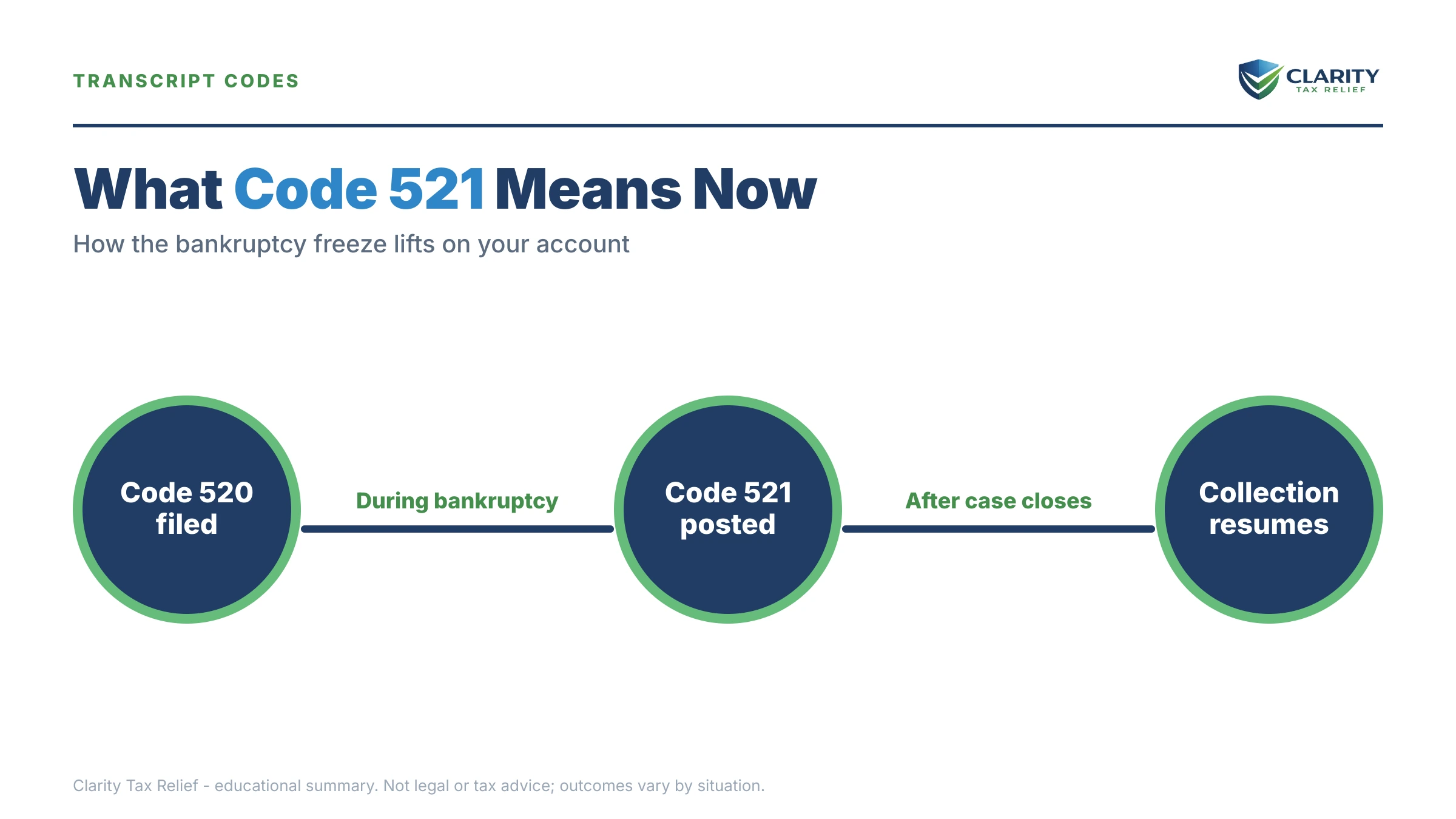
The short answer: a code 521 transcript entry means the bankruptcy or litigation freeze that code 520 opened has been released. The automatic stay is over: the IRS can resume collecting any tax debt that survived your case, and the 10-year collection clock — paused during bankruptcy — is running again.
You made it through the bankruptcy, pulled your transcript to see where you actually stand, and there it is: code 521, dated a few weeks after your case closed. Your first question is the right one — does this mean the tax debt is gone, or does it mean the IRS is coming back? The honest answer: 521 by itself says neither. It only says the referee left the field.
Whether that's good news depends entirely on the codes posted around it — the image below shows exactly what a 521 looks like on a real account transcript and which nearby lines to check first.
⏱ The clock that matters: code 521 has no response deadline printed anywhere — but the day it posted, the IRS collection system switched back on. Penalties and interest accrue monthly on every balance that survived your case, and the 10-year collection statute, paused during your bankruptcy, is running again.
What a code 521 transcript entry actually tells you
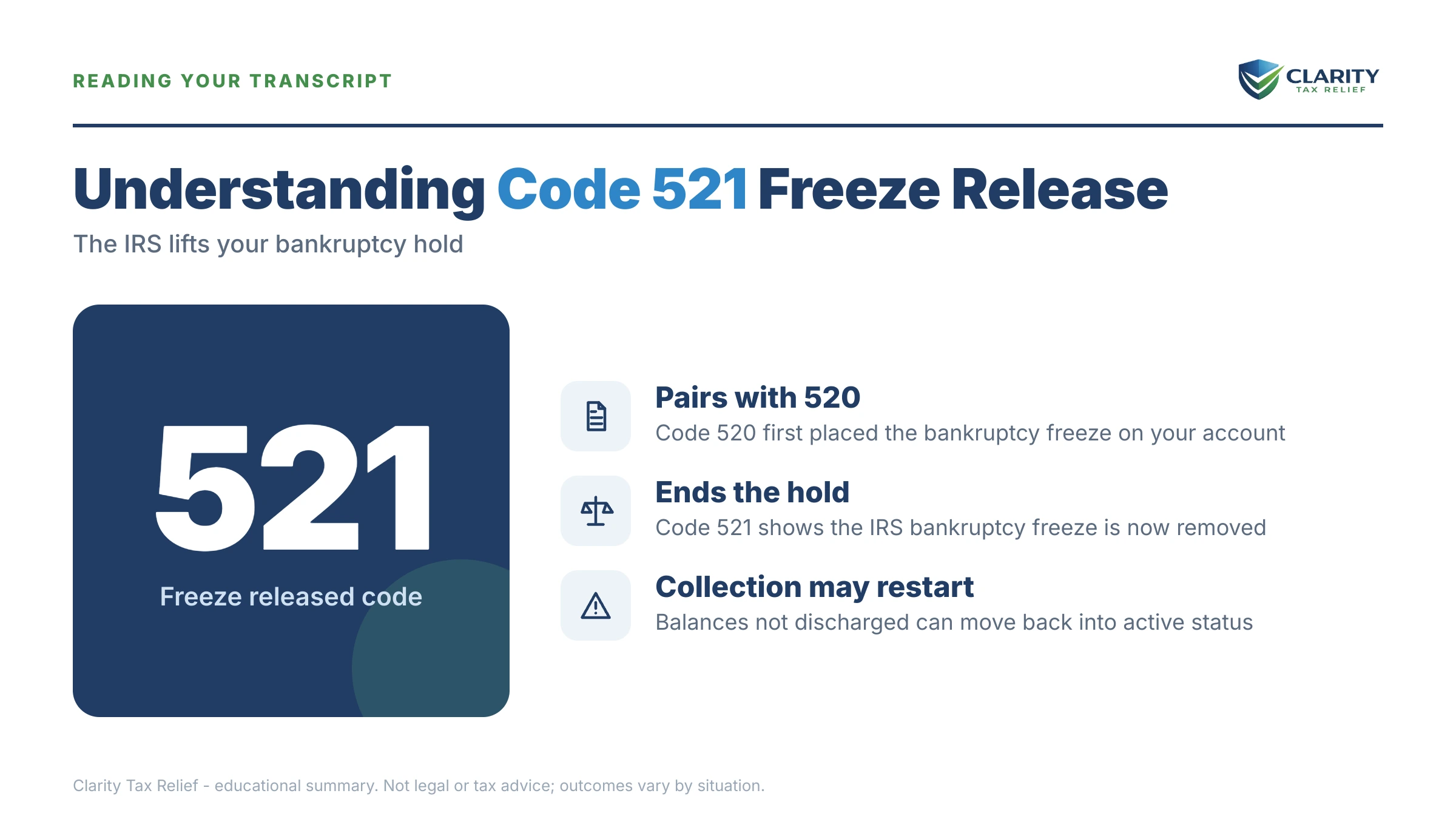
Transaction code 521 reverses transaction code 520, closing the bankruptcy or litigation freeze on your IRS account. While the code 520 transcript freeze was in place, the automatic stay barred the IRS from levying, garnishing, or offsetting against you. The 521 is the system's official record that the bar is gone.
Three details on the 521 line matter. First, the date — collection authority resumed as of that date, not the date you noticed it. Second, the tax year (module) it posted to: freezes are released year by year, so a 521 on 2022 says nothing about 2023. Third, the internal closing code, which tells IRS employees how the case ended — discharge, dismissal, or stay lifted — even though your transcript won't spell that out in plain English.
If transcript layout is new to you, our guide to how to read an IRS account transcript covers the columns and structure; this page stays focused on what 521 specifically means and what to do about it. Here's how 521 fits with the codes you're likely to see near it:
| Code | What it means | What to do |
|---|---|---|
| 520 | Bankruptcy/litigation freeze opened — collection paused | Confirm it matches your filing date; see the code 520 transcript guide |
| 521 | Freeze released — collection can resume as of this date | Check every year's remaining balance against your court order (this article) |
| 291 | Tax reduced/abated — how a discharge shows up in dollars | Verify a 291 posted for each year your discharge covered |
| 582 | Federal tax lien indicator on the account | A lien recorded pre-petition can survive discharge — check for a matching release |
| 583 | Lien released or withdrawn | If missing after payoff or discharge handling, see the code 583 transcript guide |
| 196 | Interest assessed — accruals catching up post-freeze | Expect these after a dismissal; see the code 196 transcript guide |
| 276 | Failure-to-pay penalty posted | May be abatable; see the code 276 transcript guide |
| 971 | Notice issued — the paper trail restarting | A 971 dated after your 521 usually means a collection notice is in the mail |
Why a code 521 posted: discharge, dismissal, or a completed plan
A 521 posts when the IRS Centralized Insolvency Operation processes the court order ending your case or lifting the stay. The same code covers four very different outcomes, and your next move depends on which one you got.
Chapter 7 discharge
If your Chapter 7 ended in a discharge, the taxes that passed the dischargeability tests should be wiped from the account — look for code 291 abatements on those years, usually posting around the same time as the 521. Only income taxes that meet the 3-year, 2-year, and 240-day timing rules qualify; the full tests are in our guide to discharge taxes in bankruptcy. Recent years, trust-fund payroll debt, and years with unfiled returns survive intact — and the 521 means the IRS can now collect them.
Chapter 13 plan completed
If you finished a Chapter 13 plan, priority tax claims should show as paid through your plan payments, and qualifying older balances may be discharged at completion. The 521 posts when the case closes. Your job is reconciliation: does each year's remaining balance match what the plan said would remain? Trustee payments occasionally post to the wrong year, which leaves a phantom balance that starts drawing collection notices.
Dismissal — the outcome that bites
If your case was dismissed — you fell behind on plan payments, missed a filing, or withdrew — nothing was discharged. The entire pre-petition debt returns, plus the interest that accrued the whole time the case was open, and the 521 puts all of it back in active collection. This is the scenario where the months after a 521 matter most, and it's the one our worked example below walks through.
Stay lifted mid-case
Less commonly, a 521 posts because the court granted relief from the automatic stay for the tax modules while your case continues. If your bankruptcy is still open and you see a 521, call your bankruptcy attorney before doing anything else — the code may reflect a motion you need to respond to.
The 10-year collection clock restarted — with time added
Bankruptcy pauses the IRS's 10-year collection statute for the entire case plus 6 more months under IRC §6503(h). The clock never runs while the automatic stay blocks collection, then stays paused another half year after the case closes. So a bankruptcy that lasted 14 months pushes each year's expiration date out roughly 20 months — the case length plus the 6-month tail.
This catches people who were quietly waiting out the 10-year rule. The debt doesn't reset — the clock resumes where it stopped — but every tolled month is a month the IRS gets back. Our guide to what extends the IRS collection statute covers the other pauses (offers, appeals, time abroad) that can stack on top. If you're doing this math on your own account, you can estimate each year's real expiration date with our CSED Calculator.
What happens if you ignore a code 521
After a 521 posts, the IRS collection sequence resumes on every surviving balance — automatically, whether or not a human ever reviews your file. The stages arrive in a fixed order, each carrying more enforcement power than the last:
- Balance-due notices resume. Bills and reminder notices (often flagged by a code 971 on the transcript) restart on each surviving year. No enforcement yet — this is the cheap stage.
- CP504 — Notice of Intent to Levy. The IRS can seize your state tax refund, and a federal tax lien filing becomes a live possibility if one isn't already recorded.
- LT11 / Letter 1058 — Final Notice. Starts a 30-day clock and your Collection Due Process rights (Form 12153). Caution: if you received a final notice before filing bankruptcy, the IRS may not need to issue a new one — meaning levy authority may already exist the day the 521 posts. See the LT11 notice guide.
- Levy. Bank levies come with a 21-day hold before funds leave; wage levies run continuously until released. For a 1099 contractor, the IRS can instead levy what your clients owe you — how that works is covered in can the IRS garnish 1099 income.
In 2026 this sequence is worth taking literally: IRS staffing fell roughly 27% in 2025, but these notices and levies are generated by automated systems that never stopped running. The freeze protected you; the release re-arms the machine.
| Stage | What it can do | Your window |
|---|---|---|
| Balance-due notices resume | Bills only — no enforcement power yet | The best moment to set up a resolution |
| CP504 | State tax refund can be seized; lien filing likely next | Act before the final notice issues |
| LT11 / Letter 1058 | Final notice before wage and bank levies | 30 days to request a CDP hearing (Form 12153) |
| Levy | Bank funds held 21 days, then sent; wage levy continuous; 1099 receivables reachable | Release requires an agreement or a hardship showing |
Just saw a 521 post after your bankruptcy?
The window between the freeze lifting and the first levy-track notice is when your options are widest. An experienced tax professional will pull your full transcript history, confirm what actually survived your case, and map the cheapest path forward — free, confidential, no pressure.
Your options for the debt that survived
Everything the automatic stay put on hold is available again once the 521 posts — including options that were locked while your case was open:
- Short-term payment plan — up to 180 days to pay in full, $0 setup fee. Interest and penalties continue, but the notice sequence stops.
- Installment agreement — for balances of $50,000 or less, a streamlined installment agreement can usually be set up online over as long as 72 months without a full financial disclosure (full IRS terms are on the IRS payment plans page).
- Currently Not Collectible status — if a dismissal left you unable to pay anything, collection can be paused on hardship grounds. The debt remains and the tolled CSED keeps running, which sometimes makes CNC the strategic play.
- Offer in Compromise — unavailable while a bankruptcy is open, back on the table once the 521 posts. It's means-tested (the IRS accepted roughly 1 in 5 offers in FY2024), so it fits only when your assets and income genuinely can't cover the debt. If you're weighing a refile against an offer, see bankruptcy or offer in compromise.
- Penalty relief — failure-to-pay penalties that accrued on surviving balances may qualify for first-time abatement if your prior three years are clean, or reasonable-cause relief. Note that starting summer 2026, the IRS's new Automatic Exemption from Penalty (AEP) applies some of this relief automatically, with no request needed.
- Lien cleanup — a discharge ends personal liability, but a pre-petition federal tax lien can survive against property you owned at filing. How that works — and what to do about it — is in does bankruptcy remove a tax lien.
A worked example: $48,300 back in play after a dismissed Chapter 13
Say you're a 1099 contractor who owed $48,300 across tax years 2021–2023 — quarterly estimates that never got made — and your Chapter 13 was dismissed 14 months in when contract work dried up and plan payments stopped. This is hypothetical, but the math is real:
- The balance: nothing was discharged. The full $48,300 returns, plus roughly 14 months of interest that accrued during the case — expect code 196 entries stacking it back on.
- The clock: if the 2021 tax was assessed in November 2022, its 10-year deadline was November 2032. Add 14 months of case time plus the 6-month tail — about 20 months — and it now runs to roughly July 2034.
- Payment plan: at $48,300 you're under the $50,000 streamlined ceiling, so a 72-month online agreement works out to about $671/month before accruing interest — realistically plan on somewhat more as interest and the 0.5%-per-month failure-to-pay penalty run alongside.
- The 180-day option: full payoff in six months means roughly $8,050/month — off the table for most contractors, which is why the 72-month plan or an OIC review is usually the real choice.
- Passport check: $48,300 sits below the 2026 passport-certification threshold of $66,000 — but if penalties and interest keep compounding on an ignored balance, crossing it is a real medium-term risk for anyone who travels for work.
And the contractor-specific danger: the IRS doesn't need a payroll department to levy you. It can send a levy directly to the clients who owe you money, taking a receivable in one stroke — a strong reason to have an agreement in place before the final notice issues.
How to respond to code 521, step by step
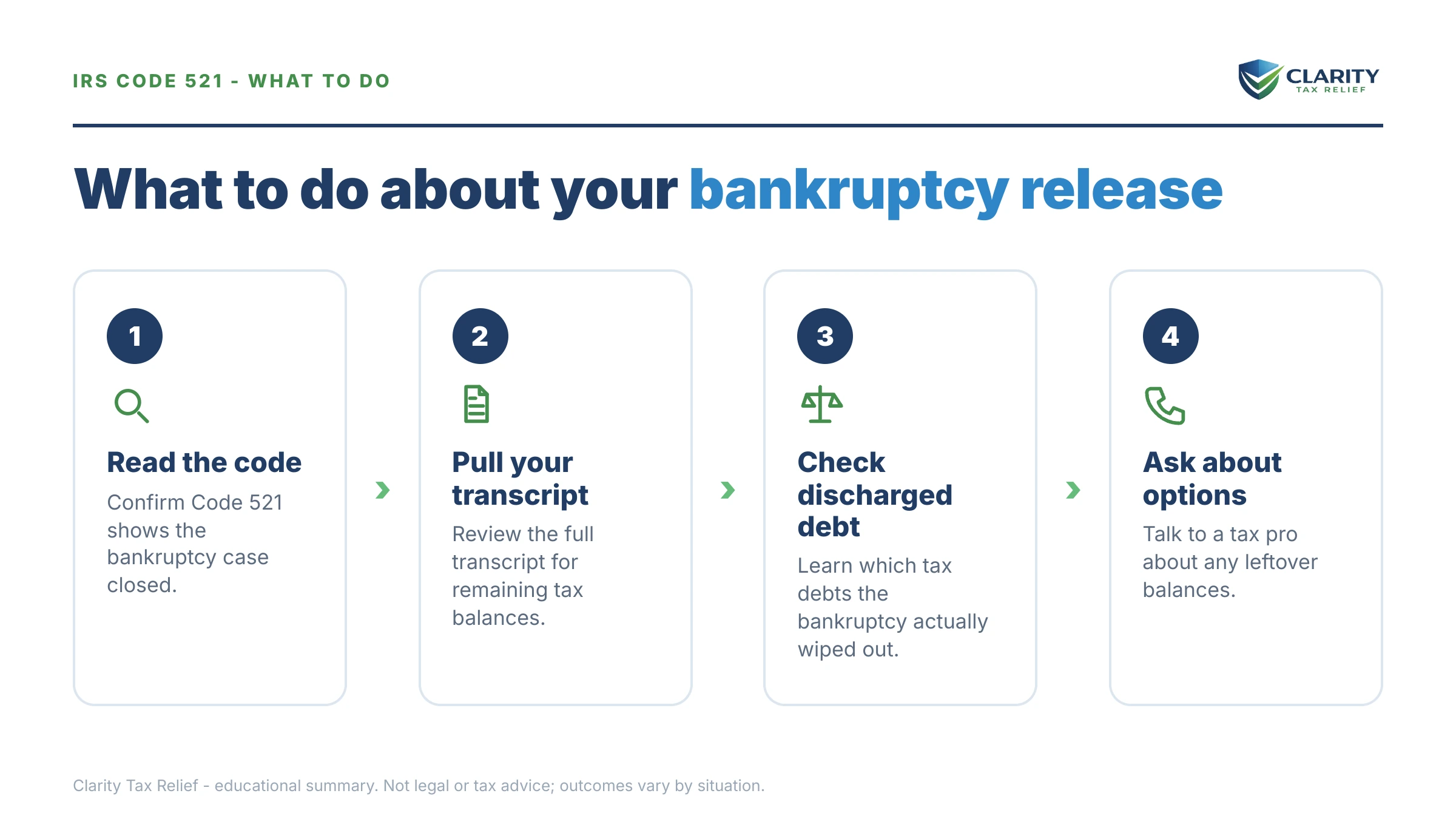
- Pull your full account transcript. Confirm the 521 posting date and check every tax year you owe for — the freeze is released per module, and each year tells its own story.
- Match surviving balances against your court order. Compare each year's remaining balance to your discharge order or dismissal. Balances that should have been discharged but still show need a written challenge, not a payment.
- Check the lien codes. Look for code 582 (lien filed) without a matching code 583 (lien released). A discharge wipes personal liability, not a recorded lien on property you owned when you filed.
- Recalculate your collection deadlines. Add the length of your bankruptcy plus 6 months to each year's original 10-year expiration date so you know the real timeline you are negotiating against.
- Set up a resolution before notices escalate. Choose a payment plan, hardship status, or an Offer in Compromise review now, while you are ahead of the notice sequence — and pay anything you can at IRS.gov/payments to slow the accruals.
When you can handle this yourself — and when help changes the outcome
You don't need professional help for every 521. If your discharge went through cleanly, the code 291 abatements posted, and the small remaining balance is one you can pay within 180 days or on a simple online plan, set it up yourself and move on. Same if your transcript matches your court paperwork line for line.
Experienced help changes outcomes in the messier scenarios: a dismissal that put a five-figure balance back in collection, discharged years the IRS is still showing as owed, a surviving lien complicating a sale or refinance, multiple years where some were discharged and some weren't, or a pre-bankruptcy final notice that means levy authority already exists. In those cases, the order you fix things in — challenging wrong balances first, then penalties, then structuring the remainder — genuinely changes what you pay. If the IRS pursues a debt your discharge covered and you can't get it corrected, the Taxpayer Advocate Service is an independent escalation path.
Terms on your transcript, decoded
- TC 520 / TC 521: the paired transaction codes that open and close a bankruptcy or litigation freeze on an IRS account.
- Automatic stay: the court-ordered pause on collection that takes effect the moment a bankruptcy petition is filed.
- Discharge vs. dismissal: a discharge wipes out qualifying debts at the end of a case; a dismissal ends the case with nothing wiped out.
- Closing code: the internal number on a 520/521 entry telling IRS staff what kind of case it was and how it ended.
- CSED: the Collection Statute Expiration Date — the day the IRS's 10-year window to collect a given assessment runs out, pushed later by bankruptcy tolling.
- Centralized Insolvency Operation: the IRS unit that processes bankruptcy cases and is the contact point for discharge-violation disputes.
Code 521 questions, answered
What does code 521 mean on an IRS transcript?
Code 521 reverses code 520 — it closes the bankruptcy or litigation freeze on your IRS account. It posts when your case ends by discharge, dismissal, or a completed plan, or when the court lifts the automatic stay. From the 521 date, the IRS can resume normal collection on any tax debt that survived the case.
Is code 521 on my transcript good or bad?
The code itself is neutral — what matters is how your case ended. After a discharge, look for code 291 entries reducing the balances that qualified; that is good news. After a dismissal, the entire debt returns with the interest that accrued during the case, and collection resumes on all of it. The codes and dollar amounts around the 521 tell you which outcome you got.
Does code 521 mean my tax debt was discharged?
No. Code 521 only says the freeze ended — it says nothing about whether any tax was wiped out. A discharge shows up separately as balance reductions, usually code 291 entries, on the specific years that passed the 3-year, 2-year, and 240-day dischargeability tests. Recent taxes, trust-fund payroll taxes, and years with unfiled or late-filed returns generally survive and remain fully collectible.
How soon after bankruptcy does code 521 post?
Typically within several weeks of the discharge or dismissal order, once the IRS Centralized Insolvency Operation processes the court's notice. With 2026 IRS staffing down roughly 27% from 2025 cuts, some accounts update slower than others. If months have passed and your transcript still shows only the code 520 freeze, the account may not reflect your case's outcome yet — worth confirming before you rely on any balance shown.
Can the IRS levy me right after code 521 posts?
Usually not immediately. Before levying, the IRS generally must issue a final notice of intent to levy (LT11 or Letter 1058), which gives you 30 days to request a Collection Due Process hearing on Form 12153. The exception: if you already received that final notice before you filed bankruptcy, the IRS may not have to send another one — which makes checking your notice history the first priority after a 521 posts.
Does bankruptcy pause the IRS 10-year collection statute?
Yes. Under IRC §6503(h), the 10-year collection clock stops for the entire time the automatic stay is in place, plus an additional 6 months after the case closes. A 14-month bankruptcy therefore pushes each year's collection deadline out by roughly 20 months. The clock is paused, not reset — but if you were counting on debt expiring, recalculate every year's date with the tolling added.
What if the IRS tries to collect a tax my bankruptcy discharged?
Collecting a discharged debt violates the discharge injunction. Send the IRS Centralized Insolvency Operation a copy of your discharge order with the case number and the tax years involved, and loop in your bankruptcy attorney. Note one exception: if a federal tax lien was recorded before you filed, the lien can survive against property you owned at filing even though your personal liability was discharged.
Why is my balance higher after code 521 than before I filed?
Interest continues to accrue on tax debt that survives bankruptcy, and after a dismissal the IRS adds back everything as if the case never happened. Look for code 196 (interest assessed) and code 276 (failure-to-pay penalty) entries dated after your 521 — those are the accruals catching up. This is why the months right after a 521 are the wrong time to wait and see.
Your next 24 hours
- Find the 521 date on your transcript — and scan each tax year for a code 291 (balance reduced), a lingering 582 lien flag, and any 971 dated after the 521, which means a collection notice is already in the mail.
- Gather your court paperwork: the discharge or dismissal order, your bankruptcy petition's tax schedule, and your last filed return, so surviving balances can be verified line by line.
- Get a free case review — call (888) 825-7779 or use the 2-minute form. Collection resumed the day your 521 posted and interest is compounding on every surviving balance; the earlier in the restarted notice sequence you act, the more options stay open.
This guide is general information, not tax or legal advice for your specific situation. Eligibility for IRS programs depends on individual facts and circumstances; no outcome is guaranteed.