
IRS Transcript Codes
Code 520 Transcript: The IRS Bankruptcy & Litigation Freeze, Explained (2026)
The short answer: a code 520 transcript entry means the IRS has frozen collection on your account because of a legal action — most often a bankruptcy filing, sometimes a Tax Court petition or Collection Due Process hearing. Levies and most collection notices stop while it's active, but the debt itself doesn't go away.
You pulled your IRS transcript to get ahead of a refinance — or to see where a bankruptcy stands — and there it is: 520, "Bankruptcy or other legal action filed," with a $0.00 amount that explains nothing. That line matters more than most codes on the page, because it changes both what the IRS can do right now and how long your debt lives. Here's what put it there, and what to do next.
The good news up front: 520 is a shield, not a threat. The image below shows you exactly what this line looks like on a real account transcript and where to look around it — the codes and dates near a 520 tell you as much as the 520 itself.
⏱ The clock that matters: code 520 has no printed deadline — but interest keeps accruing on any tax that survives the freeze, and the freeze pauses the IRS's 10-year collection clock, handing that time back to the IRS later. Every month inside the freeze adds a month to the far end of your debt's life.
What a code 520 transcript entry means — and what triggered yours
Transaction Code 520 tells every IRS collection system to stand down because a court or formal proceeding now controls your account. The IRS posts it in three main situations:
- A bankruptcy petition. The moment you file Chapter 7 or Chapter 13, the automatic stay bars the IRS from collecting. The bankruptcy court notifies the IRS, and its Centralized Insolvency Operation posts the 520 to enforce the stay inside IRS computers. This is by far the most common trigger.
- A Collection Due Process hearing. If you requested a hearing on Form 12153 after a levy or lien notice, a 520 typically posts to hold collection while Appeals considers your case.
- Tax Court or other litigation. Petitioning the Tax Court over a Notice of Deficiency, or certain other suits involving the IRS, also freezes the account with a 520 while the case is pending.
Internally, each 520 carries a "closing code" identifying which of these applies — closing codes in the 60s generally mean bankruptcy, while others flag CDP hearings or litigation. Your taxpayer-facing transcript usually won't display that detail, so the fastest way to know which 520 you have is to match the 520's date to what you filed: your bankruptcy petition date, your Form 12153, or your court petition.
One 520 posts per tax year involved, so if you owe for three years you may see three 520 lines with the same date. If you're not sure how to read the columns and dates around them, our guide to how to read an IRS account transcript walks through the layout line by line. And don't confuse this code with its cousin: a code 810 refund freeze holds money the IRS owes you, while a 520 stops the IRS from collecting money you owe it.
What the freeze does — and what it doesn't
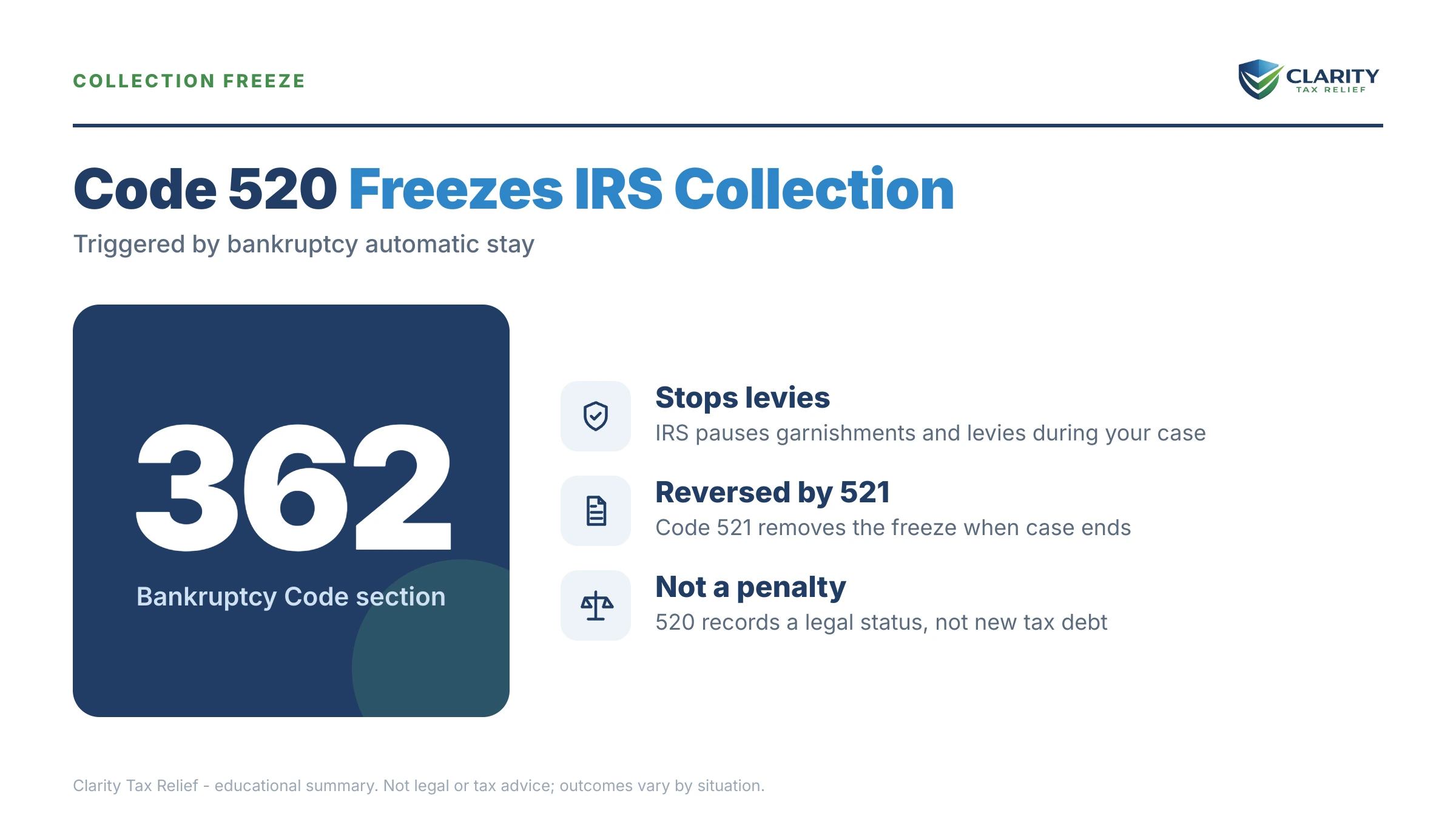
An active code 520 stops levies, garnishments, and nearly all collection notices — but it does not erase a single dollar of tax. While the freeze runs:
- Enforcement stops. No new bank levies, wage garnishments, or seizures against the frozen years. In a bankruptcy, collecting in violation of the automatic stay is a serious problem for the IRS, and the 520 is how it polices itself.
- Interest keeps running on any tax that will survive the case. The balance you see when the freeze lifts is bigger than the one that went in.
- Refunds get held or redirected. The IRS commonly reviews refunds on frozen accounts, may offset them against the debt, and in Chapter 13 the trustee may claim them under your plan.
- The CSED pauses. The 10-year collection statute stops running during a bankruptcy's automatic stay and for six months after it ends; Tax Court and CDP proceedings also suspend it while pending. See what extends the IRS collection statute for the full tolling list, or estimate your own dates with our CSED Calculator.
Two things a 520 does not do. It doesn't decide whether your tax debt gets discharged — that depends on the bankruptcy discharge rules for taxes (the 3-year, 2-year, and 240-day tests), which most recent debt fails. And it doesn't remove a federal tax lien already on record: even when personal liability is discharged, a filed lien can survive bankruptcy and stay attached to property you owned when you filed. On the transcript, look for a code 582 lien indicator near your 520 — for a homeowner, that pairing changes everything about a refinance.
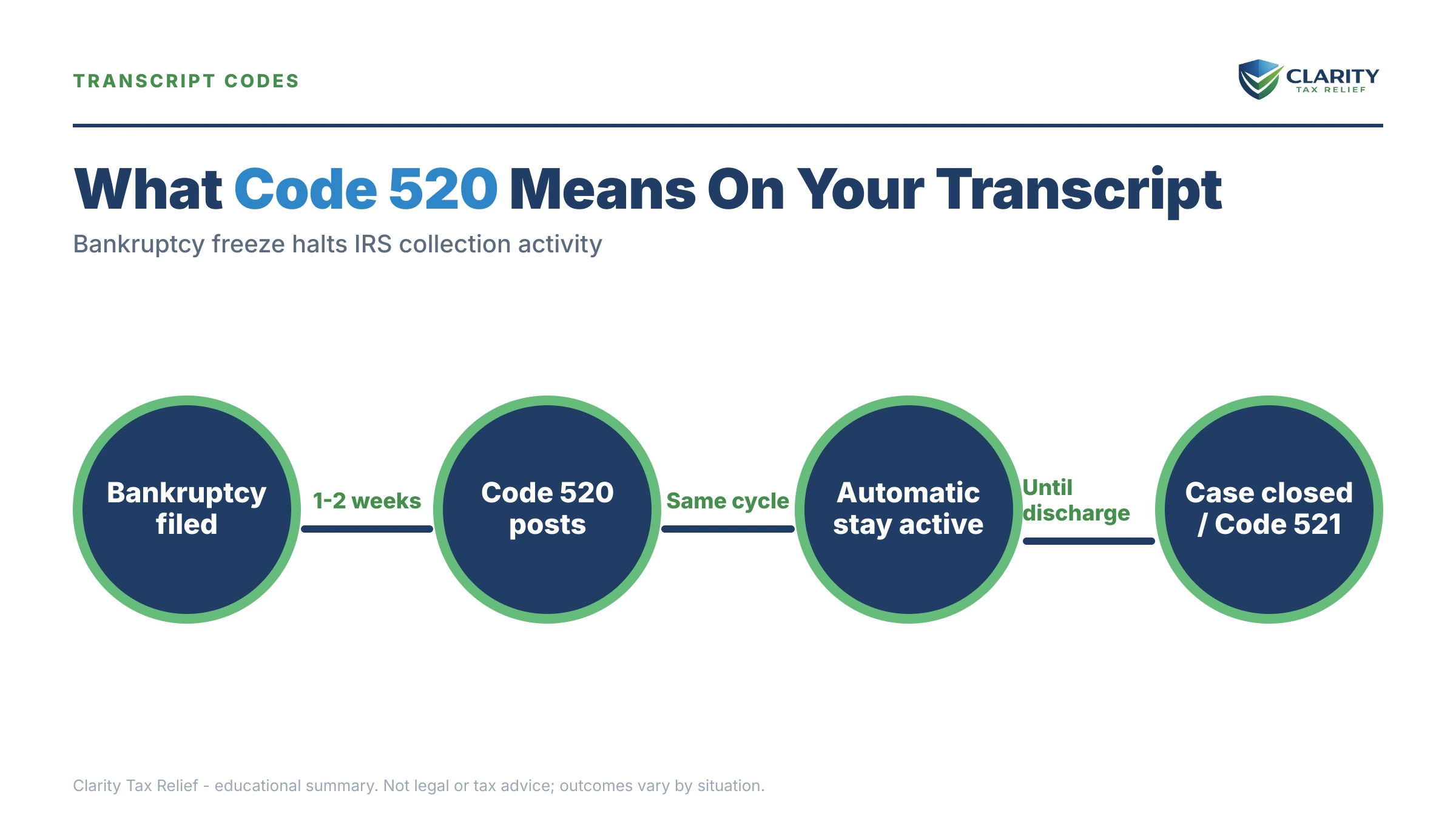
What happens next: the life cycle of a 520 freeze
A code 520 always ends the same way — with a code 521 release and the surviving balance returning to collection. The sequence runs in this order:
- 520 posts. Collection systems lock. Levies stop, notice streams pause, the account shows the legal-action flag for each frozen year.
- The freeze runs. Interest accrues on debt that will survive; the CSED clock is stopped; refunds are held or applied. In Chapter 13, this stage can last the full three-to-five-year plan.
- The case concludes. Discharge, dismissal, a Chapter 13 plan completion, a Tax Court decision, or a CDP determination — something formally closes the proceeding.
- Code 521 posts, releasing the freeze. Any dismissed or nondischargeable balance reactivates. If the debt was fully discharged or paid through the plan, the module zeroes out instead.
- Collection resumes — with more runway. Notices restart quickly, and because the CSED was suspended (plus six months after a bankruptcy), the IRS has more time to collect than the calendar suggests. On the surviving balance you'll also see interest and penalty lines resume posting — that's what code 196 interest assessments and code 276 failure-to-pay penalties look like on the transcript.
The trap in this sequence is stage 5. People come out of a bankruptcy assuming the tax problem went with it, ignore the first post-521 notices, and meet a levy months later — on a debt the IRS now has extra years to collect. The week the 521 posts is your window to set the surviving balance up on your own terms.
Staring at a 520 and not sure what survives?
Send us your transcript. An experienced tax professional will identify what triggered the freeze, what balance will come out the other side, and the smartest move to make before code 521 posts and collection restarts — free and confidential.
Decoding the 520 and the codes around it
The codes surrounding a 520 tell you where you are in the story. Use this table to place each one:
| Code | What it means | What to do |
|---|---|---|
| 520 | Bankruptcy or other legal action filed; collection frozen for that year | Match its date to your bankruptcy petition, Form 12153, or court petition; confirm one posted for every year you owe |
| 521 | Freeze released; the case concluded and any surviving balance returns to collection | Act within weeks — set up a resolution before the notice stream escalates |
| 522 | The 520 was posted in error and has been reversed | Verify the rest of the account reflects reality; keep the correction letter |
| 582 | Federal tax lien indicator on the account | Critical for homeowners — a lien can survive bankruptcy and block a clean refinance |
| 150 | The original return posted and tax assessed — the assessment date starts the 10-year clock the 520 pauses | Note its date; it's the starting point for any CSED math |
| 971 | A notice or miscellaneous action — often the court notification or post-release letters | Read the paired notice; near a 521 it usually means collection letters have restarted |
Your options while the freeze runs — and after it lifts
A 520 buys time; how you use that time decides what the debt costs you. While the freeze is active, your moves depend on the trigger:
- Bankruptcy 520: your bankruptcy attorney drives, but the tax side still needs attention — confirm which years meet the discharge tests, whether a lien was filed pre-petition, and that every current-year return gets filed on time. Fresh tax debt during a Chapter 13 can sink the plan. Our guides to Chapter 13 and back taxes and how bankruptcy stops an IRS levy cover the mechanics.
- CDP 520: the hearing itself is your negotiation. Appeals can consider a payment plan, an Offer in Compromise, or hardship status as collection alternatives — arrive with a proposal, not just objections.
- Litigation 520: the court decides the liability; nothing to set up until the decision fixes the number.
Once code 521 posts, whatever balance survived is ordinary collectible debt again, and the realistic options track the amount:
| Surviving balance | Realistic options | Key requirement |
|---|---|---|
| Under $10,000 | Guaranteed installment agreement; short-term plan (up to 180 days, $0 setup) | All returns filed; pay within 3 years for the guaranteed IA |
| $10,000–$25,000 | Streamlined installment agreement, no financial disclosure | Full-pay within 72 months or by the (now-extended) CSED |
| $25,001–$50,000 | Online 72-month plan — direct debit typically required at the top of this band; OIC or hardship status if finances warrant | Direct-debit enrollment; current-year compliance |
| Over $50,000 | Non-streamlined agreement with full financials (Form 433); OIC; Currently Not Collectible | Complete financial disclosure; the IRS verifies ability to pay |
One nuance worth knowing: fresh out of a bankruptcy, an Offer in Compromise deserves a hard look before you default to a payment plan. If the case stripped your equity and your income is thin, the collection-potential math may finally work — the IRS accepted roughly 1 in 5 offers in FY2024, so candidacy is a math question, never a given.
Refinancing your home with a code 520 on file
Mortgage underwriters see your 520 — lenders pull IRS transcripts during underwriting, and a legal-action freeze is exactly the kind of flag that generates conditions. What happens next depends on which 520 you have:
- Active Chapter 13: taking on new mortgage debt during the plan generally requires trustee or court approval, and the lender will want that approval in the file. It's done regularly — plan it with your bankruptcy attorney rather than springing it on the trustee.
- Recent discharge, 521 not yet posted: the transcript can lag the courthouse. If your case is closed but the freeze still shows, get the discharge order into your loan file and push the IRS to post the release.
- CDP or litigation 520: there's no bankruptcy on your record at all. A short explanation letter — "this reflects a pending IRS appeal, not insolvency" — plus proof of the proceeding usually resolves the underwriter's question.
- Any 520 with a lien: check for code 582. A recorded federal tax lien, not the freeze, is what actually clouds title. If one exists, you'll be dealing with lien subordination or payoff at closing — our guide to refinancing with an IRS lien maps those paths.
The strategic point for a homeowner: the freeze itself doesn't touch your title. If your transcript shows 520 but no 582, your refinance problem is documentation, not collateral — a very solvable problem.
A worked example: $41,800, a Chapter 13, and a refinance
Say you owe $41,800 for tax years 2021 and 2022, assessed in June 2023 — so the original CSED lands around June 2033. You file Chapter 13 in January 2026; a 520 posts for each year, and your five-year plan treats the recent tax as priority debt paid in full through the plan: roughly $41,800 ÷ 60 months ≈ $697/month toward the IRS alone, before other creditors.
Now the clock math. The automatic stay runs the full five years, and the CSED is suspended for that period plus six months — so if the plan fails and the debt survives, the IRS's deadline slides from mid-2033 to roughly the end of 2038. And the refinance: pulling equity mid-plan in 2028 requires trustee or court approval, which lenders in this situation know how to paper. Complete the plan instead, and by early 2031 you'd have a 521 on the transcript, a $0 balance for those years, and a clean answer for any underwriter. This is a hypothetical illustration — your dates, plan terms, and district practices will differ.
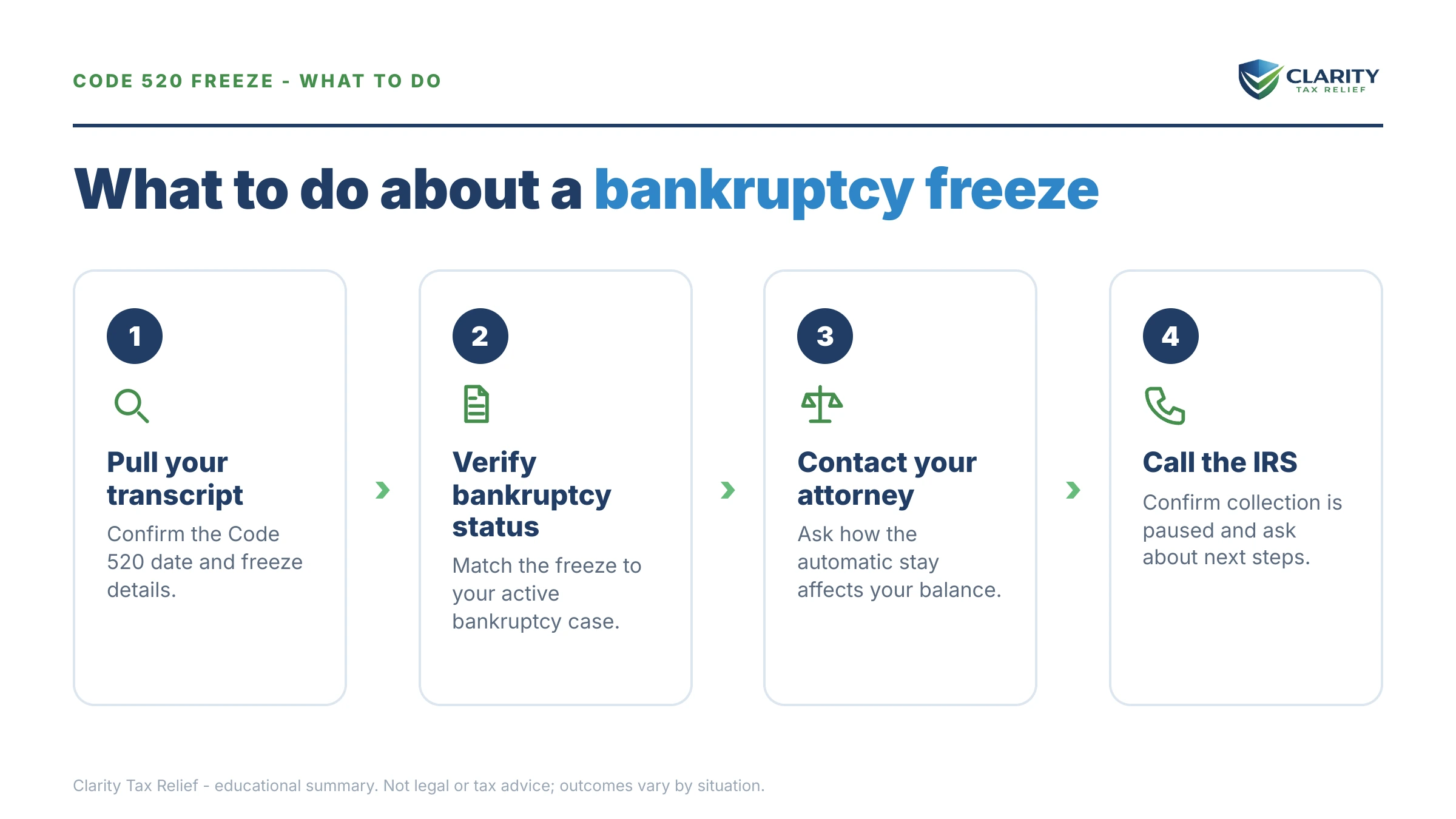
How to respond to code 520, step by step
- Pull your full account transcript. Download the account transcript for every year you owe and note the date on each 520 line — that date tells you which legal action triggered it.
- Match the 520 date to the legal action. Compare it to your bankruptcy petition date, a Form 12153 CDP hearing request, or a Tax Court petition so you know exactly which case the IRS is tracking.
- Verify the freeze matches reality. If the case was dismissed or closed and no code 521 or 522 has posted, contact the IRS with proof so the account status gets corrected.
- Stay current while the freeze runs. File every return on time and pay new-year taxes as they come due — new tax debt can default a Chapter 13 plan or undo the relief you filed for.
- Plan your exit before code 521 posts. Work out now what balance will survive the case and which resolution fits it, so you can act the week collection notices resume instead of scrambling.
When you can handle a code 520 yourself
Often, you don't need extra help for the 520 itself. If you have a bankruptcy attorney, the freeze is working exactly as designed — your only tax jobs are filing on time and confirming the 521 posts when the case closes. If your 520 reflects a CDP hearing you requested with a simple ask (say, converting to a payment plan), you can present that to Appeals yourself. And if the surviving balance will be small enough for a streamlined plan, setting it up online after release takes minutes.
Experienced help changes the outcome in four situations: when the discharge analysis is genuinely close (which years pass the 3-year/2-year/240-day tests can swing tens of thousands of dollars); when a recorded lien sits between you and a refinance and subordination or discharge paperwork has to be sequenced with the lender; when the freeze is stale — case long closed, no 521, and nobody at the IRS picking up; and when the post-521 balance is large enough that the difference between an OIC, a partial-pay plan, and a full-pay plan is real money. Those are judgment calls where a professional review before you commit tends to pay for itself.
Terms on your transcript, decoded
- TC 520: the transaction code that freezes IRS collection because a bankruptcy or other legal action controls the account.
- TC 521: the release code — the case ended and collection can resume on whatever balance survived.
- TC 522: reversal of a 520 that was posted in error.
- Automatic stay: the bankruptcy-court order that bars creditors, including the IRS, from collecting the moment a petition is filed.
- Closing code: the internal number attached to a 520 telling IRS systems whether the trigger was bankruptcy, a CDP hearing, or litigation.
- CSED: the Collection Statute Expiration Date — the end of the IRS's 10-year window to collect, which a 520 suspends.
- Discharge vs. dismissal: a discharge wipes qualifying debts at the end of a successful bankruptcy; a dismissal ends the case with nothing wiped — every frozen tax dollar comes back.
Code 520 questions, answered
What does code 520 mean on an IRS transcript?
Code 520 means the IRS has flagged your account for a bankruptcy filing or other legal action and has frozen collection while that case is open. It is an informational freeze, not a new charge — no tax, penalty, or interest is added by the code itself. The dollar amount next to a 520 is almost always $0.00.
Does code 520 mean my tax debt is being wiped out?
No. Code 520 pauses collection; it does not reduce or erase the balance. Whether any of the debt is eliminated depends on how the underlying case ends — for example, whether the tax meets the bankruptcy discharge rules. Recent income taxes and trust-fund payroll taxes generally survive bankruptcy and return to collection when the freeze lifts.
How long does code 520 stay on my account?
Code 520 stays until the legal action ends, at which point the IRS posts code 521 to release the freeze. A Chapter 7 bankruptcy might keep the freeze in place for a few months; a Chapter 13 plan can keep it there for three to five years. The 520 line itself remains visible on the transcript as history even after release.
Will I get my tax refund with a 520 on my transcript?
Often not automatically. While a bankruptcy-related 520 is active, the IRS typically holds refunds for review, may offset them against your tax debt, and in Chapter 13 your refund can be claimed by the trustee depending on your plan terms. Ask your bankruptcy attorney before counting on a refund check.
Can I refinance or get a mortgage with code 520 on my transcript?
Sometimes, but the 520 will come up. Mortgage lenders pull IRS transcripts during underwriting, and a 520 signals an open bankruptcy or tax litigation. During an active Chapter 13, taking on new mortgage debt generally requires trustee or court approval. If your 520 reflects a Collection Due Process hearing rather than bankruptcy, a letter of explanation plus proof there is no lien often satisfies the underwriter.
Does code 520 pause the IRS 10-year collection statute?
Yes. A bankruptcy freeze suspends the 10-year collection statute (CSED) for the entire time the automatic stay is in effect, plus six more months afterward. A 520 tied to a Tax Court case or CDP hearing also suspends the clock while the matter is pending. The IRS gets back every day the freeze was active — the debt does not quietly age out during a 520.
What if the code 520 is on my transcript by mistake?
It happens — usually when a bankruptcy was dismissed or closed and the release never posted, or when the IRS mis-keyed a case. The IRS uses code 522 to reverse a 520 that was input in error. Call the IRS Centralized Insolvency Operation for bankruptcy freezes, or send proof of the dismissal or closure, and ask that the freeze be corrected.
What does code 521 after code 520 mean?
Code 521 is the release: it tells the IRS computer the bankruptcy or legal action is over and collection can resume on whatever balance survived. Watch the weeks after a 521 posts — collection notices restart quickly, and your response windows begin running again. That is the moment to lock in a payment plan or other resolution.
Your next 24 hours
- Find the 520's date on your transcript. Pull the account transcript for each year you owe from IRS.gov's Get Transcript tool and confirm which legal action each 520 date matches — and whether a 582 lien line sits nearby.
- Gather your case papers. Bankruptcy petition or discharge order, Form 12153 or Tax Court petition, and your last filed return — everything needed to prove what stage the case is in.
- Get a free transcript review. Interest is accruing and the collection clock is only paused, not shrinking — use the 2-minute form at claritytaxrelief.com/#consult or call (888) 825-7779 and an experienced tax professional will map what survives the freeze and how to handle it.
If the surviving balance turns out bigger than you can pay at once, the IRS payments page covers official payment channels, and the independent Taxpayer Advocate Service can help when a stale freeze or misapplied case status won't clear through normal channels.
This guide is general information, not tax or legal advice for your specific situation. Eligibility for IRS programs depends on individual facts and circumstances; no outcome is guaranteed.