
IRS Transcript Codes
Code 810 Refund Freeze on Your IRS Transcript: What It Means and How to Get It Released (2026)
The short answer: a code 810 refund freeze means an IRS unit has stopped your refund from being paid while it checks something on your return — most often your identity or a refundable credit. You don't owe anything and nothing is being seized. The freeze stays until that same unit posts code 811 to release it.
You and your spouse filed jointly months ago, "Where's My Refund" never moved past processing, and tonight you finally pulled the transcript — and found 810 posted on the line where your $13,600 should be. That code is a hold, not a bill and not an accusation. It has a specific trigger and a specific release path, and both are readable on the page in front of you.
The image below shows you exactly what an 810 looks like on a real account transcript and which nearby lines reveal who froze your refund and why. If transcript reading is new to you, our guide on how to read an IRS account transcript covers the layout; this page covers only what's unique to 810.
⏱ Your real clock: code 810 has no printed deadline — the freeze holds your refund indefinitely until it's released with code 811. But if the IRS mailed you a verification or document-request letter, the response date printed on that letter controls. Miss it, and the IRS can disallow the refund instead of releasing it.
Why the code 810 refund freeze is on your transcript
Code 810 means an IRS unit flagged your return before paying the refund — and only that same unit can lift the flag. Unlike the softer code 570 account hold, which often resolves on its own during routine processing, an 810 is a hard freeze that requires a human decision to release.
In practice, four triggers account for nearly all 810 freezes:
- Identity verification. The IRS's return-integrity filters flagged the return as possibly not yours. A 5071C letter, 4883C, or 5747C usually follows, asking you to prove you filed it.
- Questionable refundable credits. The return claims credits the IRS sees heavily abused — the fuel tax credit, sick-and-family-leave credits, or Earned Income Credit and Child Tax Credit claims that don't match its records.
- Frivolous return screening. Returns that resemble known refund schemes get routed to the Frivolous Return Program, which can add a $5,000 penalty per return under IRC §6702 if the position isn't corrected.
- Pre-refund examination. The IRS wants to audit the return before paying. Watch for code 420 or 424 posting after the 810, or reference 1242 on Where's My Refund — code 1242 covers that exam path in detail.
Which trigger applies decides everything about the fix — which is why identifying it is step one, not calling and demanding the refund.
What your transcript shows around an 810 — and what each code means
The codes surrounding an 810 tell you who froze the refund and how far the case has moved. Read the dates and dollar amounts on each line, then match them to this table:
| Code | What it means | What to do |
|---|---|---|
| 150 | Your return posted; this is the tax it computed | Confirm the year and amounts match what you filed |
| 806 | Withholding credited from your W-2s and 1099s | Check it against your actual forms |
| 766 / 768 | Refundable credits posted (CTC, EITC, others) | These are often what the freeze is examining |
| 810 | Refund freeze — no refund pays until released | Identify the trigger; follow the steps on this page |
| 971 | A notice or letter was issued | Watch your mail — the letter names the fix |
| 420 / 424 | Examination opened or requested | Audit path — respond to Letter 566 or CP75 fully |
| 811 | Freeze released by the unit that set it | Good news — watch for 846 next |
| 846 | Refund issued, with the payment date | Nothing — the money is on its way |
A worked example: the $13,600 joint refund
Say you and your spouse filed jointly and the transcript reads: code 150 (tax) $4,400, code 806 (withholding) $11,100, and codes 766/768 (refundable credits) $6,900. Your refund is $11,100 + $6,900 − $4,400 = $13,600 — all of it frozen by the single 810 line, not just the credit portion.
Now the trigger decides the outcome. If it's identity, one successful verification releases the entire $13,600. If it's the credits and an exam disallows them, the refund shrinks to $11,100 − $4,400 = $6,700 — a $6,900 swing that turns entirely on whether you can document eligibility. Same code, very different endings.
One small consolation: if the refund is ultimately paid after a long hold, the IRS generally adds interest for the time it kept your money.
What happens if you ignore an 810 refund freeze
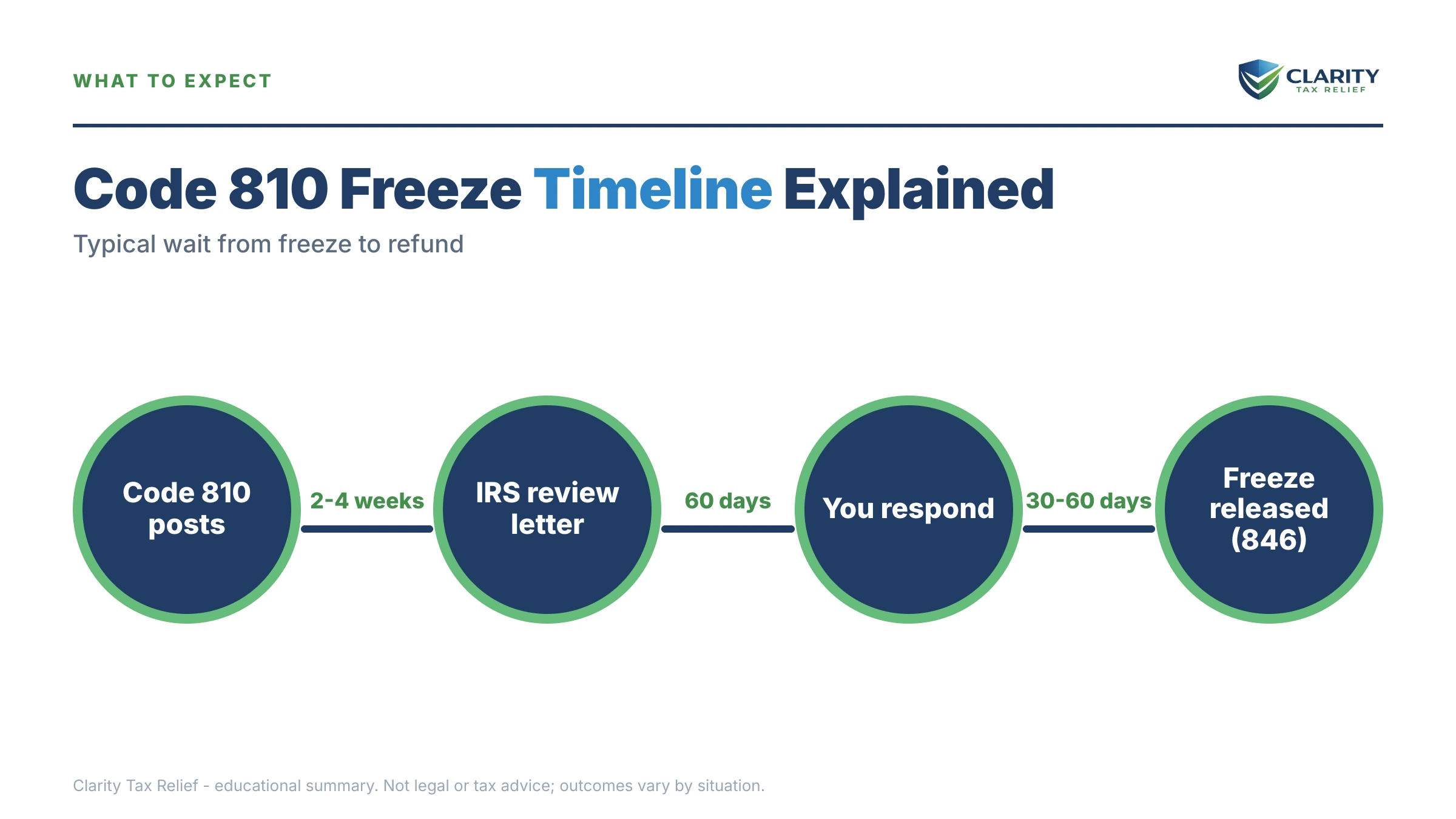
An 810 freeze never times out in your favor — left alone, it moves toward disallowance, not release. The sequence runs in stages:
- The freeze posts. Where's My Refund stalls, sometimes showing Tax Topic 151. No letter yet — the transcript knows before the mail does.
- A letter follows. Identity (5071C, 4883C, or 5747C), a review notice (CP05 or CP05A asking for documents), or an exam opener (Letter 566 or CP75). Each carries a printed response date.
- You don't respond. On the identity path, the return is treated as unverified and the refund is never processed. On the credit path, the exam disallows the credits and a code 290 adjustment rewrites your account without them.
- Formal disallowance. The refund is denied. If the return claimed fabricated credits, the $5,000 frivolous-return penalty can be added — turning a frozen refund into a balance you owe, which then enters IRS collections.
The 2026 wrinkle: with the IRS workforce down roughly 27% since 2025, the letters mail slower and the phones are harder to reach — but the automated freeze itself posts instantly and never forgets. Silence from the IRS is not the same as the case resolving.
Is a code 810 freeze sitting on your refund right now?
Send us your transcript and any IRS letters. An experienced tax professional will identify which unit set the freeze, what it's examining, and the exact response that gets your refund released — free, confidential, no pressure. Letter response windows are short once the mail arrives, so don't wait for the next notice.
Your options to get an 810 freeze released
Every 810 release runs through the unit that set the freeze, and each trigger has its own fix:
- Identity trigger: complete verification through your letter's instructions — online, by phone, or in person for a 5747C. Our guide to the 810 freeze identity verification path walks through it screen by screen.
- Document review (CP05A): send the requested proof — W-2s, final pay stubs, employer letters — by the notice date. This is usually about verifying that your reported withholding is real.
- Credit exam (CP75 or Letter 566): document eligibility for each credit — school and medical records for a child's residency, birth certificates for relationship, income records. Full, organized responses release refunds; partial ones get credits disallowed.
- A return that's actually wrong: if a preparer claimed credits you never qualified for, amend with Form 1040-X. Correcting it voluntarily is the cleanest way to avoid the frivolous-return penalty.
- Hardship or a stalled case: the Taxpayer Advocate Service can intervene when the delay causes real financial harm or the IRS misses its own timelines. Our Form 911 walkthrough shows how to request help.
- Disallowed anyway? You have appeal rights, and a formal claim-disallowance letter starts a two-year window to challenge the denial in court. Don't let a wrong disallowance simply stand.
Here's how the paper stages line up against your rights:
| What arrives | Your window | What you risk if you miss it |
|---|---|---|
| Letter 5071C or 4883C (identity) | The date printed on the letter | Return treated as unverified; refund never processed |
| Letter 5747C (in-person verification) | The appointment window in the letter | Same — the return stays in limbo |
| CP05A (send documents) | The date printed on the notice | Withholding or credits removed from the refund |
| Letter 566 / CP75 (exam) | The date printed on the letter | Credits disallowed; account adjusted with code 290 |
| Formal claim disallowance | Generally 2 years to challenge in court | The refund is permanently lost |
How to respond to a code 810 refund freeze, step by step
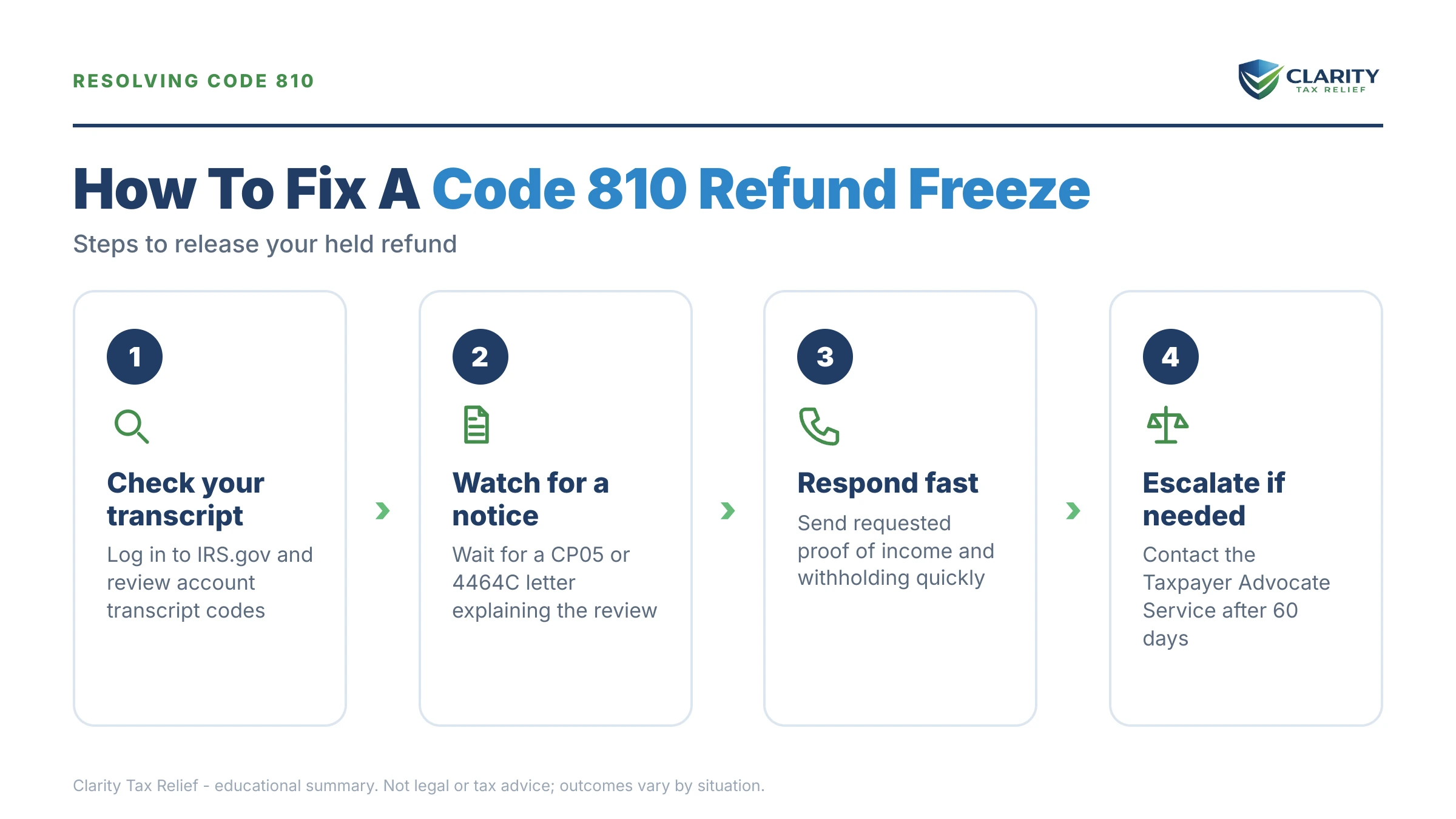
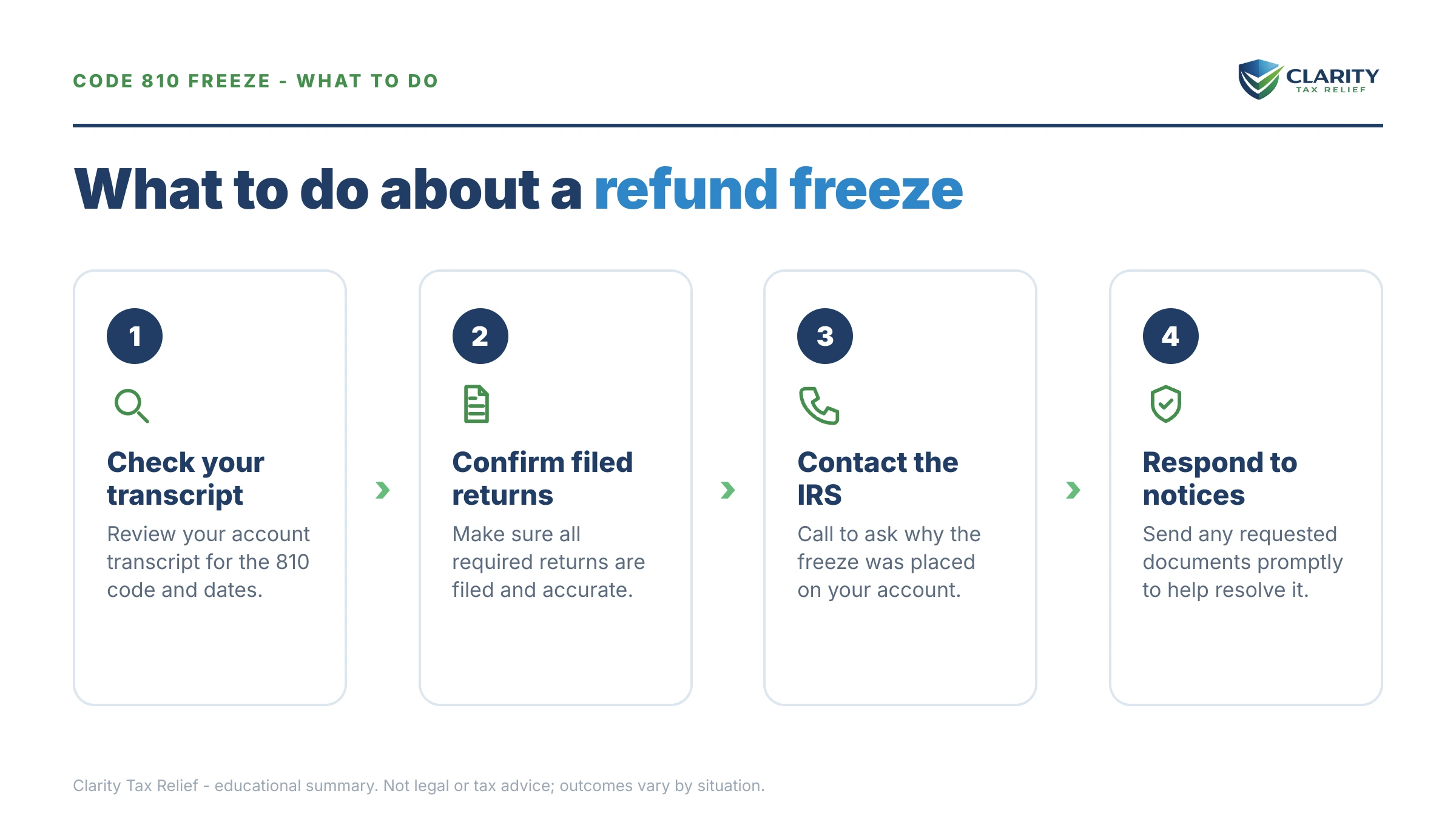
- Pull your free account transcript. Log in at IRS.gov and open the account transcript for the frozen year. Note every code and date near the 810 — a 971 means a notice went out, 420 or 424 means exam, and 811 means the freeze is already released.
- Check your mail and IRS online account for a letter. The letter names the unit that froze your refund and the exact fix — identity verification, documents, or an exam response. The date printed on it is your real deadline.
- Do exactly what the letter asks, before its printed date. Verify identity through the letter's instructions, or send the requested W-2s, pay stubs, or credit documentation. Keep copies of everything you submit.
- Call the IRS if no letter arrives within about 30 days. Call the individual line at 800-829-1040 and ask which function placed the 810 freeze. Knowing whether it's identity, review, or exam tells you the release path.
- Amend if the return claims credits you don't qualify for. If a preparer added a fuel tax credit or another credit you never earned, filing Form 1040-X to correct the return is how you head off a disallowance and a possible $5,000 frivolous-return penalty.
- Escalate to the Taxpayer Advocate if you're stalled or in hardship. File Form 911 when the frozen refund is causing real financial harm or the IRS has missed its own timelines with no explanation.
Code 810 with no letter from the IRS: what it means in 2026
An 810 freeze frequently posts weeks before any letter explains it — the code is automated; the mail is not. In 2026, with IRS staffing cut roughly 27%, that gap has widened: freezes post on schedule while explanation letters queue behind a smaller workforce.
Don't read the silence as either good news or a dead end. Check your IRS online account for digital copies of notices, confirm your mailing address is current (a moved household is a common reason "no letter" arrived), and if a month passes with nothing, call and ask which unit set the freeze. Acting on the trigger — not waiting for paper — is what shortens the hold.
When you can handle this yourself — and when help changes the outcome
Many 810 freezes are genuinely a do-it-yourself fix. If your letter is a straightforward identity verification and the return is accurate, verify and wait — no professional needed. Same if a CP05A just wants copies of W-2s you have in a drawer.
Experienced help earns its cost in four situations: an exam of refundable credits where thousands ride on how eligibility is documented; a return where a preparer claimed credits you now realize were bogus (the frivolous-penalty exposure makes the correction sequence matter); a freeze that has sat for months with no letter and no explanation; and any 810 layered on top of other problems — unfiled years, a balance due on another year, or an identity-theft return filed in your name. The order you fix things in changes what you collect, and a professional review before you respond costs nothing here.
Terms on your transcript, decoded
- Refund freeze: a hard hold that blocks payment of your refund until the unit that placed it manually releases it.
- TC 811: the release transaction — the mirror image of 810, posted only when the freezing unit clears your return.
- RIVO: Return Integrity Verification Operations, the IRS function that screens returns for identity and refund fraud before paying.
- Frivolous return: a return taking a position the IRS deems baseless — fabricated credits are the classic example — punishable by a $5,000 penalty under IRC §6702.
- Reference 1242: a Where's My Refund code meaning your frozen refund was routed to examination, usually paired with Tax Topic 151.
- Cycle code: the eight-digit code showing which weekly processing cycle your account updates in — useful for knowing when to re-check the transcript.
Code 810 refund freeze questions, answered
How long does a code 810 refund freeze last?
There is no fixed timeline — an 810 freeze lasts until the unit that set it posts code 811 to release it. Identity-verification freezes often clear within several weeks of a successful verification, while freezes routed to examination can take months. Watch your account transcript: code 811 followed by code 846 means your refund is moving again.
Does code 810 mean I'm being audited?
Not by itself. Code 810 means your refund is frozen while the IRS decides what to do — many freezes resolve with identity verification or a document review, never reaching an audit. If code 420 or 424 posts after the 810, or Where's My Refund shows reference 1242, your return has been routed toward examination.
Can I call the IRS to remove code 810?
The general refund line usually cannot release an 810 freeze — only the unit that set it can. Calling is still useful: ask the representative which function placed the freeze (identity verification, return review, or exam) so you know exactly what to fix. With IRS staffing down roughly 27% since 2025, expect long holds and call early in the day.
What does code 811 mean after an 810?
Code 811 is the release of the refund freeze — the unit that placed the 810 has cleared your return. It does not put money in your account by itself; look for code 846, the refund-issued date, which typically posts afterward. If 811 appears and no 846 follows within a few weeks, call to confirm nothing else is holding the refund.
Will verifying my identity release the 810 freeze?
If identity verification triggered the freeze, yes — completing verification through your letter's instructions is the release path. Processing is not instant; it can take several weeks after a successful verification for code 811 and then 846 to post. If your freeze came from a credit review instead, verifying identity alone will not release it.
Why do I have code 810 but no letter from the IRS?
Letters lag behind transcript codes, sometimes by weeks — the freeze posts first and the explanation mails later. Check your IRS online account for digital notices and confirm your mailing address is current. If a month or more passes with no letter and no transcript movement, call and ask which unit set the freeze rather than waiting blind.
Can the Taxpayer Advocate Service help with an 810 refund freeze?
Yes, in two situations: the delay is causing financial hardship (eviction, utility shutoff, urgent medical need), or the IRS has blown past its own timelines with no resolution. You request help with Form 911. TAS cannot override a legitimate exam, but it can force a stalled case to a decision.
What happens to my EITC or Child Tax Credit under an 810 freeze?
Refundable credits are the most common target of 810 freezes — the IRS holds the entire refund, not just the credit portion, while it checks eligibility. If the review becomes an exam (often a CP75 letter for EITC), you'll need to document income, residency, and relationship for each child. Prove eligibility and the full refund releases; fail to respond and the credits are disallowed.
Your next 24 hours
- Pull the transcript for the frozen year at the IRS Get Transcript page and write down every code and date near the 810 — especially any 971, 420, or 811.
- Gather your file: the tax return, every IRS letter you've received, your W-2s and 1099s, and — if credits are involved — proof of each child's residency and relationship. If you got an identity letter, the IRS Identity and Tax Return Verification Service is where the verification happens; for hardship escalation, start at the Taxpayer Advocate Service.
- Get a free case review. Send us the transcript and letters through the 2-minute form or call (888) 825-7779. An 810 doesn't lift on its own, and the right response to the right unit is what turns a frozen refund into a paid one.
This guide is general information, not tax or legal advice for your specific situation. Eligibility for IRS programs depends on individual facts and circumstances; no outcome is guaranteed.