
Refund Holds & Offsets
Tax Topic 151: What It Means for Your Refund and Your Appeal Rights (2026)
The short answer: Tax Topic 151 on Where's My Refund means the IRS is reducing or holding your refund — usually because of a debt offset or a proposed change to your return — and it is formally notifying you of your appeal rights. A letter explaining exactly why is already in the pipeline, and that letter sets your deadline.
You checked Where's My Refund expecting a deposit date, and the screen changed to "Take Action — Tax Topic 151, Your Appeal Rights" with no dollar amount, no reason, and no timeline. That vagueness is the worst part. But the message follows a predictable script: it means one of a short list of specific things, and every one of them has a defined fix.
Tax Topic 151 is not a bill, not an audit letter, and not a scam. It is the IRS's status-screen shorthand for "we are taking some or all of this refund, or holding it while we question something, and you have the right to push back." The image below shows exactly what the Tax Topic 151 screen looks like and where the reference number that identifies your specific issue appears.
⏱ Your real clock: Tax Topic 151 itself prints no deadline — the letter that follows it does. When that letter arrives, the response date printed on it controls everything: document requests and proposed changes each carry their own window, and a statutory notice of deficiency starts a fixed 90-day Tax Court clock. Until you respond correctly, the refund stays held and, if the cause is a debt, next year's refund is exposed too.
Why Where's My Refund shows Tax Topic 151
Every Tax Topic 151 message comes from one of two causes: a refund offset to a debt, or a proposed change or review of your return. Which one you have determines everything about how you fix it.
Cause one: an offset. Your refund is being applied to a debt in your name or your spouse's name. That can be IRS back taxes — but more often with Topic 151 it's a non-tax debt collected through the Treasury Offset Program: past-due child support, defaulted federal student loans, a state income tax balance, or an unemployment compensation overpayment. Those offsets are run by the Bureau of the Fiscal Service, not the IRS — which is why calling the IRS about them gets you nowhere.
Cause two: a review or proposed adjustment. The IRS is questioning something on the return before paying out — most commonly the Earned Income Tax Credit, the Child Tax Credit, a dependent claim, or the withholding you reported. The refund sits frozen while the IRS asks you to prove the item, or tells you it plans to change the numbers.
You don't have to wait for the mail to know which branch you're on. Your account transcript and one phone call can tell you today — the step-by-step section below shows how.
Tax Topic 151 vs. Tax Topic 152: one is routine, one is not
Tax Topic 152 is generic processing language; Tax Topic 151 is an action against your refund. Millions of filers see Tax Topic 152 every season and get paid on schedule — it simply means the return is moving through normal processing. Topic 151 is different in kind: the IRS has identified a specific reason to reduce or hold your money and is invoking the appeal process.
If your screen switched from 152 to 151 mid-season, that switch is the signal: something posted to your account — an offset claim, a freeze code, or an examination referral — and a letter is coming that names it.
Reference 1242 and what your transcript shows
The reference number under Tax Topic 151 identifies which system flagged your refund. The one people see most is reference 1242, which means the return has been pulled for review — typically to verify credits or dependents — and the refund is frozen until that review closes.
Your account transcript translates the vague screen into specifics. Pull it free (here's how to get your IRS transcript online) and look at this year's module:
- Code 810 — a refund freeze; nothing pays out until a matching release posts.
- Codes 570 and 971 together — a hold on the account plus a notice on its way to you.
- Code 898 — the refund (or part of it) was sent to another agency through an offset. The amount next to it is what left.
Ten minutes with the transcript usually answers the question the Where's My Refund screen refuses to: is my money frozen inside the IRS, or already gone to someone else?
What happens if you ignore Tax Topic 151
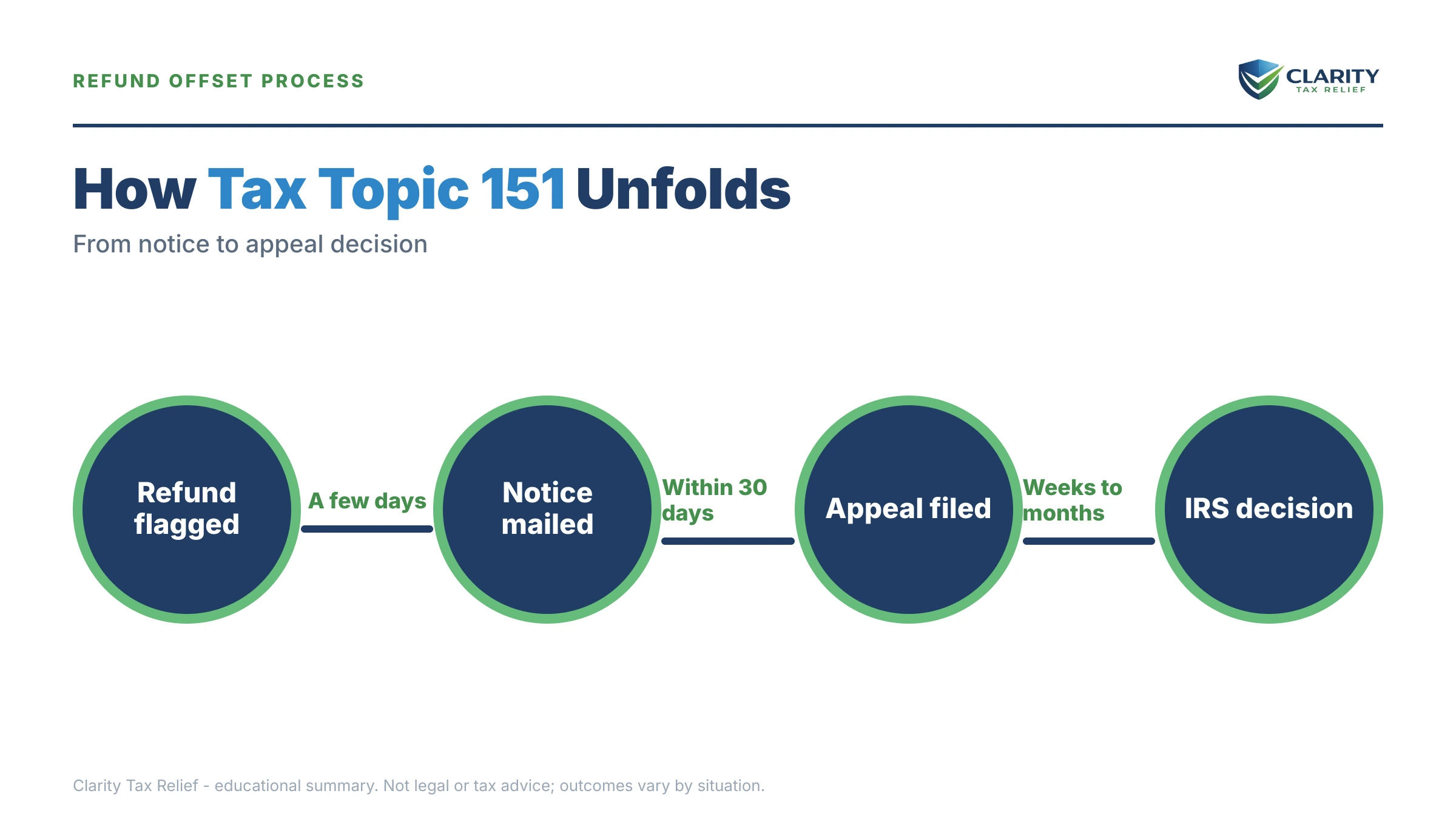
Ignoring Tax Topic 151 doesn't make the hold time out in your favor — it lets the IRS's position become final by default. The sequence runs in stages:
- The status appears. Where's My Refund shows Topic 151; the refund is held or already partially offset. You are here.
- The letter arrives. Either an offset notice showing where the money went, or an IRS letter requesting documents or proposing changes — with a printed response date.
- The window passes. If you don't respond, the IRS finalizes its version: the credit is disallowed, the adjustment sticks, or the held refund is applied and closed.
- A notice of deficiency issues. If the review created additional tax, you receive a 90-day letter — your last chance to contest the numbers in Tax Court before paying. Miss it and that right is gone permanently.
- Collection begins, and repeats. Any assessed balance enters the normal collection notice stream, and if the original cause was a debt, every future refund gets intercepted until the debt is resolved.
The table below maps each follow-up letter to the window it opens and the right you lose if it closes unanswered.
| What arrives after Topic 151 | Your window | The right at stake |
|---|---|---|
| Treasury (BFS) offset notice | No IRS window — disputes run through the agency that took the money | Recovering funds offset in error, or an injured spouse's share |
| CP05 review letter | Usually no response needed; the letter states its own timeframe | Nothing yet — the review simply continues |
| CP05A or CP75 document request | The response date printed on the letter | Release of the frozen refund and the questioned credits |
| 30-day letter (proposed changes) | The 30-day window printed on the letter | A conference with the IRS Independent Office of Appeals |
| CP3219A notice of deficiency | 90 days from the notice date | Your Tax Court petition — lost permanently if the date passes |
Staring at Tax Topic 151 with no letter yet?
We'll decode the hold for free — whether it's an offset, a freeze code, or a proposed adjustment — and tell you exactly what your response window will be when the letter lands. Your refund stays held until someone answers the IRS correctly.
Your options under Tax Topic 151, matched to the cause
Every Tax Topic 151 case has a remedy — but the right one depends entirely on which cause put the message on your screen. Using the wrong channel (calling the IRS about a child-support offset, or arguing with a loan servicer about an IRS freeze) is the single most common way people burn months.
| Option | When you're eligible | How to start |
|---|---|---|
| Respond with documents | The IRS letter asks you to verify income, withholding, credits, or dependents | Send exactly what the letter lists, by its printed date, keeping copies |
| Injured spouse allocation (Form 8379) | A joint refund was offset for your spouse's separate debt | File Form 8379 with the return or after the offset posts |
| Dispute the debt with the owed agency | A non-tax offset (child support, student loans, state debt) is wrong or already paid | Call 800-304-3107 to identify the agency, then dispute directly with it |
| IRS Appeals conference | You disagree with a proposed adjustment and the letter's window is still open | Reply requesting Appeals review (Form 12203 works for smaller cases) |
| Tax Court petition | You received a statutory notice of deficiency | File within the 90-day window — before paying anything |
| Offset bypass refund | An IRS-debt offset would cause severe, documentable financial hardship | Contact the Taxpayer Advocate Service before the refund is applied |
| Amend the return | Your own filing error caused the adjustment and the IRS's math is actually right | File Form 1040-X with the corrected figures and documentation |
If the offset traces back to IRS back taxes you can't pay all at once, the payment-plan and settlement fundamentals live in our guide to how to settle tax debt yourself — the Topic 151 screen is just the symptom in that scenario, and the balance is the disease.
A worked example: a joint refund and a $31,200 debt
Say you and your spouse filed jointly this year expecting a $6,240 refund, and Where's My Refund flipped to Tax Topic 151. The TOP hotline reveals the cause: your spouse's defaulted federal student loans from before your marriage, with a balance of $31,200. This example is hypothetical, but the math is how it actually plays out:
- The offset: the Treasury Offset Program takes the entire $6,240 and applies it to the loans. $31,200 − $6,240 = $24,960 still owed — meaning at this refund size, offsets alone would eat roughly five more filing seasons.
- The injured spouse math: your wages were $58,000 of the couple's $91,000 total income, and your withholding was $8,100 of the $10,600 the couple paid in. Because most of the payments that created the refund were yours, Form 8379 asks the IRS to allocate the refund between you — and in a split like this, a majority of the $6,240 could return to you. The IRS runs the allocation (and community-property states use different rules), so the exact figure is theirs to compute — but the non-debtor spouse is not simply out of luck.
- The longer fix: the debtor spouse deals with the loans directly through the servicer — resolution options for defaulted federal loans exist entirely outside the IRS — while both of you adjust your W-4s so next year's refund is small. A $500 refund can only be offset $500.
The lesson generalizes: the offset is a symptom. File the 8379 to rescue this year, then attack the underlying debt so Topic 151 doesn't become an annual event.
How to respond to Tax Topic 151, step by step
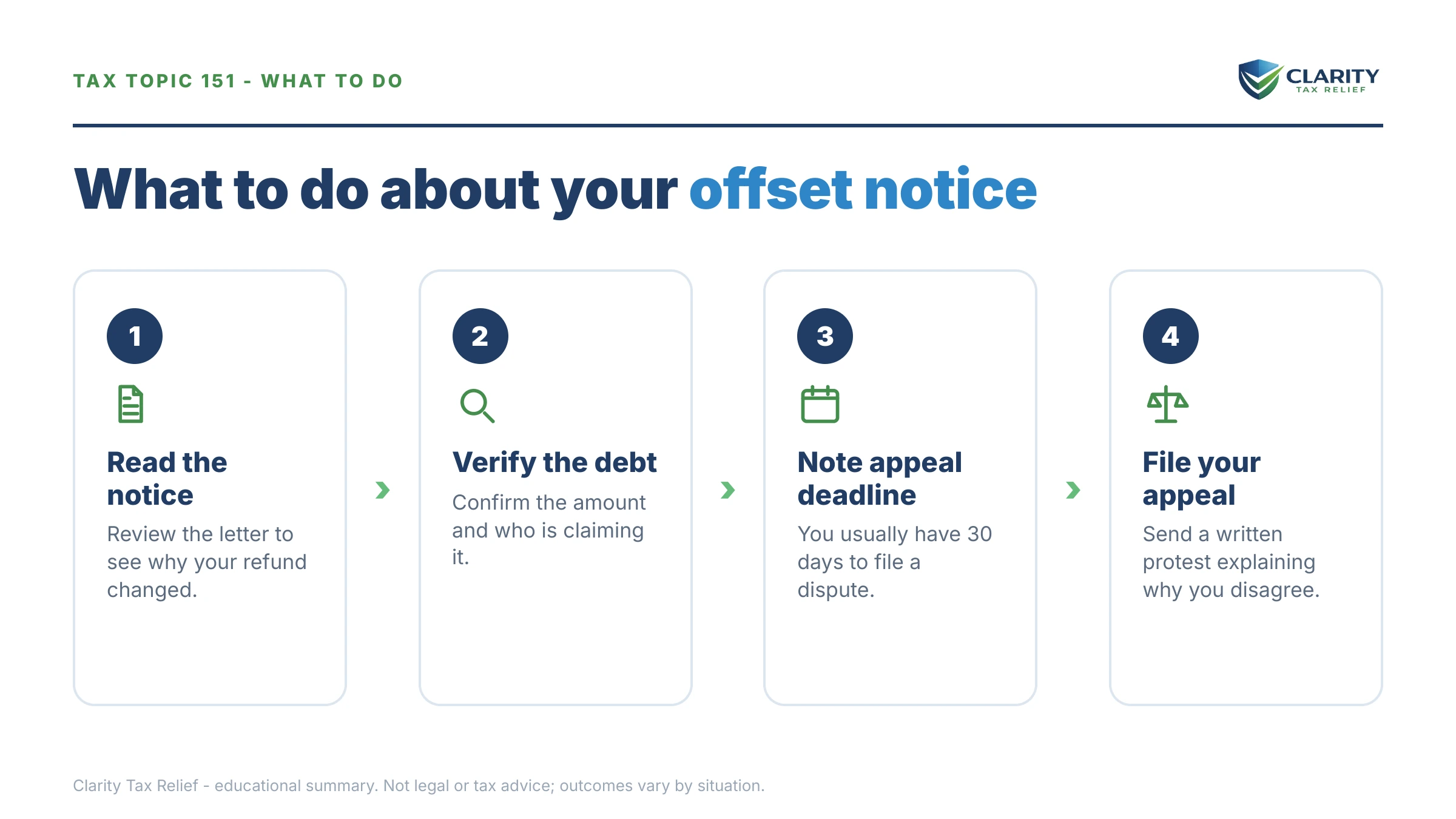
- Pull your IRS account transcript. Log in at IRS.gov and check this year's codes: 810 or 570 means a freeze or hold inside the IRS; 898 means the money went to another agency through an offset.
- Call the Treasury Offset Program hotline. Dial 800-304-3107 to learn whether a non-IRS debt took your refund, how much was taken, and which agency received it.
- Watch your mail and calendar the letter's date. The follow-up letter names the exact issue and prints your response deadline — write that date down the day the letter arrives.
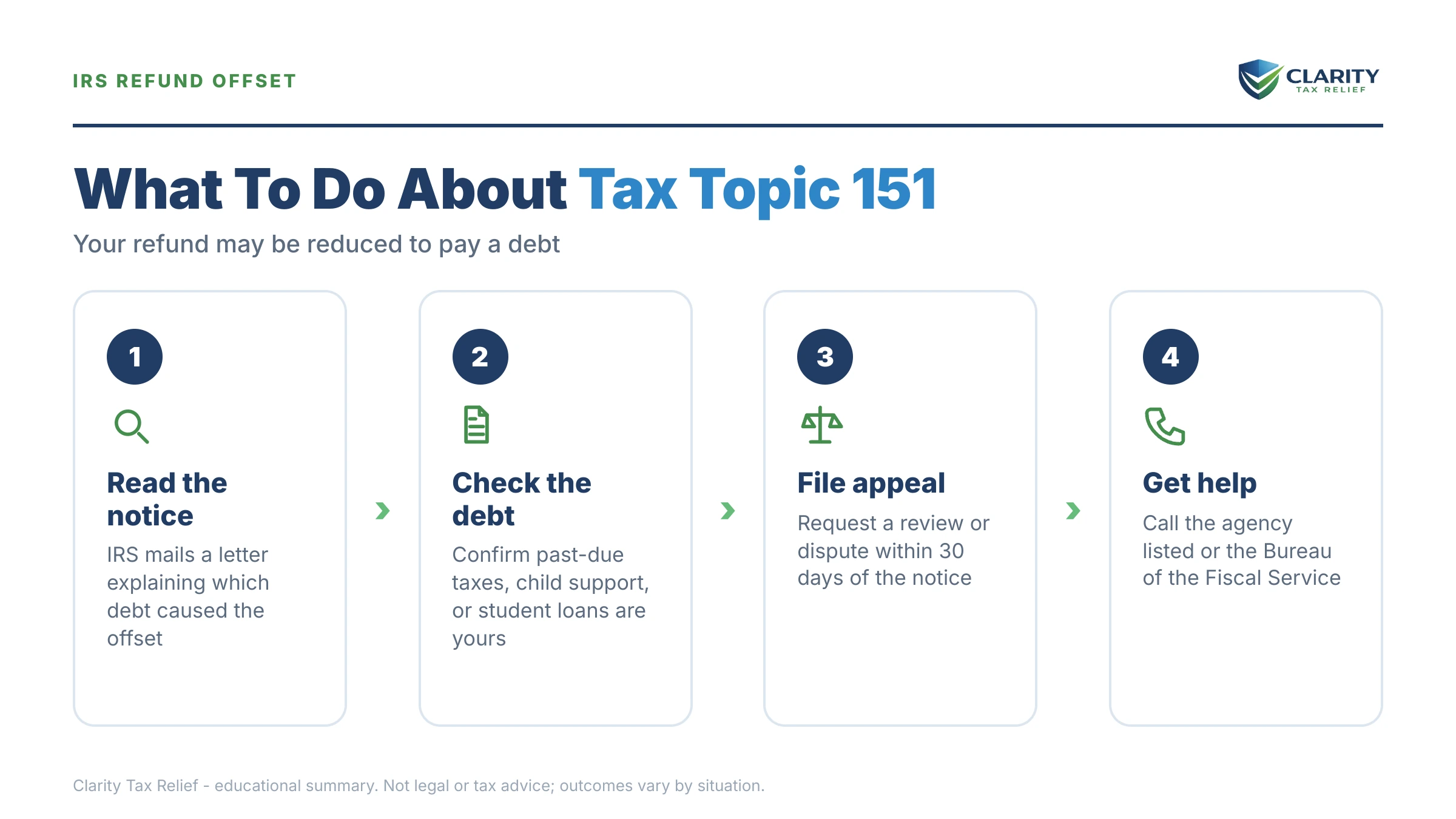
- Respond with the right remedy. Send the requested documents, file Form 8379 if a spouse's separate debt took a joint refund, or dispute a wrong debt directly with the agency that claimed it.
- Escalate before the window closes. Request an Appeals conference if you disagree with a proposed change, and if a notice of deficiency arrives, protect your 90-day Tax Court right.
When you can handle Tax Topic 151 yourself
Most Tax Topic 151 cases are genuinely do-it-yourself. Handle it on your own when the offset paid a debt you know you owe and agree with, when the letter asks for documents you actually have (a W-2, school records for a dependent, proof of residency), or when the fix is a single Form 8379 with clean income numbers. None of that requires paying anyone.
Experienced help changes the outcome in a narrower set of situations: the IRS is proposing to disallow credits worth thousands and you're inside a shrinking appeal window; a notice of deficiency has arrived and the 90-day clock is running; the offset connects to a larger back-tax balance across multiple years; or the review has stalled for months with no human reachable — a real problem in 2026, with the IRS workforce down roughly 27% since 2025 while its automated freezes and offsets run uninterrupted. In those cases, the value isn't filling out a form — it's sequencing the response so you don't concede a right you still hold. A free review of the actual letter (send a photo to the form at our consultation page) will tell you honestly which camp you're in.
Terms on your refund status, decoded
- Offset — your refund being applied to a debt instead of paid to you; legal, automated, and done before you're told.
- Treasury Offset Program (TOP) — the Bureau of the Fiscal Service system that intercepts federal payments for child support, student loans, state taxes, and other government debts.
- Reference 1242 — the Where's My Refund code meaning your return was routed for review and the refund is frozen pending it.
- Injured spouse — a jointly-filing taxpayer whose share of a refund was taken for the other spouse's separate debt; recoverable via Form 8379.
- Independent Office of Appeals — the IRS division, separate from the examiners, that reviews disputed adjustments before anyone goes to court.
- Notice of deficiency — the "90-day letter" that formally proposes additional tax and opens your one pre-payment window to petition Tax Court.
Tax Topic 151 questions, answered
Does Tax Topic 151 mean I'm not getting my refund?
Not necessarily. It means the IRS is holding or reducing your refund, but many Tax Topic 151 cases end with some or all of the money released — for example, after you verify a credit with documents or file an injured spouse claim. If the refund was offset to a debt you genuinely owe, that portion is gone, but you can confirm the exact amount taken by calling the Treasury Offset Program at 800-304-3107.
How long does Tax Topic 151 take to resolve?
There is no fixed timeline, because Tax Topic 151 covers several different situations. A straightforward offset is final within weeks, while a documentation review or proposed adjustment can run several months from the first letter to a released refund. The fastest thing you control is response speed: cases where the taxpayer answers the follow-up letter immediately resolve far sooner than cases that sit unanswered.
What does reference number 1242 mean with Tax Topic 151?
Reference 1242 means your refund is frozen while your return is routed for review, most often to verify credits like the Earned Income Tax Credit or a dependent claim. It usually pairs with a code 810 refund freeze on your transcript and a letter requesting documents. Send exactly what the letter asks for — the freeze is not released until the review closes.
Can I appeal Tax Topic 151?
Yes — announcing your appeal rights is literally what the topic exists to do. If the IRS proposes changes to your return, you can respond with documentation, request a conference with the IRS Independent Office of Appeals, and ultimately petition Tax Court if you receive a notice of deficiency. One exception: non-tax offsets like child support, student loans, and state debts cannot be appealed through the IRS — you dispute those with the agency that claimed the money.
Will Tax Topic 151 take my refund every year?
If the cause is an unpaid debt, yes — the Treasury Offset Program intercepts refunds every filing season until the debt is paid, disputed, or otherwise resolved. A large balance will not be cleared by one refund. The two practical fixes are addressing the underlying debt directly with the agency that holds it, and adjusting your withholding so you stop over-paying money that will just be seized.
What's the difference between Tax Topic 151 and Tax Topic 152?
Tax Topic 152 is the generic "your return is processing" message and usually means nothing is wrong. Tax Topic 151 means the IRS has flagged your refund for reduction or review and is invoking your appeal rights. If your screen switched from 152 to 151, something specific changed on your account — expect a letter in the mail that names the exact issue.
My spouse's debt caused the offset — can I get my share back?
Often, yes. If you filed jointly and the offset paid your spouse's separate debt, Form 8379 (Injured Spouse Allocation) asks the IRS to return your portion of the joint refund based on your income, withholding, and credits. You can file it with the return or after the offset happens. Community-property states use different allocation rules, so results vary there.
How do I find out which debt took my refund under Tax Topic 151?
Call the Treasury Offset Program at 800-304-3107. The automated line tells you whether an offset occurred, the amount, and which agency received the money. For IRS-held reviews rather than offsets, check your IRS online account and account transcript instead — the transcript codes show whether the hold is a freeze, an offset, or a proposed adjustment.
Your next 24 hours
- Find your reference number. Re-check Where's My Refund and note the code shown under Tax Topic 151 (1242 or otherwise) — it identifies which branch of the problem you have.
- Gather three things: a copy of the return you filed, your IRS account transcript for this year, and the result of one call to the TOP hotline at 800-304-3107.
- Get the hold decoded free. Bring those three items to a free case review — the form at claritytaxrelief.com/#consult or (888) 825-7779 — and an experienced tax professional will identify the cause, the remedy, and the response window before the follow-up letter's clock starts working against you. The one certainty with Topic 151 is that the refund stays held until the right answer reaches the right agency.
For the IRS's own description of the topic, see IRS Tax Topic 151, Your Appeal Rights. Injured spouse claims are filed on Form 8379, Injured Spouse Allocation, and if a hold has caused genuine financial hardship, the Taxpayer Advocate Service can intervene at no cost.
This guide is general information, not tax or legal advice for your specific situation. Eligibility for IRS programs depends on individual facts and circumstances; no outcome is guaranteed.