
IRS Transcript & Refund Codes
IRS Code 1242: Your Refund Is Frozen for Review — What to Do in 2026
The short answer: IRS reference code 1242 means your e-filed return was pulled for review and your refund is frozen until an examiner verifies it — usually the credits or withholding you claimed. It appears with Tax Topic 151. The IRS will mail a letter explaining what to send; your refund stays held until you respond.
You checked Where's My Refund expecting a deposit date and got a wall of text instead: "Take Action," Tax Topic 151, reference number 1242 — and no dollar amount. Money you were counting on is now sitting behind a freeze with no explanation on the screen. Here's the good news buried in that jargon: 1242 is a hold, not a denial — and there is a clear, documented path to getting it released.
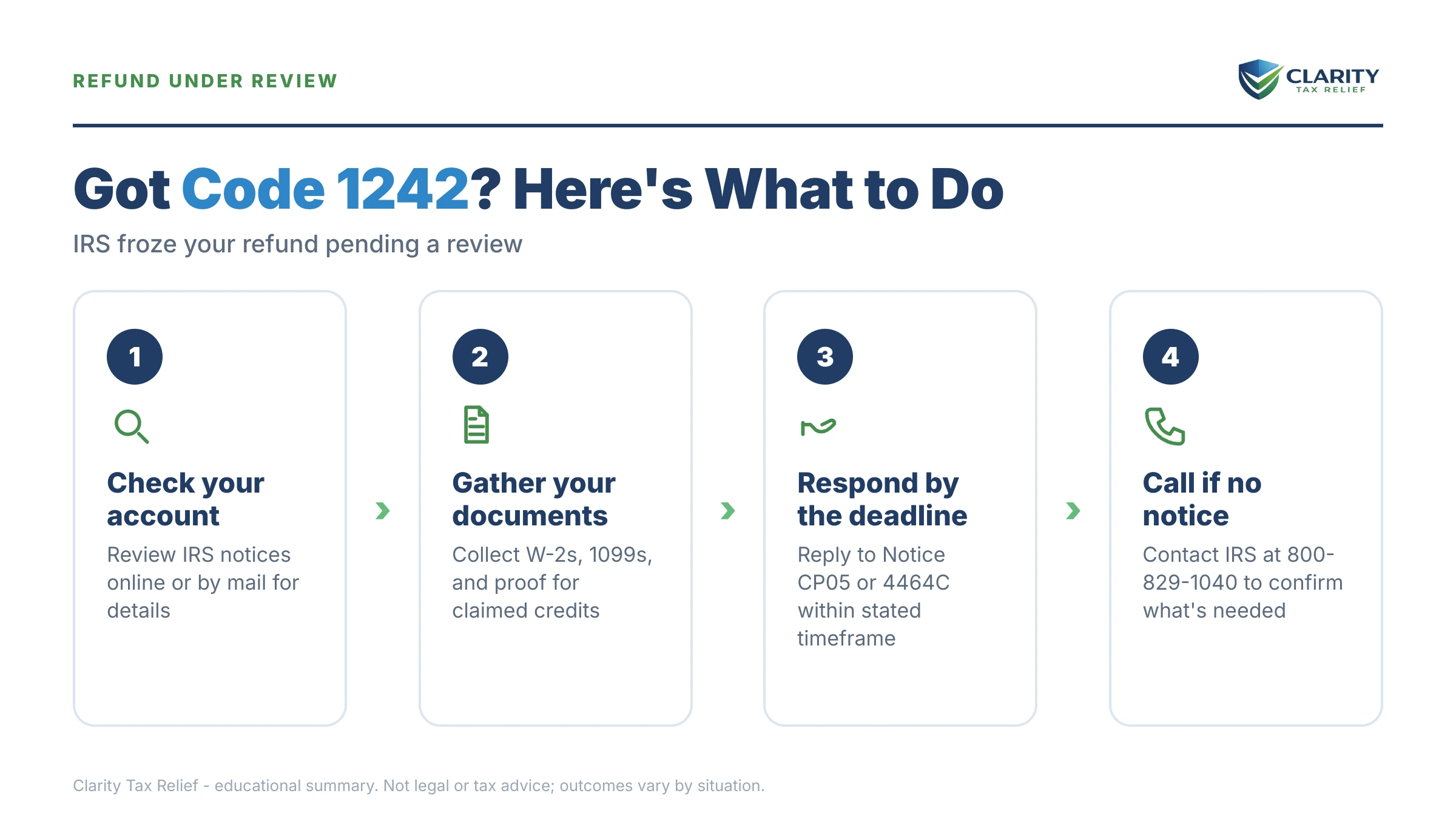
Unlike most codes covered on this site, code 1242 never appears on your transcript. It's a Where's My Refund reference number that maps to what's happening behind the scenes: your return was frozen and routed to the IRS examination function, almost always to verify specific line items before paying out. The image below shows exactly where reference 1242 appears and how to read what the IRS is telling you.
⏱ Your deadline: reference 1242 itself prints no deadline — your clock starts when the IRS letter arrives. A CP75, the most common follow-up, typically gives you 30 days to send documents. Until you respond, your refund stays frozen, and if you never respond, the IRS disallows the items under review and recalculates your refund without them.
Why you got code 1242
Code 1242 means an automated filter froze your electronically filed return and referred it to examination before paying your refund. No human decided to target you — the IRS screens returns against fraud and accuracy filters, and returns claiming refundable credits are screened the hardest because those credits are a major fraud target. The most common triggers are:
- Refundable credit claims — the Earned Income Tax Credit, Additional Child Tax Credit, or a newly claimed dependent, especially a child claimed for the first time or claimed by more than one person.
- Withholding that doesn't match IRS records — if your employer's W-2 hasn't posted to the IRS wage database yet, or the withholding on your return exceeds what the IRS can see, the whole refund can freeze until it's verified.
- A prior-year disallowance — if the IRS disallowed a credit before, a repeat claim without Form 8862-style substantiation draws scrutiny.
- Filing-pattern anomalies — a big year-over-year swing in income, filing status, or refund size compared to what the IRS expects for your SSN.
One thing 1242 is usually not: a pure identity check. If the IRS doubted you filed the return at all, you'd typically be routed to a 5071C identity verification letter instead. With 1242, the IRS believes you filed it — it wants proof of what's on it.
What code 1242 looks like on your transcript
Reference 1242 on Where's My Refund almost always corresponds to a cluster of transaction codes on your IRS account transcript. Pulling your transcript is the fastest way to confirm what stage you're in — if reading it feels like decoding hieroglyphics, start with our guide on how to read an IRS account transcript, then find your codes here:
| Transcript code | What it means alongside 1242 | What to do |
|---|---|---|
| 810 | Refund freeze — the hold that 1242 is reporting. Your refund cannot pay out while it's active. | Nothing releases it except the review closing. Respond fully to the letter. |
| 420 / 424 | Examination indicator or exam request — your return is in (or headed to) audit review. | Expect a document-request letter, most often a CP75. Gather proof now. |
| 570 | Additional account action pending — a general hold that often precedes or accompanies the freeze. | Wait; it resolves when the exam does. Don't file a duplicate return. |
| 971 | Notice issued — a letter is on its way. The date beside it approximates the mailing date. | Watch the mail and confirm the IRS has your current address. |
| 811 | Freeze released — the review closed and the hold lifted. | Watch for code 846 next; your refund is being scheduled. |
| 846 | Refund issued — the date shown is when your money goes out. | Nothing. You're done. |
You'll also see code 150 on the transcript — that just confirms your return posted and is normal on every filed return, frozen or not.
What happens if you ignore code 1242
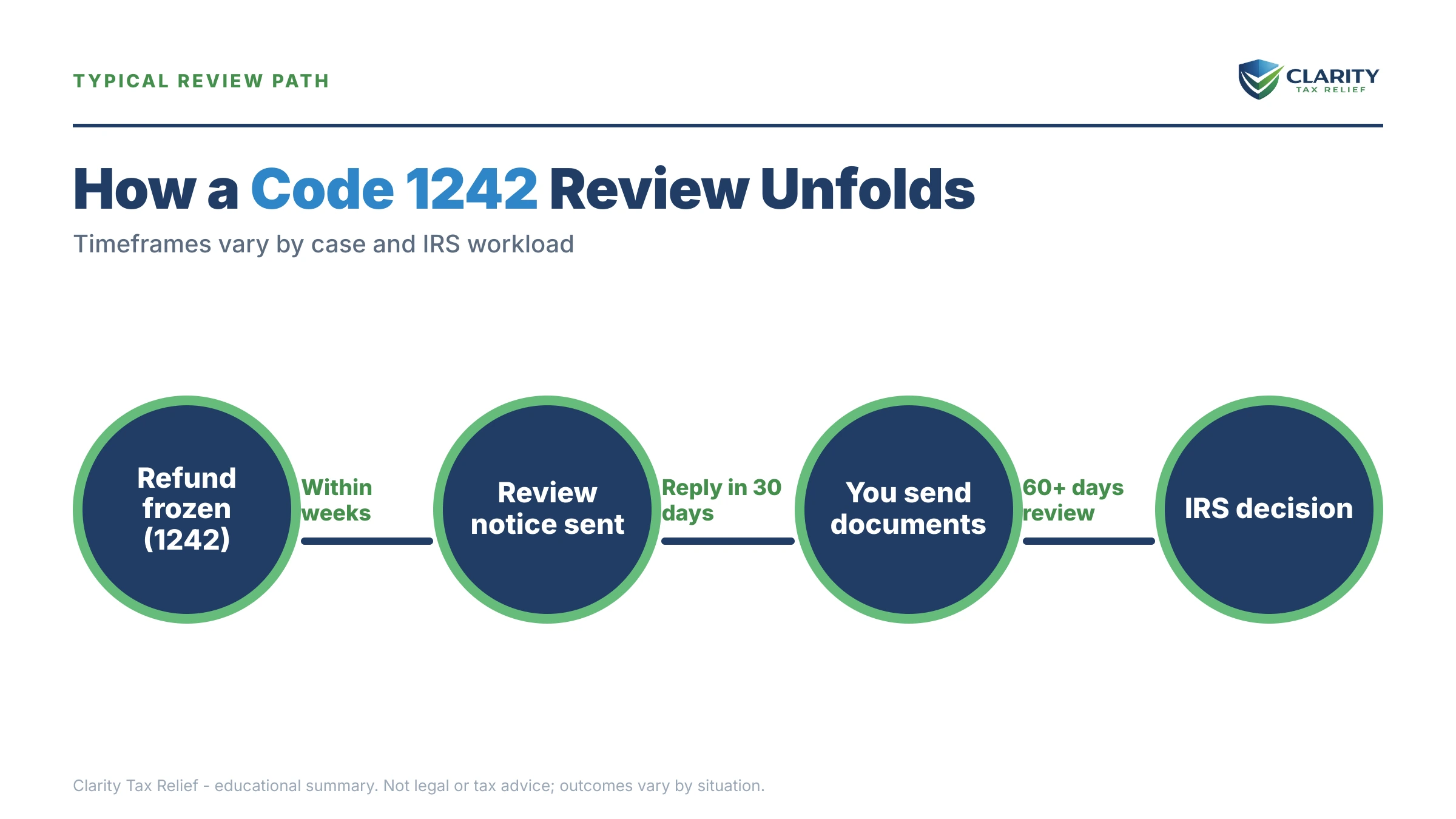
An unanswered 1242 review doesn't stall forever — it ends with the IRS disallowing the frozen items and deciding your refund without you. The sequence runs in stages:
- The letter arrives. Usually a CP75, CP75A, or similar exam letter naming the tax year, the items under review, and a response deadline (typically 30 days on a CP75). Your refund stays frozen while the examiner waits.
- No response → proposed disallowance. The examiner removes the unverified credits or withholding and sends an examination report showing your recalculated refund — or a balance due.
- Notice of Deficiency. If tax changes result, a CP3219A Notice of Deficiency follows, starting a 90-day statutory window to petition Tax Court. It's the last stop before the changes become final.
- Assessment posts. A code 290 additional tax assessment hits your transcript. The disallowed refund is gone, and if disallowed credits exceed your withholding, you now owe money — with penalties and interest accruing on it.
- Future years get harder. After a credit disallowance, you generally must attach Form 8862 to claim it again, and reckless claims can trigger a 2-year credit ban (10 years for fraud). Next year's refund starts life under suspicion.
One more clock runs quietly in the background: refunds must generally be claimed within 3 years, so a frozen refund you never pursue can eventually become a refund you can never collect.
Refund frozen under code 1242 right now?
The letter that follows sets a real deadline — often just 30 days — and a wrong or incomplete response can cost you the entire credit. An experienced tax professional will decode your transcript, tell you exactly what the examiner needs, and help you get the freeze released. Free, confidential, no pressure.
Your options at every stage of a 1242 freeze
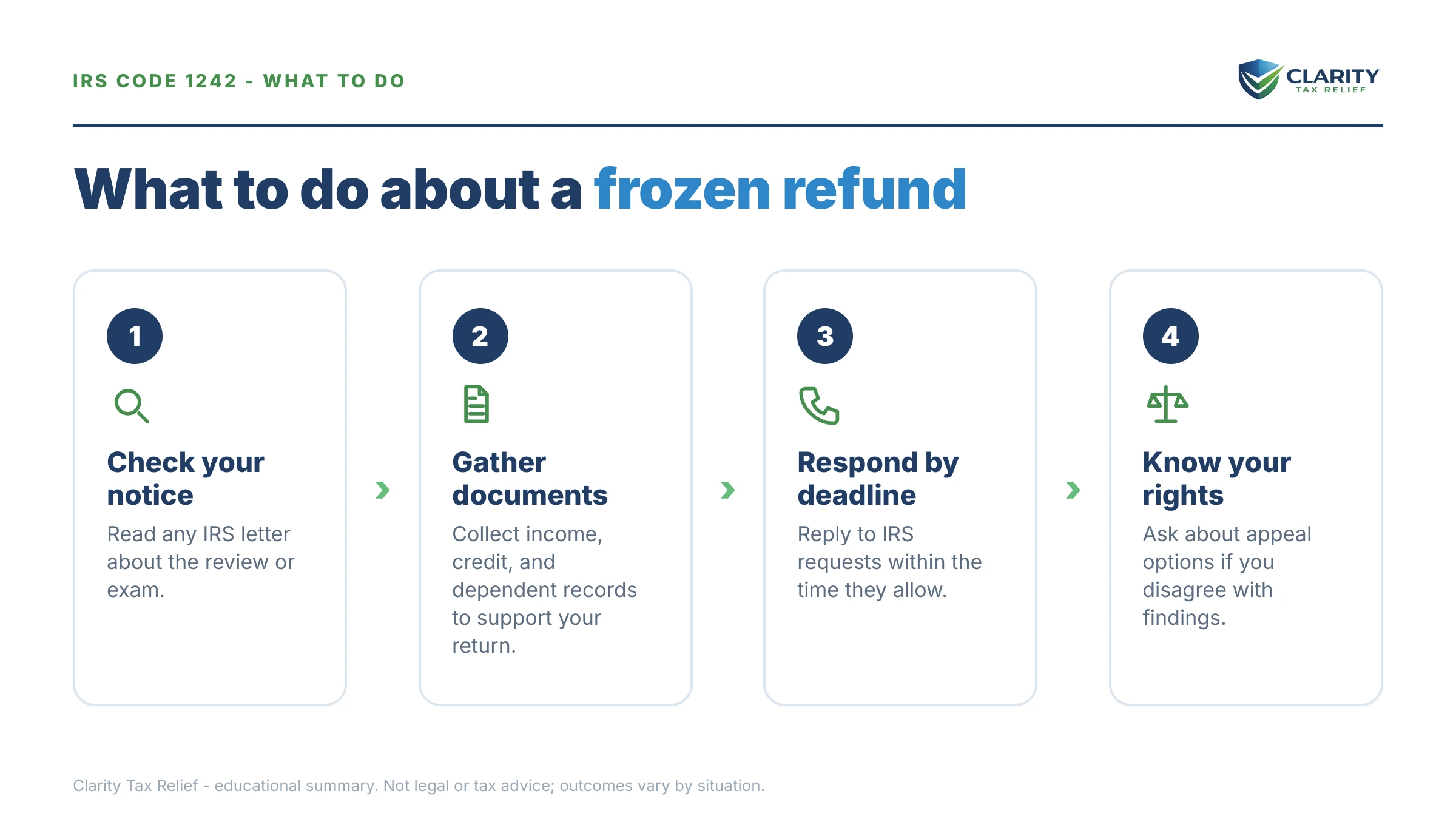
Every stage of a 1242 review has a corresponding remedy — even a closed, disallowed exam can be reopened with the right documents. Which door is open depends on where you are:
| Option | When it applies | How to start |
|---|---|---|
| Respond with documents | The letter has arrived and the deadline hasn't passed — this is the fastest, cheapest path for almost everyone. | Mail or upload copies of everything requested by the printed deadline. |
| Appeals review | You responded, disagree with the exam report, and are within the window printed on the report. | Request an Appeals conference in writing; Tax Topic 151 exists because this right is yours. |
| Tax Court petition | You received a Notice of Deficiency and are within its 90-day window. | File a petition before day 90 — this deadline cannot be extended. |
| Audit reconsideration | The exam closed against you (often because you missed the deadline) but you now have documents the examiner never saw. | Request IRS audit reconsideration with the new evidence. |
| Taxpayer Advocate Service | The frozen refund is causing genuine financial hardship — eviction risk, utility shutoff, medical need — or the IRS has sat on your complete response for months. | File Form 911 with the Taxpayer Advocate. |
| Amend the return | You review your return and realize the flagged item actually was claimed in error. | Tell the examiner you agree to the correction — often faster than filing a 1040-X mid-exam. |
How to respond to code 1242, step by step
- Pull your account transcript. Log into your IRS online account and check which codes posted alongside the freeze — 810, 420, or 570 tell you whether your return is in examination or simply on hold.
- Watch the mail. The IRS sends a letter — often a CP75 — naming the tax year, the exact items under review, and your response deadline.
- Gather your proof now. For a credit review that means birth certificates, school or medical records showing your child at your address, your lease, and your W-2 with a final paystub.
- Respond by the letter's deadline. Send copies of every requested document — never originals — and keep proof of mailing or the upload confirmation.
- Track the release on your transcript. Code 811 means the freeze lifted; code 846 with a date means your refund is on the way.
- Appeal if you disagree. Tax Topic 151 appears with 1242 because you have the right to an independent Appeals review before any disallowance becomes final.
A worked example: a $7,400 refund frozen under 1242
Say you're a single W-2 employee expecting a $7,400 refund, built like this on your transcript: $3,650 of withholding (code 806), $2,350 of Earned Income Credit (code 768), and $1,400 of Additional Child Tax Credit (code 766). Check the math: $3,650 + $2,350 + $1,400 = $7,400. Where's My Refund flips to Tax Topic 151, reference 1242 — the filters flagged the child you claimed. Three ways it can end:
- You prove everything. School records and a pediatrician's file show your child at your address all year. The exam closes with no change, 811 releases the freeze, 846 posts, and the full $7,400 arrives — with interest added if the IRS pays more than 45 days after the filing deadline.
- You prove part of it. The records show the child lived with you only four months, failing the residency test. The EITC and ACTC ($2,350 + $1,400 = $3,750) are disallowed, and your refund shrinks to the $3,650 of withholding — still yours, because you actually paid it in.
- You never respond. Same $3,750 disallowance, but now it happened by default, a Notice of Deficiency ran its course, and Form 8862 stands between you and those credits next filing season.
If your 1242 is about withholding instead — say your employer folded and never filed its W-2s — the entire $7,400 can sit frozen until the IRS verifies your wages. Your W-2 and final paystub of the year are the evidence that unlocks it. The difference between outcome one and outcome three isn't luck; it's a complete response mailed on time.
When you can handle a 1242 review yourself
Most single-year 1242 reviews with clean documentation are genuinely do-it-yourself. If your child lived with you all year, the school and doctor have your address on file, and your W-2 matches your return, your response is a stack of photocopies and a certified-mail receipt — see our guide to EIC audit proof of residency for exactly which records examiners accept.
Experienced help changes outcomes in the harder fact patterns: both parents claimed the same child and the tie-breaker rules decide who wins; the income supporting your EITC is self-employment income the examiner doubts; you've already had a credit disallowed and Form 8862 is in play; a Notice of Deficiency has issued and the 90-day clock is running; or more than one year is frozen at once. In those cases, how the evidence is framed — not just whether it exists — decides whether $3,750 in credits survives.
Terms behind code 1242, decoded
- Reference number 1242 — the Where's My Refund code meaning your e-filed return was frozen and referred to examination before your refund pays out.
- Tax Topic 151 — the companion message telling you your refund is being held or offset and that you have formal appeal rights.
- Refund freeze (code 810) — the transcript hold that stops any refund from leaving your account until it's released by code 811.
- Correspondence examination — an audit conducted entirely by mail; you prove specific line items with documents instead of meeting an auditor.
- Notice of Deficiency — the "90-day letter" that makes proposed changes final unless you petition Tax Court in time.
- Form 8862 — the form required to reclaim the EITC or other refundable credits after a disallowance.
Primary sources if you want the IRS's own words: Understanding your CP75 notice, the official IRS refund status page, and the Taxpayer Advocate Service for hardship cases the normal channels can't move.
Code 1242 questions, answered
Is IRS reference code 1242 an audit?
Usually yes, in the mildest form — a correspondence examination handled entirely by mail. The IRS is verifying specific items on your return, most often the Earned Income Credit, the Child Tax Credit, a dependent, or your withholding, before releasing your refund. Nobody visits your home; you prove the items with documents. If you can back up what you claimed, the exam closes and the refund releases.
How long does code 1242 take to resolve?
It depends on how fast the letter arrives and how fast you respond. The IRS typically mails the examination letter within a few weeks of the 1242 reference appearing, and processing your documents can take several more weeks — longer in 2026, with IRS staffing down roughly 27% since 2025. Responding completely and correctly the first time is the single biggest factor you control.
Will I still get my refund with reference 1242?
Yes, if the items under review check out — the freeze is a hold, not a denial. Prove the credits or withholding you claimed and the full refund releases, sometimes with interest added if the IRS pays it more than 45 days after the filing deadline. If you can only document part of what you claimed, you receive a reduced refund rather than nothing.
What is the difference between code 1242 and Tax Topic 151?
They travel together but say different things. Tax Topic 151 is the general message that the IRS is holding or offsetting your refund and that you have appeal rights. Reference number 1242 is the specific code telling you why: your e-filed return was frozen and routed to examination for review. Other reference numbers under Topic 151 point to different issues, so the exact number matters.
What transcript codes show up with reference 1242?
Most people see code 810 (refund freeze) and code 420 or 424 (examination) on their account transcript, often with 570 (additional account action pending) and 971 (notice issued) alongside. The date next to the 971 is a strong clue for when your letter went out. When the review closes in your favor, 811 releases the freeze and 846 shows your refund date.
Should I call the IRS about code 1242?
Wait for the letter first — phone agents generally cannot release an examination freeze, and the letter tells you exactly what to send. If nothing arrives within about a month of seeing 1242, call the main IRS line at 800-829-1040 to confirm a letter was issued and verify your mailing address. If the frozen refund is causing genuine financial hardship, the Taxpayer Advocate Service can intervene through Form 911.
Does code 1242 mean I did something wrong?
No. Returns are selected by automated filters, and refundable-credit claims are screened heavily because they are a major fraud target — honest filers get caught in the same net. The freeze is the IRS asking for proof, not an accusation. Respond with complete documents and most 1242 reviews close without any change to the return.
What happens if my credits are disallowed after a 1242 review?
Your refund is recalculated without the disallowed credits, and if you already received money you may owe some of it back. Going forward, you generally must attach Form 8862 to claim the credit again, and the IRS can ban reckless claims from the credit for 2 years — 10 for fraud. If you disagree, you can appeal, petition Tax Court within 90 days of a Notice of Deficiency, or request audit reconsideration with new documents.
Your next 24 hours
- Confirm the code. Pull up Where's My Refund, screenshot the Tax Topic 151 / reference 1242 message, then log into your IRS online account and note which transcript codes posted — 810, 420, 570, 971 — and their dates.
- Build your evidence folder. This year's return, your W-2 and final paystub, and — if you claimed a child — school, medical, or lease records tying that child to your address for the year.
- Get a free case review. The letter's response window is short and a first response is the one that counts most — send us your transcript and situation at the 2-minute form or call (888) 825-7779, and an experienced tax professional will map your fastest path to a released refund.
This guide is general information, not tax or legal advice for your specific situation. Eligibility for IRS programs depends on individual facts and circumstances; no outcome is guaranteed.