
IRS Transcript Codes
Code 150 IRS Transcript: What It Means and How to Read It (2026)
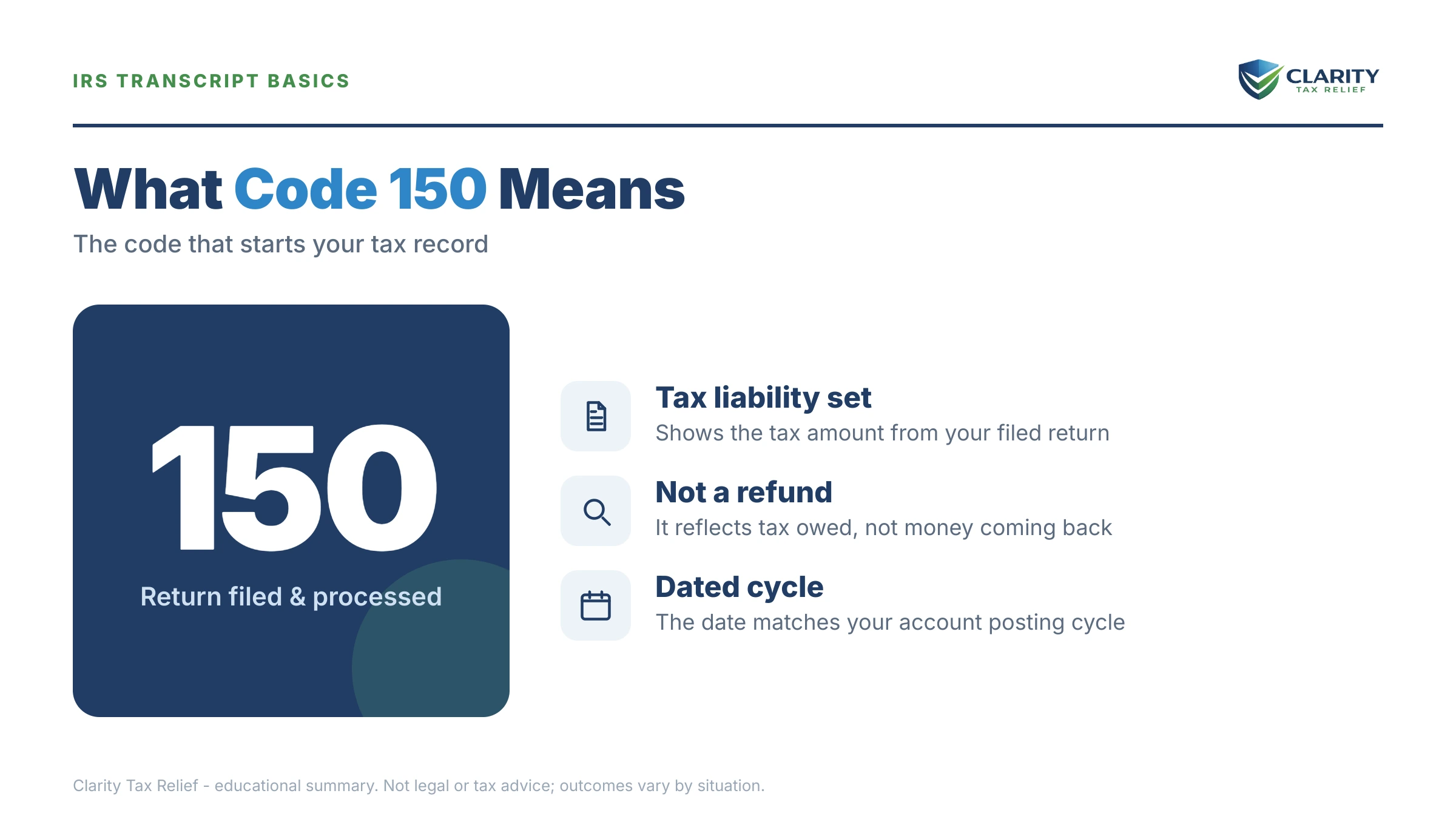
The short answer: code 150 on an IRS transcript means the IRS processed your tax return and officially assessed the tax on it. The amount beside code 150 is your total tax liability for the year — not your refund and not a bill — and the date beside it is your official assessment date.
You pulled up your account transcript to check on your refund, and the first line under "Transactions" is code 150 with a dollar figure that matches nothing on your return — not your refund, not your withholding, not anything you recognize. That mismatch is the whole confusion, and it clears up fast once you know what the 150 line actually measures.
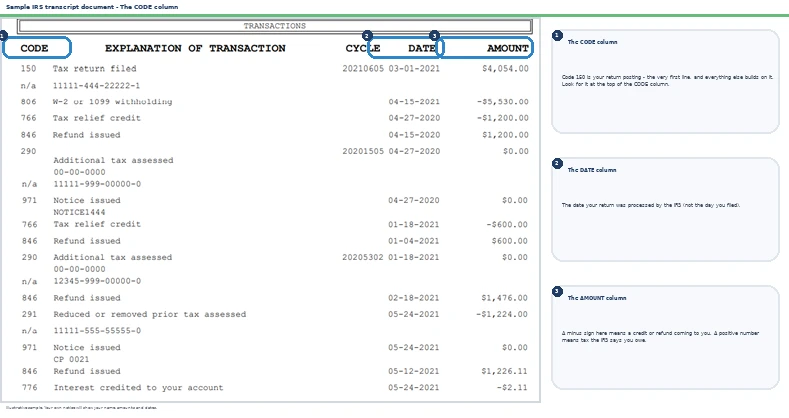
Two figures on the code 150 IRS transcript line do all the work — the amount and the date — and the image below shows you exactly what that section of the transcript looks like and where to look. Once you can read those two figures, every other code on the page falls into place around them.
⏱ The clocks behind code 150: the code itself sets no response deadline. But if the assessment left a balance due, failure-to-pay penalties and daily-compounding interest have been accruing since the return's original due date — and the IRS's 10-year collection statute starts running from the code 150 assessment date.
What code 150 on an IRS transcript means
Code 150 is the transaction that creates your tax record for the year: it posts when the IRS finishes processing a return and formally puts the tax on its books. Every processed return gets one. It is the anchor line of the transcript — withholding, credits, holds, and refunds all post as separate codes above and below it. (If the transcript's layout itself is the confusing part, our guide on how to read IRS account transcript pages walks the whole document top to bottom.)
A code 150 gets onto your transcript one of three ways:
- You filed and the return processed. The normal case — 150 posting means processing of the return itself is complete.
- The IRS adjusted the return during processing. The 150 amount may differ from your Form 1040's total tax line if a math error or credit change was applied — a notice explaining the change usually follows.
- The IRS filed for you. A 150 on a year you never filed typically means the IRS filed a substitute return for me-territory: an SFR built from W-2s and 1099s with no deductions beyond the basics. If you later file your own return, a code 599 IRS transcript entry shows the IRS logged it — and your real numbers can replace the inflated SFR assessment.
What code 150 is not: it is not an audit flag, not a refund approval, and not a bill. Audits show as code 420; refunds show as code 846; bills arrive later by mail if the math leaves a balance.
The amount next to code 150 is not your refund — or your balance
The dollar figure on the 150 line is your total tax liability for the year — essentially the total tax line from your Form 1040 as the IRS processed it. Your withholding and refundable credits post separately as negative entries, so the 150 amount alone tells you nothing about whether you're getting money back or writing a check. Subtract the negative lines below it from the 150 amount: negative means refund, positive means balance due.
A 150 of $0.00 is also normal. It means no tax was assessed — usually because the standard deduction zeroed out a modest income, or because refundable credits carry the whole refund.
The date next to code 150: your assessment date
The date on the code 150 line is the day your tax was legally assessed — and if you owe, it starts the IRS's 10-year collection window. That window, called the CSED, is explained in our guide to how long the IRS can collect back taxes; certain events like an offer in compromise or bankruptcy pause it. If you're staring at a 150 on an old year and wondering how much collection runway the IRS has left, you can estimate it with our CSED Calculator.
Don't confuse the assessment date with your filing date. If you e-filed in late January, the 150 date is often weeks later — it reflects the IRS processing cycle, not the day you hit submit.
Code 150 and the codes around it
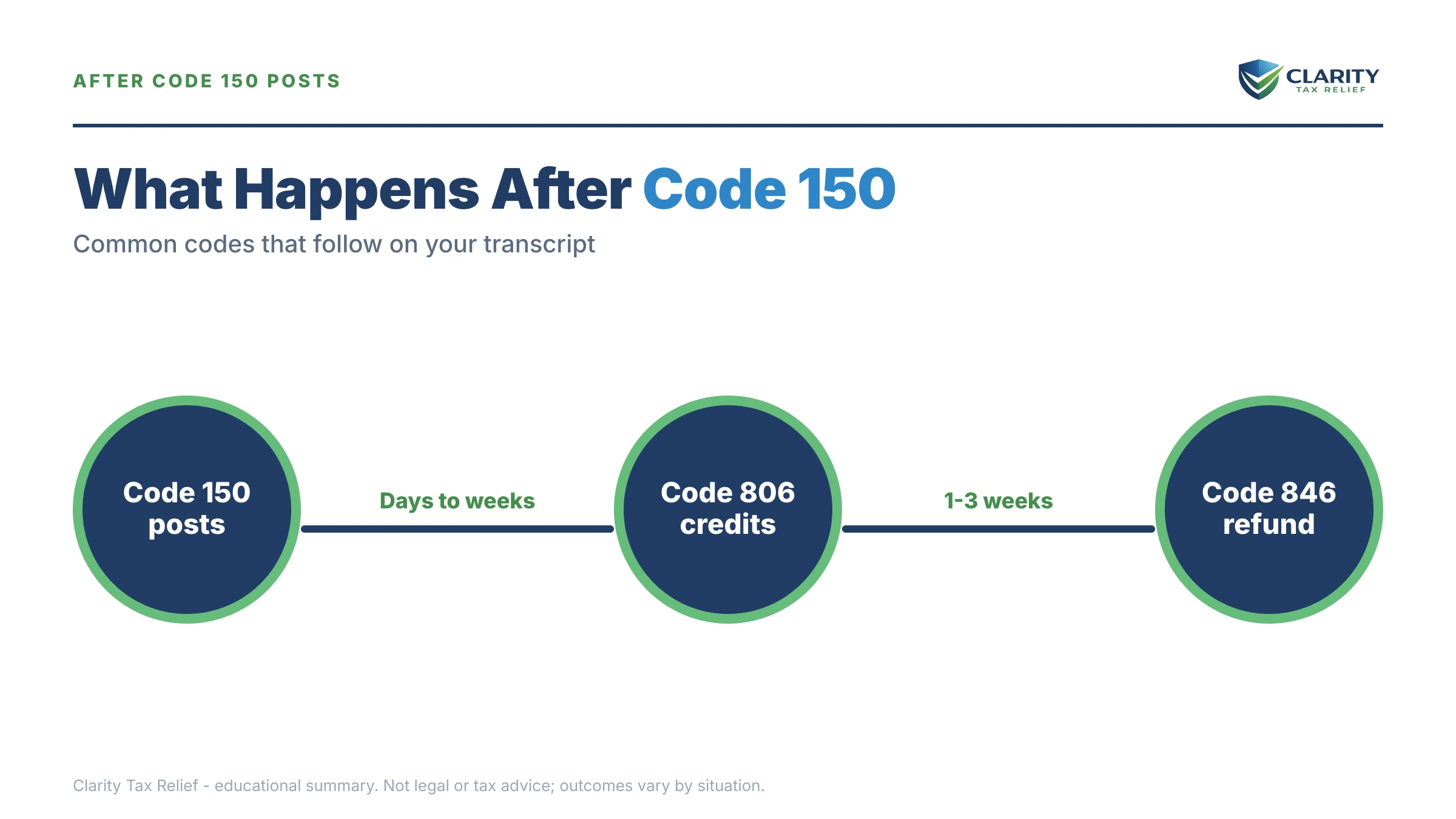
A code 150 almost never appears alone — the lines around it are what tell you whether a refund, a hold, or a bill comes next. Here's the decoder for the companions you're most likely to see:
| Code | What it means | What to do |
|---|---|---|
| 806 | Federal withholding from your W-2s and 1099s, posted as a negative (credit) amount | Confirm it matches Box 2 of your W-2s; a shortfall here changes your whole math |
| 766 / 768 | Refundable credits (768 is the Earned Income Credit), also negative amounts | Add them to your withholding when netting against the 150 amount |
| 570 | A hold freezing your refund or account activity while something is reviewed | Wait for the explanation — often a 971 notice — before assuming the worst |
| 971 | A notice or letter was issued about your account | Watch the mail; the letter says what the IRS wants |
| 846 | Refund issued — the code refund-watchers are actually waiting for | The date beside it is when your refund was sent |
| 290 | Additional tax assessed after the original 150 — an adjustment, exam result, or CP2000 outcome | Match it to the notice that triggered it; you may have appeal rights |
| 420 | Examination (audit) indicator on the return behind your 150 | Don't panic and don't ignore it — gather records and respond to the exam letter |
Say your code 150 shows $11,300: the math, worked out
A hypothetical makes the whole read concrete. Say you're a single W-2 employee and your 2025 account transcript shows:
- Code 150: $11,300 — your total tax for the year
- Code 806: −$8,150 — federal income tax withheld from your paychecks
Net the two lines: $11,300 − $8,150 = a $3,150 balance due. That balance now grows on two tracks: a failure-to-pay penalty of 0.5% per month (about $16 a month at this balance) plus interest that compounds daily at the federal rate.
At $3,150, your realistic moves are simple. Pay in full and both accruals stop. Take a short-term plan and spread it over up to 180 days — roughly $525 a month over six — with no setup fee. Or set up a monthly installment agreement: about $88 a month clears the principal over 36 months, though accruals continue until it's paid off, so faster is always cheaper.
Flip the numbers to see the other outcome: if your 806 withholding were −$12,400 against the same $11,300 assessment, the transcript points to a $1,100 refund — and the line to watch for next is the 846.
What happens if code 150 leaves a balance and you ignore it
An unpaid balance behind code 150 starts the IRS's automated notice sequence, beginning with a CP14 bill that typically gives you about 21 days. From there each unanswered notice hands the IRS more enforcement power:
- CP14 — the first bill for the balance your transcript already shows. No enforcement yet; this is the cheapest moment to act.
- CP501 / CP503 — reminder notices. Still just bills, but penalties and interest have been compounding the whole time.
- CP504 — Notice of Intent to Levy. The IRS can now take your state tax refund, and a federal tax lien becomes a live possibility.
- LT11 / Letter 1058 — the final notice. A 30-day clock starts, along with your Collection Due Process rights (requested on Form 12153). After it runs, the IRS can levy.
- Levy — a bank levy freezes funds for a 21-day hold before they're sent to the IRS; a wage levy is continuous until released.
One 2026 reality check: the IRS workforce was cut roughly 27% in 2025, so reaching a human is harder than ever — but this notice sequence is generated by automated systems that never stopped running. The escalation happens whether or not anyone at the IRS ever reads your file.
Balance behind your code 150 — or a 150 on a year you never filed?
Send us your transcript. An experienced tax professional will decode every line, confirm what you actually owe, and map your options before the automated notice sequence escalates — free, confidential, no pressure.
Your options when code 150 assesses more than you can pay
The IRS has a resolution track for every balance size, and most of them can be set up before the first notice even arrives. Which track fits depends mostly on the amount your transcript math produces:
| Balance after withholding & credits | Realistic options | What it takes |
|---|---|---|
| Under $10,000 | Pay in full, a 180-day short-term plan ($0 setup fee), or a guaranteed installment agreement | No financial disclosure; keep current-year filings and withholding on track |
| $10,000 – $25,000 | Streamlined installment agreement, set up online | No Form 433 financials; direct debit optional at this level |
| $25,001 – $50,000 | Online long-term plan, up to 72 months; streamlined terms generally require direct debit above $25,000 | Still no full financial disclosure in most cases |
| Over $50,000 | Installment agreement with financial disclosure (Form 433-F), Currently Not Collectible status, or an Offer in Compromise where the math supports it | Full income, expense, and asset review; every option here is means-tested |
Two add-ons can shrink the balance itself. If the assessment includes penalties and your prior three years are clean, First-Time Penalty Abatement can remove them — and starting summer 2026, the IRS's new Automatic Exemption from Penalty (AEP) applies similar relief automatically, with no request needed. An Offer in Compromise is real but narrow: the IRS accepted roughly 1 in 5 offers in FY2024, and eligibility turns entirely on what your income and assets show the IRS could ever collect.
How to respond to code 150, step by step
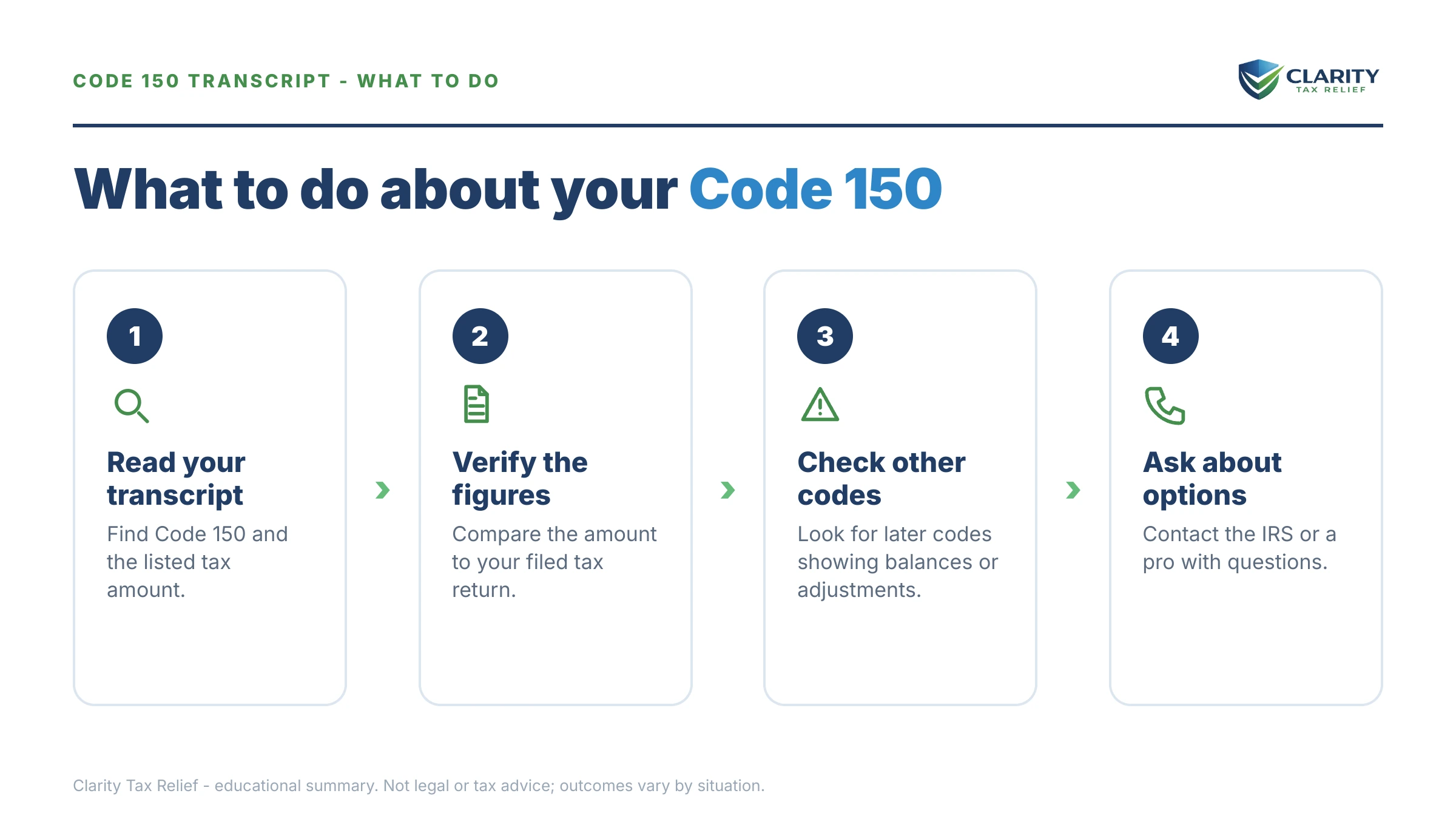
- Find the code 150 line. Open your account transcript for the tax year and locate transaction code 150. Write down the amount and the date beside it — those two figures drive everything else.
- Do the balance math. Subtract the negative entries below it — code 806 withholding and codes 766/768 credits — from the 150 amount. A negative result points to a refund; a positive result means a balance due.
- Compare against your return. Match the 150 amount to the total tax line on your Form 1040 copy. If they differ, the IRS changed something during processing — watch for a math-error or adjustment notice explaining why.
- Check for holds and exam codes. Scan below the 150 line for code 570 (hold), code 971 (notice issued), or code 420 (exam) before assuming a refund is on the way.
- Act on any balance before the first bill lands. If the math shows you owe, pay at IRS.gov/payments or set up a payment plan now — the CP14 bill that follows typically gives you about 21 days before the notice sequence escalates.
When you can handle code 150 yourself — and when help changes the outcome
Most code 150 lines need no response at all — the code confirms normal processing. You can confidently handle this on your own when the 150 amount matches your return, the math points to a refund, or the balance due is small enough to pay within 180 days — the IRS payment plans page lets you set that up online in minutes.
Experienced help changes outcomes in a few specific situations: a 150 posted on a year you never filed (an SFR assessment is almost always inflated, and replacing it takes a properly prepared original return), a 150 followed by code 420 exam activity, multiple years showing balances at once, or a balance over $25,000 where the setup you choose — plan type, penalty relief, or a means-tested alternative — meaningfully changes the total you pay. In those cases the order you fix things in matters as much as the fix itself.
Terms on your transcript, decoded
- Assessment — the formal act of recording tax on the IRS's books; code 150 is that act for your return.
- Transaction code (TC) — the three-digit codes the IRS master file uses to log every action on your account.
- Cycle code — the eight-digit number near your 150 line showing the year, week, and day your return posted; our IRS cycle code meaning guide decodes it digit by digit.
- "As of" date — a projected balance-calculation date the transcript uses for interest math; it is not a deadline and moves routinely.
- Substitute for return (SFR) — a return the IRS prepares for a non-filer from third-party income reports, with no deductions argued in your favor.
- CSED — the collection statute expiration date: 10 years from the code 150 assessment date, pausable by events like an offer in compromise or bankruptcy.
Code 150 IRS transcript FAQs
Is code 150 on my IRS transcript good or bad?
Code 150 is neutral — it simply confirms the IRS processed your return and recorded the tax for that year. For most filers it's actually good news, because nothing else can post — withholding, credits, or a refund — until 150 appears. Whether your year ends well depends on the codes around it: an 846 means a refund is coming, while a positive balance left after withholding posts means a bill is coming.
Does code 150 mean my refund is approved?
No. Code 150 means your return posted and the tax was assessed — a refund is approved only when code 846, refund issued, appears with a date. Your withholding (code 806) and refundable credits (codes 766 and 768) post as separate lines, and a hold like code 570 can delay the refund even after 150 appears.
What does the amount next to code 150 mean?
It's your total tax liability for the year — the tax the IRS calculated from your return — not your refund and not what you owe. Payments and credits post as separate negative entries, like code 806 for withholding. Subtract those from the 150 amount: a negative result points to a refund, and a positive result means a balance due.
Why does my code 150 show $0.00?
A $0.00 code 150 means the IRS assessed no tax on the return — common when income was low enough that the standard deduction wiped out the liability, or when refundable credits drive the entire refund. It can also appear on some substitute-for-return postings before the IRS calculates the tax. A zero 150 with credit codes below it usually still produces a refund.
What is the date next to code 150 on my transcript?
It's your official assessment date — the day the tax legally went on the IRS's books. If you filed early, it's often several weeks after you e-filed, because it reflects the IRS processing cycle rather than your filing date. It matters for one big reason: if you owe, the IRS's 10-year collection statute (CSED) runs from that assessment date.
Does code 150 mean I'm being audited?
No — code 150 posts on virtually every processed return and has nothing to do with audit selection. Audit activity shows up as code 424 (an exam request) or code 420 (an audit indicator) on the transcript. If you see 150 with no exam codes below it, your return simply processed normally.
I never filed a return — why is there a code 150 on my transcript?
A code 150 on a year you didn't file usually means the IRS prepared a substitute for return (SFR) using income reported by your employers and banks. An SFR gives you no deductions beyond the basics, so the assessed tax is almost always higher than a real return would show. Filing your own return can replace the SFR figures — often shrinking the balance substantially.
How long after code 150 does the refund code 846 appear?
There's no fixed gap, but on a clean return the 846 refund line typically posts within one to three weekly transcript updates after 150 appears. Holds change that: a code 570 freezes the refund until it's resolved, and an identity-verification letter stops the clock entirely until you respond. Your cycle code tells you which day of the week your transcript updates.
Your next 24 hours
- Pull the line. Open your account transcript (get it free at IRS.gov Get Transcript) and write down the code 150 amount and date for the year in question.
- Gather the paper. Your Form 1040 copy and W-2s — so you can match the 150 amount to your return's total tax line and confirm the 806 withholding figure against Box 2.
- Get it reviewed. If the math shows a balance you can't pay, the 150 sits on a year you never filed, or a hold or exam code follows it, request a free case review at the 2-minute form or call (888) 825-7779 — penalties and interest compound monthly while the transcript just sits there.
This guide is general information, not tax or legal advice for your specific situation. Eligibility for IRS programs depends on individual facts and circumstances; no outcome is guaranteed.