
IRS Transcript Codes
Code 766 on Your IRS Transcript: What This Credit Means for Your Refund (2026)
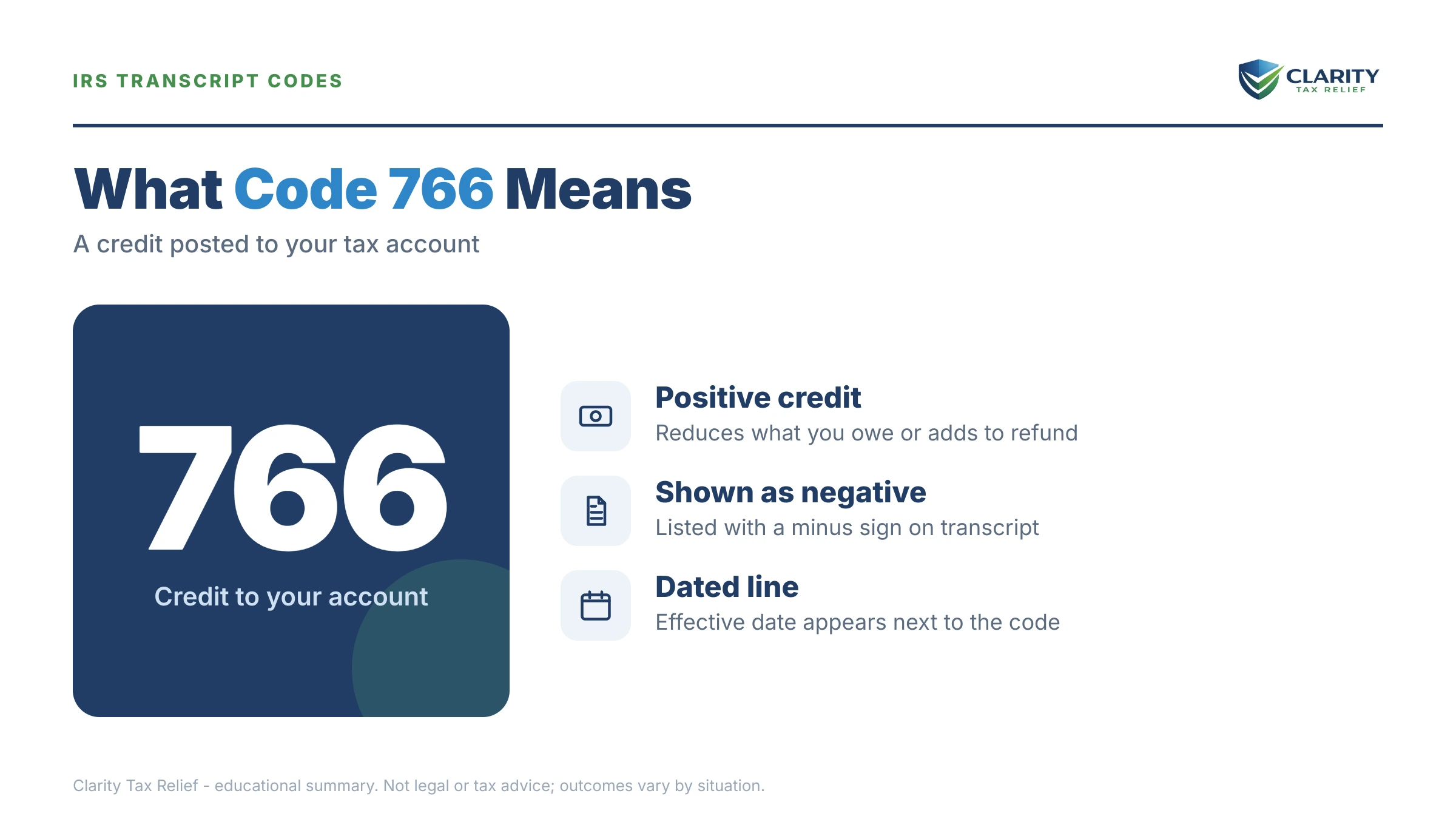
The short answer: code 766 on an IRS transcript means a credit was posted to your account — usually a refundable credit like the Additional Child Tax Credit. The negative amount is money in your favor, not money you owe. But it is not your refund: the refund only exists once code 846 appears.
Code 766 rarely shows up alone. If you also see code 570 on the same transcript, the credit has posted but your refund is frozen while the IRS reviews the account — the money is yours, it just isn’t moving yet.
You filed your Schedule C return, pulled up your account transcript to check on your refund, and hit a wall of numbers — including a code 766 IRS transcript line showing something like −$6,200 next to a date that already passed. A negative number from the IRS looks like bad news at first glance. It's the opposite: on a transcript, negative means the money runs toward you, and this guide maps exactly what has to happen before it reaches your bank account.
The image below shows you exactly where the 766 line sits on a real account transcript and how to read the columns around it — the code, the date, and the amount each answer a different question, and mixing them up is where most of the panic starts.
If the whole document still looks like machine language, start with the hub guide on how to read an IRS account transcript — this article stays focused on the 766 line itself and the handful of codes that decide whether it becomes cash.
Why code 766 appeared on your IRS transcript
Code 766 is the IRS transaction code for a credit posted to your taxpayer account — most often a refundable tax credit from the return you just filed. The IRS master file records everything as debits (positive) and credits (negative), and 766 is the general-purpose credit entry. A negative 766 amount is always money in your favor.
Common sources of a 766 line, especially for self-employed filers, include the refundable portion of the Child Tax Credit, the refundable 40% of the American Opportunity Credit, a net Premium Tax Credit from marketplace health insurance, the fuel tax credit on Form 4136, or a credit transferred in from another tax year. Multiple 766 lines can post on the same transcript — one per credit — so add them together before comparing against your return.
Two codes that look like 766 but aren't: code 768 is specifically your Earned Income Tax Credit, and code 806 is your federal withholding. All three are credit lines that reduce the tax on your code 150 line — they're teammates, not duplicates.
One more thing that trips almost everyone: the date next to 766 is usually April 15 of the filing season. That's the credit's legal effective date — the return's due date, which the IRS uses to compute interest — not the day money moves. It can sit weeks in the past while your refund is still processing, and that's completely normal.
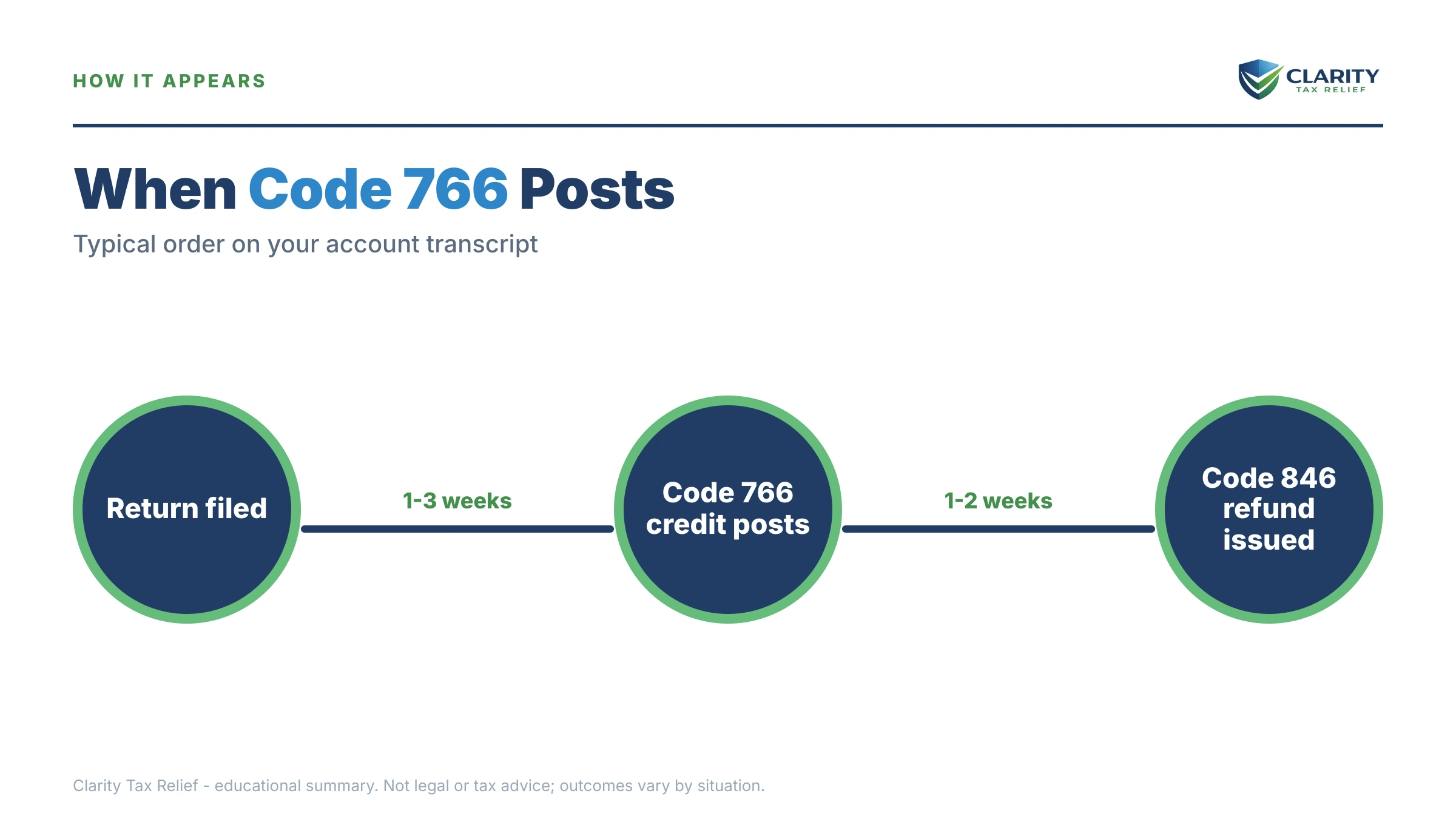
What happens after code 766 posts — the sequence to watch
Code 766 by itself triggers nothing; what matters is which code posts after it. Your account moves through one of three paths, in this order:
- Return and credits post. Code 150 records your return and tax; 766, 768, and 806 record the credit side. At this stage the IRS has accepted the numbers but not approved a payment.
- The clean path: code 846. For most filers, code 846 — refund issued — posts within days to a couple of weeks, and its date is the real deposit or check date. 846 is the only code that means money is moving.
- The hold path: code 570. If something needs review — income that doesn't match IRS records, a credit that needs verification — code 570 posts and freezes the refund. A code 971 often follows, meaning a notice explaining the hold is in the mail. A more serious version is the code 810 refund freeze, which frequently requires identity or credit verification before anything else happens.
- Resolution or adjustment. The hold either releases and 846 posts, or the IRS changes your numbers — a code 290 adds tax, and a code 291 reduces it. If your 766 credit shrinks here, a notice will spell out which credit was adjusted and why.
- The offset path: 826 or 898. If you owe the IRS for another year, code 826 sweeps your credit to that year's balance before any refund is paid. If you owe certain non-IRS debts — past-due child support, defaulted federal student loans, state income tax — code 898 records a Treasury offset. Whatever survives still arrives with an 846.
"Ignoring" a 766 costs you nothing on the clean path — the money comes on its own schedule. The danger is ignoring a 570 or 810 that is waiting on you: an identity verification or document request left unanswered can park a refund indefinitely, because the IRS's automated systems never chase you to release your own money.
Credit posted, but the refund is stuck?
If your code 766 is trapped behind a 570 hold, an 810 freeze, or an offset that swallowed the whole credit, an experienced tax professional can read your complete transcript and tell you exactly what's blocking the money — free, confidential, no pressure.
Where a code 766 credit comes from — and what to check for each
The source of your 766 determines what can go wrong with it, because each credit has its own verification rules. Match your 766 amount to the credits on your Form 1040 before assuming anything else:
| Credit source | Why it posts as 766 | What to check |
|---|---|---|
| Additional Child Tax Credit (refundable portion) | The part of the Child Tax Credit paid even when it exceeds your tax | PATH Act delays early-season refunds until mid-February; dependent SSNs must match exactly |
| American Opportunity Credit (refundable 40%) | Up to 40% of the education credit is refundable | The IRS matches against Form 1098-T from the school — mismatches trigger a 570 hold |
| Net Premium Tax Credit | Marketplace insurance subsidy reconciled on Form 8962 | A missing Form 8962 is a top cause of held refunds — confirm it was attached |
| Fuel tax credit (Form 4136) | Credit for federal tax on fuels used off-highway (farming, some businesses) | Heavily scrutinized for fraud — expect verification if claimed for the first time |
| Credit transferred from another year | An overpayment or misapplied payment moved into this year's account | Check the other year's transcript to confirm both sides of the transfer match |
Note what's not on this list: your withholding (that's code 806), your estimated tax payments (they post under their own payment codes), and the Earned Income Credit (that's 768). If your refund math seems short, the missing money is usually sitting on one of those other lines, not on 766.
What to do based on the codes around your 766
The codes surrounding your 766 — not the 766 itself — decide whether you wait, respond, or push back. This is the decoder for the lines you're most likely to see next to it:
| Code | What it means | What to do |
|---|---|---|
| 768 | Earned Income Tax Credit posted (a specific type of credit) | Nothing — add it to your 766 and 806 when totaling your refund |
| 846 | Refund issued — the date on this line is your money date | Nothing — expect deposit on or shortly after the 846 date |
| 570 | Hold on the account; refund paused for review | Wait one to two weekly cycles; if a 971 posts, respond to the notice promptly |
| 971 | Notice issued — an explanation letter is in the mail | Read it carefully; it usually names the credit under review and what to send |
| 810 | Refund freeze — often identity or credit verification | Act, don't wait: complete any verification requested, or the freeze can sit for months |
| 826 | Your credit was applied to another tax year you owe | Pull that year's transcript to confirm the balance the credit paid down |
| 898 | Refund offset to a non-IRS debt (child support, student loans, state tax) | The offset notice names the agency; disputes go to that agency, not the IRS |
Transcripts refresh on a weekly schedule for most accounts, so checking hourly changes nothing — here's what day IRS transcripts update so you can check once and move on with your week.
A worked example: turning a $6,200 code 766 into an actual refund
Say you're a sole proprietor — call her Maya — who files a Schedule C return. Her tax, including self-employment tax, posts as code 150: $7,800. She has no W-2 withholding, but she made $3,000 in quarterly estimated payments, and she claimed refundable credits totaling $6,200 — the refundable Child Tax Credit for her two kids plus a net Premium Tax Credit — which post as 766: −$6,200.
The account math: $7,800 tax − $6,200 credits − $3,000 payments = −$1,400. That negative $1,400 is her pending refund. On the clean path, an 846 posts for $1,400 with a deposit date — done.
Now the variant that catches self-employed filers: suppose Maya still owes $2,100 from a prior year she couldn't pay in full. Before any refund is issued, a code 826 moves the entire $1,400 to that year's account. No 846 ever posts, her prior-year balance drops to $700, and the first she hears of it is a notice — even though her transcript showed a healthy negative $6,200 credit the whole time. The 766 was real; it just had somewhere else to go first.
This example is hypothetical, but the mechanics are exact: 766 is one ingredient in a formula, and old balances get fed before you do.
How to read and respond to code 766, step by step
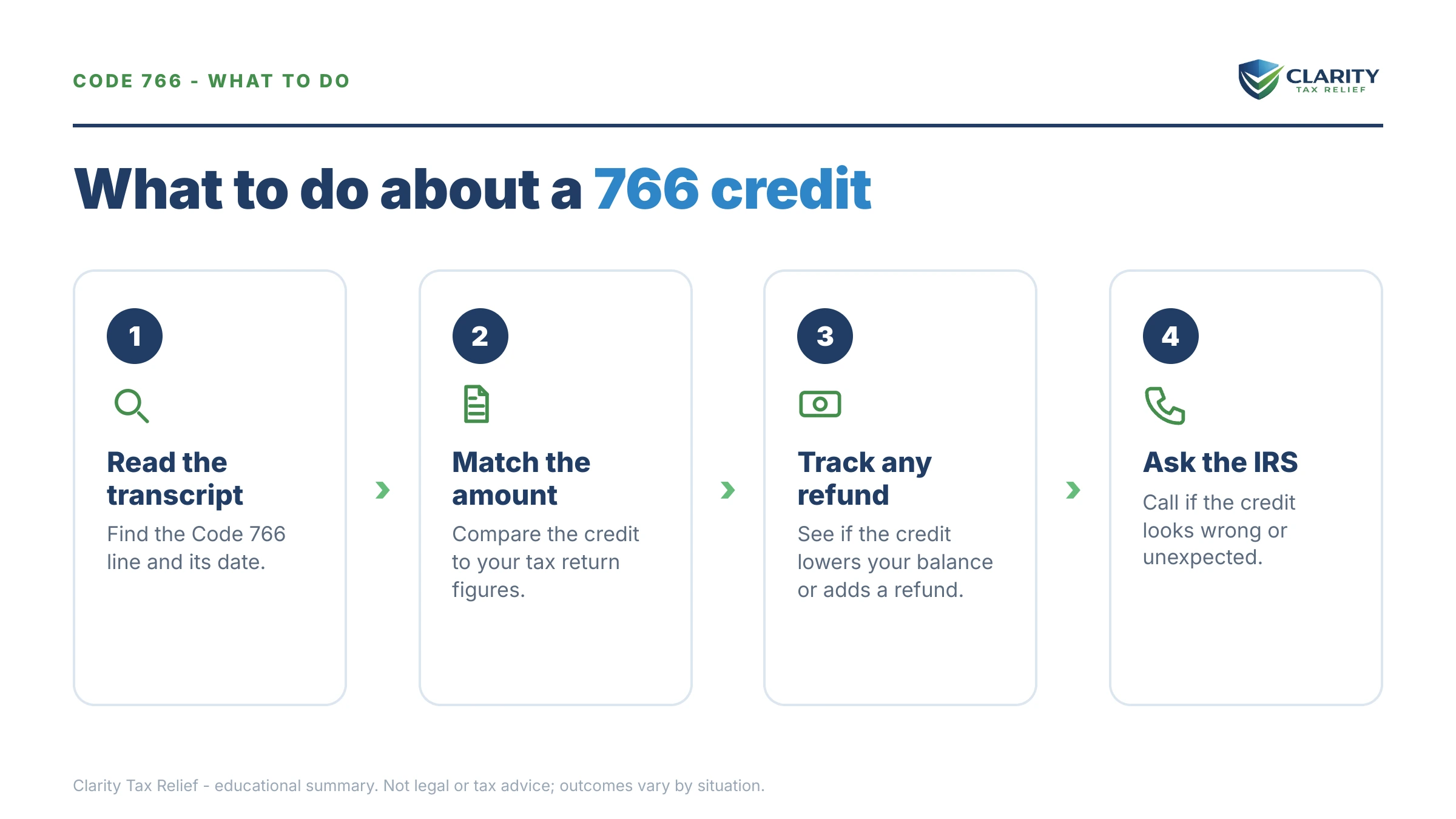
- Confirm the amount is negative. On the 766 line, a minus sign means the credit runs in your favor. Match the figure against the refundable credits you claimed on your return — if it is smaller than expected, the IRS adjusted a credit and a notice explaining why is likely on its way.
- Ignore the date next to it. The date beside code 766 is usually April 15 of the filing season — the credit's legal effective date, not a deposit date. Your money date only ever comes from the code 846 line.
- Run the account math. Take the code 150 tax amount and subtract every negative line — 766, 768, 806, and any payments. A negative total is your pending refund; a positive total means you still owe.
- Scan for blocking codes. Look for 570 (hold), 810 (refund freeze), 826 (credit moved to another tax year), or 898 (offset to a non-IRS debt). Any one of these changes what happens next and whether you need to act.
- Watch for code 846. That is the refund-issued line, and its date is the real payment date. If it has not posted about three weeks after e-file acceptance and no hold code appears, check Where's My Refund and re-check your transcript on its weekly update day.
When you can handle code 766 yourself — and when it's worth getting help
Most people who see code 766 need no help at all — the credit posts, the 846 follows, and the money arrives. You can confidently handle this yourself when the amount matches your return, no hold codes appear, and you're simply inside the normal processing window. You can pull your own transcript free anytime through the IRS Get Transcript tool.
Experienced help changes the outcome in a narrower set of situations: an 810 freeze that hasn't moved after you completed verification, a 570 hold stretching past two months with no notice, a 766 credit absorbed across multiple back-tax years you're still untangling, or an IRS adjustment that cut your credit and you have documents proving it was right. In those cases, someone who reads transcripts daily can spot in minutes what the codes are actually saying — and if a delayed refund is causing genuine financial hardship, the Taxpayer Advocate Service can also intervene at no cost.
Terms on your transcript, decoded
- Transaction code: the three-digit codes the IRS master file uses to record every event on your account — assessments, payments, credits, holds, and refunds.
- Credit (negative amount): on a transcript, negative numbers are money in your favor and positive numbers are money you owe — the reverse of how bank statements read.
- Refundable credit: a credit paid to you even when it exceeds your tax — the reason a 766 can produce a refund larger than everything you paid in.
- "As of" date: the date the IRS uses to compute interest and penalties on the account snapshot — not a deadline and not a refund date (full explainer: the "as of" date on an IRS transcript).
- Offset: the government applying your refund to a debt — an IRS debt (code 826) or a non-IRS debt through the Treasury Offset Program (code 898) — before paying you the remainder.
Code 766 questions, answered
Is code 766 on my transcript a refund?
No — code 766 is a credit posted to your account, not a refund payment. It means the IRS recorded a refundable credit or other credit in your favor, shown as a negative amount. The refund itself only appears as code 846, which carries the actual date money is sent. Many filers see 766 days or weeks before 846 posts, and a hold code like 570 can stretch that gap further.
Why is the code 766 amount negative on my transcript?
On IRS account transcripts, negative numbers are money in your favor and positive numbers are money you owe. So a 766 line reading -6,200 means a $6,200 credit was applied to your account. If the negative amount is smaller than the credits you claimed on your return, the IRS likely adjusted one of them — compare it line by line against your Form 1040 and watch for a notice explaining the change.
What does the date next to code 766 mean?
It is the credit's effective date, not a payment date — for credits claimed on a current-year return it is usually April 15 of the filing season, the return's due date. The IRS uses that date to compute interest, which is why it can sit in the past while your refund is still processing. The only date that predicts money arriving is the one on the code 846 line.
What is the difference between code 766 and code 768?
Code 768 is specifically the Earned Income Tax Credit; code 766 covers other credits posted to your account, such as the refundable portion of the Child Tax Credit, the refundable part of the American Opportunity Credit, or a credit transferred in from another year. Many transcripts show both lines. Together with code 806 (withholding), they are the credit side of the math that determines your refund.
Does code 766 mean my refund is approved?
Not by itself. Code 766 confirms the IRS accepted the credit into your account, but the refund is only approved when code 846 posts. Between the two, a code 570 hold, an 810 refund freeze, or an offset code (826 or 898) can reduce or stop the payment. If your transcript shows 766 with no 846 and no hold codes, you are most likely just waiting on normal processing.
Can the IRS take my code 766 credit for back taxes or other debts?
Yes. If you owe the IRS for another year, the credit is applied there first — you will see code 826 moving it to that year's account. If you owe certain non-IRS debts like past-due child support, defaulted federal student loans, or state income tax, the Treasury Offset Program can take some or all of the refund, which posts as code 898. Any remainder still comes to you with a code 846.
I have code 766 but no code 846 — how long will my refund take?
For most e-filed returns, the IRS says refunds arrive within about 21 days of acceptance, and code 846 typically posts a few days to a couple of weeks after your credits appear. Returns claiming the EITC or Additional Child Tax Credit cannot be paid before mid-February under the PATH Act, which stretches early-season waits. If three weeks pass with no 846 and no hold code, check Where's My Refund and your transcript's weekly update.
Your next 24 hours
- Find your 766 line and read around it. Confirm the amount is negative, note every other code on the page — especially 570, 810, 826, or 898 — and run the math against your code 150 tax.
- Gather your return and both transcripts. Pull your Form 1040 copy and your account transcript, and check Where's My Refund once so you have the IRS's official status alongside the codes.
- If a hold, freeze, or offset is sitting on your credit, get a free review. Use the 2-minute form or call (888) 825-7779 — an experienced tax professional can tell you whether your refund is simply processing or genuinely stuck, and what unlocks it.
This guide is general information, not tax or legal advice for your specific situation. Eligibility for IRS programs depends on individual facts and circumstances; no outcome is guaranteed.