
IRS Transcript Codes
Code 806 IRS Transcript: What the Withholding Credit Means in 2026
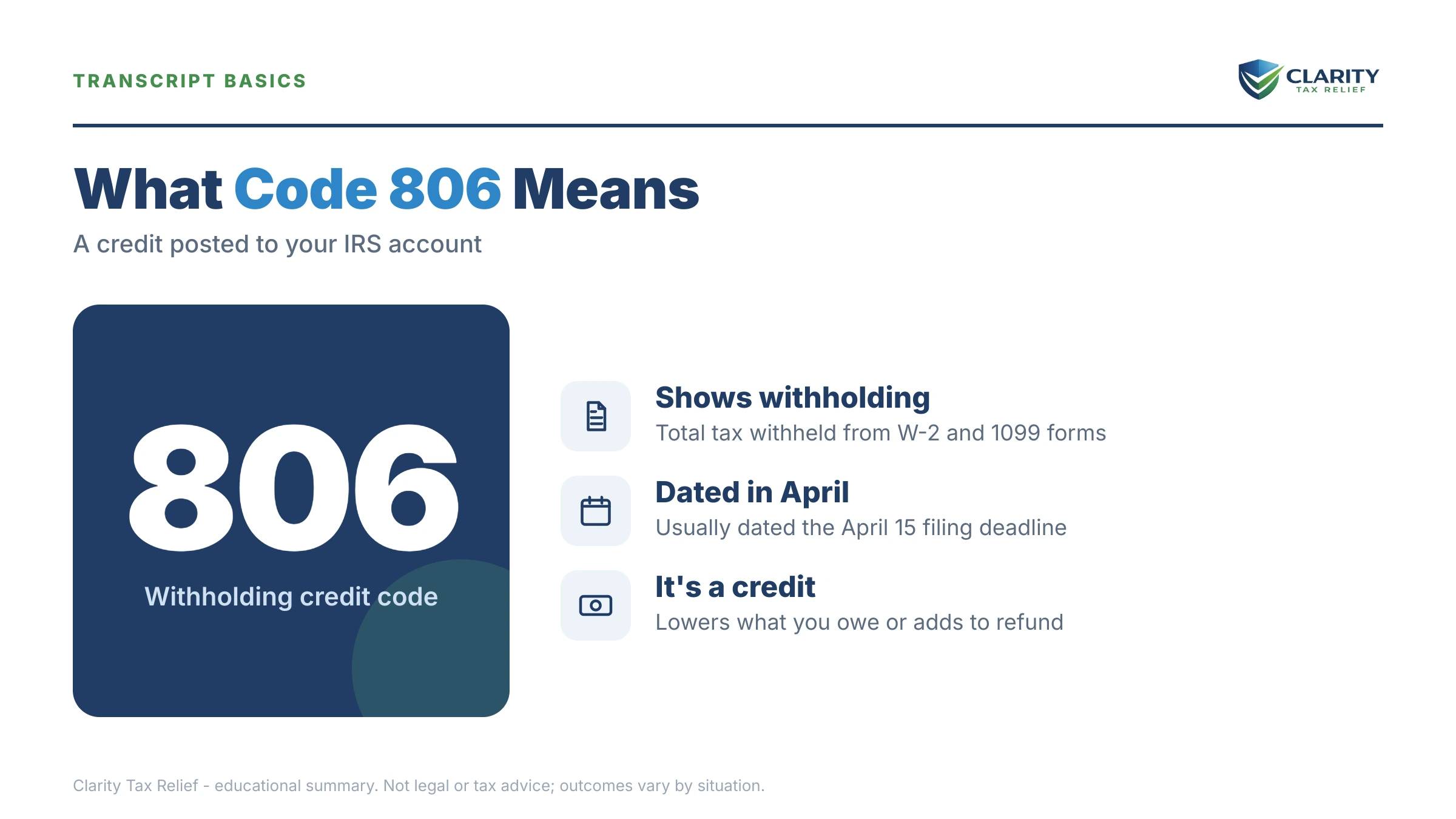
The short answer: code 806 on an IRS transcript is your federal tax withholding credit — the total withheld from your W-2s, 1099s, and W-2Gs as reported on your return — the IRS can adjust it later if payer records differ. It posts as a negative number because it's money credited to you, it's always dated April 15, and it is not your refund amount.
Code 806 is only part of the picture. Read it alongside code 766, which adds any refundable credits to your account, and code 570, which means the IRS has put a hold on your refund while it reviews the return.
You pulled up your account transcript to figure out where your money is, and there it sits: 806, a dollar amount with a minus sign, and a date of April 15 that has nothing to do with when you filed. If you searched "code 806 IRS transcript" wondering whether that negative number is bad news, breathe — it's the opposite. It's the IRS acknowledging money that was already taken out of your pay. The real question is whether the amount is right, and what the codes around it say.
This guide decodes the 806 line itself, the math it feeds into, and the verification sequence the IRS runs behind it — the image below shows you exactly what this section of an account transcript looks like and where to look. For the transcript's overall layout — the columns, sections, and sign conventions — see our guide to how to read an IRS account transcript; this page stays focused on the 806 line.
⏱ The date next to code 806 is not a deadline. Code 806 is always dated April 15 of the filing season — the return due date — no matter when you filed, because the law treats withholding as paid on that date. The only real clock connected to 806 runs when your withholding falls short of your tax: penalties and interest accrue monthly on any unpaid balance until it's resolved.
Why code 806 is on your IRS transcript
Code 806 posts because the return you filed claimed federal income tax withholding — the number from line 25 of your Form 1040. When the IRS processes the return, it records your tax as code 150 and, in the same posting cycle, records the withholding you claimed as code 806. Its official name in IRS systems is "Credit for Withheld Taxes and Excess FICA."
Two details in that name matter. First, "withheld taxes" means the 806 initially reflects what you reported — the IRS posts your claimed number first and verifies it against payer-filed forms afterward. Second, "excess FICA" means the line also includes excess Social Security tax: if two employers together withheld Social Security past the annual wage-base cap, the overage is folded into your 806 total.
If you're a 1099 contractor, your 806 is often small or missing entirely — nobody withholds from most contractor pay, which is exactly why quarterly estimated payments exist. When a contractor does see an 806, it usually traces to one of these sources:
| Form | Withholding box | Typical situation |
|---|---|---|
| W-2 | Box 2 | Regular employee paycheck withholding — the most common source |
| 1099-NEC | Box 4 | Backup withholding (24%) after a TIN mismatch or B-notice on contractor pay |
| 1099-K | Box 4 | Backup withholding taken by a payment platform or marketplace |
| W-2G | Box 4 | Federal tax withheld from gambling or lottery winnings |
| 1099-R | Box 4 | Withholding on a retirement or 401(k) distribution |
| SSA-1099 / 1099-G | Voluntary withholding | Elected withholding on Social Security or unemployment benefits |
Every one of those payers files its copy with the IRS, and the IRS's document-matching system compares the total against your 806. That comparison — not the 806 itself — is where transcripts go sideways.
How code 806 fits into your refund or balance math
Code 806 is one input in a three-part equation: your code 150 tax, minus your code 806 withholding and any credits, equals your refund or your balance due. Nothing about an 806 line, by itself, tells you which side of that equation you land on.
The pieces, in transcript language:
- Code 150 (positive) — the tax your return assessed.
- Code 806 (negative) — your withholding credit.
- Codes 766 and 768 (negative) — refundable credits like the Earned Income Credit or Additional Child Tax Credit. These are not withholding; they post on separate lines.
- Code 846 — the result, if the credits win: your actual refund amount and its issue date.
If the positive 150 outweighs the negative lines, no 846 ever posts — instead a balance due exists, and penalty and interest codes start stacking. That's the outcome most 1099 contractors staring at a small 806 need to plan for.
A worked example: $48,300 in contractor income and a $3,000 code 806
Say you're a 1099 contractor who grossed $48,300 last year across three clients. One platform flagged a mismatch on your taxpayer ID mid-year and backup-withheld 24% on $12,500 of your payouts — $3,000, reported in box 4 of your 1099. Nothing was withheld from the rest, and you didn't make quarterly payments. This is a hypothetical, but the math is the point:
- Your transcript shows 806 −$3,000, dated April 15 — the backup withholding, credited to you.
- After roughly $9,300 in business expenses, your net profit is about $39,000. Self-employment tax on that runs roughly $5,500 ($39,000 × 92.35% × 15.3%).
- Income tax on what's left after the standard deduction and the SE-tax deduction adds very roughly $2,900. Total tax: about $8,400, posted as code 150.
- $8,400 tax minus the $3,000 code 806 leaves roughly $5,400 due — plus an estimated-tax penalty for the missed quarterlies, plus the 0.5%-per-month failure-to-pay penalty and daily interest until it's handled.
So the same 806 line that means "refund incoming" for a W-2 employee can mean "your only credit didn't cover the bill" for a contractor. You can rough out the added penalty and interest cost on a balance like this with our IRS Penalty & Interest Calculator — it estimates, it doesn't promise — and the options table below shows what to do about the balance itself.
What happens if your code 806 doesn't match IRS records
An 806 the IRS can't match to payer-filed forms triggers a verification sequence — the refund doesn't just arrive late, it stops. Withholding verification is one of the most common reasons a transcript stalls after the 806 posts, and in 2026 — with the IRS workforce down roughly 27%, per TIGTA reports — the automated matching still runs on schedule while the human review that resolves it moves slower. Here's the sequence, in order:
- Automated document matching. IRS systems compare the withholding you claimed against every W-2, 1099, and W-2G payers filed under your Social Security number.
- Code 570 posts. A mismatch — or a payer form that never arrived — puts a hold on your account. Nothing refunds while a code 570 on your IRS transcript is open.
- Code 971 posts. The IRS mails a notice or letter, often asking for copies of the forms that show the withholding.
- Code 807 reverses the credit. If the withholding can't be verified, the IRS backs it out — an 807 posts as a positive amount canceling part or all of your 806, and the account is refigured without it.
- Code 810, if the claim looks fabricated. Inflated or invented withholding is a known refund-fraud pattern, so a suspicious 806 can draw a code 810 refund freeze — a harder stop that usually requires identity or wage verification before anything moves.
- Assessment and collection. If the reversal leaves you owing, the IRS assesses the difference — sometimes visible as a code 290 on your transcript — and the normal balance-due notice sequence begins, with penalties and interest attached.
The critical thing to understand: a reversal is not final if you have the paper. If a client backup-withheld your money and then botched or never filed its 1099, that $3,000 is still yours — but the IRS won't credit what it can't see. Your copy of the form, your pay statements, and a corrected filing from the payer put it back.
Code 806 stuck, reversed, or nowhere near your tax bill?
Whether your withholding credit is frozen behind a 570, wiped out by an 807 you can prove wrong, or simply too small to cover what you owe — the account is fixable, and it's cheapest to fix before penalties and interest compound further. An experienced tax professional will read your full transcript free and map the exact next move.
Your options if code 806 falls short of your tax bill
A code 806 smaller than your code 150 means a balance due, and the IRS has a program for nearly every balance size. Which one fits depends on the amount and your finances — eligibility is means-tested, not automatic:
| Option | Who it fits | Cost and terms |
|---|---|---|
| Pay in full | Any balance you can cover now | Stops the failure-to-pay penalty and interest immediately; no fee at IRS.gov |
| Short-term payment plan | Balances you can clear within 180 days | $0 setup fee; interest and penalties continue but collection stops |
| Guaranteed installment agreement | Balance of $10,000 or less, returns filed | Monthly payments; approval is required by statute when the criteria are met |
| Streamlined installment agreement | Balance of $50,000 or less | Up to 72 months, set up online without full financial disclosure |
| Currently Not Collectible | Paying anything would create genuine hardship | Collection pauses; the debt and interest remain and the IRS reviews later |
| Offer in Compromise | Assets and income genuinely can't cover the debt | $205 fee (waived if AGI ≤ 250% of poverty); the IRS accepted roughly 1 in 5 offers in FY2024, per IRS data |
For a balance in the $5,000–$6,000 range like the worked example, the streamlined route is usually the practical answer — here's how to set up an IRS payment plan online, step by step. And if backup withholding is what created your 806 in the first place, fix the source too: give the payer a corrected W-9 so 24% of your pay stops disappearing going forward.
How to respond to code 806, step by step
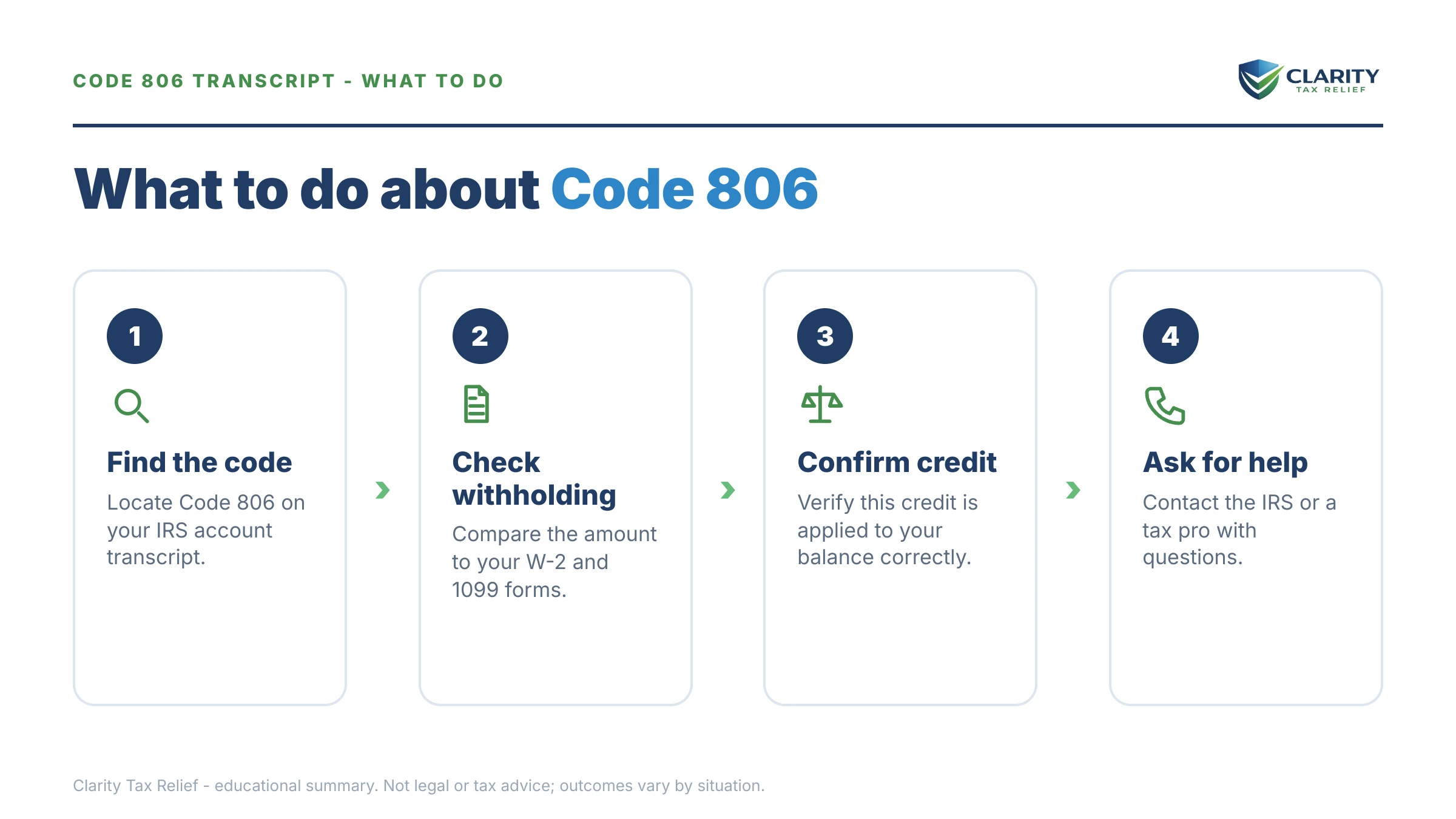
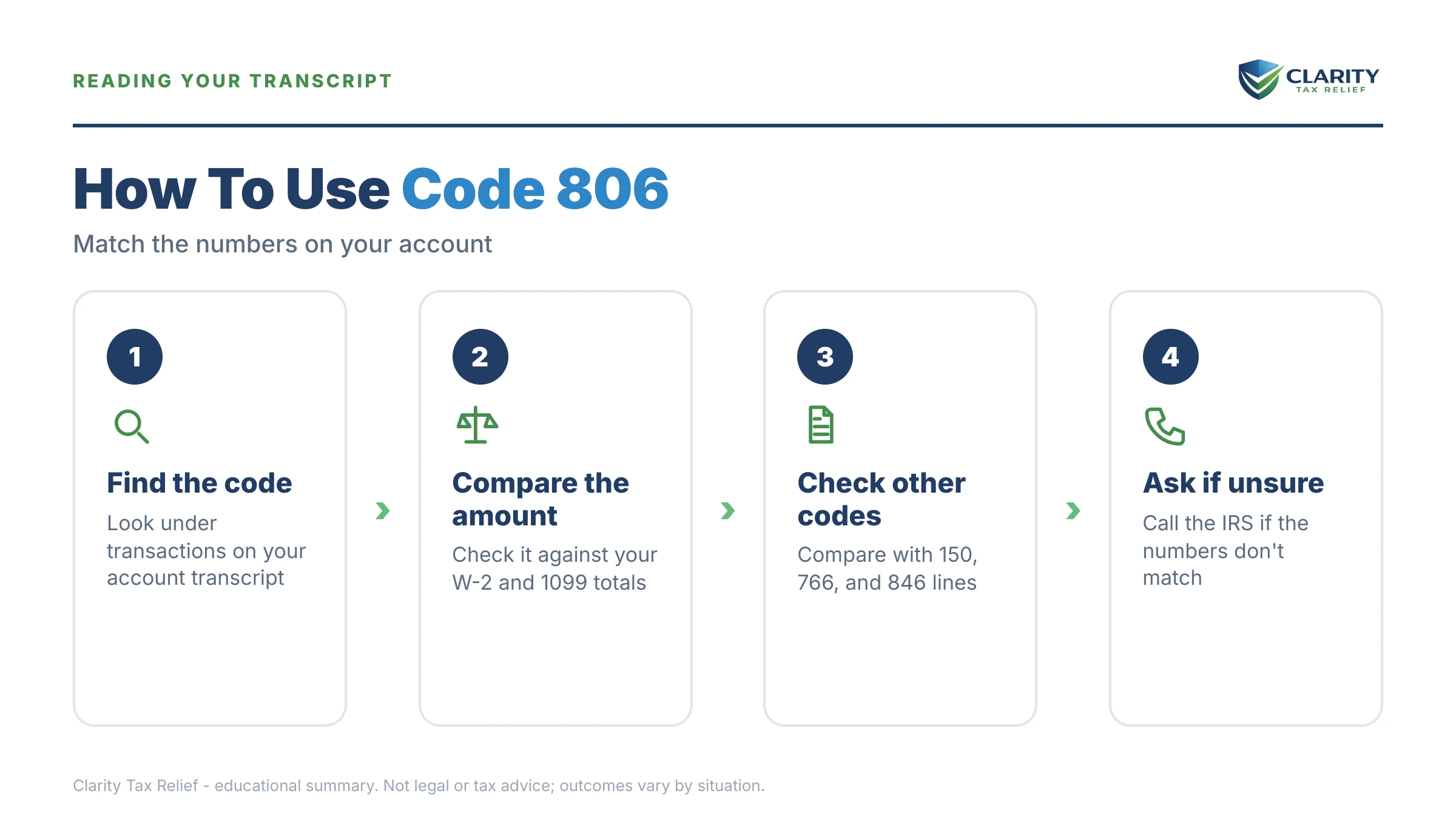
- Pull your wage and income transcript to see every W-2, 1099, and W-2G payers filed for you, including the federal withholding boxes.
- Add up your own withholding — W-2 box 2, 1099 box 4, W-2G box 4, plus any excess Social Security — and compare the total to the 806 amount.
- Scan the lines below 806 for codes 570, 810, 807, or 971 — each one changes what happens next on your account.
- Run the refund-or-balance math — subtract the 806 and any 766/768 credits from the code 150 tax; a negative result points to a refund, a positive result to a balance due.
- Fix any mismatch in writing — send copies of the forms showing the withholding in response to any IRS notice, or ask the payer to correct a form it filed wrong.
- Set up payment if you're short — arrange a short-term plan or installment agreement before the failure-to-pay penalty and interest compound.
Step one is the step most people skip, and it's the one that answers everything: the IRS wage and income transcript shows exactly what payers told the IRS, so a five-minute comparison tells you whether your 806 will verify cleanly or stall.
When you can handle code 806 yourself
Most code 806 situations need no professional help at all. If your 806 matches your forms, no hold codes sit beneath it, and the math points to a refund, you're just waiting on normal processing — do nothing. If the math points to a balance you can pay within 180 days, or one under $50,000 that fits a streamlined plan, the IRS's online tools handle it directly and no one needs to be paid a fee for that.
Experienced help changes the outcome in a narrower set of cases: an 807 reversal of withholding you can document, an 810 freeze that won't release after identity verification, a payer that backup-withheld your money and never filed the 1099, multiple unfiled years muddying the account, or a balance large enough that the payment terms themselves are worth negotiating. In those cases, the difference between a form-letter response and a properly documented one is often the withholding credit itself.
Terms on your transcript, decoded
- TC 806 — "Credit for Withheld Taxes and Excess FICA": the withholding total from your return, posted as a negative credit.
- TC 807 — the reversal of that credit, posted as a positive amount when the IRS can't verify the withholding.
- Backup withholding — the flat 24% a payer must take from contractor or platform payments after a taxpayer-ID mismatch or IRS notice.
- Wage and income transcript — the IRS's record of every information return (W-2, 1099, W-2G) filed under your SSN; the document your 806 gets checked against.
- "As of" date — a bookkeeping date for computing interest, not a refund date; here's what the "as of" date on an IRS transcript actually means.
- Cycle code — the eight-digit code showing which weekly batch your account updates in; decoded in our IRS cycle code guide.
Code 806 questions, answered
What does code 806 mean on an IRS transcript?
Code 806 is the credit for withheld taxes and excess FICA — the total federal income tax withheld from your W-2s, 1099s, and W-2Gs as reported on your return, posted to your account as a credit — the IRS can adjust it later if payer records differ. It appears on almost every transcript for a filed return that reported any withholding, and by itself it is completely routine. It becomes a problem only when the amount doesn't match what your payers reported to the IRS.
Why is code 806 a negative number?
The negative sign means the amount is a credit in your favor, not money you owe. IRS account transcripts show charges (tax, penalties, interest) as positive numbers and credits (withholding, refundable credits, payments) as negative numbers. So an 806 of -$3,000 means $3,000 was credited against your tax, which is good news.
Why is my code 806 dated April 15 when I filed in February?
Every code 806 carries the return due date — April 15 — no matter when you filed, because by law withholding is treated as paid on the due date of the return. The date is an effective date for the credit, not a deadline and not a refund date. Your actual refund date, if you're owed one, appears next to code 846.
Is code 806 the amount of my refund?
No. Code 806 is one input into the refund math, not the result. Your refund is roughly your code 806 withholding plus any code 766 or 768 credits, minus the code 150 tax and any penalties. The actual refund amount and date appear on the code 846 line — if 846 hasn't posted, the IRS hasn't approved a refund yet.
What if code 806 doesn't match the withholding on my W-2 or 1099?
First confirm the payer actually sent the form to the IRS by pulling your wage and income transcript — if a 1099 or W-2 is missing there, the IRS can't verify that withholding and may hold your refund with code 570 or reverse the credit with code 807. Contact the payer to correct its filing, and keep your copy of the form as proof. If the IRS reverses withholding you can document, respond to the notice with the form copies rather than accepting the change.
What is code 807 on a transcript?
Code 807 is the reversal of a withholding credit — the IRS removing some or all of the code 806 amount, usually because it couldn't match your claimed withholding to payer-filed forms. An 807 shows as a positive number that cancels part of the negative 806. If a reversal creates a balance due you dispute, respond with copies of the W-2s or 1099s showing the withholding.
Does code 806 include excess Social Security tax?
Yes. The official name of transaction code 806 is 'Credit for Withheld Taxes and Excess FICA,' so it includes excess Social Security tax — what happens when two or more employers together withhold Social Security beyond the annual wage-base cap. If you worked a W-2 job alongside contracting and both payroll systems withheld, that excess shows up inside your 806 total.
Your next 24 hours
- Find the 806 line on your account transcript and note the amount, then look at every code posted below it — a clean 806 followed by an 846 needs nothing from you; a 570, 807, or 810 needs a response. You can pull both transcript types free at IRS.gov's Get Transcript page.
- Gather your paper — every W-2, 1099, and W-2G with a withholding box, your filed return, and your wage and income transcript — so the claimed number and the payer-reported number sit side by side.
- Get a free case review if the numbers don't match or the 806 leaves you owing — call (888) 825-7779 or use the 2-minute form at claritytaxrelief.com/#consult. There's no notice clock on a transcript code, but interest and penalties on any shortfall accrue every month you wait. If a balance is the outcome, the IRS's own payment plans page covers the official terms.
This guide is general information, not tax or legal advice for your specific situation. Eligibility for IRS programs depends on individual facts and circumstances; no outcome is guaranteed.