
Unfiled Returns
The IRS Filed a Substitute Return for Me: What Do I Do Now? (2026)
The short answer: if the IRS filed a substitute return for me is your situation, the IRS prepared a return on your behalf under IRC §6020(b) using the harshest assumptions allowed — single or married-filing-separately status, no dependents, no deductions, no business expenses. You can almost always replace it by filing your real return, which usually lowers the balance.
You skipped filing that year — maybe money was tight, maybe the records were a mess — and now a letter says the IRS did it for you, and the number at the bottom is bigger than anything you imagined owing. Here's the part the letter doesn't make obvious: that number is the IRS's opening figure, built without a single deduction you're entitled to. It is designed to be replaced, and replacing it is usually the fastest way to shrink it.
The image below shows you exactly what an SFR letter looks like and where to find the filing status and income figures the IRS used — those two items are where most of the inflation hides.
⏱ Your deadline: if your letter is a CP3219N Notice of Deficiency, you have 90 days from the date printed on it to file a U.S. Tax Court petition before the SFR tax is assessed automatically. Earlier letters (like a CP2566 proposal) print their own response date — typically about 30 days — so the date on your notice controls.
Why the IRS filed a substitute return for you
The IRS files a substitute for return (SFR) under IRC §6020(b) when its computers hold W-2s or 1099s for a year with no return attached to your Social Security number. Every employer, bank, brokerage, and gig platform that paid you sent the IRS a copy of the same forms it sent you. When enough time passes with no Form 1040 to match them against, the Automated Substitute for Return program builds one from those documents alone.
An SFR usually doesn't arrive out of nowhere. It's the end of the non-filer letter chain: a CP518 "final notice — return not filed" typically comes first (often after earlier reminders), then a proposed assessment — commonly a CP2566 notice — showing the IRS's calculation, then a CP3219N Notice of Deficiency if you don't respond. The IRS only knows your income — not your expenses, dependents, or cost basis — which is why the number is almost always wrong in its favor.
How the IRS calculated the number — and why it's inflated
A substitute return uses single or married-filing-separately status, one standard deduction, and zero deductions or credits beyond that. For a married couple, that alone can be devastating: filing jointly is an election both spouses must sign, so the IRS won't make it for you — it defaults you into married filing separately, the worst brackets in the tax code, even though a joint return was always your plan.
It gets worse for anyone self-employed or anyone who sold anything. A 1099-NEC is taxed at its full gross amount with no business expenses. A 1099-B or 1099-K from selling stock, crypto, or goods is treated as pure profit, because the IRS has no idea what you paid for what you sold.
| Item | How the SFR treats it | What your real return can claim |
|---|---|---|
| Filing status | Single or married filing separately | Married filing jointly, head of household — your actual election |
| Dependents & credits | None | Child Tax Credit, EITC (if the refund window is still open), education credits |
| Deductions | One standard deduction at the SFR's status, nothing else | Joint standard deduction or itemized: mortgage interest, state taxes, medical |
| Business income (1099-NEC/K) | Taxed at full gross receipts, zero expenses | Schedule C expenses: mileage, supplies, home office, contract labor |
| Stock / crypto / goods sold | Gross proceeds taxed as if 100% profit | Cost basis subtracted; only the actual gain is taxed |
| Withholding & estimated payments | Credited, but only what payers reported to the IRS | Everything you can document, including estimated payments applied to the wrong year |
What happens if you ignore the substitute return
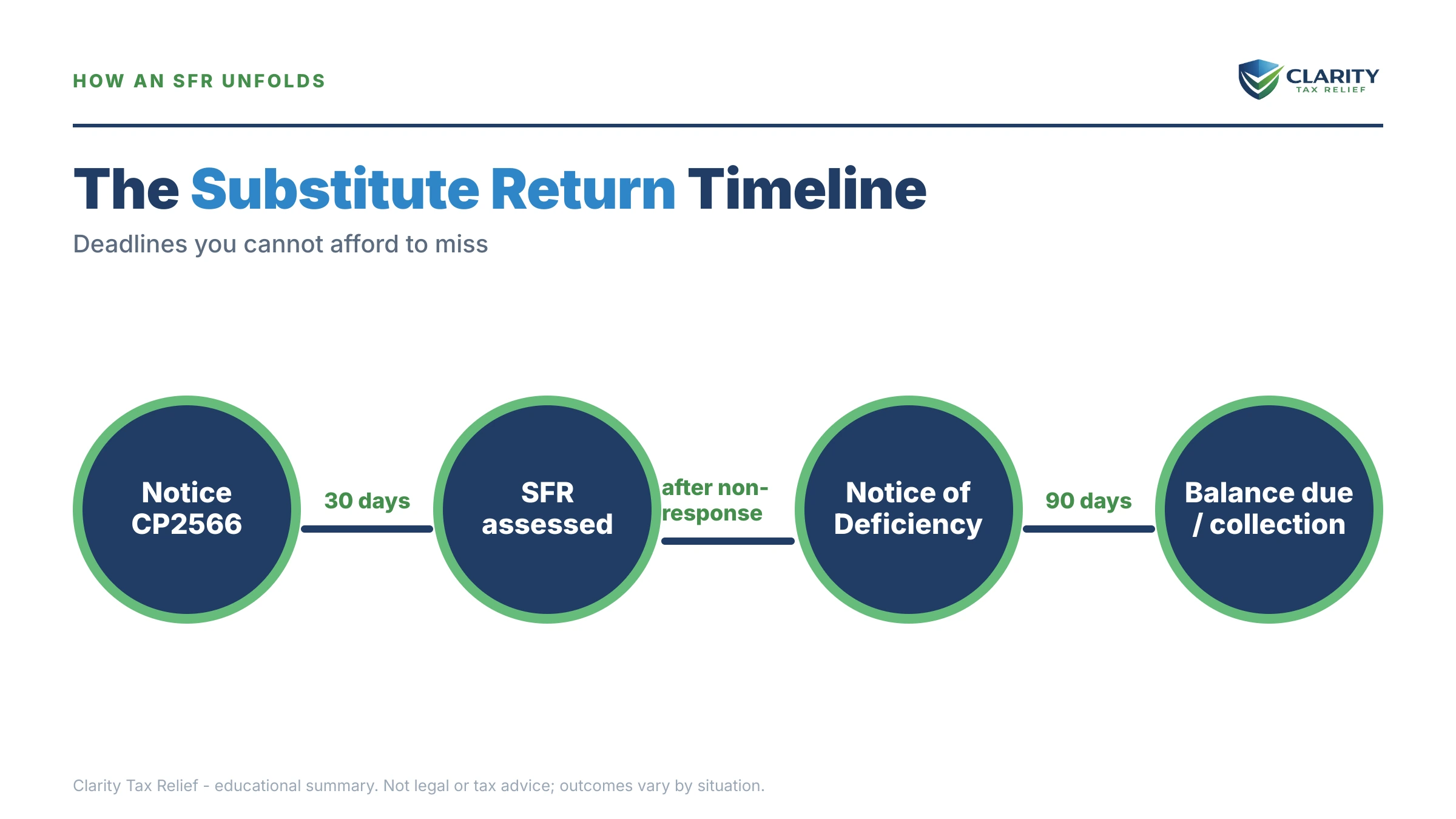
Once a CP3219N Notice of Deficiency is issued, you have 90 days before the SFR balance becomes a legally enforceable assessment. From there, the account flows into the same automated collection machine as any other tax debt — a machine that kept running through the roughly 27% IRS workforce cut in 2025 and never needs a human to escalate your file. The sequence looks like this:
- Proposed assessment (CP2566 or similar). The IRS shows its math and gives you a response date — typically about 30 days — to file your return, agree, or dispute. This is the cheapest exit ramp.
- CP3219N Notice of Deficiency. The statutory 90-day clock starts. File your return, or petition the U.S. Tax Court to contest the amount before it's assessed. Miss both and the assessment posts automatically.
- Assessment and the first bill. The SFR tax, failure-to-file and failure-to-pay penalties, and interest post to your account, and balance-due notices begin.
- Intent-to-levy notices, then a final notice. The standard escalation follows — the IRS can take your state refund, file a federal tax lien, and after a final notice's 30-day window, levy wages and bank accounts.
- The quiet losses stack up. Any refund you were actually owed for that year expires 3 years after the return's original due date. If the assessed balance grows past $66,000 (the 2026 threshold), your passport can be certified for denial or revocation. And the SFR year blocks other fixes — it generally doesn't count as a filed return for bankruptcy discharge (see unfiled returns and bankruptcy discharge) or for the filing compliance most IRS resolution programs require.
Holding an SFR letter right now?
Send us a photo of it. An experienced tax professional will identify which notice you have, whether a 90-day deficiency window is running, and how much a real return would likely change the number — free, confidential, no pressure.
Your options after the IRS filed a substitute return
Filing your actual return replaces an SFR in almost every case — the IRS calls it SFR reconsideration, and it costs nothing but preparation. That's option one for nearly everyone, because it attacks the amount instead of just arranging to pay an inflated number. The remaining options handle whatever balance survives the correction. (For the broader playbook on resolving any balance on your own, see how to settle tax debt yourself.)
| Option | Who it fits | Cost | Typical timeline |
|---|---|---|---|
| File your actual return (SFR reconsideration) | Nearly everyone with an SFR — the amount is wrong in the IRS's favor | $0 IRS fee; preparation cost only | Often several months to process; longer with 2026 staffing |
| Tax Court petition | Only while a CP3219N 90-day window is open and you dispute the amount | Modest court filing fee | Preserves rights immediately; case can take a year or more |
| Short-term payment plan | You can pay the corrected balance within 180 days | $0 setup; interest and penalties continue | Set up online same day |
| Long-term installment agreement | Balance ≤ $50,000 qualifies online, up to 72 months | Setup fee applies (reduced or waived for lower incomes); interest continues | Online approval often immediate once returns are filed |
| Offer in Compromise | Assets plus future income genuinely can't cover the debt; actual returns must be on file | $205 fee, 20% down on lump-sum offers (both waived with low-income certification) | Many months; roughly 1 in 5 offers accepted in FY2024 |
| Currently Not Collectible | Paying anything would prevent basic living expenses | $0; debt remains and interest accrues | Granted after financial review; revisited periodically |
| Penalty relief | Clean 3-year history (first-time abatement) or reasonable cause | $0 | Sometimes granted by phone; written requests take longer |
Two SFR-specific notes on that table. First, the IRS generally requires your actual returns on file before it will accept an Offer in Compromise — an SFR year doesn't count, so the replacement return isn't just about the amount; it unlocks the programs. Second, penalties on an SFR are heavy because the failure-to-file penalty runs 5% per month (capped at 25%) — ten times the failure-to-pay rate, although in months where both penalties apply the failure-to-file portion drops to 4.5%, for 5% combined — and it's recalculated on the corrected tax when your return replaces the SFR. If the prior three years were clean, first-time penalty abatement may remove penalties on top of that, and starting in summer 2026 the new Automatic Exemption from Penalty (AEP) begins applying similar relief automatically, with no request needed. You can rough out what penalties and interest are adding to your balance with our IRS penalty & interest calculator.
One caution before you file: run the numbers first. In rare cases a real return reveals income the IRS didn't have on file. And if the SFR year is one you did file but the IRS adjusted, the fix is different — see how to amend a return to reduce tax debt.
Say the SFR says you owe $36,900: a worked example
This is a hypothetical, but it's the shape of most married-couple SFR cases. Say one spouse earned $95,000 in gross 1099 contracting income in the unfiled year, the other earned $38,000 in W-2 wages with $3,400 withheld, and neither return was filed.
The SFR sees only the contractor. It computes married-filing-separately tax on $95,000 with zero business expenses: roughly $13,400 in self-employment tax plus roughly $11,800 in income tax — about $25,200 in tax. Add the capped failure-to-file penalty (~$5,670, since the failure-to-file rate drops to 4.5% in months where the failure-to-pay penalty also applies), the failure-to-pay penalty, and compounding interest, and the letter lands at roughly $36,900.
Now the couple files the real joint return. Documented business expenses of $27,000 cut the net profit to $68,000, dropping self-employment tax to about $9,600. The joint standard deduction and joint brackets — even with the spouse's $38,000 of wages added — produce roughly $8,400 of income tax. Total tax: about $18,000, minus $3,400 already withheld, leaves roughly $14,600 of unpaid tax. The failure-to-file penalty recomputes on that lower figure (~$3,285 at the reduced rate), and with failure-to-pay penalty and interest the corrected total lands around $21,000 — roughly $15,900 less than the SFR, before any penalty abatement. The remaining balance fits a streamlined installment agreement (it's under $50,000), at very roughly $300–$400 a month over 72 months depending on interest. Which payment channel to use for the plan is its own decision — here's the best way to pay the IRS, compared.
How to respond to a substitute return, step by step
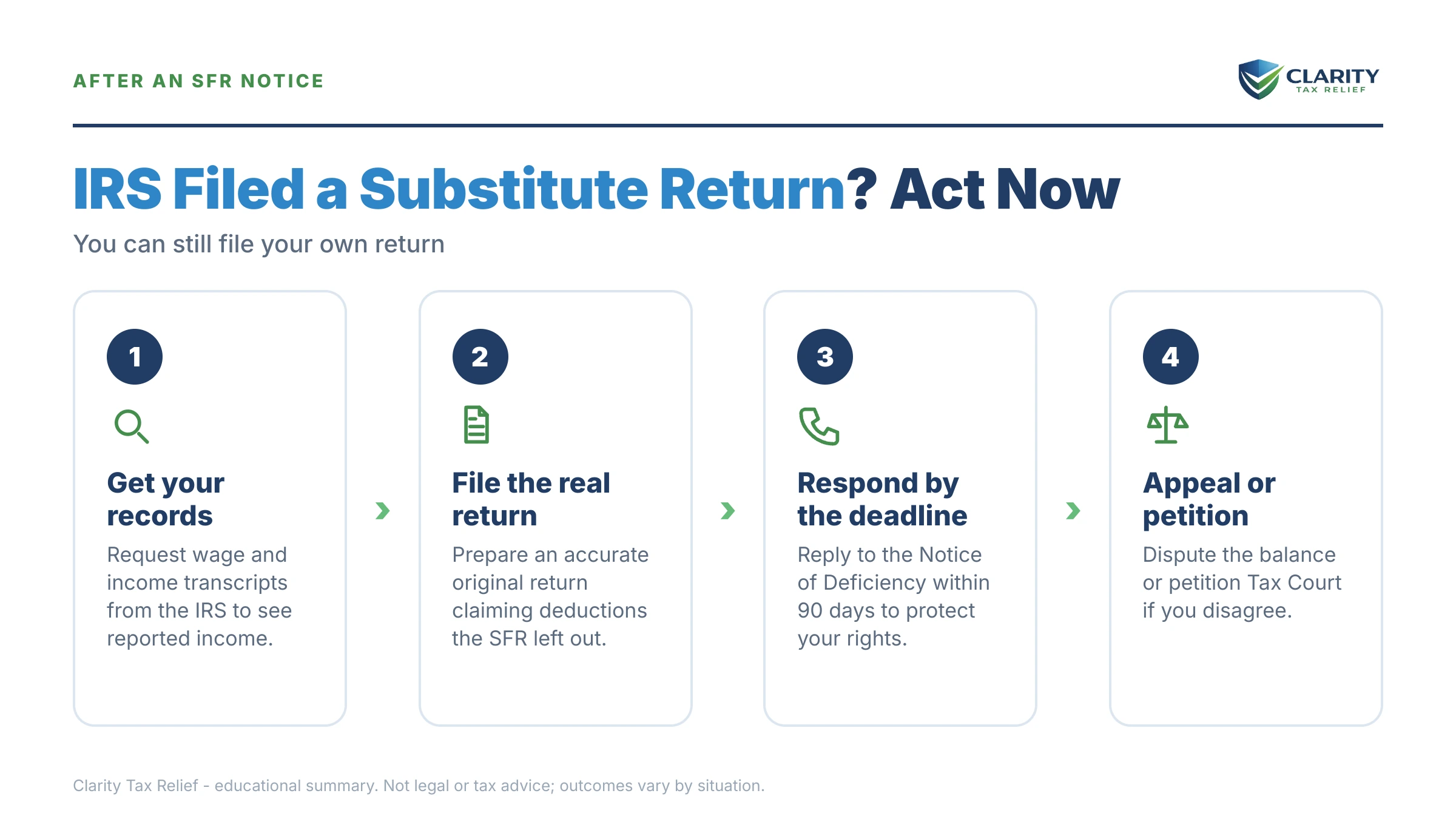
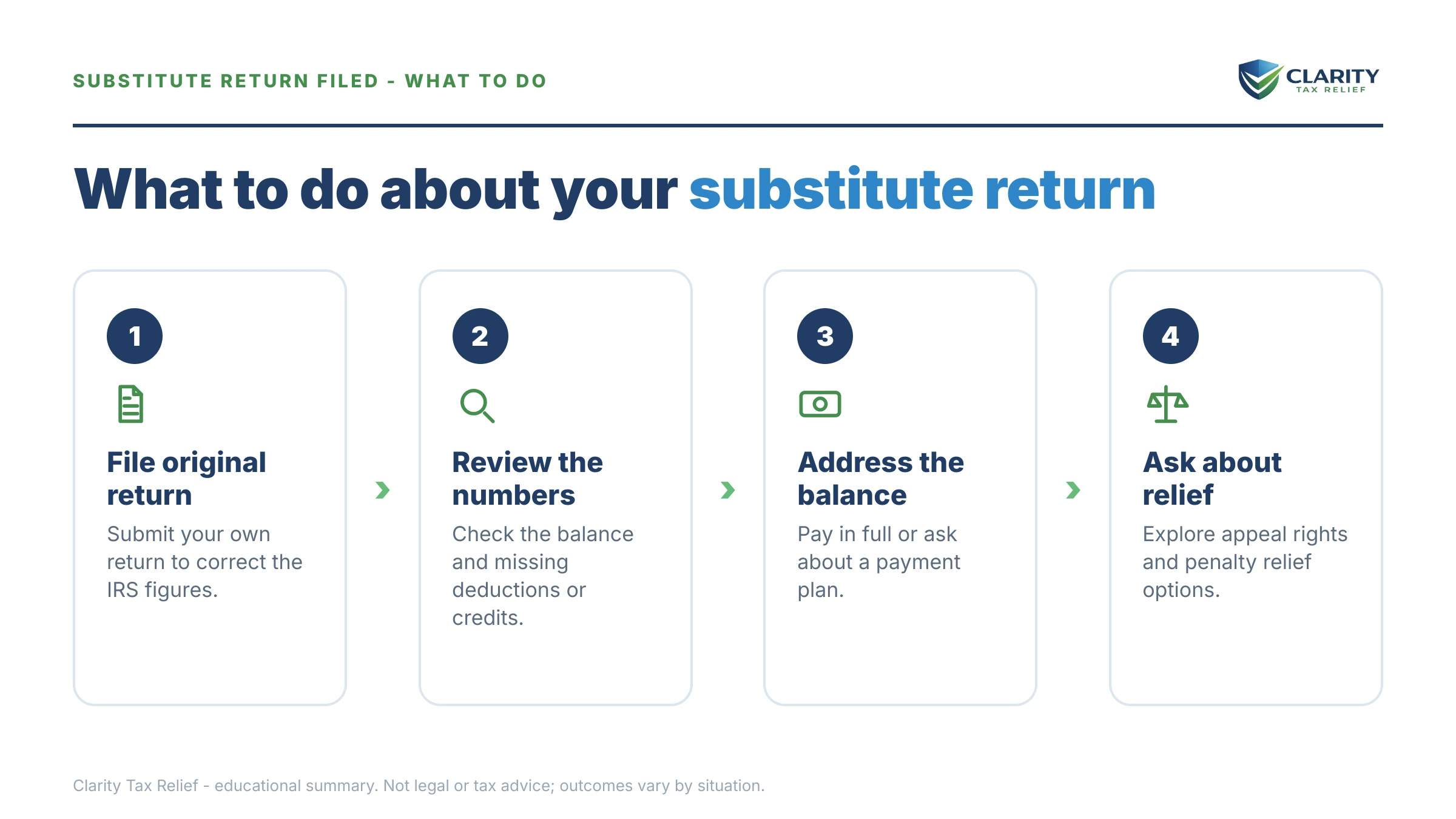
- Identify the letter you're holding. Find the notice number in the top corner — CP59, CP518, CP2566, or CP3219N — and the response date printed on it. The notice number tells you whether a 90-day Tax Court window is running or the tax has already been assessed.
- Pull your wage and income transcripts. Request the IRS wage and income transcript for every unfiled year. It lists every W-2, 1099, and 1098 the IRS used to build the SFR, so your real return accounts for every document already in the system.
- Prepare your actual return for that year. Use the correct filing status, claim your dependents, deductions, business expenses, and cost basis. This return replaces the IRS's math and is the single biggest lever for lowering the balance.
- File it where your notice directs. Mail the return to the address on your SFR letter with a copy of the notice, not to the regular filing address. If a CP3219N 90-day window is about to close and the return isn't ready, file a Tax Court petition to preserve your rights first.
- Resolve the corrected balance. Once the IRS processes your return and adjusts the assessment, set up a payment plan, request penalty relief, or pursue hardship status for whatever balance remains.
If receipts and records for that year are long gone, they can usually be reconstructed — here's how to file back taxes without records. And if this SFR year is one of several unfiled years, know that the IRS's standard expectation is six years of back returns, not your entire history.
When you can handle an SFR yourself
Plenty of SFR cases don't need professional help. If the SFR covers one year, your income was all W-2, the IRS's number is close to right, and the corrected balance is something you can pay within 180 days or on a simple online plan — file the return, set up the arrangement, and you're done. The IRS's process is genuinely designed to accept your late return and move on.
Experienced help changes outcomes in specific situations: a 90-day deficiency window that's about to close before you can finish the return; multiple unfiled years stacked together; self-employment or crypto years where reconstructing expenses and basis drives tens of thousands of dollars of difference; a levy or lien already in motion while your replacement return sits in a slow 2026 processing queue; or a corrected balance still large enough that Offer in Compromise math is worth running properly. In those cases, the sequencing — which year to file first, when to request a collection hold, when to petition — is where money is won or lost.
Terms on your SFR letter, decoded
- Substitute for Return (SFR): a tax return the IRS prepared for you from third-party income documents when you didn't file one yourself.
- Section 6020(b): the law that authorizes the IRS to prepare and sign a return on your behalf when you fail to file.
- Notice of Deficiency: the formal letter (CP3219N for non-filers) that gives you 90 days to challenge the proposed tax in Tax Court before it's assessed.
- Assessment: the moment a tax amount is formally recorded against your account — the point where a proposed number becomes a collectible debt.
- SFR reconsideration: the IRS process for accepting your actual late-filed return and adjusting an SFR assessment to match your real numbers.
- CSED: the Collection Statute Expiration Date — the end of the 10-year window the IRS has to collect, counted from the assessment date and pausable by appeals, offers, and bankruptcy.
Substitute return questions, answered
Can I still file my own return after the IRS filed a substitute return?
Yes, in almost every case — even years after the SFR was assessed. The IRS calls this SFR reconsideration: you prepare and file your actual return, and the IRS processes it and adjusts the assessment to match your real numbers. The main exception is a year already decided by a Tax Court judgment, where reopening the amount is much harder.
Will filing my real return lower what the IRS says I owe?
Usually, and often dramatically, because an SFR skips your filing status election, dependents, credits, itemized deductions, business expenses, and cost basis on anything you sold. Penalties are recalculated on the lower corrected tax, which shrinks the total further. The rare exception is a return that reveals income the IRS didn't have on file — an experienced tax professional can check for that before you send anything.
Does a substitute return count as filing my taxes?
No. An SFR is a return the IRS prepared under IRC §6020(b), not a return you filed, and that distinction matters three ways. It doesn't count as a claim for any refund you were owed, it generally doesn't count as a filed return for discharging that year's tax in bankruptcy, and it doesn't satisfy the filing compliance the IRS generally requires before accepting resolution programs like an Offer in Compromise.
How long do I have to fight a substitute return?
Two clocks matter. If you're holding a CP3219N Notice of Deficiency, you have 90 days from the date on it to petition the U.S. Tax Court before the tax is assessed. After assessment, there's no fixed deadline to file your replacement return — but collection keeps escalating while you wait, and any refund you were owed for that year expires 3 years after the return's original due date.
Why did the IRS file me as married filing separately when we're married?
Because filing jointly is an election both spouses must sign, and the IRS won't make it for you. An SFR defaults to single or married filing separately — the least favorable brackets and standard deduction. Filing your actual joint return replaces that status and is frequently the single biggest reduction in an SFR balance for a married couple.
Does the 10-year collection statute apply to a substitute return?
Yes. The 10-year collection statute (CSED) runs from the date the SFR tax was assessed, just like any other assessment. Events like a pending Offer in Compromise, bankruptcy, or a collection appeal pause the clock, so the real expiration date is often later than ten calendar years. Filing your replacement return doesn't restart the clock on the original assessment.
Can I go to jail because the IRS filed a substitute return?
An SFR is a civil process, and the overwhelming majority of unfiled-return cases are resolved civilly — with tax, penalties, and interest, not prosecution. Willful failure to file can be charged criminally in egregious cases, which is exactly why voluntarily filing your real returns now is the move that helps you: it demonstrates compliance rather than concealment.
How long does the IRS take to process my replacement return?
Several months is common, and 2026 processing is slower than usual — the IRS workforce was cut roughly 27% in 2025, and SFR reconsideration returns are processed by hand. Critically, collection does not automatically pause while your return sits in the queue, so you may need a collection hold or an interim payment arrangement to keep automated levies from moving forward in the meantime.
Your next 24 hours
- Find the notice number and date in the top corner of your letter. CP3219N means a 90-day Tax Court clock is running from that date; CP2566 means the assessment hasn't happened yet and your response date is printed on the page.
- Gather three things: the letter itself, whatever records you have for the unfiled year (W-2s, 1099s, bank statements, expense records), and your IRS online account login so your wage and income transcripts can be pulled.
- Get the SFR reviewed free — call (888) 825-7779 or use the 2-minute form. If a 90-day window is open, acting inside it preserves rights you can't get back; either way, interest and the failure-to-pay penalty accrue every month the IRS's inflated number stands.
Primary sources: the IRS's own explainer at Understanding your CP3219N notice, official plan terms at IRS payment plans and installment agreements, and independent help through the Taxpayer Advocate Service if the IRS's processing delays are causing you harm.
This guide is general information, not tax or legal advice for your specific situation. Eligibility for IRS programs depends on individual facts and circumstances; no outcome is guaranteed.