
IRS Notices
IRS CP518 Notice: The Final Unfiled-Return Warning — What to Do in 2026
The short answer: a CP518 notice is the IRS's final reminder that it has no record of your tax return for the year shown. It follows the CP59 and CP516 notices, and it's the last letter before the IRS can file a substitute return for you — using your gross income and none of your deductions.
You already knew that year never got filed. Now the IRS has said so three times, and this letter — "final reminder" printed right on it — says it's done asking. That knot in your stomach is real, but here's what it's telling you correctly: the window to file your version of that year, with your deductions, is still open. Today.
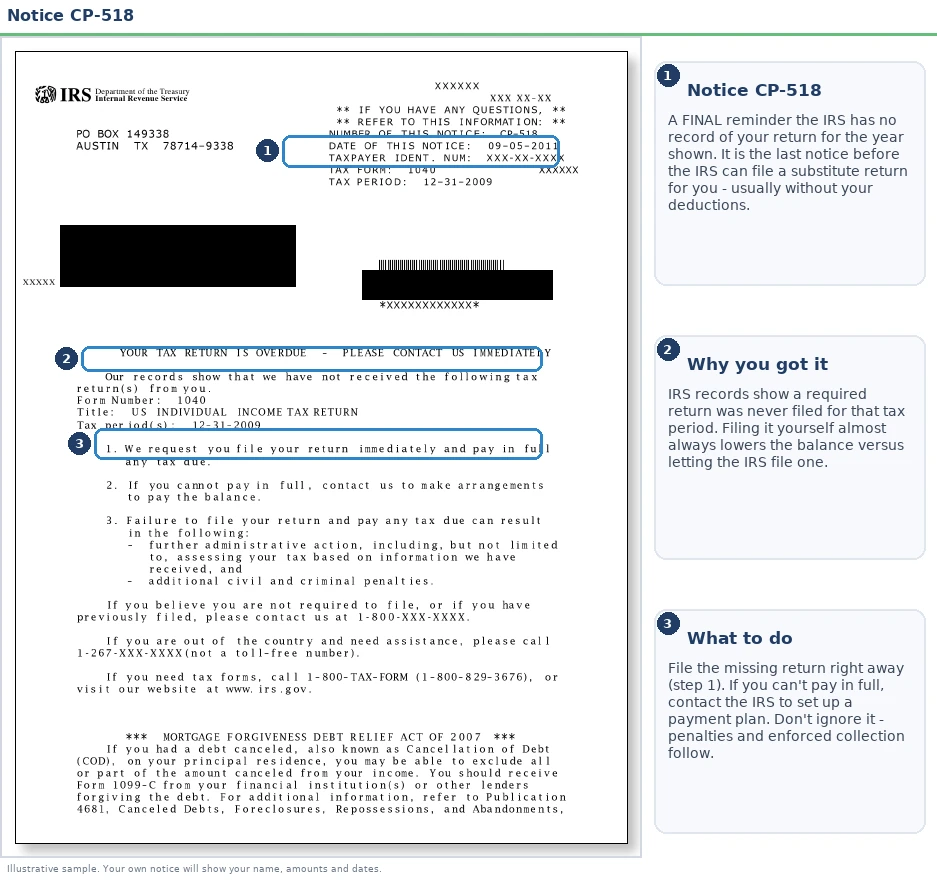
The image below shows exactly what a CP518 looks like and where to find the tax-year box and the response section — the two spots that decide your entire next move.
⏱ The real clock: a CP518 prints no fixed day count — "file immediately" is the instruction. But if tax is due for that year, the failure-to-file penalty adds 5% per month, up to a 25% cap, and once the IRS starts building a substitute return, your cheapest exit starts closing.
Why you got a CP518
A CP518 means the IRS's records show income under your Social Security number for a specific year — and no tax return to go with it. Employers, clients, banks, and payment platforms all reported money to the IRS. The computer expected a Form 1040 to match. None ever posted.
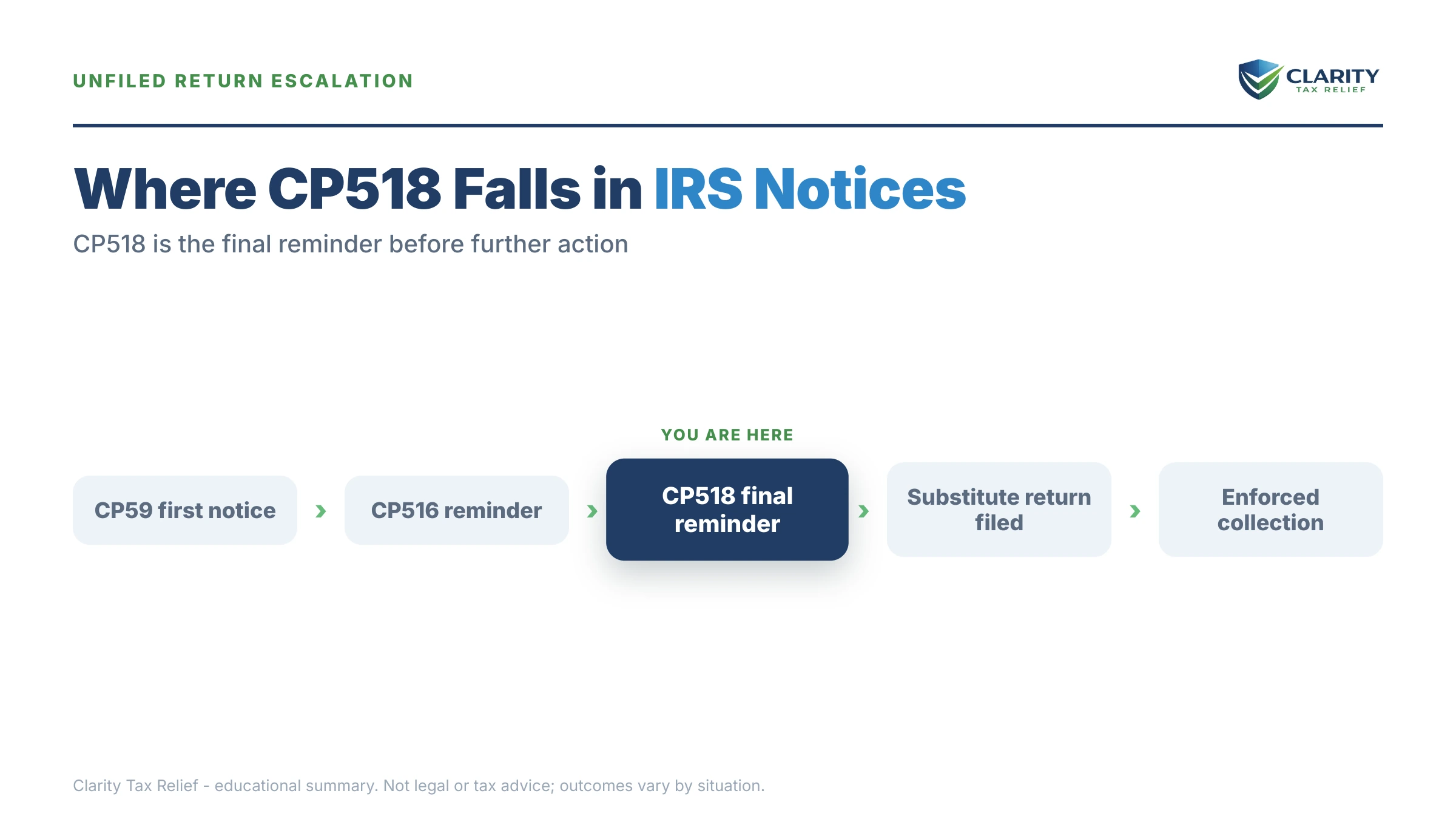
Before the CP518 arrived, the system sent a CP59 notice (the first "no return on file" letter) and a CP516 notice (the second request). The CP518 is the third and last. Check the tax-year box — the image shows where it sits — because everything on this notice concerns one specific year, and you may have more than one unfiled.
Not every CP518 means you actually skipped filing. A paper return that never processed, a return filed under a different name after marriage, or a year where you genuinely fell below the filing threshold can all trigger one. That's why the notice includes a response section: you can tell the IRS "I already filed" or "I wasn't required to file" instead of preparing a new return. (For how IRS letters work in general, see why did I get a letter from the IRS.)
One more distinction: this is not a bill. There is no balance on a CP518 — yet. The whole point of acting now is deciding who calculates that balance: you, or an IRS computer with none of your records. Businesses get a parallel version (CP518B) for unfiled business returns; this guide covers the individual notice.
What happens if you ignore a CP518 notice
After a CP518, the IRS's next move isn't another reminder — it's preparing a substitute for return (SFR) that computes your tax with zero deductions. The sequence from here is automated and runs in stages:
- CP518 — final reminder. You are here. The IRS still wants your return; nothing has been assessed.
- Substitute for return prepared. The IRS builds a return from the W-2s and 1099s on file: single or married-filing-separately status, standard deduction only, no business expenses, no dependents, no credits.
- CP2566 — proposed tax. The IRS mails you its math and asks you to agree, pay, or send your own return.
- CP3219N — Notice of Deficiency. The "90-day letter" for non-filers. You get 90 days to petition the U.S. Tax Court; silence means the proposed amount becomes legally assessed.
- Assessment → collections. The SFR balance turns into a regular tax debt: bills, then intent-to-levy notices, with lien and levy authority behind them.
Here's the trap that makes an unfiled year different from every other IRS problem: waiting runs out no clock at all. The 3-year assessment statute and the 10-year collection statute both start only after a return is filed or an SFR is assessed. An unfiled year stays open indefinitely — the IRS can come for it in 2030 or 2035 just as easily as today.
| Stage | What it is | What's at stake |
|---|---|---|
| CP59 | First notice: no return on file | A request — penalties accrue only if tax is due |
| CP516 | Second request for the return | Same message; the IRS's patience is running down |
| CP518 (you are here) | Final reminder before the IRS acts alone | Last easy chance to file your own numbers |
| SFR + CP2566 | IRS computes tax from reported income, no deductions | Proposed tax typically far above a real return |
| CP3219N | Statutory Notice of Deficiency | 90 days to petition Tax Court — then assessment |
| Assessment & collection | The SFR balance becomes legally owed | Bills, then lien and levy notices begin |
What a substitute return costs a self-employed filer: the math
The SFR hits self-employed people harder than anyone, because it taxes gross receipts as if you had zero business expenses. A hypothetical shows why.
Say you're a sole proprietor and 2023 never got filed. Clients reported $86,000 on 1099-NECs. Your real books show $34,000 of legitimate expenses — mileage, materials, software, insurance — so your true net profit was $52,000.
The substitute return ignores every expense. It computes income tax plus 15.3% self-employment tax on the full $86,000, at single status with only the standard deduction. Suppose the proposed tax lands around $24,000 in this hypothetical.
Then penalties stack on top. The failure-to-file penalty caps at 25% of the unpaid tax: $24,000 × 25% = $6,000. Add the 0.5%-per-month failure-to-pay penalty and compounding interest, and the assessed balance climbs to roughly $31,200 — and keeps growing every month it sits unpaid.
Now run it the other way. File the real return and both income tax and the 15.3% SE tax get computed on $52,000 of net profit instead of $86,000 of gross — every deducted dollar escapes two taxes at once. The correct tax could plausibly come in at a fraction of the SFR figure, and every penalty then gets calculated as a percentage of that smaller, correct number. You can estimate how penalties and interest build on your own numbers with our Penalty & Interest Calculator.
That's the entire strategic picture of a CP518 in one comparison: the return you file is almost always cheaper than the return the IRS files for you.
Holding a CP518 right now?
The IRS has asked three times — the next step is a tax return you didn't write, with none of your deductions. Send us a photo of your CP518 and an experienced tax professional will map the unfiled year, what the IRS already knows, and the cheapest way through — free and confidential.
Your options after a CP518
Filing the actual return — even with no payment attached — is the correct response to a CP518 in nearly every situation. What varies is what comes with it:
- Just file (refund years and small balances). If withholding or estimated payments covered the year, you may be owed money — but only if you claim it within 3 years of the original due date. No failure-to-file penalty applies when nothing is unpaid.
- File and use a short-term plan. If you can pay the balance within 180 days, the short-term payment plan has a $0 setup fee. Interest and the 0.5%/month late-payment penalty continue, but the 5%/month filing penalty stops the day your return is in.
- File and set up an installment agreement. Balances up to $50,000 can generally be spread over up to 72 months through an online agreement. Filing first is mandatory — the IRS won't approve a payment plan while required returns are missing. See why you should file even if you can't pay.
- File and request Currently Not Collectible status. If paying anything would leave you unable to cover basic living expenses, collection can be paused. The debt remains and interest accrues, but levies stop while you're in hardship.
- Ask for penalty relief. First-time abatement can remove the failure-to-file penalty if your prior 3 years were clean — and starting summer 2026, the IRS's Automatic Exemption from Penalty (AEP) begins applying qualifying relief without a request. Reasonable cause (illness, disaster, records destroyed) is a separate path.
- Multiple years unfiled? The IRS's standard enforcement practice generally looks for the last 6 years of returns — you usually don't have to reconstruct your whole life, but the order you file in matters.
| The clock | How long | What passes with it |
|---|---|---|
| Refund claim (RSED) | 3 years from the return's original due date | Any refund for that year is forfeited permanently |
| Failure-to-file penalty | 5% of unpaid tax per month, capped at 25% | The cheap months — the cap hits around month five |
| CP3219N petition window | 90 days from that notice's date | Your right to contest the SFR in Tax Court before paying |
| Assessment statute | Normally 3 years after filing | Never starts on an unfiled year — the IRS can assess indefinitely |
| Collection statute (CSED) | 10 years from assessment | Also never starts until a return or SFR posts — waiting runs out nothing |
How to respond to a CP518 notice, step by step
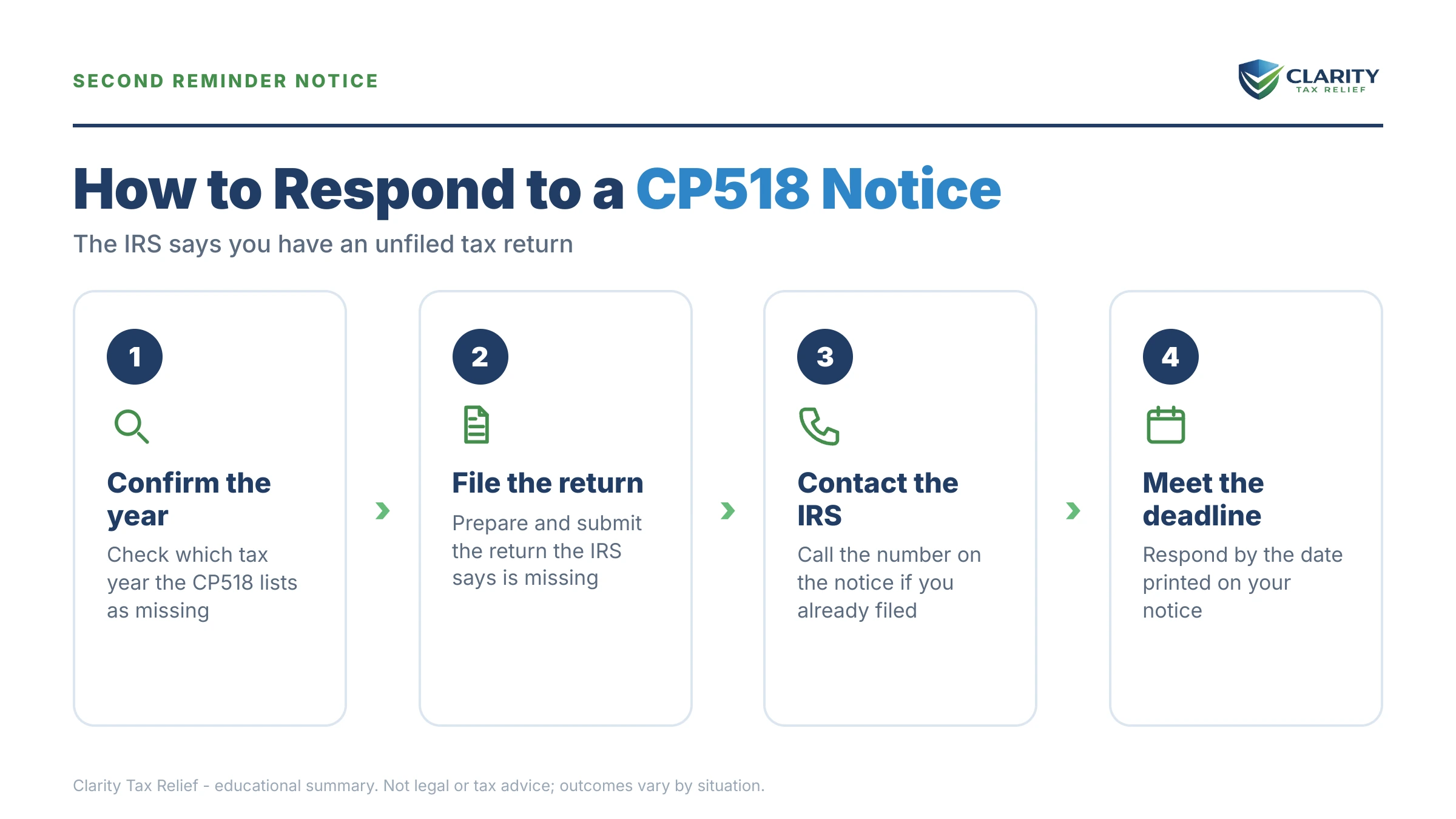
- Confirm the tax year and check your records. Find the tax-year box on the CP518 and verify whether you actually filed for that year — if you did, respond with a signed copy of the return instead of filing again.
- Pull your wage and income transcript. Request the IRS's record of every W-2 and 1099 reported under your SSN for that year so your return matches what the IRS already knows about.
- Prepare the real return with every deduction. Complete the missing Form 1040 — including your Schedule C expenses if you're self-employed — because the IRS's substitute return would use gross income with no write-offs.
- File it and answer the notice. Mail the return to the address on the CP518 (or e-file if that year is still accepted) and use the notice's response section so the account gets matched.
- Arrange payment for any balance. Pay what you can and set up a payment plan for the rest — filing stops the 5%-per-month failure-to-file penalty even if you can't pay a dime today.
- Get a professional review if it's more than one year. Multiple unfiled years, business income, or an SFR already in motion change the order of operations — have an experienced tax professional map the sequence before you send anything.
Your wage and income transcript is the backbone of step 2 — it's free through IRS Get Transcript. One warning for the self-employed: the transcript shows only what was reported — your gross 1099 income. It contains none of your expenses. If your records for the year are thin, our guide to filing back taxes without records covers legitimate reconstruction — bank statements, mileage rebuilds, vendor histories.
When you can handle a CP518 yourself
Most single-year CP518s with W-2 income and records in hand are a do-it-yourself fix. If the missing year is one W-2 job, your withholding likely covered most of the tax, and there's a decent chance you're owed a refund — prepare the return, file it, respond to the notice, done. The same goes if you already filed and just need to send proof, or if you genuinely fell below the filing threshold and only need to say so on the response form. Any balance you do owe can be paid directly at IRS.gov/payments.
Experienced help changes the outcome in a different set of situations: several unfiled years stacked together (the filing order affects penalties, refund offsets, and what the IRS pursues), self-employment or business income with missing expense records, an SFR that's already been assessed and needs to be unwound with a real return, or reported income that isn't actually yours — a 1099 issued in error, or identity theft. Those cases aren't about filling in forms; they're about sequencing, reconstruction, and knowing which relief to request in which order. If you're deep in this — say haven't filed taxes in 3 years or more — start there before touching anything.
If you hit a wall with the IRS itself — a return you filed that the system won't acknowledge, hardship the process is making worse — the Taxpayer Advocate Service is an independent, free channel inside the IRS.
Terms on your CP518, decoded
- Substitute for Return (SFR): a return the IRS prepares for you from reported income — single or married-filing-separately status, standard deduction only, no business expenses, dependents, or credits.
- ASFR: the Automated Substitute for Return program — the computer system that builds SFRs at scale; no human weighs your circumstances.
- Failure-to-file penalty: 5% of the unpaid tax per month late, capped at 25% — ten times the rate of the failure-to-pay penalty, which is why filing always comes first.
- CP3219N: the "90-day letter" for non-filers — your last chance to contest the SFR figures in Tax Court before they're assessed.
- Refund statute (RSED): the 3-year deadline to claim a refund; miss it and the money is forfeited even though you overpaid.
- Delinquent return: a required return filed after its due date — filing it is exactly what stops the SFR track.
CP518 questions, answered
Is a CP518 notice serious?
Yes — a CP518 is the IRS's final notice about an unfiled tax return, after CP59 and CP516 went unanswered. No money is being seized at this stage, but it is the last letter before the IRS can build a substitute return using only the income reported to it, with none of your deductions. Filing the real return now is almost always cheaper than anything that comes after.
What happens if I ignore a CP518 notice?
The IRS can prepare a substitute for return (SFR) using the W-2s and 1099s on file, then send a CP2566 proposing the tax and a CP3219N giving you 90 days to petition Tax Court. If you do nothing, the proposed amount is assessed and your account moves into the regular collection track — bills, then lien and levy notices. Every stage is automated, so silence never makes the file go away.
Can I still file my own return after getting a CP518?
Yes, and you should — filing your actual return is the single best response to a CP518 at any stage. Even after the IRS assesses a substitute-return balance, you can submit your real return and ask the IRS to adjust the account to your correct figures, though it processes faster and cleaner if you file before the SFR is finished. Your return captures deductions, expenses, and credits the IRS will never apply for you.
What if I'm owed a refund for the year on my CP518?
Then file quickly — you have 3 years from the return's original due date to claim a refund, and after that the money is gone permanently even though you were owed it. The failure-to-file penalty won't apply, because it's calculated as a percentage of unpaid tax and you have none. A refund year is the easiest CP518 to resolve, but only if you file inside the window.
Do I need to respond to a CP518 if I wasn't required to file?
Yes — use the response section of the notice to explain why no return is due, because the IRS's system assumes you owe one until told otherwise. Remember that self-employed people must file once net self-employment earnings hit just $400, far below the regular filing thresholds. If you already filed, send a signed copy of the return with your response so the account can be matched up.
Can you go to jail because of a CP518?
A CP518 is a civil notice, and the overwhelming majority of unfiled-return cases are resolved civilly with returns, penalties, and payment arrangements. Willful failure to file can be charged criminally, but prosecutions target deliberate, usually large-scale evasion — and voluntarily filing before the IRS comes looking is the strongest protection there is. The practical risk of ignoring a CP518 is financial: an inflated substitute-return assessment plus penalties.
What's the difference between CP59, CP516, and CP518?
They're the same message at three escalating volumes: CP59 is the first notice that the IRS has no return on file for a year, CP516 is the second request, and CP518 is the final reminder before the IRS can act on its own. The facts don't change between them — only the IRS's patience. After CP518, the next step isn't another reminder; it's a substitute return built without your deductions.
Your next 24 hours
- Find the tax-year box on your CP518 and write the year down — every decision that follows depends on which year is missing, and whether it's the only one.
- Gather what you have for that year: 1099s, W-2s, bank statements, and any expense records — or plan to pull your free IRS wage and income transcript to see what was reported.
- Book the free case review — the 2-minute form or (888) 825-7779. The IRS has asked three times; filing your version of that year before the IRS builds its own keeps your deductions on the table and stops the 5%-per-month filing penalty from growing.
This guide is general information, not tax or legal advice for your specific situation. Eligibility for IRS programs depends on individual facts and circumstances; no outcome is guaranteed.