
IRS Notices
IRS CP516 Notice: You Haven't Filed a Tax Return — What to Do (2026)
The short answer: a CP516 notice means the IRS has no record that you filed a tax return for the year shown — and it's typically the second time it has asked, after a CP59. It is not a bill; no tax is assessed yet. File the missing return, or prove you filed or weren't required to.
This isn't the first letter about that year — the CP516 exists because the earlier request went unanswered, and the IRS's non-filer program doesn't drop cases. You may not even remember why the year went unfiled. The good news: at this stage, nothing has been assessed, nothing is being collected, and you still control the numbers.
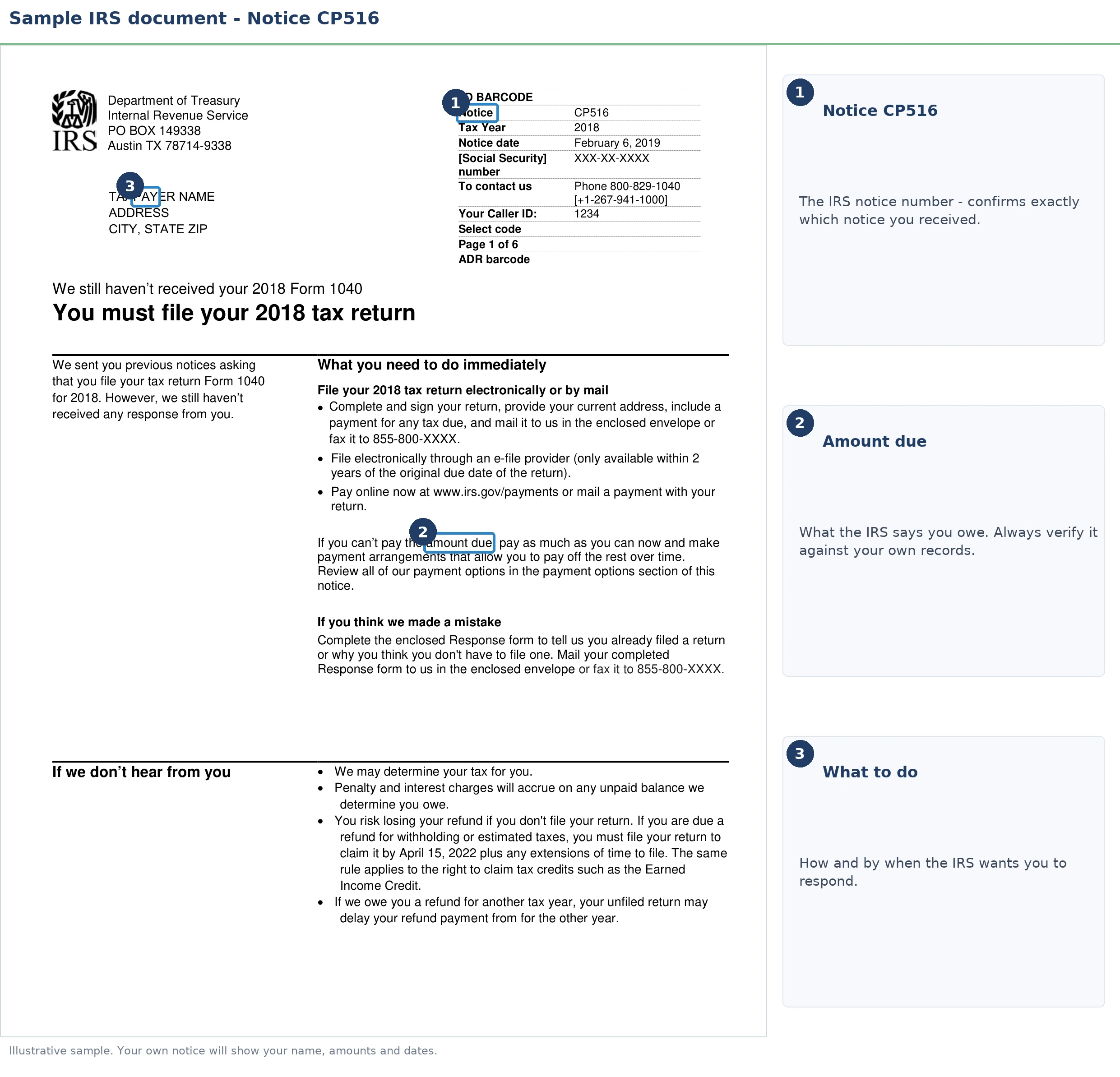
The image below shows exactly what a CP516 looks like and where the tax year and response date sit — check those two lines first, because everything else in this guide keys off which year the IRS says is missing.
⏱ Your deadline: the response date printed on your CP516 — the IRS sets it on the notice itself, not by statute. If you'll owe for that year, the failure-to-file penalty is already growing at 5% of the unpaid tax per month, up to a 25% cap, and it doesn't wait for you to respond.
Why you got a CP516
A CP516 means employers or payers reported income under your Social Security number for a year with no tax return on file. Your W-2s, 1099s, and mortgage forms all get copied to the IRS, so it knows roughly what you earned — it just has no return from you to match against it. When the first request (usually a CP59 — no return filed) goes unanswered, the CP516 follows as the second ask.
Common reasons the year went unfiled: you filed an extension and October came and went, you moved and lost track of a W-2, you assumed you didn't earn enough to file, or you mailed a paper return that never processed. The CP516 doesn't accuse you of anything — it's an automated records mismatch, one of the most common reasons you got a letter from the IRS at all.
What a CP516 is not: a bill, an audit, or a levy warning. No tax has been assessed yet — which is exactly why acting now is so much cheaper than acting two notices from now.
What happens if you ignore a CP516 notice
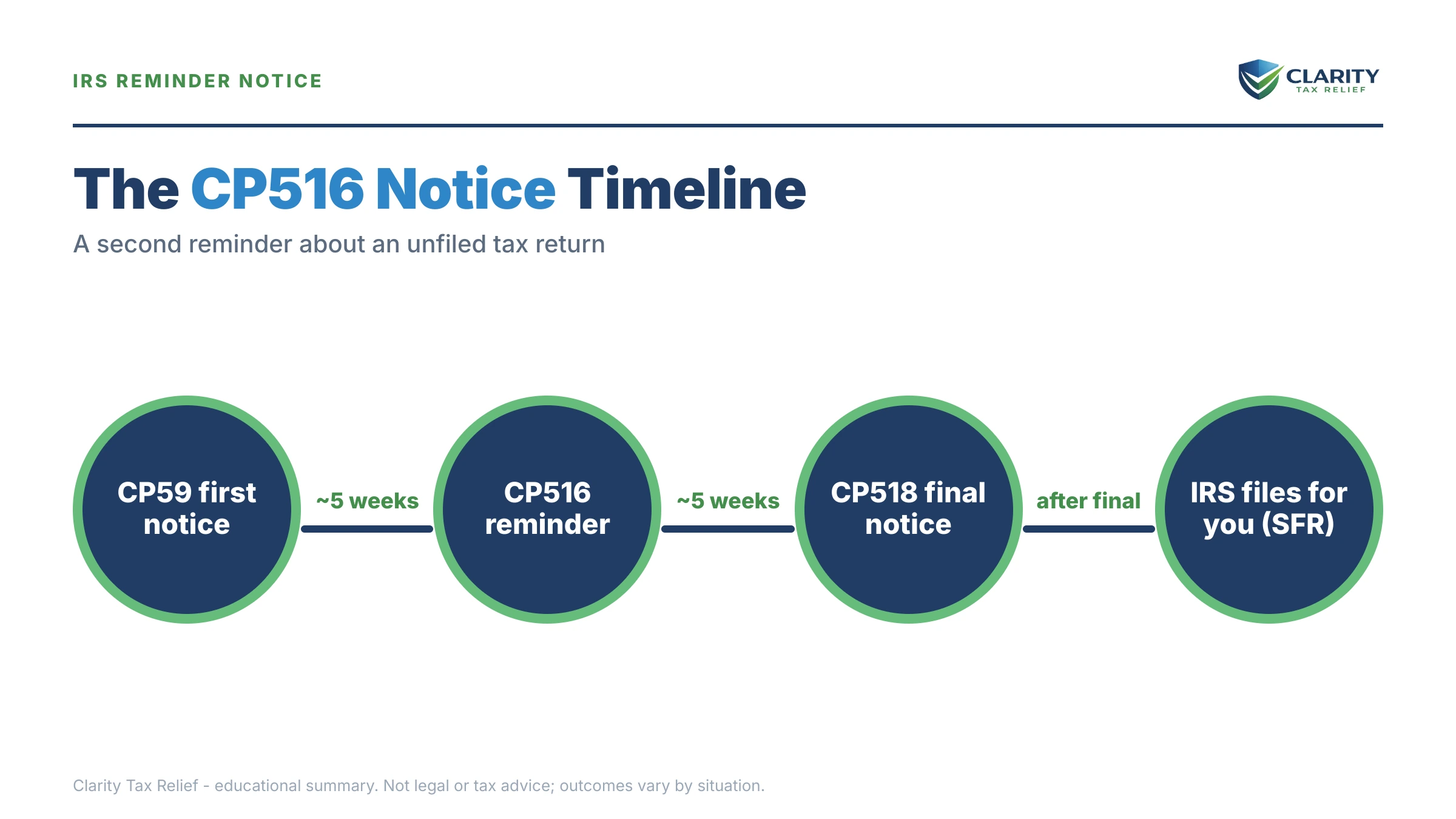
Ignoring a CP516 leads to a CP518 final notice, and then the IRS can file a return for you — a substitute for return that uses no deductions or credits beyond the standard deduction. The sequence is automated and runs in one direction:
- CP59 — first request for the missing return. Already behind you.
- CP516 — second request. You are here. Still no assessment, still full control.
- CP518 final notice — the last request before the IRS acts on its own.
- CP2566 — the IRS proposes a substitute-for-return tax figure built from third-party records, calculated at the worst filing assumptions.
- CP3219N — deficiency for non-filers — a statutory notice giving you 90 days to petition Tax Court. If it passes, the SFR tax is assessed and the account moves into the regular collection stream — balance-due bills, then intent-to-levy notices.
One more thing most readers don't realize: an unfiled year never closes. The IRS's normal time limit to assess tax doesn't start running until a return is filed — so a year you never file stays open indefinitely, while filed years eventually go quiet.
| Notice | Your response window | What you lose if it passes |
|---|---|---|
| CP59 | Date printed on the notice | The quietest, lowest-pressure moment to file on your own numbers |
| CP516 (you are here) | Date printed on the notice | Your last routine reminder — the next notice is the final one |
| CP518 | Date printed on the notice | The chance to file first, before the IRS builds a return from third-party records |
| CP2566 | Date printed on the notice | The easiest window to replace the IRS's inflated math with your real return |
| CP3219N | 90 days | Tax Court review before assessment — after this, the SFR balance is assessed and collection begins |
Holding a CP516 for a year you never filed?
Send us a photo of the notice. An experienced tax professional will pull the IRS's income records for that year, tell you whether you're looking at a refund or a balance, and map the fastest path to close it — free, confidential, before the IRS files a return for you.
Which of these four situations are you in?
A CP516 has four honest resolutions, and the right one depends on facts you can confirm in about fifteen minutes.
1. You already filed
Paper returns can take months to process, and the notice stream doesn't check the mailroom. Log into your IRS online account: if the return posted after the notice date, you can generally stand down. If it shows nothing, mail a signed copy of the return with proof of the original mailing date to the address on the notice.
2. You weren't required to file
If your income for that year fell below the filing threshold for your filing status, respond in writing explaining why no return was due — don't just toss the notice. The IRS's records show gross income, not your circumstances, so silence reads as noncompliance even when you legitimately owed nothing.
3. You're owed a refund
Many W-2 employees who skip a year actually overpaid through withholding. There's no failure-to-file penalty when you're due money — but the refund is forfeited if you don't file within 3 years of the original due date. Check whether you can still get a refund from 3 years ago before that window quietly closes.
4. You'll owe when you file
File anyway, immediately. The failure-to-file penalty (5% per month) is ten times the failure-to-pay penalty (0.5% per month) — though in months where both apply the failure-to-file portion drops to 4.5% (5% combined) — the math behind why you should file even if you can't pay. Once the return is in, real options open: short-term plans up to 180 days with no setup fee, online installment agreements up to 72 months for balances under $50,000, hardship status if paying anything is genuinely impossible, and penalty relief if your compliance history is otherwise clean. Starting summer 2026, the IRS's new Automatic Exemption from Penalty (AEP) can even remove qualifying penalties without a request.
Why filing yourself beats an IRS substitute for return
A substitute for return (SFR) is a return the IRS builds for you under IRC §6020(b), using only the income documents on file — single or married-filing-separately status, the standard deduction, and nothing else. No dependents, no credits, no adjustments, no itemizing. If you've already had one filed, see our guide to what happens when the IRS filed a substitute return — it can usually be replaced with a real return, but that's a slower, harder road than filing before the SFR exists.
Say you earned $68,500 in W-2 wages, single, and never filed the year on your CP516. This is hypothetical, but the arithmetic is real:
- If your withholding covered the tax — common for a single W-2 employee at this income — you owe nothing and face no failure-to-file penalty, because the penalty is a percentage of unpaid tax. Your only risk is losing your own refund to the 3-year clock. Filing costs you an afternoon.
- If your W-4 under-withheld and you owe, say, $3,400: the failure-to-file penalty runs 5% per month, but because the failure-to-pay penalty (0.5% per month, roughly $17) applies at the same time, the failure-to-file portion drops to 4.5% — about $153 a month — and caps at 22.5%, or $765, after five months. The failure-to-pay penalty continues after that, and interest compounds on all of it. Filing today stops the biggest penalty from the moment the return is in, even if you can't pay a dollar yet.
- If you wait for the SFR: the IRS computes the year at single status with the standard deduction only. For a straightforward W-2 filer the raw tax may land close to reality — but the SFR ignores your student-loan interest, IRA or HSA contributions, dependents, and every credit, and it arrives with the penalties above already stacked on. Whatever it shows becomes the assessed balance the collection machine pursues.
Want to see the penalty math on your own numbers? You can estimate it with our IRS Penalty & Interest Calculator before you file.
How to respond to a CP516, step by step
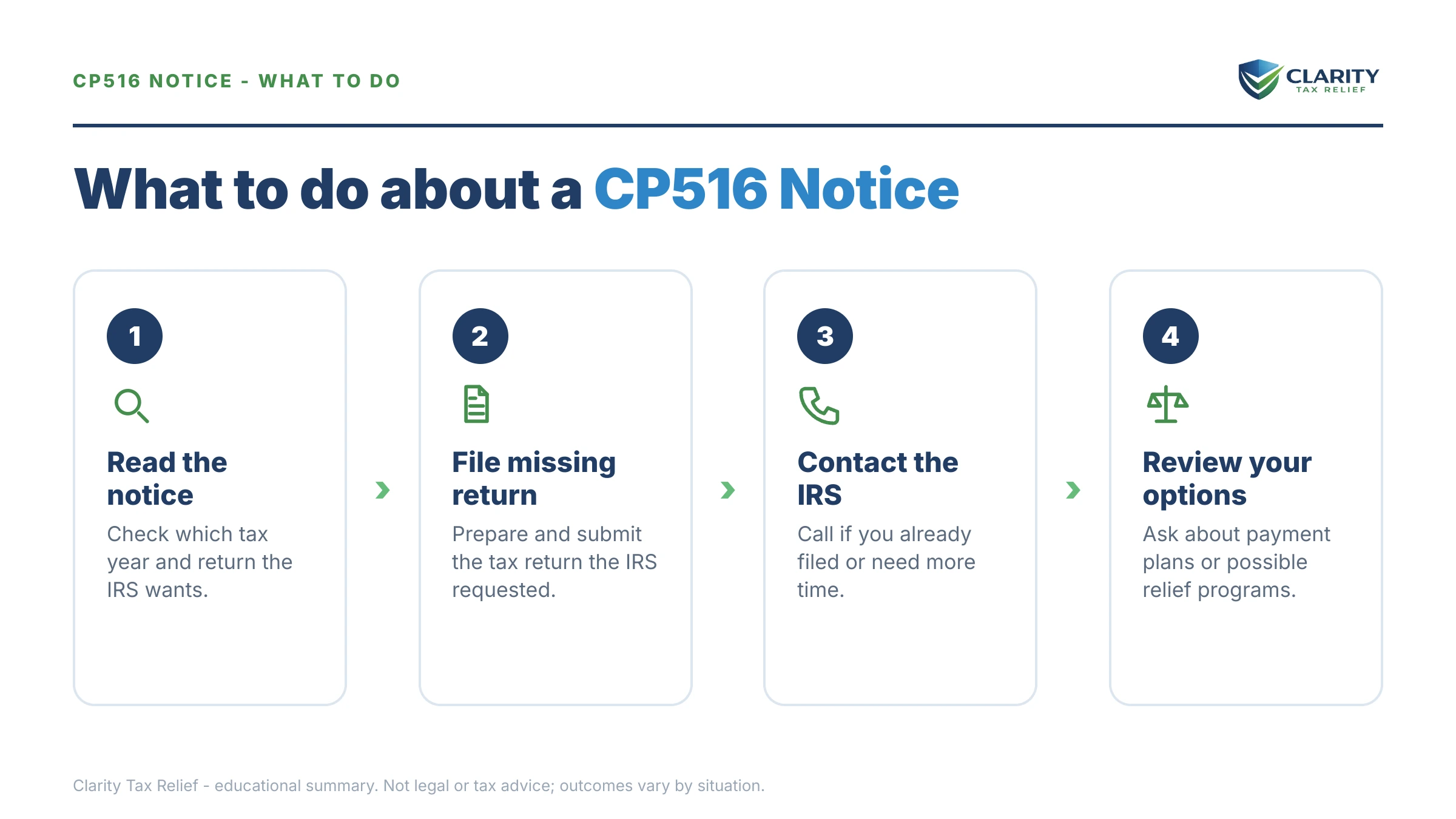
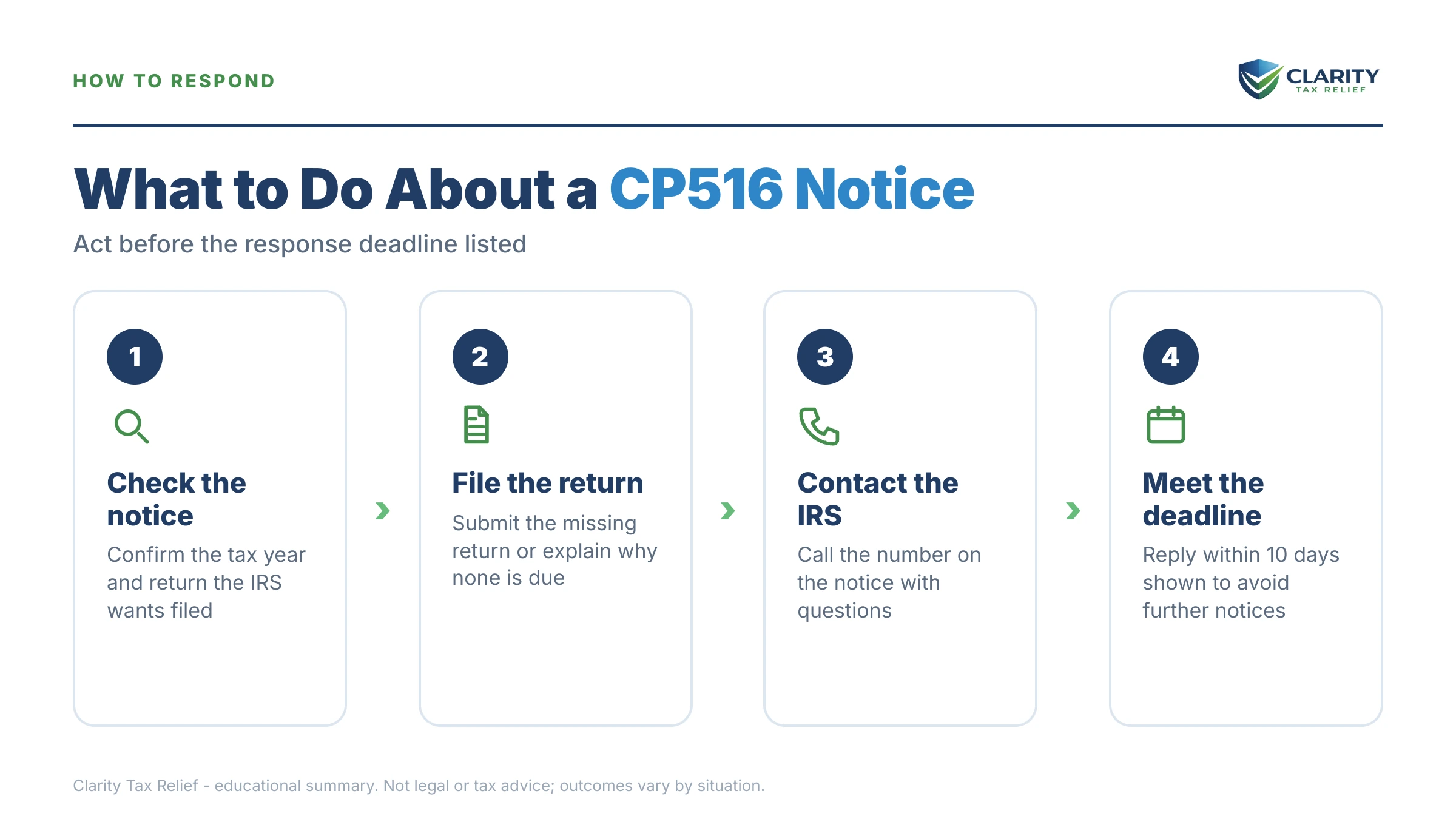
- Confirm the tax year and response date. Both are printed near the top of your CP516 — every decision that follows keys off the year the IRS says is missing.
- Verify whether you actually filed. Check your IRS online account or account transcript for that year; if a return already posted, respond with proof instead of filing twice.
- Pull your income records. Request the free wage and income transcript listing every W-2 and 1099 reported under your Social Security number for that year.
- File the missing return. File even if you can't pay a dime — filing stops the 5%-per-month failure-to-file penalty and blocks a substitute for return.
- Respond in writing if no return is due. If you already filed or your income fell below the filing threshold, mail an explanation with documentation to the address on the notice.
What your transcript shows on an unfiled year
Your IRS account transcript for the missing year tells you exactly where the non-filer process stands — before any letter arrives. Here's how to read the codes you're most likely to see (you can pull transcripts free at IRS.gov Get Transcript, and our wage and income transcript guide walks through it step by step):
| What you see | What it means | What to do |
|---|---|---|
| Return transcript shows "N/A" or no record | No return has processed for that year — the CP516 is accurate | Prepare and file the year now, on your numbers |
| Code 971 | A notice was issued — your CP59, CP516, or the next letter in line | Match each 971 date to a letter so you know your true stage |
| Code 806 | Your W-2 withholding is credited on the account, even with no return | Good sign — that credit counts toward whatever the return shows |
| Code 150 (on a year you never filed) | A return posted — possibly an IRS substitute for return | Confirm whose return it is; if it's an SFR, file an original return to correct it |
| Code 290 | Additional tax was assessed — the SFR balance is now real | You're past the prevention stage; get the assessment reviewed and corrected |
| Code 599 | The IRS secured a return — your late filing was received | Confirm processing, then address any balance it created |
When you can handle a CP516 yourself
Most single-year CP516s are a do-it-yourself problem. If it's one missing year, you have (or can pull) the income documents, and you're a W-2 employee with a simple return, you don't need to hire anyone — file the year, respond to the notice, and set up a payment plan if a balance results.
Experienced help changes the outcome when the situation is bigger than one clean year: multiple unfiled years (the IRS's own policy generally wants the last six — see how many years of back taxes you have to file, and the order you file them in matters), self-employment or business income with no records (our guide to filing back taxes with no records covers reconstruction, but a professional does it faster and more defensibly), an SFR that's already been assessed, or a projected balance large enough that resolution strategy — penalties, payment terms, hardship — decides what you actually pay.
Terms on your CP516, decoded
- Return delinquency — IRS shorthand for a required return that was never filed; the CP59/CP516/CP518 series is the "return delinquency" notice stream.
- Substitute for return (SFR) — a return the IRS prepares for you from third-party records, always at the least favorable filing assumptions.
- IRC §6020(b) — the law that authorizes the IRS to file that substitute return when you don't.
- Failure-to-file penalty — 5% of the unpaid tax per month the return is late, capped at 25%; it's zero if no tax is unpaid.
- Refund statute — the 3-year window from a return's original due date to claim a refund; miss it and the overpayment is forfeited.
- Statutory notice of deficiency — the formal 90-day letter (CP3219N for non-filers) that's your last stop before the SFR tax is assessed.
CP516 questions, answered
What is a CP516 notice from the IRS?
A CP516 is a follow-up request — typically the second notice — telling you the IRS has no record of a tax return from you for the year printed on it. It is not a bill and not an audit; no tax has been assessed yet. It follows the CP59 first request, and if you don't respond, the CP518 final notice comes next.
Is a CP516 notice serious?
Yes — more serious than the CP59 before it, because it means the IRS's automated non-filer program is still tracking the missing year. Nothing is being levied at this stage, and no balance exists yet. But one more ignored notice puts you in substitute-for-return territory, where the IRS calculates your tax for you without any of your deductions or credits.
What happens if I ignore a CP516 notice?
The IRS sends the CP518 final notice, then can file a substitute for return (SFR) using the W-2s and 1099s employers already reported. An SFR uses single or married-filing-separately status and the standard deduction only — no dependents, credits, or itemized deductions — so it almost always shows the highest possible tax. That amount then gets assessed and moves into collection.
I already filed — why did I get a CP516?
Returns cross in the mail with notices, especially paper returns, which can take months to process. Check your IRS online account or account transcript: if the return posted, you can generally disregard the notice; if it shows nothing, respond with a signed copy of the return and proof of the date you sent it. Don't assume the IRS will connect the two on its own.
What if I don't have my W-2 or records for that year?
You can rebuild the year from the IRS's own files. A wage and income transcript — free from your IRS online account — lists every W-2, 1099, and 1098 reported under your Social Security number for that year. For a W-2 employee, that transcript is usually enough to prepare an accurate return; self-employed filers may need bank statements to reconstruct income and expenses.
Can I still get my refund if I file the return now?
Only if you file within 3 years of the return's original due date — after that, the refund is legally forfeited, even though you overpaid. There is no failure-to-file penalty when you're owed a refund, because the penalty is a percentage of unpaid tax. So if withholding covered you, the only thing at risk is your own money.
What if I file the return and can't pay what I owe?
File anyway — the failure-to-file penalty (5% per month) is ten times the failure-to-pay penalty (0.5% per month), though in months where both apply the failure-to-file portion drops to 4.5% (5% combined), so filing without paying stops the most expensive penalty immediately. Then set up a payment arrangement: balances under $50,000 generally qualify for an online installment agreement of up to 72 months, and short-term plans give you up to 180 days at no setup fee.
Can I go to jail over a CP516 notice?
Almost certainly not. The return-delinquency notice stream is a civil process aimed at getting a return filed, and the IRS resolves the overwhelming majority of non-filer cases with returns, penalties, and payment plans. Criminal prosecution is reserved for willful, usually multi-year, high-dollar evasion — and voluntarily filing before the IRS forces the issue is the strongest way to stay on the civil side.
Your next 24 hours
- Find the tax year and response date printed near the top of your CP516 — write both down, because they define exactly what the IRS is asking for and by when.
- Gather what you have for that year: any W-2s or 1099s, your last filed return, and your IRS online account login — or plan to pull the wage and income transcript that lists everything reported under your SSN.
- Get the year reviewed free. Call (888) 825-7779 or use the 2-minute form at our free consultation page — an experienced tax professional can tell you whether that missing year is a refund waiting or a balance growing at 5% a month, and file it before the IRS files it for you.
For the IRS's own explanation of this notice, see Understanding your CP516 notice; if the filed return produces a balance, payment options live at IRS.gov/payments.
This guide is general information, not tax or legal advice for your specific situation. Eligibility for IRS programs depends on individual facts and circumstances; no outcome is guaranteed.