
IRS Transcript Codes
810 Freeze + Verify Identity: What Actually Releases Your Refund (2026)
The short answer: verifying your identity releases an 810 refund freeze only if identity verification is why the IRS set it. If you got a 5071C, 4883C, 5747C, or 6330C letter, verify — code 811 marks the release, typically within nine weeks. If the 810 was set over a credit you claimed, verification alone won't lift it.
You checked "Where's My Refund," got nothing, pulled your transcript, and found it: 810 — Refund Freeze, with no dollar amount and no explanation. Every forum thread gives the same two-word prescription — verify identity. Sometimes that's exactly right; sometimes it's a detour that costs you months while the real problem sits untouched.
This guide walks the whole 810 freeze verify identity path: how to tell whether identity verification is actually what your freeze is waiting on, which letter unlocks which verification channel, and what to do when the freeze survives verification. The image below shows exactly where code 810 sits on an IRS account transcript and which nearby codes reveal what kind of freeze you're dealing with.
⏱ The clocks that matter: an 810 freeze has no fixed release date — but two real deadlines run around it. Respond to any identity-verification letter by the date printed on it, and remember that you generally have 3 years from a return's original due date to claim its refund. A frozen refund is preserved by a timely-filed return; an unfiled year's refund simply expires.
Why code 810 is on your transcript
Code 810 is a hard refund freeze: a specialized IRS unit has blocked your refund from being paid, and it will not release on its own. That's what separates it from routine processing holds — an 810 waits for a specific action, either from the IRS or from you. (For the full anatomy of the code itself, see our code 810 refund freeze guide; this page is about the identity-verification path specifically.)
Four things set an 810, and each is owned by a different unit:
- Identity or return verification. The Taxpayer Protection Program (TPP) suspects the return might not be yours — or wants proof it is — before paying out. This is the only 810 that identity verification releases.
- A questionable refundable credit. Return Integrity Verification Operations (RIVO) freezes refunds built on credits its filters distrust: the fuel tax credit, the self-employed sick and family leave credit (Form 7202), household employment taxes, and inflated withholding.
- The frivolous return screen. Returns claiming credits that don't legally exist for that year get routed here, and Letter 3176C follows.
- An exam referral. Less common at the start — but an unresolved 810 can end up in examination, marked by code 420.
Certain filing patterns trip these filters far more often. Filing several years at once, large refundable credits with little or no withholding history, and gig income that doesn't match what platforms reported are all classic triggers — and since the 1099-K $20,000 threshold reversion, plenty of gig income shows up nowhere on IRS records at all, which makes big refund claims stand out more, not less. None of this means the IRS is accusing you of fraud. The system stops payment first and asks questions second.
Will verifying your identity release the 810 freeze?
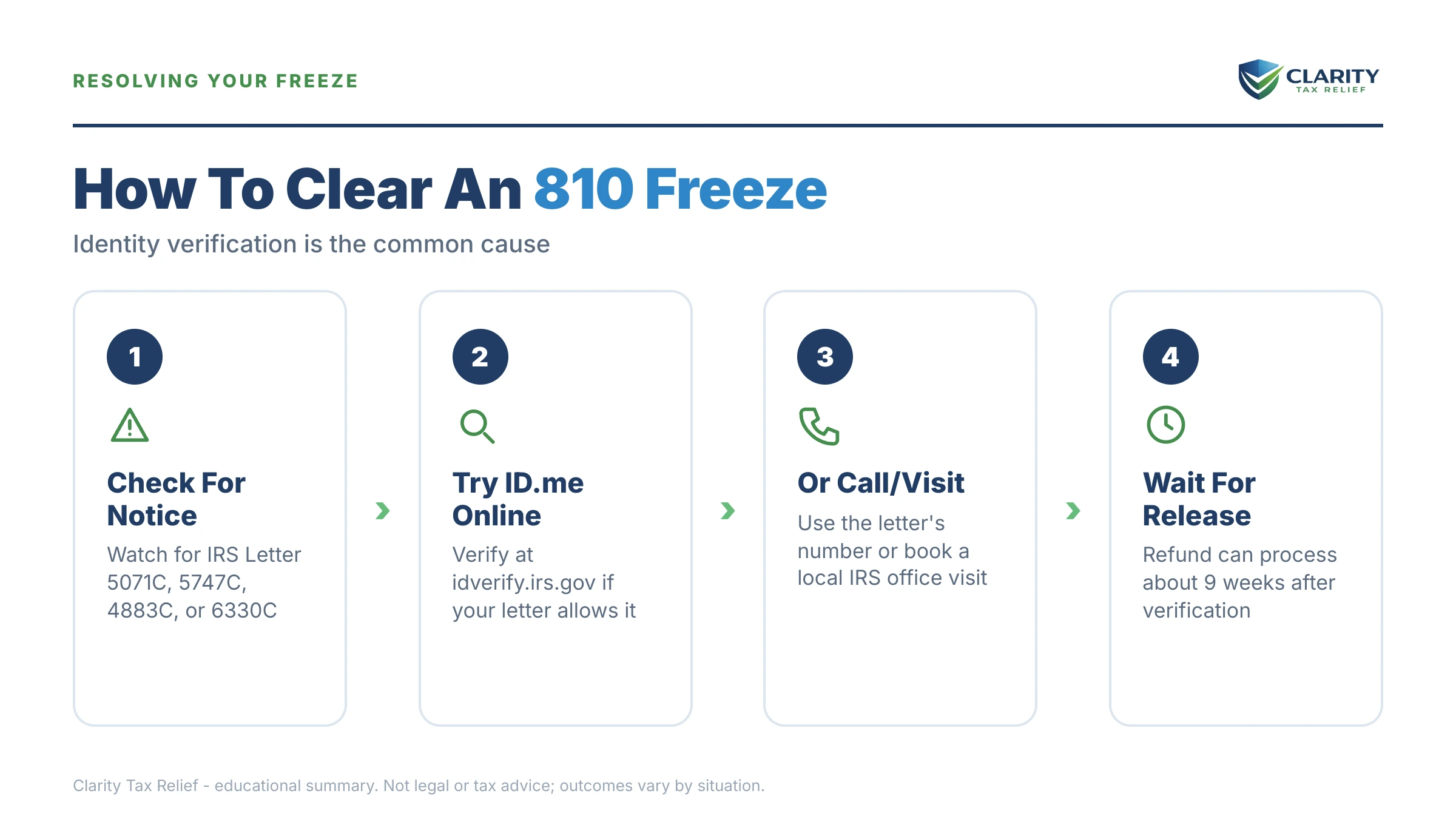
Identity verification releases an 810 freeze only when the Taxpayer Protection Program placed it — and the TPP always announces itself with a letter. If your freeze is identity-driven, one of four letters is coming (or already came): 5071C, 4883C, 5747C, or 6330C. Each one dictates a different verification channel, and using the wrong one wastes weeks.
You cannot verify proactively without a letter. The IRS's online tool asks for information printed on the letter itself, so a bare 810 with an empty mailbox means one of three things: the letter is still in the pipeline, it went to an old address, or your freeze isn't an identity freeze at all. Look for code 971 ("notice issued") near the 810 — that's your confirmation a letter exists. No 971 after several weeks? Call the IRS and ask which unit set the freeze before you do anything else.
| Letter | How you verify | What happens after |
|---|---|---|
| 5071C letter | Online through the IRS verification service, or by phone using the number on the letter | Return resumes processing; 811 then 846 post once released |
| 4883C letter | Phone only — call the number printed on the letter with your returns in hand | Same release path; expect long hold times in 2026 |
| 5747C letter | In person at a Taxpayer Assistance Center — appointment required | Bring photo ID plus current and prior-year returns |
| Letter 6330C | Online or phone, per the letter's instructions | Functions as a 5071C variant — same release path |
One more scenario worth naming: if the return the IRS is asking you to verify isn't one you filed, do not verify it as yours. Tell the agent it's not your return — that shifts your case into identity-theft handling (Form 14039 territory), which protects you instead of validating a thief's filing.
What happens if you ignore an 810 freeze
An 810 freeze never times out in your favor — the refund stays frozen while every other clock on your account keeps running. Here's the sequence when nothing gets done:
- The refund sits frozen. Code 810 doesn't age off. Months can pass with no transcript movement and no money.
- An unanswered verification letter stalls the return itself. If the TPP can't confirm the return is yours, the IRS may treat it as never filed — which matters enormously if that year actually owes tax, because failure-to-file and failure-to-pay penalties accrue as though you never submitted it.
- Credit-driven freezes escalate. A RIVO freeze that gets no documentation can turn into a CP05A document demand, a Letter 3176C warning of a possible $5,000 frivolous-return penalty under IRC §6702, or a full disallowance of the credit.
- Exam referral. Code 420 posts and the frozen year moves into audit — a slower, more demanding process than answering the first letter would have been.
- Other years' refund windows close for good. The freeze preserves nothing on years you haven't filed. Every unfiled refund year is marching toward its own 3-year expiration regardless of what happens to the frozen one.
Staring at an 810 with no idea which kind it is?
Send us your transcript and any IRS letters. An experienced tax professional will identify which unit froze your refund, whether identity verification will actually release it, and what to send if it won't — free, confidential, no pressure.
Your options when the 810 isn't (only) about identity
Roughly speaking, there are four kinds of 810 freeze, and each has exactly one release path — matching yours correctly is the whole game:
| What triggered the freeze | How you'll know | What releases it |
|---|---|---|
| Identity / return verification (TPP) | A 5071C, 4883C, 5747C, or 6330C letter arrives | Successful identity verification — code 811 follows |
| Questionable refundable credit (RIVO) | No identity letter; often a bare 810, then a CP05A or document request | Documentation proving the credit — or a Form 1040-X removing it |
| Frivolous return screen | Letter 3176C warning of a possible $5,000 penalty | A corrected or amended return filed by the letter's deadline |
| Exam referral | Code 420 posts; an examination letter follows | Completing the exam — provide records, appeal if you disagree |
Two clarifications save people the most time. First, an 810 review is not the same as a general refund review — a 4464C letter means the IRS is checking wages and withholding without a hard freeze, and it usually resolves without any action from you. Second, if catching up on returns produced a balance due instead of a refund, the freeze becomes the smaller problem — start with our hub on how to settle tax debt yourself for the payment-plan and hardship options, because the IRS will collect on the balance-due year whether or not the frozen year ever pays out.
A worked example: $23,800 frozen across three late returns
Say you drove for delivery apps for three years and never filed — then caught up all at once in March 2026, submitting 2022, 2023, and 2024 together. Between the Earned Income Tax Credit and the Child Tax Credit, the returns claim refunds of $6,300 (2022) + $8,100 (2023) + $9,400 (2024) = $23,800. Three late returns, large refundable credits, and no withholding history is precisely the profile the IRS's pre-refund filters flag — and now the 2024 transcript shows an 810.
Here's how the pieces play out. The 2022 return was due in April 2023, so its refund claim window ran to April 2026 — filing in March 2026 preserved that $6,300 with weeks to spare. That's the part most people miss: the 3-year clock is about when you file the claim, not when the IRS pays it, so even a long freeze can't take away a refund you claimed on time. If you'd waited until May, that $6,300 would have been gone permanently — see the 3-year refund deadline for how that cutoff works.
Next, the freeze itself. If a 5071C arrives, you verify online, and the IRS's stated window means the 2024 return could finish processing up to nine weeks later — 811, then 846 with a deposit date for the $9,400. The 2022 and 2023 refunds process on their own tracks and aren't held hostage by the 2024 freeze unless they were flagged separately.
Now the wrinkle: suppose the 2023 return actually nets out to $1,900 owed once self-employment tax is calculated, instead of a refund. That balance has been accruing failure-to-file and failure-to-pay penalties since April 2024 — and the failure-to-file penalty runs at ten times the failure-to-pay rate, which is why filing beat waiting even before the freeze. The IRS will offset that balance, penalties and interest included, from whichever refunds release first. You can estimate what a balance-due year has grown into with our IRS Penalty & Interest Calculator.
Last wrinkle: if the 2024 return also claimed a credit RIVO questions — say a sick-leave credit that only ever applied to 2020 and 2021 — identity verification clears the TPP hold but the refund stays frozen behind the credit review. In that case, amending to remove the bad credit typically releases the valid remainder faster than arguing for a credit the law doesn't support.
How to respond to an 810 freeze, step by step
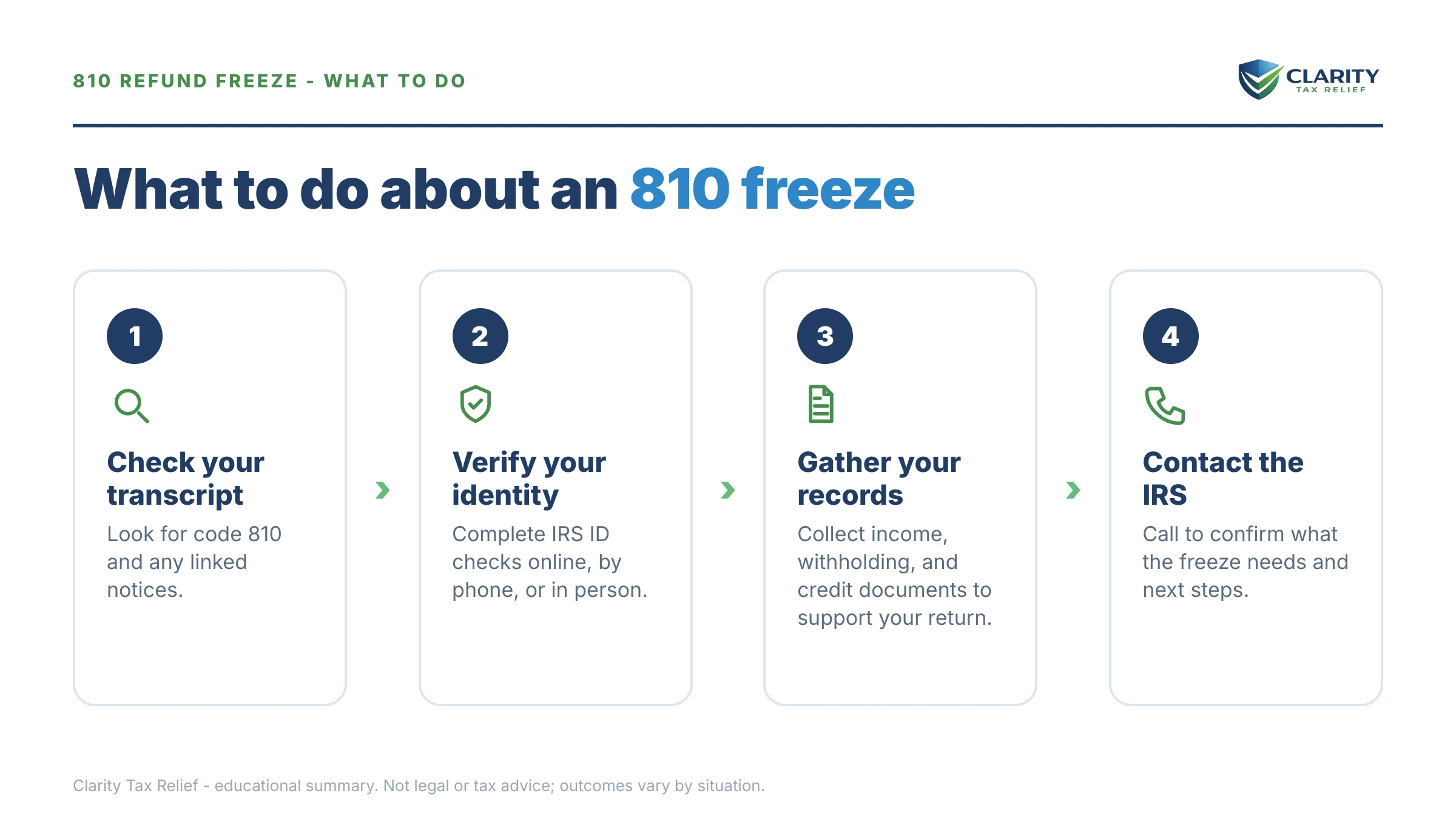
- Pull your account transcript. Confirm the 810, note its date, and look for a 971 (notice issued) or 420 (exam) posted near it — those codes tell you which path you're on.
- Match your letter to the right verification channel. 5071C and 6330C verify online or by phone, 4883C is phone-only, and 5747C requires an in-person appointment at a Taxpayer Assistance Center.
- Verify with your documents ready. Have the letter, the tax return you filed, a prior-year return, and government photo ID in front of you — the process fails without them and restarting costs weeks.
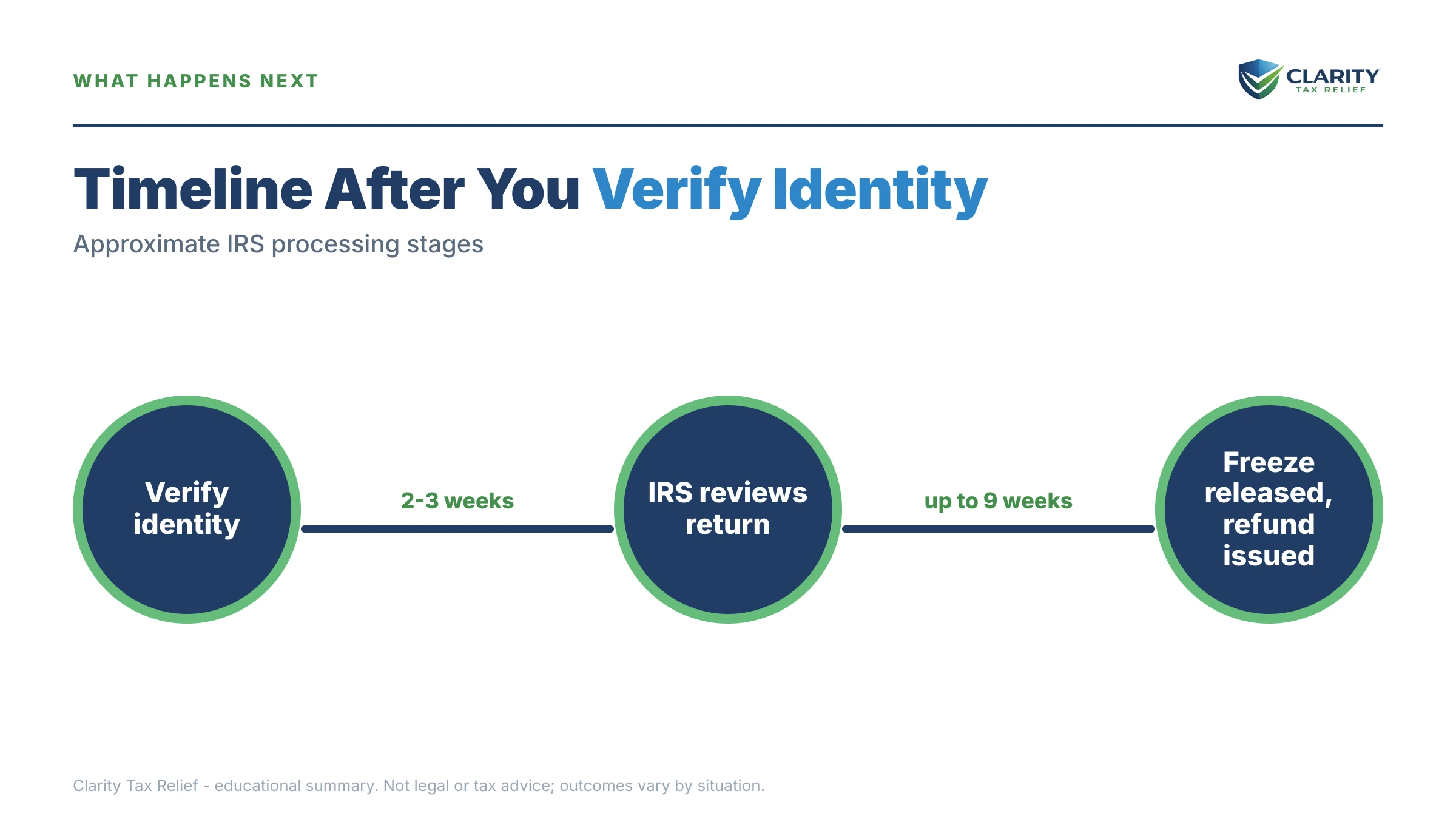
- Watch the transcript for codes 811 and 846. The IRS says to allow up to nine weeks after successful verification; 811 releases the freeze and 846 sets your refund date.
- Escalate if nothing moves. If nine weeks pass with no 811, call the IRS to ask what's still holding the return, answer any new letter fast, and request Taxpayer Advocate help if the delay is causing hardship.
The online path runs through the IRS's Identity and Tax Return Verification Service, which requires an ID.me account. If the site rejects your documents or loops you at the selfie step — a common 2026 complaint — our guide to idverify.irs.gov not working covers the workarounds, including forcing the phone or in-person route.
After you verify: the transcript codes to watch
Once you've verified, the transcript — not "Where's My Refund" — is where release shows up first, usually with the weekly update cycle. You can pull yours anytime through the IRS's Get Transcript tool. Here's the decoder for what posts around an 810:
| Code | What it means | What to do |
|---|---|---|
| 810 | Hard refund freeze — a specialized unit blocked payment | Identify which unit set it before acting |
| 971 | Notice issued — a letter is on its way | Watch the mail; the letter names your next step |
| 811 | Freeze released — the block is lifted | Nothing; processing resumes on its own |
| 846 | Refund issued — the listed date is your payment date | Confirm your bank info was current on the return |
| 570 | Separate account hold, independent of the 810 | Usually self-resolves; the 810 still controls |
| 420 | Return referred to examination | Respond to the exam letter with documentation |
When you can handle this yourself — and when help changes the outcome
Most identity-driven 810 freezes are genuinely do-it-yourself. If you filed the return, you got a 5071C or 6330C, and your documents are in order, online verification takes about fifteen minutes and costs nothing — no professional needed. The same goes for a 4883C phone call if you can tolerate the hold time, and a 5747C appointment if there's a Taxpayer Assistance Center within reach.
Experienced help changes the outcome in a narrower set of situations: an 810 that's been sitting for months with no letter and no answers; a Letter 3176C, where the wrong response can lock in a $5,000 penalty; multiple catch-up years where refunds, balances due, and credits interact and the order of fixes changes what you keep; and hardship cases where the frozen refund is rent money — a Form 911 to the Taxpayer Advocate can force movement, but it has to document the hardship correctly. The Taxpayer Advocate Service is free and independent, and worth knowing about whether or not you hire anyone.
Terms on your transcript, decoded
- TC 810 / TC 811: the freeze and its release — 811 is the code you're waiting for after verification.
- Taxpayer Protection Program (TPP): the IRS unit that flags possibly-stolen identities and sends the 5071C-family letters.
- RIVO: Return Integrity Verification Operations — the unit that freezes refunds over questionable credits and withholding, not identity.
- TC 971: "notice issued" — proof a letter exists even if it hasn't reached your mailbox.
- RSED: Refund Statute Expiration Date — the deadline, generally 3 years from the return's due date, after which an unclaimed refund is forfeited.
- Frivolous return penalty: the $5,000 penalty under IRC §6702 for returns claiming positions with no legal basis — the threat inside Letter 3176C.
810 freeze questions, answered
Does verifying my identity release an 810 refund freeze?
Only when identity verification is the reason the freeze was set. If the Taxpayer Protection Program flagged your return — you'll get a 5071C, 4883C, 5747C, or 6330C letter — successful verification lets the return finish processing, and code 811 marks the release. If a different unit froze the refund over a credit you claimed, verifying changes nothing; you have to resolve the credit question itself.
How long after I verify my identity will the 810 freeze release?
The IRS says to allow up to nine weeks after successful verification for your return to finish processing. Many filers see code 811 and then code 846 sooner than that, usually with the weekly transcript update. If nine weeks pass with no movement, call the IRS — a second, unrelated hold may be sitting behind the identity freeze.
Can I verify my identity for an 810 freeze if I never got a letter?
No — the IRS's online verification tool only works with a letter in hand, because it asks for information printed on it. If your transcript has shown 810 for several weeks with no letter, call the IRS at 800-829-1040, confirm your mailing address, and ask which unit placed the freeze and whether a verification letter was issued. Moving without updating your address with the IRS is the most common reason the letter never arrives.
What does code 810 with no other codes on my transcript mean?
It usually means your return was flagged before it finished processing — 810 can post even before code 150 (return filed) appears. A bare 810 is more often a credit or income review than an identity issue, but you can't confirm which until a letter arrives or you call. Watch for code 971, which means a notice has been issued and is on its way.
What's the difference between code 810 and code 570?
Code 570 is a general hold on your account that frequently resolves on its own once the IRS finishes a routine check. Code 810 is a hard refund freeze placed by a specialized unit, and it almost never releases without an action — verifying your identity, documenting a credit, or amending the return. If you see both, the 810 controls; clearing the 570 alone won't pay the refund.
What if the 810 freeze doesn't release after I verify my identity?
A freeze that survives verification means a second issue is attached to the return — most often a credit review, a frivolous-return screen, or an exam referral. Watch your transcript for a new code 971 and respond quickly to whatever letter follows, such as a CP05A or Letter 3176C. If the frozen refund is causing genuine financial hardship, the Taxpayer Advocate Service can take the case with Form 911.
Does an 810 freeze mean I'm being audited?
Not by itself. An audit shows up on your transcript as code 420 or 424, and it comes with its own examination letters. That said, an 810 review can end in an exam referral if the IRS can't verify a credit or income figure from what you filed — which is why responding to the first letter with documentation beats waiting.
Will my refund be released if my 810 came from claiming the self-employed sick leave credit?
Only if the credit is legitimate for the year you claimed it and you can document it. The Form 7202 sick and family leave credits applied to 2020 and 2021 only — claims on later-year returns get denied and can draw a $5,000 frivolous-return penalty under IRC §6702. If the credit doesn't hold up, amending to remove it is usually the fastest way to release the valid part of your refund.
Your next 24 hours
- Find the codes around your 810. Pull your account transcript and write down three things: the 810's date, whether a 971 sits near it, and whether a 420 appears anywhere. Then check your mail pile for anything from the IRS with "5071C," "4883C," "5747C," or "6330C" in the corner.
- Gather your verification kit. The letter (if you have one), the return that's frozen, a prior-year return, government photo ID, and your income documents for the frozen year — everything verification or a credit review could ask for, in one folder.
- Get a free case review. If there's no letter, the freeze has outlasted nine weeks, or unfiled years are tangled into it, have an experienced tax professional map the release path before another refund window closes — use the 2-minute form or call (888) 825-7779. The freeze isn't accruing a penalty, but any balance-due year behind it is.
This guide is general information, not tax or legal advice for your specific situation. Eligibility for IRS programs depends on individual facts and circumstances; no outcome is guaranteed.