
IRS Letters
IRS Letter 6330C: How to Verify Your Identity and Release Your Return (2026)
The short answer: Letter 6330C means the IRS stopped a tax return filed under your Social Security number and won't process it until you verify your identity. Unlike Letter 5071C, you generally can't verify online — you must call the Taxpayer Protection Program number printed on the letter. Until you call, that return goes nowhere.
You filed weeks ago — a big self-employment year, a balance you'd already planned around — and instead of confirmation, the IRS sent a letter saying it won't even process the return until you prove you're actually you. That's Letter 6330C, and for most people it's one phone call. This guide walks you through making that call count, and what to do about the money side while the return sits frozen.
The image below shows exactly what a 6330C looks like and where to find the phone number and tax year you'll need before you dial.
⏱ Your real clock: follow the response instructions and timeframe printed on your letter — that's the date that controls. But there's a second clock the letter never mentions: if your held return shows a balance due, the 0.5%-per-month failure-to-pay penalty and daily interest have been running since the original filing deadline — and they keep running the entire time the return sits unverified.
Why you got Letter 6330C
Letter 6330C comes from the IRS Taxpayer Protection Program, which pulled a return filed under your name and SSN out of processing because something about it tripped the agency's identity-fraud filters. The IRS wants to confirm the real taxpayer filed it before anything — refund, assessment, or account posting — happens.
Two possibilities explain the letter. Either you filed the return and an automated filter flagged it, or someone else filed a return using your Social Security number. The letter itself doesn't tell you which one happened — the phone call does.
The filters flag legitimate returns constantly, and self-employed filers get caught more than most. A first-time Schedule C, a sharp swing in income, a new bank account for direct deposit, an address change, or e-filing through a new preparer or device can all look like fraud signals to a computer. Getting a 6330C does not mean you did anything wrong, and it is not an audit — no one is questioning your deductions.
If you're trying to place this letter among everything else the IRS mails, our decoder on why did I get a letter from the IRS maps the families. The 6330C sits in a small identity-verification cluster, and which letter you got determines how you're allowed to verify — that's the next section.
Letter 6330C vs. 5071C, 4883C, and the other identity letters
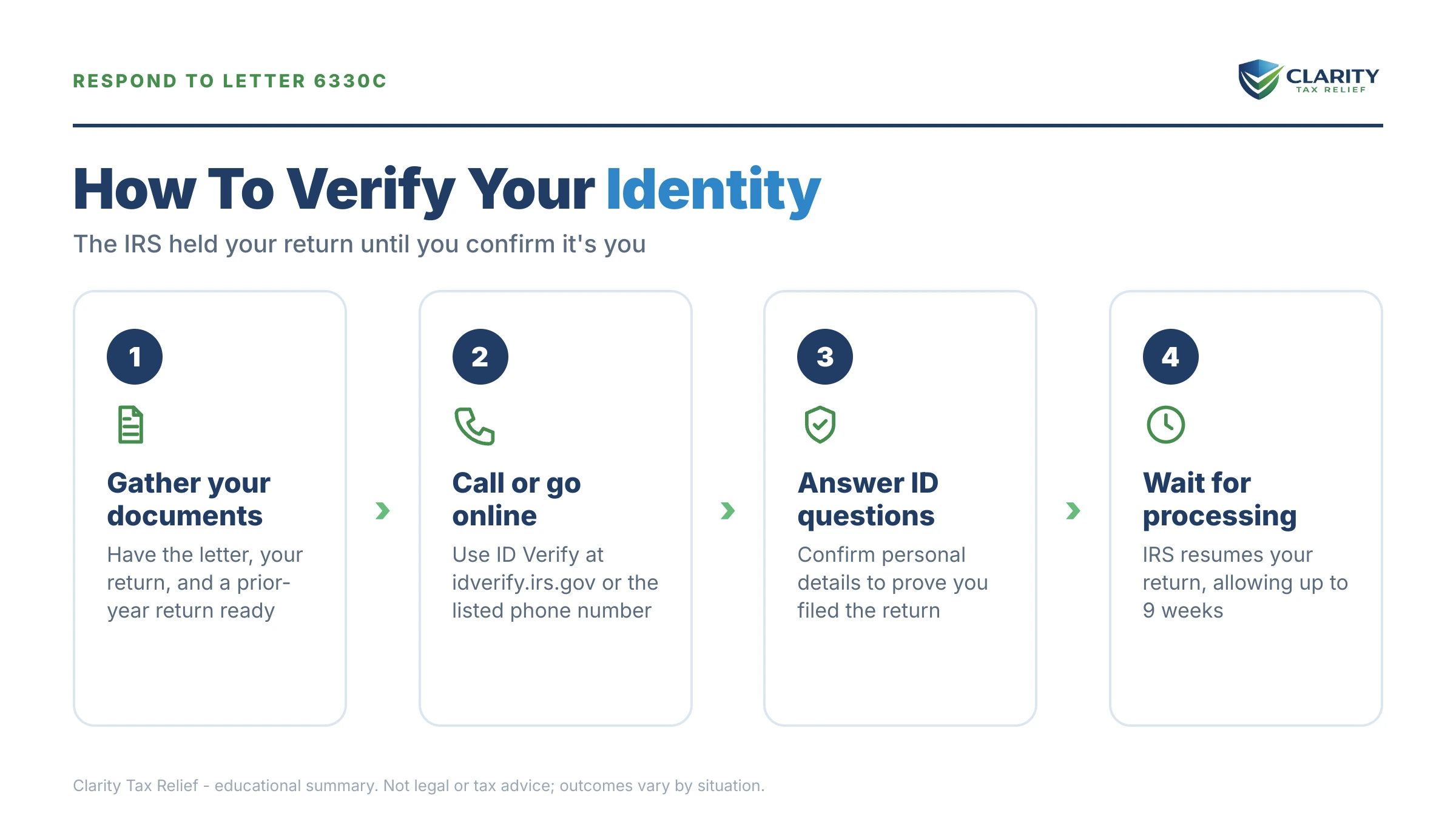
Letter 6330C is a phone-verification letter: the IRS wants you to call the Taxpayer Protection Program line printed on it, not use the online tool. That's the single most common mistake people make — spending an hour fighting the online Identity and Tax Return Verification Service, which is built around the 5071C letter, only to learn their letter type isn't accepted there. (If you did try online and hit a wall, our guide to idverify.irs.gov not working explains why.)
| Letter | How you verify | When the IRS uses it |
|---|---|---|
| 6330C | Phone — call the Taxpayer Protection Program number printed on the letter | A filed return tripped fraud filters; the IRS wants live phone verification before processing |
| 5071C | Online (ID.me) or phone | The most common verification letter, with an online self-service option |
| 4883C | Phone only | The 6330C's older sibling — same trigger, same phone-line process |
| 5747C | In person at a Taxpayer Assistance Center | Higher-risk flags that phone or online verification can't clear |
| 5447C | Phone or mail, designed for filers outside the U.S. | International addresses where the domestic tools don't work |
One more distinction worth knowing: a 6330C is about verifying a return before processing. If the IRS suspects identity misuse on your account more broadly, that arrives as a Letter 4310C instead, and the response path is different.
What happens if you ignore Letter 6330C
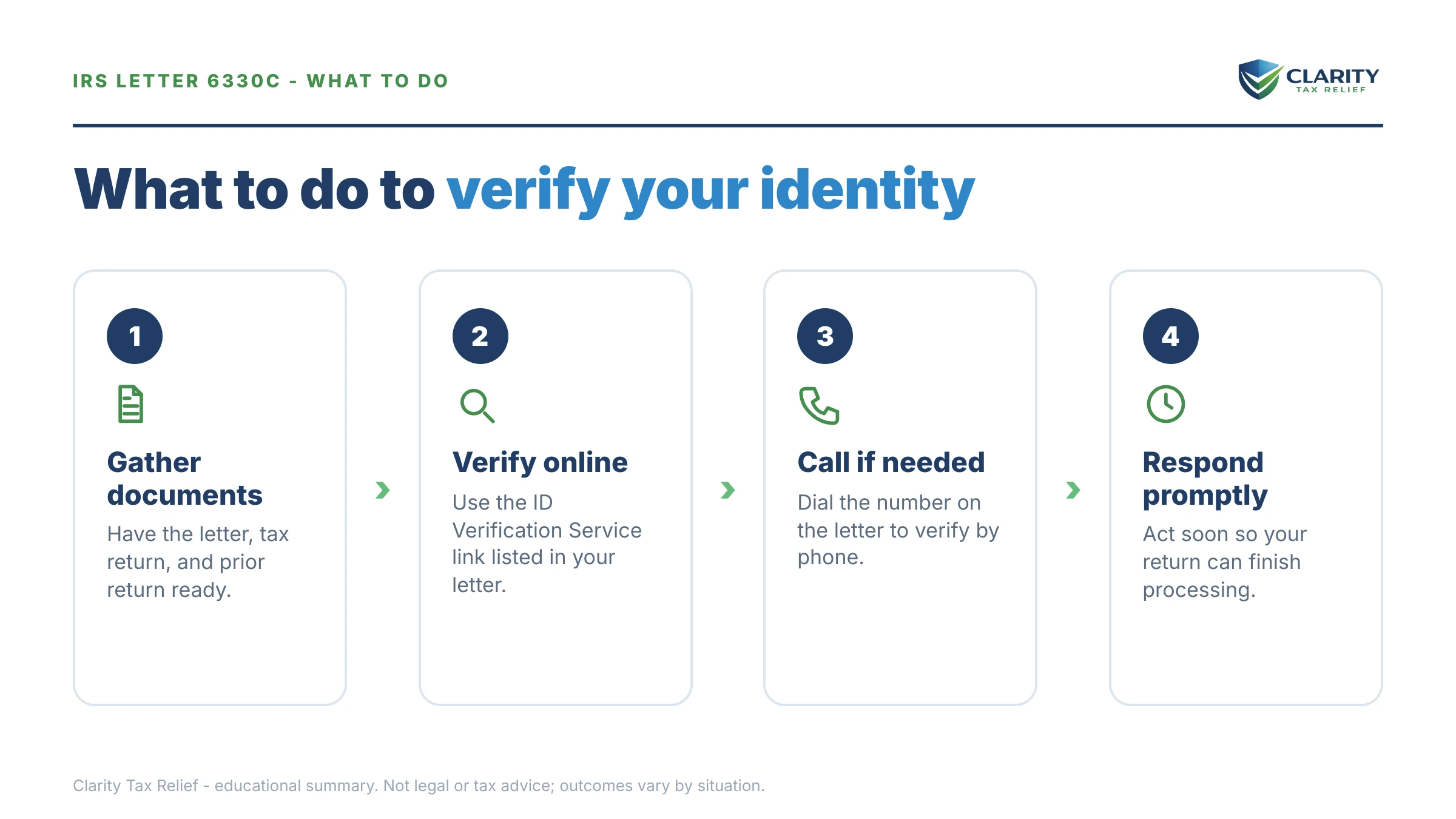
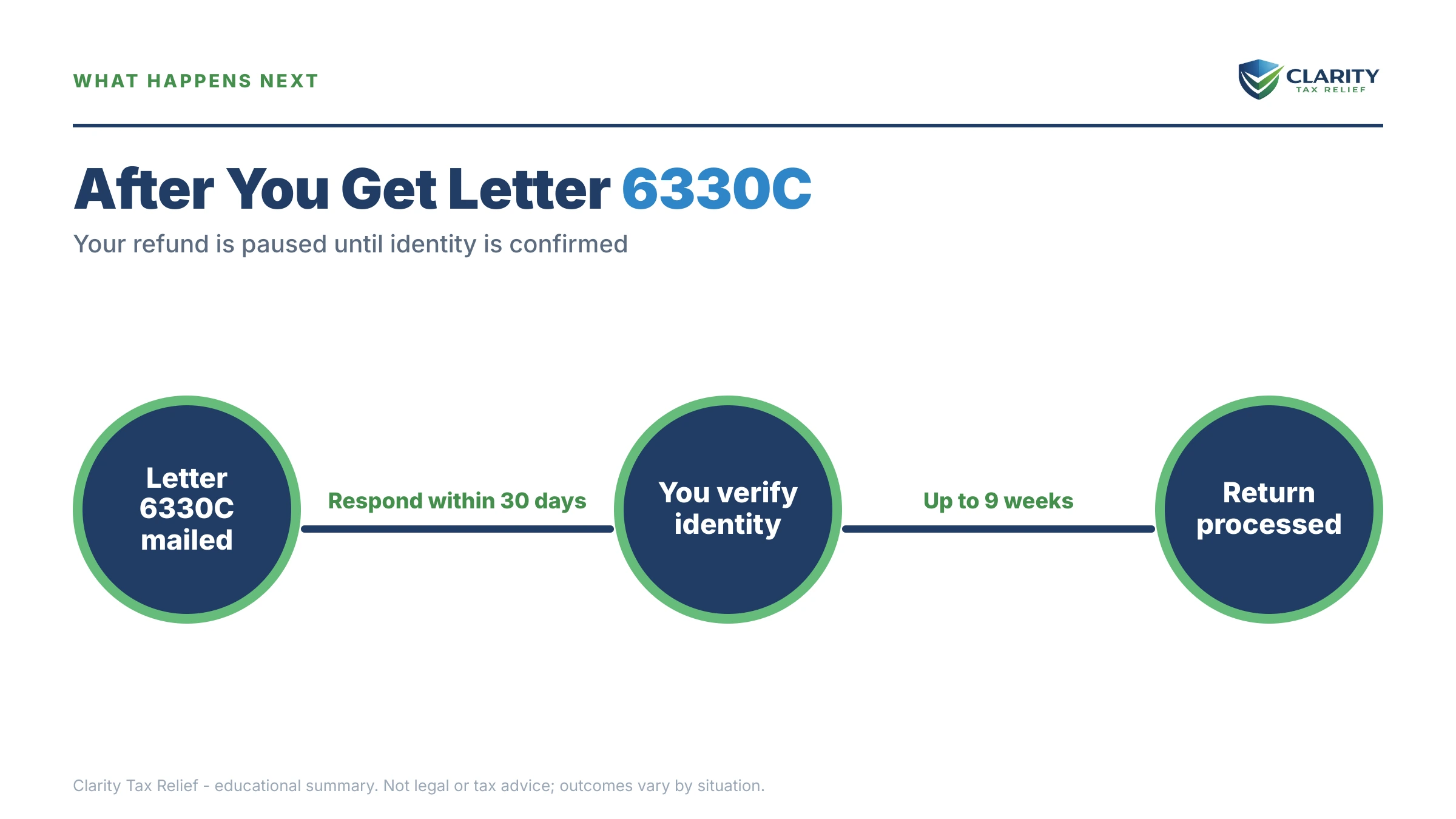
If you never respond to Letter 6330C, the IRS never processes the return — no refund, no assessment, and no start to any of the timelines you may be assuming are running. The hold doesn't age out in your favor. Here's the sequence, in order:
- The return sits in Taxpayer Protection Program suspense. It's unprocessed and unassessed — your account transcript may show no return filed at all, or a hold code like the ones covered in our 810 freeze and identity verification guide.
- Any refund on the return stays frozen indefinitely. There is no automatic release; verification is the only key.
- If the return shows a balance due, the meter runs anyway. Penalties and interest accrue from the original filing deadline whether or not the IRS has processed the return. Waiting costs real money every month.
- The IRS may send a follow-up letter — and can ultimately pull the unverified return from processing. At that point its records treat you as if you never filed for that year.
- Non-filer treatment is the expensive endgame. The failure-to-file penalty runs 5% per month — ten times the failure-to-pay rate — though in any month where both penalties apply, the failure-to-file portion drops to 4.5% (5% combined). A non-filed year can eventually lead to a substitute return and the full collection-notice sequence on top of it.
In 2026 there's an extra wrinkle: the IRS workforce shrank roughly 27% in 2025, so the phone lines are harder to reach — but the automated systems that freeze returns, add penalties, and escalate accounts never stopped. The hold is automated; the fix requires a human. Get in the queue early.
Return frozen by a 6330C — and a balance growing underneath it?
An experienced tax professional can map your verification path, confirm what's actually on your IRS account, and build the payment strategy before penalties stack any higher. The review is free and confidential.
Your options when Letter 6330C arrives
For Letter 6330C there is one primary path — a phone call to the Taxpayer Protection Program line printed on the letter — plus backup routes if you can't get through, and a separate set of decisions if the held return shows a balance due.
Route 1: the phone call (what actually happens)
You call the number on the letter with your documents in front of you. The representative asks questions pulled from the flagged return and your prior-year return — filing status, income figures, line items — that only the real filer should be able to answer. The call ends one of two ways:
- You confirm you filed it. The hold is released and processing resumes — the IRS typically cites up to nine weeks for the return to post, though many clear sooner.
- You confirm you didn't file it. The IRS blocks the fraudulent return, and you move to the identity-theft track below.
Route 2: you can't get through
Persistence is the honest answer: call right when the line opens in the morning, midweek if you can. If repeated attempts fail, ask (through the IRS's main appointment process) for an in-person verification appointment at a Taxpayer Assistance Center — bring the same documents plus government-issued photo ID. If the frozen return is creating a genuine financial hardship, the Taxpayer Advocate Service can intervene; our guide to how to contact the Taxpayer Advocate Service covers when they'll take a case.
Route 3: the return isn't yours
Tell the representative on the call — this is the exact scenario the program exists to catch. You'll typically be instructed to file Form 14039, the identity-theft affidavit, and to file your own legitimate return on paper if you haven't filed yet. Afterward, enroll in the IP PIN program so nobody can e-file under your SSN again, and read our guide to someone filed taxes in my name for the full cleanup sequence.
If your held return shows a balance due
Here's the trap for self-employed filers: verification releases the return, but it also starts the collection clock on whatever you owe — and the penalties that accrued during the freeze come with it.
Say you're a sole proprietor whose flagged return shows $76,400 due — a strong 1099 year with no withholding and quarterlies that fell behind. This is hypothetical, but the math is real. The failure-to-pay penalty runs 0.5% per month: about $382 a month on $76,400, plus interest compounding daily on top. Let the 6330C sit for three months and you've added roughly $1,146 in penalty alone before counting interest. You can estimate your own accrual with our Penalty & Interest Calculator.
Two moves blunt the damage. First, you can make voluntary payments designated to that tax year right now, even while the return is unprocessed — every dollar paid stops penalty and interest on that dollar. Second, once the return posts and the tax is assessed, pick the arrangement that matches your balance:
| Assessed balance | Realistic options | What the IRS requires |
|---|---|---|
| $10,000 or less | Guaranteed installment agreement | Individuals only, with an income-tax balance of $10,000 or less excluding penalties and interest; all returns filed; timely filing and payment for the past 5 years with no installment agreement in that period; and a plan that pays in full within 3 years — approval is by statute |
| $10,001–$25,000 | Streamlined installment agreement | No detailed financial disclosure; direct debit recommended |
| $25,001–$50,000 | Online long-term plan, up to 72 months | Balance at or under $50,000; direct debit generally expected near the top of the band |
| $50,001–$100,000 (a $76,400 balance sits here) | Non-streamlined installment agreement; pay down to $50,000 for the online plan; Currently Not Collectible or an Offer in Compromise only if your finances genuinely qualify | Form 433-F financial disclosure for the full-balance plan; means-testing for hardship or settlement routes |
Run the $76,400 math both ways. Pay it down by $26,400 and the remaining $50,000 fits the online 72-month plan — roughly $695 a month in principal before accruing interest and penalties. Keep the full balance and you're requesting a non-streamlined agreement with Form 433-F financials; our guide to an IRS payment plan over $50,000 walks through what the IRS looks at. Settlement and hardship options exist, but they're means-tested — the IRS accepted roughly 1 in 5 offers in FY2024, so treat an Offer in Compromise as a math question, not a marketing promise.
How to respond to Letter 6330C, step by step
- Gather your documents: the 6330C letter, the tax return it references, your prior-year return, and the supporting forms behind the flagged return — W-2s, 1099s, and Schedule C records.
- Call the Taxpayer Protection Program number printed on your letter — use only that number, and call right when the line opens in the morning for the shortest hold times.
- Answer the verification questions: the representative will confirm whether you filed the return and ask details from it and your prior-year return that only the real filer should know.
- Report identity theft if the return isn't yours: tell the representative on the spot, file Form 14039 if instructed, and request an IP PIN so no one can e-file under your SSN again.
- Ask when processing resumes and note the date — the IRS typically cites up to nine weeks after verification, and your account transcript is the fastest way to confirm the return has posted.
- Deal with any balance before it grows: make a voluntary payment designated to the flagged tax year now, then set up a formal payment arrangement once the return posts and the tax is assessed.
When you can handle Letter 6330C yourself
Most people who actually filed the flagged return can resolve a 6330C with one phone call and no professional help. If you have the letter, both returns, and your supporting documents — and you're expecting a refund or owe an amount you can pay — make the call yourself and save the fee.
Experienced help changes outcomes in four situations: the return isn't yours and the identity-theft cleanup spans multiple years; you can't get through after weeks of attempts and the frozen return is choking your cash flow; the held return carries a large balance (like the $76,400 example above) where the resolution you choose after posting determines what you pay for years; or the verification letter arrived alongside unfiled years, because the order you fix things in — returns first, penalties second, balance last — changes the total. And if the freeze itself is causing hardship, the free route through the Taxpayer Advocate Service exists precisely for stuck cases; use it.
Terms on your letter, decoded
- Taxpayer Protection Program (TPP): the IRS unit that screens returns for identity fraud before processing — the phone line on your 6330C rings there, not the general IRS line.
- Identity verification: the live question-and-answer session confirming the real taxpayer filed the return; for a 6330C it happens by phone, not through the online tool (the IRS explains the process at its Identity and Tax Return Verification Service page).
- Form 14039: the identity-theft affidavit you file if the flagged return isn't yours — it formally marks your account and triggers the IRS's victim-assistance process.
- IP PIN: a six-digit code, new each year, that must accompany any e-filed return under your SSN — the strongest lock against repeat fraudulent filings.
- Assessment: the official recording of tax on your account. An unverified return is unassessed — which is why no payment plan can attach to it yet, and why the balance is invisible to most IRS systems until you verify.
- Failure-to-pay penalty: 0.5% of the unpaid tax per month, accruing from the original filing deadline — it runs during the freeze even though the return hasn't posted.
Letter 6330C questions, answered
Can I verify my identity online for Letter 6330C?
Generally no — Letter 6330C directs you to call the Taxpayer Protection Program number printed on the letter, and the IRS's online Identity and Tax Return Verification Service is built around Letter 5071C and its variants. Try the phone line first, with the letter and both tax returns in hand. If you repeatedly can't get through, you can request an in-person appointment at a Taxpayer Assistance Center instead.
What happens if I ignore Letter 6330C?
Your return is never processed. Any refund is never issued, and if the return shows a balance due, penalties and interest keep accruing from the original filing deadline even though the return sits in limbo. Eventually the IRS can treat the unverified return as if it was never filed, which creates a non-filer problem on top of the original one.
Does Letter 6330C mean someone stole my identity?
Not necessarily. The IRS's fraud filters flag plenty of legitimate returns — a big swing in income, a new address, a first-time Schedule C, or a change in bank account can all trigger the hold. The letter means the IRS wants confirmation before processing, not that theft occurred. If you did file the return, one successful phone call usually resolves it.
How long after verifying for Letter 6330C will my return be processed?
The IRS typically cites up to nine weeks after successful verification, though many returns post sooner. Refunds are released after processing completes, and balance-due returns are assessed on the same timeline. If nothing has moved well past nine weeks, check your account transcript online or contact the Taxpayer Advocate Service.
Is Letter 6330C a scam?
A genuine 6330C arrives by postal mail — the IRS will not text, email, or call you first about identity verification. The letter never asks for payment, gift cards, or bank passwords; it only asks you to call and answer questions about your own return. If you're unsure, don't use the number on a suspicious letter — confirm the hold through your IRS online account at IRS.gov first.
What do I need before calling the number on Letter 6330C?
Have four things in front of you: the 6330C letter itself, the tax return it references, your prior-year tax return, and the supporting documents behind the flagged return — W-2s, 1099s, and schedules. The representative asks questions only the real filer should be able to answer. If you can't answer enough of them, you may be asked to verify in person instead.
What if I never filed the return Letter 6330C is asking about?
Tell the representative immediately — this is exactly what the Taxpayer Protection Program exists to catch. The IRS will keep the fraudulent return from processing, and you'll typically be told to file Form 14039, the identity-theft affidavit, and to file your own legitimate return on paper if you haven't yet. Request an IP PIN afterward so no one can e-file under your SSN again.
Can I set up a payment plan while my return is held under Letter 6330C?
Not on that year's balance — the IRS can't put an installment agreement on tax that hasn't been assessed yet, and an unverified return isn't assessed. You can, and should, make voluntary payments designated to that tax year, which stop penalties and interest on every dollar paid. Once the return posts after verification, set up the formal plan.
Your next 24 hours
- Find two things on your letter: the Taxpayer Protection Program phone number and the tax year the letter references. Circle both — that's everything the call requires you to locate.
- Gather your call kit: the flagged year's return, last year's return, and the W-2s, 1099s, and schedules behind them. If the return shows a balance, consider sending a voluntary payment toward that year at IRS.gov/payments today — accrual stops on every dollar you pay.
- If the held return carries a balance you can't pay in full, get a free case review before the return posts and collection starts — the 2-minute form or (888) 825-7779. Interest and penalties are accruing either way; the strategy you set now decides what they add up to.
This guide is general information, not tax or legal advice for your specific situation. Eligibility for IRS programs depends on individual facts and circumstances; no outcome is guaranteed.