
IRS Letters
IRS Letter 4310C: Possible Identity Theft on Your Account, Explained (2026)
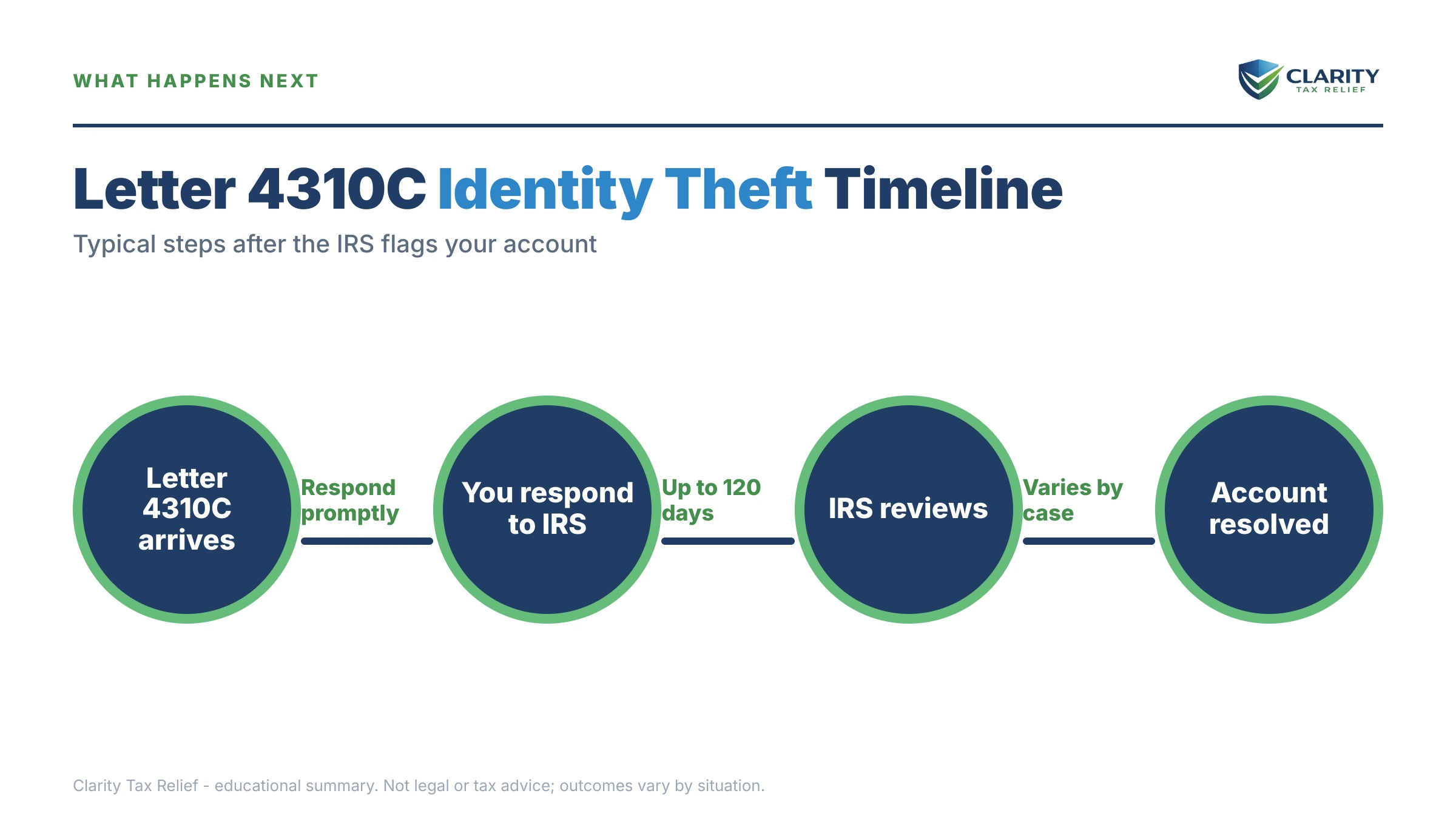
The short answer: IRS Letter 4310C means the IRS detected — and in most cases already addressed — suspicious activity on your tax account that may involve identity theft. Unlike a 5071C or 4883C, most 4310C letters don't ask you to verify your identity or respond at all. Your job is confirming the IRS's version of events matches yours.
You expected junk mail or a bill, and instead the words identity theft are sitting next to your own Social Security number on official IRS letterhead. Take a breath: a Letter 4310C is usually the IRS telling you it already caught the problem — not announcing a new one. The real work is confirming that's true for your account, because sometimes the letter is only half the story.
Every 4310C contains one paragraph that decides whether you can file this letter away or need to pick up the phone. The image below shows exactly what the letter looks like and where that language sits, so you can find it on your own copy in seconds.
⏱ Your deadline: Letter 4310C itself usually sets no response deadline — most versions require no reply at all. If your copy asks you to call, the timeframe printed on your letter controls. The real clock is what may sit behind the letter: interest accrues monthly on any balance the fraud created, and a frozen refund does not release itself.
Why you got Letter 4310C
The IRS sends Letter 4310C when its fraud filters detect activity on your account — most often a suspicious tax return — that may involve identity theft, and usually after it has already acted on it. Someone may have attempted to file using your name and Social Security number, and the IRS stopped it, removed it, or flagged your account for protection.
The 4310C comes in several versions, but each one has an operative paragraph that tells you one of two things: either the IRS handled it and needs nothing from you, or it asks you to call the number on the letter if the details described don't match your situation. That single paragraph is the whole letter. Everything else is background.
One edge case matters more than the rest: sometimes the "suspicious return" the IRS flagged is actually yours. A new address, a new bank account, or a big swing in income can trip the same filters a thief would. If the letter describes a return you legitimately filed, call — because your real return may be sitting in limbo until you do. On a joint return, note the letter may relate to either spouse's SSN, so check whose number appears on it.
Letter 4310C vs. the other IRS identity letters
Letter 4310C is the only letter in the IRS identity-theft family that usually requires no response. Its cousins — the verification letters — all demand something from you before the IRS will process a return. Mixing them up costs people months, so here's the whole family in one place. (If you're not sure why the IRS writes to people at all, our guide to why you got a letter from the IRS covers the full system; this page covers only the 4310C.)
| Letter | What it means | What you must do |
|---|---|---|
| Letter 4310C | The IRS detected — and usually already handled — possible identity theft on your account | Usually nothing; check that your records match, and call only if the letter's facts are wrong |
| Letter 5071C | A return was filed under your SSN and the IRS won't process it until you verify your identity | Verify online or by phone; any refund stays held until you do |
| Letter 4883C | Same verification demand, but the IRS wants it by phone only | Call the number on the letter with your current and prior-year returns in hand |
| Letter 5747C | The IRS wants verification face to face | Book an in-person appointment at a Taxpayer Assistance Center |
| Letter 5447C | Identity verification for filers living outside the U.S. | Verify by phone or mail using the letter's instructions |
| Letter 6330C | A verification variant tied to a return the IRS is holding | Verify through the channel the letter specifies before processing resumes |
What happens if you ignore Letter 4310C
Ignoring a 4310C is safe only when everything in it is accurate — and that's exactly what you can't assume without checking. If the letter caught the whole problem and your account is clean, nothing happens, honestly. But when the fraud went further than the letter describes, the fallout arrives in a predictable sequence:
- Phantom income stays on your record. If a thief attached fake wages or a fake 1099 to your SSN, the IRS's matching systems will treat that income as yours in later reviews.
- A refund freeze hardens. Your legitimate refund can sit behind a Code 810 refund freeze with no automatic release date until the identity case fully closes.
- A fraud-created balance gets assessed and billed. If the fraudulent activity produced a balance due, a CP14 bill arrives — addressed to you, for money you never owed.
- Automated collection escalates. The bill is followed by CP501 and CP503 reminders, then a CP504 that lets the IRS seize your state refund, then a final notice of intent to levy — the machine never pauses to ask whether the debt is genuine.
- Levy. A wage levy is continuous until released; a bank levy puts a 21-day hold on your funds before they leave. If you rent, there's no house for a lien to sit on — which in practice means your paycheck and bank account are what automated collection reaches for.
- It happens again next season. Without an IP PIN on your account, a thief can e-file first next year — and your real return bounces as a duplicate.
The 2026 backdrop makes this worse, not better: the IRS workforce was cut roughly 27% in 2025, so identity-theft casework moves slower — but the notice and levy systems are automated and never stopped. A human may not look at your file for months while the machine keeps escalating.
Holding a 4310C — and a balance or freeze behind it?
Send us a photo of your Letter 4310C and any collection notice that came with it. An experienced tax professional will pull your account, confirm what the identity thief actually did, and map the fastest path out — free and confidential. Interest keeps accruing on any assessed balance while you wait, so sooner beats later.
Your options after a 4310C letter, by situation
Your next move after a 4310C depends entirely on whether the IRS's version of events matches your records. Five situations cover nearly every recipient:
| Your situation | Your move | What it costs |
|---|---|---|
| Letter says resolved, and your account checks out | Get an IP PIN, keep the letter with your tax records, monitor your credit | Free |
| Someone filed a return in your name the IRS didn't fully catch | File Form 14039, report the theft to the FTC, and paper-file your legitimate return | Free, but time-heavy |
| The flagged return was actually yours | Call the number on the letter and confirm your identity so your real return resumes processing | Free |
| Your real refund is frozen with no movement for months | Confirm the identity case is closed; if it drags, request help from the Taxpayer Advocate Service | Free |
| A fraud-created balance is being billed — or levied | Dispute in writing through the identity-theft process and request a collection hold; get professional help if a levy notice has landed | Free to dispute; professional fees vary |
If the fraud goes deeper than the letter — a full return filed and refunded in your name — start with our guide to what to do when someone filed taxes in my name; the recovery sequence there picks up where the 4310C leaves off.
Check your transcript: the codes that show what really happened
Your account transcript is the only place you can see what the identity thief actually did — the 4310C summarizes, but the transcript shows the entries. Pull it through your IRS online account and look for these four codes on the tax year the letter references:
| Code | What it means | What to do |
|---|---|---|
| 150 | A return posted for that year | Confirm the figures match the return you filed — a 150 you don't recognize means a fraudulent return processed |
| 810 | Refund freeze on the account | Your money is held until the identity case resolves — see our 810 freeze and identity verification guide for the release path |
| 570 | A hold stopping account activity | Normal during identity review; watch for it to reverse — details in our Code 570 account hold guide |
| 971 | A notice was issued | Match the date to your 4310C or any follow-up letter — our Code 971 notice issued guide decodes it |
What a fraud-created balance really costs: a $36,900 example
A fraud-created assessment enters IRS collection exactly like a real debt — the automated system never asks whether you actually owe it. Here's a clearly hypothetical example of why disputing beats paying.
Say a thief's activity leaves a $36,900 assessment on your account, and by the time you untangle the 4310C, collection notices are arriving. If you treated that balance as real and put it on a 72-month installment agreement, the principal alone runs $36,900 ÷ 72 ≈ $513 a month — before interest, and before the failure-to-pay penalty, which starts at 0.5% of the balance per month, about $184 a month at the outset. That's roughly $700 a month, for years, on money you never owed. And payments made on a fraud-created balance can take a long time to recover even after the IRS agrees it was fraud.
Now add the renter's problem. If you don't own a home, there's no real estate for a lien to attach to — so when automated collection escalates, it reaches for what you do have: your paycheck and your bank account. A wage levy is continuous until released, and losing a slice of every check is the difference between making rent and not. You can estimate what a levy could take from your specific paycheck with our IRS Wage Garnishment Calculator.
The identity-theft route reaches a different destination entirely: once the IRS's identity-theft unit confirms the assessment stems from fraud, it adjusts the account — the correct outcome isn't a payment plan on $36,900, it's a corrected balance of $0. That's why the single worst move after a 4310C is quietly setting up payments on a debt you should be disputing.
How to respond to Letter 4310C, step by step
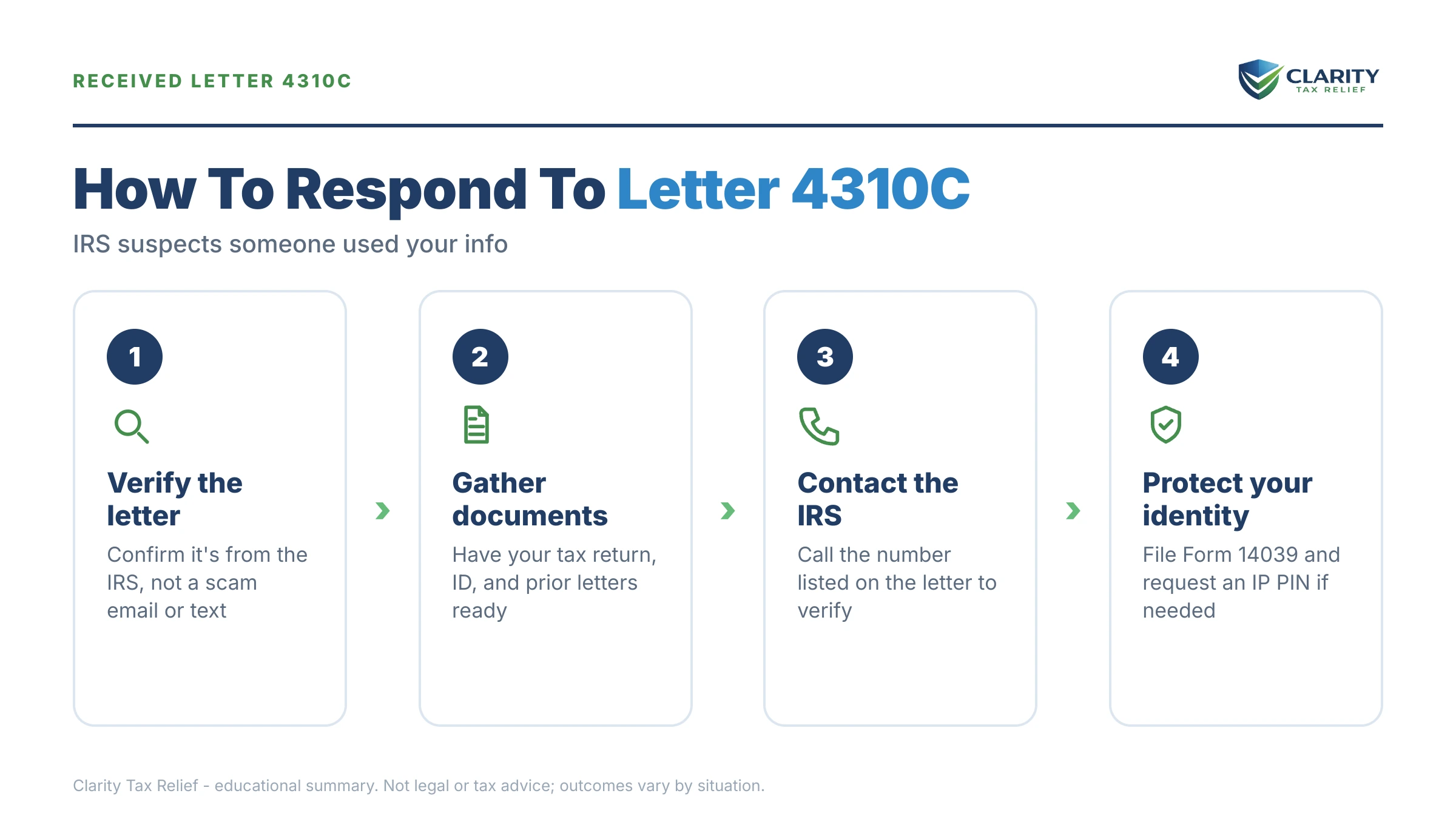
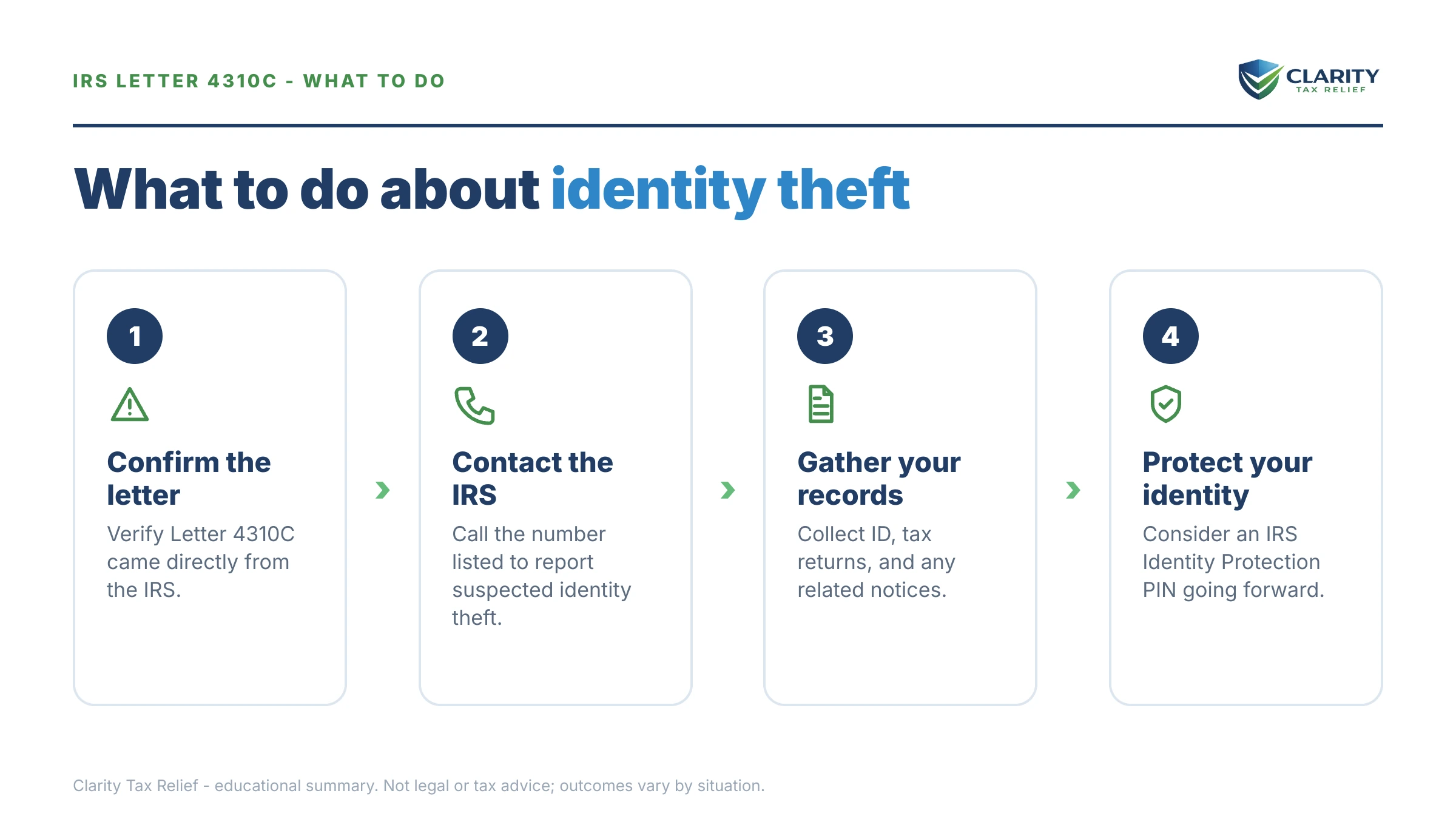
- Read your specific letter. Find the paragraph that says whether any action is required — most 4310C versions require none, but some ask you to call the number printed on the letter if the details don't match your situation.
- Pull your IRS records. Log in to your IRS online account and check your account transcript and wage records for returns, income, or balances you don't recognize.
- Report what the IRS missed. If the fraud goes beyond what the letter describes, file Form 14039 and report the theft at IdentityTheft.gov.
- Lock your account with an IP PIN. Request an Identity Protection PIN so no one can e-file under your Social Security number without it.
- Dispute any balance that isn't yours. Respond to the collection notice in writing, state that the assessment stems from identity theft, and ask for a collection hold while it's investigated — don't pay it to make it stop.
- Get help if collection is already moving. If a levy notice has arrived or your refund has been frozen for months, have an experienced tax professional review your account before the next notice lands.
When you can handle a 4310C yourself
Most people can handle a routine 4310C entirely on their own. If your letter says the IRS resolved the issue, your transcript shows nothing you don't recognize, and no balance or freeze exists, your whole to-do list is an IP PIN and a folder to keep the letter in. No professional is needed for an informational 4310C with a clean account.
Experienced help changes outcomes in four situations: a fraud-created balance has already reached intent-to-levy notices; the theft touches multiple tax years, each needing its own correction; your legitimate refund has been frozen for six months or more and the case needs Taxpayer Advocate escalation; or you're self-employed and phantom 1099 income was assessed against you, which requires reconstructing what your real income was. In those cases, the order and wording of the dispute genuinely change how fast — and whether — the account gets corrected.
Terms on your letter, decoded
The 4310C and its follow-ups lean on jargon (the IRS keeps its own reference at Identity Theft Central). Here's what each term means in plain English:
- Tax-related identity theft: someone using your SSN to file a return, claim a refund, or attach income to your record.
- IP PIN: a six-digit code, reissued yearly, without which no return can be e-filed under your SSN.
- Form 14039: the Identity Theft Affidavit — how you formally report tax identity theft the IRS hasn't already flagged.
- Refund freeze (Code 810): a transcript marker showing your refund is held until the identity issue resolves.
- IDTVA: Identity Theft Victim Assistance — the IRS unit that works identity-theft cases; the Taxpayer Advocate has repeatedly flagged its resolution times as stretching well past a year.
- Taxpayer Protection Program: the IRS screening operation behind the 5071C/4883C/5747C verification letters — a different track from your 4310C.
Letter 4310C questions, answered
Do I need to respond to IRS Letter 4310C?
Usually no. Most 4310C letters are informational — the IRS is telling you it spotted and addressed suspicious activity on your account, and no response is required. Read your copy carefully, though: some versions ask you to call the number printed on the letter if the information described doesn't match your situation, and that call is how you catch a mistake early.
Is Letter 4310C the same as a 5071C letter?
No. A 5071C demands that you verify your identity before the IRS will process a return, and your refund stays frozen until you do. A 4310C works in the opposite direction: the IRS has already detected — and usually resolved — the suspicious activity, and most versions require nothing from you. If you received both, the 5071C is the one with a job attached.
Does Letter 4310C mean someone filed a tax return in my name?
It often means someone tried. The IRS sends a 4310C when its filters catch activity on your account that looks like identity theft — frequently a suspicious return it stopped before processing. Pull your account transcript to confirm: if a Code 150 shows a return you didn't file, or income you don't recognize appears on your wage records, the attempt got further than the letter suggests.
Will Letter 4310C delay my refund?
It can. If the suspicious activity involved the same tax year you filed for, the IRS may hold your legitimate return while it sorts the accounts out, often marked by a Code 810 refund freeze on your transcript. There's no fixed release date — freezes lift when the identity issue is fully resolved, which can take months given 2026 staffing levels.
Should I file Form 14039 after getting a 4310C?
Usually not — Form 14039 exists to report identity theft the IRS doesn't already know about, and a 4310C means it already knows. File the affidavit only if your letter instructs you to, if the facts in the letter don't match your situation, or if you discover fraud on a tax year the letter doesn't cover.
How do I know my Letter 4310C is real and not a scam?
A real 4310C arrives by postal mail and never asks for money, gift cards, or your full bank details. It won't come by email, text, or phone. Verify it yourself: log in to your IRS online account, or call the IRS at the official number listed on IRS.gov — not any number a caller gives you — and ask whether the letter was issued.
Should I get an IP PIN after receiving Letter 4310C?
Yes. An Identity Protection PIN is a six-digit code that blocks anyone from e-filing a return under your Social Security number without it — the single strongest lock available. It's free through your IRS online account, and once you've been an identity-theft target, it's the difference between this happening once and happening every filing season.
Can identity theft create a tax debt the IRS tries to collect from me?
Yes — and this is the most expensive mistake 4310C recipients make. If a fraudulent return or phantom income leads to an assessment, the IRS's automated collection system will bill you, then escalate toward liens and levies, without checking whether the debt is genuine. Dispute it through the identity-theft process; never set up a payment plan on a balance that isn't yours.
Your next 24 hours
- Find the operative paragraph on your letter — the sentence that says whether any action is required — and note the tax year(s) the letter references.
- Gather your last filed return and log in to (or set up) your IRS online account to pull the account transcript for that year and scan for anything you don't recognize.
- If you found a balance, a freeze, or a return that isn't yours, get a free case review — the form takes two minutes at claritytaxrelief.com/#consult, or call (888) 825-7779. Interest accrues monthly on any fraud-created balance, and disputes get harder the further collection escalates.
This guide is general information, not tax or legal advice for your specific situation. Eligibility for IRS programs depends on individual facts and circumstances; no outcome is guaranteed.