
IRS Letters
IRS 5747C Letter: In-Person Identity Verification, Explained (2026)
The short answer: a 5747C letter means the IRS flagged a tax return filed under your Social Security number as possible identity theft — and froze it, refund included, until you verify your identity, usually in person at a Taxpayer Assistance Center. If you didn't file that return, tell the IRS immediately.
The refund tracker sat on nothing for weeks, and now the letter that finally arrived doesn't ask you for money — it asks for you, in a federal office, with documents in hand, before the IRS will even touch your return. That's unsettling, but it's also the most solvable IRS letter there is: you are the one person on earth who can end this, and the whole fix is one appointment.
Of the IRS's identity letters, the 5747C is the strictest tier — it usually cannot be cleared with a phone call or a website, which is exactly what separates it from its cousins. The image below shows exactly what a genuine 5747C looks like and where to find the tax year, the flagged return, and the contact instructions on your copy.
⏱ Your real clock: most 5747C letters print no fixed day count — but the freeze has no expiration date either. Your return, and any refund on it, stays frozen until you complete verification, and Taxpayer Assistance Center appointments often book out weeks ahead. Every week you wait to call adds at least a week to the end of the line.
Why the IRS sent you a 5747C letter
A 5747C means the IRS Taxpayer Protection Program stopped a return under your SSN before processing it because something about it didn't match your history. The filters aren't accusing you of anything — they compare this year's return against last year's data, and when enough details shift at once, the return gets pulled for human-verified identity proof.
If you're recently divorced, you may have tripped several filters in a single filing: a filing status that changed from married-filing-jointly to single or head of household, a new last name not yet updated with the Social Security Administration, a new address, a refund routed to a bank account the IRS has never seen, and your first return without a spouse's income history attached. None of those things are wrong — they're just new, and new is what the fraud filters flag.
The other possibility is the one the letter exists to catch: someone else filed a return in your name. That includes strangers with stolen data — and, in uglier divorce situations, an ex who still knows your SSN. The appointment resolves both scenarios; we'll cover the didn't-file path below.
One quick sanity check before anything else: real 5747C letters come by postal mail only, never by email or text, and never demand payment to "release" a refund. If the letter itself feels off, our guide to how to tell if an IRS letter is real shows how to verify it independently. And if your letter is about the IRS reviewing your return's accuracy rather than your identity, that's a different animal — the 4464C letter.
5747C vs 5071C vs 4883C: which identity letter you have
The IRS uses different identity letters for different risk levels, and the letter number controls how you're allowed to verify. The 5747C sits at the top: it generally cannot be resolved online or by phone alone.
| Letter | How you verify | Typical situation |
|---|---|---|
| 5747C | In person at a Taxpayer Assistance Center, by appointment (some letters list an alternative — follow yours) | Highest-risk flag; online/phone verification wasn't offered or didn't work |
| 5071C | Online through the IRS Identity Verification Service, or by phone | Standard identity flag; most common of the group |
| 4883C | By phone with the Taxpayer Protection Program line | Flag where the IRS wants to ask questions directly |
| 5447C | By phone or mail, with options for filers outside the U.S. | Identity flag for international or overseas filers |
If your 5747C mentions an online option and it fails — ID.me lockouts and document-upload errors are common — see idverify.irs.gov not working before you burn days retrying. For most 5747C holders, the appointment was always going to be the answer.
What happens if you ignore a 5747C letter
A 5747C freeze never expires on its own — ignoring it doesn't trigger collections, it triggers permanence. The sequence looks like this:
- Frozen at intake. Your return sits in Taxpayer Protection Program inventory. "Where's My Refund" shows nothing useful, and your account transcript may show a 810 refund freeze or simply stay blank for the year.
- Silence, not escalation. Unlike a balance-due notice, no scarier letter is coming to force the issue. The case just waits — which is worse, because there's no automated nudge reminding you the clock is running.
- Refund exposure grows. Refund claims don't stay collectible forever — there's a limited window to claim old-year refunds, as our guide to getting a refund from 3 years ago explains. Don't test how an unverified return interacts with that window.
- Balance-due exposure compounds. If the flagged return showed tax owed, the freeze doesn't pause your debt. Interest and late-payment penalties accrue on the unpaid balance, and the IRS can eventually treat the year as unfiled.
- Fraud stays unresolved. If a thief filed the return, ignoring the letter leaves your account tangled and your SSN exposed for next season too.
In 2026, with IRS staffing down roughly 27% from the 2025 cuts, nobody is going to chase you to fix this. The system will happily hold your money forever; you have to go get it.
Holding a 5747C with a frozen refund?
Send us a photo of your letter. An experienced tax professional will confirm whether the flagged return is yours, map the fastest verification path for your situation, and flag anything else on your account before your appointment — free and confidential.
Your two paths: you filed the return, or you didn't
Everything about your 5747C response depends on one question: is the return described in the letter actually yours?
Path 1: You filed it — verify and release it
This is the majority case. You book the appointment, show up with documents, answer questions about the return and your history, and the IRS releases the return into normal processing. You do not need Form 14039 or an identity-theft case — the flag was a false positive, and verification closes it.
Path 2: You didn't file it — report the fraud
If you never filed the return in the letter, someone else did, using your SSN. Call the number printed on your letter and say exactly that. The IRS will pull the fraudulent return before it processes — which is the system working as designed. Because the IRS caught it first, you generally don't need to file the Form 14039 identity-theft affidavit, though it becomes relevant if fraud touches other years. Our guide to someone filing taxes in your name covers the full cleanup, and afterward you should lock your SSN with an IP PIN (CP01A) so no return can be e-filed without your six-digit code.
The divorce-specific edge case: if you suspect your ex filed it — to grab a refund built on your withholding, or to claim the kids first — treat it as fraud, not a family dispute. Report it through the letter's instructions, then still file your own correct return. You can also fight a duplicate dependent claim separately; don't let either issue wait on the other.
What the freeze costs: a $27,500 example
Say you're newly divorced and your first single return shows a $27,500 refund — a year of paycheck withholding set for married rates, plus your half of a joint estimated payment made before the split. The 5747C freezes all of it. Here's the hypothetical math on timing:
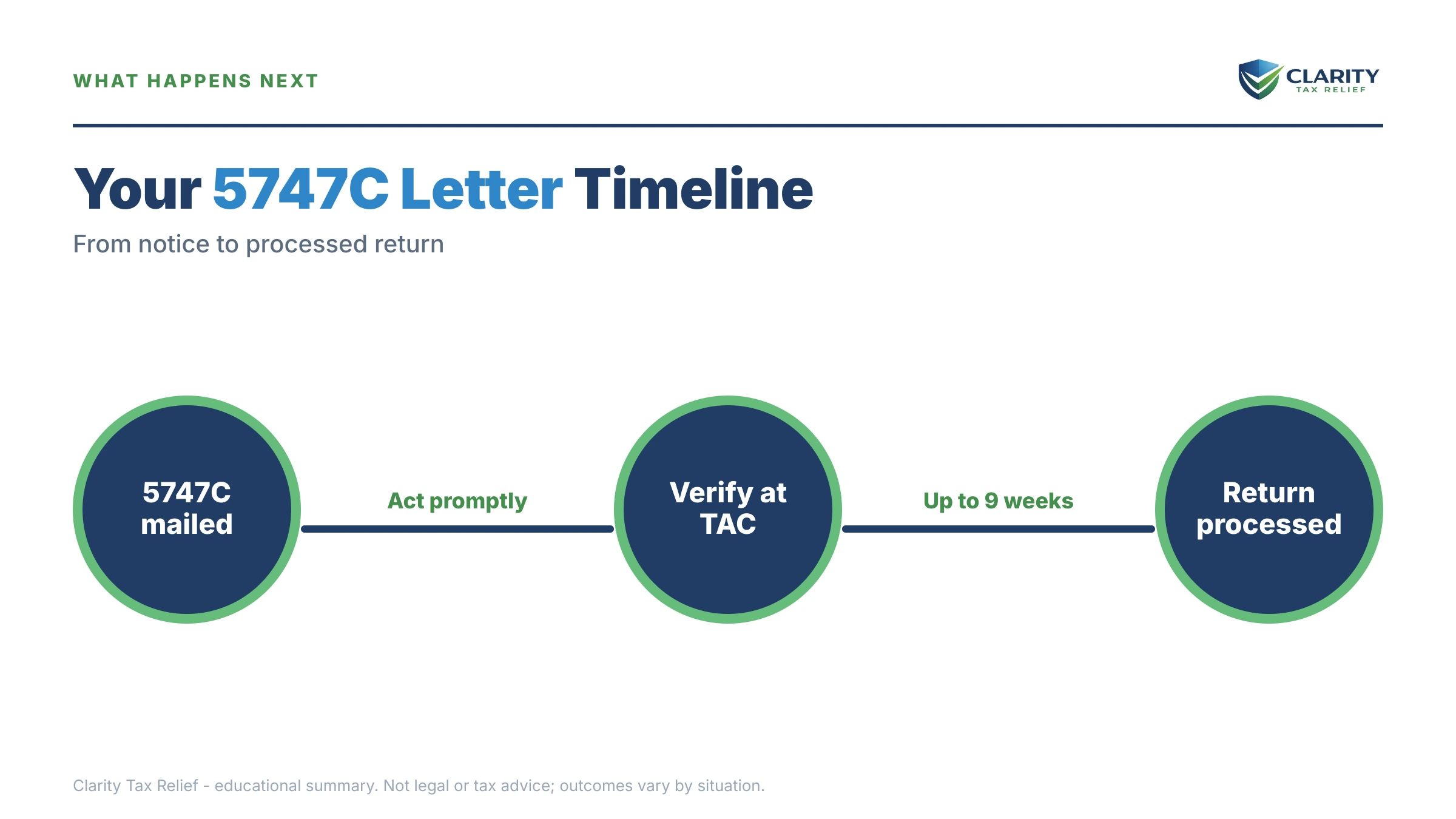
- Call this week: if the nearest Taxpayer Assistance Center slot is 3 weeks out (21 days), and post-verification processing runs to the IRS's typical up-to-nine-weeks window (63 days), you're looking at roughly 21 + 63 = 84 days — about 12 weeks until the $27,500 lands.
- Sit on the letter for a month first: that same math becomes 30 + 21 + 63 = 114 days — nearly 4 months. Your delay stacks on top of theirs, never instead of it.
One small consolation: when a refund is issued long after the filing deadline, the IRS generally adds overpayment interest on top — taxable, and no substitute for having $27,500 during the most expensive year of your life. The only lever you control is how fast the appointment happens.
How to respond to a 5747C letter, step by step
Before the steps, build your folder. Showing up without a required document is the most common way a 5747C visit fails — and failing means rebooking and losing weeks.
| Bring this | Examples that work | Why the IRS needs it |
|---|---|---|
| The 5747C letter | Your original copy, all pages | Routes you to the right case and appointment type |
| Government photo ID | Driver's license, state ID, passport | The core identity proof; bring a second ID if you have one |
| The flagged return (if you filed it) | Complete copy of the tax return named in the letter | The agent verifies you know what's on it |
| A prior-year return | A full copy of a different year's return | Confirms your filing history matches IRS records |
| Supporting income documents | W-2s, 1099s for the flagged year | Ties the return's income to real payers |
| Name-change proof (if applicable) | Divorce decree, updated Social Security card | Bridges a post-divorce name mismatch on the spot |
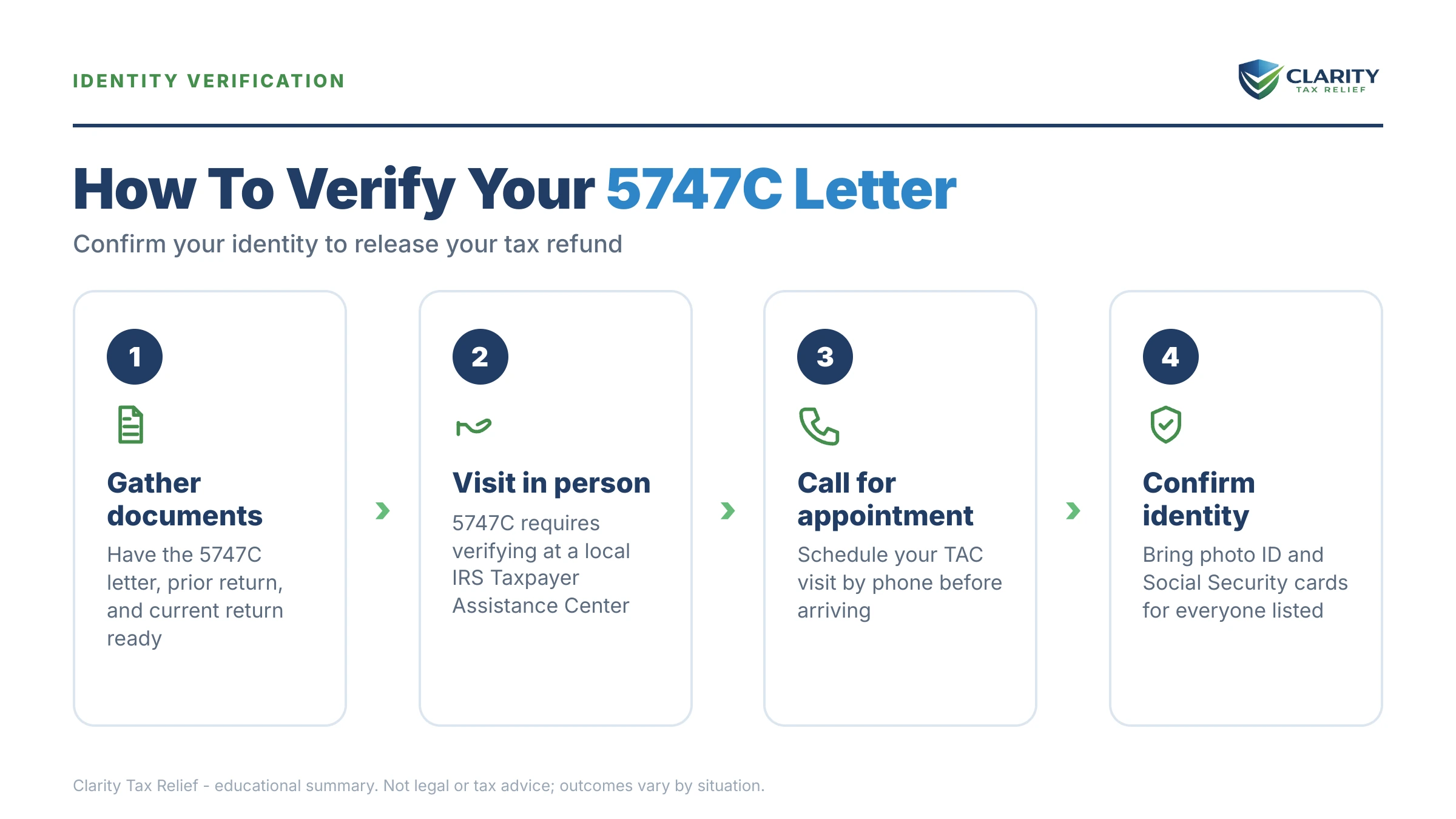
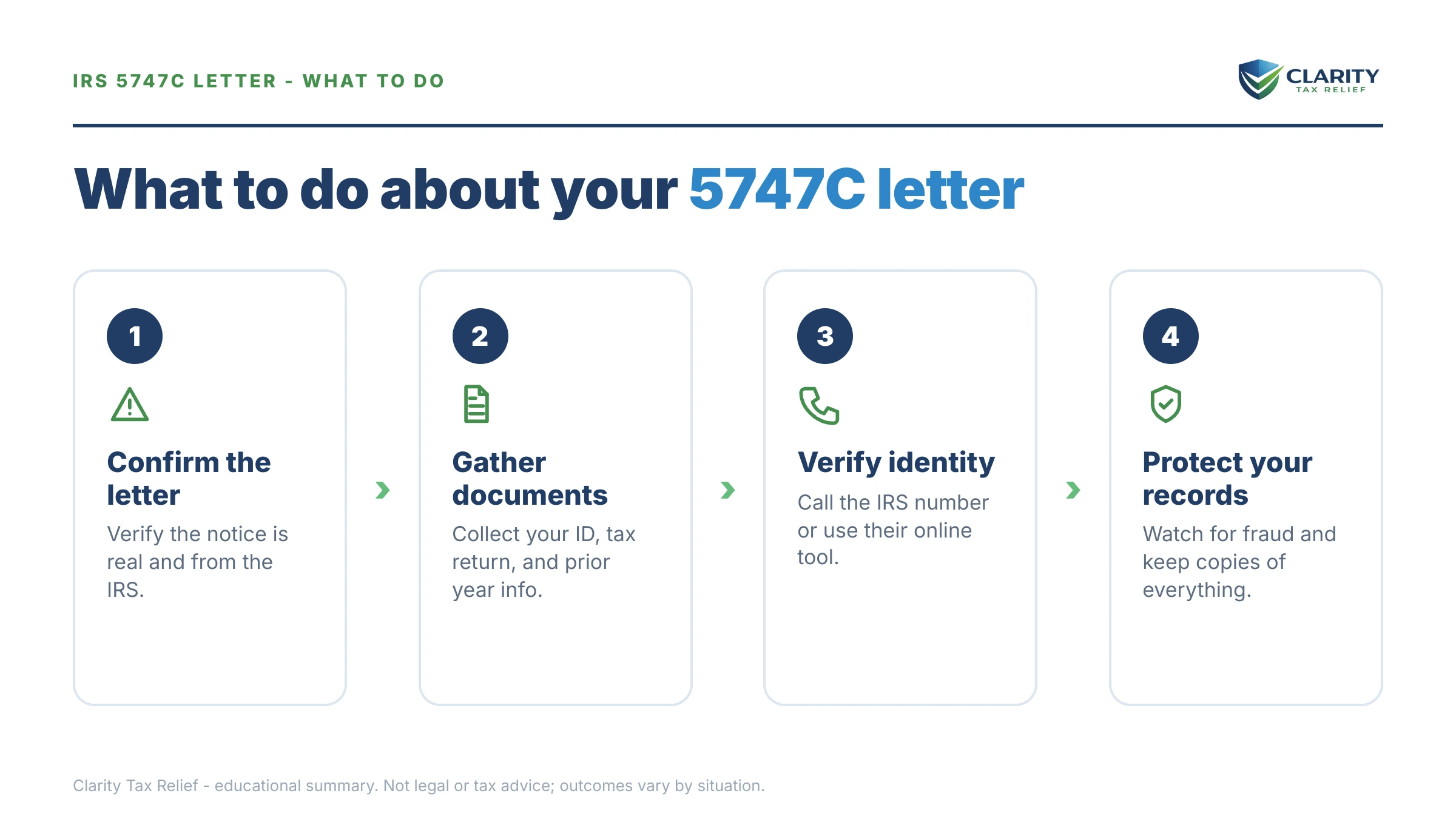
- Confirm the tax year and return. Check the year and return details printed on the letter against what you actually filed — or confirm you never filed that return at all.
- Choose your path — filed or didn't file. If the return is yours, you're verifying it; if it isn't, call the number on your letter to report a return you didn't file.
- Book your Taxpayer Assistance Center appointment. Call the IRS appointment line at 844-545-5640 — or use the online option only if your specific letter lists one.
- Gather your documents the night before. Pull the letter, your photo ID, the flagged return, a full prior-year return, and your W-2s or 1099s into one folder.
- Verify in person and get confirmation. Attend the appointment, answer the identity questions, and ask the agent to confirm your verification is complete before you leave.
- Track your transcript until the freeze lifts. Watch your IRS account transcript in the following weeks for the hold to release and your return to finish processing.
Situations that change the 5747C playbook
The flagged return shows a balance due. Verification releases the return for processing — it does not release you from the tax. Interest and the failure-to-pay penalty run from the original due date regardless of the freeze, so if you owe and can't pay, verify first, then line up a payment option; our guide on how to settle tax debt yourself walks through every program once the return posts.
No Taxpayer Assistance Center within reach, or no usable photo ID. Call the number on your letter and explain — the IRS has alternative procedures, and the Taxpayer Advocate Service can intervene when verification is genuinely impossible through normal channels. Don't just give up; the freeze won't.
You're living outside the U.S. Overseas filers usually get the 5447C variant with mail and phone options instead of an office visit. If you received a 5747C while abroad, call the letter's number to ask for the international path before booking travel.
You verified and nothing happened. If your transcript shows no movement well beyond the typical processing window, follow up — a second freeze code, an unrelated hold, or a lost verification does happen, and it's one of the situations worth digging into a stuck refund rather than waiting longer.
When you can handle a 5747C yourself
Almost always — and honestly, the core task is one only you can do. No professional can sit in that chair and prove your identity for you. If you filed the return, the letter is legitimate, and you can get to an appointment with the documents above, book it today and skip the fees: this is a DIY letter.
Experienced help changes the outcome in the messier versions: a fraudulent return (especially one you suspect an ex filed) tangled across multiple years, a flagged return that also shows a balance you can't pay, an account where the freeze never lifts after verification, or a 5747C that arrives alongside other IRS problems — unfiled years, old debt, a pending audit. In those cases the verification is step one of five, and the order you take the steps in matters.
Terms on your 5747C, decoded
- Taxpayer Protection Program (TPP): the IRS unit that screens returns for identity fraud and issues the 5747C, 5071C, and 4883C letters.
- Taxpayer Assistance Center (TAC): a local IRS walk-in office — appointment-only — where 5747C verification happens face to face.
- TC 810 (refund freeze): the transcript code that often marks an identity hold; it must be released before any refund can be issued.
- Identity Protection PIN (IP PIN): a six-digit code, reissued yearly on a CP01A notice, that blocks anyone from e-filing under your SSN without it.
- Identity Verification Service: the IRS's online verification tool — the standard path for a 5071C, but usually not sufficient for a 5747C.
Official references: the IRS's own page on understanding your Letter 5747C, its Identity Theft Central hub, and the Taxpayer Assistance Center locator for finding and booking your nearest office.
5747C letter questions, answered
Is the 5747C letter a scam?
A genuine 5747C arrives by U.S. mail — the IRS will never email, text, or call you to demand identity verification. The letter asks you to appear at an IRS office; it never asks for payment, gift cards, or bank logins to release your refund. If anything feels off, look up the IRS appointment line independently at IRS.gov instead of trusting the number on the page.
Why did I get a 5747C letter from the IRS?
The IRS's Taxpayer Protection Program flagged a return filed under your Social Security number as possibly fraudulent. Common triggers include a new address, a changed filing status, different employer data, or a refund routed to a new bank account — all common after a divorce. It can also mean an identity thief actually filed in your name, which is exactly what the appointment sorts out.
Can I verify a 5747C online instead of in person?
Usually not — the 5747C is the IRS's highest-scrutiny identity letter, and most versions require an in-person visit to a Taxpayer Assistance Center. Some recent letters list an online or alternative option first, so follow the instructions printed on your specific letter. If yours only offers the in-person path, no phone call or online upload will substitute for the appointment.
What do I need to bring to a 5747C appointment?
Bring the 5747C letter itself, a current government-issued photo ID, a copy of the tax return listed in the letter (if you filed it), a complete copy of a prior-year return, and supporting documents like W-2s or 1099s. Missing documents are the most common reason a visit fails, which means rebooking and losing more weeks. If your name recently changed, bring proof of the change too.
How long after verifying a 5747C will I get my refund?
The IRS says processing typically takes up to nine weeks after successful verification, though many filers see movement sooner. Your account transcript is the best tracker: watch for the freeze to release and a refund-issued code to post. If nothing has moved well past that window, contact the IRS again or ask the Taxpayer Advocate Service for help.
What if I never filed the return in my 5747C letter?
Tell the IRS exactly that, using the contact instructions on the letter — it means someone likely filed a fraudulent return with your Social Security number. The IRS will remove the bogus return from your account, and because the IRS caught it before processing, you usually do not need to file Form 14039. You should still get an Identity Protection PIN so it can't happen again next year.
What happens if I ignore a 5747C letter?
Nothing good, and nothing automatic: your return simply never processes. Any refund stays frozen indefinitely, and if the return showed a balance due, the IRS can eventually treat the year as unfiled while penalties and interest build on the unpaid tax. The hold does not expire on its own — verification is the only exit.
Will I get an IP PIN after a 5747C?
If the verification confirms identity theft, the IRS generally enrolls you in the Identity Protection PIN program, and you'll receive a CP01A notice with a new six-digit PIN each year. Even if your return turns out to be legitimate, you can opt into the IP PIN program voluntarily through your IRS online account. The PIN blocks anyone from e-filing under your SSN without it.
Your next 24 hours
- Find the tax year and return details on your letter and decide the one question that controls everything: did you file that return, or not?
- Build the folder tonight — the 5747C letter, your photo ID, the flagged return, one complete prior-year return, your W-2s or 1099s, and your divorce decree if your name changed. Then call 844-545-5640 and take the earliest appointment offered.
- If fraud is involved, the return shows a balance you can't pay, or your account has other tangles, get a free case review first — the 2-minute form or (888) 825-7779. Your refund stays frozen until you act; the only thing that shortens the wait is starting now.
This guide is general information, not tax or legal advice for your specific situation. Eligibility for IRS programs depends on individual facts and circumstances; no outcome is guaranteed.