
IRS Notices
IRS CP11 Notice: What It Means and How to Respond (2026)
The short answer: a CP11 notice means the IRS found what it believes is a miscalculation on your tax return, corrected it, and assessed a balance due. The tax is already on your account — and you have 60 days from the notice date to dispute the change before your strongest appeal rights expire.
You filed months ago and assumed that tax year was closed. Now the IRS says it redid your math, and the number at the bottom of the letter — a number you never agreed to — is already sitting on your account. That's unsettling, but a CP11 is one of the most correctable notices the IRS sends, and the clock that matters most is printed right on it.
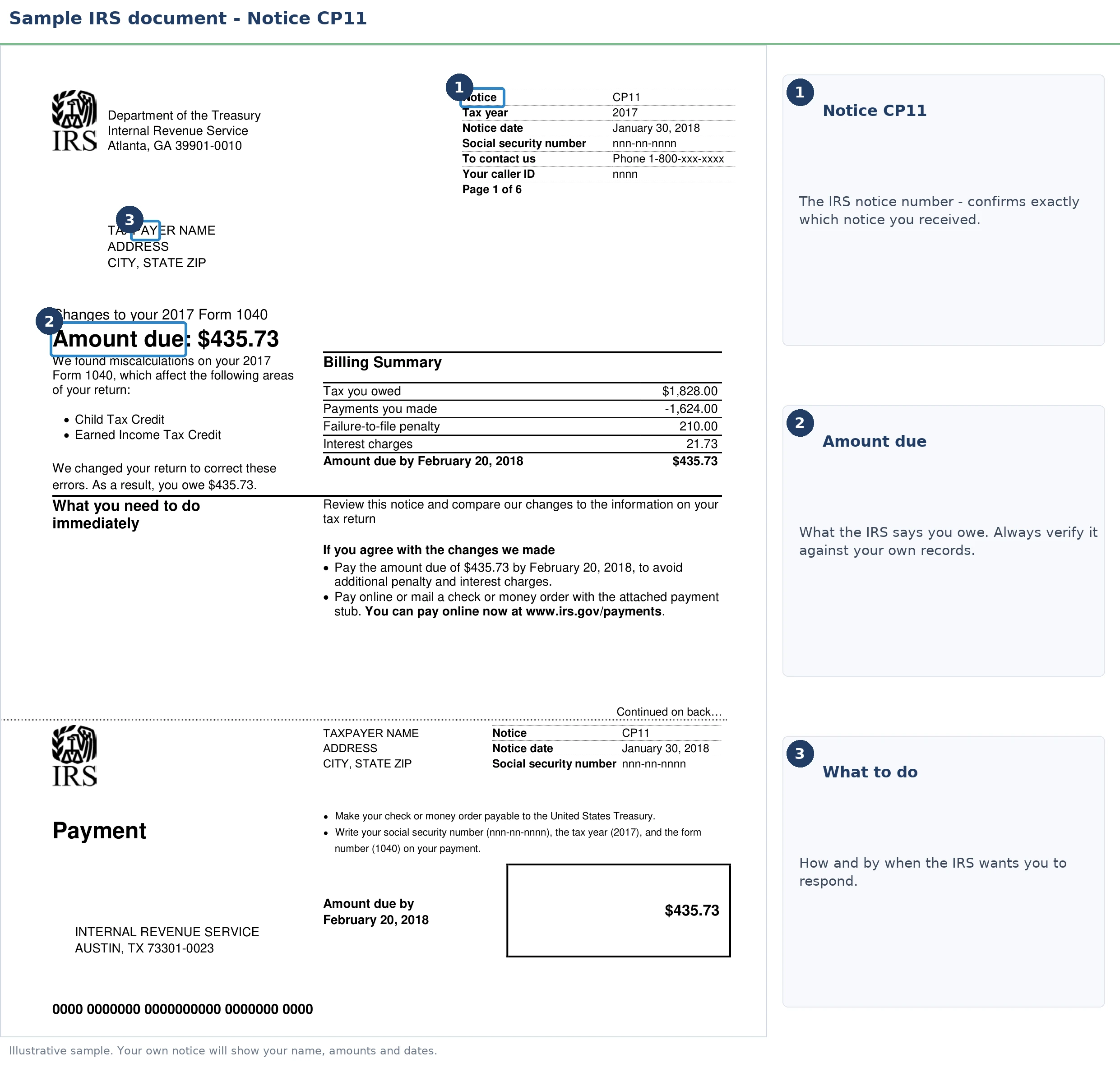
Unlike most IRS letters, a CP11 isn't a proposal or a question. The change has already been made under the agency's math error authority, which lets a computer adjust your return without an audit and without asking you first. Three numbers on the page control everything — the notice date, the new balance, and the payment due date — and the image below shows exactly what a CP11 looks like and where to find each one.
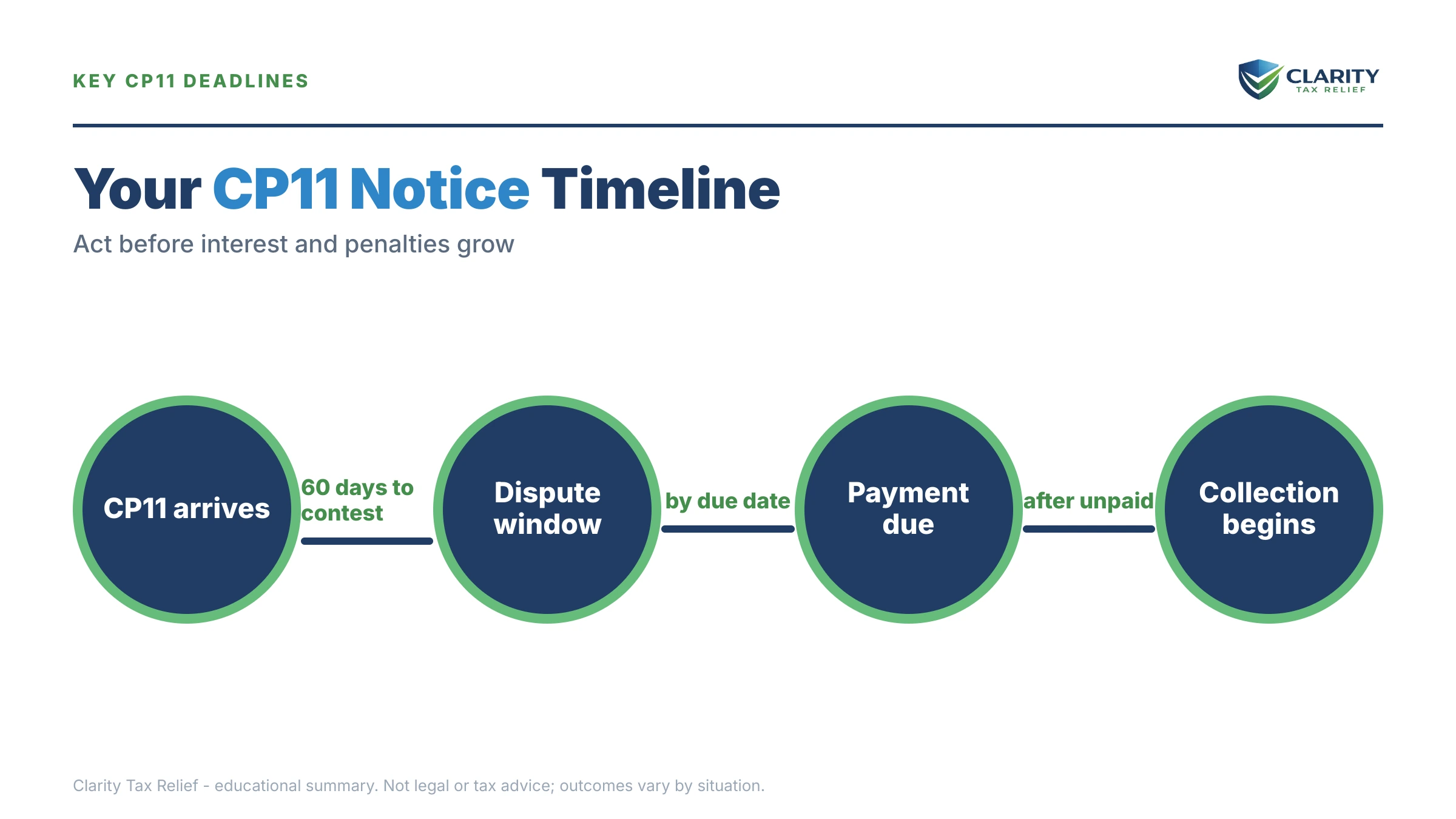
⏱ Your deadline: you have 60 days from the date on your CP11 to dispute the change and keep your full appeal rights. The notice also prints a separate payment due date — pay or set up an arrangement by that date to keep the balance out of the collection sequence. Interest and a monthly late-payment penalty accrue until the balance is resolved.
Why you got a CP11 notice
A CP11 notice means the IRS corrected a miscalculation on your return and assessed additional tax under IRC §6213(b) — its math error authority — skipping the normal audit and appeal process entirely. If you're not sure why any IRS letter arrived, start with our overview of why did I get a letter from the IRS; but a CP11 specifically means a computer recalculated a line and the new number created a balance due.
The most common triggers are simple ones:
- Worksheet errors — the taxable-Social-Security worksheet is a classic. Depending on your other income, up to 85% of benefits can be taxable, and a small slip changes the tax due.
- Credit miscalculations — the Child Tax Credit, Earned Income Tax Credit, or premium tax credit claimed at an amount the IRS's records don't support.
- Arithmetic and tax-table mistakes — a transposed digit, a wrong tax-table lookup, or totals that don't add.
- Identity-number mismatches — a dependent's SSN or name that doesn't match Social Security records, which can knock out a credit and raise the tax.
The CP11 sits in a family of IRS math error notices. If the same kind of correction had gone the other way — changing your refund instead of creating a balance — you'd be holding a CP12 notice instead. And when the IRS thinks you qualify for a credit you didn't claim, it sends invitations like the CP09 notice rather than a bill. One thing a CP11 is not: an audit. Nobody is examining your records.
The 60-day window: the most important right on the page
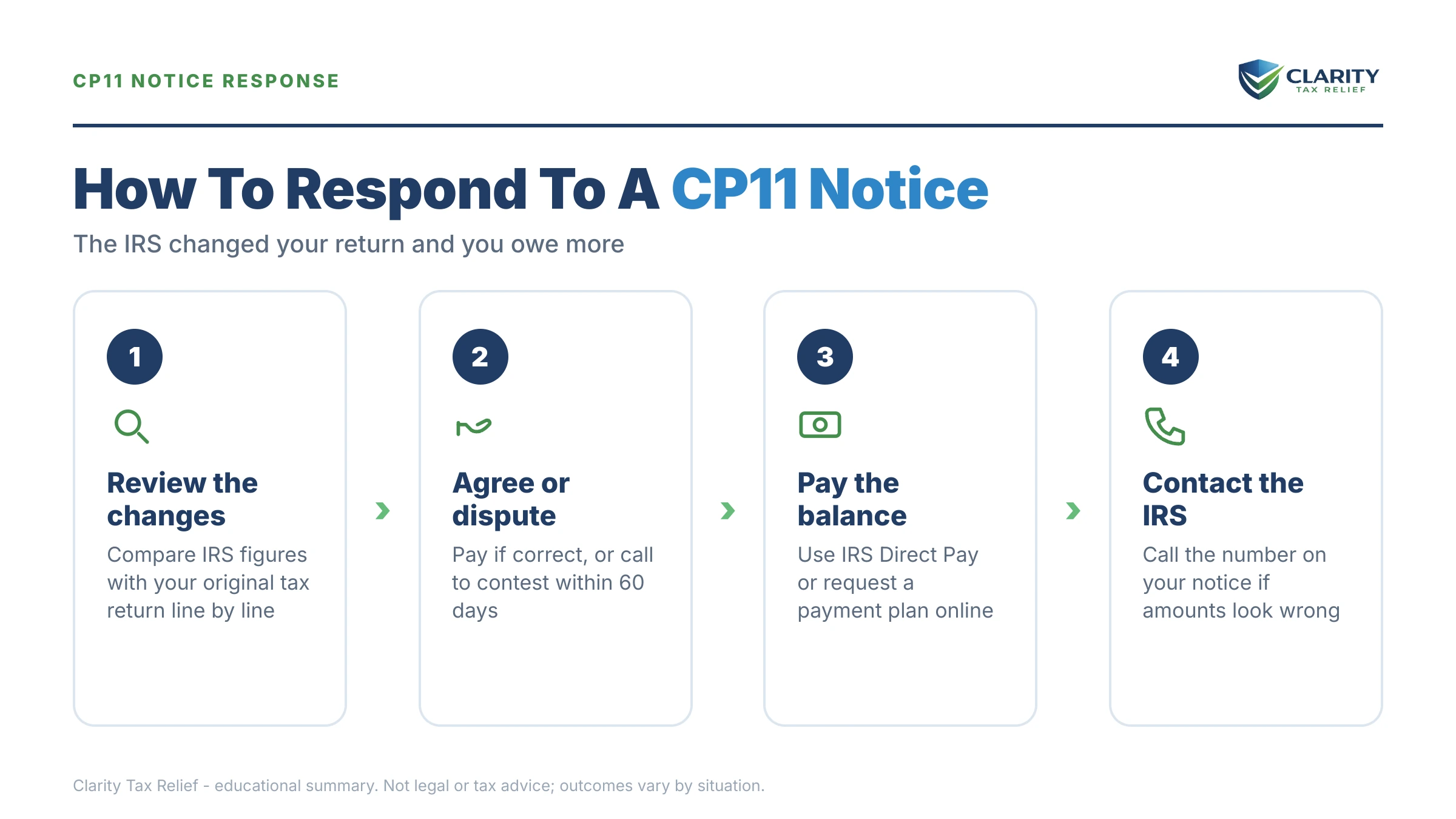
Disputing within 60 days of the CP11 date forces the IRS to reverse the math error assessment — even if it still believes you owe. That's the trade built into math error authority: the IRS gets to assess instantly without the usual process, but you get 60 days to demand that the assessment be abated. If you make that request in time and the IRS still disagrees with your return, it must restart through formal deficiency procedures — issuing a statutory notice of deficiency that preserves your right to contest the tax in Tax Court before paying a dime.
Miss the window and the assessment simply stands. You can still fight an incorrect change, but only through slower routes: paying and filing a refund claim, or asking the IRS to reconsider with documentation while penalties and interest keep running. The 60 days run from the date printed on the notice, not the day you opened the envelope — mail delays eat into your window, so count from the notice date today.
| Deadline | What it controls | What you lose if it passes |
|---|---|---|
| 60 days from the CP11 notice date | Your right to demand abatement of the math error assessment | The IRS no longer has to reverse the change; disputes shift to pay-first refund claims |
| Payment due date printed on the CP11 | Whether the balance enters the collection notice sequence | Reminder notices begin; the failure-to-pay penalty keeps adding 0.5% per month plus interest |
| 30 days from a later LT11 / Letter 1058 | Collection Due Process hearing rights (requested on Form 12153) | The IRS can levy bank accounts, wages, and up to 15% of Social Security payments |
CP11 vs. CP12, CP14, and CP2000: which letter are you holding?
Four notices get mixed up constantly, and they carry very different rights and clocks. Check the notice code in the top corner of your letter against this table before doing anything else:
| Notice | What it means | Your move |
|---|---|---|
| CP11 | The IRS corrected a miscalculation and the change is already assessed — you owe | Verify the changed line; dispute within 60 days or pay/arrange by the due date |
| CP12 | Same math error correction, but it changed your refund instead of creating a bill | Compare it to your return; the same 60-day dispute window applies if it's wrong |
| CP14 | A first bill for tax you reported yourself but didn't fully pay — nothing was changed | Pay or set up a plan by the notice date, typically about three weeks out |
| CP2000 | A proposed change from an income-document mismatch — not yet assessed | Agree or dispute by the response date; you can still contest before any tax is assessed |
What happens if you ignore a CP11
An unpaid CP11 balance enters the same automated collection sequence as any other IRS debt — and no human needs to review your file for it to escalate. In 2026, with the IRS workforce down roughly 27% per TIGTA reports, reaching a person to fix an error is harder than ever, but the notice stream and levy systems run on their own. Here is the order of what follows:
- The payment due date passes. No enforcement yet, but the failure-to-pay penalty (0.5% per month) and daily-compounding interest keep growing the balance — and your 60-day dispute clock may be running out at the same time.
- Reminder notices arrive. A CP501 and then a CP503 restate the balance. Still just bills, but each one reflects a bigger number.
- CP504 — Notice of Intent to Levy. The CP504 notice lets the IRS seize your state tax refund, and a federal tax lien becomes a live possibility.
- LT11 — Final Notice. The LT11 notice starts a 30-day clock and your Collection Due Process rights. After it expires, levies are legal.
- Levy. Bank accounts (with a 21-day hold before funds leave), wages (continuous until released), and federal payments — including up to 15% of Social Security through the FPLP.
Every stage above is preventable at the stage before it. The cheapest fix is the one you make while the letter in your hand still says CP11.
Holding a CP11 right now?
Your 60-day dispute window is already running. Get your CP11 reviewed free before it closes — an experienced tax professional will check whether the IRS's change is even correct, then map your cheapest way out. No pressure, no obligation.
If the IRS is right but you can't pay: your options
Even when the correction is accurate, you never have to choose between paying in full today and ignoring the notice. The realistic options, roughly in order of cost:
- Pay in full by the due date. Stops the failure-to-pay penalty and the notice sequence immediately. Interest stops accruing once the balance hits zero.
- Short-term payment plan. Up to 180 days to pay in full, with a $0 setup fee. Interest and penalties continue, but escalation stops.
- Monthly installment agreement. Balances of $50,000 or less generally qualify online for up to 72 months. The IRS's guaranteed installment agreement is available to individuals with an income-tax balance of $10,000 or less (excluding penalties and interest) who have filed all required returns, have filed and paid on time for the past 5 years with no installment agreement during that period, and agree to pay in full within 3 years.
- Currently Not Collectible status. If any payment would leave you unable to cover basic living expenses, collection can be paused. The debt remains and interest accrues, but levies and the notice sequence stop. On a fixed income this is often the right answer — see IRS hardship while on Social Security.
- Offer in Compromise. Settling for less than the full balance is real but means-tested: per IRS data, the agency accepted roughly 1 in 5 offers in FY2024, and it only makes sense when your income and assets genuinely can't cover the debt. For a typical CP11-sized balance, a payment plan is usually faster and cheaper.
- Penalty relief. If your prior three years were clean, first-time penalty abatement can remove the failure-to-pay penalty — and starting in summer 2026, the IRS's new Automatic Exemption from Penalty (AEP) applies qualifying relief automatically, with no request needed.
If you're retired and this is your first balance due in years, our guide for taxpayers who are retired and owe back taxes walks through how fixed-income budgets change the math on every option above.
A worked example: a $4,800 CP11 on a fixed income
Say you're retired, living on Social Security plus a small pension, and your CP11 says the IRS recalculated the taxable portion of your benefits — adding $4,800 in tax. Here's the arithmetic on each path:
- Do nothing: the failure-to-pay penalty adds 0.5% of $4,800 — about $24 — every month, roughly $288 over a year, plus interest compounding daily on the whole balance. And the notice sequence above starts marching.
- Short-term plan: $4,800 over 180 days works out to about $800 a month for six months, with no setup fee. Accrual continues but ends quickly.
- 72-month plan: the minimum is about $67 a month ($4,800 ÷ 72), but at that pace penalties and interest offset much of each payment. Something like $200 a month clears the debt in a little over two years and cuts the total accrual sharply.
- Hardship: if even $67 would crowd out medicine or rent, Currently Not Collectible status pauses collection entirely while you regroup.
Before choosing any of those, check the first path: if you rerun the taxable-benefits worksheet with your SSA-1099 and your original figure holds up, a dispute filed inside the 60-day window can make the entire $4,800 disappear. You can estimate what waiting would cost with our IRS penalty & interest calculator — the gap between acting this week and acting next year is rarely small.
How to respond to a CP11 notice, step by step
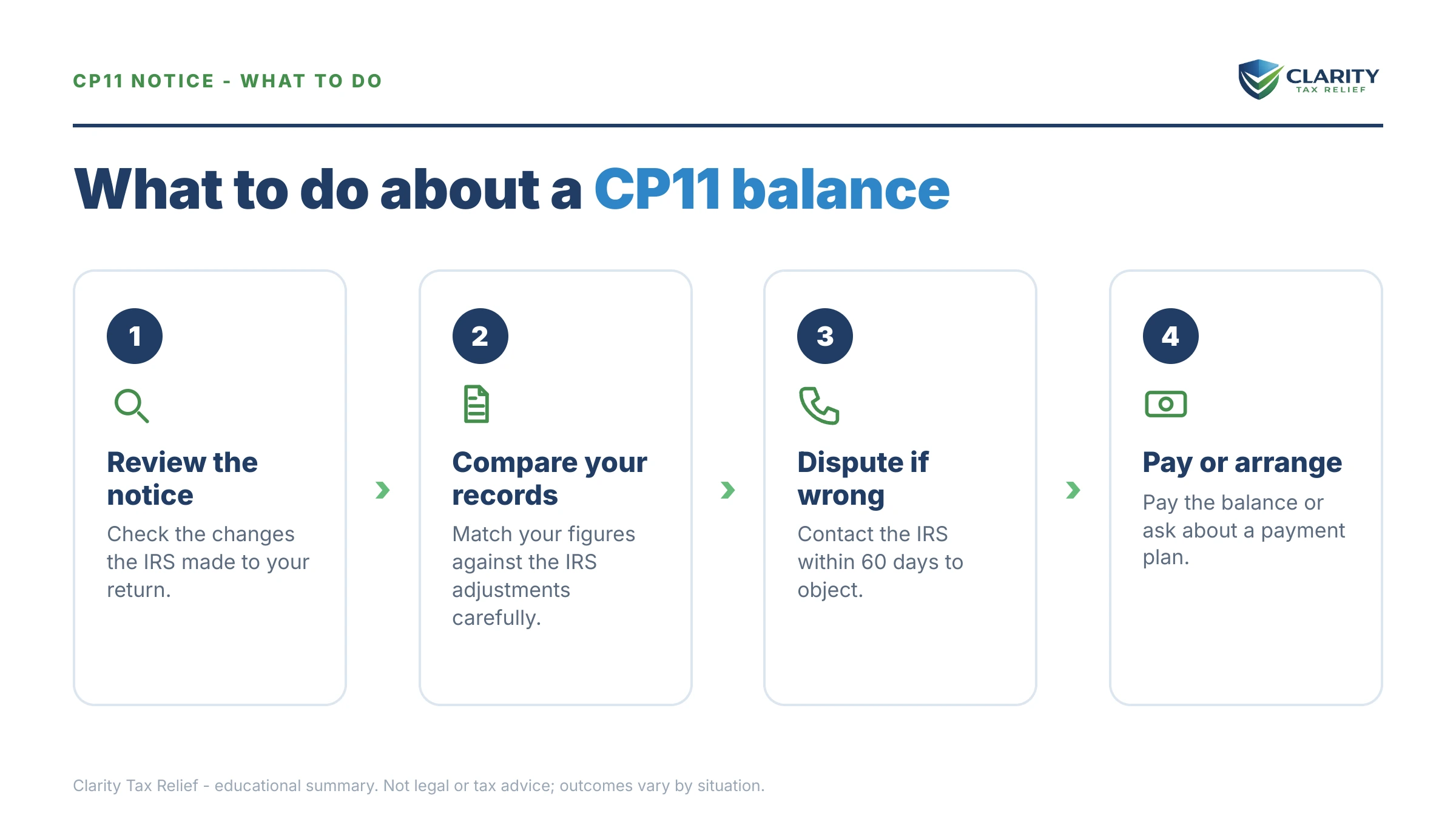
- Pull your filed return and find the changed line. The CP11 names the item the IRS corrected — compare the notice's figure to the one on your return.
- Verify the math yourself. Rerun the worksheet or credit calculation the notice references before you accept or dispute the change.
- Dispute within 60 days if the IRS is wrong. Call the number on the notice or write to the address shown, and include documentation supporting your original figures.
- Pay or arrange payments by the due date if the IRS is right. Pay at IRS.gov/payments, or set up a short-term plan or monthly installment agreement online.
- Request penalty relief and keep everything. Ask about first-time abatement if you qualify, and file copies of the notice, your response, and proof of payment.
When you can handle a CP11 yourself
Many CP11s never need professional help. If you check the IRS's math, agree with the correction, and can either pay in full or set up a simple online plan, you can resolve this in an afternoon — the IRS's own page, Understanding your CP11 notice, covers the mechanics, and a straightforward dispute of one obviously wrong line is also very doable by phone.
Experienced help changes outcomes in a narrower set of situations: the 60-day window has already closed on a change you believe is wrong; the correction involves credits with documentation requirements (dependents, EITC, premium tax credit reconciliation); the CP11 lands on top of other tax years or other notices; or your income is fixed and the real question is whether hardship status beats a payment plan. If the balance itself is causing genuine hardship and you can't get traction with the IRS, the Taxpayer Advocate Service is a free, independent option as well.
Terms on your CP11, decoded
- Math error authority — the legal power (IRC §6213(b)) that lets the IRS correct certain return errors and assess tax immediately, without an audit.
- Assessment — the formal recording of tax on your IRS account; on a CP11, it has already happened.
- Abatement — the reversal of an assessed tax or penalty; disputing within 60 days forces abatement of a math error assessment.
- Statutory notice of deficiency — the formal letter the IRS must send to reassess after a timely dispute, which opens your right to Tax Court before paying.
- Failure-to-pay penalty — the 0.5%-per-month charge that runs on any unpaid balance after the due date, on top of interest.
- Federal Payment Levy Program (FPLP) — the automated system that can take up to 15% of Social Security and other federal payments once a balance reaches the levy stage.
CP11 questions, answered
Is a CP11 notice serious?
A CP11 is more serious than a first bill because the tax has already been assessed — the IRS changed your return, and the new balance is legally on your account. Nothing is being levied at this stage. The real risk is the 60-day dispute window: if it closes and the change was wrong, correcting it becomes far harder and slower.
What is the difference between a CP11 and a CP12 notice?
Both are math error notices, but they point in opposite directions. A CP11 means the IRS's correction created a balance due — you owe money. A CP12 means the correction changed your refund, usually resulting in a different refund amount than you claimed. The 60-day dispute window applies to both, so check either notice against your filed return before accepting it.
Can I dispute a CP11 notice?
Yes — you have 60 days from the date on the notice to dispute the change by phone or in writing. If you dispute in time, the IRS must reverse the math error assessment, and if it still believes you owe, it has to follow formal deficiency procedures that preserve your right to go to Tax Court before paying. Send documentation that supports your original figures and keep copies.
What happens if I miss the 60-day deadline on a CP11?
The assessment stands, and you lose the automatic right to have it reversed. You can still fight an incorrect change, but the paths are slower: paying the balance and filing a refund claim, or asking the IRS to reconsider with documentation. Penalties and interest keep accruing the whole time, so if you believe the CP11 is wrong, act inside the window rather than after it.
Is a CP11 an audit?
No. A CP11 is an automated math error correction, not an examination — a computer recalculated a line on your return and adjusted the tax. No one is questioning your deductions or asking for records. Audits arrive through different letters, such as Letter 566 or a CP75, and follow a completely different process with different rights.
Can the IRS take my Social Security check over a CP11 balance?
Not at the CP11 stage — no levy of any kind can happen this early. If the balance goes unresolved through the full notice sequence and a final notice of intent to levy, the IRS can eventually take up to 15% of each Social Security payment through the Federal Payment Levy Program. Setting up even a modest payment plan before the final notice prevents that entirely.
What if I agree with my CP11 but can't pay it?
Set up a payment arrangement before the due date — that stops escalation even though interest continues. Balances under $50,000 generally qualify for an online plan of up to 72 months, and a short-term plan gives you up to 180 days with no setup fee. If paying anything would leave you unable to cover basic living expenses, Currently Not Collectible status can pause collection.
Why did the IRS change the taxable amount of my Social Security benefits?
The taxable-Social-Security worksheet is one of the most commonly miscalculated lines on a return, so it's a frequent CP11 trigger. Depending on your other income, up to 85% of your benefits can be taxable, and a small error in the worksheet changes the tax due. Rerun the worksheet with your SSA-1099 in hand — if your original figure was right, dispute the CP11 within 60 days.
Your next 24 hours
- Find two things on your CP11: the notice date in the top corner (count your 60 days from it) and the line the IRS says it changed, listed in the "changes to your return" section.
- Gather three documents: your filed return for that year, the CP11 itself, and — if the change involves your benefits — your SSA-1099 or other income records for the same year.
- Get a free case review before the 60-day window closes: send a photo of your CP11 through the 2-minute form or call (888) 825-7779. An experienced tax professional will tell you whether the change is correct and which option costs you the least.
This guide is general information, not tax or legal advice for your specific situation. Eligibility for IRS programs depends on individual facts and circumstances; no outcome is guaranteed.