
IRS Notices
IRS CP09 Notice: The Earned Income Credit You May Be Owed (2026)
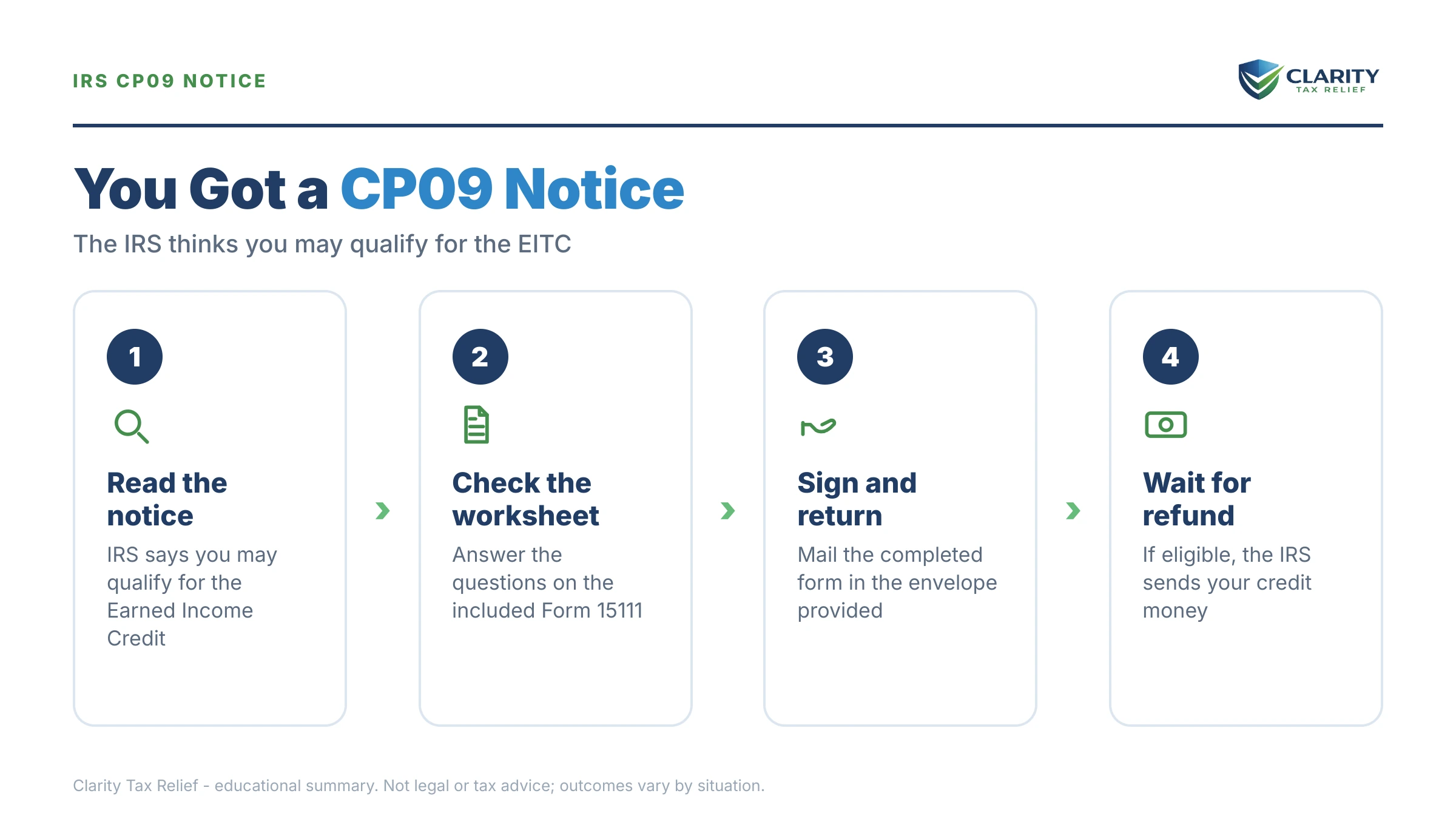
The short answer: a CP09 notice means the IRS reviewed your return and believes you may qualify for the Earned Income Tax Credit — but you didn't claim it. It is not a bill and not an audit. Complete the enclosed Form 15111 worksheet, sign it, and mail it back; if you qualify, the IRS sends the refund.
You opened the envelope braced for a bill — and instead the IRS is saying it may owe you money. That alone makes most people suspicious, especially after a year where the business barely broke even and every letter felt like a threat. This one is different: a CP09 is real, it's common, and the money is yours if the worksheet inside confirms you qualify.
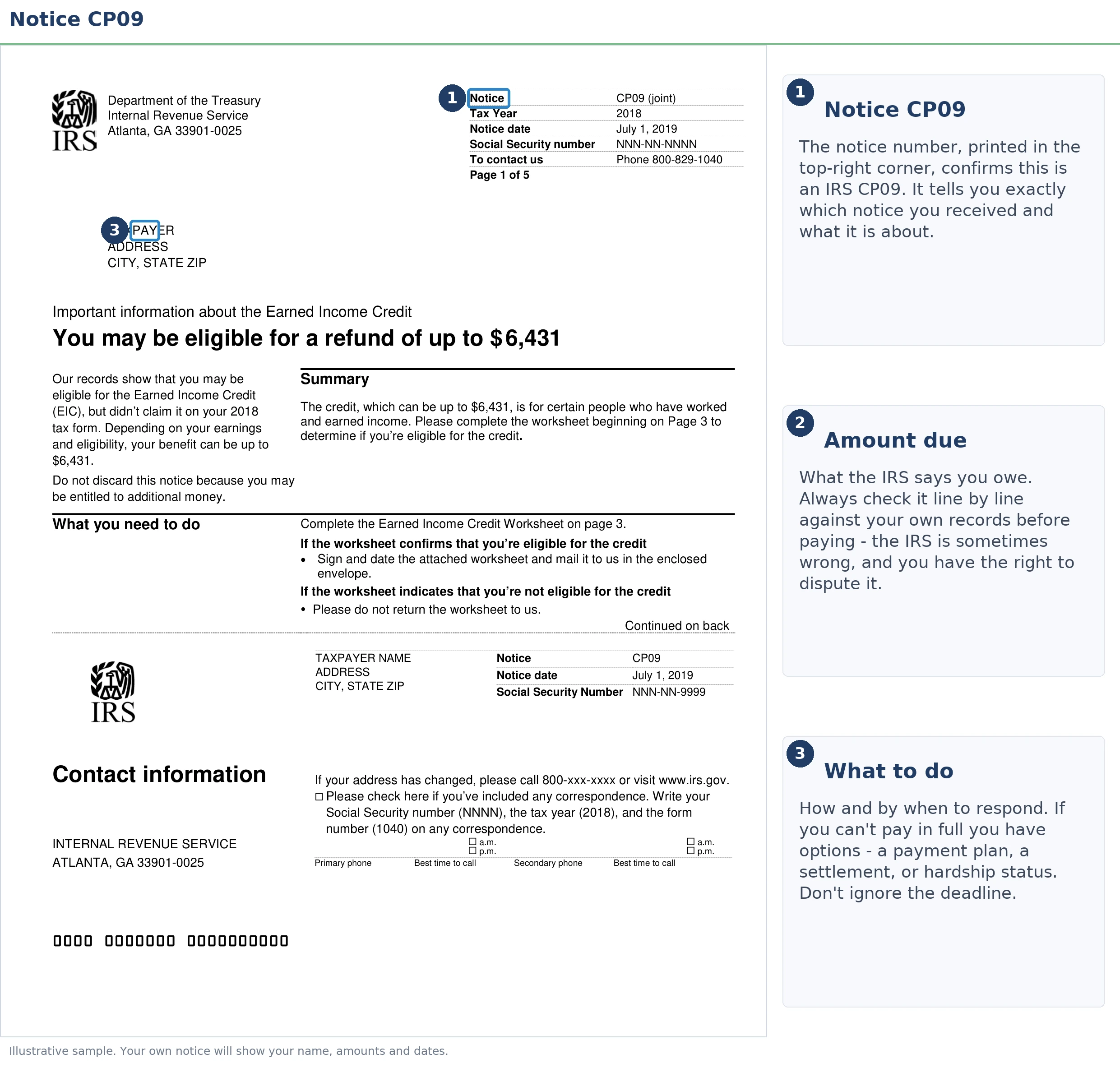
The image below shows exactly what a genuine CP09 looks like and where to look on the page — the tax year, the estimated credit, and the Form 15111 worksheet — so you can confirm the letter in your hand before you fill anything out.
⏱ The real clock: a CP09 carries no penalty for a slow reply — but the refund itself expires. You generally have 3 years from your return's original due date to claim an Earned Income Tax Credit refund. Once that window closes, the money is gone for good, so respond as soon as you can — not "someday."
Why you got a CP09 notice
The IRS sends a CP09 when its records show you likely qualified for the Earned Income Tax Credit but left it off your return. Its computers compare the income, filing status, and dependents on your return against the EITC's rules — and when the math says you probably qualified, a CP09 goes out with a worksheet attached.
The most common trigger is an income drop. The EITC phases in and out by earned income, and for tax year 2025 it tops out at just over $8,000 for a family with three or more qualifying children. A small-business owner who had a rough year — thin margins, a slow season, a big equipment write-off — can land inside the EITC range for the first time in their life, and tax software rarely flags a credit you've never claimed before.
Other common causes: a new child on the return, a filing-status change after a divorce, or a preparer who skipped Schedule EIC. If you want the bigger map of why the IRS writes at all, see why did I get a letter from the IRS — but a CP09 is one of the few letters in that whole universe that works in your favor.
One boundary worth knowing up front: a CP09 goes to filers who appear to have a qualifying child. If the IRS thinks you qualify for the EITC without children, it sends a CP27 notice instead — same idea, different worksheet.
What happens if you ignore a CP09
Ignoring a CP09 costs you the refund — the IRS will not add the Earned Income Tax Credit to your account without your signed Form 15111. There's no enforcement sequence here; the escalation runs against your wallet, not from the IRS:
- Nothing punitive happens. No penalties, no interest, no collections — a CP09 is an invitation, not a demand.
- The credit never posts. The IRS calculated that you probably qualify, but it won't pay without your signed worksheet confirming the facts it can't see — like where your child lived during the year.
- You may not get a reminder. The IRS isn't obligated to chase you to hand you money. For many taxpayers, the CP09 is the only letter on the subject.
- The refund statute runs out. The three-year window to claim the credit closes — the same rule covered in our guide to the 3-year refund deadline.
- The overpayment becomes the Treasury's permanently. After the statute expires, no worksheet, amended return, or appeal can recover it.
And in 2026 there's a practical reason not to wait: the IRS workforce shrank roughly 27% in 2025, so paper responses process slower than they used to. The earlier your worksheet lands, the earlier your refund — or your debt reduction — posts.
Got a CP09 — but you also owe the IRS?
That's the exact situation where this notice gets interesting: the credit can shrink a balance that's growing every month. Send us the CP09 and your last notice about what you owe, and an experienced tax professional will map out how they interact — free, confidential, no pressure.
Form 15111: the worksheet that decides your CP09 refund
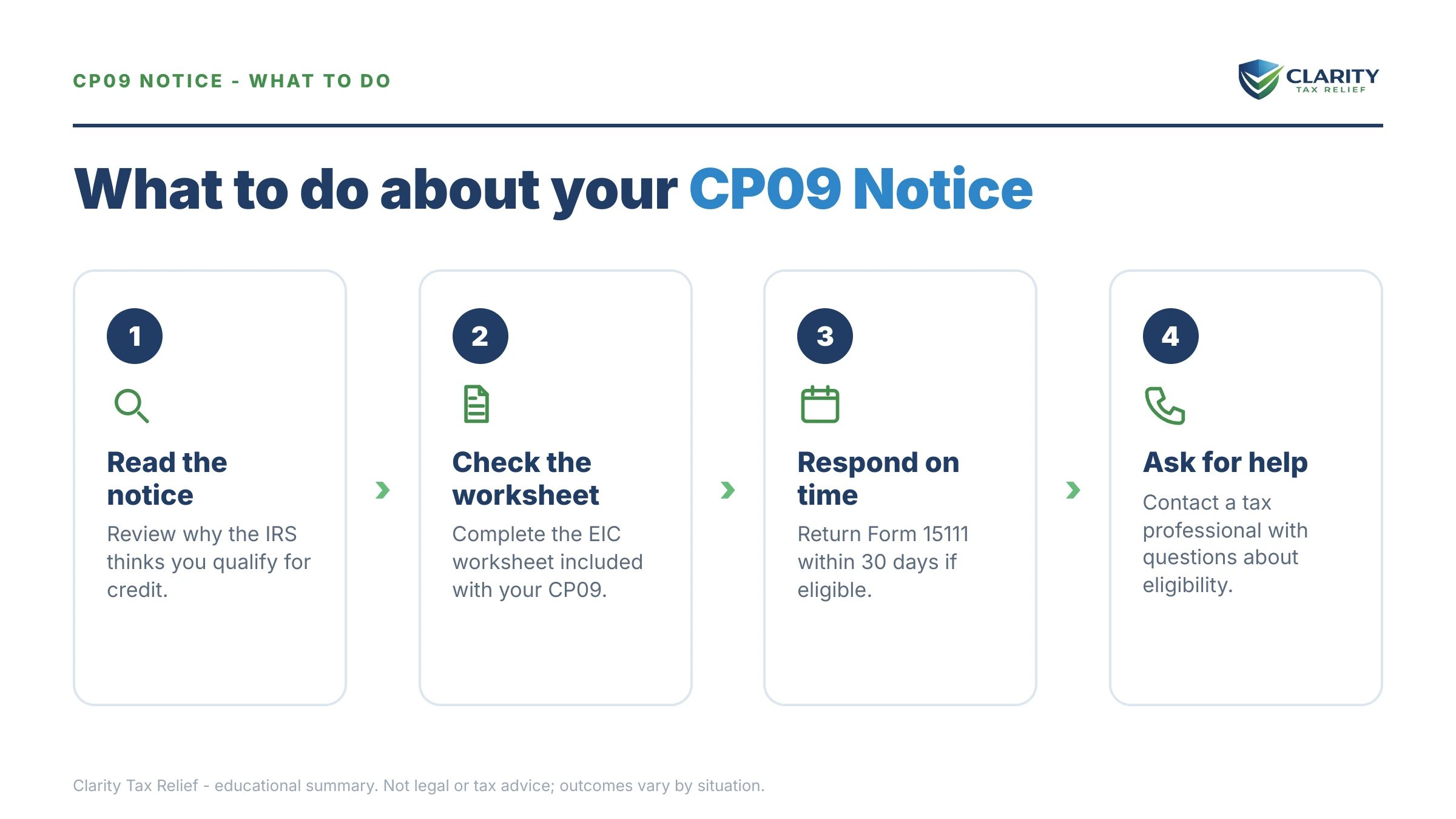
Form 15111 is the Earned Income Credit Worksheet enclosed with every CP09 — and it, not a new tax return, is how you claim the money. You do not file a Form 1040-X for this. Answer the questions, sign, and return it in the envelope (or to the fax number) printed on your notice; the image below shows where the worksheet sits within the notice packet.
The worksheet walks through the eligibility gates the IRS can't verify from your return alone:
- Valid Social Security numbers for you, your spouse, and each qualifying child — ITINs don't qualify for the EITC.
- Filing status. Married filing separately generally can't claim the credit unless you meet the special rules for separated spouses.
- Qualifying child tests: relationship, age, and — the one the IRS checks hardest — the child living with you in the U.S. for more than half the year.
- Investment income under the annual cap shown in the worksheet's instructions.
- You can't be someone else's dependent or qualifying child yourself.
If you're self-employed, one line matters more than all the others: your earned income is your net Schedule C profit, not your gross receipts. A year with $140,000 of sales and $121,000 of expenses is a $19,000 earned-income year for EITC purposes. If you run an S corporation instead, the W-2 wages you paid yourself count as earned income — but K-1 distributions don't. And the number has to be real in both directions: inflating profit to boost the credit, or deflating it out of habit, are both problems if the IRS asks questions later.
Two honesty checks before you sign. First, if your EITC was denied in a past year, you may need Form 8862 on file before the credit can pay — the CP79 notice is how the IRS flags that requirement. Second, if the worksheet shows you don't qualify, don't sign it. There's no penalty for not responding, but signing an inaccurate claim can mean repayment, penalties, and a multi-year ban on the credit.
CP09 vs. CP08 vs. CP27: which credit notice do you have?
The IRS uses at least five different notices for Earned Income Tax Credit and related-credit issues, and each one demands a different response. Check the code in the top corner of your letter before doing anything:
| Notice | What it means | Your move |
|---|---|---|
| CP09 | You may qualify for the EITC (with a qualifying child) but didn't claim it | Complete, sign, and return Form 15111 |
| CP08 | You may qualify for the Additional Child Tax Credit you didn't claim | Complete and return its worksheet (Form 15110) |
| CP27 | You may qualify for the EITC with no qualifying children | Complete and return its worksheet (Form 15112) |
| CP75 | The IRS is auditing an EITC claim and wants proof | Send residency/relationship documents by the notice deadline |
| CP79 | Your EITC was disallowed; recertification required | Attach Form 8862 to your next claim |
Some households get a CP09 and a CP08 for the same year — the two credits have overlapping but different rules, so answer each worksheet separately. They don't cancel each other out.
If you owe back taxes: where the CP09 money actually goes
If you owe the IRS, a CP09 refund is applied to your balance before a dime reaches your bank account. On your transcript that shows up as code 826 when it moves to another tax year you owe, or as an offset through the Treasury Offset Program when it goes to a non-IRS debt like child support or state taxes. If you have required returns that were never filed, the IRS can hold the refund entirely until they're in — that's the CP63 notice situation.
That sounds like bad news. Run the numbers and it usually isn't.
A worked example (hypothetical). Say you run a small shop with two employees, and a brutal 2025 left your Schedule C showing $19,400 of net profit. You file jointly with one qualifying child, and the CP09 worksheet confirms you qualify for roughly $4,200 of EITC. Meanwhile, you personally owe $8,900 from the same rough stretch — the kind of balance covered in our guide to 941 back taxes when a business falls behind on payroll.
Return the signed Form 15111 and here's the math: the $4,200 never hits your checking account. It offsets the debt instead — $8,900 − $4,200 = $4,700 remaining. You just cut the balance nearly in half without writing a check, and the failure-to-pay penalty (0.5% per month) and interest now accrue on $4,700 instead of $8,900. Ignore the notice, and you keep owing the full $8,900 — compounding — while your own money sits unclaimed until the statute erases it.
For a business owner with payroll debt, that's the entire decision: the CP09 is the cheapest debt payment you'll ever make, because it's funded with money that was already yours.
How to respond to a CP09, step by step
- Verify the notice: log in to your IRS online account and confirm the CP09 matches the tax year and name on your return — a real CP09 never asks you to pay anything.
- Work through Form 15111: answer every eligibility question honestly, using your actual filing status, each child's Social Security number, and your real net self-employment profit.
- Sign and send it back: both spouses must sign on a joint return; use the envelope or the fax number printed on your notice, and consider certified mail so you have proof.
- Keep a complete copy: photograph the notice, the completed worksheet, and your proof of mailing before anything leaves your hands.
- Track the result: watch your IRS online account or transcript over the following weeks — code 766 means the credit posted, 846 means the refund is on the way, and 826 means it went to a balance you owe.
Tracking your CP09 refund on your transcript
Your IRS account transcript shows the CP09 refund's progress weeks before any letter or deposit arrives. After you return Form 15111, these are the codes that tell the story:
| Code | What it means | What to do |
|---|---|---|
| 971 | Notice issued — often the CP09 itself | Nothing; it confirms the notice is on your account |
| 766 | Credit posted — the EITC was allowed | The math is done; a refund or offset comes next |
| 846 | Refund issued, with the date | Watch your bank account or mailbox around that date |
| 826 | Refund applied to another tax year you owe | Check which year absorbed it and your new balance |
| 898 | Refund offset to a non-IRS debt | Contact the agency that received it, not the IRS |
| 570 | Hold — the account is under review before release | Wait; respond promptly if the IRS asks for documents |
A 570 hold after a worksheet isn't unusual — the IRS sometimes verifies the claim before paying, much like the review behind a CP05 notice. If a hold sits for months with no letter, that's when a professional inquiry (or the Taxpayer Advocate) is worth the effort.
When you can handle a CP09 yourself
Most people can handle a CP09 alone — it is one worksheet, and the IRS designed it for taxpayers, not professionals. If your qualifying-child facts are clean, your income is W-2 or a straightforward Schedule C, and you owe the IRS nothing, fill it out, sign it, mail it, and you're done. You don't need to pay anyone for that.
Experienced help changes the outcome in a handful of situations:
- You owe back taxes — especially payroll debt. The CP09 credit is one piece of a larger resolution, and the order you fix things in (unfiled returns, penalties, then the balance) changes what you ultimately pay.
- Your EITC was disallowed before. The Form 8862 recertification rules — and the possible two- or ten-year bans — make a mistake here expensive.
- Your Schedule C is shaky. If your net profit was estimated, reconstructed, or wrong, claiming a profit-based credit on top of it invites questions you want answered correctly the first time.
- Custody is contested. When two households could claim the same child, the tie-breaker rules decide it — and getting it wrong triggers the duplicate-dependent process.
Terms on your CP09, decoded
- Earned Income Tax Credit (EITC): a refundable credit for workers with low-to-moderate earned income — refundable means the IRS pays it out even if you owed no tax.
- Form 15111: the Earned Income Credit Worksheet enclosed with the CP09; signing and returning it is how you claim the credit without amending your return.
- Qualifying child: a child who meets the relationship, age, and residency tests — the residency test (living with you more than half the year) is the one the IRS verifies most often.
- Earned income: wages plus net self-employment profit; investment income, unemployment, and Social Security don't count toward it.
- Refund offset: the IRS's right to apply your refund to back taxes or other government debts before paying you anything.
- Refund statute (RSED): the deadline — generally three years from the return's due date — after which an unclaimed refund is forfeited permanently.
CP09 questions, answered
Is a CP09 notice a scam?
A real CP09 arrives by postal mail and never asks you for money — it tells you the IRS may owe you a refund. Scammers rarely impersonate letters that pay you, but verify anyway: log in to your IRS online account and confirm the notice matches your account before sending anything. Never give bank details to anyone who calls or texts claiming to "release" your CP09 refund.
How long does it take to get the CP09 refund after sending Form 15111?
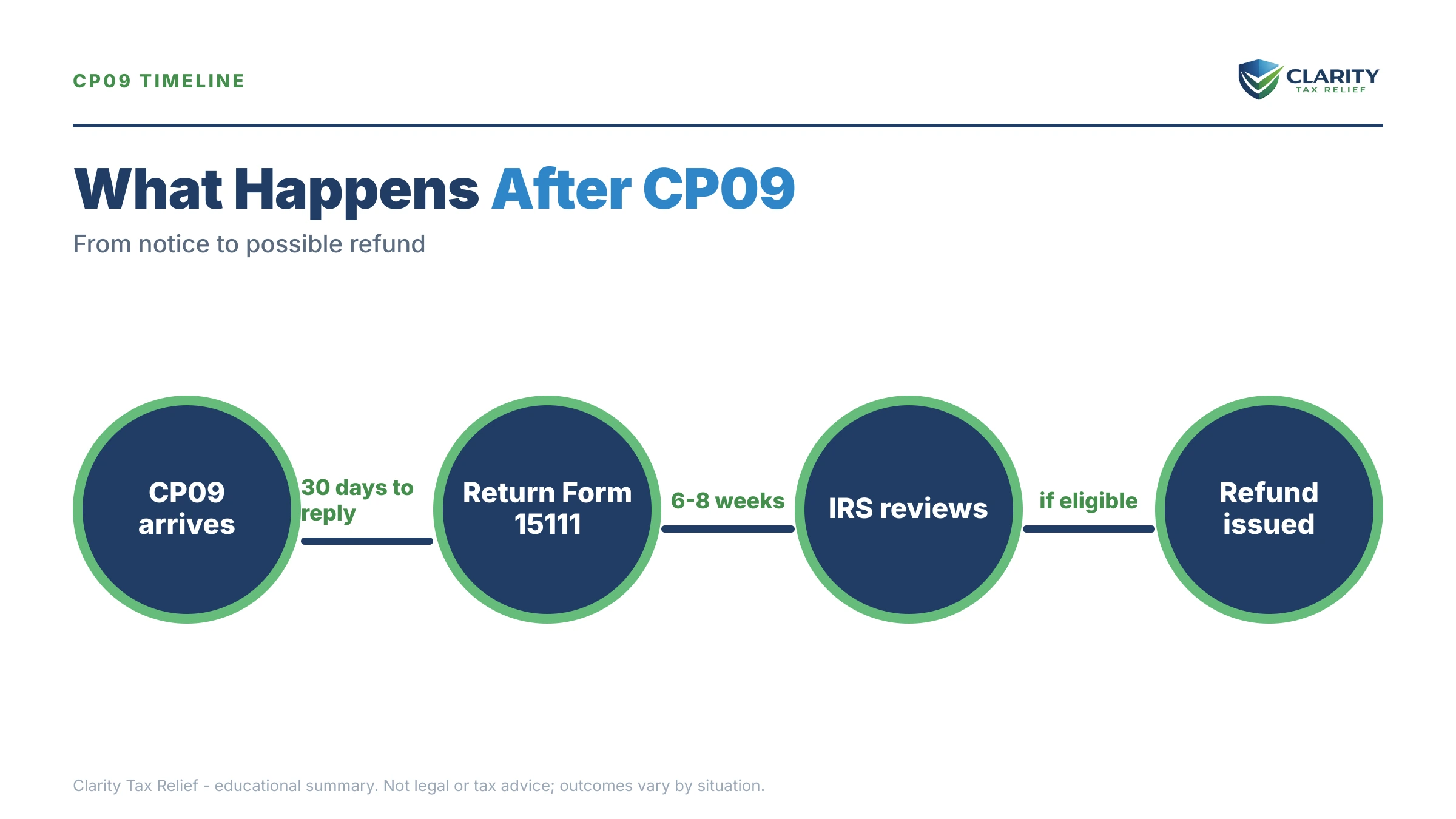
Most CP09 refunds arrive within several weeks — the IRS commonly cites six to eight — after it receives and processes your signed worksheet. In 2026, processing can run longer because the IRS workforce was cut roughly 27% in 2025. If you owe other federal or state debts, the refund may be reduced or absorbed by offset before anything reaches your bank.
Do I need to file an amended return to claim the EITC from a CP09?
No. Form 15111 replaces a Form 1040-X for this one issue — the IRS recalculates your return and issues the refund itself once you qualify. File an amended return only if something else on the return also needs to change, such as adding a dependent or correcting income; in that case the 1040-X handles both.
Will I get the CP09 refund if I owe back taxes?
Not in cash — the IRS applies the credit to your oldest balance first, then to other federal or state debts through the Treasury Offset Program. That's still worth doing: the credit reduces a debt that is accruing interest and penalties every month. On a transcript, the offset shows as code 826 (another tax year) or 898 (a non-tax debt).
What if I don't actually qualify after working through Form 15111?
Then do nothing — there is no penalty for not responding to a CP09, and no follow-up enforcement. Keep the notice with your tax records in case a question comes up later. Do not sign and return the worksheet if the answers show you don't qualify; claiming EITC you're not entitled to can lead to repayment, penalties, and a future ban on claiming the credit.
Can I claim the EITC for earlier years if I never got a CP09?
Yes — if you qualified in a prior year and didn't claim it, you can file an amended return for that year, generally within three years of the return's original due date. The IRS doesn't catch every missed credit, so no CP09 doesn't mean no eligibility. Check each open year; the income limits and credit amounts differ year to year.
What if my EITC was denied or reduced in a previous year?
You may need to attach Form 8862 before the IRS will pay the credit again. If a prior EITC claim was denied for anything other than a math error, the recertification requirement applies — and if the denial was for reckless or fraudulent claims, a two-year or ten-year ban can block the credit entirely. The CP79 notice is how the IRS tells you Form 8862 is required.
Does answering a CP09 increase my audit risk?
Responding honestly to a CP09 doesn't flag you — the IRS invited the claim. But EITC claims are among the most-reviewed items on any return, and self-employed income gets extra scrutiny because net profit drives the credit in both directions. If the IRS wants proof of a qualifying child's residency or relationship, it opens a CP75 review — keep school, medical, and lease records handy.
Your next 24 hours
- Find two things on the notice: the tax year it covers and the estimated credit amount the IRS printed — that's what's on the table.
- Gather three things: your return for that year, Social Security cards (or numbers) for each child, and — if you're self-employed — your Schedule C showing net profit.
- Get a free case review if you also owe: if there's a balance, payroll debt, or unfiled years anywhere in the picture, call (888) 825-7779 or use the 2-minute form before you send the worksheet — interest and penalties on what you owe accrue monthly, and the CP09 credit should be part of the plan, not an afterthought.
Primary sources: the IRS's official page at Understanding your CP09 notice, its Earned Income Tax Credit overview, and — if your worksheet stalls with no response for months — the Taxpayer Advocate Service.
This guide is general information, not tax or legal advice for your specific situation. Eligibility for IRS programs depends on individual facts and circumstances; no outcome is guaranteed.