
IRS Notices
IRS CP63 Notice: Your Refund Is Held for Unfiled Returns — What to Do in 2026
The short answer: a CP63 notice means the IRS is holding your entire tax refund because its records show you haven't filed one or more prior-year returns — and it believes those returns may show tax due. The refund stays frozen until you file the missing years or prove you weren't required to file.
You filed this year's return on time, watched "Where's My Refund" for weeks, and instead of a deposit you got a letter saying the IRS is keeping your money because of a year you never filed. That's the CP63 in one sentence — this year's refund is being held hostage by a past year's paperwork.
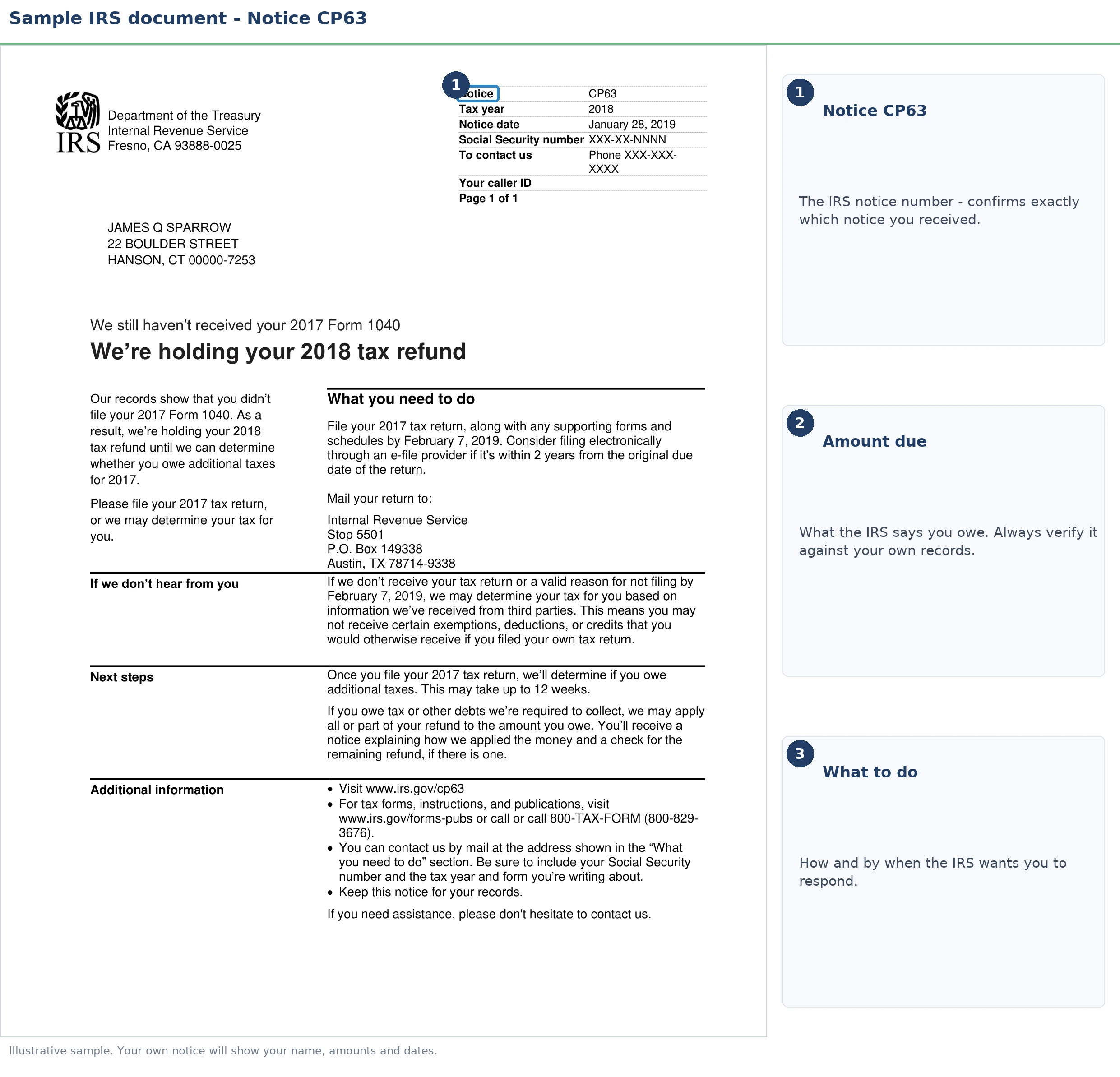
The good news: unlike most IRS letters, the CP63 tells you the exact fix. File the year or years it names, and the hold has a defined end. The image below shows exactly what a CP63 looks like and where to find the specific tax years the IRS says are missing — those years are your entire to-do list.
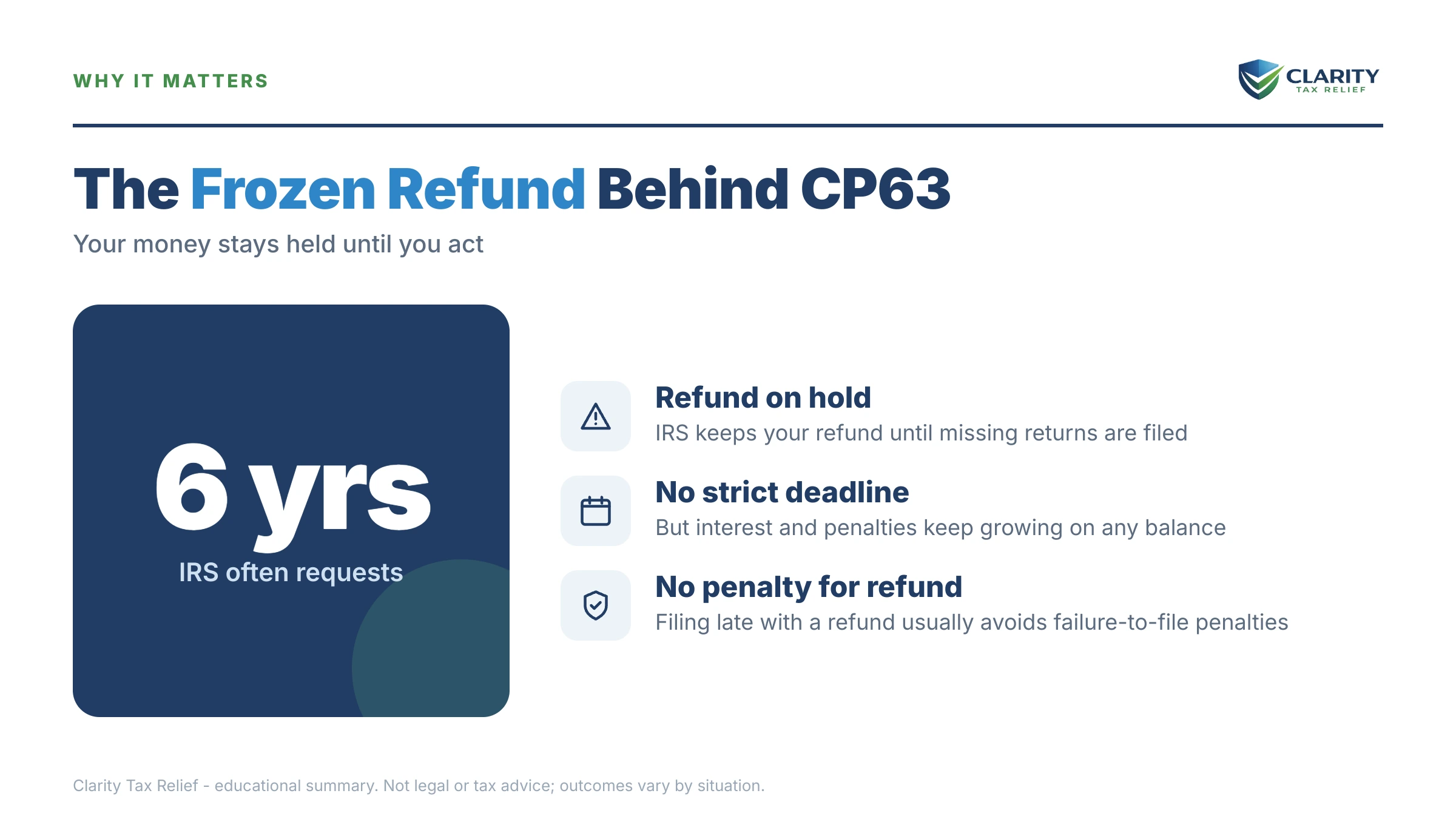
⏱ The real clock: a CP63 has no printed response deadline — the hold is open-ended until you act. But two clocks are running anyway. If the unfiled year owes tax, the failure-to-file penalty grows at 5% per month, up to a 25% cap, plus interest. And if the unfiled year was actually owed a refund, you generally have only 3 years from that return's due date to claim it before it's gone permanently.
Why the IRS sent you a CP63 notice
The IRS sends a CP63 when it processes a return claiming a refund while its records show at least one unfiled prior-year return it believes will show tax due. The trigger is automated: employers, banks, brokerages, and payment platforms send the IRS copies of your W-2s and 1099s every year. When those documents exist for a year with no return attached — and the income looks big enough to create a tax bill — the system flags you.
Then, the moment you file a return with a refund on it, the IRS grabs the refund as a deposit against what the missing year might owe. It won't send you the money and then chase you for the old year separately. It holds first and asks questions second.
Note what the CP63 is not. It's not an audit, and it's not a judgment about the return you just filed. If your refund were held because the IRS was reviewing this year's numbers, you'd have a CP05 notice instead — and if they wanted documents to support that review, a CP05A notice. The CP63's problem lives entirely in the past years it lists. (For the bigger picture on how the IRS decides who gets which letter, see why you got a letter from the IRS.)
You may also see a CP88 notice at some point — it comes from the same delinquent-return refund-hold program and carries the same instruction: file the missing years.
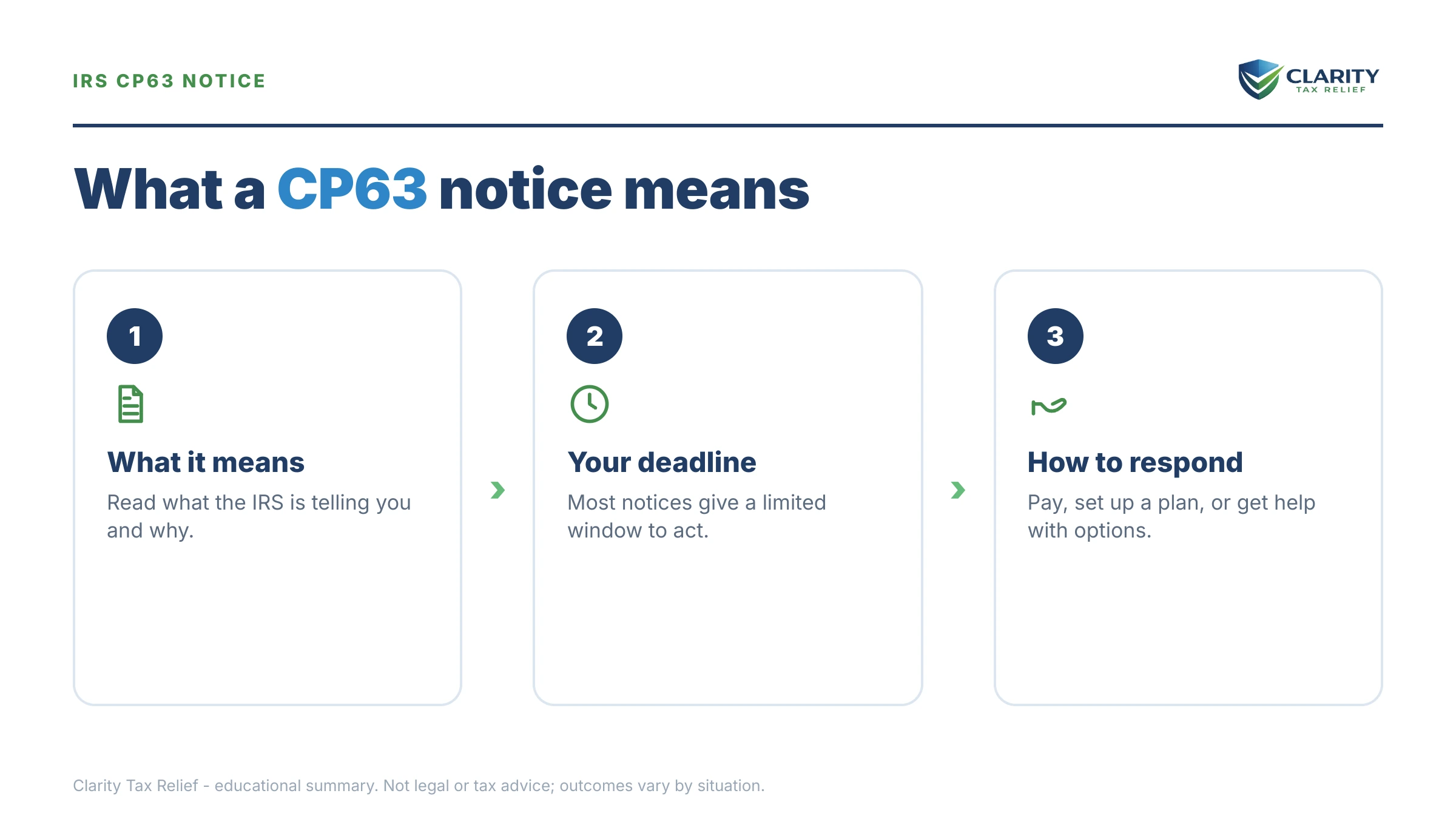
What a CP63 refund hold actually does
A CP63 freezes 100% of your refund — not a portion sized to the estimated old debt, the whole thing. For a married couple filing jointly, that means the entire joint refund is held even if only one spouse has the unfiled year. The IRS treats the joint refund as one pot.
Three things about how the hold behaves:
- It doesn't expire. There is no point where the IRS gives up and releases the money. The hold ends when the listed returns post or the IRS accepts that no filing was required.
- It repeats. File next year with the old gap still open, and next year's refund gets held too. One unfiled year can quietly confiscate several refunds in a row.
- It's a warning shot. The refund hold is the gentlest tool in the IRS's unfiled-return toolkit. What follows if you stay silent is considerably worse — and it's already queued up.
What happens if you ignore a CP63
Ignoring a CP63 ends with the IRS filing the missing return for you — with no deductions, no credits, and the least favorable filing status — and then applying your held refund to that inflated bill. The sequence is automated, and it runs in stages:
- CP63 — refund held. You are here. Your money is frozen, but nothing has been assessed against you yet. This is the cheapest moment in the whole sequence.
- Delinquent-return notices. The IRS starts demanding the missing returns directly: a CP59 notice asking you to file, followed by reminder notices for the same years.
- Final filing demand. A CP518 notice tells you this is the last request before the IRS acts on its own.
- Substitute for Return (SFR). The IRS prepares the return itself from the W-2s and 1099s on file — gross income only, no business expenses, no dependents, married-filing-separately or single status — and proposes the tax via CP2566 or a CP3219N notice of deficiency. Here's what it means when the IRS files a substitute return for you.
- Assessment and collection. The SFR balance becomes legally owed. Your held refund is applied to it, and whatever remains enters the collection notice stream — bills, then intent-to-levy notices, with liens and levies at the end of that road.
| Stage / notice | What it says | What changes for you |
|---|---|---|
| CP63 | Refund held — file your missing return(s) | Refund frozen; no tax assessed yet; you still control the numbers |
| CP59 / reminders | You have unfiled returns — file now | The unfiled years become their own active case |
| CP518 | Final notice — file or the IRS acts | Last chance to file on your own terms |
| SFR: CP2566 / CP3219N | The IRS computed your tax for you | Tax proposed with zero deductions or credits — usually the worst-case number |
| Assessment & collection | Balance due — pay or face enforcement | Held refund applied to the SFR bill; the rest goes to collections |
The 2026 wrinkle: the IRS workforce was cut roughly 27% in 2025, so reaching a human about your hold is harder than ever — but the systems that flag non-filers, hold refunds, and build SFRs are automated and never stopped. Silence doesn't buy you slack; it just moves you down the list above.
Holding a CP63 with years you're afraid to open?
Send us a photo of the notice. An experienced tax professional will pull your IRS records, tell you exactly which years to file and what they'll likely show — before penalties and a substitute return make the numbers worse. Free and confidential.
What happens after you file: the three outcomes
Once the missing return posts, the held refund goes one of three ways — released in full, partially applied, or fully absorbed by the old balance. Which one you get depends entirely on what the unfiled year shows:
| What the missing year shows | What happens to the held refund | Your move |
|---|---|---|
| A refund, filed within 3 years of its due date | Held refund released — and the old year's refund is paid too | File fast; you're leaving two refunds on the table |
| A refund, but the 3-year window has closed | Held refund released; the old refund is forfeited | File anyway to clear the hold and stop future holds |
| A balance smaller than the held refund | Refund applied to the balance; the difference is sent to you | File and let the refund settle it — often no cash out of pocket |
| A balance larger than the held refund | Entire refund applied; the remainder becomes a collection balance | File, then set up a payment arrangement for the rest |
| No filing requirement that year | Hold released after the IRS accepts your explanation | Call the number on the notice and document why no return was due |
That first row deserves emphasis: many CP63 recipients had withholding in the unfiled year and are actually owed money on it. But the refund on an unfiled year dies 3 years after that return's due date — here's how the 3-year refund deadline works. If your missing year is close to that line, filing it is genuinely urgent even though the CP63 itself prints no deadline.
If the missing year leaves a balance you can't pay
Filing the missing return is still the right move even when it creates a bill — because filing stops the 5%-per-month failure-to-file penalty and replaces the IRS's worst-case SFR math with your real numbers. Once the balance is fixed, your options scale with its size:
| Balance after the refund is applied | Realistic options | What it takes |
|---|---|---|
| Under $10,000 | Pay within 180 days ($0 setup) or a guaranteed installment agreement — individuals only, with an income-tax balance of $10,000 or less excluding penalties and interest, all returns filed, timely filing and payment for the past 5 years with no installment agreement in that period, and full payment within 3 years | Set up online in minutes; no financial disclosure |
| $10,000–$25,000 | Streamlined installment agreement | Up to 72 months; no detailed financials required |
| $25,000–$50,000 | Streamlined agreement, typically with direct debit; online setup up to 72 months | Direct debit usually expected at the upper end |
| Over $50,000 | Non-streamlined agreement, hardship (CNC) status, or an Offer in Compromise if the math supports it | Full financial disclosure (Form 433 series); professional review pays for itself here |
Interest and the 0.5%-per-month late-payment penalty continue on any plan, so a plan buys protection from enforcement, not a discount. Penalty relief is a separate conversation — and since first-time abatement requires a clean prior-three-year history, a taxpayer with multiple unfiled years usually needs a reasonable-cause argument instead.
A worked example: the numbers on a real-shaped CP63 case
Say you're married filing jointly. In 2023 your spouse went independent and grossed $68,500 on 1099s, and that return never got filed — quarterly taxes felt impossible, then the deadline slid by. This April you filed jointly as usual, expected a $4,800 refund, and got a CP63 instead. Here's roughly how the math plays out (hypothetical figures, real mechanics):
- The 2023 return: after mileage and expenses, net self-employment profit comes to about $54,000. Self-employment tax alone runs about $54,000 × 92.35% × 15.3% ≈ $7,630. Add income tax on that profit, offset partly by your W-2 withholding, and suppose the return shows $10,000 unpaid.
- Failure-to-file penalty: 5% per month capped at 25% — the cap hit long ago: $2,500.
- Failure-to-pay penalty: 0.5% per month, roughly 24 months so far: about $1,200.
- Interest on all of it: call it roughly $1,500 by mid-2026. Total: about $15,200.
- The held refund: your $4,800 is applied automatically, leaving about $10,400 — which fits a streamlined installment agreement at roughly $145/month over 72 months before ongoing interest.
Now compare the do-nothing version: an SFR on $68,500 of gross 1099 income, filed married-filing-separately with zero expenses, would propose tax on $14,500 more income than actually existed — easily thousands more, plus the same penalties on the bigger number. Filing your own return isn't just compliance; it's the single biggest dollar lever in the whole case. You can rough out your own penalty and interest exposure with our Penalty & Interest Calculator.
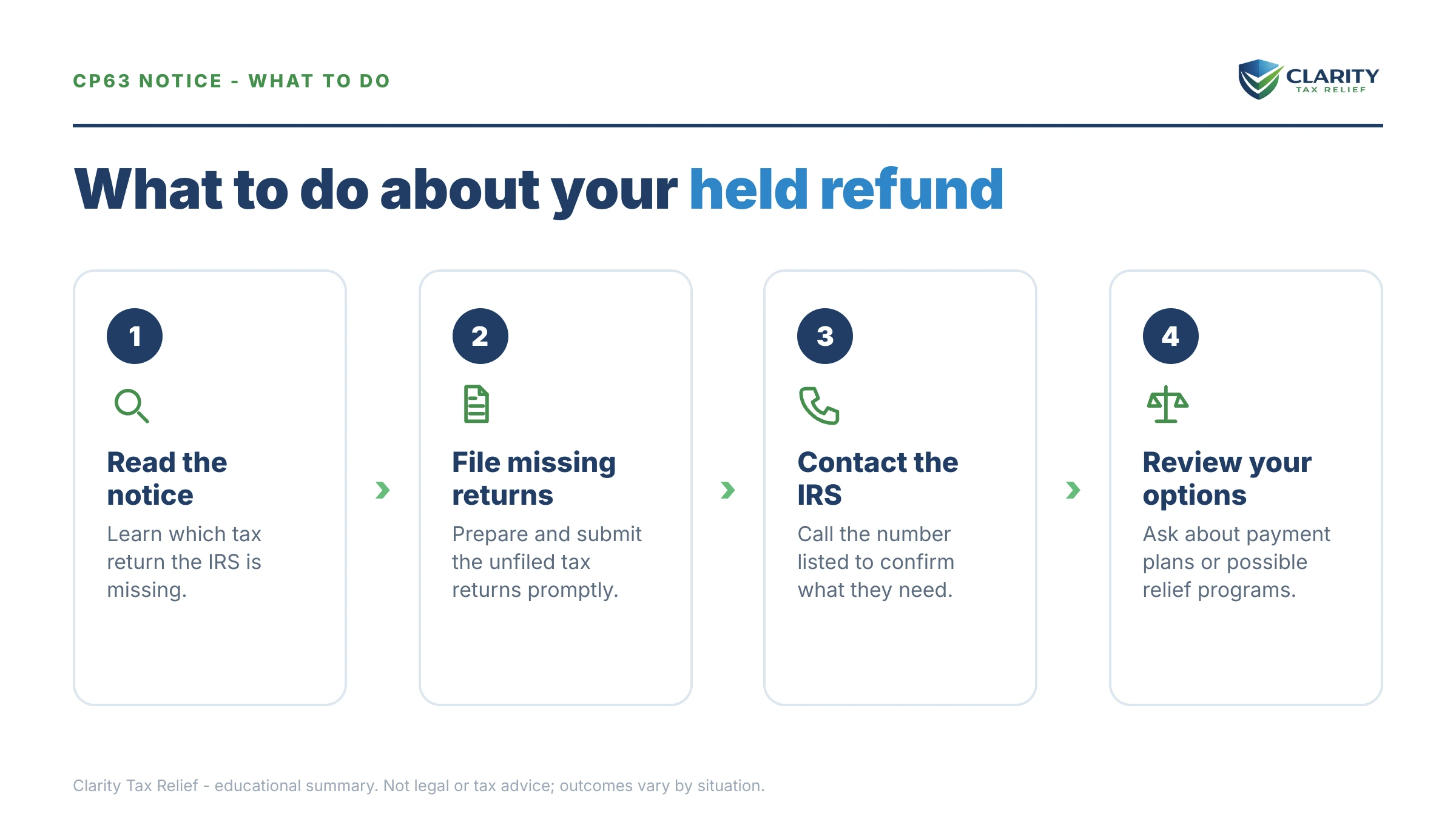
How to respond to a CP63, step by step
- Confirm which years the IRS wants. The tax years are printed on the notice — write them down, because every step that follows is about those years, not the return you just filed.
- Pull your IRS wage and income transcripts. They list every W-2 and 1099 the IRS has on file for the missing years, so you're building the return from the same data the IRS will check it against.
- Prepare and file the missing returns. Use that year's forms and rules, claim every deduction you're entitled to, and mail them to the address on the notice with proof of mailing — prior years can't be e-filed.
- Respond if you already filed or weren't required to. Call the number on the notice; send a signed copy with proof if the return was filed, or explain in writing why no filing requirement existed that year.
- Settle any balance and track the release. If the old year owes more than the held refund covers, set up a payment plan for the remainder, then watch your transcripts until the return posts and the hold lifts.
If your records for the missing years are gone — a common reason people froze in the first place — transcripts plus bank statements can rebuild most returns. Here's the full playbook for filing back taxes with no records, and a step-by-step on ordering wage and income transcripts.
When you can handle a CP63 yourself
Plenty of CP63 cases are safe DIY. If the notice lists one missing year, you have (or can get) the W-2s and 1099s for it, and the income was straightforward wages, you can prepare the return, mail it with proof, and wait out the release without paying anyone. That's especially true if the missing year likely shows a refund — you're just claiming money.
Experienced help changes the outcome when the case has layers:
- Multiple unfiled years, especially if you're unsure how many — the IRS generally wants the last six, and the order and content of those filings affect penalties and payment options. See how many years of back taxes you have to file.
- Self-employment or business income in the missing years — every legitimate expense you reconstruct directly shrinks the balance your refund gets applied to.
- An SFR already in motion — a CP2566 or CP3219N on top of your CP63 means deadlines with legal consequences, and the response strategy changes.
- A big projected balance — when the old years will owe more than the held refund, the filing and the resolution plan should be designed together, not sequentially.
Terms on your CP63, decoded
- Refund hold: the IRS keeping your refund in suspense — not applied, not paid out — until a compliance issue is resolved.
- Delinquent return: a required tax return that was never filed; the years listed on your CP63 are your delinquent returns.
- Substitute for Return (SFR): a return the IRS builds for you from third-party documents, with no deductions or credits — almost always a worse result than filing yourself.
- RSED (Refund Statute Expiration Date): the deadline — generally 3 years from a return's due date — after which a refund on that year can no longer be claimed.
- Assessment: the formal recording of a tax debt on your IRS account; before assessment nothing is legally owed, after it collection can begin.
- Wage and income transcript: the IRS's year-by-year list of every W-2 and 1099 filed under your Social Security number — the raw material for rebuilding old returns.
CP63 questions, answered
How long will the IRS hold my refund after a CP63?
Until every return listed on the notice is filed and processed, or the IRS accepts that you weren't required to file — there is no automatic release date. Prior-year returns must be paper-filed and typically take longer to post than current returns, especially with the IRS workforce cut roughly 27% in 2025. Follow up if the hold hasn't released a couple of months after your return posts to your transcript.
What if I already filed the return the CP63 says is missing?
Call the number printed on the notice and check your account transcript for that year — a recently mailed return may simply not have posted yet. If you filed long ago, send a signed copy of the return with proof of the original filing, such as a certified-mail receipt or e-file acceptance. Name or SSN mismatches can also make a filed return look missing in IRS records.
Will I get my refund back after I file the missing return?
Yes, if the missing-year return shows no balance due, the full held refund is released once the return processes. If the old year shows tax owed, the IRS applies your held refund to that balance first and sends you whatever is left. If the old year owes more than the held refund, the remainder becomes a collection balance with its own notices.
Can I lose the held refund permanently?
The current-year refund the CP63 froze isn't forfeited by time, but it will be applied to any balance the IRS eventually assesses — including a substitute-for-return assessment built without your deductions. The refund at real risk of vanishing is on the unfiled year itself: you generally have 3 years from that return's due date to claim it, and after that the money is gone for good.
Is a CP63 notice an audit?
No. A CP63 is a filing-compliance hold, not an examination — nobody is questioning the numbers on the return you just filed. If your refund were held for a review of the current return, you'd get a CP05 instead. The CP63 issue is entirely about the prior years the IRS says are missing, and filing them is the fix.
What's the difference between a CP63 and a CP88?
Both notices come from the same IRS delinquent-return refund-hold program: your refund is frozen because the IRS shows unfiled returns it believes will owe tax. The notice number differs, but the fix is identical — file the years listed or prove you weren't required to. If you've received both, treat them as one problem and respond once, covering every year either notice names.
What if I wasn't required to file the year the IRS wants?
Call the number on the notice and explain why — for example, your income that year was below the filing threshold. Be ready to address what the IRS sees: its records show gross figures from W-2s and 1099s, so a 1099 that overstates your true taxable picture (gross platform sales, for instance) may still need a return or a written explanation before the hold releases.
How many years of unfiled returns do I have to file to get my refund released?
Start with the specific year or years printed on the CP63 — that's what triggered this hold. For broader compliance, the IRS generally looks for the last six years of returns, so if you have older gaps, expect them to surface. Filing the listed years releases the hold; filing the rest of the six-year window keeps the next notice from starting the cycle over.
Your next 24 hours
- Find the tax years on the notice. They're printed on the CP63 along with the amount being held — those years define everything you need to do.
- Gather what you have for those years: any W-2s or 1099s, your last filed return, and an IRS transcript request for whatever is missing (see Get Transcript at IRS.gov).
- Get a free case review. Your refund stays frozen — and if the missing year owes, penalties and interest keep compounding — until those returns are filed right. Call (888) 825-7779 or use the 2-minute form, and we'll map the fastest release path before you mail anything.
Primary sources: the IRS's own explainer at Understanding your CP63 notice, and payment options for any leftover balance at IRS.gov/payments.
This guide is general information, not tax or legal advice for your specific situation. Eligibility for IRS programs depends on individual facts and circumstances; no outcome is guaranteed.