
IRS Notices
IRS CP88 Notice: Refund Held Over an Unfiled Return — What to Do (2026)
The short answer: a CP88 notice means the IRS is holding your tax refund because its records show a prior-year return you never filed — and it projects that missing return will show a balance due. The refund stays frozen until you file the missing return, prove you already filed, or show you weren't required to file.
You did everything right this year — filed on time, expected a deposit — and instead the IRS mailed you a CP88 saying your refund is being held hostage over a tax year you'd half forgotten about. If you're a sole proprietor, that freeze hits twice: the refund you'd earmarked for quarterly estimates or slow-season cash flow is stuck, and now an old Schedule C year is back on the table.
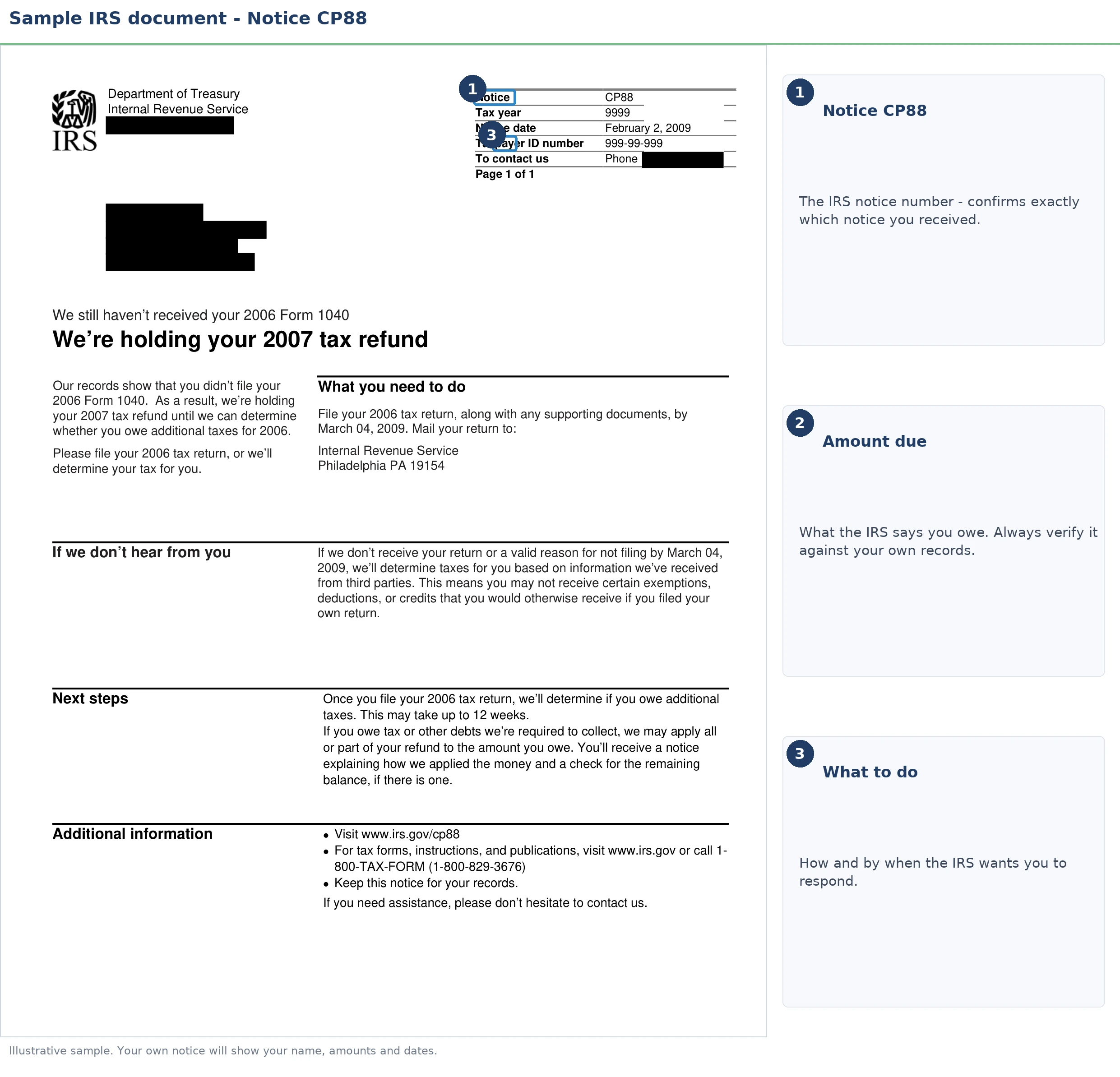
Here's the good news buried in the bad: the IRS isn't taking your money at this stage — it's parking it. What happens to it next is almost entirely up to what you do in the coming weeks. The image below shows exactly what a CP88 looks like and where to find the tax year the IRS says is missing — that one box drives everything else on this page.
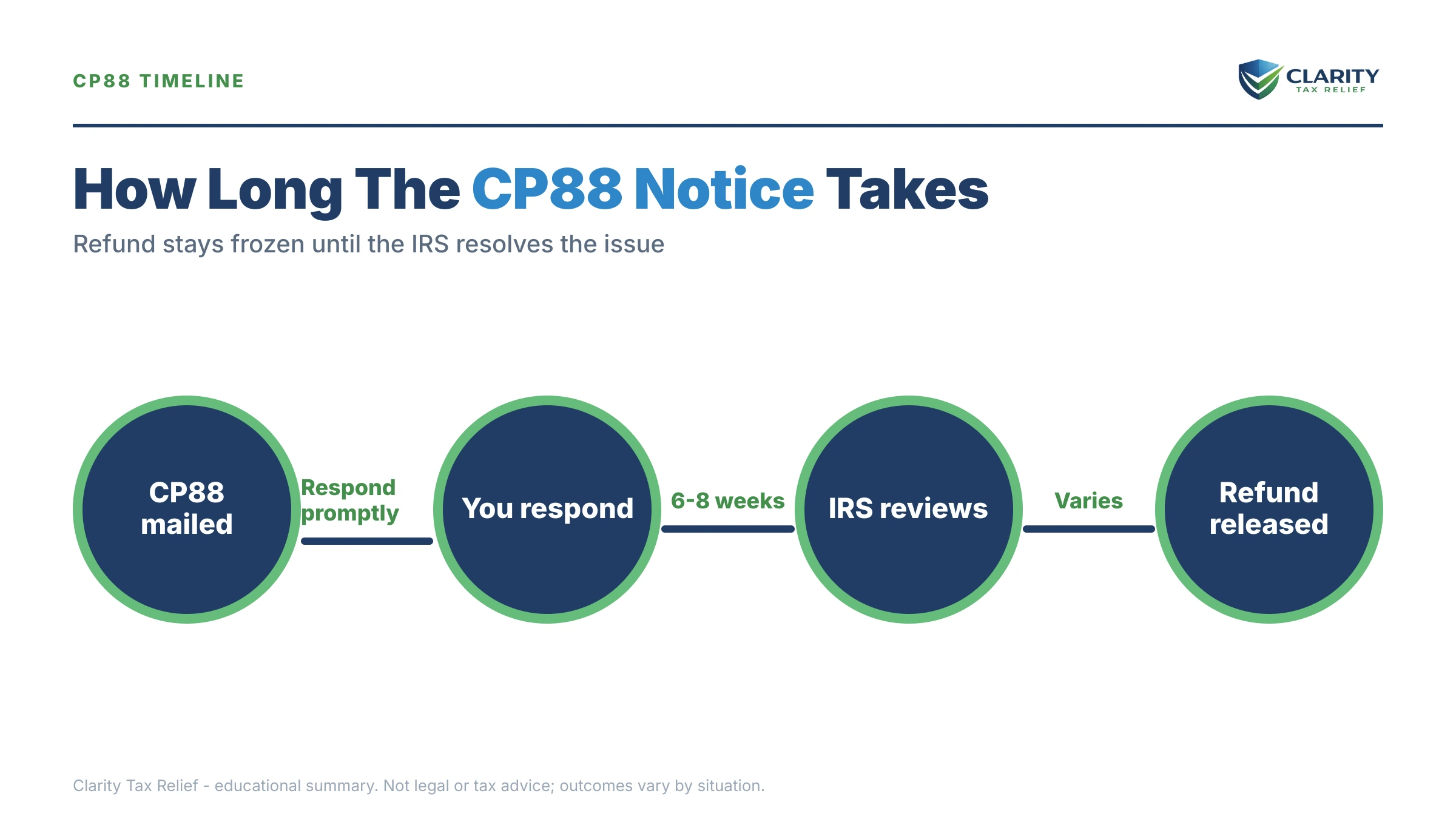
⏱ Your deadline: the response date printed on your CP88 notice. There is no automatic release — your refund stays frozen until the missing-return issue is resolved, and penalties and interest keep accruing monthly on whatever the unfiled year turns out to owe. A separate clock also matters: if the unfiled year would have produced its own refund, you generally have three years from that return's original due date to claim it before it's gone permanently.
Why you got a CP88 notice
A CP88 — the IRS calls it a "Delinquent Return Refund Hold" — is issued when income documents were reported under your Social Security number for a year with no return on file, and the IRS projects that year will owe tax. So instead of paying out this year's refund and then chasing you for the old year, it holds the money as leverage and as a future payment source.
Self-employed taxpayers are the CP88's core audience. Every client who sent you a 1099-NEC or 1099-K created an income record the IRS can see — with zero withholding behind it. The computer sees gross income, no return, no payments, and projects a balance. W-2 employees with heavy withholding rarely trip this; sole proprietors trip it constantly.
Three situations produce most CP88s: you genuinely didn't file that year, you filed but the return was never processed (paper returns go missing more than the IRS likes to admit, especially during the 2025–2026 staffing cuts), or you assumed you didn't need to file because your income felt too small. That last one is a trap for the self-employed — the filing threshold for self-employment income is just $400 of net earnings.
A note on cousins and lookalikes. If you received a CP63 notice earlier, it flagged the same refund hold — a CP88 arriving afterward means the IRS still shows the return as missing and the hold is still active. If your refund is instead held while the IRS reviews the return you just filed, that's a different program entirely: a CP05 notice, or a CP05A notice if they want documents. And if you're not sure where your letter fits in the IRS's alphabet, start with why did I get a letter from the IRS.
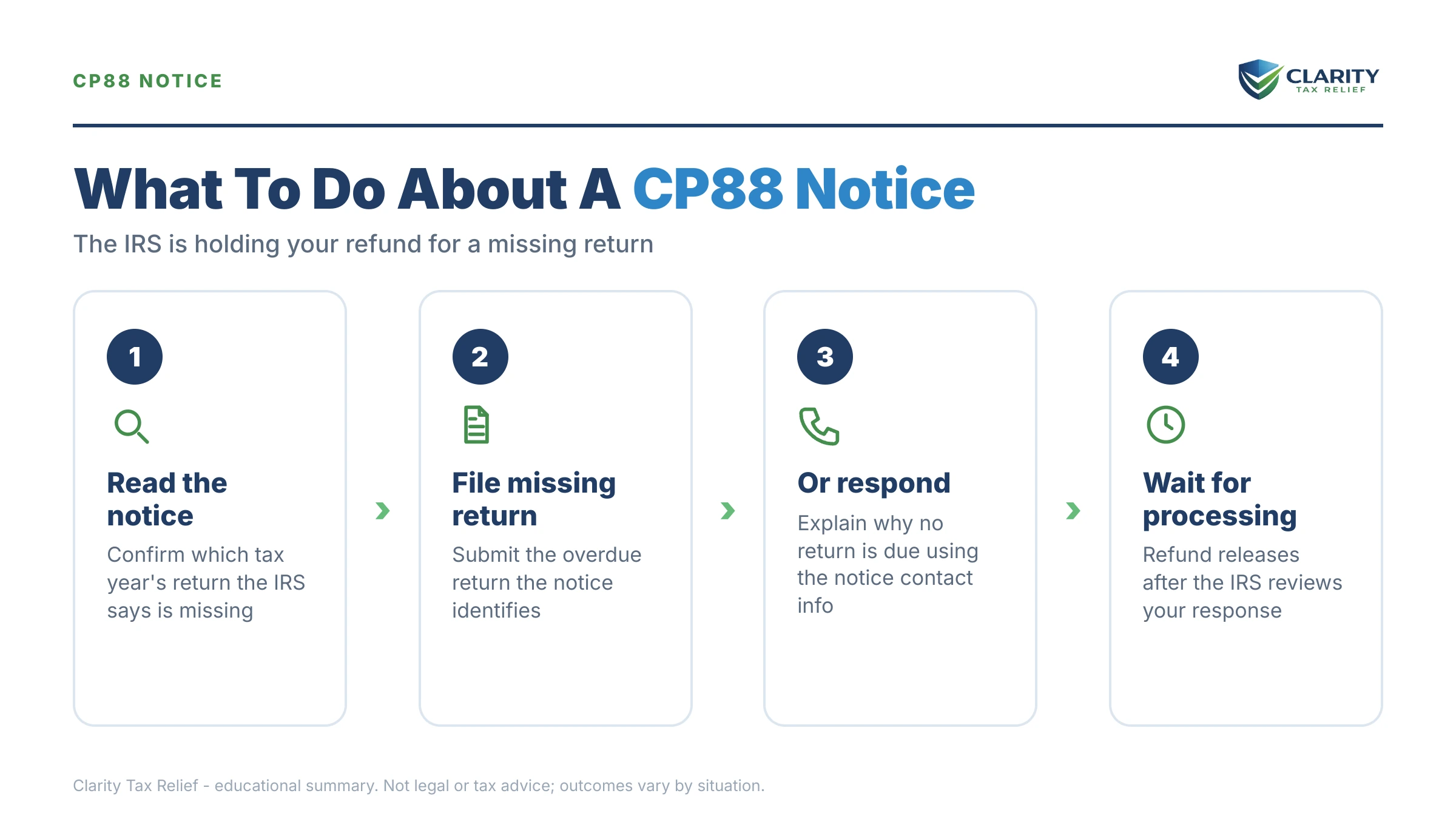
What happens if you ignore a CP88
Ignoring a CP88 ends one way: the IRS prepares the missing return for you — with zero business expenses — and applies your frozen refund to the inflated bill. The sequence is automated and it runs in this order:
- The hold continues. Your refund sits frozen indefinitely. Nothing releases it except resolving the missing return.
- Delinquent-return notices stack up. If you haven't already received them, the return-delinquency series follows — from a CP59 notice up through the final-demand CP518 notice.
- The IRS files a substitute for return (SFR). It builds the return from the 1099s and W-2s on file: gross income, no Schedule C expenses, no credits you'd qualify for, and the least favorable filing status. See what it means when the IRS filed a substitute return for me.
- A CP3219N Notice of Deficiency arrives. The CP3219N gives you 90 days to file your own return or petition Tax Court before the SFR numbers become a legal assessment.
- Assessment and collection. The inflated balance is assessed, your held refund is swallowed by it, and whatever remains enters the normal collection pipeline — bills, then lien and levy notices.
Four different clocks run through that sequence, and they don't all favor the IRS. Here's what each one controls:
| The clock | When it runs | What you lose if it passes |
|---|---|---|
| CP88 response date | Printed on your notice | The easy window — the IRS starts moving toward preparing the return for you |
| Refund statute (RSED) for the unfiled year | Generally 3 years from that return's original due date | Any refund the missing year itself would have paid — forfeited permanently |
| 90-day window after a CP3219N | 90 days from the Notice of Deficiency date | Your right to contest the SFR numbers in Tax Court before assessment |
| 10-year collection statute (CSED) | Starts only once tax is assessed | Nothing — this clock eventually favors you, but an SFR assessment is what starts it |
That second row deserves emphasis. If the "missing" year would actually have refunded you money — common when clients over-reported your 1099 income or you had estimated payments on file — the three-year claim window is a hard wall. The details are in can I still get a refund from 3 years ago, but the short version is: file before it closes or that money belongs to the Treasury forever.
Holding a CP88 with a refund you need?
Send us a photo of your CP88 before the response date on it passes. An experienced tax professional will confirm which year the IRS wants, what that return will actually show, and the fastest route to releasing your refund — free, confidential, no pressure.
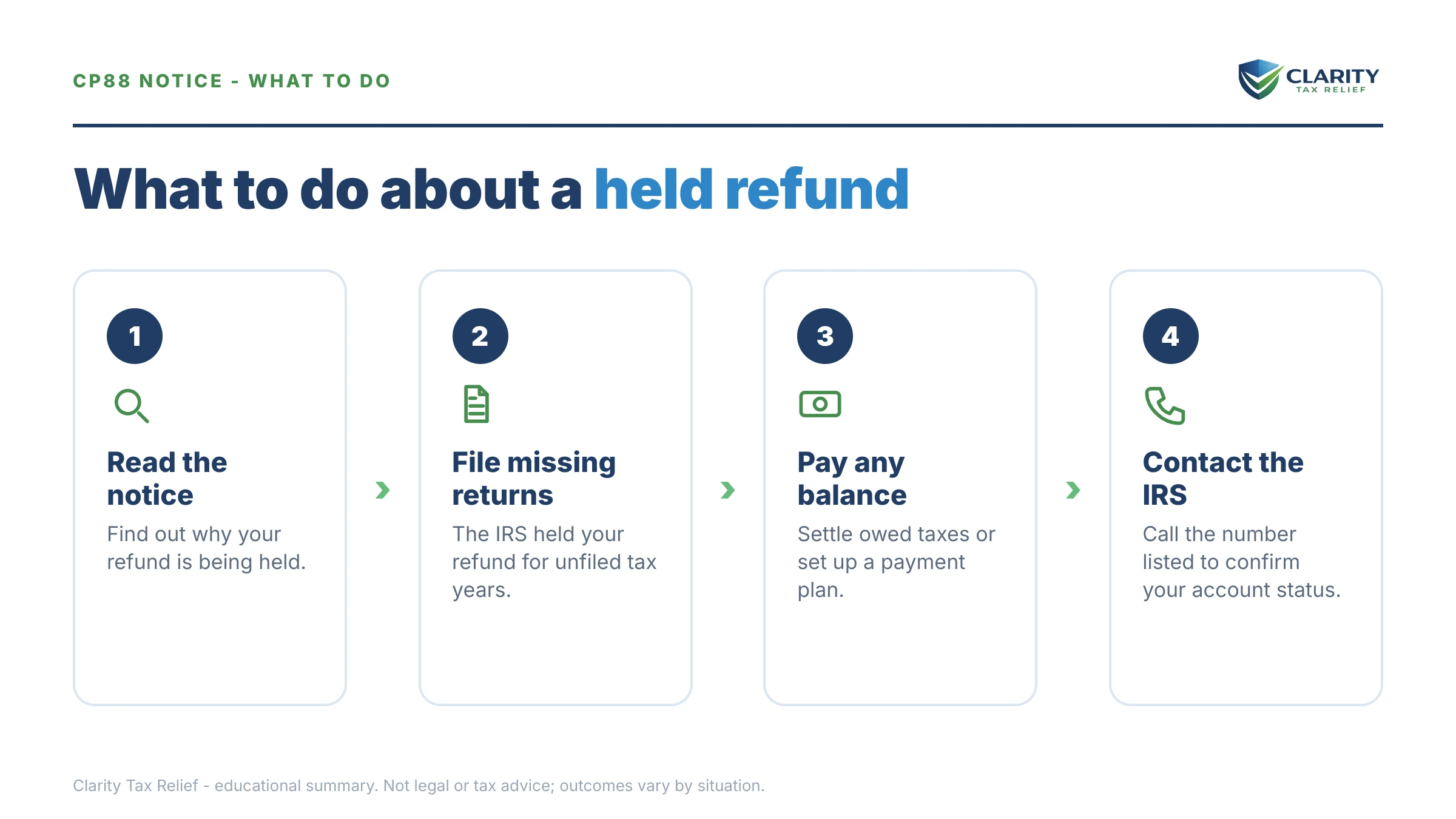
Your options for releasing a CP88 refund hold
Every CP88 resolves through one of four responses: file the missing return, prove you already filed, show you had no filing requirement, or do nothing and let the IRS file for you. Only the first three end with money in your pocket.
| Your situation | What to do | What it costs | When the hold lifts |
|---|---|---|---|
| Return genuinely unfiled | Prepare and file the real return for that year | Prep time or a preparer's fee, plus any balance due — often covered partly or fully by the held refund | After the return finishes processing — mailed prior-year returns can take months, so file early |
| You already filed that year | Send the CP88 response form with a signed copy of the return and proof of filing | Free | After the IRS matches your proof to its records |
| You weren't required to file | Send the response form explaining why (income below the threshold for that year) | Free — but confirm the $400 self-employment threshold first | After the IRS accepts the explanation |
| You do nothing | — | An SFR taxing gross income with no expenses, plus failure-to-file and failure-to-pay penalties and interest | It doesn't — the refund is applied to the inflated balance |
Filing the actual return is the right move in most cases, even when it shows a balance — because your return includes the business expenses, self-employed health insurance, and credits an SFR never will. If you're missing that year's paperwork, you can rebuild it: start with filing back taxes with no records.
If the missing return shows a balance bigger than your held refund, that's a manageable problem, not a crisis. A short-term IRS plan gives you up to 180 days with no setup fee, and balances under $50,000 can go on a monthly agreement of up to 72 months — the walkthrough is in how to set up an IRS payment plan online. Interest and the late-payment penalty continue on either, but enforcement stops.
The math: what a CP88 costs a sole proprietor who waits
The gap between filing your own late return and letting the IRS build one is usually thousands of dollars. Here's a clearly hypothetical example with the arithmetic shown.
Say your $4,800 refund is frozen by a CP88 because you never filed your 2023 return — a year your clients reported $46,000 of 1099-NEC income for your one-person business.
The SFR path (do nothing): the IRS taxes all $46,000 as pure profit. Self-employment tax alone runs about $46,000 × 92.35% × 15.3% ≈ $6,500. Add roughly $3,200 of income tax after the standard deduction, and the projected balance is about $9,700 — before the failure-to-file penalty (5% per month, capped at 25%, so up to ~$2,400 here), the 0.5%-per-month failure-to-pay penalty, and compounding interest. Total exposure pushes past $12,500. Your $4,800 refund is applied and vanishes, and you still owe roughly $7,700 and climbing.
The self-filed path: your real 2023 books show $18,000 of legitimate expenses — mileage, supplies, software, insurance. Net profit drops to $28,000. Self-employment tax falls to about $3,950, income tax to roughly $1,250 — a true balance near $5,200. Even with maxed penalties and interest (very roughly $1,800 more), you're around $7,000. Your held $4,800 covers most of it, leaving roughly $2,200 — a sum a short-term plan handles easily.
Same income, same year: filing yourself saves over $5,500 in this example, purely because only you can put your expenses on the return. You can rough out your own penalty-and-interest exposure with our Penalty & Interest Calculator — it estimates, it doesn't promise. And the penalties themselves may be reducible: if your prior three years were clean, first-time abatement can remove them, and starting summer 2026 the IRS's new Automatic Exemption from Penalty applies some relief without any request at all. See failure-to-file vs. failure-to-pay penalties for how the two charges stack.
How to respond to a CP88, step by step
- Confirm the missing year. Read the tax-year box on your CP88 and log into your IRS online account to verify which return the IRS shows as unfiled — CP88s occasionally follow returns that were filed but never processed.
- Pull your income records. Request a wage and income transcript for the missing year from IRS.gov — it lists every W-2 and 1099 reported under your Social Security number, so your return matches what the IRS already has.
- Prepare and file the real return. Include every legitimate business expense on your Schedule C; prior-year returns generally must be mailed, so send yours to the address on your notice with proof of mailing.
- Or send the response form with proof. If you already filed or had no filing requirement, complete the response section of the CP88 and attach documentation instead of a new return.
- Track the hold until it releases. Watch your IRS online account for the missing return to post; the refund is then released or applied to that year's balance, and anything left over is sent to you.
When you can handle a CP88 yourself
You can usually resolve a CP88 on your own when one year is missing, you have (or can reconstruct) that year's records, and you agree a return was due. Filing one late Schedule C return and mailing it with the notice stub is squarely a DIY job — so is sending proof if you already filed. There's no fee to respond and no trick to it.
Experienced help changes the outcome in a few specific situations: multiple unfiled years (the order and lookback matter — see haven't filed taxes in 3 years), an SFR that's already been assessed and needs to be replaced with a correct return, a missing year with major reconstruction problems (cash income, lost 1099s, a closed bank account), or a projected balance far beyond what the held refund covers. In those cases, the sequencing — file the returns, then attack penalties, then structure payment on what remains — often determines what you actually end up paying.
Terms on your CP88, decoded
- Delinquent return — a required tax return that was never filed by its due date; the reason your refund is being held.
- Refund hold — the IRS freezing your current-year overpayment as leverage and as a payment source for a projected prior-year debt.
- Substitute for return (SFR) — a return the IRS prepares for you using only reported income, with no business expenses and no favorable elections.
- Notice of Deficiency — the formal 90-day letter (CP3219N for non-filers) that must be issued before SFR numbers become a legal assessment.
- RSED (Refund Statute Expiration Date) — the deadline, generally three years from a return's original due date, after which that year's refund can no longer be claimed.
- Wage and income transcript — the IRS's record of every W-2 and 1099 filed under your SSN for a year; the blueprint for rebuilding a late return.
The IRS's own summary of this notice is at Understanding your CP88 notice, and you can pull the transcripts mentioned above at IRS Get Transcript.
CP88 questions, answered
Why is the IRS holding my refund with a CP88 notice?
A CP88 means the IRS records show at least one prior-year tax return you never filed, and its computers project that the missing return will show a balance due. Rather than pay out your current refund and then chase you for the older year, the IRS freezes the refund until the missing return is filed or you prove you had no filing requirement. Self-employed taxpayers see CP88s often because 1099s create income records with no withholding behind them.
How long will the IRS hold my refund after a CP88?
There is no fixed release date — the hold lasts until the IRS resolves the missing-return issue. If you file the delinquent return, the refund is released (or applied to any balance) after that return finishes processing, which for a mailed prior-year return can take several months. Checking your IRS online account is the fastest way to see when the return posts.
Will I get my refund back if I file the missing return?
Usually, yes — minus anything you owe. Once the missing return processes, the IRS applies your held refund to any balance due on that year, including penalties and interest, and sends you whatever is left. If the missing return shows no balance, or even its own refund, you can receive both — but an old year's refund must be claimed within roughly three years of that return's original due date.
What if I already filed the return the CP88 says is missing?
Respond with proof instead of filing again. Send the response section of the CP88 with a signed copy of the return you filed, plus any proof of mailing or e-file acceptance you kept. Duplicate filings can create processing tangles that hold your refund even longer, so documentation beats refiling in almost every case.
What if I wasn't required to file that year?
Complete the response form attached to the notice and explain why — for example, your gross income was below the filing threshold for that year. Be careful if you were self-employed: the self-employment filing threshold is only $400 of net earnings, far below the regular threshold, so many sole proprietors who assume they didn't need to file actually did.
Is a CP88 the same as a CP63 notice?
They are close cousins — both tell you the IRS is holding your refund because of unfiled prior-year returns it believes will show tax due. Getting a CP88 after a CP63 generally means the IRS still shows the return as missing and the hold remains active. The fix is identical for both: file the missing return or document why you didn't need to.
What happens if I ignore a CP88 notice?
The refund stays frozen, and the IRS eventually prepares a substitute for return (SFR) using only the income reported to it — no business expenses, no deductions beyond the basics, and the least favorable filing status. That inflated balance is then assessed after a 90-day Notice of Deficiency window, your held refund is applied to it, and the remainder enters the normal collection pipeline.
Your next 24 hours
- Find two boxes on your CP88: the tax year the IRS says is missing, and the response date. Those two facts define your entire to-do list.
- Gather that year's income picture: any 1099s or W-2s you kept, bank statements showing deposits and expenses, and last year's return — or plan to pull the wage and income transcript so your numbers match the IRS's. If you end up owing, payment options live at IRS.gov/payments.
- Get a free case review before your response date passes. Use the 2-minute form or call (888) 825-7779 — an experienced tax professional will map the missing year, the hold, and the fastest release path in one conversation.
This guide is general information, not tax or legal advice for your specific situation. Eligibility for IRS programs depends on individual facts and circumstances; no outcome is guaranteed.