
IRS Notices
IRS CP27 Notice: You May Qualify for the Earned Income Credit (2026)
The short answer: a CP27 notice means the IRS believes you may qualify for the Earned Income Tax Credit — without a qualifying child — but didn't claim it on your return. It is not a bill or an audit. Verify you're eligible, complete the attached Form 15112 worksheet, and mail it back to claim the refund.
You braced for a bill when you saw the IRS return address — most 1099 workers do. Instead, this letter says the government may owe you, and that's exactly why so many CP27s end up in the junk drawer: it reads too good to be true. It isn't. The CP27 is a real IRS notice with real money behind it — but only if you respond correctly.
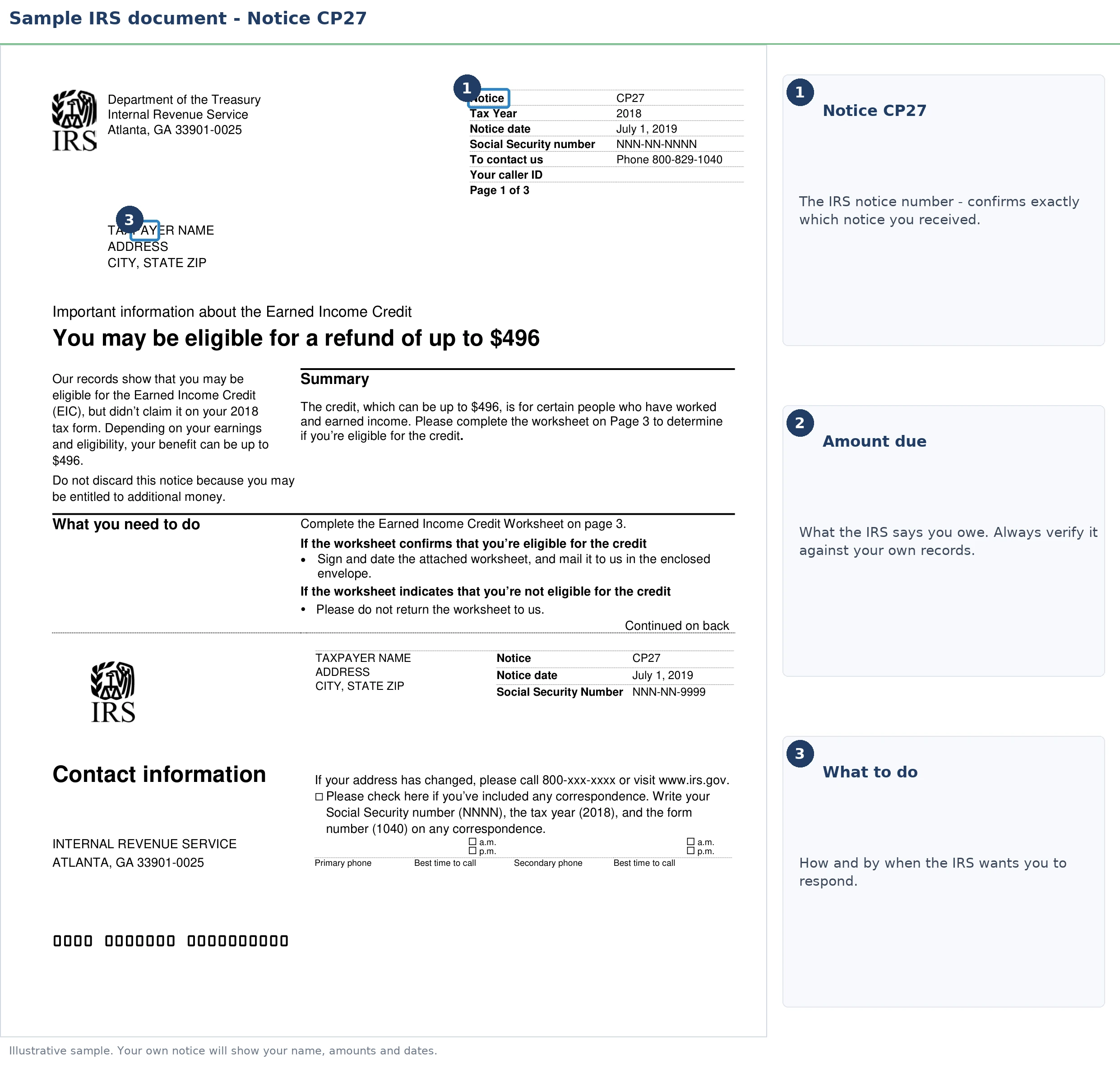
Two things make a CP27 different from almost every other IRS letter: it comes with its own claim form (Form 15112) stapled inside, and ignoring it costs you money instead of triggering collections. The image below shows exactly what a real CP27 looks like and where to look for the parts that matter, so you can confirm yours is genuine before you fill anything out.
⏱ Your real clock: a CP27 has no enforcement deadline — nothing bad happens if you don't respond. But refunds expire. You generally have 3 years from your return's original due date to claim money the IRS owes you. Once that window closes, the credit is gone permanently — no extensions, no exceptions for good excuses.
Why you got a CP27 notice
A CP27 notice means the IRS matched the income on your return against the Earned Income Tax Credit tables and found you may qualify — with no qualifying child — for a credit you never claimed. The IRS screens millions of processed returns for exactly this, and mails CP27s to filers whose income lands in the eligible range.
For a 1099 contractor, the trigger is usually your net Schedule C profit. Your gross receipts might look healthy, but after mileage, supplies, and platform fees, the profit line can drop below the EITC ceiling — and the IRS's computers notice even when you don't.
Here's the critical nuance: the IRS screens on what its computers can see, but it can't verify every eligibility rule on its own. That's why the notice asks you to confirm eligibility on the worksheet instead of just sending a check. A CP27 is an invitation to claim money — not a determination that you qualify.
If you're trying to make sense of IRS mail in general, our decoder on why did I get a letter from the IRS covers the whole system. This page covers only the CP27 — and everything you need to answer it is right here.
What happens if you ignore a CP27
Nothing the IRS does gets worse if you ignore a CP27 — but the refund it points to quietly expires, generally 3 years after your return's original due date. The sequence looks nothing like a collection-notice escalation. It's an erosion:
- Silence. The IRS usually does not send a second request. There's no CP27 follow-up chain the way balance-due notices escalate — this was likely your one prompt.
- The refund statute keeps running. Every month you wait is a month off the roughly 3-year window to claim the money. If the notice sat unopened for a while, part of the clock is already spent.
- The window closes. Once the refund statute expiration date passes, the credit becomes legally unclaimable. The money stays with the Treasury forever — the same hard wall we cover in can I still get a refund from 3 years ago.
- If you owe on other years, you lose twice. An unclaimed credit could have been applied against a balance that's growing with interest. Skipping the worksheet means paying that debt with money the IRS was offering back to you.
One more thing a CP27 will never do: turn into an audit because you ignored it. Declining to claim a credit is always allowed. The only penalty is self-inflicted — the refund never arrives.
Holding a CP27 and not sure whether to sign it?
Send us a photo of your CP27 and last year's return. An experienced tax professional will check whether you truly qualify, whether an amended return would pay you more, and whether back taxes would swallow the refund — free, confidential, no pressure.
Do you actually qualify? The EITC without a qualifying child
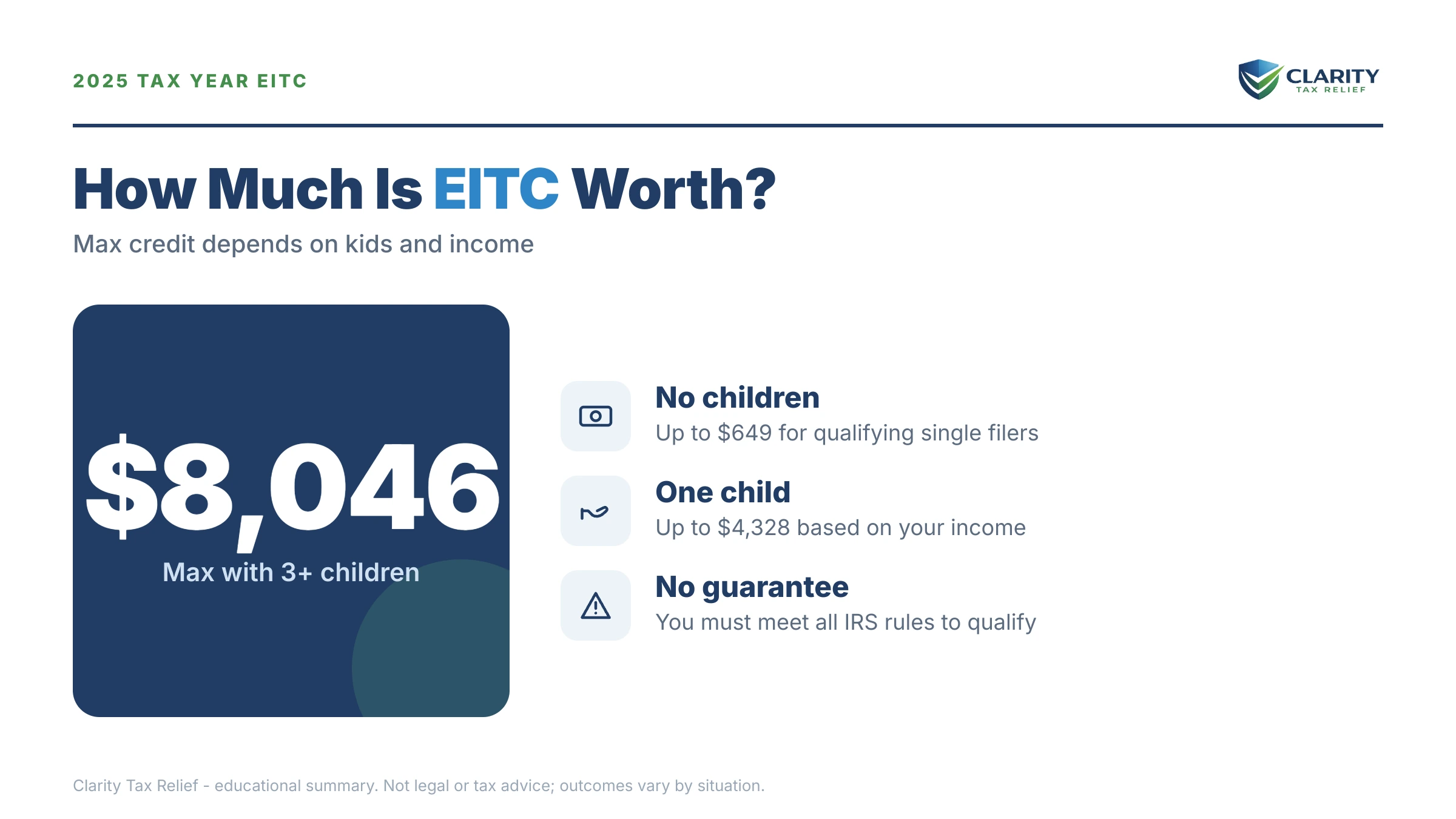
The EITC without a qualifying child is the strictest version of the credit: income limits sit around $19,000 for single filers in recent years (higher for joint filers), and an age window of 25 through 64 knocks out younger and older workers entirely. Before you sign Form 15112, walk every line of this table:
| Requirement | What it means | What disqualifies you |
|---|---|---|
| Earned income under the limit | Wages plus net self-employment profit below the year's ceiling (roughly $19,000 single in recent years; more if married filing jointly) | Income over the limit — including AGI over the limit even if earned income is under it |
| Age 25–64 at year end | For the no-child EITC, you (or your spouse on a joint return) must be at least 25 and under 65 | Being 24 or younger, or 65 and older, with no spouse in the window |
| Valid Social Security number | An SSN valid for employment, issued by the return's due date, for you (and your spouse if joint) | Filing with an ITIN |
| Not someone's dependent | No one else can claim you as a dependent or as their qualifying child | A parent or relative claiming you on their return |
| Investment income under the cap | Interest, dividends, and capital gains must stay under the annual limit (a little over $11,000 in recent years) | A big brokerage or crypto gain year, even with low earned income |
| Eligible filing status | Any status except married filing separately — unless you lived apart from your spouse the last 6 months of the year or are legally separated | MFS filers who lived with their spouse in the second half of the year |
| U.S. home & income rules | Main home in the U.S. more than half the year; no foreign earned income exclusion (Form 2555) | Living abroad most of the year or excluding foreign income |
Notice what the IRS can't fully see when it mails a CP27: whether someone else claims you as a dependent, where you lived during the year, and whether your Schedule C numbers were accurate in the first place. If any row above disqualifies you, don't sign the worksheet — signing an eligibility form you know is wrong creates a problem far bigger than a missed credit.
A CP27 worked example: 1099 contractor, $54,600 in gross receipts
Say you're a single 34-year-old contractor whose 1099-NECs total $54,600 in gross receipts. That sounds far too high for the EITC — until Schedule C does its work. This is a hypothetical, but the mechanics are exactly how the IRS runs the math:
- Gross receipts: $54,600
- Business expenses (mileage, phone, supplies, platform fees): $38,400
- Schedule C net profit: $54,600 − $38,400 = $16,200
- Earned income for EITC purposes (net earnings from self-employment): $16,200 × 0.9235 ≈ $14,961
For the EITC, you're a $14,961 earner — not a $54,600 one. Using recent-year figures for a single filer with no qualifying child (the exact numbers adjust for inflation annually), the credit tops out around $650 and phases out at 7.65 cents per dollar of income above roughly $10,600. So: $650 − [0.0765 × ($14,961 − $10,600)] ≈ $650 − $334 ≈ a credit of roughly $300. Form 15112 and the IRS compute the precise amount for your year — you don't have to.
Now the contractor-specific wrinkle. If you never paid the self-employment tax on that $16,200 profit — a common first-year miss we break down in self employment tax owe irs — the CP27 credit doesn't arrive as a check. It's applied against your balance first, shrinking both the debt and the interest compounding on it. Still worth claiming, just don't plan around the deposit.
And the flip side: if you had skipped your expenses and reported the full $54,600 as profit, no CP27 would ever have arrived — you'd be miles above the limit. Accurate expenses are what put you in range. But the line runs both ways: you can't omit real expenses to boost the credit, and Schedule C numbers bent to hit the EITC sweet spot are a classic exam trigger.
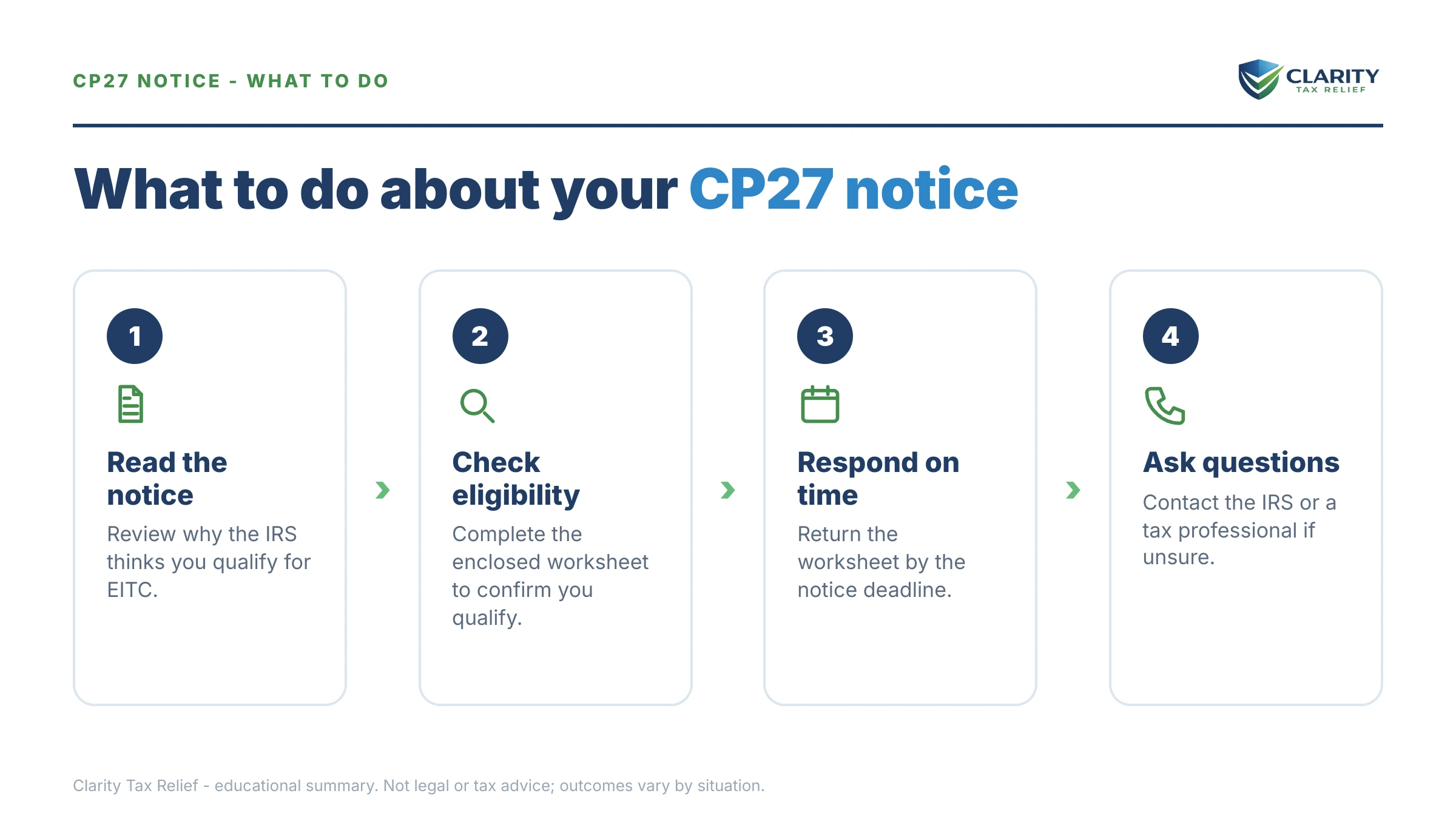
How to respond to a CP27 notice, step by step
- Match the notice to your return. Confirm the tax year and name on the CP27 match a return you actually filed, and check your IRS online account to make sure a refund hasn't already been issued for that year.
- Check every eligibility requirement. Go line by line through the rules for the EITC without a qualifying child — age, dependency, Social Security number, investment income, filing status — before you sign anything. If any line disqualifies you, do not return the worksheet.
- Complete Form 15112. Fill out the Earned Income Credit worksheet attached to your notice, answer every question honestly, and sign and date it — both spouses must sign on a joint return.
- Mail it back and keep a copy. Send the completed worksheet in the envelope provided or to the address printed on your notice, and keep a photocopy or a photo as proof you responded.
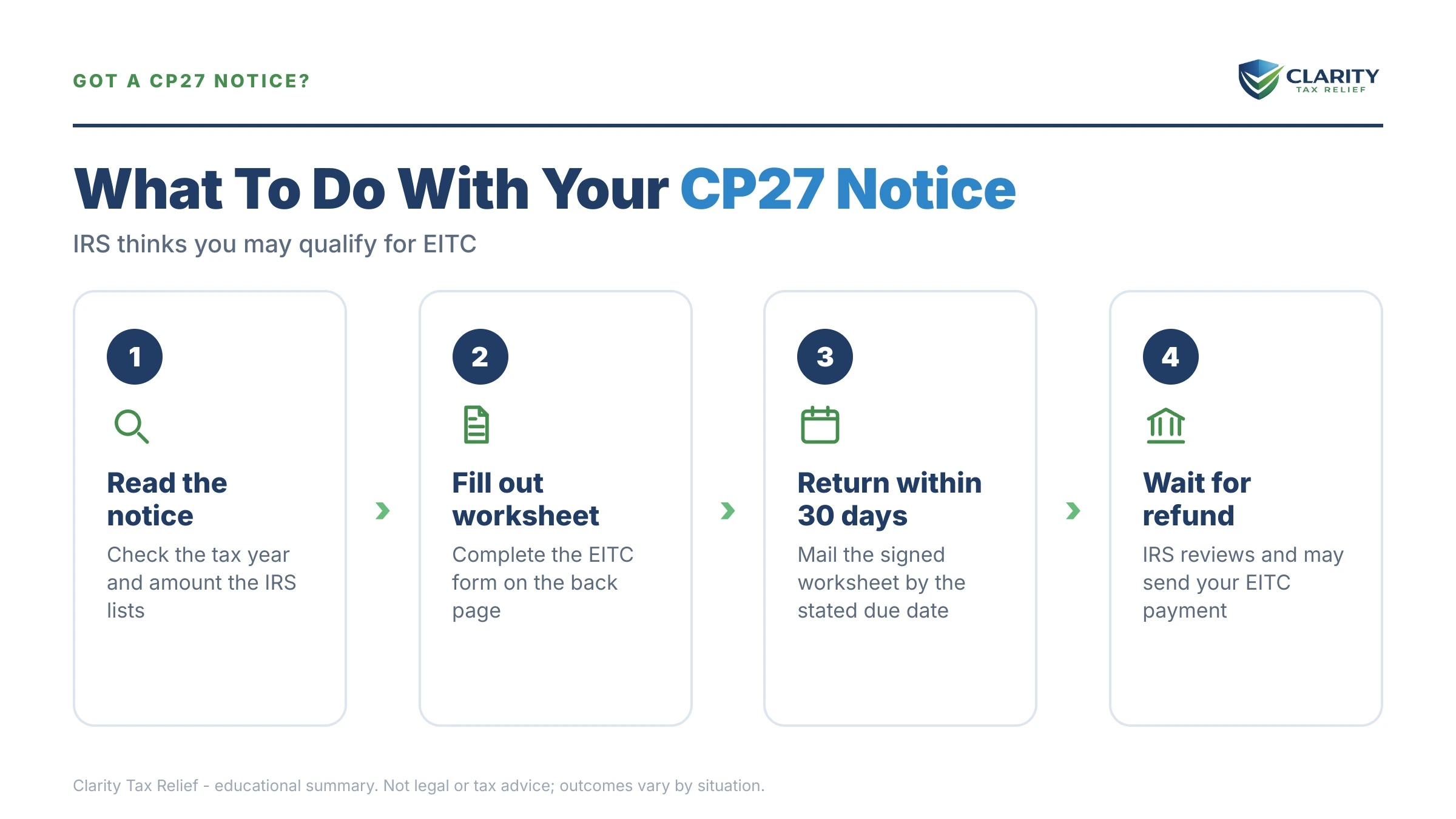
- Track the response. Give the IRS typically 6 to 8 weeks to process the worksheet, and watch your IRS online account for the credit posting or a refund date.
- Follow up if nothing arrives. If more than eight weeks pass with no refund and no letter, call the number printed on the CP27 — or contact the Taxpayer Advocate Service if the delay is causing you financial hardship.
What happens after you mail Form 15112
The IRS typically processes a returned CP27 worksheet in about 6 to 8 weeks — and with the IRS workforce down roughly 27% after the 2025 cuts, the slow end of that range is the realistic one in 2026. Here's the sequence:
| Stage | Typical timing | What happens |
|---|---|---|
| You mail Form 15112 | Day 0 | The worksheet joins the IRS paper queue; keep your copy and mailing proof |
| IRS reviews the worksheet | Typically 6–8 weeks | Eligible → credit posts to your account and a refund is scheduled; not eligible → the IRS sends a letter explaining why |
| Offset screening | Before any refund is paid | The refund is applied first to federal tax debts, then checked against state tax, child support, and other debts |
| Refund arrives — or doesn't | After processing | Direct deposit or paper check; if 8+ weeks pass with nothing, call the number on the notice or check your online account |
That offset row deserves emphasis. If you owe federal back taxes, child support, or certain other government debts, the refund can be intercepted before it ever reaches your bank — the mechanics are covered in our guide to the Treasury Offset Program tax refund rules. An offset is not a rejection: the credit was allowed; it just went to a debt instead of your account, and you'll get a notice saying where it went.
CP27 vs. CP09 and the other EITC notices
The CP27 is one of a family of IRS credit-and-refund letters, and each demands a different response — mixing them up is the most common CP27 mistake we see. Here's the map:
| Notice | What it says | What to send back |
|---|---|---|
| CP27 | You may qualify for the EITC with no qualifying child | Form 15112 worksheet |
| CP09 | You may qualify for the EITC with qualifying children | Form 15111 worksheet |
| CP08 | You may qualify for the Additional Child Tax Credit | The worksheet enclosed with the notice |
| CP75 | Your claimed EIC is being audited — prove eligibility | The documents the notice requests, by its deadline |
| CP79 | Your EITC was disallowed for a prior year | Form 8862 with your next return before claiming again |
The one that trips people up most: if your CP27 says "no qualifying child" but you actually have one — a child who lived with you more than half the year and meets the relationship and age tests — don't use Form 15112. Amend the return instead. The EITC with even one qualifying child is worth several times the no-child credit, and the worksheet path locks you into the smaller number. And if the IRS changed your return and adjusted your refund rather than inviting a claim, you're looking at a different letter entirely — see our CP12 notice guide for that one.
When you can handle a CP27 yourself
Most people can handle a CP27 alone: the worksheet takes about ten minutes, costs nothing, and carries no downside if you honestly qualify. If your return was accurate, you clear every eligibility line, and you owe the IRS nothing, fill out Form 15112 tonight and mail it — you don't need anyone's help, including ours.
Experienced help changes the outcome in four specific situations:
- You have a qualifying child the IRS missed. An amended return claiming the with-child EITC pays far more than the worksheet — but it has to be built correctly.
- You have unfiled years or back taxes. The order you fix things in determines whether this credit shrinks your debt efficiently or vanishes into a mess of offsets.
- Your Schedule C was wrong. If income or expenses were misreported, signing an eligibility worksheet on top of a flawed return compounds the problem. Fix the return first.
- Your EITC was disallowed before. Prior disallowance adds the Form 8862 requirement and extra scrutiny — worth getting right the first time.
Terms on your CP27, decoded
- Earned Income Tax Credit (EITC): a refundable credit for lower-income workers — "refundable" means it can pay you even if you owe no tax.
- Form 15112: the Earned Income Credit worksheet attached to a CP27; signing and returning it is how you claim the credit for that year.
- Qualifying child: a child meeting the IRS's relationship, age, and residency tests; having one moves you from the CP27 (Form 15112) path to the CP09 (Form 15111) path — and to a much larger credit.
- Earned income: wages plus net self-employment profit — for 1099 workers, the Schedule C bottom line, not gross receipts.
- Refund statute expiration date (RSED): the deadline — generally 3 years from the return's due date — after which an unclaimed refund is permanently forfeited.
- Treasury Offset Program: the government-wide system that intercepts refunds to pay federal tax debts, state taxes, child support, and certain other obligations before you're paid.
CP27 notice questions, answered
Is a CP27 notice good or bad news?
Good news, with a catch. A CP27 means the IRS thinks you may be owed money through the Earned Income Tax Credit — it is not a bill, an audit, or a penalty. The catch is that the IRS can't verify every eligibility rule on its own, so you must confirm you actually qualify before signing and returning the worksheet.
What is Form 15112 and where do I send it?
Form 15112 is the Earned Income Credit worksheet that comes attached to your CP27 notice. You answer a short series of eligibility questions, sign it (both spouses sign on a joint return), and mail it back using the envelope provided or the address printed on the notice. Keep a copy — it's your proof you responded.
How long after returning Form 15112 will I get my refund?
The IRS typically processes CP27 worksheets in about 6 to 8 weeks, though 2026 staffing cuts can stretch that. If you qualify, the refund comes by check or direct deposit; if you don't, the IRS sends a letter explaining why. If eight weeks pass with nothing, check your IRS online account or call the number printed on the notice.
What happens if I ignore a CP27 notice?
Nothing bad happens — no penalties, no collections, no enforcement. But the refund doesn't come to you automatically, and it expires: you generally have 3 years from your return's original due date to claim it. After that, the money stays with the Treasury permanently, with no exception for a good excuse.
What is the difference between a CP27 and a CP09?
Both say you may have missed the Earned Income Tax Credit — the difference is children. A CP09 goes to filers the IRS believes have qualifying children and uses Form 15111; a CP27 goes to filers without qualifying children and uses Form 15112. If you got a CP27 but actually have a qualifying child, don't use the worksheet — amend your return instead, because the credit with a child is worth far more.
Will the IRS keep my CP27 refund if I owe back taxes?
Yes — any refund the credit creates is applied to federal tax debts first, and it can also be offset for state taxes, child support, and certain other debts through the Treasury Offset Program. Responding is still worth it: the credit shrinks what you owe dollar for dollar, which reduces the interest building on your balance.
Can I get the EITC on 1099 self-employment income?
Yes. Net self-employment profit counts as earned income for the EITC — it's your Schedule C profit, not your gross 1099 receipts, that drives the math. That cuts both ways: legitimate expenses can bring your income into the eligible range, but you may not skip real expenses to inflate the credit, and manipulating Schedule C numbers to hit the EITC sweet spot is a well-known audit trigger.
Is the CP27 notice a scam?
A real CP27 arrives only by postal mail and never asks for a fee, gift cards, or bank login details to release your refund. Verify it yourself: log into your account at IRS.gov and compare your letter to the IRS's own CP27 page. Anyone who calls, texts, or emails demanding payment to process an EITC refund is a criminal, not the IRS.
Your next 24 hours
- Find two things on the notice: the tax year in the upper corner, and the Form 15112 worksheet attached behind the letter. Confirm the year matches a return you filed — then compare it against the official IRS page, Understanding your CP27 notice, to verify it's real.
- Gather three documents: your tax return for that year (including Schedule C if you're a 1099 worker), your 1099s, and your Social Security card or a record of your SSN. That's everything the worksheet asks about — the full eligibility rules live on the IRS's Earned Income Tax Credit page.
- Get a second set of eyes before you sign. If anything above gave you pause — a possible qualifying child, back taxes, a shaky Schedule C — get a free review at the 2-minute form or call (888) 825-7779. The refund window only runs one way, and it's already running. If the IRS later stalls on a worksheet you've submitted and the delay causes hardship, the Taxpayer Advocate Service can intervene for free.
This guide is general information, not tax or legal advice for your specific situation. Eligibility for IRS programs depends on individual facts and circumstances; no outcome is guaranteed.