
IRS Notices
IRS CP12 Notice: What It Means and Your 60-Day Dispute Window (2026)
The short answer: a CP12 notice means the IRS found a math or clerical error on your return, corrected it, and changed your refund amount. If you agree, do nothing — the refund typically arrives in 4–6 weeks. If you disagree, you have 60 days from the notice date to ask the IRS to reverse the change.
You filed with one refund number in your head, and now the IRS is telling you that number was wrong — maybe higher, maybe lower, either way not what you signed. It's unsettling to learn a computer rewrote your return without asking. The good news: a CP12 comes with a built-in right to push back, and this page maps exactly how to use it.
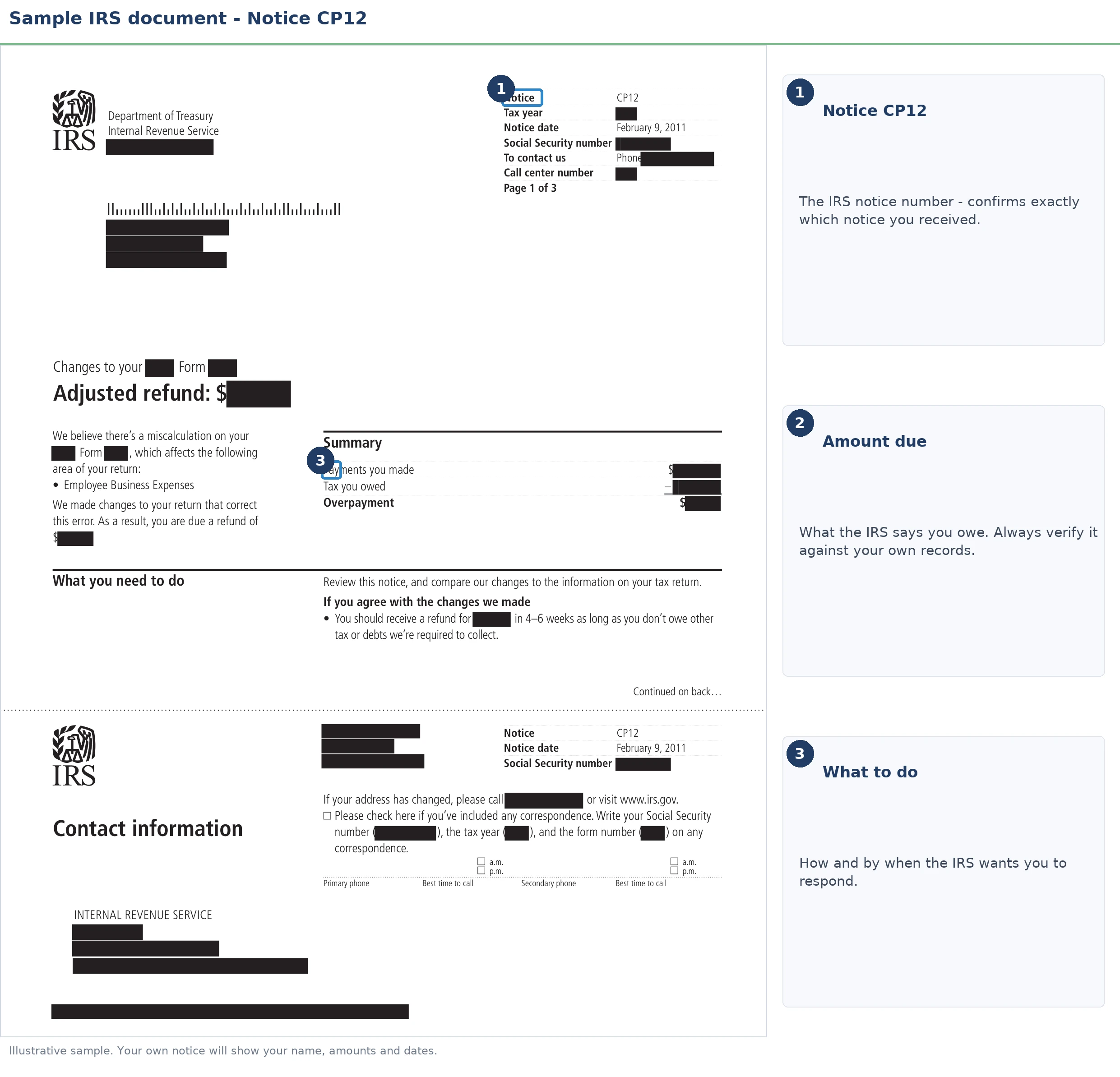
The image below shows exactly what a CP12 looks like and where to find the two things that matter most — the adjusted refund figure and the notice date that starts your 60-day clock.
⏱ Your deadline: you have 60 days from the date printed on your CP12 to dispute the change. Respond inside that window and the IRS must reverse the adjustment while it reviews your position — and your right to challenge the change in Tax Court before paying is preserved. Let it pass, and the correction becomes final.
Why you got a CP12 notice
A CP12 notice is issued when the IRS corrects a math or clerical error on your return and the correction changes your refund — up or down. Unlike most IRS mail, nobody selected your return for anything: an automated system recalculated a line while processing it, using what the IRS calls "math error authority" under Internal Revenue Code §6213(b). That authority lets the IRS fix arithmetic and clerical mistakes summarily — no audit, no examiner, no request for documents. (For how this notice fits into IRS mail generally, see why did I get a letter from the IRS; the whole automated family is covered in our guide to IRS math error notices.)
The corrections that most often trigger a CP12 in 2026:
- Credit computations — the Earned Income Tax Credit or Child Tax Credit figured on the wrong income line, or with the wrong number of qualifying children.
- Missing or mismatched Social Security numbers — a dependent's SSN that doesn't match Social Security records forces a credit recalculation.
- Standard deduction errors — a deduction amount that doesn't match your filing status or age.
- Arithmetic carried down the return — one wrong subtraction on page one that changed every line below it, including your refund.
- Self-employment math — the one-half SE tax deduction or SE tax itself computed incorrectly, common on gig and 1099 returns.
One thing worth locking in early: a CP12 is not an audit and not an accusation. Nobody is reviewing your deductions or questioning your honesty. If your refund is being held for a genuine review, that arrives as a different letter — see our CP05 notice guide for that scenario.
CP11 vs. CP12 vs. CP13 vs. CP16: which one are you holding?
The math-error family has four members, and the notice number tells you which direction the money moved:
| Notice | What the correction did | What it means for your wallet |
|---|---|---|
| CP11 | Created or increased a balance due | You owe money — a bill with a pay-by date |
| CP12 | Created or changed an overpayment | Your refund amount changed — up or down |
| CP13 | Changed the return, net result zero | No refund, no balance — but the return on file changed |
| CP16 | Changed your refund AND applied it to other tax you owe | The corrected refund went to a debt, not to you |
All four carry the same 60-day dispute right. If your letter says you owe rather than that your refund changed, you're in the wrong article — our CP11 notice guide covers the balance-due version. And if the IRS is telling you about a credit you didn't claim but may qualify for, that's a CP09 notice — an invitation, not a correction.
What happens if you ignore a CP12
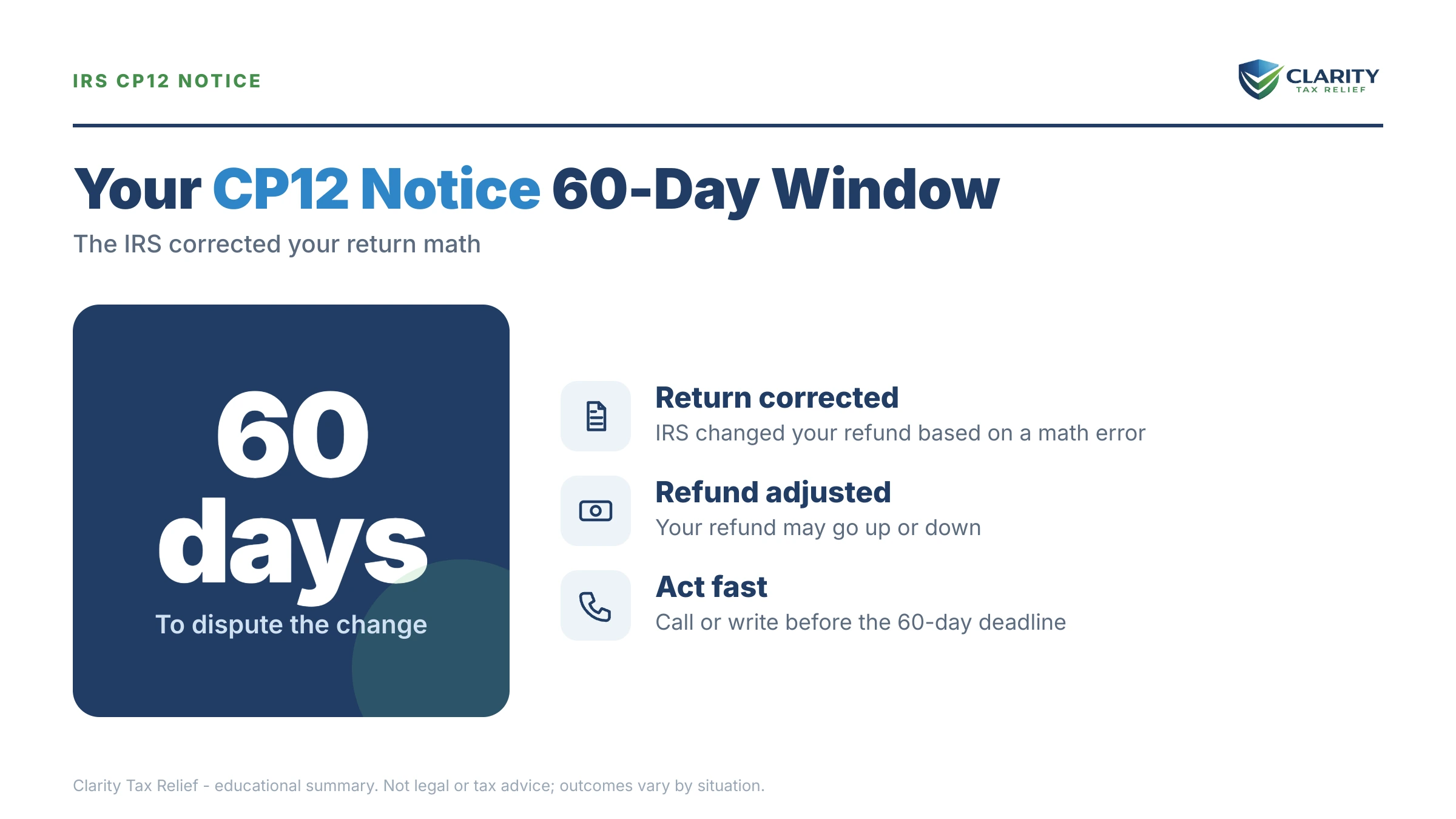
Ignoring a CP12 costs you nothing if the IRS is right — and can cost you the entire disputed amount if it's wrong. "Do nothing" is a legitimate response here, but it should be a decision, not a default. Here's the sequence either way:
- Day 0 — the notice date. Your 60-day dispute clock starts, whether or not you've opened the envelope. The clock runs from the printed date, not from receipt.
- Weeks 4–6 — the refund moves. If you take no action and owe no other debts, the adjusted refund is typically issued. If you owe other tax years or offset-eligible debts, it's applied to those instead — no check, just a follow-up notice.
- Day 60 — the dispute window closes. The adjustment becomes final. The IRS no longer has to reverse it on request, and the pre-payment path to Tax Court disappears with it.
- After day 60 — recourse narrows. Correcting a genuine IRS error now means an amended return or refund claim, filed within the refund-claim statute and often taking months to process.
There's a quieter risk running the other direction. If the CP12 increased your refund and the IRS's correction was itself a mistake, the agency can later reverse course and bill you for money you've already spent — with interest attached. Verifying the notice now protects you in both directions. That's especially true in 2026: with the IRS workforce down roughly 27%, getting a human to unwind a bad adjustment after the fact takes far longer than disputing it inside the window.
Holding a CP12 you're not sure about?
Send us a photo of the notice and the return you filed. An experienced tax professional will tell you whether the IRS's correction is actually right — and, if it isn't, get your dispute in before the 60-day window closes. Free, confidential, no pressure.
Your options after a CP12: agree, dispute, or trace the money
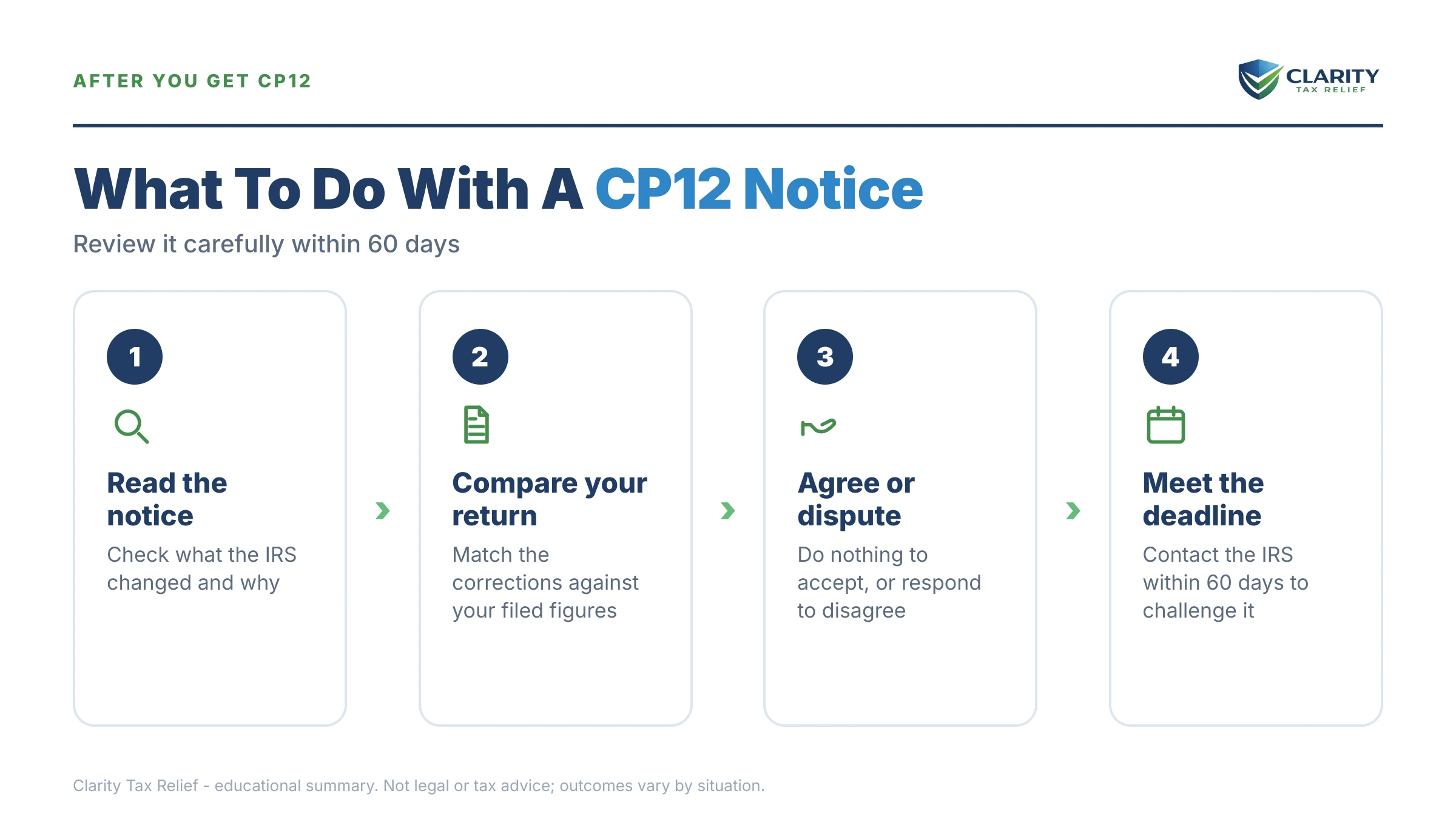
Every CP12 resolves through one of five paths, and which one you take depends on whether the IRS's math checks out — and whether the refund actually shows up. If you agree, the adjusted refund typically arrives within 4–6 weeks of the notice date.
| Your situation | Your move | Your window |
|---|---|---|
| The IRS's correction is right | Do nothing; keep the CP12 with your tax records | Refund typically arrives in 4–6 weeks |
| The correction is wrong | Call the number on the notice or dispute in writing; request reversal | 60 days from the notice date |
| Partly right, partly wrong | Dispute only the line you contest, with documentation for your figure | 60 days from the notice date |
| You agreed, but no refund came | Check your IRS online account and transcript for offset activity | After about 6 weeks |
| You missed the 60 days | File Form 1040-X to correct a genuine error | Generally within the refund-claim statute — usually 3 years from filing |
The dispute path is stronger than it looks. A timely dispute doesn't just start a conversation — it legally obligates the IRS to reverse the adjustment while it reviews your position. If the IRS still believes it's right, it can't simply re-impose the change; it must issue a statutory notice of deficiency, which opens the formal 90-day letter and Tax Court petition process. That means you get to fight the change before paying a dime. Miss the 60 days, and that leverage is gone.
On your account transcript, a CP12 usually appears as a code 291 (tax reduced) or a code 290 adjustment, paired with code 971 for the notice itself — and code 846 when the refund is actually released.
Will you actually see the CP12 refund?
A CP12 refund goes first to any other debt the government can reach — the check only comes if nothing else is in line. This is the part the notice itself barely explains, and it's where most "my CP12 refund never arrived" stories end.
| Debt in line | Who intercepts it | How it shows up |
|---|---|---|
| Other federal tax years you owe | IRS, internally | CP49 notice; code 826 on your transcript |
| Past-due child support | Treasury Offset Program | Offset letter from the Bureau of the Fiscal Service; code 898 |
| State income tax debt | Treasury Offset Program | Offset letter; code 898 |
| Defaulted federal student loans | Treasury Offset Program | Offset letter; code 898 |
If your refund was applied to another IRS balance, you'll get a CP49 refund applied notice confirming it. Interceptions for non-tax debts run through the Treasury Offset Program, which sends its own letter naming the agency that took the money.
A worked example: the refund that never arrives
Say you're a gig worker who just caught up on three unfiled years — the situation we walk through in haven't filed taxes in 3 years — and the IRS assessed $61,200 across those returns. You also filed your current-year return claiming a $1,340 refund. A CP12 arrives: the IRS corrected your Earned Income Tax Credit, which you'd computed on the wrong income line, raising your refund to $2,460.
Here's where that money actually goes. The $2,460 never reaches your bank account — the IRS applies it to your oldest balance first. Your back-tax total drops from $61,200 to $58,740 ($61,200 − $2,460 = $58,740), a CP49 confirms the transfer, and code 826 posts to your transcript. The CP12 was technically good news, but the real problem is the $58,740 still accruing penalties and interest every month — and that balance is what needs a plan, not the notice.
How to respond to a CP12 notice, step by step
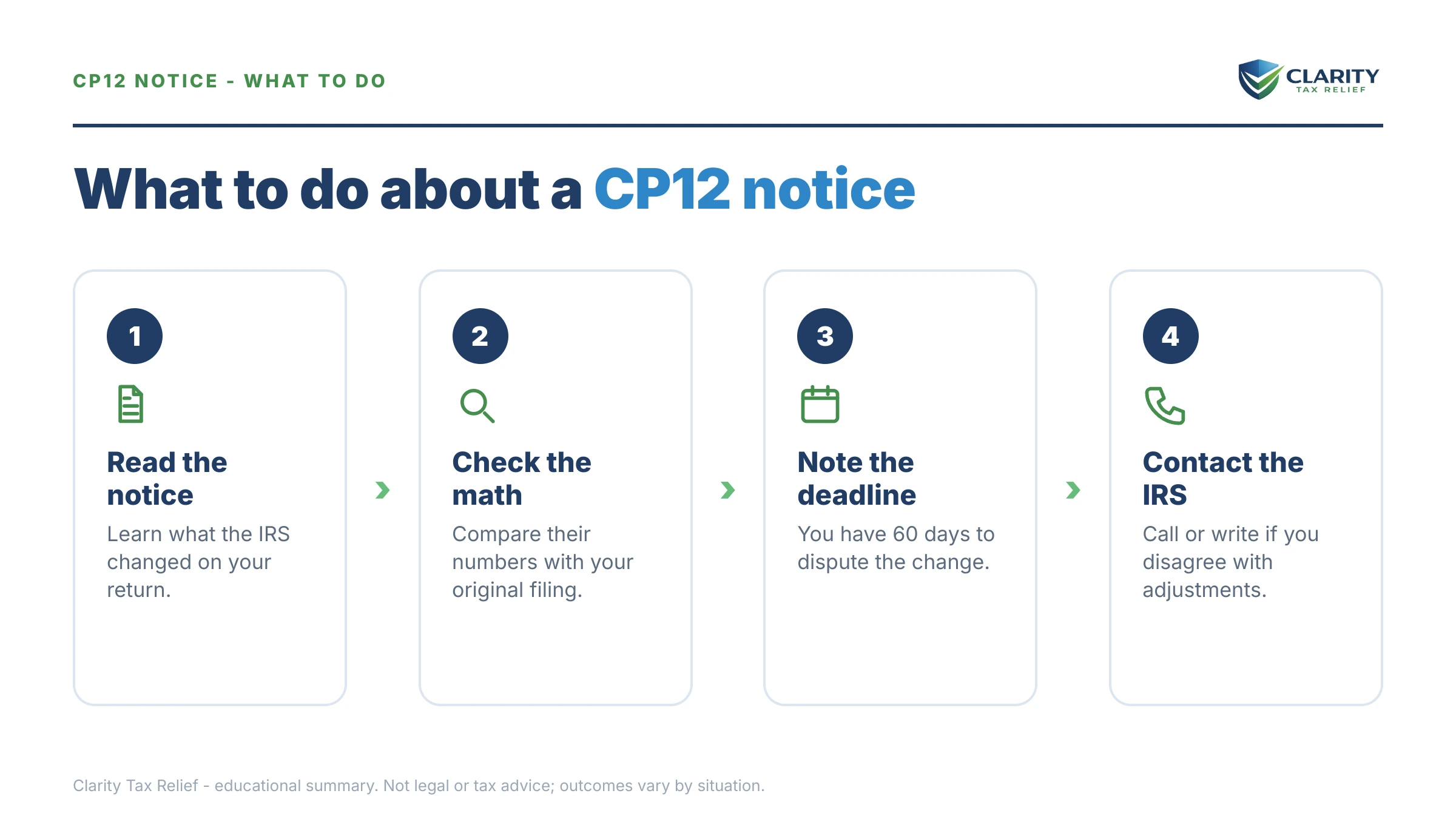
- Compare the notice to your filed return. Open the "Changes to your tax return" section of the CP12 and match it line by line against the return you filed — the notice names the exact line the IRS recalculated.
- Verify the adjustment in your IRS online account. Log in at IRS.gov and confirm the adjusted refund, the notice on file, and any sign the refund was applied to another balance instead of being sent to you.
- Decide inside the 60-day window. If the IRS is right, do nothing and watch for the refund. If it's wrong, don't wait — the clock started on the notice date, not the day you opened the envelope.
- Dispute by phone or in writing if you disagree. Call the number printed on the CP12 or mail a response with a copy of the notice and the documents that support your figures, and ask the IRS to reverse the change.
- Track the money. If you agreed and no refund arrives within about six weeks, check your account transcript for offset activity before assuming the notice failed.
You can review the IRS's own summary of this notice at Understanding your CP12 notice, and set up or check your balance through the IRS online account for individuals.
One scam check while you're at it: a real CP12 arrives only by postal mail and never asks you to pay anything — it's a refund notice. Any "CP12" that demands a fee to "release" your refund, or arrives by email or text, is a criminal's work, not the IRS's.
When you can handle a CP12 yourself
Most CP12s need no professional help at all. If the correction matches an honest arithmetic slip, the dollar change is small, and you have no other tax problems, the right move is to verify, file the notice, and wait for the refund. Paying anyone to "handle" a routine CP12 you agree with is money wasted.
Experienced help changes the outcome in a narrower set of situations: the IRS's "correction" is actually wrong and the disputed amount is significant; the adjustment guts an EITC or Child Tax Credit claim involving dependents you'll need to document; the refund vanished into offsets tied to unfiled years or a large back-tax balance; or the 60-day window is nearly gone and the dispute needs to land correctly the first time. In those cases the CP12 is a symptom, and the underlying account is the real case. If you've hit a wall with IRS processing itself, the Taxpayer Advocate Service is an independent, free channel within the IRS for stuck cases.
Terms on your CP12, decoded
- Math error authority — the law (IRC §6213(b)) that lets the IRS correct arithmetic and clerical mistakes on a return immediately, without an audit or deficiency procedures.
- Adjusted refund — the new refund amount after the IRS's correction; it replaces the figure on the return you filed.
- Abatement — the reversal of an IRS change; a timely 60-day dispute requires the IRS to abate its math-error adjustment while it reviews your position.
- Overpayment — the IRS's term for tax you paid beyond what you actually owed; a CP12 is the IRS recalculating your overpayment.
- Offset — the government applying your refund to another debt — back taxes, child support, state tax, student loans — before sending you anything.
- Statutory notice of deficiency — the formal letter the IRS must send if it wants to reinstate a change you disputed on time; it opens a 90-day window to petition Tax Court before paying.
CP12 notice questions, answered
Is a CP12 notice good news or bad news?
Usually it's neutral or mildly good news: the IRS corrected an error and, in many cases, your refund went up. But treat it as a claim to verify, not a verdict — the IRS's automated corrections are sometimes wrong, and a "bigger refund" can be intercepted for other debts before it ever reaches you. Compare the notice to your return line by line before you accept it.
How long after a CP12 notice will I get my refund?
Typically 4 to 6 weeks from the notice date, if you agree with the change and owe no other federal or state debts. If nothing has arrived after six weeks, check your IRS online account before calling — the most common explanation is an offset, where the refund was applied to back taxes, child support, or student loans instead of being sent to you.
What if I disagree with my CP12 notice?
Contact the IRS within 60 days of the notice date — call the number on the notice or respond in writing with a copy of the notice and your documentation. A timely dispute requires the IRS to reverse the change while it reviews your position, and if it still disagrees it must use formal deficiency procedures, which preserve your right to challenge the change in Tax Court before paying.
Does a CP12 notice mean I'm being audited?
No. A CP12 is a math-error correction, not an examination — an automated system recalculated a line on your return under the IRS's summary "math error authority." No one is questioning your deductions or asking for receipts. An audit arrives through different letters entirely, such as a CP05 refund review or an examination letter.
Why did the IRS reduce my refund on a CP12?
The most common reasons are credit calculations: the Earned Income Tax Credit or Child Tax Credit computed on the wrong income figure, a dependent's missing or mismatched Social Security number, a standard deduction that doesn't match your filing status, or an arithmetic error carried down the return. The "changes to your tax return" section of the notice names the exact line the IRS adjusted.
Can the IRS keep my CP12 refund for back taxes?
Yes. Before any refund is sent, the IRS applies it to other federal tax years you owe — you'd see a CP49 notice confirming the transfer. Refunds can also be intercepted through the Treasury Offset Program for past-due child support, state income tax, and federal student loans. The CP12 tells you the refund amount, not whether you'll receive it.
What happens if I miss the 60-day CP12 deadline?
The correction becomes final and the easy reversal path closes. You can still ask the IRS to fix a genuine error — typically by filing an amended return (Form 1040-X), generally within three years of filing the original — but you lose the automatic-reversal right and the pre-payment path to Tax Court. If real money is at stake, act inside the window.
Should I file an amended return instead of disputing my CP12?
Not if you're inside the 60-day window — a phone call or written dispute is faster and preserves stronger rights. Filing Form 1040-X to argue with a math-error change usually adds months of processing and can muddy the account. Amend only if the window has passed, or if you're correcting something different from what the CP12 changed.
Your next 24 hours
- Find two things on the notice: the notice date in the top-right area (it starts your 60-day clock) and the adjusted refund amount in the "Changes to your tax return" section.
- Gather three documents: the return you filed for that year, the CP12 itself, and the income records behind the corrected line — W-2s, 1099s, or the worksheet you used for the credit.
- Get a free case review if the correction looks wrong, the dollars are significant, or the refund is disappearing into balances you can't explain — the 2-minute form or (888) 825-7779, before the 60-day dispute window on your notice closes.
This guide is general information, not tax or legal advice for your specific situation. Eligibility for IRS programs depends on individual facts and circumstances; no outcome is guaranteed.